Tag: burden
-

How I Stopped Carrying the Weight of the World and Started Enjoying Life
“These mountains that you are carrying, you were only supposed to climb.” ~Najwa Zebian
During a personal development course, one of my first assignments was to reach out to three friends and ask them to list my top three qualities. It was to help me see myself the way others saw me.
At the time, my confidence was low and I couldn’t truly see myself. I didn’t remember who I was or what I wanted. The assignment was a way to rebuild my self-esteem and see myself from a broader perspective.
As I vulnerably asked and then received the responses, I immediately felt disappointed. All three lists shared commonalties, specifically around responsibility. The problem was, I didn’t see responsibility as a positive trait. In fact, I didn’t want to be responsible; I wanted to be light, fun, and joyful.
Though I understood that my loved ones shared this trait in a positive light—as in I was trustworthy and caring—intuitively, I knew responsibility was my armor. I used it to protect and control while, deep down, I wanted to be free and true to myself.
I didn’t trust life. I found myself unable to let go out of fear of what may or may not happen to myself and others. I let my imagination run loose in dark places and believed if I thought my way out of every bad scenario or was on guard, I could somehow be prepared to meet the challenges that arose.
I thought that if I oversaw everything, it would get taken care of correctly and then I’d be safe from the pain of life. The pain in life was not only my own, but my family’s, the local community’s, and the world’s. I wanted to plan and plot a way to fix everything so that everything would be perfect.
I saw myself as a doer—a person that takes actions and makes stuff happen. I relied heavily on pushing myself and coming up with solutions and, at times, took pride in my ability to work hard, multi-task, and be clever. With time, however, I felt resentful and exhausted.
Over the years it became too heavy a burden. My shoulders could no longer carry the weight of the world, and I was incapable of juggling so many balls. I had to let go.
There were so many things that were out of my control, including situations that had nothing to do with me, and yet there were so many people I loved and so many dangerous possibilities.
Living in a state of constant responsibility meant I had to be alert; I had to be on guard. I was never present and thus unable to have fun. I didn’t understand how to enjoy life while being responsible. I saw these as competing desires and ended up avoiding joy totally.
I believed I could save joy for a vacation or that wedding coming up next month. I always postponed joy until later so that I could resume being responsible.
However, being a doer and taking responsibility for things that were not in my direct control had consequences. I was unhappy and drained, constantly wondering why I couldn’t just relax and enjoy life.
Even when I went away on a vacation, I was unable to calm my mind and have fun. I told myself once x,y,z was taken care of, then I’d feel calm, but then something new would come up and I’d be thinking about that instead of enjoying my trip.
This left me with a powerful realization: I felt safer feeling anxious and tense than I did feeling happy.
In some twisted way, it served me. At the time, being happy was too vulnerable, while being on guard for the next catastrophe felt safer. This was not how I wanted to continue living life.
I wanted to remove the armor. I wanted to trust and enjoy life, and I wanted to believe that whether or not I was on top of everything, things would work out.
I knew that I could be responsible without carrying the weight of the world on my shoulders. That I could be dependable and caring without being stressed or serious. Those were expectations I had falsely placed on myself, and it was up to me to remove them.
Once I realized that solving the world’s problems was harming my health and that I was choosing fear over joy out of a false sense of security, I decided to give myself permission to feel the discomfort and vulnerability of happiness. In doing so I found the courage to let go, trust, play, and love life.
I began setting boundaries with myself. The person that had placed the badge of responsibility on my shoulders was me, and I had chosen to do it out of fear, not love. I had to let go of knowing everything that was going on in other people’s lives and the world and take space from social media, friends, and family to make space for me.
I began to cultivate joy by practicing presence daily and taking the time to do things I enjoyed doing.
I took yoga classes, watched comedy shows, went to the beach, and continued personal development courses.
I learned that although I was great at multi-tasking and pushing through, it wasn’t what I wanted. I wanted to courageously follow my dreams and enjoy my precious life.
That meant that I had to feel the uncertainty, sadness, and danger of life’s circumstances without jumping in to fix anything. I had to take a step back and bring awareness to my thoughts so I wouldn’t unconsciously join the merry-go-round of solving problems.
I was a beginner at all these things, but the more I practiced, the more joy I experienced, and this spread onto others. Surprisingly, friends would tell me how I inspired and helped them—not by solving their problems but by being bold enough to enjoy my life.
If you want to enjoy your life but stress yourself out trying to save everyone from pain, begin to set boundaries with yourself. Stay in your lane and focus on the areas you have direct control over—your attitude, your daily activities, and your perspectives.
Try slowing down, investing time and energy into activities that light you up. You can’t protect anyone from what’s coming in the future, but you can enjoy your present by letting go and opening up to joy.
-
If You’re Afraid to Ask for Help Because You Don’t Trust People
“Ask for help. Not because you are weak. But because you want to remain strong.” ~Les Brown
I sat in the doctor’s office, waiting—linen gown hanging off me, half exposed—while going through the checklist in my mind of what I needed help with. I felt my breathing go shallow as I mentally sorted through the aches and pains I couldn’t seem to control.
Fierce independence and learning to not rely on others are two of the side effects of my particular trauma wounds, stemming from early childhood neglect and abandonment. During times of heightened stress, my default state is one of significant distrust.
Letting people in and asking for help has never been my strong suit.
Not only did it prove painful at times, asking for help has also proven to be unsafe. I’ve been given poor and damaging advice from people I assumed knew more than me. I’ve emotionally attached to people who disappeared when I least expected it. I’ve been lied to, betrayed, and left behind when my help was no longer useful.
I’ve been injured both physically and emotionally when relying on others to care for me and have been let down more times than I can possibly recall.
I have plenty of reasons to convince myself that no one can help me. That I’m in this life all alone. Some days I feel just that.
Other days, I sit in my doctor’s office ready to make myself vulnerable one more time looking for support that I’ve been unable to give myself. Hoping, fingers crossed, that maybe this time I’ll be seen, heard, and cared for.
When the doctor walked in, I was writing a note on the depression screening form justifying why I feel sad some days. I know it’s normal to feel sad doing the work I do as a mental health therapist. Working with people’s sad can be sad. I wanted to be upfront.
And also, I’ve been focusing on healing the trauma in my body that injured my nervous system starting in infancy. Actively inviting my body to retrieve its pain to set it free and regulate my system to a state that is considered normal. Except I don’t know what normal feels like.
Her very first questions to me: “Are you getting back what you put into your work? Is it worth it?”
I blink, unsure if I heard her correctly.
“Are you asking me if the work I’m doing is more depleting than rewarding? Am I receiving as much as I’m giving?” I ask.
“Yes,” she responds assuredly.
I exhale.
She sees me. She actually sees me. I ask myself this very question every day.
This one question cracks me wide open. I know I can trust her.
I hear words pouring out of my mouth explaining the work I’ve been doing with myself. My intention to heal my nervous system and my body, how hard it’s been to feel all the emotional pain that’s come up and the subsequent physical pain that comes and goes to remind me just how deep all this stuff runs.
I shared with her my most recent discovery—my earliest known physical trauma at nine months old, when my mother gagged me to make me throw up to “protect” me.
When her behavior was discovered, she was admitted to a hospital for psychiatric services for over a month. My brother and I were placed in the care of anyone who was available to watch us.
At the most important time for healthy attachment and trust to form, I was taught that survival meant staying clear of those who are assigned to protect you. They can hurt you. And the world was not a safe place.
This was the first of many experiences in my life that would drill in the same belief. My body spent years trying to protect me by tensing up, shaking, or wanting to flee when I sensed any kind of danger—being trapped, pressured, controlled, or trusting authority figures was high on my list of subconscious nos.
To me, there was no logic to the way my body reacted to what seemed the smallest threat, so I shamed myself for it.
I couldn’t understand why driving on the highway put me in an instant state of hypervigilance. Why I would wake up in the middle of the night unable to breathe. Why the bright lights and enormous amount of stimuli in the grocery store made me freeze the moment I walked in. Why perceived conflict made me want to curl up into myself or attack and bail.
All I knew was I was not “normal,” and I felt like I had no control over it.
I recall the first infomercial that serendipitously came across the screen during a sleepless night while I was traveling in my early twenties. At the time I always slept with the television on to drown out the noise of my thoughts in the silence of night. A woman talked about her struggle with anxiety and the way it internally took over her life. I immediately tuned in.
She was talking about me. She was talking about so many of us. I couldn’t believe someone understood what I desperately tried to hide and despised about myself.
It was the first of many books, programs, methodologies, and practices I would try. It was the first time I felt seen and sought help.
It wasn’t that I didn’t want help. I just didn’t trust it, nor was I comfortable with being vulnerable enough to ask for it. Particularly because I had proof that when I did rely on people, they could turn on me, or even worse, leave.
And then there was the cultural push to just “suck it up” or accept that “it is what it is.” Key words to encourage us to abandon ourselves.
Sucking it up is exhausting, and it doesn’t help. It doesn’t change what’s hard, and from what I can tell, years of sucking it up never made me stronger. Just more certain I was stuck in this mess of myself alone.
Even though I help people for a living, and fully understand that I am the help I encourage people to seek, I forgot that I, too, was able to ask for help.
This meant I had to have the courage to let my guard down. To let go of the feeling of burden I was afraid to put on another. To remember that every single one of us has our hardships, and we actually want to be needed and helpful to another when we have the space.
It’s why we are here as humans. To give love and receive it. When I give someone the opportunity to love or support me, it gives them the chance to feel the fullness of my gratitude. To receive love back from me in return and feel needed and wanted as well. It is also the most solid reminder for both of us that we are never actually alone.
We need each other.
It is a practice for me to remember this. It’s also a practice to remind myself that I have been cared for far more often than I’ve been hurt. That those who have harmed me or left me had their own burdens to bear that I was not meant to be a part of. And that every time I do ask for help, like in my doctor’s office, and receive it wholeheartedly, I am able to keep myself filled and balanced to be able to help the people I care about even more.
I exhaled when my doctor acknowledged me. I knew it was safe to let her in, yet I still swallowed tears while I did so. Her validation of my challenge felt comforting; her support, the extra oxygen I needed. Knowing the value of support has never made it easy for me to ask, but it has made it easier.
As humans we are regularly encouraged to give, yet it is equally important to learn to receive. We need both to keep ourselves balanced and in flow so we can be the love we want to feel. To give is a powerful feeling, while receiving can make us feel a little vulnerable. That’s okay. The more courage we use to ask for help, the more strength we have to give out in return.
If you are feeling resistance to seeking help, ask yourself where your fear lies. Is it a current concern or is it one from the past? Does vulnerability make you uneasy or bring up insecurities you have around being judged or feeling like a burden? Or do you feel it’s hard for you to let your guard down and trust another?
When resistance lingers, choose people who’ve been loyal and consistently supportive in the past. If you don’t have any relationships like that, or if involving your personal relationships feels too uncomfortable, consider professional support. There are affordable and even free resources available, if money is an issue.
The key is to remember that you, too, deserve a place to be you and invite in the help that everyone needs at times. To release your burdens so you can stand back up and move forward with more ease and a lighter load. So you have the strength to be a support for others and also for yourself.
When feeling weighed down, ask for help—whatever that looks or feels like for you. The past may have taught you what you don’t want, but you have the power to choose what you do want in the present. There are people out there who you can rely on and who want to be there for you. They are simply waiting for you to ask.
So go ahead and let someone in. No one needs to or is expected to navigate this wild life alone. Not even you.
-
Why I Never Let Anyone Support Me Until the Day I Almost Died
“Why don’t you get up and make the coffee, while I stay in my sleeping bag and plan our ascent route?” I half-heartedly ask my climbing partner Hank.
He just looks at me with that unassuming, “give-me-a-break Val Jon” look of his. It’s three o’clock in the morning, cold, dark, and damp, and neither of us wants to leave the comfort of our tent. But we’re committed to this climb, so we don our parkas and gloves and confront the bitter cold.
In silence, Hank and I gather up our gear and join the rest of our climb team assembled at base camp, which is located at eleven thousand feet.
Thirty-three climbers in all have come together for this extraordinary ice climb to the summit of Mount Shasta in Northern California. During our team meeting, we decide to make our ascent via “Avalanche Gulch,” a treacherous glacier route up a steep icy slope. This particular route is shorter than others, but it’s also notorious for its deep crevasses and unstable blue fractures, so one wrong move could mean sudden death.
Ice climbing requires crampons for the boots and ice axes for leverage and braking. Ropes, carabiners, and belays are reserved for near-vertical climbs, which we may or may not need for this particular ascent route.
For those unfamiliar with ice climbing, braking is used when a climber loses their footing on steep slopes. It’s done by grabbing the ax with both hands, flipping onto one’s side, and plunging the sharp metal tong into the ice.
A firmly planted ax serves as an anchor and stabilizes the fallen climber’s position until they can regain their footing. Everyone on the team has practiced the braking procedure many times over along with other vital safety and life-saving protocols.
As the full moon casts a bluish glow over the ice, we begin our ascent to the summit. At about twelve thousand feet, we come upon a massive fissure running horizontally across the steep glacier face. We traverse around its left edge and cross back about thirty feet above it. Climbing to the slope’s center, we zig-zag our way up to gain altitude and distance from the crevasse.
Traversing around crevasses is a treacherous activity. If one climber slips, the entire group could be pulled into the abyss. For this reason, we are untethered and climbing independently. We are, however, organized into small teams of six to provide each other support if needed.
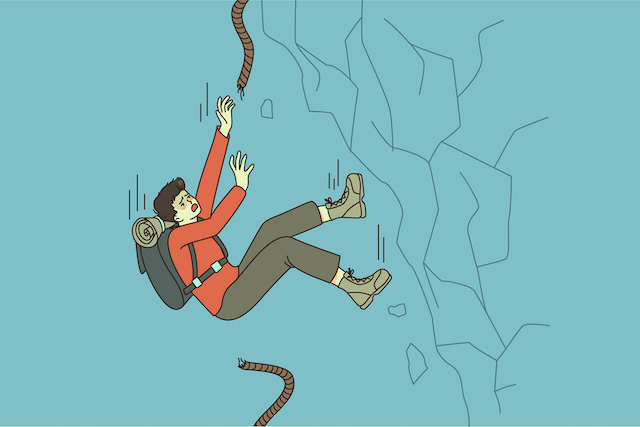
All goes well as we gain altitude above the crevasse, until one fateful moment when the crampon on my left boot suddenly pops loose and I lose my footing.
Tumbling headfirst downhill, I instinctively grab my ice ax with both hands and prepare to stop. Landing hard on my back, however, my ax bounces loose from my hands and I slide uncontrollably down the steep slope towards the crevasse.
In a moment of frozen terror, my life flashes before my eyes and I am going to die! Then suddenly my flailing body slams into something solid, knocking the wind out of me.
Stunned and disoriented on my back with my head pointed downhill, I’m unable to get a bearing on how close to the edge I’ve come and how close to death I am.
Looking up, I see a blur of movement and shifting dark images. Clearing the snow and ice off my glacier glasses, I realize Hank and my fellow climbers have formed a human net, catching me just a few yards before I careened over the edge of the crevasse!
I’m in shock, numb, and completely speechless. I’m also totally embarrassed and feeling extremely vulnerable. I’ve spent years being a strong and independent man, priding myself on not needing the help of anyone. Needing help always seemed like a sign of weakness to me, so this emergency situation is deeply disturbing.
“We’ve got you, VJ! Hold on buddy, we’re not gonna let you fall!” I fidget around trying to stand myself up and respond, “Thanks guys, I can take it from here.” “Lay still, you’re pushing us back towards the edge!” Hank barks at me. “No, really, I’m okay guys, I’ve got this.” There was no way I was going to be the weakest link in this chain! This time, however, a number of my team members replied, “No you don’t have it VJ, you need to stop right now or you’re going to kill us all!”
That message got in. The reality of killing my fellow climbers so I can stay in control is just too much for me to bear. The humbling realization shatters my macho control mechanism and I suddenly relax into letting them help me.
As they reattach my gear, stand me up and reassure me with pats on the back, I realize it’s nearly impossible for anyone to support me. Experiencing them caring for me this way is both wonderful and wrenching.
My chest tightens and tears come to my eyes as I realize how many times in my life I’ve not let others help or support me. I would always say, “No problem, I can do it myself.” I didn’t want to burden anyone or put anyone out.
The deeper truth, however, is that if I let someone support me, I would be obligated to them in the future. The result might be that they could then somehow control me the way my father controlled me as a child.
Looking into the caring faces of my fellow climbers, I suddenly see superimposed images of my mother, sister, and little brother, my friends, and exes who I’ve shunned and alienated with my stubborn macho independence
I reflect on the pain and frustration that not being able to help me must have caused all these people in my life. So many opportunities I have had to accept the support of those who love and care for me, but no, I have to be strong and independent.
How selfish and arrogant of me to rob them of the opportunity to contribute to my life! And how easy it would be for me to slide into humiliation over this display of narcissism.
Standing here among those who just risked their lives to save mine, I realize I have a choice; I can dramatize my humiliation and hide behind my rugged individualism, or I can humbly open myself to their care and support.
I choose to set humiliation aside and open with humility, and as I do, a wave of emotion fills me. For the first time in my life, as far back as I can remember, I’m able to see that accepting help from others is not a sign of weakness, it’s an act of humility.
I also realize that rather than being a burden to people when I’m in need, it allows them to feel useful and to make a difference by offering their support and care. There’s no doubt that my fellow climbers are ecstatic about having just saved my life; I can see the joy and exhilaration on their faces.
Still surrounded by a human net of care, I thank each member of my team for saving my life, and I apologize for placing them in additional danger. Each one of them nods in recognition, and nearly everyone assures me that having the chance to help save my life was far more important to them than blaming me for being a bit heedless.
As I allow myself to be vulnerable and let their care in, my defensive armor melts, then drops away. We resume our ascent, and tears fill my glacier glasses as I reflect on the experience of my life being saved by this remarkable group of friends.
How strange and new this is for me. I don’t need to see out of my glasses because I have the full support of those behind me as well as those in front to help me along if I need it.
I’ve always been the one to give support to others, but now I can receive support as well. I breathe into this new awareness and suddenly have a profound realization that has remained with me for years.
As I exhale, it’s synonymous with the movement of giving support, and as I inhale, it’s synonymous with the movement of receiving support. Engaging in both inhaling and exhaling doesn’t mean I’m weak, it means I’m human.
Without further incident, we all ascend to the 14,179-foot summit of Mt. Shasta where a crystalline blue sky embraces the curve of the earth. The summit perch looks like a small crater and is no more than about twenty feet in diameter. Its outer rim is composed of a ring of rocky crags with one high point that signifies the very pinnacle of the mountain.
Shining, sunburned faces grinning from ear to ear sit together in a blissful exchange of laughter and tears.
After celebrating our joint accomplishment, we begin the ritual of reading and signing the register book stowed atop most climbable mountains in the world. The one at the summit of Mt. Shasta is contained inside a green metal canister under the Western crag.
Each member of the team, like those before us, takes the opportunity with the book. After finishing, Hank hands it to me. As the last to see the register, I flip through its yellowed pages and my eyes fall on a passage written by a climber on October 23rd, 1972. I’ll never forget the inscription:
“Father, I dedicate this climb to you. I’m standing at the top of Mount Shasta today because of the love, support, and encouragement you gave me as I was growing up. It’s because of your commitment and love that I was able to make it to the summit today. And although you lost your legs in the Korean War and have never been able to stand beside me. Father, I want you to know that today I stand on the top of this mountain for both of us. I love you with all my heart and all my soul, your son John.”
How beautiful this dedication is! I take in the grandeur of the Earth’s curve from this high summit, close the book, and clutch it firmly to my chest. A wave of inspiration fills me, and I feel deep abiding compassion for all the world’s fathers, sons, mothers, and daughters . . . and I am challenged to act upon the humility that was moving so deeply within me.
You see, up until this very moment I’ve coveted a deep wound in my psyche. As a boy, I was violently abused by my father, and as a result, I cut myself off from him in my early twenties vowing to never speak with him again.
But now I am faced with a choice . . . should I maintain my position and continue to empower all the reasons why I should not reach out to him? Or should I humble myself and take a chance by reconnecting after all these years? It is here, within these deeply challenging life choices, that we both test the authenticity of our inspirations and discover what we are truly devoted to.
I made my choice, and not only did I resurrect my relationship with my father, I affirmed that there is nothing more important to me than living with an open heart and honoring the humility I was gifted with high atop the summit of humility.
-
If You Think You Can’t Be Happy Until All Your Burdens Are Gone
“As rain falls equally on the just and the unjust, do not burden your heart with judgments but rain your kindness equally on all.” ~Buddha
Our burdens come in many forms. They are our relationships, our responsibilities, and our pasts that haunt us from beneath our consciousness. They weigh us down and prevent us from experiencing life’s true joy.
Some people have to care for a sick family member most of their life. Some women give birth to stillborn babies. Some soldiers get their legs blown off while deployed.
My story is unextraordinary: I’m a white, middle-class woman. My life has been easy, and I have no reason or right in this world to feel emotionally oppressed. And yet, for all my life, I’ve felt I was a burden to those around me.
It all started, as many stories have, with my parents.
My mother always told me about how she had to purchase books on strong willed children because I was “too much” as a toddler, and she didn’t know how to handle me.
Both of my parents pushed me to be independent: do it on my own, regardless of whether I was ready. Often, I was. But on the occasion I wasn’t, I wanted to be a good daughter, so I tried and tried until I could do it independently anyway.
They praised my independence. I also watched them dole out criticism to anyone who relied on others or let others take advantage of them.
Because I love my parents fiercely, I took this to heart and vowed never to be a burden to them.
I have spent most of my life fighting to control how others viewed me so that I could assure them that I was not going to be a burden.
When I was a young adult, a few years out of college, I was forced out of my first (beloved) teaching job. I had nowhere to go and was waiting to hear back from the graduate programs I had applied to.
Although I never asked them to move back in, my parents told me, “Well, you better not think you’re moving back in with us, because that’s not happening.”
After picking up the pieces of my broken self, I set off for grad school with my then-husband in tow.
I married my first husband at twenty-four, mistaking pain for love. He was profoundly troubled—touched by depression, anxiety, and deep-seeded self-loathing, and I was going to save him. I was going to be the force that moved him from “burden” to “power.”
We fought and struggled and suffered, and as you probably guessed, I did no saving of any kind. I did, however, endure relentless emotional and verbal abuse for years. I wish I could say that our toxic relationship was fully his fault, but unfortunately that’s not the way things work.
After years of poor emotional regulation skills and believing everything in life is a burden, I treated him like one, too. Communication is a two-way street, and I was an excellent emotional manipulator. After completing grad school and our third year of marriage, I finally acknowledged that our relationship was built on pain, and I divorced him.
I got a new job and moved to a new state, away from my failed marriage and away from my parents. I met a man who made me feel, for the first time in my life, like I wasn’t a burden.
As Thich Nhat Hanh said, “You must love in such a way that the person you love feels free.”
To this day, my husband makes me feel light and free. He sits with all of my emotions, my good ones and my bad ones. He takes my poor communication and bad emotional self-regulation skills in stride and gently calls me out when I make him feel like he is a burden.
My husband has taught me what it means to love unconditionally and give support without the expectation of anything in return. And he has taught me how to give unconditional love as well.
Over the years I’ve become progressively better at acknowledging my feelings about being a burden to others and how others can be a burden to me.
A couple years ago, my mother turned her criticism to one of her best friends who gives money to her adult daughters by paying some of their bills. My feelings of being a burden burned in my heart as my mom raged for over a half an hour about how her friend was wrong to give them money because her daughters would never know how to stand on their own two feet.
I bit my tongue. Telling her to stop raining judgment on others would only make me a burden on her.
But it was at that moment that I experienced a turning point. I realized that avoiding becoming a burden to people was becoming a burden to me!
It’s like the adage, “Don’t be too busy worrying about whether they like you that you don’t even consider whether you like them.”
The very thing I was avoiding in my life had become the heaviest burden that I was carrying with me, day in and day out.
Last summer, I watched my dad—after finding his eighty-nine-year-old mother passed away one morning—fail to acknowledge any emotions or grief. Instead, he complained about having to cancel her cable, hire painters for her condo, and the burden of being her executor. And then he commented how much time my mother spends taking care of her ninety-seven-year-old mother.
He said how much time they’ll have when my maternal grandmother passes away. How much time they’ll have when my brother’s children are in school, and they don’t have to babysit. How much time they’ll have when my mother can retire and doesn’t have the burden of having to work… the list goes on.
I will not wish away someone else’s life or my time to make my own life a little easier. I will not spend my life waiting for all my burdens to disappear, only to learn that all the joy is gone and there is nothing left.
The opposite of joy is not pain: it’s numbness.
If you take away the pains, the joys will be gone too, and you’ll be left feeling empty.
You cannot remove yourself from being someone else’s burdens (that’s on them). You can’t even remove all your own burdens. But you can move through your burdens and transcend your pain to find more joy in life.
If you feel you’re a burden on others, understand that every person on this earth deserves connection and support, including you. Needing and asking for help doesn’t make you a burden, and if someone implied this to you or even said it directly, they were wrong.
If you’re feeling hopeless that people exist who love without any expectations, take heart: they are out there. And when you find them, learn from them how to give unconditional love, and give them that in return. You don’t have to go through life alone.
If you’re waiting on a time that you will never have any burdens, remember that you can choose where your focus is. It’s easy to ruminate on our burdens and pains. When you find yourself obsessing over what’s weighing you down, gently release the thoughts.
Find things in your life to build upon joy: relationships, creative practices, or hobbies. These are great ways to interrupt the pain and make you feel lighter.
And remember that judgments are burdens. Before you judge others, ask yourself what kinds of burdens they might be carrying. You can’t get rid of their burdens for them, but you can help them carry them, simply by being there and listening.
Rain will fall on your life. We all have burdens and feel like we’re the burden from time to time. But if you can shift your perspective, you can stop your burdens from weighing you down and you can experience all the joy life has to offer. And if you’re lucky, you can rain your joy and kindness on others, too.