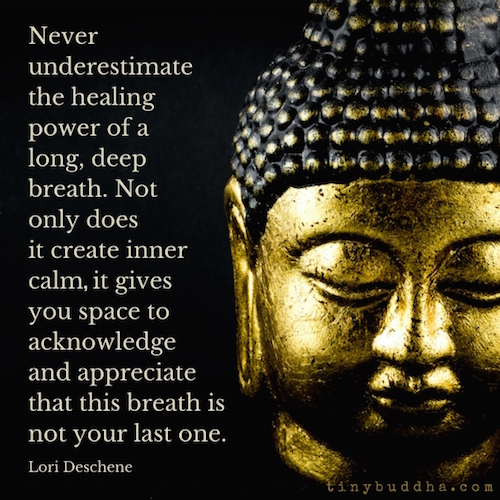
Tag: breath

  • How to Speak from the Heart: Let Your First Word Be a Breath

    How to Speak from the Heart: Let Your First Word Be a Breath

    “Mindfulness is a pause—the space between stimulus and response: that’s where choice lies.” ~Tara Brach

    We’ve all been there.

    A sharp reply. A snide remark. A moment when we said something that didn’t come from our heart but from somewhere else entirely—a need to be right, to sound smart, to prove a point, to stay in control, or simply to defend ourselves.

    What follows is the spinning. The knowing that what was said didn’t align with our soul. The overthinking, the replaying of the moment, the rumination, the regret, the tightening in the chest, the wish we could take it back.

    We justify, we rationalize—but deep down, we know those words weren’t true to who we really are. They weren’t true to the part of us that longs to connect.

    For many years, I lived in that loop.

    I prided myself on being kind, thoughtful, intelligent, articulate, in control. I made every effort to be so. But I was operating from a place filled with expectations and invisible scripts—needing to prove, impress, or protect. I was filling roles: the composed professional, the high achiever, the witty and loyal friend, the perfect daughter and sister, the confident partner, and the ideal mother.

    And so, although my words were often considered, they lacked something deeper and essential: heart.

    I thought being thoughtful meant thinking more. Planning my responses. Winning debates. But what I didn’t realize was that thinking without presence can become a wall, not a bridge.

    It wasn’t until I learned to pause—to breathe—to allow space between stimulus and response, and to use that space to connect within, that I began to understand a different kind of thoughtfulness. A deeper kind: heartfulness.

    This is wisdom—not intellectual but embodied. It lives not in the mind, but in the body. In the breath. In the heart.

    The Journey Back to the Heart

    This shift didn’t happen overnight.

    It came slowly as I gave myself permission to pause, to reflect, to grow. I started noticing how my words were shaping my relationships and my experience of life overall. I wanted to feel better. Calmer. More connected. Ruminate less. Regret less. Suffer less. Feel happier, more relaxed, more authentic.

    Mindfulness opened that door.

    Through meditation, self-inquiry, and contemplative reading, I began to understand the power of being impeccable with my words.

    Books like The Four Agreements by Don Miguel Ruiz—and its core teaching: be impeccable with your word—resonated deeply. So did the Buddhist teaching on Right Speech, which invites us to ask before speaking: Is this kind? Is this honest? Is this timely? Does it add value?

    These questions became my framework.

    I would repeat them silently each morning during meditation. I would return to them during conversations, especially the difficult ones. Eventually, they became part of me.

    And here’s what I realized: being impeccable with our words isn’t just about avoiding gossip or negativity.

    It’s about creating love.

    It’s about adding to the world rather than taking from it.

    It’s about using words to build, not break.

    That meant pausing before I spoke. Feeling into my body. Listening for what was true beneath the surface.

    And slowly, my words began to change.

    I began to feel the quiet power of responding instead of reacting. I was no longer using my energy to defend or ruminate.  Instead, I was using it to create connection and kindness.

    This was a new kind of power—not the kind that makes us feel “in control,” but the kind that offers space. Space to connect with who I really am. Space to choose love.

    A Simple, Yet Powerful Phrase to Remember

    Just a few weeks ago, I came across a podcast where Jefferson Fisher, a Texas trial lawyer who speaks often about emotional regulation and grounded communication was being interviewed.

    He suggested:

    “May your first word be a breath.”

    And in that moment, I felt the wisdom of the years of practice, reflection, and self-inquiry come together in one clear, simple, and practical sentence, something I could share with others to help implement and integrate the power of pausing before speaking.

    This quote offered the simplest reminder for the wisdom I have spent years cultivating.

    If there is one thing that you take away from this article, let it be this: “Let a breath be your first response” and see what happens.

    This phrase has become a kind of shorthand for me.

    A phrase I carry into parenting, relationships, conversations, and teaching.

    Because when your first word is a breath…

    You create space. You reconnect with the part of you that knows who you want to be. You return to the heart—before habitual reactivity takes over.

    Why This Matters

    Our brains are wired for efficiency. Most of us live and act from a place of patterned reactivity, what neuroscience calls the default mode network. This is the brain’s autopilot, built from years of conditioning and past experiences. It’s like mental autopilot: fast, familiar, and often defensive.

    The brain does not distinguish from good or bad, from positive or negative, from happier or unhappy. It doesn’t filter for what’s kind, truthful, or wise—it simply scans for what’s familiar and safe. It’s designed for survival, not fulfilment.

    And when we’re triggered—by stress, conflict, or fear—our nervous system kicks into fight-or-flight mode. In this state, we’re primed to protect, defend, or escape. Our field of vision narrows. Our breath shortens. Our first words are often fast, defensive, sharp—not because we’re unkind, but because we’re unsafe.

    This is why we say things we regret.

    It’s why we speak without consideration, even when we know better.

    It’s why our words can feel out of sync with who we truly are.

    But mindfulness interrupts that cycle.

    It invites us to pause. To observe. To breathe.

    And in that pause, we return to ourselves. We reconnect with the part of us that knows. And we get to choose again.

    This matters because when we give ourselves permission to pause, to check in, and to bring more heart into our lives, we begin to create something more meaningful.

    We stop living in reaction.

    We stop creating pain for ourselves and others.

    And instead, we begin to cultivate an inner peace that radiates outward, into our relationships, our work, and our presence in the world.

    Let This Be Your Invitation

    “May my first word be a breath.”

    Not because you have to believe in it, but because you can experience its benefits immediately.

    Try it the next time you’re in a difficult moment—before replying to that message. Before responding to your child’s cry. Before defending yourself in an argument.

    Pause. Feel your feet on the ground. Feel your body.

    Breathe in for two seconds. Hold for two seconds. Breathe out for two seconds.

    And ask yourself: What would my heart want to say here?

    The Life That Becomes Possible

    Imagine a life where your words feel true. Where your voice comes from clarity, not chaos. Where you speak, not to prove, impress, or control, but to connect.

    A life where your presence calms the room, not because you’ve mastered perfection, but because you’ve learned to pause.

    This is the life I live now.

    Not perfectly, but intentionally.

    It’s the life that opened up when I stopped performing and started pausing. When I chose presence over reactivity. When I let my heart lead instead of habit.

    It’s available to all of us.

    And it begins not with a plan, a list, or a big transformation. It begins with something much simpler.

    A breath.

    So if you’re looking for one practice to change your life—one small shift that creates ripples in how you speak, relate, and live—let it be this:

    May your first word be a breath.
  • A Powerful Practice for Self-Awareness: How to Avoid Doing Things You’ll Regret

    A Powerful Practice for Self-Awareness: How to Avoid Doing Things You’ll Regret

    Self-awareness is arguably the holy grail of inner peace, especially when you’re under pressure. But what is it? How do you achieve it?

    As a teacher of self-awareness, I’ll be the first to admit that it does not always come easy. Given our human instinct to resist whatever challenges us to grow and change, the journey to self-awareness often involves a struggle. I know mine sometimes does.

    To be more self-aware, I’ve had to cultivate a willingness to admit I don’t have it all figured out and that I might not always be right, especially when I feel really strongly that I am. I’ve had to make a point to look at my reality more objectively and admit when the way I’m doing something is just not working for me anymore.

    These admissions never come easily. But I will say that addressing my emotional reactivity has been essential to getting me to a place of greater self-awareness.

    When I was a young mother, I spent years trying to protect my kids from the impact of the dysfunction around them. Outwardly, we looked like the perfect family who had it all. My husband and I were pretty skilled at managing the family’s image, but the real story unfolding inside the four walls of our home was a marriage buckling under the weight of inauthentic emotional reactions like shame, blame, and guilt.

    We lived like this for decades. If you could call it living.

    For the longest time, I let my emotions run the show, relying on what felt like a satisfying reaction rather than reflecting on what was or wasn’t actually working.

    Firing off a sarcastic remark felt like I was being heard.

    Pushing the blame on others felt like a solution.

    Launching impulsively into action felt like the surest and fastest way to get the problem behind me!

    In the heat of the moment, a full-blown emotional reaction felt like it was protecting me. Ironically, all it actually protected me from was self-awareness and the change and personal growth that depend on it!

    Unaware that I was making the choice to act out my reactions, I couldn’t see the lack of wisdom in it. After the dust settled and the smoke cleared, the end result was nearly always the same: a truckload of pain, confusion, and an even bigger mess.

    By the time I mustered the courage to seek a divorce, my children were adults. I knew it was time for a massive change, and I thought my newfound courage would empower me to close the door on the powerful and damaging reactive emotions I had been running on for so long.

    But it wasn’t easy.

    As I gained more and more clarity, it became obvious to me: the reactivity I had acted out during my marriage was still surfacing even after my divorce. As Jon Kabat-Zinn said, “Wherever you go, there you are!” Needless to say, this was a hard fact to face.

    By separating myself from an untenable situation, I thought my shame and guilt would disappear with it. Boy, was I wrong!

    I still had a debilitating fear of uncertainty and faced enormous self-doubt about moving into the world on my own. I struggled with guilt and shame about my past life choices.

    I had been acting out some very specific patterns for decades, and over that long stretch those patterns had become habitual. So, whenever I faced a stressful situation, I fell right back into those same old patterns.

    The hard truth was that, like the deep and gnarled roots of an old tree, these emotional patterns of reactivity weren’t coming out without real effort and determination.

    A New Approach: The Practice

    Eventually, it became clear to me that if I wanted real change in my life, I needed a new approach. And that new approach became the fundamental practice of my program, the Inner Peace Blueprint, backed by a key Harvard study on the benefits of mindfulness.

    Researchers found that when practitioners of mindfulness focused awareness on their physiological state, it led to improved emotional regulation, which led to an empowered sense of self.

    So here is what I did:

    Every time I felt myself getting hijacked by shame, guilt, self-pity, insecurity, or fear, I interrupted those reactions by relaxing my physical tension and focusing on my breathing. This is the most basic technique I used—the practice of posture and breath.

    When I felt I couldn’t trust myself (or others), I would do the practice.

    When insecurity hit me as I imagined being on my own after thirty-six years of marriage, I would do the practice.

    When fear and guilt washed over me as I listened to my children talk about their own reactions to the divorce, I would do the practice.

    Remembering to do the practice took a lot of discipline, which was really not that surprising given the fact I had been reacting emotionally for my entire life, getting stuck in my head and going nowhere fast. My reactions were so familiar to me that they felt like who I was. They had become a deeply ingrained habit and were really hard to break.

    Not challenging this habit, however, was simply no longer an option. And the practice was the best way I could see to get the job done, so I stuck with it. Every time I paused to relax my body and breathe, I experienced myself calming down, even if just a little. Over time, I started to see how all the little bits of calm were adding up to a lot more calm.

    What I Learned About Self-Awareness

    With greater calm, greater self-awareness (which I define as “being able to see what I’m really up to”) came pretty naturally.

    I paid close attention to what I said when I was under pressure and asked myself: “Was it constructive or not?”

    Whenever I did something to get the pressure behind me and “make it stop!” I stopped to evaluate if what I did actually helped. Or did it just dig the hole I was in that much deeper?

    The practice afforded me the self-awareness to stop and consider my emotional state before I opened my mouth. It also gave me the self-awareness to make sure I waited until I was calm and clear about what to do (or not do) before proceeding.

    Today, the practice is still my primary self-awareness tool because it always brings me back to the now-moment. When I can focus my attention on my physical tension and release it through breath, I become more aware of my emotional state and can better regulate what I do and say as a result. This, to me, is the definition of self-empowerment.

    Even when I lose sight of how my reaction is impacting and distorting my perception, behavior, and choices, I can be pretty sure that it is and that staying focused on calming down before I respond is always my best bet.

    This new way of responding to my reactions with the practice helped me break the habit of acting out my reactivity and making things worse as a result. And this is what keeps me on a trajectory toward sustainable, lasting transformation.

  • Conscious Breathing: A Simple Way to Heal Your Pain and Be Present

    Conscious Breathing: A Simple Way to Heal Your Pain and Be Present

    “Feelings come and go like clouds in a windy sky. Conscious breathing is my anchor.” ~Thich Nhat Hanh

    I never gave much thought to my breath unless I was submerged under water for long periods without any.

    Today I rely on it for more than the obvious function of keeping me alive.

    Breathing has become my biggest tool and best friend.

    It has become a foundation for living with conscious presence and awareness.

    Breathing consciously has helped me overcome anxiety and has provided a gateway into peace.

    The breath has helped me move through long-buried emotions and trauma.

    When I try to exert control over outside conditions, my mind speeds up, I feel anxious and fearful, and I create false scenarios of doom and destruction.

    My biggest savior in this downward spiral has been breathing. Lying down, putting on some music, and beginning to breathe. Breathing in and out of my mouth. Taking in as much oxygen as possible, with no gaps between the inhalation and the exhalation.

    In the past, I have resorted to other means of dealing with this anxiety of my mind. Alcohol, drugs, and excessive exercising were some of my favorites.

    Today I have given all these other methods up, as they didn’t really work.

    What are some of the methods you use to quiet the mind? Do they serve you? Do they actually help or make things worse?

    In the past I was running away from feelings, trying to avoid the internal chaos.

    Breathing helps me move through the feelings and chaos.

    It sounds so simple, and it is.

    Through breathwork, my life has transformed.

    I used to be ready to defend myself at any moment. Really.

    Inside my body, I felt surges of adrenaline, as if an attacker was about to kill me. I was always on high alert, ready to pounce into action.

    The excessive exercise kept this adrenaline rolling at high levels all the time. I was addicted to it and almost felt like I needed it to survive.

    Eighteen months ago I began conscious connected breathwork. From my very first session, I was hooked. This was better than drugs.

    As a result of my breathing, all of my unconscious, buried cellular emotion started to surface. Unpleasant blacked-out memories from childhood, traumatic experiences—they all came rushing back.

    It became very clear then what I had been running from. I didn’t want to face those painful feelings.

    I made a commitment to myself, however, that I would continue to show up. I dropped the story. I dropped any goal of “fixing” myself and just let go.

    I decided I would be willing to lie down for an hour and breathe. Whatever happened from there was what needed to happen. I dropped the “poor me” drama that this horrible trauma had happened to me, and instead, I felt it.

    The terror, the anger, and the pain became my companions. Welcoming them in with open arms, I breathed through them—and they passed.

    I stopped, turned around, looked straight at these feelings, and took my power back.

    Today, I am not on the run anymore. My body doesn’t shake like it used to, and my legs aren’t constantly twitching up and down.

    I can sit still.

    I know now that when my mind starts to create drama, I can lie down and breathe.

    The clarity comes, the peace comes, and the feelings pass. I allow them, without trying to make them be any different.

    Is there something you are on the run from? Childhood abuse? A traumatic incident? Relationship heartbreak? What would happen if you faced it?

    What if the resistance to facing and feeling what you are avoiding is actually worse than going through it?

    What if under the mental obsession is fear, and under the fear is freedom?

    The obsessions of the mind are not real.

    They are fantasies created to take up mental space. Like watching a soap opera on TV, it takes us out of reality. It is a distraction.

    What if you decided to turn off the TV in your mind that is creating false dramas to keep it entertained and distracted?

    What would be in the space without the constant stream of mental soap operas?

    What I have found in this space is presence, peace, and grace. The feeling that everything is okay right here and now.

    Right here and now is all there is.

    I live in Bali and have an early morning 4:00am routine that consists of making a cup of coffee, writing, breathing, meditating, and praying. I honor the ancestors, then I drive on my motorbike to yoga and practice being present in the moment as I drive.

    Breathing with awareness helps me to be here now. It snaps me back into the moment.

    I notice and watch the sunrise.

    The early morning Balinese action is all happening on my way to yoga. The women making their offerings on the street, the children on their way to school, the dogs and chickens in the road, the men on their way to work in the rice paddies, and the local market buzzing with action—I take all this in as I drive.

    These moments matter. This is what I love about my life here in Bali. The everyday moments of life as they unfold.

    When in the present, gratitude erupts. Smiling inside, I feel whole and complete, and nothing else really matters.

    Breathing on my scooter, on a bus, while waiting in a line, I take five conscious breaths. Sometimes I count to five on the inhalation and count to five on the exhalation.

    This breathing practice comes with me everywhere I go.

    We all have the gift of breath. Use it. Become conscious of it.

    Turn off the mental TV and see what is truly there: A stunning sunset. Colorful flowers. Birds soaring. A happy child smiling.

    These moments are like snapshots that will never again be repeated. Missing these moments is missing life.

    Today we have a conscious choice to wake up out of the fog, wipe off the lenses, and see through the haze.

    The breath is our anchor. Use it to connect, to breathe through feelings without having to change them.

    Breathe into the emotions that scare you and allow them to come. Welcome them with open arms, and they will pass.

    The only way out is through, opening the doorway to presence and freedom.

    Breathing is our ticket into the present, our passage through the buried trauma of the past, and our vehicle to process difficult emotions.

    Conscious breathing is a life changer, accessible to all, and you can begin right now.