Tag: boundaries

  • If You’re in a Painful Relationship and Considering Estrangement…

    If You’re in a Painful Relationship and Considering Estrangement…

    “I understand the life around me better, not from love, which everyone acknowledges to be a great teacher, but from estrangement, to which nobody has attributed the power of reinforcing insight.” ~Nirad C. Chaudhuri

    I was brought up to understand that family is family.  So I have naturally given great weight to the importance of family bonds. However, what happens when a familial bond breaks? Do you commit yourself to holding on despite the cost, or do you acknowledge the damage and take the necessary steps to sever the tie?

    Personally, I sit somewhere in the middle. Any important relationship deserves an extended amount of effort, patience, understanding, and forgiveness in rebuilding. However, you can only do so much, and there comes a point when it could be in everyone’s best interests to walk away.

    I speak from personal experience. I’ve been estranged twice in my lifetime. Once from my father, which was my choice, and the other time from my sibling, who ultimately made the decision to walk away; I guess I just dotted the i’s and crossed the t’s on it.

    Let me be clear, neither estrangement was a wonderful experience. The process of severing ties is heartbreaking, regardless of the situation that led to the estrangement. It hurts when you feel you’ve been rejected, and it hurts when you know you’re rejecting someone.

    But when it’s the right decision for you, and once the hurt abates somewhat, there is a sense of relief. Although you may never feel happy about it, you’ll feel happier overall for the steps you took in protecting yourself and your well-being.

    As with all life events there is opportunity to learn and reflect…

    In hindsight, there are certain actions I should have taken before the relationships ended, especially when it came to my sibling. Perhaps taking these actions could have prevented the outcome? Who knows? Regardless, these behaviors would certainly have helped me heal quicker even if the end was inevitable.

    If you find yourself struggling in a relationship with a family member—or any type of relationship for that matter—these five suggested actions can help.

    1. Be yourself.

    This is what I kick myself the most about when I think about my estrangement from my sibling. I was never myself. I was always trying to impress them and seek their approval.

    You see, my sibling was a lot older than me; by the time I was two they had already left home. Visits were few and far between, and when my sibling married, there were tensions between my family and their spouse.

    Everything had to be done to keep them happy. We had to tread on eggshells around them to maintain the relationship, and that stuck with me well into adulthood. I believed If I stepped out of line then the relationship would end. So I said what I thought they wanted to hear and acted in the way I felt I needed to act.

    This led to a lot of resentment on my part. No matter how hard I tried, I never felt fully accepted.

    As I saw this would soon impact my own children, I knew things had to change.

    I stopped kowtowing, and within a year they had broken away, communication basically stopped. The hardest thing was knowing that all those years I had presented an unauthentic version of me. I felt I had let myself down. What might have happened if I had just been myself?

    It can be challenging to be yourself when it’s a family member you want to please, but you can’t let the labels they place on you define you. Be who you really are. Yes, you might be rejected, but being someone you’re not is exhausting and likely to lead to more unhappiness. You’re the one who has to live with yourself after all—it’s better to love the person you are!

    If I had my time again, I would just be me, and I encourage everyone to adopt this approach too.

    2. Communicate.

    Relationships all too easily break down when there is a lack of communication. Good communication builds your connection, helps you deal with potential issues early, and allows both parties to have their needs met.

    Too often, we end up shouting, judging, criticizing, or not communicating at all. This isn’t a recipe for a healthy relationship.

    In his book Non-violent Communication, Marshall Rosenberg sets out a framework he created which allows people to express their needs and make requests without any negative behaviors. Using this method can make it easier to ask for what you want, and it also gives you a better chance of actually getting it. It’s a technique I wish I had known a lot earlier, but one that I use now to great effect.

    It’s a four-step process:

    Convert judgements to observations.

    So rather than saying, “You never listen to me” (quite an emotionally charged statement), you would say, “I see you checking your phone when I try to talk to you,” which is more factual and less likely to trigger a defensive response.

    Say how you feel.

    Express how you’re feeling without blame or judgment. Instead of saying, “I really needed you and you weren’t there,” express your feelings like this: “I was feeling really alone.” This is a powerful way of expressing ourselves and taking ownership of our feelings.

    State your needs as they relate to you and your values.

    So rather than saying, “You need to change how you treat me,” you would say, “I have a need to be respected as a human being.”

    Ask for what you want.

    Start with “Would you be willing/like to…?” For example, “Would you be willing to put your phone down when we have a conversation?” Framing your request in this way gives the other person the freedom to say no, meaning they don’t feel forced or pressured and in turn more likely to say yes.

    Here’s an example of the four-step process all put together:

    I see you checking your phone when I try to talk to you. I feel frustrated. I value being listened to. Would you be willing to put down your phone when we have a conversation?”

    3. Stand strong (even when you’re scared).

    As a recovering people-pleaser, I used to shy away from standing up for myself. I would choose to agree rather than confront. Life was more peaceful when I just smiled and nodded. But this is not a healthy strategy.

    With my father, I needed him to acknowledge and take responsibility for his actions. With each attempt to broach the subject of his behavior toward my mother and me, there would be denial, false accusations, and even aggression. Fear would make me back down.

    But you have to stand strong, even when you’re scared. If an issue is important to you, don’t allow for it to be brushed under the carpet to fester. Facing issues head on allows you the opportunity to resolve them. It provides you (and them) with clear boundaries and makes repeat behaviors less likely.

    4. Accept your part.

    Nobody is perfect. Relationships are two-person territory. It would be so easy for me to look back and put everything on my sibling or on my father, but that would be inaccurate. I have to accept my share of accountability too. We all do.

    I should have spoken up. I should have acted differently in certain circumstances. I should have been honest about how I was feeling. People aren’t mind readers after all. This isn’t about accepting all of the blame; it’s just about acknowledging your part. It helps you grow as a person.

    5. Forgive and let go.

    Firstly, you need to forgive yourself. You’re a human being after all, we all make mistakes. Show yourself the same compassion you readily show to others.

    Secondly, when you’ve had time (which may include therapy) and feel capable, start to forgive the person, even if you’re now estranged. This doesn’t mean you have to forget what happened but more allow the anger, resentment, or any other emotions that don’t serve you to be lifted from your heart.

    I find writing a gratitude letter (listing what you found good about them and your time together, plus anything you’re grateful to them for) really helpful in the process of forgiving and letting go. It helps to refocus on the good side of the person (and your relationship) rather than the negative.

    Remember, we feel hurt because we loved and cared deeply, two important components of a happy life. Letting go allows us to move forward to what is right for us. Use what happened to personally grow and build a better life.

    Every life event, good or bad, has something to teach us…

    I’ve grown so much from my own experiences and use those learnings to positively affect all the other relationships in my life. There is always hope for reconciliation, but for now, I’m at peace with where I’m at, and I hope you will be too.
  • How to Set Difficult Boundaries in a Compassionate Way

    How to Set Difficult Boundaries in a Compassionate Way

    “We can say what we need to say. We can gently, but assertively, speak our mind. We do not need to be judgmental, tactless, blaming, or cruel when we speak our thoughts.” ~Melody Beattie

    When I first learned about the concept of boundaries, I imagined how freeing it would feel to finally be able to say an empowered “no” at every turn. I imagined myself turning down drinks from leering strangers at bars, denying eager clipboard-carriers’ requests for money, and rejecting requests to do more than my fair share of work projects.

    “‘No’ is a complete sentence” would be my anthem.

    Eventually, though, I began to understand that boundaries are more complicated than simply saying no to strangers. Sometimes setting boundaries meant having awkward, painful conversations with loved ones about dynamics in our relationship that no longer served me.

    For example: I needed to ask a friend to leave more space for me in our conversations. I needed to ask a family member to please stop complaining to me about another family member. And I needed to have a talk with my partner about my dissatisfaction with the division of emotional labor in our relationship.

    And the thought of having these conversations filled me with discomfort.

    Intellectually, I knew that I had every right to set healthy boundaries with my loved ones. Emotionally, though, the thought of actually having these conversations elicited anxiety—and a great deal more of fear than I originally imagined.

    Within the past decade, conversations about boundary-setting have taken center stage in mental health discourse. Being able to set boundaries around our time, space, and bodies is a critical skill for maintaining mental health, recovering from addiction, and building healthy relationships with others. But boundary-setting can also prompt very real, very intense discomfort for both the boundary-setter and boundary receiver.

    As I contemplated my discomfort, I wondered: How can I set boundaries authentically when I’m afraid of hurting someone I care about? How can I simultaneously set boundaries while letting the recipient know that I really, truly care about their feelings? 

    These questions inspired me to consider an approach to boundary-setting that made these difficult conversations a little less… difficult.

    In my experience, most boundaries can be divided into two distinct categories: Shield boundaries and sandbox boundaries.

    Sometimes boundaries are like shields: moments of verbal self-defense that protect us from others’ unwanted behavior. Shield boundaries ward off unwanted physical touch, defend against others’ anger or cruelty, or protect our time, belongings, and material goods.

    Shield boundaries might take the form of “Don’t touch me like that,” or “I’m sorry, but you can’t borrow $20,” or “I can’t volunteer at the phone bank next week.” Generally, they’re simple, short, and clear-cut—variations on saying “no.”

    Some boundaries feel less like self-defense and more like letting go: detaching from old patterns, feelings, and relationships that no longer serve us.

    Imagine a sandbox that is filled with various things belonging to various people. You reach down and pick up only the items that belong to you. You avoid picking up your mother’s guilt, your partner’s debt, your boss’s anxiety, and your friend’s insecurity. They are not yours to carry.

    Having healthy sandbox boundaries means that you only carry your “stuff” out of the sandbox—nobody else’s. They distinguish your emotions and responsibilities from others’ emotions and responsibilities.

    Of the two, sandbox boundaries are especially challenging for recovering people-pleasers because we are accustomed to carrying everyone’s stuff out of the sandbox—not just our own. Historically, we’ve assumed responsibility for others’ happiness, health, finances, relationships, addictions, and so on. (By the same token, many of us have probably under-assumed responsibility for our own health, happiness, and beyond.)

    When we set sandbox boundaries and break these patterns of over-giving, we literally rewrite the status quo. We let go of the roles we’ve played in our relationships for years or even decades. We may have become so accustomed to acting like others’ caretakers, fixers, or de facto therapists that letting go of these roles can bring a great deal of fear.

    We may wonder, “Will he still love me if I’m no longer willing to caretake?” or “Will she think I’m selfish if I ask for more attention?” We might think, “What will she like about me when I’m not fixing her problems?” or “What if they don’t care what I have to say?”

    In order to set boundaries that allow our relationships to continue in new and healthy ways, we need to face these fears head-on. In fact, these fears can be gateways to authentic and meaningful boundary-setting. Here’s how:

    Radically Transparent Boundary-Setting

    Radically transparent boundary-setting gives you permission to honor your feelings in the moment, fear and all, and invites the boundary-recipient in instead of pushing them away.

    You don’t have to pretend to be cold, stoic, or flawlessly confident in order to set a successful boundary. In fact, by acknowledging that boundary-setting is unfamiliar or even scary, you can create a vulnerable container that invites the boundary-receiver in for a meaningful, compassionate conversation.

    Radically transparent boundary-setting includes three key ingredients:

    1. Acknowledge your fear or discomfort around setting the boundary
    2. Express the “why” behind the boundary
    3. Set a clear, direct boundary

    Imagine, for example, that you have a dear friend who regularly consults you to process her family drama. You’re beginning to feel frustrated that your conversations revolve entirely around her, and you realize you’re no longer willing to assume the role of her therapist. In this case, you might use the Radical Transparency approach like this:

    Example 1: “It’s hard for me to say this, but I want to be honest with you: I feel upset that so many of our conversations revolve around your family trouble because it makes me feel less like a friend and more like a therapist. Can we practice making our conversations closer to 50/50?”

    Example 2: “I know that in the past I’ve offered advice and support around your family issues, but I’m trying to take better care of myself now, so I can’t continue to be the person you come to with your family trouble. I need our friendship to be more balanced.”

    Example 3: “I’m afraid of hurting you, but the health of our friendship is important to me, so I want you to know that I can’t continue to be the only person you come to with your family trouble. Our friendship has begun to feel imbalanced, and it’s important for me to have friendships in which I feel seen and valued.”

    Example 4: “I’m nervous to say this, but I’m making an effort to communicate more authentically with those close to me, so I need to tell you that I’m feeling sad about how imbalanced our conversations have been. I feel like you don’t make an effort to ask me about my life. Can we discuss how to fix this?”

    Radical transparency has two key benefits.

    First, by naming your fear or discomfort around setting the boundary, you acknowledge that you’re initiating a difficult conversation that can elicit mixed feelings⁠—for both of you. This also helps the recipient understand that you’ve taken into account the impact this boundary could have on their feelings.

    Second, by expressing the “why” behind your boundary, you remind the recipient that your boundary isn’t an attempt to control their behavior, but rather an attempt to protect yourself, be it your body, integrity, mental health, time, resources, or material goods. You might also emphasize your desire for honesty, authenticity, or openness in the relationship, each of which conveys a genuine intention to keep your relationship healthy.

    Radically transparent boundary-setting gives me permission to be fully authentic while helping my loved ones feel considered.

    Of course, this approach isn’t appropriate for all scenarios. I use this method to set difficult boundaries with close friends, family, and partners⁠—individuals with whom I generally feel safe, have a certain degree of emotional intimacy, and have a vested interest in continuing our relationship. (I don’t use this approach when I’m setting boundaries with casual acquaintances, with folks who make me feel emotionally unsafe, or when I’m enforcing a previously established boundary that the recipient has ignored.)

    Ultimately, we can’t control how others respond to our boundaries. Even if we state them with the utmost compassion, the recipient may still feel hurt, insulted, or confused—and that’s okay. If we avoid these critical conversations, we create conditions in which resentment, anger, and frustration seethe and boil over, unaddressed⁠—which is almost always more devastating to the relationship than the boundary conversation would have been.

    It is not only our right, but our responsibility to set healthy boundaries in our relationships with loved ones. Even when it’s uncomfortable. Even when it’s scary. It’s our responsibility to communicate our needs and limitations in our relationships because, if we don’t, we leave others with the burden of mind-reading our needs⁠—a burden no person should have to bear.

    Like marriage and family therapist Vienna Pharaon writes: “You cannot stay quiet and expect people to show up the way you need them to. Your words are the gateway to your needs getting met.”

  • How to Tell If Your Relationship is Codependent (and What to Do About It)

    How to Tell If Your Relationship is Codependent (and What to Do About It)

    “Love rests on two pillars: surrender and autonomy. Our need for togetherness exists alongside our need for separateness.” ~ Esther Perel

    Healthy relationships require a delicate balance of intimacy and autonomy, giving and receiving, self and other.

    As we struggle to walk this delicate tightrope, we might feel less like graceful acrobats and more like pendulums swaying recklessly from side to side. As I reflect on my own romantic journey, I notice a trend: I got very close to past partners, losing myself in them entirely, and then emerged from the codependent haze terrified and self-abandoned.

    “Never again!” I would vow. “I’d rather be alone than lose myself in a relationship!” So I’d spend a few months embracing utter independence —dating sporadically, not getting attached, heart under lock and key—until my loneliness sent me into the arms of another partner.

    So wherein lies the balance? The answer can be found in the idea of interdependence: relationships that rely on mutual intimacy and mutual separateness.

    Licensed professional counselor Jodi Clark explains that “an interdependent person recognizes the value of vulnerability, being able to turn to their partner in meaningful ways to create emotional intimacy. They also value a sense of self that allows them and their partner to be themselves without any need to compromise who they are or their values system” (emphasis added).

    In contrast, codependent relationships exist between partners who rely predominantly on each other for their sense of value or purpose. People in codependent relationships tend to neglect themselves while over-prioritizing their partners’ values, needs, and dreams. The result? A painful and tangible loss of self.

    So how can we walk the tightrope of togetherness and separateness gracefully? After all, attachment to others isn’t wrong—it’s natural and necessary. But how much is too much? How can you tell if your relationship is codependent or interdependent?

    Here are 7 key points that differentiate codependent from interdependent relationships:

    1. Codependent relationships: I use my partner’s love to fill a void of self-love.
    Interdependent relationships: I love myself and my partner at the same time.

    In codependent relationships, it may feel like there’s not enough love to go around —because there’s not. A codependent partner may make up for her own lack of self-love by attempting to fill her empty well strictly with her partner’s love. She may be hyper-vigilant, scouring for scraps of love the way a vulture might.

    That’s how I felt before I entered codependency recovery. My love for myself was so scarce that I felt like a starving castaway, desperate for anything that resembled sustenance. My desperation made me more likely to accept meager substitutes for love. I craved attention—even if it was of the negative variety.

    In interdependent relationships, we replace that scarcity mentality with an abundance mentality. There is plenty of love to go around. We have a wellspring of self-love and—icing on the cake!—love from a partner who cares for us deeply.

    2. Codependent relationships: I under-communicate my own needs in order to prioritize my partner’s needs.
    Interdependent relationships: I’m free to express my needs and I am receptive to my partner’s needs.

    Healthy interdependent relationships do not require partners to shrink, minimize, or subjugate themselves. They allow for free expression by both parties.

    This isn’t to say that everyone’s needs are met 100% of the time. However, both partners understand that they are complex, unique beings with a diverse array of needs and preferences. A difference in opinion doesn’t have to threaten the safety of the relationship.

    As the saying goes: “Any relationship you have that could be ruined by having a conversation about your feelings, standards, or expectations wasn’t really stable enough to begin with.”

    3. Codependent relationships: I use time with my partner to avoid being alone.
    Interdependent relationships: I enjoy alone time and time spent with my partner.

    If we can’t find peace or pleasure in our own company, we’ll place unrealistic burdens on our relationships to be our sole providers of happiness.

    Years ago, the stretch of hours that separated the end of the workday from seeing my partner stretched on like an infinite desert. I felt terribly anxious in my own company and used any numbing agent I could to pass the time: shots of vodka at 4pm, binge-watching Girls, whatever. When I could see my partner, my night finally began in earnest. My then-partner could sense this, of course, and felt justifiably burdened by my absence of a private life.

    Enjoying our own company allows us to enjoy time with our partners without using that time to escape from our own anxiety. It also allows our partners to feel valued for who they are⁠—not for the negative emotions they prevent us from feeling.

    4. Codependent relationships: My relationship is responsible for making me happy.
    Interdependent relationships: I am responsible for my own happiness and love co-creating joy with my partner.

    Can romantic partnerships make us happy? Absolutely.

    Will we be happy if our romantic relationships are our sole source of happiness? Absolutely not.

    Where our happiness or mental health is concerned, we can’t put all of our eggs in one basket. The risks are too great.

    I still remember the days when having a disagreement with my then-partner felt like the end of the world. When we were arguing, everything was wrong. The single spout that distributed my happiness was broken! This was not the recipe for a grounded or balanced life.

    My tunnel-vision meant that I was more likely to be reactive in arguments, less likely to give my partner space when he needed it, and more likely to respond to small differences of opinion as if they were catastrophes —which leads me to Point 5…

    5. Codependent relationships: I cannot tolerate intense emotions. In order to calm down, I need my partner to soothe me.
    Interdependent relationships: I can soothe myself when I’m distressed, and I ask for help when I’d like support.

    Learning how to self-soothe when distressed provides us a powerful foundation of resilience, inner strength, and self-trust.

    When I’m distressed, I follow a personal blueprint. Depending on my mood, I might rest in bed and wait for my nervous system to calm, go for a run to release my energy, or journal. I also have a shortlist of folks I feel comfortable calling that includes a few dear friends, my sponsor, my family, and my partner. My partner is one ofmy sources of self-soothing; he is not the only source.

    If my partner doesn’t have the capacity to soothe me in a given moment, he knows that I can meet that need in other ways. He doesn’t feel like he must neglect his own needs in order to protect my mental or emotional health. When one partner must neglect their own well-being to soothe another, resentment inevitably follows.

    6. Codependent relationships: I prioritize my partner or my partnership at the expense of my own goals and dreams.
    Interdependent relationships: I feel free to pursue my own goals and dreams and can build a life with my partner.

    All relationships require some degree of compromise. However, we can only compromise so much before our sense of self begins to erode. If you find yourself sacrificing the bulk of your dreams and desires to benefit your partnership, you’re probably not truly meeting in the middle.

    Sacrificing our goals can have unintended and disastrous consequences on the very relationships we sacrificed them for. Separated from our dreams, we are divorced from a core component of who we are. We lose the lifeblood, the motivation, and the energy that propel us forward in the world. The unique skills and gifts we possess rust and decay from underuse. Like clockwork, our sense of purpose, value, and self-worth decline.

    If your partnership is totally at odds with your own vision for the future, think carefully. Your partner can simultaneously be a fantastic person and completely misaligned with your goals.

    7. Codependent relationships: I can’t imagine leaving my partner under any circumstances.
    Interdependent relationships: I am deeply invested in my partnership and I know that I can walk away if it becomes toxic or unhealthy.

    Both partners must be willing to leave a relationship should it ever become toxic or unhealthy.

    “But wait,” you might be thinking, “doesn’t that mean that they’re just not really committed to each other?”

    Not at all. Being able to persevere through a period of disagreement, tension, or stagnancy is essentially a prerequisite for a long-term relationship. Subjecting yourself to an unhealthy or toxic dynamic, though, is another thing entirely. Unwillingness to leave a toxic partnership (when otherwise able to do so financially and logistically) demonstrates a profound lack of self-love and self-advocacy.

    Even when deeply unhappy in their partnerships, many codependent folks feel incapable of leaving —or of setting effective boundaries with their partners. This paralysis is often driven by beliefs such as “Life would be meaningless without them,” “I could never find anyone else,” “I’ll be alone forever,” or “It’s better to be unhappily married than single and alone.”

    It’s easy to see how a lack of self-love contributes to this scarcity mentality.

    If you recognize yourself in the above depictions of codependent relationships, don’t be discouraged. I have been in deeply codependent partnerships before and now find myself agreeing with every interdependent statement on this list. With effort and practice, it is possible to outgrow our codependent conditioning and find healthy, interdependent relationships.

    At its core, codependency is a dysfunctional relationship with the self that stems from a lack of self-worth—and is generally the result of being raised in a neglectful or dysfunctional family. When we rediscover our own sense of purpose, value, and self-compassion, we no longer need to rely on our partners for our sole sense of self-worth. We can engage in our relationships in balanced, grounded, other-loving, and self-loving ways.

  • 10 Things You Need to Know to Have a Strong, Happy Relationship

    10 Things You Need to Know to Have a Strong, Happy Relationship

    “The most painful thing is losing yourself in the process of loving someone too much, and forgetting that you are special too.” ~Ernest Hemingway

    When I was in my early twenties, I was in a relationship with a man who abused me emotionally and psychologically for many months.

    It turned out I was his first serious relationship, and this had often made him feel overwhelmed and insecure. He didn’t feel “good enough” for me or deserving of my love. Ironically, we’d both suffered from low self-esteem but had shown it in completely different ways.

    During my time with him I often felt insecure, stupid, unattractive, and utterly unlovable. That dysfunctional relationship stripped me of much of my self-esteem, and damaged my faith in human nature.

    But in hindsight, my ex did me a big favor. My experience with him made me, for the first time in my life, give serious thought to what I wanted from a future relationship and partner, as well as how to strengthen my self-esteem and confidence.

    I read as many books as I could on self-confidence, self-love, healthy connections, and boundaries (there was no Internet in those days). I learned how to meditate and trust my intuition, and I stopped being a people-pleasing pushover who put everyone else first.

    As a result of what I learned, I created the following ten relationship rules for myself, which I believe are essential for strong self-esteem and loving long-term relationships.

    1. No relationship can flourish on love alone.

    No amount of love for my ex-boyfriend could alter the fact he treated me badly and his behavior toward me was destructive. Love alone was not enough to salvage our relationship.

    In order for a relationship to survive and thrive, it needs trust, respect, attention, kindness, patience, empathy, commitment, communication, understanding, mutual liking, loyalty, compromise, and security. And you need a partner who is also willing to work at nurturing the relationship.

    All relationships require work and effort; there are no exceptions. Love is an essential part, but it does not conquer all. You can love your partner with all your heart and still end up in a relationship that is damaging and dysfunctional.

    Love alone can’t turn a bad relationship into a good relationship, and you can’t change an abusive person into a loving, respectful partner if they don’t want to change.

    2. Self-love is never selfish.

    Most of us have been conditioned to think self-love is selfish or conceited, but in reality there’s nothing further from the truth.

    The most powerful relationship you’ll ever have is your relationship with yourself. Other people may come and go, but you’ll always have yourself, so it’s vital to like and love the person you are.

    I discovered that when I’m more loving and compassionate toward myself, my capacity to love others in a more selfless and caring way increases. I no longer crave love or acceptance from other people.

    When you feel good about yourself, you treat others well. Looking back, I realize my ex-boyfriend didn’t like, let alone love, himself very much.

    The only person who can give you self-love is you. You don’t need anyone else’s permission, only the willingness to be more compassionate and attentive to yourself and your needs. To do that, you need to identify your needs—spiritual, physical, mental, and emotional—and then prioritize them. Even when other people have conflicting wants.

    3. Perfection doesn’t exist.

    Movies, magazines, and social media all have a lot to answer for when it comes to creating unrealistic expectations of a “perfect” relationship, partner, and life.

    No relationship, even between “soul mates,” is perfect because perfection doesn’t exist.

    We do our partner a great disservice when we expect them to complete us, read our minds, understand all our feelings, fulfill all our social needs, always be romantic and passionate, and always make us happy. Such pressures are all too often unbearable.

    And we do ourselves a great disservice, and make ourselves miserable in the process, when we demand “perfection” in everything we do, or how we look or live our lives.

    4. Kindness always counts.

    Acts of kindness, no matter how small, always have an impact. They always make a difference.

    One day, at the end of my relationship with my ex, my then manager found me crying in the restrooms at work. After coaxing me to tell her why I was so upset, she gave me a hug and sent me home for the rest of the day. It was precisely what I needed at the time.

    I’ve never forgotten her kindness, and now I consciously try to be as compassionate as possible in my daily life.

    Kindness reminds us of our shared humanity, our innate need for other people, and our sense of connection to everything around us, especially our loved ones. Our actions count. We count.

    When we show kindness to others, we are also showing kindness to ourselves because our acts of compassion resonate within us. The positive energy, good karma, whatever you wish to call it, is good for us; it makes us feel better about ourselves.

    Whenever possible, choose kindness. Be kind to your loved ones, friends, and colleagues even when they are driving you crazy. Show kindness to strangers. Be kind even to those who have hurt you. It will benefit you in more ways than you can imagine.

    5. Love is meant to be shown.

    No one likes to feel they are unappreciated or taken for granted in a relationship. I know that only too well from personal experience.

    We can’t just assume that our loved ones know how important they are to us, so it’s vital to show them in words and actions.

    Say “I love you,” praise them, and give them compliments. Show your partner how much you appreciate them. Express your admiration for them to other people too.

    Take a genuine interest in their interests. Celebrate their successes and comfort them when they’re upset. Say “thank you” often and “sorry” when necessary.

    Life is short, so show your love for others without embarrassment and don’t forget to show yourself love too. (Remember, self-love is never selfish.)
    6. You’re different but always equal.

    You and your partner are two unique individuals in a relationship, both different but always equal.

    It does not matter if one of you earns more money, is older, stronger, healthier, or more educated—you both deserve equal levels of respect and an equal say in your partnership. You are both equally worthy.

    Respectful compromise is vital, as is give and take. An equal relationship offers us a safe, loving place to grow.

    Just as you are both different, all relationships are different. Don’t waste your time comparing your unique relationship to other people’s unique relationships. Your relationship doesn’t need to look like anyone else’s; it just needs to work for you.

    7. Communication is key.

    One tactic my ex used when I tried to express a matter that was important to me was to laugh at me, mimic me, or declare I was wrong, crazy, stupid, or paranoid. His verbal bullying was a way to not only belittle me but to also deny me my voice, my right to be heard.

    A lack of effective communication causes resentment, arguments, and misunderstandings among even the most loving couples. A healthy relationship requires that both partners listen to each other and communicate in a respectful way.

    When we listen to our partner, we must focus our full attention on what they are saying, and not interrupt them or hastily respond with our viewpoint, blame, criticisms, or anger. Anger always clouds our judgment and can make us say hurtful things we later regret.

    Instead, we need to first pause to digest what they said, see their perspective, and then consider our response.

    It’s important to remember that you and your partner are a team, not combatants.

    Of course, you can only control yourself, and just because you listen fully and focus on understanding and compromise, that doesn’t guarantee they will as well. But most people are more apt to open their minds when someone has offered them the same courtesy.

    8. Boundaries are meant to protect your well-being, not close off your heart.

    My relationship with my ex clearly revealed to me my inability to set effective boundaries. I let him walk all over me, which worsened my already fragile self-esteem.

    As I mentioned before, partners work as a team in healthy relationships, and teams work best when there are clear boundaries—when both people clearly communicate what they’re comfortable with and say no when they need to. The intention of setting boundaries is not to close off your heart or limit your love, but to ensure there is respect and greater understanding.

    You need to first recognize and understand your feelings in order to set boundaries and realize when those boundaries are crossed. Vague or unrealistic boundaries can alienate you from your partner, which is why you must be clear so no misunderstandings arise.

    What do you like or dislike? What are your preferences? Where should the line be drawn and what actions would cross that line?

    You must think about how to please yourself too, not just other people. It is your right to say no as much yes, and voice your needs.

    Boundaries don’t lessen your love, but serve to protect you from situations that threaten your love, feelings, and well-being. Partners who respect each other’s boundaries ask permission first, take each other’s feelings into account, show gratitude, and respect differences.

    9. The most precious gift is time (and attention).

    All too often we give our precious time to things, tasks, and people that don’t enrich our lives. We work overtime every day instead of going home to our loved ones or we spend hours on social media instead of talking to our partners.

    When we give time to our loved ones, we show them clearly that they matter to us. When we spend time on our relationship, we show that we value it and our partner.

    In the same way, when we give time ourselves, we reinforce that we matter. Whether we enjoy a hobby, sleep, or read a book, it’s time well invested. Self-care always needs moments of solitude and reflection. We all have the right to spend time alone.

    When the time comes to look back on our lives, we are likely to regret working long hours in a job we didn’t like, or people pleasing those who did not care for us or appreciate our efforts. We will never regret the moments we spent with our loved ones and friends, doing things we enjoyed, or moments spent taking good care of ourselves.

    Choose wisely who and what you give your time and attention to; it really is the most precious gift you have.

    10. Forgiveness opens our hearts.

    Grudges, regrets, and resentment poison relationships and lives. They steal our present moments and keep us imprisoned in the past. It takes more energy to be angry and full of resentment than to forgive, and that energy is damaging and toxic.

    None of us can change our past experiences, but we can change our perception of them. When we choose to see our past hurts, betrayals, and mistakes as valuable learning tools, we’re better able to forgive others as well as ourselves. Forgiveness is incredibly empowering and it frees us to focus on the present moment.

    We really do forgive for our sake, no one else’s. It is an act of strength and an essential part of healing because it releases our pain and, crucially, releases the hold the experience once had on us.

    When my ex turned up unexpectedly several months after we split up seeking reconciliation with me, I of course refused but I also forgave him and wished him well.

    Our conversation that day was an important part of closing that chapter of my life and moving forward, and hopefully it was the same for him too.
    I was determined to not let my relationship with my ex cast a shadow over the rest of my life, and instead wanted to learn from it so that I wouldn’t repeat the same patterns in the future.

    And I succeeded.

    Today I have strong self-esteem and know how to set healthy boundaries in my relationships. I’ve been happily married for many years to a wonderful man who believes in these ten rules as much as I do.

    And that’s made all the difference.

  • How to Stop Agreeing to Things That Aren’t Good for You

    How to Stop Agreeing to Things That Aren’t Good for You

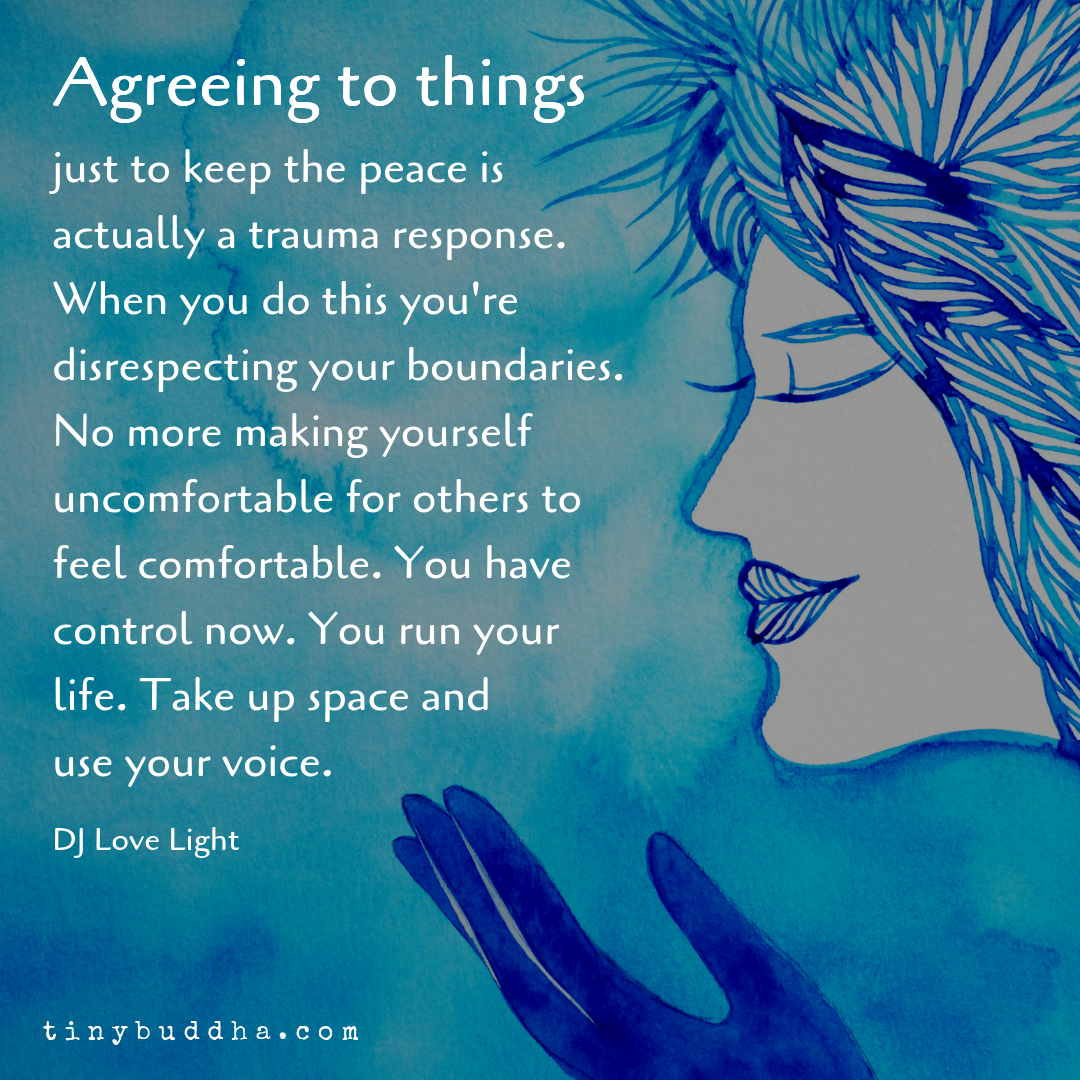
    “Agreeing to things just to keep the peace is actually a trauma response. When you do this you’re disrespecting your boundaries.” ~DJ Love Light

    Two years ago, I moved from New England to the Pacific Northwest. It was time for a change, and though I was excited to begin a new chapter of my life, I was sorry to leave my old friends behind.

    The first year in my new home was hectic. I hopped from hostel to hostel on the hunt for an apartment to call my own. Eager to make friends, I spent my evenings attending meetups of all varieties. My business grew as I welcomed a new influx of clients. Atop these external pressures sat my anxiety, a presence whose intensity ebbed and flowed like an unpredictable tide.

    I struggled to maintain consistent contact with my New England friends during this time of transition. One day, I needed to reschedule a phone call with a friend because I felt utterly overwhelmed. I apologized and rescheduled for the following weekend, despite the fact that it would be my first free weekend in months, and I would need time to recuperate. “I’ll make it work,” I told myself.

    Lo and behold, when the next weekend arrived, I was anxious and exhausted from yet another stressful week. The thought of a phone call felt utterly overwhelming, and so I cancelled. Again.

    This time, my friend was rightfully upset with me. He viewed my persistent rescheduling as lack of investment in our friendship, and we slowly lost touch.

    Even now, months later, I feel deep shame for how I handled that interaction. It was a painful loss, one that taught me an incredibly valuable lesson: making promises you can’t keep is a surefire way to erode relationships⁠—relationships with others and your own relationship with yourself.

    Since then, I’ve learned how to break the overpromising pattern and trust myself again. Here’s how.

    Why Do We Overpromise and Under-Deliver?

    Generally, overpromising stems from our desire to be liked or accepted. We believe that we are most valuable to others when we give 110%, and so we overpromise —we make a commitment that is unrealistic given our present circumstances.

    Overpromising might look like:

    • Agreeing to complete a work project by an unrealistic deadline
    • Promising to call a friend even though your schedule is totally bonkers
    • Agreeing to attend multiple parties in one weekend even though you have social anxiety

    Overpromising is a specific form of people-pleasing, a phenomenon in which we act against our natural impulses in order to garner another’s approval, acceptance, or love.

    When we overpromise, we attempt to become an idealized version of ourselves—a version who does these things, effortlessly, on a certain timeline. By doing so, we deny our natural limitations and prioritize what we believe others want from us instead of what we need from ourselves.

    Somewhere along the way, most people-pleasers learned that their authentic selves were not lovable enough, so they believe —consciously or subconsciously⁠—that the only way to secure the love they crave is to be different. They may put great effort into seeming more sociable, more productive, more accommodating, or happier than they really are. In the case of overpromising, they put great effort into giving more than they comfortably can.

    As a result, those of us who overpromise either do the agreed-upon task—albeit resentfully⁠—or back out altogether. Either way, it causes serious damage because we learn that we cannot trust ourselves. We’re left with a nagging sense of shame and a conviction that we must do better next time, and so the cycle repeats itself.

    The secret to breaking this guilt-filled cycle is to communicate our needs, limitations, and desires from the outset with proactive boundaries.

    The Power of Proactive Boundaries

    When we think about boundaries, we generally think of what I refer to as retroactive boundaries: responding to someone else’s behavior with a clear assertion of what is, or is not, acceptable to us. We might feel threatened, angry, unsafe, overwhelmed, or triggered, and we respond accordingly. For example:

    On a first date, your companion puts his arm around your shoulders. You feel uncomfortable. You remove his hand and say, “I’m not ready for public displays of affection yet.”

    Your father asks you who you’re voting for in the election. You say, “Dad, I’d like to keep who I’m voting for private.”

    Your friend Barb asks if she can borrow $100. You reply, “I’m sorry Barb, but as a rule, I don’t lend money.”

    Retroactive boundaries are a form of verbal self-defense. They’re powerful and effective, but many find them horribly difficult to set. It can be challenging to speak up for ourselves when we already feel threatened, bullied, or pressured. If we were raised in an environment where we were harmed when we spoke up for ourselves, we may find the very idea of setting boundaries impossible.

    To circumvent the awkward process of setting retroactive boundaries, I have learned the art of proactive boundary-setting. Proactive boundaries require us to consider, in advance, what our needs, limitations, and desires will be. We then communicate those needs in the early phase of the relationship, effectively incorporating our needs into the relationship’s very foundation.

    A few examples:

    • You exchange numbers with someone you meet at an event. You’re hopeful that this could turn into a friendship. When she texts you the following day, you reply with enthusiasm and let her know that you tend to take a few hours or days to reply to texts.
    • You have a history of trauma. Before your romantic relationship gets physical, you tell your partner that you prefer to take physical intimacy slow. You explain that you wait to have sex until you feel safe and comfortable.
    • You’ve been offered a new job. You also have a toddler in childcare. You tell your new employer that, should your toddler get sick and need to be picked up from childcare, you will need to leave work early to do so.

    Setting proactive boundaries requires self-acceptance. We need to be able to acknowledge and accept our own needs in order to convey them to others. In doing so, we create an opportunity for others to be authentic and share their needs with us.

    Sometimes, both parties will be willing to meet the other’s needs or find a manageable compromise. Sometimes, after we share our proactive boundaries, we may learn that our needs are not compatible with the needs of our new partner, friend, or colleague. And that’s perfectly okay. Wouldn’t you rather learn that from the outset instead of six months—or six years—down the road?

    How to Set Proactive Boundaries

    Scenarios like this might make a good fit for proactive boundaries:

    • Negotiating how quickly you reply to texts, calls, and emails
    • Discussing the rate of intimacy in a physical relationship
    • Limiting how many extra responsibilities you take on in the office
    • Negotiating dating as a single parent
    • Determining how you will manage money when you move in with your partner

    Finding the right language can be the most challenging part of boundary-setting. In my experience, opening a two-way conversation where both parties can express their needs without judgment is the simplest way to create a healthy conversation. You might try the following:

    When setting proactive boundaries in new friendships or new romantic relationships:

    “I’m excited about this connection we’re building. I’d like to have a conversation with you about what we each want this relationship to look like. I’d love to hear a bit about your needs and share some of my own.”

    When setting proactive boundaries in existing relationships going through a transition:

    “I know we’re about to enter a new phase of our friendship/romantic relationship/working relationship. To make the transition easier for both of us, I’d like to have a conversation with you about what we each want this new phase to look like. I’d love to hear a bit about your needs and share some of my own.”

    When setting proactive boundaries at work:

    “I’m really looking forward to working with you. Before we get started, I’d love to schedule a conversation to discuss how I can best meet your needs, and vice versa.”

    Setting proactive boundaries doesn’t eliminate the possibility that your friends, colleagues, or loved ones will overstep your boundaries in the future. However, in those circumstances, it’s far easier to reference a previously agreed-upon boundary than to set a fresh boundary from scratch.

    Proactive Boundaries Have Changed My Life

    I used to carry a heavy burden of shame for the trail of broken promises I left behind me. Now, I understand that accepting my own needs is the key to keeping my word.

    I use proactive boundaries daily. My friends know that I am slow to respond to texts, emails, and Facebook messages. My partner knows that I have a trauma history and need to set the tone of our physical interactions. My clients know that I work four days a week, 10am – 5pm, and do not reply to emails outside of that time frame. My immediate family knows that I will not discuss politics at home.

    Setting these boundaries has allowed me to love myself. Before, I hated the fact that my anxiety prevented me from keeping in better touch. I hated the way my trauma surfaced at the least opportune moments. I felt guilty and lazy when I didn’t reply to my client’s emails on the weekends. Now, I accept that these are my needs, and I give others the opportunity to accept them, too.
    Those who know my boundaries and choose to connect with me anyway are a powerful reminder that my needs do not make me unworthy of other’s affections. They remind me that I am lovable and enough, just as I am.

  • 9 Powerful Lessons from People-Pleasers Around the World

    9 Powerful Lessons from People-Pleasers Around the World

    A woman struggles to tell her boss that no, she won’t work overtime for the third day this week.

    A man feels resentful in his relationship because he always gives, and his partner always takes.

    A woman wants to stop faking pleasure in the bedroom but doesn’t know how.

    Though their stories differ, these folks share a painful secret. They worry that if they are truly and authentically themselves, they will not be loved or accepted. They have spent their lives morphing into smaller, more “acceptable” versions of who they are, sacrificing their authenticity along the way.

    I, too, am a recovering people-pleaser. In my teens and early twenties, I listened in envy as my friends splattered their unfiltered truths across our conversations like fistfuls of finger paint. Meanwhile, every time I needed to turn down an invitation to a party, World War III raged in my chest as I was racked with nerves and guilt. The thought of disappointing others terrified me.

    I used to feel terribly alone in my predicament. Specifically, I was convinced that 1) I was the only one who struggled with this degree of people-pleasing, 2) there was something dreadfully wrong with me, and 3) I would be that way forever.

    In the years since, my work has led me to speak with recovering people-pleasers, recovering codependent folks, highly sensitive people, empaths, and chronic caregivers around the world. From Ireland to Yemen, India to Malaysia, France to South Africa and more, I’ve spoken with folks who are conquering the people-pleasing pattern, setting empowered boundaries, and mastering the art of speaking their truth.

    Their stories taught me that people-pleasing is a very common—and entirely breakable—pattern. From hundreds of conversations, here are the nine most valuable lessons I learned:

    1. If you don’t speak your truth, your truth will speak through you.

    At first, staying silent to keep the peace sounds like a good idea. Why speak our truth and deal with others’ negative reactions when we could stomach our own discomfort like champs? Those of us who played the role of peacekeeper in our families of origin will find this approach familiar, maybe even comfortable.

    But people-pleasers around the world agree: external peace does necessitate inner peace. When you stay silent, the folks around you might be blissfully ignorant, but you feel the repercussions emotionally and physically. Debilitating anxiety, depression, jaw tension, and stomach aches, for example, are common symptoms folks report when they stifle their voice over an extended period of time.

    Recovering people-pleasers around the world recommend: Recognize that speaking your truth isn’t some corny self-help mantra: it’s a necessary prescription for a psychologically and physically healthy life.

    2. If it’s hard for you to access your wants and needs, a great first step is to tune into your body’s simple physical desires.

    Even those of us who have long histories of people-pleasing can access the sacred whispers of our inner selves through our bodies. As Martha Graham famously wrote, “The body never lies.” We can begin living our truth by listening for our bodies’ cues for food, sleep, movement, sex, dance, and play.

    Recovering people-pleasers around the world recommend: Sleep when you’re tired. Don’t eat food you don’t like. Don’t have sex if you’re not in the mood. Dance when you want to dance. The more you practice listening for these simple wants, the more complex desires will arise.

    3. Expecting others to mind-read your needs is a recipe for resentment.

    In the past, I spent undue time and energy analyzing others for cues of their likes and dislikes. I was a bonafide chameleon, tailoring my colors in whatever way I believed would please others most.

    Given my hyper-vigilance to others’ preferences, I believed that if people really knew me and really loved me, they would predict my needs, too. Unfortunately, you can’t love your way into being a mind reader, and I was regularly disappointed when folks didn’t show me care in the way I wanted.

    When we assume that others should automatically know how to take care of us, we assume that we all share the same definition of being cared for. You might need your partner to say, “I love you,” but your partner might show her love by rewiring your toaster.

    Gary Chapman’s book The 5 Love Languages depicts five distinct ways folks show love, including words of affirmation, quality time, gifts, acts of service, or physical touch. Avoid the guessing game and explicitly communicate your needs often.

    Recovering people-pleasers around the world recommend: Explain your needs to loved ones to avoid mixed messages that could lead to painful miscommunications.

    4. Caregiving can be selfish when we don’t have a strong foundation of self-love.

    Many people-pleasers take care of others because it gives us a sense of value. We structure our identities around being reliable, generous, good listeners, and maybe even sacrificial. However, if we give care to others without taking care of ourselves—without developing our own interests—we may find that we need to be needed to feel a sense of purpose. This means that we may insist on caregiving even when our efforts are no longer required, requested, or welcome, which can violate someone else’s boundaries and autonomy.⠀

    Recovering people-pleasers around the world recommend: Give yourself the degree of love and care you’d regularly give to others. Pay your bills. Go to the doctor. Take quiet time. Treat yourself to a nice dinner. This way, when you do make the decision to take care of others, you can do so with no strings attached.

    5. Just because it feels awkward to state your needs and take up space doesn’t mean it’s wrong. It means it’s new.

    Many of the folks I spoke with remembered how scary it felt to state their needs and take up space at first. To them, it felt “impossible,” “terrifying,” and “overwhelming.” Can you relate?

    That discomfort is a natural growing pain. After all, breaking the people-pleasing pattern means rewriting the scripts you’ve followed since childhood. Maybe as a kid you were told that speaking your truth made you unlovable. Perhaps you were bullied in school for being different and made fierce efforts to blend in as a result. Regardless, you are breaking a years- or decades-long pattern of making yourself small. It will feel less challenging with practice.

    Recovering people-pleasers around the world recommend: Instead of interpreting anxiety as a sign that you’re doing something wrong, reframe it as an affirmation that you’re doing something new—and growing as a result.

    6. It’s totally normal to feel mean, guilty, or overwhelmed after setting a healthy boundary.

    If you grew up in an environment where you were punished or neglected when you expressed your true feelings, learning the art of honest expression is a radical act. The simple act of setting a boundary may feel like an enormous emotional upheaval. You are learning how to stand up for yourself, and like any new skill, it takes practice. 

    After setting a boundary, you might wonder if you’re a bad friend/mother/colleague/[insert role here]. You’re not, of course, but your nervous system needs to learn that with time.

    Recovering people-pleasers around the world recommend: Acknowledge that by setting a boundary, you’ve just done some serious emotional work. Hold yourself with compassion and give yourself permission to rest and recuperate.

    7. If you struggle to set boundaries, you might have a tendency to cut people out when resentments arise. Learning to set boundaries will help you maintain your relationships through moments of conflict.

    For much of my life, I was unable to maintain a single close friendship for more than a year. It seemed that every friendship eventually withered away—not with a bang, but a whimper.

    When I sat down and reflected on this pattern, I realized that when conflicts arose—and conflicts will naturally arise in all meaningful relationships—I had chosen to let the friendships fade instead of addressing, and resolving, my grievances.

    People-pleasers might cut folks out when we don’t have the tools to communicate how we really feel. When we break the people-pleasing habit, we develop the ability to have difficult conversations with friends and loved ones—which enables us to nurture and strengthen those relationships.

    Recovering people-pleasers around the world recommend: Contrary to popular belief, boundaries are an invitation to connect. Remember to consider the many ways that setting boundaries will benefit, instead of threatening, your relationships.

    8. Sometimes extroversion is just people-pleasing at a social scale. For some of us, breaking the people-pleasing pattern means learning to embrace our own introversion.

    As people-pleasers, we regularly act against our instincts to become a version of ourselves we believe is lovable. For many of us, the bubbly extrovert we present in social settings is really just an unconscious performance. In my conversations with many people-pleasers, I was shocked to hear gregarious, fast-talking folks share that all they wanted was permission to be quiet. “I want to trust that I’m worthy of love even when I’m not entertaining others,” they would say.

    As children, we may have received love only when we actively acted in an outgoing, cheerful manner. If our parents were addicts or suffered from mental illness, we may have acted as their de facto caretakers, providing sunshine, reassurance, and good spirits. As a result, we feel that in order to be loved, we must be constantly happy or outgoing—and we are exhausted by it. In adulthood, we’re tired of performing and we crave inner peace.

    Recovering people-pleasers around the world recommend: Practice giving yourself permission to not always be “on” around others.

    9. There is no “right” way to feel after leaving a toxic relationship.

    I had to leave a platonic relationship recently. It was a friendship that had many beautiful parts and many toxic parts, and my decision to leave was fraught with indecision.

    In the aftermath, I felt a hundred ways about it. I felt grief at the loss. I felt empowered for advocating for myself. I felt anger at the circumstances that led to our dissolution. I felt compassion for my friend’s limitations, as well as my own. I felt self-doubt and found myself second-guessing whether I handled the conflict properly. I felt hopeful for friendships yet to come. And I really missed my friend.

    There is no right way to feel after leaving a toxic relationship. Relationships are never one-dimensional, and so our emotions when they end will rarely be one-dimensional, either. You can simultaneously be certain you had to leave and miss the person terribly.

    Recovering people-pleasers around the world recommend: When you leave a toxic relationship, recognize that all of your feelings are legitimate. You don’t need to pick just one.

    ⁠—-

    Years and hundreds of conversations later, my initial understanding of people-pleasing has shifted entirely:

    The myth: “I am the only one who struggles with this degree of people-pleasing.”

    The truth: If you are a recovering people-pleaser, you are far from alone. Millions of folks worldwide are doing the challenging and rewarding work of learning to speak their truth. There are even Facebook support groups like this one designed specifically for folks who are working to conquer the people-pleasing pattern.

    The myth: “There is something dreadfully wrong with me.”

    The truth: As a kid, people-pleasing was likely how you secured love and affection from distant, neglectful, or self-centered caregivers. It was a survival strategy. Now, you can give yourself permission to let it go.

    The myth: “I will be this way forever.”

    The truth: People-pleasing is not a life sentence; it is a pattern that you can break with practice and intention. You can seek support from friends, therapists, and coaches as your practice the art of radical self-expression.

    As hundreds of folks around the world made clear: With time and intention, you can master the art of speaking your truth and find the strength, authenticity, and inner peace you’ve been waiting for.

  • How to Reduce Holiday Stress by Setting Strong Boundaries

    How to Reduce Holiday Stress by Setting Strong Boundaries

    I love the holidays. I eagerly anticipate the first snowfall, adore the scent of pine, and watch It’s A Wonderful Life every year without fail.

    That said, even the merriest among us know that the holidays can be emotionally, physically, and psychologically taxing. In addition to buying gifts, negotiating travel plans, and shuttling from gathering to gathering, many of us spend extended time with our families—and every family, no matter how loving, has its fair share of challenges.

    When these difficult family dynamics combine with holiday-season stress, we may find ourselves at a crossroads. Do we burn out, freak out, and spend the holidays in a state of discomfort? Or do we set boundaries around our time, space, and energy?

    Setting Boundaries With Family Members

    For many of us, breaking the people-pleasing pattern and setting boundaries poses a unique challenge. Personally, I was taught that my value lay in how much I gave, and so speaking up for myself—or setting limits on my giving—at first felt mean and inconsiderate.

    Setting boundaries among family members can be doubly challenging. For years, we may have felt burdened by unspoken expectations that have made it hard to put our own needs first.

    For most of my life, I struggled to set boundaries with my parents because they raised me, fed me, clothed me, and supported me financially until I reached adulthood. At first, it was hard to instate boundaries because I felt I owed them everything.

    Likewise, many parents would leap out in front of a train for their kids, and many siblings would go to great lengths to keep one another safe and happy. As a parent or sibling, you may feel obligated to offer your time, money, space, or energy without limitation.

    Boundaries illuminate and challenge these unspoken expectations. Whereas before you may have been the resident people-pleaser or over-giver, setting boundaries changes your role in your family system. They enable you to prioritize your own needs and give at a sustainable rate.

    Boundaries can protect your material possessions, your emotions, your physical space, or your spiritual beliefs. They are not “mean.” They simply draw a line between what belongs to you and what belongs to others.

    As I prepare to have difficult conversations about boundaries, I like to keep these four key principles in mind:

    When we refuse to set a boundary, we prioritize other people’s comfort over our own needs. Setting boundaries is a courageous act of putting ourselves first. It’s a great way to break the people-pleasing habit and practice the art of self-care and verbal self-defense.

    Difficult honesty is not unkindness. It’s not mean to stand up for yourself. It’s actually the most truthful and authentic way to interact with others.

    You can manage your boundaries or manage other people’s feelings, but you can’t do both. The bottom line is, your boundaries might make people feel frustrated or resentful. That burden is not yours to bear.

    Other people are not mind-readers. Don’t expect them to be. There is no shame in directly asking for your feelings to be acknowledged or your needs to be met. Even our loved ones need ongoing instruction in how to care for us because we are always changing—as are our needs and boundaries.

    This holiday season, practice setting boundaries in your family to give yourself the gift of feeling joyful, peaceful, and empowered. Here are some common holiday scenarios in which boundaries might come in handy:

    Example #1: It’s okay not to go home for the holidays.

    Maybe your adult children have finally fled the nest and you want to spend the holiday in Cancun with your spouse. Maybe you want to visit your fiancé’s family instead of your own. Maybe home is a toxic environment and you’d prefer to stay home and enjoy the company of your dog, Bobo.

    You are not selfish for wanting to spend the holidays in the way you’d like. You are allowed to have desires that differ from your parents’ or siblings’. You are allowed to have a different understanding of what makes the “perfect” holiday.

    It can be tough to buck traditions that have been in your family for decades. Sometimes, finding the right language is the hardest part.

    My favorite way to communicate a boundary is the “I-statement” approach developed by clinical psychologist Thomas Gordon in 1970. It centers your feelings and experiences, reduces the likelihood of defensiveness in the listener, and offers concrete suggestions for change.

    Here’s how it works:

    • I feel _________________________________________.
    • When you _____________________________________.
    • Because _______________________________________.
    • I need ________________________________________.

    In the case offered above, you might try this: “I feel sad and overwhelmed when I come home for Christmas because there’s a lot of unresolved tension in our family. I need to spend a peaceful Christmas on my own this year.”

    Example #2: It’s okay to need a break if you’re hosting.

    Holiday hosting is no small feat. In my extended family, Christmas Eve was always a bonanza, complete with platters of hors d’oeuvres, mountains of gifts, and screaming kiddos hopped up on Neapolitan cookies. My grandma, our gracious hostess, would start preparing the moment summer vacation was over. It was a big deal.

    Whether you’re hosting the extended family for one evening or hosting your kids for two weeks, you are offering your time, space, and energy in a big way. It’s taxing for your nervous system and your body, and it’s okay to take a break. “Taking a break” might mean spending a day by yourself, enjoying an afternoon nap, or outsourcing host responsibilities for an hour in the midst of the party.

    Try this: I feel stressed when I host the family for Christmas Eve because it’s a ton of work to cook the food, mingle with guests, and clean up afterwards. I need someone to help me clean up when the guests start to leave.

    Example #3: It’s okay to need alone time if you’re visiting.

    Visiting entails fewer responsibilities than hosting, but it’s not always a walk in the park. As a visitor, you’re out of your comfort zone. You’re in a new environment, away from your routines and creature comforts. Even if you haven’t seen the folks you’re mingling with in months or years, it’s perfectly normal to take some time to be alone.

    Try this: I feel overwhelmed by the non-stop festivities when I visit for Christmas because I’m used to having a lot of time to myself at home. I need one day where I can be alone so I can rest and recharge.

    Example #4: It’s okay to disengage in controversial conversations.

    Despite the litany of horror stories that illustrate the dangers of talking politics/religion/etc. around the dinner table, some of our loved ones can’t seem to help themselves. I know from personal experience: Some family members get a kick out of instigating uncomfortable conversations.

    This year, you don’t have to choose between entering a heated conversation or forcing a chuckle on the sidelines. You can set a boundary that simultaneously protects your values and limits your involvement.

    Try this: I feel uncomfortable when you talk about politics over Thanksgiving dinner because it creates an atmosphere of tension. Let’s change the conversation to something less controversial so we can enjoy one another’s company.

    Example #5: It’s okay not to be okay with your family’s dynamics.

    Every member of every family changes over time. Habits or routines that you loved as a child might not feel comfortable as you get older. Certain family tensions may have worsened as the years have passed.

    Bottom line? Just because you accepted these behaviors and dynamics before does not mean you need to accept them now.

    Maybe your brother always comments on your weight, and you’d really like him to stop. Maybe your grandmother constantly asks you why you’re going to school for music instead of medicine. Maybe certain family members get really drunk at your annual Christmas party and, this year, you’re not comfortable with them attending.

    By addressing these discomforts in a straightforward manner, you can give yourself the gift of prioritizing your own feelings and needs.

    But What If They Don’t Like My Boundaries?

    The question I get most often is, “Okay, so I set a boundary. But what if they don’t like it? What if they don’t do what I ask?”

    Your family members might not like your boundaries. Your boundaries may activate their deepest fears and insecurities, and they might wonder, “Does she still love me? Is he angry? What does this mean for our relationship?”

    Your family members may get angry or upset. They may need time to adjust. They may even use guilt in an attempt to make you change your mind.

    It’s important to enter these challenging conversations with realistic expectations for how your loved ones may react. Preparing for surprise, anger, or sadness will make it easier to hold firm to your boundary when faced with resistance.

    During the conversation, acknowledge that your boundary may be difficult to hear. This helps your loved one feel seen and included in the process.

    I also like to offer positive alternatives to the behaviors I’m trying to quelch. I want to make clear to my loved ones that I care about our relationship and I’m willing to work to find ways of interacting that feel good for both of us. For example:

    • “I will be staying at a hotel when I come home for Christmas this year. I would love to carve out a day to spend together, just the two of us.”
    • “Talking about this topic is difficult for me. Can we change the conversation? I’d love to hear how work’s been going for you.”
    • “It’s really important to me that I meet my need for alone time. That said, time with you is really important to me. Can we work together to find a balance that works for both of us?”

    Sometimes, no matter how firmly you hold to your boundary, others will be unwilling to change. Perhaps you express that your brother’s toxic behavior is no longer acceptable to you, but he carries on anyhow. Perhaps you explain that you’re no longer willing to host the annual holiday party, but nobody else steps up to volunteer.

    You cannot change other people. You only have control over your own reactions and behavior. Sometimes, you may have to choose between tolerating the unacceptable behavior or evacuating the environment (e.g., not attending the family’s holiday gathering, ceasing contact with a family member altogether, etc.)

    Though deeply challenging, making the bold decision to evacuate a toxic environment is a phenomenal act of self-care. Organizations like Stand Alone offer support and community to individuals who have had to make that difficult decision, and can be a wonderful resource this time of year.

    Remember: you can simultaneously set boundaries and be loving, compassionate, and kind. You can sit with your loved one’s pain, hold space for their reaction, and reiterate how much they mean to you—all while making clear that your boundary is non-negotiable.

    It takes a great deal of courage to speak up and alter old ways of relating to others, especially in your family. Every time you set a boundary, you bring your outer world into alignment with your inner needs. It is a gift that only you can give yourself—and a gift unlike any other.

  • How to Break Unstable Relationship Patterns

    How to Break Unstable Relationship Patterns

    “Being willing to accept responsibility for the situation you’re in is the first step to a more fulfilling love life.” ~Renée Suzanne

    Remember the haunting ballad “Foolish Games” by Jewel?

    Jewel wrote the song when she was sixteen. She kept a serious journal, and said in an interview that a verse in the song was “about a relationship that I was dramatically involved in on paper.”

    That pretty much sums up my first relationship, which was a dramatic pseudo-relationship in many ways. I was sixteen going on seventeen, hopelessly romantic yet shrewdly skeptical of love at the same time. My emotions were wild and intense, and that was what I thought “real love” felt like.

    This drama followed me throughout the few but memorable relationships I had in my twenties. When a partner was rude to me or put me down, I’d think that I somehow deserved it or that it was a challenge to do better with a quick-witted comeback. I’d tell myself that the other person needed “space” to “calm down,” without giving as much care or thought to what I really wanted or needed.

    Mind games and second-guessing are part and parcel of an unstable relationship.

    As Anita wrote in a forum comment: “Maybe you are testing him each time you withdraw—will he go after me?” In my mind, I’d rationalize it as the need to be “reaffirmed” that I was really what the person was looking for in an ideal partner.

    All of the unstable relationships I was in ultimately failed.

    In hindsight, it’s no wonder why!

    I had constantly attracted and been attracted to partners who lacked commitment, reliability, and emotional stability. Things would blow hot and cold on a regular basis in either direction (“She’s So Cold,” by The Rolling Stones, was yet another song with lyrics I could relate to).

    When I reached my early thirties, I started putting in more effort to break out of these negative relationship patterns. I realized that I had to accept responsibility for being in horrible relationship situations that I thought no wise and sane person would ever put up with.

    I’d like to share what I learned in the hopes that my experience may help someone else who’s desperately trying to move forward from a troubled dating history.

    5 Lessons About Breaking Unhealthy Relationship Patterns

    1. Observe your thoughts and their actions.

    When I observed myself, I noticed that my own thoughts about love and relationships were full of negative or anxious associations. I believed that it was close to impossible to be in a healthy relationship or that I would always be attracted to unstable types.

    This anxiety carried over into my behavior on a daily basis. I was always skeptical to the point of being paranoid. Being too trusting is a fault, but I saw how the other extreme could be just as damaging as it didn’t give me much of a chance to see the good side of others. I couldn’t expect my relationships to improve if I had such low confidence in ever being in a fulfilling relationship.

    I also had to recognize when someone’s words and actions didn’t line up. A glib speaker might be able to use words to perfectly express or explain something, but it’s a person’s behavior that really matters at the end of the day. A partner who proclaims they’re the greatest is an egomaniac if they fail to see how their hurtful words or behavior affects you.

    2. Get clear on your boundaries.

    Think about what makes you feel sad, uncomfortable, drained, or diminished as a human being.

    My list of personal boundaries includes the following:

    • I need a partner who’s financially responsible.
    • I need a partner who won’t resort to belittling my mind and opinions should we have a clash of opinions.
    • I need plenty of alone time to rest, recharge, and dedicate to my creative projects.

    You need to understand what your personal boundaries are so that you can maintain them. More importantly, it helps you keep a distance from people who don’t respect your limits.

    Boundaries don’t exist because you’re selfish or because you want to make life difficult for others. Boundaries are a form of self-care for your mental and emotional health. If this makes things “difficult” for others, perhaps they’re not the people you should be spending most of your time and life with.

    3. Get clear on what you want.

    When you have a better idea of what you don’t want, shift the focus onto what you do want in your relationships.

    Think about the time and energy you’ve poured into unstable relationships. If you spent as much time and energy on seeking a healthy relationship, wouldn’t you have a reasonable chance of success?

    To enjoy a stable relationship with someone mature and available, consider the deeper values you and your partner need to be in alignment with.

    Do you want to have kids, or are you looking for someone who can also be a stepparent? Are you adamantly childfree and need a partner to respect this choice of yours? How financially responsible would you like your partner to be, and what are your financial expectations in a relationship?

    These aren’t exactly romantic questions, and you don’t want to be unrealistic with a never-ending list of points that a potential partner must check off. But knowing what your deal breakers are before entering a relationship can save you a lot of time and heartache.

    4. Don’t give up on yourself.

    You may feel like your dating history is akin to scorched earth, where there’s nothing but rubble, ashes, and a rancid boatload of chronic low self-esteem.

    No matter how bad it is, don’t give up on yourself.

    You are a unique individual, and the story of your life is up to you to create. There may be setbacks and failures, but you never have to lose sight of your dreams and goals.

    To lose yourself in a relationship is a sad way to feel out of touch with who you really are.

    Spend the time to not just get to know yourself, but to know what really motivates you. This self-understanding will serve as a source of inspiration whenever you need to remind yourself of your gifts and strengths.

    5. Choose wisely.

    You always have a choice at the end of the day.

    Instead of self-destruction through an unstable relationship, you can choose self-love and commit to leaving unhealthy relationships behind you. Choose peace over drama and emotional rollercoasters when it comes to romantic partners. Choose relationships where you feel free to be your authentic self instead of needing to walk on eggshells for fear of saying something that will set your partner off.

    Above all, choose to be with someone who is kind and respectful toward you.

    Your failed relationships help you to recognize the negative patterns that you need to break free from. This freedom allows you to begin healing from within, and it helps you move on in wisdom, not anger. You’re then able to face each day at an optimum level with the knowledge that you’ll be able to handle whatever comes your way.

    Realize that it’s not impossible to break free from negative relationship patterns. Know that life has more to offer than unstable relationships, and that you are worth a whole lot more than someone else’s self-destructive tendencies.

  • How to Set Boundaries in Awkward Situations with Strangers

    How to Set Boundaries in Awkward Situations with Strangers

    “Boundaries aren’t about punishing. Boundaries are about creating safety for yourself.” ~Sheri Keffer

    The person sitting beside you at the bar keeps talking to you despite your obvious disinterest. The flirty Uber driver mentions—three times—how beautiful you are. Your cousin’s new boyfriend gives you a too-long hug with wandering hands.

    In awkward situations with strangers, we tend to hope that non-verbal cues will be sufficient to set a boundary. We use silence, crossed arms, uncomfortable laughter, and glares to communicate discomfort. But some folks cannot—or will not—take the hint.

    Here, we find ourselves at a crossroads: We can either set clear verbal boundaries or tolerate the uncomfortable behavior indefinitely.

    For the longest time, I struggled to set boundaries in awkward situations with strangers. Throughout childhood, I was taught how to be kind, nice, and open-minded—but never how to have difficult conversations and advocate for myself. I worried that setting firm boundaries was mean, so I tolerated uncomfortable behavior in silence, which allowed the awkward situations to escalate even further.

    Eventually, I realized that setting firm boundaries is a form of verbal self-defense. It is our responsibility to advocate for, and protect, our time and space.

    My goal for this article is to demystify the process of boundary-setting and offer concrete suggestions of language you can use to be clear and direct. These are phrases I’ve crafted, edited, and re-crafted over years of boundary-setting practice. My hope is to help you make awkward situations as not awkward as possible.

    Before we dive in, let’s get clear on five key principles for boundary-setting:

    1. When we refuse to set a boundary, we prioritize other people’s comfort over our own needs. Setting boundaries is a courageous act of putting ourselves first. It’s a great way to break the people-pleasing habit and practice the art of self-care and verbal self-defense.

    2. Difficult honesty is not unkindness. It’s not mean to stand up for yourself. It’s actually the most truthful and authentic way to interact with others.

    3. You can manage your boundaries or manage other people’s feelings, but you can’t do both. The bottom line is, your boundaries might make people feel frustrated or resentful. That burden is not yours to bear. As the saying goes, “The only people who get upset about you setting boundaries are the ones who benefited from you having none.”

    4. It’s not your job to protect people from feeling uncomfortable. Remember: the folks imposing on your space aren’t giving your comfort a second thought—so don’t twist yourself into knots trying to protect their feelings. As Registered Clinical Counselor Jordan Pickell says, “It makes sense for people to feel bad and weird when they have crossed a line.”

    5. Safety first. If you ever feel unsafe or threatened, do whatever you need to do to get to safety. Don’t be a boundary-setting hero.

    For consistency, the examples below use “Bob” as the generic name of our boundary-violator. However, folks of all genders, ages, races, etc., violate boundaries.

    Certain suggested phrases are direct and firm. Others are lighter and playful. Experiment with the language to find the tone that works best for you.

    Case #1: The Handsy Hugger

    Maybe it’s an eager fan who approaches you after an open mic performance. Maybe it’s your step brother’s uncle who you see twice a year at family barbecues.

    Handsy Huggers comes in many shapes and forms, but they all have one thing in common: they hug you for an uncomfortably long time with wandering hands.

    My recommendation: In a scenario that runs the risk of uncomfortable physical contact, it’s better to avoid a hug altogether. Next time a Handsy Hugger approaches you, give yourself permission not to enter his outstretched arms. Hang back, offer a smile (or not), and when he looks at you quizzically, say, “I’m not in the mood for a hug today, Bob.” In the next breath, redirect the conversation to literally any other topic.

    Case #2: The Flirty Uber Driver

    I have been asked, by two separate Uber drivers, if I would consider marrying them. I’ve sat in the backseat as Uber drivers have commented on how much they liked my clothing and eyed me from the rearview.

    When you’re in someone’s Uber, you can’t exactly escape to the ladies room. Some drivers will continue bantering with you even if you put headphones on and stare blankly out the window.

    My recommendation: Depending on your mood, you can use a casual or direct approach.

    • Casual: “It’s been nice talking with you, but I’ve had a long day and don’t really feel like talking right now.”

    • Direct: “To be honest, your comments are making me uncomfortable. I’d prefer not to talk right now.”

    (Note: If your rideshare driver makes you feel unsafe or threatened, report them through the app immediately.)

    Case #3: The Non-Stop Texter

    You meet a nice man named Bob at the bar or on a hike. You exchange numbers. Within hours, your phone begins buzzing. Bob asks you a litany of questions. He sends a greeting every morning. Throughout the day, your phone erupts with Bob’s favorite Youtube videos of tap-dancing cats.

    You don’t reply, but your silence doesn’t deter Bob from sending text after text after text. You consider ignoring his messages wholesale, but you’re concerned that if you run into Bob in public, you’ll feel guilty and awkward.

    My recommendation: Despite the rising popularity of cell phone boundaries, some folks seem to feel entitled to your time and space via your inbox. They’re not. You’ve got two options:

    • If you hope to keep this person as a friend but adjust how often you text, try this: “Bob, I like to have healthy boundaries with my phone and I’m not interested in texting this often. Next time we meet up, let’s have a conversation about our expectations for communicating when we’re not together.”

    • If you feel overwhelmed and want to cut the cord entirely, try this: “Bob, I’m not open to a friendship with you at this time. You’ve been reaching out a lot recently and I feel overwhelmed by it. I have no hard feelings toward you and I wish you the best.”

    Case #4: The Person At the Bar Who Won’t Stop Talking To You Despite Your Obvious Disinterest

    I like to write in my journal at bars. I’m a sober lady and I don’t drink, but I love feeling comfortably anonymous in a social atmosphere.

    Despite my hunched posture, downcast eyes, and scribbling hand, many a barstool neighbor attempts to strike up a conversation with me. The first one or two questions are fine—a pleasantry, really—but often, my bar neighbor will continue on, chatting at me despite my obvious disinterest.

    I can’t count the number of times I have diverted my eyes and offered muttered “uh huhs” and “yeahs” before throwing a twenty onto the bar and escaping into the night, feeling resentful.

    My recommendation: Especially when alcohol might be involved, it’s best to set a firm boundary as clearly and directly as possible. Turn to your barstool neighbor and say, “I appreciate the chance to chat, but I don’t feel like talking right now.”

    Case #5: The “Harmless Older Person”

    Ah, yes. The older lady or gentleman who uses your age difference to justify being “harmlessly flirty” with you. Any of this sound familiar?

    • “If I was your age, I’d have swept you off your feet by now!”

    • “You’re a real beauty, you know that?”

    • “I just love the sight of a spry young man.”

    • “As my father used to say: Just ‘cuz you’re married doesn’t mean you stop lookin’.”

    It doesn’t matter if the speaker is 20 or 200—if someone’s flirtation makes you uncomfortable, you have every right to shut that commentary down.

    My recommendation: Keep it simple. Try this: “I know you’re trying to be kind, but please don’t make comments like that. They make me feel uncomfortable.”

    Case #6: The Uninvited Mansplainer

    There’s nothing quite like the particular fury of having a man 1) assume you know nothing about a certain topic because you’re a woman, 2) explain said topic authoritatively, indefinitely.

    Merriam Webster defines mansplaining as “when a man talks condescendingly to someone (especially a woman) about something he has incomplete knowledge of, with the mistaken assumption that he knows more about it than the person he’s talking to does.”

    Ladies, you might be familiar with mansplaining if you’ve ever bought strings at a guitar store, watched a sporting match, or discussed anything related to cars, electronics, or grilling. Opportunities for mansplaining abound.

    My recommendation: Make it clear that not only do you know this information already, but you’d really like them to stop. Try this: “I’m really familiar with (insert topic here) and I don’t need any more information. Thanks anyway.”

    Case #7: The Personal Space Invader

    You’re standing on the subway, or in the check-out line, or at the club, and someone’s body is too close for comfort. Maybe it’s intentional, which is creepy. Perhaps they aren’t aware of the space they’re occupying. Regardless, you’re not enjoying their front near your back / the smell of their breath / their odor.

    It’s time to set a boundary.

    My recommendation: “Excuse me, could you please move back and give me some space? Thanks.”

    Case #8: “Can I Have Your Number?”

    You’ve been chatting with a stranger, Bob, for a few minutes. As he gets up to leave, he asks for your number. You’re not into it.

    This circumstance tends to elicit boundary-white-lies, such as “Sorry, but I have a partner,” or “Oh, I don’t give out my phone number to strangers.”

    I understand that white lies might be your most comfortable entry point into boundary-setting. I am, at heart, a boundary-setting pragmatist. That said, when you’re ready, experiment with a firmer approach. It might be scary, but it will certainly be empowering.

    My recommendation: “I’ve enjoyed chatting with you, but I’m not going to give you my number. Have a nice rest of your day!”

    Bringing Boundaries To Life

    By now you’ve probably realized that, in each of the cases above, the words you can use to set boundaries are pretty straightforward. It’s actually saying them that’s the hard part.

    With this toolbox of phrases in hand, you can bring these boundaries to life using three simple steps:

    Step 1: Practice boundary-setting aloud.

    Many of us have never fathomed speaking up this directly. Our ability to boundary-set is just like any other skill: it takes time, effort, and practice.

    In the comfort of your own home, practice stating your boundaries aloud. Get used to wrapping your tongue around the words. Consider standing in front of a mirror and using a firm, confident tone.

    At first, it will be uncomfortable and strange—guaranteed. You may find yourself worrying about being “mean,” “rude,” or “harsh.”

    These reactions are totally normal and totally surmountable. Practicing your boundaries alone makes them easier to retrieve when you’re feeling burdened by the tension of an uncomfortable situation.

    Step 2: Role play with your friends. (Yes, really.)

    Once you’ve developed an arsenal of failsafe boundary phrases, practice with a friend or two.

    Give each other feedback. Tell your friend when she sounds overly apologetic. (“Stand in your power, girlfriend!”) Tell your friend when she’s sounding like a huge, mean jerk (“Okay, maybe take that down a notch.”) Have fun with it.

    If you want to uplevel your boundary-setting game, ask your friends to push back against your boundary. (Psychologist Harriet Lerner refers to this as a countermove: a “change back!” reaction.) Practice re-asserting yourself in the face of annoyed reactions. This way, when you begin setting these boundaries out and about, it will feel natural and familiar.

    Step 3: Practice

    As with all new skills, don’t expect perfection immediately. Your first few boundaries in the real world might be clunky, awkward, or embarrassing. Maybe you’ll speak too quietly and the offender won’t be able to hear you. Maybe you’ll boil over in rage and feel terribly guilty afterwards.

    All of this is normal. Be patient with yourself as you strengthen your boundary-setting muscle.

    P.S.: What About Silence?

    Is silence ever an effective form of boundary-setting? To answer this question I like to refer to writer Courtnery J Burg’s take, which she published on Instagram this year. She writes,

    “I’m all about boundary work. But sometimes the healthiest, best way to keep your sanity is to just walk away. To not respond. To not answer that text or that call. Sometimes the answer is no answer at all. This isn’t the same as avoiding. It’s acknowledging what is yours to carry + what isn’t. It’s remembering that not all situations must be handled with delicate gloves and deep, heartfelt energy. That occasionally, no response CAN BE your response and that you have nothing to feel guilty for and no one to explain yourself to for it.”

    Generally, I advocate verbal boundaries because 1) they’re most effective, 2) I spent many years trying to be “good” and “quiet” and I’m rebelling, and 3) they’re a great way to practice your boundary-setting muscle. However, certain awkward situations with strangers are most effectively curtailed with silence.

    As a rule of thumb, I use silence as a boundary with:

    • Catcallers. Silence or the middle finger tends to do the trick.

    • Strangers who message me insistently through social media. Most folks with public social media profiles will occasionally receive a deluge of creepy messages from strangers. Don’t engage. Block the account.

    • Arguers. Suppose I set a firm boundary and the stranger argues my point — asking me “Why?”, urging me to reconsider, etc. You do not owe a stranger any justifications or explanations. Your work is done.

    With time, boundaries that once felt impossible or too-awkward to assert will be second-nature. By practicing this skill of verbal self-defense, you will give yourself the gift of moving confidently and powerfully through the world. You deserve it!

  • 10 Things You Need to Know to Maintain Strong Friendships

    10 Things You Need to Know to Maintain Strong Friendships

    “A friend is someone with whom you dare to be yourself.” ~Frank Crane

    Studies show that feeling connected to other people is a core human need. A sense of connection impacts not only on our mental health but also our physical well-being. It reduces our risk of disease and increases longevity.

    While the research is clear, statistics also suggest that our level of social connectedness is declining. Social media might help us be more widely connected, but it doesn’t usually replace the connection we experience in offline friendships.

    It seems that as adults we aren’t that good at friendships. People complain that it’s hard to make friends and maintain existing friendships after leaving school. It’s largely because we are busy with jobs and families, but I wonder whether there are other reasons outside of those external circumstances.

    Growing up I had a very specific ideal of what “true friendship” looked like, which I had primarily picked up from books, TV, and movies: You have a best friend who you share everything with, hang out with 24/7 and grow old with—through thick and thin and of course happily ever after.

    Only my reality looked different, which in itself made me feel that there was something wrong with me.

    I also struggled because I felt like an outsider. I am mixed race (half Chinese, half German), was born and raised in Germany, and grew up very conscious of looking different, which is something I simply cannot hide. My parents told me to be proud of being different, but I wanted nothing more than to blend in because I felt that my difference isolated me.

    I was a painfully shy kid. I always found it difficult to approach other kids and I began feeling invisible to the world.

    I wanted to belong so badly and would have done anything to fit in, but because I had convinced myself that I was too different, I eventually stopped trying. Instead, I pretended I didn’t care about not being part of the group. I didn’t want anyone to see that I was upset. On the outside I seemed self-confident and strong, but always faked it and never made it (until much later in life). In short, I was doing the opposite of being myself.

    The belief that nobody noticed me stuck with me into adulthood until I eventually realized that I hadn’t been invisible but rather I had been hiding. I had built a solid wall around me.

    As an adult I can see that I probably wasn’t all that different from the others. How many of us grow up thinking we need to pretend to be someone we are not in order to belong and to be loved? How many of us still do this now as adults? And how ironic is it that by wearing a mask we achieve the opposite of what we intend and basically make it impossible to experience true connection?

    Over the years, I’ve learned a lot about letting people in and creating meaningful connections. And I’ve come a long way from that insecure little girl who hid behind a wall and felt chronically isolated. If you’ve struggled to form and maintain friendships, perhaps my lessons may help.

    1. Not all friendships are created equal.

    Friendships are not a “one size fits all” kind of affair but rather come in different shapes and forms. A friend doesn’t have to cater to all your needs. It’s more natural to have friends for different areas of your life. That doesn’t make any one friend “less than,” but it feels much healthier than placing undue expectations on one person.

    For example, a lot of my close friends live far away and we no longer share our everyday lives with each other, but I know I can still rely on them. Then there are people I’ve just met. While sometimes I instantly click with people, with others it takes longer to connect deeply. I also have loose acquaintances, and while we might not discuss our deepest thoughts, it’s still fun to connect through experiences and mutual interests.

    Once we open our minds to what friendship can look like, we will gain access to connections that would have otherwise gone under our radar.

    2. Connection is a two-way street.

    The quality of connection is made up of what both of you are putting in. And the connection is likely to break apart if you expect what you are not prepared to give.

    This doesn’t just apply to what you are willing to do for the other person. Are you fully showing up as yourself? Are you allowing others to really see you? And are you prepared to really see the other person, too, including the more challenging things that can feel heavy and painful?

    3. People can only honor your needs and wishes if you communicate them.

    We often expect others not only to read our minds but also to be on the same page as us on all matters. Chances are that if you haven’t clearly communicated what you expect from your friend, they might have no idea.

    But also, remind yourself you have no “right” to others fulfilling your needs and wishes. Be prepared that others aren’t able or don’t want to give what you would like them to give you.

    You know that saying “In times of crisis, you find out who your real friends are”? Well, I don’t entirely agree with that. It assumes that there is an unwritten rule about how friends need to behave, but there can be multiple reasons why they might not be able to be there for you to the extent you expect them to.

    When my mum passed away, for example, my friends reacted in different ways. I totally understand that a lot of people find death highly uncomfortable and simply too terrifying to talk about, so, I accepted that I wasn’t able to talk about it with all of my friends.

    Fortunately, some friends were able to be there for me. This experience taught me to formulate my needs and ask for help. On some days, the support I needed was to be able to talk and cry and on other days, I wanted to be left alone. The only way for my friends to know was for me to tell them.

    4. You don’t need to agree on everything.

    Maybe this is just me, but I feel an urge to agree with my friends on everything. Disagreements on even the smallest of issues cause me a certain level of discomfort. Of course, this is where the cycle of not being myself begins: by not saying what I really want in order not to upset the other person. That’s what compromise is for though, right?

    I am therefore teaching myself to remember that it’s okay to disagree and to learn to accept that niggling feeling of discomfort that I still feel, even when I know this won’t affect the friendship overall.

    That being said, sometimes disagreement is a sign that someone isn’t a person I want to be friends with—there are certain no-gos, certain things that just aren’t okay with me. Get clarity on your no-gos and stop sweating about the rest.

    5. You don’t have to like each other all the time.

    This for sure is another remnant of my Hollywood friendship ideal. Do you like yourself all the time? I don’t. I can be moody or thoughtless. I have characteristics I don’t like and that I am working on changing.

    The same goes for every other person. And not only do we all have bad days and do stupid things sometimes; we might also have spleens or characteristics that are annoying to others. But they are likely outweighed by our loveliness . If so, maybe you can accept them in your friends and focus on all the rest instead of getting worked up over them or trying to change them.

    6. Friendships need appreciation to flourish.

    Don’t take friendships for granted, whether it’s the little or the big things: tell and show the other person that they are appreciated and loved, and express your gratitude. Especially when we have known somebody for a long time, we may expect them to just know how we feel. And chances are they do, but it’s always nice to hear it, too.

    7. Not everyone will give as much as you give.

    Just the way we set our own boundaries and decide what we are prepared to give, everyone else has the same right. And everyone’s boundaries are different.

    While solid friendships naturally involve give and take, it shouldn’t be about tit for tat. Don’t keep count and don’t expect reciprocity for everything you are giving into the friendship. Give because you want to, not because you feel obligated or because you want something in exchange.

    8. Grudges erode relationships.

    I am pretty good at holding a grudge. I also know that it’s my coping mechanism for trying to protect myself from getting hurt and disappointed again.

    Here’s a secret: It doesn’t work! Also, is it worth proving that you were “right”? Do you even know for sure that you were “right”? Put yourself in the other person’s shoes: Can you understand where they are coming from? Communicate when you are upset, clear the air, and move on. But remember:

    9. Strong friendships require strong boundaries.

    Boundaries are so important, and a lot of us are unfortunately not very good at a) identifying our boundaries b) ensuring they are honored, and c) walking away when they are not.

    Personally, I have two main areas where I am still learning to communicate my boundaries: First, I’m part introvert and as much as I enjoy socializing, it can also feel depleting. Saying no to an invite or leaving a gathering when my limit has been reached still doesn’t come easy but it’s getting easier. It’s a matter of taking my own needs seriously as well as explaining them to my friends.

    Secondly, people tend to find it easy to open up to me and often come to me for advice. As much as I want to help people and especially support my friends, I am still figuring out where my boundary is. I don’t want to take on a one-sided role of “counselor” in a friendship, since this inevitably leaves me feeling resentful. I am aware this is as much about me naturally putting myself in that role as it is about people’s expectations of me.

    10. People change.

    Are you the same person you were ten years ago? Even one year ago?

    We all change, and especially when we’ve known somebody for a while, it’s easy to assume that we know everything about them.

    I love this quote by George Bernard Shaw: “The only man I know who behaves sensibly is my tailor; he takes my measurements anew each time he sees me. The rest go on with their old measurements and expect me to fit them.”

    Are you still listening? Are you curious? Are you taking an interest?

    Sometimes we change so much that we drift apart, and that’s okay. The fact that we may grow so far apart that we no longer want to be friends doesn’t take away from all the joy and fun we had in the past.

    Though I have long since bid farewell to my warped idealistic friendship model, I do make a conscious decision about who I want to spend my time with. And the criteria for that can change over time and are for me to decide.

    My only advice is this: don’t be quick to discard relationships from a place of disappointment, hurt feelings, a bruised ego, or even a sense of revenge.

    If somebody means something to you, talk to them. Figure out a new way to be friends going forward—one that works for both of you. But also accept that people are not there to adhere to your expectations or to the image you built up of them in your head.

    And remember that connections in whatever form add immeasurably to the quality of our lives. Let’s open our hearts and minds to experience more of them!

  • What to Do When Someone You Love is Struggling

    What to Do When Someone You Love is Struggling

    “Sometimes the easiest way to solve a problem is to stop participating in the problem.” ~ Jonathan Mead

    I don’t think I’m alone in having someone in my life whom I wish I could change. Someone I see struggling, who ignores or resents any lifesavers I send their way. I can clearly see how this person contributes to their own struggles, but they remain totally unaware of it. Sometimes, I want to shake some sense into this person; I think, “If only they would get their life together…”

    For many of us, this person is a relative: a sister, brother, parent, or child. For others, it’s a close friend or coworker. A lot of times, it’s someone we want in our lives, even if it’s painful to keep them there. No matter who it is, it certainly isn’t easy to see someone you care about struggle.

    Being in the presence of another’s pain used to provoke a deeply emotional response from me. And I know others feel the same. Sympathy and the desire to help someone in distress are naturally instinctual responses.

    According to Darwin, humans and animals alike take comfort in one another’s company, protecting one another and defending each other against threats.

    I get that. It makes total sense to me. I would have gone to the ends of the earth to see the people I care about happy. I did just about anything to try and change them; I read books and articles, reaching out for experts’ advice on how I could get them to see the light. In fact, I became one of those “experts” myself, and if I’m honest with myself, it’s because I was looking for a way to help the ones I love.

    You see, I didn’t just have one person in my life who was struggling. At one point, it seemed like the majority of my family members were having a tough time. That led me to feel desperate and helpless, unable to live my own life while sensing their pain.

    I always hung on to the hope that the people in my life would somehow change. That something I had overlooked would prove to be the magic bullet to help them live a good and fulfilling life.

    I kept buying more books, reading more articles, and encouraging them to go to therapy, whether they wanted to or not. I reasoned, pleaded, led interventions. Dreamed of my ideal relationships with them, imagined them happy and full of life. Yearned for their smiles and enthusiasm for life. Believed that I couldn’t be happy until they were.

    I made it my life mission to change others, becoming a therapist to help make changes in other people’s lives, fixing what was broken.

    Well, as you can imagine, that never worked. When you have people in your life whom it hurts to love, the only logical solution seems like trying to help them change. But I had to learn the long and hard way, by running into dead ends and facing many disappointments, that you can’t make other people change. You can’t make other people happy. And you can’t rescue another person.

    The only person you can change is yourself. So that’s what I did. I learned to manage my anxiety around other people’s discomfort. I decided that other people’s struggles and journeys were just that: their struggles and journeys. I stopped trying to be helpful and instead decided that I had a right to be happy.

    It’s so important to understand that you can’t make somebody change. You can inspire them to change. You can educate them toward change. You can support them in their change. But you can’t force them to change just so that you can feel more comfortable around them.

    Maybe that sounds like giving up. Maybe that even sounds a bit uncaring. However, I didn’t stop trying to be helpful to those struggling because I stopped loving them. I stopped because I saw it was not only not working, it was also contributing to their problems.

    When I made efforts to take on other people’s problems I would do too much. I relieved them for a moment of their pain; however, I wasn’t providing them with the space they needed to solve their own issues. If I kept jumping in to help them, they would keep relying on me, instead of themselves, which wouldn’t allow them to better deal with life’s many difficulties on their own.

    After years of doing the same things over and over again, with very little result, I decided it was time to change my approach. I was doing the very thing I wanted to see other people stop doing: I was contributing to my own problems. And it was time to stop doing that. It was time to be happy, not only for me, but for those that I cared about. It was time to be less helpful.

    Our efforts to be helpful might be based on good intentions, but those good intentions don’t always yield good results.

    By committing to learning what real help is, I came to understand that if I could manage my anxiety about other people’s problems and invest my time thinking about real solutions, I could change my responses and do something that was legitimately helpful.

    As the first step in this process, I began to define my true beliefs, values, and ideas about helping others.

    I’ve learned that in crisis situations, it’s best for me to calm myself down and respond as wisely as possible—when it’s needed and, of course, when it’s welcomed. The ability to manage my emotions in the highly anxious and emotional presence of another, especially a loved one in pain, is a lifelong mission of mine, because I truly believe it’s what will be helpful.

    If we can all manage ourselves in the face of other people’s problems, we can truly be present and accountable.

    On my journey to find out what it means to be truly helpful, I’ve found some tools I keep in my back pocket when the going gets tough.

    First, stay in touch.

    This isn’t easy to do in the presence of someone who’s very anxious and upset. Some people naturally create distance when anxiety is high. Thinking that you can’t help, or that the situation is too large, can lead you to run in the other direction.

    I try to stay in contact with people I care about, even if their problems are too big for me to solve or aren’t solvable at all, like having an illness. Staying in touch helps me manage myself around the big stuff I can’t solve, and learn to accept people as they are.

    Second, see the person past the problem.

    When I was walking around with a hammer, I was basically seeing everyone in my life as a nail. There was more to them than the issues they were facing, but I wasn’t relating to them as whole people. Now I look for other people’s strengths, and their ability to solve their own issues. People are more resilient than we tend to think.

    Third, respect others’ boundaries and ability to solve their own problems.

    Many people are vulnerable when they face life’s stressors, and some people look to others to solve their problems for them. These days, I try to respect other people enough to let them come up with their own answers.

    Determining how much to say or not say in each situation we face is not an exact science. I respect others’ boundaries by supporting their autonomy, being there for them but staying out of the way when my opinion isn’t needed. I make sure that any ideas for possible solutions come from them. I offer useful information without telling anyone what to do.

    Fourth, know your own limitations.

    It was humbling for me to find out how little control I have over the way others decide to live their lives. I changed my thought process from thinking I knew what’s best for my loved ones, to defining what I really could and couldn’t do; then my responses became clearer.

    I was able to be more open and honest about the reality of my own life and how available I could be for others. I learned the hard way that, most of the time, my limits of time and energy were reached before other people’s needs were met.

    Fifth, become more objective.

    Boy, is it hard to think objectively when it comes to our important relationships. In intense emotional situations, it’s easy to get pulled into it all and feel pressured to do something instead of taking a step back and seeing the bigger picture.

    With each situation I face, I work on getting more objective about it, reflecting on how I can remain calm and not feel the need to solve anything immediately.

    Remaining objective is about seeing the difference between reality and what you feel. So, for example, instead of thinking you need to break your best friend’s unhealthy relationship pattern because it hurts you to see her in the same painful situation over and over again, you might step back and recognize she’s making progress, even if it’s slow, and we all need to learn our own lessons in our own time.

    Sixth, work toward being open and honest.

    We all have a need to feel seen, heard, and understood. However, way too many people aren’t open and honest in their relationships. When we can be open about our vulnerabilities and share our own experiences, it can be healing and calming. We can let others know that we can relate to them. When we’re trying to solve and fix everything, we aren’t connecting with others at a deeper level. We’re acting as if we’re above them.

    By making an effort to stop trying to be helpful, I saw many changes in my life. I no longer felt the pressure I once put on myself to be responsible for other people. I no longer made other people’s struggles about myself. And through all of that, I was able to foster better relationships with the people I care about—relationships based on reality, versus fantasies of who I wished they would be.

    What I describe here is my own personal experience. I share it as a way to get you thinking, but there’s no one-size-fits-all method for determining what real help is.

    The biggest lesson I learned in all of this is that I wasn’t helping anyone when I was swooping in trying to solve every problem without looking at the bigger picture. I understand now that when my “helping” is rooted in anxiety and an urge to smooth things over, it isn’t coming from a genuine place.

    I now know it’s okay to not have all of the answers; it’s okay to take my time to think things over; it’s okay to throw my hands up and say, “This situation really stinks right now, and it’s going to be hard for a while.”

    It’s okay for you to do all those things, too. Not every struggling person needs saving. Knowing that, and accepting it, might be the most helpful thing you can do.

  • The Power of Saying No (Even to People You Love)

    The Power of Saying No (Even to People You Love)

    “When you say yes to others, make sure you are not saying no to yourself.” ~Paulo Coelho

    “Yes, of course.”

    “Yes, that’s no trouble at all.”

    “Yes, I can do that.”

    “Yes, I’d love to help.”

    Yes, yes, yes. “Yes” seemed to be the key word in my relationships with partners, family, friends, and colleagues.

    I wanted to be helpful, kind, and thoughtful; I wanted to be there when people needed me. I didn’t want to let them down or disappoint or displease them. I spent a lot of my time devoted to my self-image as a capable, nice person who could be relied on. As a people-pleaser, I held niceness close to my heart.

    Unsurprisingly, people always assumed I’d drop everything to help them or do what they wanted me to do. They were used to me giving up my time for them and putting their needs and wants before my own.

    This was especially the case in my close relationships, in which I found it hardest to say no.

    I grew up believing saying no to others was negative, unhelpful, and selfish.

    As a child, I was often told not to cause a fuss or bother anyone and to expect very little. As a result, I believed that others were worthier than me and that their needs and wishes should take precedence over mine. I felt guilty for saying what I wanted or how I felt, as if I had no right to do so.

    Unsurprisingly, I found it difficult to voice my opinions and needs, and I believed that what I thought, felt, and wanted wasn’t important.

    I was also fearful of confrontation and avoided it at all costs. Saying no risked provoking someone’s anger and making them think badly of me. It meant possible abandonment, the withdrawal of approval and love. So it seemed far safer and easier to say yes, even if I wanted to say no.

    My readiness to say yes certainly didn’t gain me other people’s respect or consideration. Even though I consistently gave a lot more than I received in return and often felt hurt, resentful, and unappreciated, I kept saying yes.

    My habit of people-pleasing attracted into my life the sort of people who disrespected and used me. This included a relationship with a guy who turned out to be a bully.

    Throughout our time together, I went along with whatever he wanted. I kept saying yes to the relationship despite the fact that he emotionally and psychologically mistreated me. I kept putting his needs and happiness before my own, and of course he had no respect for me. Why would he when it seemed I had no respect for myself?

    It was only when things became unbearable and I got sick that I knew I had to say no to the relationship and start saying yes to myself.

    My inability to say no had created a great deal of inner turmoil, which had obviously impacted my physical and emotional health. I realized I had to say no to a lot of things and a lot of people in order to heal myself and protect my well-being.

    The end of my dysfunctional relationship made me see that it’s often in our closest connections that we most need to practice saying no because we often maintain unclear or flexible boundaries with the people we’re closest to.

    Say No to a Lack of Boundaries

    Boundaries are essential for healthy connections and show that you respect yourself and your partner. It’s through boundaries and our ability to say no to each other that we come to know our partners better and also connect with them more deeply. When we can freely voice our opinions, we meet as equals.

    People-pleasers often have a hard time setting boundaries, and this was certainly the case for me. We can develop a blurred sense of where our boundaries lie, if we have bothered to give serious thought to them in the first place.

    I realized that I had to set boundaries before I embarked on another relationship.

    I had to build up my confidence and begin to trust myself. I needed to work out what I liked and disliked, what I wanted and didn’t want, and where exactly my line would be crossed.

    I knew that if I continued to have hazy boundaries, I would remain vulnerable to mistreatment and would continue to attract into my life people like my ex-boyfriend.

    Say No to Inauthenticity

    I had mistakenly thought going along with what other people wanted would mean less disagreement and conflict. I thought it was good for my relationships, but in fact the opposite was true.

    Whenever I said yes in a powerless way, I was being inauthentic to myself and the other person. There was little honesty in many of the yeses I said.

    My need to be liked and approved of and to please the other person overshadowed my need to be true to myself.

    Suppressing my wants and needs meant that my partner could not know the real me. None of us are mind readers, so they could only guess what they thought I wanted, and most of the time they assumed I wanted what they wanted because I never said otherwise.

    When we don’t feel able to voice our wants and needs in a relationship, our connection lacks true intimacy. If we cannot be open to our partner, how can we be closely connected? If we continually hold a part of ourselves back from our loved ones, either from fear of conflict or a reluctance to drop our mask of “niceness,” we create inauthentic connections that cannot grow into something deeper and stronger.

    Intimacy cannot flourish from pretense, only authenticity.

    Say No to Self-Sacrifice and Being a Martyr

    In the past, I sometimes said yes reluctantly and with little enthusiasm, which, of course, didn’t please the other person. This went against my intention to minimize any conflict.

    These yeses were tinged with martyrdom; I felt I was sacrificing my time and energy. I was often bored doing things I didn’t want to do, all of which took away time I could never get back.

    When you feel obligated to agree to do something you don’t want to do, it usually backfires on you. You end up feeling resentful of the person who asked you in the first place, and you resent yourself and your weakness. The help you offer will lack genuineness, and people will be able to sense your unhappiness and resentment.

    I learned that in every relationship there must be compromise rather than one partner’s continual self-sacrifice.

    Say No to Catastrophizing

    People who have a hard time saying no are often worried about other people’s reactions and feelings. They tend to build up in their imagination all sorts of negative scenarios resulting from saying no.

    Yet we are not responsible for others’ reactions to what we say or do; the only reactions and emotions we can control are our own. This was a revelation to me, taking into account my childhood conditioning.

    When we catastrophize a partner’s reaction to our “no,” we show a lack of faith in their ability to respond like a reasonable person, and it reveals that we don’t really know or trust them.

    Would your partner be so angry if you dared to voice your opinion that they would actually leave you or stop loving you? If so, what do these reactions say about them? Would you want to be with someone like that anyway? If they prefer you to be a doormat and always compliant, what does this say about their view of relationships?

    If you say yes out of fear, you need to look at what makes you fearful in your relationship. Fear is an indication of a power imbalance and therefore an unequal relationship. There is a big difference between being afraid of your partner and being afraid of their opinion of you if you say no. Their disappointment in your no is based on their expectations of hearing a yes.

    If your partner is so averse to you voicing your wants and needs, you should leave that relationship. You cannot stay with someone who thinks their needs and wants are more important than yours. It’s not good for your self-esteem and, as I discovered, your health.

    Say No to Draining Situations and People

    There is a lot of positive power in using no in the right way. You don’t say no to purposely hurt others; you say no to protect yourself from people and situations that can hurt you.

    When you say no to draining people and situations, you open up the space for positive energy and relationships to enter your life. It allows more worthwhile activities and opportunities to come your way.

    Your no creates the necessary boundaries that give you time for yourself, time to focus on your self-care and interests and what matters most to you. You’ll also have extra time and energy to help people you genuinely care about in a much more meaningful way.

    I had to cut ties with certain people, realizing they didn’t contribute anything but negativity to my life. I had to say no to these relationships.

    Saying no in these circumstances is a form of self-protection. You have the right to say no to situations and people that threaten your peace of mind or well-being.

    How to Use the Power of No

    We have obligations to our loved ones and should be there for them when they truly need us, but we also have obligations to ourselves.

    When we say no, it shouldn’t intentionally cause another person any real harm; it should always come from a place of consideration and compassion, but it also has to be assertive and come from a source of strength.

    I found that it helps to focus on the fact you are not saying no to the person but to their request. This separation makes it feel a lot less personal.

    It also helps to start small. Begin by saying no to acquaintances and colleagues and anyone else you feel safer saying no to. Once you have gained some confidence, you can say no to less significant matters in your close relationships—such as what to eat for dinner, which movie to see at the cinema, what to do with your free time, and so on.

    Most of my friends and family were initially surprised when I no longer just went along with what they wanted. But their reaction to my no wasn’t negative. In fact, many were relieved and pleased that I was finally being assertive.

    I then practiced saying no to more significant requests for help or bigger favors that would take more time and energy. In time, saying no became easier.

    Don’t be rushed or pressured into making a decision if you need time to think about someone’s request. Simply say, “Can I get back to you?” “I need to check my schedule first” or “I’ll let you know.” Any impatience on the other person’s part is their business, and there’s no need to get caught up in a discussion before you give your answer.

    It’s important to remain calm when you say no. You don’t need to give lots of reasons—doing so can weaken your no—but you can apologize for not being able to help, if you wish. It depends, of course, on the request. A simple “Sorry, but I don’t have the time right now” or “I’m sorry, I’m not able to help” will suffice. Always use “I” rather than “you” when you give a short explanation for your response.

    When you say no to certain people, they might react with anger, surprise, disappointment, coaxing, or guilt trips. It’s important to not be manipulated by their reactions or swayed into changing your mind.

    Their response to your no is often an accurate indicator of the health of your relationship with them. They have become used to your yeses, and this has shown them how to interact with and treat you. They’ve gotten used to you putting them first, but now you need to give them a different instruction, which involves changes they might not like.

    In time, unless they’re a bully, they’ll adapt and even prefer the more assured you. They will have more respect for you and your time.

    But if they refuse to accept the changes, you must say no to the relationship.

    Say Yes to Yourself

    Your no protects your personal power in your relationships. It enables you to be more honest with other people, yourself, and what you want. Your no allows you to say yes to things that are important to you.

    When I realized my no could be linked to a self-affirming yes, it was a powerful revelation to me. Saying no didn’t feel negative anymore; it was something that empowered me and allowed me to prioritize my time. After all, our time is limited, so we cannot say yes to everything.

    I began to focus on the positive aspects of saying no: yes to more time to do what I wanted, yes to more self-esteem, yes to good relationships, and yes to greater control over my life.

    Say Yes to Self-Empowerment

    Saying no and taking better care of myself made my yeses feel more powerful because they were authentic and came from a place of strength. The more honest I was about saying yes and no, the more people respected my time and boundaries and appreciated my help.

    I also learned I can live with others’ disappointment, and I cared less about their reaction to my no. I was no longer afraid of upsetting people.

    Saying no doesn’t stop you from being a nice and considerate person. Sometimes, the kindest thing you can do is say no to someone, including yourself.

    When you are self-empowered, you know you are enough, and you know you are worthy. You know you don’t need to exhaust yourself doing everything for everyone else in order to be liked and valued.

    Helping those in genuine need, if you are able, is always a good thing. However, you can’t help everyone, but you can help yourself.

  • Why Speaking My Truth Is the Cornerstone of My Recovery

    Why Speaking My Truth Is the Cornerstone of My Recovery

    “When I loved myself enough, I began leaving whatever wasn’t healthy. This meant people, jobs, my own beliefs and habits—anything that kept me small. My judgment called it disloyal. Now I see it as self-loving.” ~Kim McMillen

    I like to think of my inner self as a curly-haired stick figure who lives inside my chest cavity. Like most inner selves, mine has a simple, childlike quality. She smiles when she’s happy and cries when she’s sad. She has an intuitive sense of what is right and wrong. She speaks her needs simply, the way a young girl might.

    My inner self and I are on good terms nowadays, but it hasn’t always been this way. When I was addicted to booze, food, and relationships, I treated my inner self like a prisoner.

    For years, I dazed her with whiskey and wine and snuck away to make rash decisions under the light of the moon. Through a groggy haze she would slur warnings: “Don’t drive! Don’t sleep with him! It’s dangerous!” But I had abandoned her, lost in the sweet abyss of another blackout, and left her alone to handle the consequences that met the body I’d left behind.

    As I got older, I sought love in the way the women of my family had for generations: by getting thin. I fed my inner self rations and scraps, barely enough to get by. Her hungry cries were met with six almonds, a tall glass of water, one slice of bread.

    As my eating disorder progressed, I purged after most meals, eyes watery and kneecaps bruising against the linoleum floor. I monitored my inner self with scornful eyes. She shrunk under my gaze.

    As you might imagine, playing captor to my inner self got very tiring. I felt a wave of relief when I became romantically involved with a partner and could focus my attention on him instead.

    Finally, a respite! I was no longer trapped alone with my inner self and her incessant whining, her needs, her uncontrollable feelings! By contrast, he seemed uncomplicated. Unbroken. Better than I could ever be.

    Over the next two years, my visits to my inner self became more and more infrequent. She gathered dust like a china doll.

    Sometimes—after particularly debilitating hangovers, tortured binges, or grueling arguments with my partner—I would recognize, with a sharp burst of clarity, the unmanageability of my predicament.

    Remorsefully, I would vow to do better. I would rush back to my inner self and pant, out of breath, “This is the last time. I won’t treat you so badly again.” But those promises quickly collapsed under the weight of my shame.

    To alleviate my self-loathing, I cracked the whip above my inner self, desperate to improve. “Work harder!” I shouted. ”Do more!” “Be better!” “Fix yourself!”

    Around the addiction carousel I went, stumbling from drinking to eating disorder to codependency to perfectionism. My inner self bore the brunt of my cruelty. Eventually, she stopped trusting me entirely.

    Years of therapy and self-reflection later, I reached an impasse.

    By most definitions of the word, I was utterly free; I made my own work schedule, enjoyed financial security, and could travel any time, anywhere. In the presence of friends, I radiated enthusiasm and laughed straight from my belly. But in my own company, when the afternoon sunlight cast shadows across my carpet and the muted sounds of the city came through my open window, I felt utterly alone.

    I couldn’t deny the truth: I was trapped in a life dictated by vicious, anxious cycles. The life I wanted—the liberated, peaceful, inspired life—would be unattainable until I confronted my addictions. Not just one of them, but all of them. I had to tug the weed from the soil at the very root.

    And so I took a deep breath and stepped off of the addiction carousel. Squinting and dizzied beneath the carnival lights, I took a hard and honest look at my inner self—the first I’d taken in years.

    She had become unrecognizable. Emaciated, exhausted, fearful. Anxiety ran through her veins, rich and red as blood. She was afraid of me. And her voice—the voice that had called out:

    “I’m overwhelmed. Can we slow down for a second?”
    “I’m tired. Can we go home and sleep?”
    “I’m so fucking sad today.”
    “Don’t sleep with him! You don’t even know him!”
    “I’m doing the best that I can.”
    “Can you hear me?”

    That voice had disappeared entirely. Like newborn babies whose cries go unanswered, my inner self’s voice had died. My heart broke as I reflected on the years of neglect I’d shown her.

    I realized then that my newfound sobriety was much more than a refusal to pick up the bottle. It was an uncompromising commitment to rebuild trust with my inner self. After years of neglect, I had to show her, with my words and actions, that I would care for her

    Since then, I’ve come to learn that each of us enters recovery with a traumatized inner self. Every time we acted addictively by taking that drink, or eating all three pints, or spending our savings, or losing ourselves entirely in our lovers, we neglected that quiet voice that was always there, that knew we were harming ourselves, that begged to be treated with love.

    I have been untangling my myriad addictions for almost three years, and this conception of my inner self has been my greatest tool in my recovery. Every time my inner self speaks up, I am presented with a choice. I can listen and act accordingly. Or I can disregard her wishes and begin another cycle of neglect.

    In recovery, my work is to rebuild trust with my inner self by feeling and speaking her truth by:

    • Naming and feeling my feelings instead of numbing them
    • Prioritizing my reality over others’ perceptions
    • Setting boundaries with others

    Naming and Feeling My Feelings

    During my addictions, I became an expert at self-medicating my anxiety, shame, fear, and sadness. A hearty glass of cabernet, I believed, was the respite I deserved after a long, weary day of trying not to feel my feelings.

    When I woke up the next morning with a headache and drinker’s remorse, anxiety was the only emotion accessible to me. Grief, loss, anger, and sadness were buried under layers of shame that hardened over time. I effectively exiled my full spectrum of human emotion.

    Recovery, especially early recovery, has been a process of reclaiming the sensitivities that make me human. Without the vices that numbed my heart like Novocain, my feelings arise swiftly, uncensored and colorful. Not just the painful ones, but the happy and beautiful ones, too. I cry most days with equal parts sadness and joy.

    At times, I feel like there must be something wrong with me, as if someone cranked the volume dial on my emotions to the max and left it there.

    My work in recovery is learning to sit with, and work with, those feelings. What makes this challenging work possible—enjoyable, even—is the relief my inner self feels when, for the first time in ages, her simple truth travels from her heart to my lips without interruption. With every potent emotion comes an opportunity to make her feel seen and heard.

    Prioritizing My Reality Over Others’ Perceptions

    When I was in the throes of my addictions, I became an expert at keeping up appearances. Nightly, my inner monologue went something like this:

    Can I get away with sneaking another drink? I wonder if Joe saw me pour the last two… Probably better to put this one in my water bottle…

    I wonder if this bathroom has a fan to hide the sounds of my purging… I better turn the water on. And fake a sneeze or two to explain my watery eyes…

    Did they notice that I blacked out at the party last night? God, I hope not… How can I find out what I said without seeming suspicious?

    Managing appearances became my part-time job. I cared more about others’ perceptions of my reality than my own reality. White lies and half-truths flooded my conversations, even when I had nobody to impress and nothing to prove. Every time I distorted my story, I became more distant from my inner self.

    In recovery, I uncompromisingly follow my inner self’s judgment. I am accountable to her first and foremost. My friends’, family, and colleagues’ opinions of me are secondary because, at 1AM when I’m sleeplessly staring at the ceiling, my inner self is the one I’m stuck with.

    In recovery, when I’m swept away by the cacophony of others’ needs and wishes –

    “Will you sign up for this?”
    “Want to go back to my place?”
    “Can you help?”
    “Call me back”
    “I need—”
    “Will you—”
    “I want—”

    I get quiet. I listen. And I whisper, “What do you really need right now?”

    And this time, I really listen.

    Setting Boundaries With Others

    As a recovering people-pleaser, I hate disappointing others. I spent most of my life avoiding it as much as possible. As a result, my calendar was packed with tedious obligations and my relationships were all give and no take. I left social interactions to massage the corners of my mouth, which ached from forcing a smile. I hooked up with people I didn’t even like. Basically, I felt like a shadow of myself.

    In recovery, the reason why I say no to that beer is the same reason I don’t go to the party, or don’t sleep with that stranger, or don’t call during my lunch break. The same reason I say “No thanks, I don’t drink” is the same reason why I say “I felt hurt when you said that” or “No, I won’t.”

    Boundaries are honesty in action. Every time I set one, I teach my inner self that she can trust me.

    When I get nervous to set a particular boundary, I remember that my inner self is gaining strength under my protection and care. In this delicate stage of early recovery, she is fragile, like a seedling. She requires a safe, secure, reliable environment in which to grow. If I’m committed to bringing her to life, it’s my responsibility to shape that environment—even if that means erecting a fence to keep the pests out.

    My addiction was characterized by living out of alignment with my inner self. My recovery, by extension, must be characterized by the opposite. For me, recovery and speaking my truth are inseparable.

    I’ve heard folks describe addiction as one’s isolation from others. I think that first and foremost, addiction is one’s isolation from one’s self.

    The more we treat our inner selves with compassion, the less important it becomes to please others and manage appearances. Our emotions thicken, arise, and depart. When we break the cycle of abusing our inner selves, our own company becomes bearable. And when our own company becomes bearable, sobriety becomes possible.

  • Two Types of Boundaries That Can Help You Take Good Care of Yourself

    Two Types of Boundaries That Can Help You Take Good Care of Yourself

    “Daring to set boundaries is about having the courage to love ourselves, even when we risk disappointing others.” ~Brené Brown

    Do you have the courage to love yourself and set the boundaries you need?

    For years I didn’t, and wondered why my life didn’t work. I didn’t really understand what boundaries were or why I needed them.

    My severe lack of boundaries allowed me to give away my energy, time, power, and love to others, leaving virtually nothing for myself.

    For years I lived in a perpetual state of lack, feeling like I wasn’t enough. Looking back, it makes sense that I didn’t feel like I was enough; I was giving everything I had to everyone else.

    Unsurprisingly, things eventually reached a breaking point, and at the age of thirty-six it all came crashing down on me.

    Living without boundaries, overworking myself to the point of burnout, trying to please everyone, battling with money, having an emergency operation, and leaving a toxic relationship had left me almost broken. I finally surrendered and realized something had to give, before I did completely. My lack of boundaries was costing me too much.

    At the time I didn’t realize that an issue with boundaries was the root cause to the problems I was facing, but I could no longer deny, avoid, or ignore that something had to change. I had spent too long focused on how I could look after and help others, and simply wasn’t taking care of myself.

    Boundaries help us to recognize our own needs. They show us it is perfectly acceptable to have needs and to take care of them. Always.

    Not having healthy boundaries allows you to deny your needs through numbing behavior, such as: addiction, overworking, overspending, overdrinking, procrastination, people-pleasing, and unhealthy relationships. Whatever your personal preference, all of these behaviors allow you to disconnect from who you really are and how you really feel.

    The more you deny your needs, the louder they shout to try and get your attention, so you have to keep numbing away to quiet them down, and that’s no way to live.

    We must establish boundaries to promote and protect our self-care, self-worth, and self-love. It is only from that place that we can look after ourselves, which allows us to truly be there for others.

    Creating healthy boundaries means that you take responsibility for yourself, your time, your feelings, and your energy instead of allowing yourself to be buffeted around by everyone else’s.

    Boundaries allow you to take control rather than allowing others to control you, and conversely allow you to give more to others because you come from a place of abundance rather than lack.

    To create boundaries for yourself you have to tune in to your personal needs and your true feelings.

    In essence, it’s understanding what feels good for you, and what doesn’t. As you work on your boundaries, start to notice where you may be blocking your true feelings. If you are perpetually busy or distracted, leaving no time to connect to yourself and how you really feel, then you need to make time to reflect, recharge, and listen to what your body, mind, and soul are trying to tell you.

    There are two sets of boundaries you need to work on, which I refer to as your internal and external boundaries. Both require you to take notice of yourself, which may be a new experience if you’ve spent a long time focusing on others.

    You can see your internal boundaries as those that you have some control over. They dictate how you treat yourself. Do you sleep to fully recharge your system, eat a healthy diet, think and say kind things to yourself, and make time for the activities that light up your soul?

    During my twenties there were times when I hardly seemed to have slept at all. I was at University and worked in a credit control office, which I loathed, and also did bar shifts most nights. I’d spend the day studying, then go to the office and then straight to the bar, working until late. I had youth on my side and all the fire to keep going, but my energy wasn’t really channelled, I was exhausted a lot of the time, and I missed a lot of experiences because I was always working.

    I needed to set internal boundaries, even though my life was busy, as my choices were a recipe for burnout.

    Life will always get in the way, but do you consistently take care of yourself? If you listen to your heart you’ll know if you don’t. And odds are, you can feel if you don’t.

    If you consistently ignore your health and well-being, believe every negative thought you have about yourself, and treat yourself like you’re not a priority, you likely feel both physically and emotionally drained.

    Make looking after yourself a priority and notice how quickly you start to feel different. Notice how you feel when you allow yourself to sleep enough, eat well, support yourself, care about yourself, and ultimately, love yourself. All the time.

    Looking after your internal boundaries is the foundation for your external boundaries, how other people treat you, and how they and external situations affect you.

    The more you can understand your true feelings and attune to yourself, the easier it becomes to set and maintain your personal boundaries, in any situation,

    Boundaries are a work in progress; they cannot be a one-and-done exercise. Life and the people around you are constantly changing, so you will need to keep managing your boundaries as those changes happen.

    Look at any issue you are facing—perhaps you’re feeling anxious or overwhelmed, for example—and notice if there is a boundary that has fallen away or may have never even existed. Often when we feel overwhelmed it’s because we haven’t taken the time for self-care so we can be in the best place to find the answers we need.

    Once you’ve developed boundaries for yourself, it’s time to apply that philosophy to everything and everyone else. These are your external boundaries, protecting yourself from the outside forces that can potentially throw you off balance.

    I have found it useful to think of our boundaries with other people as energy exchanges. If there are people in your life who regularly leave you feeling drained, then it’s probably time to look at your boundaries with that person to see what might need to change.

    You don’t have to give your time to people who leave you feeling depleted. If they request more than you can reasonably give, you can say no. If they are vocally unsupportive of your choices, you can choose to speak about other topics when you’re with them. If you don’t like how they speak about other people, or they have values you don’t agree with, you can choose to spend less time with them, if any time at all.

    I found that working on my boundaries made me reassess a lot of friendships and who I trust and want to be in my inner circle.

    If there are people who drain your energy, and you feel worse for being around them, then it may be better for you to remove that person from your life.

    If that’s not possible, you can always alter how you interact with them. If face-to-face time becomes too challenging you can use another method, such as a short call, brief email, or social media.

    Ultimately it’s about finding what works for you and focusing on the people who protect your energy.

    If this is a new concept you can, like I did, feel that boundaries have to be big and solid, like a steel wall, so that nothing can ever get past them.

    When I left a very painful relationship my first thought was that trust was always going to be an issue for me, so it would be near impossible to have another relationship again. So I closed that avenue in my mind and focused elsewhere.

    Maintaining a steel wall like this is exhausting. It shuts out the good as well as the bad, and we risk becoming closed to life. It also means we don’t move forward in life either, as we’re busy using all of our energy to hold up the wall.

    Over time I realized that it was most important that I learned to trust myself again, and could start to build trust with other people at my own pace.

    As I continued to work on my boundaries I realized that I didn’t need to use so much energy to keep everything out. I just needed to focus on living my life, how I wanted, and to move away, in whatever way I needed to, from what didn’t serve me. Like water.

    For example, when a discussion became an argument that I could never win, going round and round in circles, I realized I could just remove myself from the debate. I didn’t have to prove my point to someone who didn’t want a resolution and was only looking to create drama, I could simply go and do something else.

    “Water is the softest thing, yet it can penetrate mountains and earth. This shows clearly the principle of softness overcoming hardness.” ~Lao Tzu

    My boundaries didn’t need to be fixed and rigid to work. They, and I, could be like water simply moving through life. Flowing with ease this way and that, toward what served me and away from anything that didn’t. No apology.

    This approach kept me open and moving instead of shut-off and stuck, able to adapt to all of life around me.

    Even when you are really attuned to yourself and have set healthy boundaries, they can still falter. You can still find yourself giving too much of your time, energy, and power, trying to please everyone else, and losing sight of what you need for yourself.

    If you find yourself falling back into old habits, recognize that it happened and start to take care of yourself to recover, in a way that works for you.

    When you’ve centered yourself, look for the lesson. There is no failing, only learning. Stay like water and choose to be light rather than becoming heavy and weighed down by the situation.

    Recognize your humanity and don’t forget your humility as well. Just as there is something to learn, there will be always be a reason to laugh, which helps you let go and move forward.

  • My Needs Matter Too: How I Started Speaking Up and Setting Boundaries

    My Needs Matter Too: How I Started Speaking Up and Setting Boundaries

    “Setting boundaries is a way of caring for myself. It doesn’t make me mean, selfish, or uncaring just because I don’t do things your way. I care about me, too.” ~Christine Morgan

    In my early twenties, I could shout into a megaphone at a political rally of thousands, but I couldn’t decline drinks from strangers at the bar. I could perform original music for an attentive audience, but I couldn’t tell my friends when I felt hurt by something they’d said. I could start a business, advocate for new laws at City Hall, and share deeply personal poetry on Facebook, but I simply couldn’t speak up for myself in moments of conflict.

    At the time, I had no idea that boundary setting and speaking up were systemic issues millions of people struggled with. I didn’t understand that my inability to set boundaries probably originated in my childhood as the cumulative result of my untended emotional needs.

    I just thought I wasn’t trying hard enough.

    I judged myself mercilessly for being unable set boundaries. I spent many mornings scribbling viciously in my journal, unpacking the previous day’s events. These are unedited excerpts:

    “She asked to reschedule our meeting, and even though I promised myself I’d never schedule an early-morning phone call again, I did—for 7:00am. Ugh. Why didn’t I just ask her to reschedule?”

    “I resent him so deeply for how he treated me, but when I saw him in the coffee shop yesterday, I acted like everything was peachy keen. What the hell? I’m so frustrated. How do I get better at standing up for myself??”

    Woven tightly around my self-judgment was a thick mesh of confusion. I was the type of person who looked forward to therapy, hoarded self-improvement books, and spent evenings with girlfriends unraveling the scrappy tangles of our psyches. I liked understanding myself. You can imagine, then, that I was totally and completely flummoxed by my inability to understand—never mind remedy—my people-pleasing habit.

    Most of the time, the thought of saying no—to friends, family, lovers, and colleagues—simply didn’t enter my mind space. No matter how uncomfortable or unsafe I felt, the only future that felt available to me was one in which I pleased the offending person and later felt victimized and resentful.

    Other times, when I felt brave enough to simply entertain the notion of saying no, I felt a heaviness in my chest and a closing in my throat. The words literally couldn’t escape my mouth.

    My friends who had no issues setting boundaries were wary of my explanations. To them, setting a boundary was like swatting an annoying gnat. But to me, it was like battling a saber-toothed tiger.

    I wish I’d known then what I know now: that boundary setting isn’t a simple box to check off of your self-care to-do list. It represents a complicated matrix of issues related to one’s family of origin, socialization, limiting beliefs, and, most importantly, one’s relationship with oneself. Setting boundaries is the final step on an extensive journey of self-reflection and diligent practice. Had I understood this years ago, I would have been able to reassure myself:

    You are not weak.

    You are not stupid.

    You are doing the best that you can.

    We set boundaries to protect ourselves. In order to protect ourselves effectively, we need to know what we’re protecting. Developing a rich understanding of our own needs, desires, values, and vision gives us the firm sense of identity we need to keep from wavering in our commitment to speak our truth.

    When I didn’t have a clear sense of who I was or what I wanted, it was easy to let others define me; wait for others to speak up for me; resent people who didn’t proactively predict or meet my needs; prioritize others’ needs over my own; and seek value from external sources, like whether others liked me or found me attractive. Combined, these tendencies were painfully disempowering. I often felt like a shadow of myself.

    I first began to build a solid sense of identity after I went through a devastating breakup with a long-term partner. My codependency had been a contributing factor to our separation, and I was finally beginning to understand that I couldn’t expect others—lovers, parents, friends, or colleagues—to be my purpose for living.

    I also couldn’t allow external measures of success—like climbing the career ladder, losing weight, or winning awards—to be the driving forces behind my behavior.

    I had to go deeper. Here’s how I did it.

    Step 1: Meet your fundamental needs.

    At first, I wasn’t sure where to begin. I mean, how do you build an identity?

    In that fragile state of post-breakup unknowing, questions like “Where do you see yourself five years from now?” or “What direction do you want to take your business in?” were enough to reduce me to tears. I didn’t know what direction I wanted my career to go in. I didn’t even know how I would get through the weekend.

    What I did know was that I wanted Kava tea before bed, and that I couldn’t sleep without lavender oil in my diffuser, and that going on long walks around the park with my best friend made my heart feel lighter.

    As I explain in my previous post about discovering what you want when you’re a people-pleaser, these mild, uncomplicated wants were sacred whispers from my innermost self. By pursuing these small desires, I learned to trust myself.

    Maslow’s hierarchy of needs gave me a helpful roadmap as I became more accustomed to taking care of myself.

    Recovering people-pleasers like me rarely meet our own needs and/or prioritize others’ needs instead. Oftentimes, we neglect even our most elementary needs at the bottom of the hierarchy.

    In the past, for example, I regularly cancelled dentist appointments and annual physicals, though I fiercely encouraged others in my life to take good care of themselves. I didn’t get enough sleep and postponed trips to the grocery store.

    Only when I began to meet these primary needs did other, more complex desires arise. We must meet our own fundamental needs on a regular basis in order to construct the firm foundation upon which our sense of identity will be built.

    Step 2: Uncover your core identity.

    Over months, I slowly climbed Maslow’s hierarchy, continuing with basic self-care as more vibrant desires surfaced. I began to crave rich social connections, meaningful bonds with family members, travel, and dancing. My natural curiosity, which I hadn’t felt connected to in years, awakened.

    Ultimately, I found myself considering how I could make the most of my life—how I could self-actualize and “become the most that one can be.” I considered the following questions during my morning journaling sessions:

    • Vision: What do I want my future to look like?
    • Identity: Who am I and what roles do I play?
    • Values: Which principles or morals most resonate with me?
    • Skills: What abilities do I possess?
    • Desires: What do I crave?

    Exploring my identity across multiple planes gave me the chance to learn how expansive I actually was.

    For starters, I possessed far more skills that I’d ever given myself credit for! I was uniquely empathic, a good listener, organized, and great at designing systems.

    I learned that I valued personal freedom, self-expression, financial responsibility, and playfulness.

    As someone who was recovering from a codependent romantic relationship, I was stunned to remember that I was sister, a daughter, a coach, a community leader, a best friend, and more.

    Wide-eyed, I realized that I was so much more than the shadow-self I’d felt like months before.

    I’d spent so much time defining myself by others that this simple exercise—putting my pen to paper and exploring myself for thirty minutes—was a milestone: not only because of what I discovered, but because I took the time for myself to do it at all.

    Take some time to explore your own roles, values, morals, abilities, and desires. It’s easier to set boundaries to protect the things that matter to you most when you’re clear on what those things are.

    Step 3: Bring your authentic self to your relationships.

    In retrospect, that early period of self-discovery was the most profound period of my life to date. It was characterized by the uncompromising commitment to prioritize my innermost self. Most importantly, those months provided me the firm foundation I needed to bring my authentic self to my relationships with others.

    Boundary setting is like working a muscle—difficult and exhausting at first, but eventually, second nature. With this new understanding in hand, I began to tentatively set firm and healthy boundaries in my relationships.

    At first, simply saying no to a party invitation was a challenge. But I did it.

    Not long after, I set non-negotiable work hours and withdrew from a few extracurricular commitments that no longer served me. It was hard, but also felt totally righteous.

    As I pocketed these small successes, setting harder boundaries felt less impossible. Eventually, I told best friends when their actions upset me; terminated romantic partnerships that weren’t meeting my needs; and unpacked old childhood hurts with my parents. I’d be lying if I said I didn’t dance around my kitchen once or twice—okay, definitely twice!—totally overjoyed that boundary setting was coming more easily to me.

    After each difficult conversation, rocky though it may have been, a weight lifted from my chest. In the absence of that weight, I could navigate the world more freely. I noticed that I was more present for my clients, more playful with my friends, and more authentic with my family. Relationships that had once been a source of resentment finally felt nourishing because I was bringing my full self to the table.

    Notice when you’re being inauthentic in your relationships so can you start creating this same freedom for yourself. Practice communicating what you think, want, and need and sharing how you honestly feel. Once you start working this muscle, it becomes much easier to set boundaries in all areas of your life.

    It’s A Lifelong Journey

    Putting my truth into action is a lifelong journey because my truth is always changing. My relationships grow, my needs shift, and my identity—the very bedrock of who I am and what I’m protecting—transforms.

    Years later, I still occasionally find myself challenged by moments of confrontation. In those moments, I always harken back to the fiercely empowering truth that I set these boundaries to protect the vibrant inner self that I’ve come to know and respect.

    I like to remember that this journey may not be linear.

    I like to remember the progress I’ve made so far.

    Most importantly, I like to remember to have patience and compassion for this inner self of mine. She has become so brave. She exposes herself to the elements, and risks being seen, known, and loved by herself and by others.

  • How to Help Without Hurting Yourself and Avoid Healer Burnout

    How to Help Without Hurting Yourself and Avoid Healer Burnout

    “Compassion is not a relationship between the healer and the wounded. It’s a relationship between equals.” ~Pema Chodron

    The technical term is Baader-Meinhof phenomenon. This is when one stumbles upon a new, unfamiliar, or unusual piece of information, and soon encounters that same subject again, within a short time, sometimes repeatedly.

    So, for example, you decided to take the plunge for that hipster, purple hair streak that you thought was so punk rock, but now you see it on everyone.

    You have recently been car shopping, narrowing it down to a couple of choices, and now Honda Fits are having babies everywhere you look.

    Or you just stumbled on the amazing word “phantasmagorical.” See, I passed it along and now I bet you are going to see this word everywhere.

    The Baader-Meinhof phenomenon has been showing up for me within the context of healing, helping, and service. They seem to be popping out of the woodwork: people who are searching, no longing, to have their occupation better reflect their desire to help others. And it is a gorgeous, hopeful thing.

    Whether it is a natural paradigm swing related to politics, racial injustices, our climate crisis, or just a general craving to hold the warm pulse of our shared humanity, people are wanting to do more. We know the planet does not need more stockbrokers. But we feel an urgent need for more peacemakers, storytellers, teachers, healers, dreamers, activists, and lovers of all kinds.

    I have been swimming in this world of service for the last fifteen years, tending to people’s hearts, minds, and bodies through my work as an acupuncturist and herbalist.

    I came to this work with a very open heart, deeply wanting to bring a balm of medicine to the suffering of those around me. Even now I can feel the give-the-shirt-off-my-backness that I possessed in the beginning. It was very beautiful, but not very sustainable.

    It continues to be a very fulfilling journey, but there are a few things I wish I had known from the beginning. Because only a few short years into my practice, I began to feel the effects of going “all in” without knowing how to hold healthy boundaries for myself and others.

    My slow lowering into the fiery pit of burnout began in subtle ways, like taking more naps. Which turned into not being able to make it through a single day without figuring out when I could get horizontal.

    I would often spend the weekend afternoons with my friend the couch, not wanting to leave my perch of pillows. A lifelong exerciser, I no longer had the energy for even a stroll with my dogs around the block. And getting in regular snacks and meals became a new part-time job for fear of blood sugar crashes, with shakes and nausea. My physical form was in full revolt, and I was crispy fried exhausted.

    I wish I could say that I have only experienced one bout of adrenal fatigue over the last many years, but the truth is, there have been several. And there are a few words of advice that I wished someone had given me a long time ago, that I pass along to you now.

    1. Take time every morning to set up your boundaries.

    The topic of energy boundaries is vast, but in the simplest of terms, we need to have practices in place so that we don’t absorb the energy, emotions, or vibrations of those around us.

    I don’t care if you are a doctor, a firefighter, a teacher, a health coach, a social worker, a massage therapist, or a hospice nurse, when you work with other people, you will sometimes pick up their stuff. We all experience this in our everyday lives.

    For example, you are driving home from work, feeling tired but settled, when your best friend calls you. Without warning she launches into her most horrific day, her delayed work project, her demeaning boss and her backstabbing coworkers. At the end of the conversation she apologies for “dumping on you” and hangs up. And how do you feel? Completely slimmed.

    Depending on the exact work you do, the intensity level, the number of interpersonal interactions you have daily, and your own health and sensitivity level, you may need more practices than others. But here is a simple one to start off with.

    Every morning before you start your day, take ten minutes to set up your “container.” Your container is really a mirror into your attitude toward yourself. You can see it as a bubble, an egg, or the semi-permeable membrane of a cell. It is not an armoring, but a reflection of your own internal fullness. And most importantly you are arranging your container so that it only contains your vibration or higher, that everything else will shed away.

    The more time you allow your imagination to create with this, the stronger your container will feel.

    2. Take time every evening to clear and let go of anything that is not yours.

    Will your container function perfectly all day long? Not usually. It’s natural that when we get tired, overwhelmed, or overworked, your container starts to get some little holes in it. That’s why it’s important to clear all of the energetic debris from your day.

    Take ten min before falling asleep to let go of anything you’ve been carrying, or anyone else’s energy that is not yours to hold.

    You can do this by welcoming in the elements—letting the water of a shower wash you clean, imagining wind blowing you clear, or seeing your entire old container compost into the earth, like a skin that you are shedding. And then in your mind, make the simple internal request to call your own energy back, any power that you lost over the course of the day while you were in giving mode.

    3. Recognize what self-care really is.

    Self-care is not some kind of entertainment that allows you to zone out from the challenges of your life. It can’t be bought by shopping therapy. It can’t be applied to the body in the form of more manis and pedis. It is not something that you search for in your external world that you hope will make you feel full and rich inside.

    Real self-care is something that fills up your internal well. It’s something that breathes vitality and life force into your container. It adds energy to your system instead of glossing over the surface or giving out more.

    Some examples of worthwhile self-care include Qi Gong, Tai Qi, many forms of yoga, chanting, meditation, prayer, and, my favorite of all, being in nature. There is a reason that naturalist, John Muir, so many years ago, figured out that, “into the forest I go to lose my mind and find my soul.”

    4. Know that you don’t need to save the world.

    Whatever you are doing, it is enough. However small it seems at this time, it’s plenty. When we are really driven by a desire to help others it can often feel like there is always more to do. Or anything we actually do is just a drop in some endless ocean.

    Even the word service can be misused and misunderstood. Merriam-Webster defines service as the “occupation of serving,” like you are someone’s servant, or even subservient, which means “below, compliant, obedient.”

    Zen Buddhist teacher, Joan Halifax, describes how “it’s sometimes challenging to keep altruism healthy; as we stand at this cliff’s edge, we can be vulnerable to falling into harm.” This is when are we are so excessively focused on helping others that we ignore our own needs. And the truth is that most altruists are really good at giving and really terrible at receiving.

    Dr. Barbara Oakley created the term pathological altruism, which she describes as “behavior in which attempts to promote the welfare of another, or others, results instead in harm that an external observer would conclude was reasonably foreseeable.”

    This is the teacher that eats a five-minute lunch everyday in order to be ready for her next class and all of her extra responsibilities. This is the nurse that holds her bladder for ten hours, purposely not drinking water, because her rounds are so slammed. This is the activist who “sleeps” on her desk for days and days during a busy voting season.

    When the original heart of our giving fades into a kind of exhausted fog, we begin to find our service being dangerously driven by fear, compulsion, and cynicism. When we expect ourselves to save the world, we will inevitably be met with a sense that our work is ultimately of no benefit to anyone, including ourselves.

    5. No more wounded healers allowed.

    It is time to ask now: What is my original motivation of being in service? How does my own need to feel of value, and ultimately my ego, stand in the way of more authentically doing my work?

    Continue to do the deep, personal work of healing and transforming your own wounds, traumas, and dramas so that the lens that you see and heal through is no longer about you.

    Continue to strengthen your own rooted sense of confidence and inherent worth so that you don’t need to find it through “helping” other people.

    As painter, Georgia O’Keeffe, once said, “I have already settled it for myself so flattery and criticism go down the same drain and I am quite free.” Because it is an extremely shaky way to live when your sense of self is entirely tied up in your perceived outcome of helping others.

    We live in a very results-driven, outcome-oriented society. But the truth is that we have no control over how and what another person does with our help. Allow it to be an offering with no accolades attached. Every treatment, every session, every day teaching, or every kindness extended. That once it is given, it is gone, and it is no longer about us.

    I once tried to explain this idea to a friend who was just starting off teaching meditation. She was having a hard time understanding how you could let go of the outcome of your work.

    “Isn’t the entire point to provide value and service? Isn’t your ultimate goal to want to help” she asked?

    “Well yes,” I said, “of course your intention is to help. But you don’t have any control over the outcome. So stop ruminating and obsessing over ‘giving people their money’s worth or providing results.’ ”

    We had a laugh together a few weeks later when she confessed that while still resisting this idea, she had a session with a new client. During the session, she felt really inspired, like she was making a big impact on this woman, like she said all of the right things. When the session was finished the client felt great, but only because she had fallen asleep and not heard a single word my friend had said.

    This story still plays out in my head occasionally when I catch my intentions shifting off course. And then I remember to reorient my work from a place of offering, a candle contained in a little floating basket, gently rocking and drifting out into the sea of life.

    I wish this for you too. May you always believe in your unconditional value so that your insecurities or doubts never cloud your highest work. May you continue to feel your own humanness as you more fully connect with the humanness of others. May you enjoy many, long years meeting others with empathy, respect, and integrity.