Tag: book

  • Finding Freedom in Illness: A Guide to Suffering Less When Sick (Interview & Giveaway)

    Finding Freedom in Illness: A Guide to Suffering Less When Sick (Interview & Giveaway)

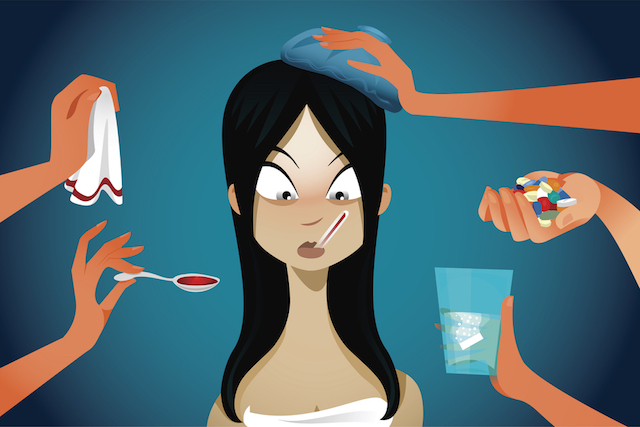
    Sick

    UPDATE: The winners for this giveaway include:

    • Naomi
    • KC
    • Lisa Pellegrino
    • Caroline Létourneau
    • Viktor Dmitriv
    • Kristin Kollinger
    • Heather S
    • Erica Lombard
    • Christine
    • Bridget Howe

    If you’ve ever been sick for a prolonged period of time, you understand how physically, mentally, and emotionally draining it can be.

    Maybe you don’t know what’s causing your illness, or how to treat it, and you’re tired of searching for answers.

    Maybe you blame yourself for repressing emotions, not exercising, or otherwise potentially causing your condition; or maybe you don’t hold yourself responsible, but fear that others do.

    Maybe you can no longer do the things you love; or maybe you can do them, but it’s much harder, and therefore, far less satisfying.

    While I’ve never struggled with a long-term physical illness, I’ve watched loved ones grapple with serious challenges; I’ve sympathized with their feelings, fears, and frustrations; and I’ve wished I could do something to help.

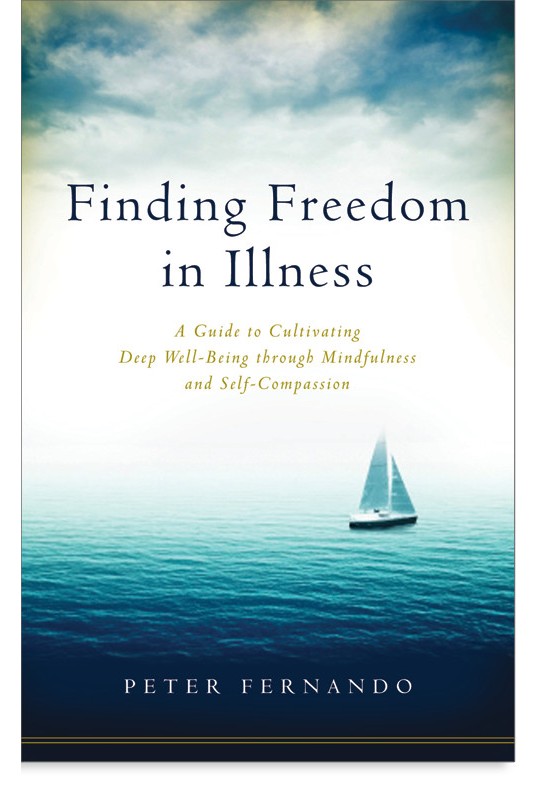
    Going forward, I will point them to Tiny Buddha contributor Peter Fernando’s new book, Finding Freedom in Illness: A Guide to Cultivating Deep Well-Being through Mindfulness and Self-Compassion. 

    Having struggled with various chronic illnesses through the years, Peter knows what it’s like to live a life that’s full of challenges and losses. He’s experienced prolonged periods of darkness, despair, desperation, and discomfort—and yet he still believes he’s lived a wonderful life.

    Why? Because he chooses to see his illnesses as spiritual teachers. And though he admits he would not have chosen them, he’s learned, through them, to free himself from the mental suffering that comes from judging the present.

    Profoundly insightful, Finding Freedom in Illness explores how anyone can free themselves from their suffering and access the liberating power of here-and-now awareness. Though the book is clearly intended for others dealing with physical conditions, anyone can benefit from the teachings related to mindfulness and self-compassion. I know I certainly have.

    I’m grateful that Peter took the time to answer some questions about his book, and that he’s offered ten free copies to Tiny Buddha readers.
    Finding freedom in illnessTHE GIVEAWAY

    To enter to win one of ten free copies of Finding Freedom in Illness:

    • Leave a comment below
    • For an extra entry, share this interview on Twitter or Facebook, and post a second comment with the link

    You can enter until midnight PST on Monday, May 9th.

    *Winners in the US will receive a print copy. Winners outside the US will receive a gift card to order a free digital copy.

    THE INTERVIEW

     1. Tell us a little about yourself and what inspired you to write this book.

    I’m a guy in his late thirties who was a Buddhist monk in his twenties. I’ve been living with various health conditions for most of my life, and bodily challenges have been a huge part of the path for me. I teach meditation in Wellington, NZ with Original Nature Meditation Centre, and run an online course, A Month of Mindfulness.

    The book arose of out conversations I had been having with other folks on the spiritual path, people who also have been living with illness—and a sense of the disorientation, distress, and confusion that can ensue when faced with such challenges and limitations. So, the main inspiration was wanting so share some love!

    On another level, my own situation has highlighted the difficulty in attending retreats or groups on a regular basis, and a need for a home-based practice that is tailored to the specific issues, emotions, and challenges that accompany the experience of being physically unwell.

    For example: When you can’t sit up for long periods of time, how do you meditate?

    When you are exhausted, how do you open your heart and find a real sense of kindness for yourself and others?

    When you are in pain, how do you find a place in yourself that is still okay?

    So I wanted to share some of the practices and perspectives I have developed through trial and error since my twenties, with the hope that they will be useful for folks in similar situations.

    2. I really appreciated your opening chapter, as I think a lot of spiritual people blame themselves for their physical ailments. Can you talk a little bit about the mind/body connection and the difference between taking responsibility for our part in healing and blaming ourselves for being sick?

    This subtle difference has and (continues to be) a central piece of living with illness, for me personally. The bottom line, I think, is don’t beat yourself up for being ill.

    Shame and guilt are so destructive and painful, and yet can easily follow theories of being absolutely responsible for being ill or healthy. Whatever makes you feel ashamed or guilty isn’t going to lead to well-being in the long run.

    From the perspective of the mind that wants to understand our illness (and of course, be as well as we can, on all levels), there is another key piece, for me: any belief is just a belief. It’s not experience.

    So the belief “I’m creating this illness—it’s my fault” is just an idea, right now. The belief “My mind has no bearing on the state of my body” is also just an idea.

    If there are certain mind-body connections that are contributing to our illness, they can only be known by us. Not through a theory, a doctrine, or even trying to mimic someone else’s healing journey. Of course, they are all useful as hypotheses, but not as fixed beliefs about what is going on.

    Awareness practice, on the other hand, takes us right into our own experience, where we begin to know directly what effects certain mind states have on the body, and what effects they don’t have.

    We become curious, and even innocent in our exploration. We don’t have to have a fixed belief in anything, which allows the tendency toward shame or self-blame to relax, and is also where the feeling of freedom begins to emerge. Curiosity and genuine interest in our mind, body, and heart, in this moment, is where the power lies.

    What the process of paying attention reveals about the mind/body connection is different for everyone. There may be one, and there may not be—that’s just how it is.

    Many enlightened teachers have died following long illnesses, such as the teacher of my teachers, Ajahn Chah. Many uptight and stressed out people live physically healthy, outwardly successful lives.

    So the only touchstone for what is real is our own experience, our own body-mind, in the intimacy of awareness. No shoulds, no guilt-trips, and no identity of being a failure. To me, that is what taking responsibility is about.

    3. How does mindfulness help us cope with physical illness, and what’s a simple mindfulness practice anyone can do daily?

    Mindful awareness helps us cope in every way possible! Without being aware of our reactions to pain, loss, social isolation, or fatigue, those reactions will take over.

    When we are aware of what is happening in the present moment, with an embodied awareness, there is a natural inclination to abide in states of being that feel good, and to relax those that don’t.

    If we don’t see them, they take on a life of their own and can become our entire identity, rather than the momentary arising of emotion or perception that they actually were.

    A simple practice I do daily is to stop, close my eyes, and take stock of what’s going on in the mind and heart, for five minutes. No agenda or desire for a specific outcome—just a real curiosity.

    I ask, “What am I doing, right now, in my heart?” And then, “Is this kindness to myself, or is it something else?”

    This is the gateway to authentic mindfulness, in my opinion. To me, an open, kind heart is an essential part of mindful awareness. Attending to its presence or absence goes a long way in tracking the quality of the mind throughout the course of a day.

    4. In chapter 3, you talk about the stories our minds tell us about the present, the past, and the future. Can you elaborate a little on these stories, how they keep us stuck, and how we can start letting them go?

    The word “stories” is a kind of shorthand to refer to the psychological narratives that arise in the mind’s eye, with regard to “Who I am, what others think of me, what I will be, what I was,” and so on.

    They are the first indicator of underlying heart-drives or emotions that are stirring in us. It’s important to say here that the word doesn’t refer to functional stories, which we need to survive. These are useful, when imbued with creativity and wellness of heart.

    Our psychological narratives, on the other hand, are habitual and don’t come from a sense of choice—they are knee-jerk reactions, often with deep historical roots, that take us into some form of stress, suffering, or emotional stuck-ness.

    The habitual, seemingly out-of-control nature of these is their defining characteristic. Starting to let these go is a process that requires sensitivity and patience, in my experience. It’s easy to say, “Just be present,” but to actually do it requires a journey into our own heart. Otherwise, it can become dissociation or avoidance, which doesn’t lead to well-being.

    For me, there are always three stages to the process. The first is mindfulness: seeing what is happening, with objectivity, rather then being caught in it. It’s a kind of stepping back. We realize we can see the mind, not just be caught in it. This is the miracle of mindful awareness, really.

    But seeing a story is one thing. Freeing attention from its grip is another. So the second part of the process is a receptive awareness, feeling how the energy feels in the body.

    This is more than seeing—it’s sensing, which requires a kind of awareness we may not be used to. So we can begin experimenting with it.

    When we feel what’s going on, we can then pan out to recognize that a story is just the branches of a core root feeling.

    For example, the story “I’m going to have a terrible time seeing my friends tomorrow” could just be the root energy of fear. Knowing it as such makes the story seem less personal, and we recognize that these are forces at work in the present, not realities that will happen in the future. It’s all happening now.

    The third stage in the process is relaxation. When we feel the root of a story we can consciously incline toward relaxing around it. Relaxation is another word for letting go. When we relax around an emotion or an energy, it begins to calm. It also has less power to solidify into a full-blown story. We find we can be with instead of be in. Life frees up as a result.

    5. In chapter 4, you wrote, “openness is courage.” Can you expand on this?

    Being open to what is here is perhaps what is most scary for us as humans, I think. Our lives are geared toward distraction, intellect, and ideas—so much so that sitting somewhere without checking our phone, for example, can feel disorienting and uncomfortable.

    It feels uncomfortable and scary because it means being open to what is actually here—including the body and mind and emotions, just as they are. So cultivating that ability is a courageous act.

    When it comes to illness, the stakes are even higher. We’re not just cultivating an openness to “boring life as it is,” but very often to unpleasant sensations, depleted energy, and physical pain.

    Trusting that our own compassionate awareness can meet that, too, is always an act of courage. Sometimes we just can’t, which is okay. And sometimes it’s just not the right thing to do—especially if it heightens the discomfort in the body or the stress in the mind.

    But when we feel resourced enough to rest in awareness, and be with the pure experience of this moment, we gain vistas into new worlds of possibility. If we remain there for a period of time, we may be surprised by a quiet sense of peace and ease that begins to emerge.

    6. In the section on meeting our dark emotions, you wrote that we need to stop judging anger, fear, and despair as “bad.” What do you think is the key to embracing these feelings without getting lost in them?

    Oh, good question! It’s a fine line isn’t it? For me it always comes back to the Buddhist maxim of the “Middle Way”: that poise in the middle of indulging in destructive emotions on the one hand and repressing them on the other.

    My tendency has been more toward the latter, so learning how to actually feel and un-shame them has been a big part of my own journey. However, if one’s tendency is to feed them, get lost in them, and rail against illness, some discernment and wise discrimination can be really useful.

    But most of us have a default setting that judges dark emotions and tries to push them away, to some extent. We believe this is what being “strong” means.

    From the meditative perspective, we are looking for strength in presence, not just strength of will, however. When presence, grounded in the body, meets a force like anger or fear, there is a transformation that can happen. Through not indulging the story, and not trying to push the energy down, we feel what is here, as just so.

    In Buddhist teachings, this is the essence of the third foundation of mindfulness—mindfulness of the heart. Through this poise, the primal energies of dark emotion begin to dissolve, and transfer their energy back to our core presence. They relax and calm without being pushed away. It’s an alchemy of sorts.

    Of course, sometimes we need to push them away temporarily, just to function. The above isn’t an absolute statement about what we should always do.

    But when we gradually train ourselves in the skill of meeting dark emotions as just so, and feel them in the body, we discover a new place in ourselves that can handle their intensity without resorting to self-judgment. This makes living with illness much easier in the long run, in my experience.

    7. Why do you think so many of us deny ourselves rest when we’re drained or unwell, and what mental shift do we need to make to start taking care of ourselves in this way?

    I think it’s something to do with the way we are conditioned to value ourselves. Modern society puts most value on doing, achieving, and “being somebody,” it seems, and very little on “just being.” So we get hooked into it.

    Rest means relaxing an identity of being useful or productive, which can be scary. If our identity is entirely dependent on value-through-doing, then it can feel intolerable to really rest and take care of ourselves. We believe it’s lazy, or self-indulgent, or that we are a failure and there are other people somewhere out there judging us.

    From the perspective of inner well-being and harmonizing with the limitations of our physical condition, however, we can find a different way of viewing conscious rest.

    On the level of the body, it just feels good, so that’s one thing. On the heart level, we realize that it actually reminds us of our real value rather than takes us away from it.

    Our deepest value is just in being us. When we feel that in our hearts, and relax the need to prove ourselves, be approved of, or the opposite sides to that coin, then paradoxically, a new kind of value emerges. It’s one that feels peaceful and meaningful through just being here.

    When we get a sense of that, it becomes much easier to feel confident about consciously resting.

    There’s always a bit of friction involved in changing gears, particularly if our lives are very busy, but it lessens the more we can tune in to the deeper kind of value that comes through letting go of the need to always be someone doing something useful. And weirdly, when we do that, energy to do useful things, within our capacity, often comes back quite naturally.

    8. Can you tell us a little about the difference between pain and suffering, and how we can suffer less?

    Well, that’s a huge topic, with a lot of subtlety involved, I think. For myself, the Buddhist teaching around the difference between painful or unpleasant sensation in itself, on a sensory level, and the existential dis-ease that usually accompanies it, has been very potent.

    Basically, the teaching says that they are two different things. We tend to think they are one in the same, but when we attend carefully and with sensitivity, we begin to notice that while physical pain or discomfort very often conditions suffering in the heart, it doesn’t ultimately have to. So, it’s a freeing teaching.

    It doesn’t mean liking pain, though, or trying to be fit into some kind of equanimous ideal where we never suffer in the face of it. As an ideal, that doesn’t go very far.

    The journey to suffering less around pain involves meeting exactly what is here, including our reactions to it. But by being curious about them, we discover how to relax the heart-contraction around pain.

    Very often, relaxing the contraction (and the stories, judgments, self-images, or predictions that come with it) can lead to more space opening up in our awareness. In this space, physical pain doesn’t have the same hold over the mind. We suffer less.

    9. It’s easy to get down on ourselves when we feel we’re not at our best. What has helped you stay out of this trap?

    Well, it’s a trap I am very familiar with, and definitely not free of! But it’s something I have gradually learned to relate to rather than be completely identified with.

    For myself, self-compassion has been the guiding light in this regard. I first used it as a concept, which, in itself, was very powerful. It’s a radical shift from the default position of inner-tyranny many of us live within. On the conceptual level, it takes a bit of reflection to come alive.

    I remember feeling like it was indulgent or selfish to be compassionate with myself, in the beginning. But it slowly started to make good sense, particularly when I saw directly that it actually increased my ability to relate to others in the same way.

    Then on the heart level, it’s been a cultivation—creating space around the identity of the me who is “wrong” in some way, and really holding that sense with a sense of great warmth and kindness.

    In this space, I began to feel what tyrannical mind actually does in the present moment: it generates pain. Compassion began to arise when I started being aware of this pain in a very direct but tender and patient way.

    It started to teach me. It was like, “Oh, okay. When I hold on to these self-images, this is the result. Wow—that’s really painful. Maybe I could start to relax that?”

    So the heart began to learn, naturally, when I took the time to bring awareness to bear upon what often seemed so real and true that I never questioned it.

    10. What’s the main message you hope readers take from this book?

    I think the main message I would like to communicate is that being physically ill doesn’t mean we can’t have a rich inner life. There are ways of living with the limitations of illness that can open us right into the magic of this existence.

    We don’t need to feel like we’ve failed, we are wrong, or there is no hope. The real treasures are right here underneath the surface—for all of us, healthy or not.

    FTC Disclosure: I receive complimentary books for reviews and interviews on tinybuddha.com, but I am not compensated for writing or obligated to write anything specific. I am an Amazon affiliate, meaning I earn a percentage of all books purchased through the links I provide on this site. 

    You can learn more about Finding Freedom in Illness on Amazon here.
  • Overcoming Disappointment in Work, Love, and Life (Book Giveaway)

    Overcoming Disappointment in Work, Love, and Life (Book Giveaway)

    Disappointed

    Update – The winners for this giveaway are:

    • simpleshoes
    • twylapopcorn

    When life doesn’t meet our expectations, it can devastate our sense of security, threaten our self-esteem, and leave us feeling lost, scared, and out of control. I know—I’ve been there quite a few times before.

    Like the time I moved across the country to live with a man I’d met online just a month prior, only to recognize nine months later that we were two broken people who were toxic together.

    Or the time I got involved with a multi-level marketing company, thinking I’d be a huge success, only to realize six months later I’d invested myself (and my savings) in a pyramid scheme.

    Or when I left LA with my fiancé, thinking we’d be able to live on two coasts near both of our families, only to realize after three years in limbo that we couldn’t make it work.

    When things don’t go to plan, we feel out of control, angry with ourselves, and possibly with others. We wonder what we could have done differently and if we’ll ever be happy, now that the thing we pinned all our hopes to hasn’t worked out.

    Author Christine Hassler knows a thing or two about dealing with these kinds of life-shattering disappointments.

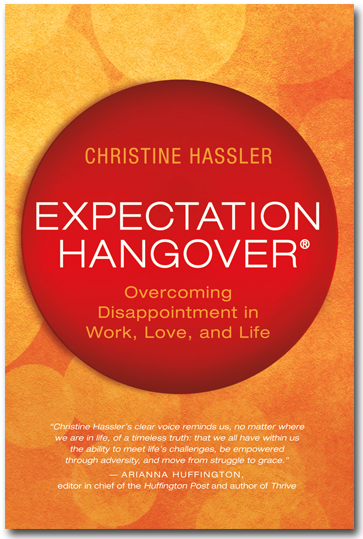
    In her new book Expectation Hangover: Overcoming Disappointment in Work, Love, and Life Christine addresses how to deal with disappointment on the emotional, mental, physical, and spiritual level.

    If you’re disappointed, maybe even devastated, by unmet expectations in your personal or professional life, you’ll likely appreciate the insight, wisdom, and practical exercises that pepper her book.

    It will help you reframe what’s happened and empower yourself to thrive, not in spite of your struggles, but because of them.

    I’m grateful that Christine took the time to answer some questions about her book, and that she’s offered two free copies of Expectation Hangover to Tiny Buddha readers.

    Expectation HangoverTHE GIVEAWAY

    To enter to win one of two free copies of Expectation Hangover:

    • Leave a comment below
    • For an extra entry, share this interview on Twitter or Facebook, and post a second comment with the link

    You can enter until midnight PST on Monday, May 2nd.

    *US winners will receive a physical book in the mail; winners outside the US will receive an eBook.

    THE INTERVIEW

     1. Tell us a little about yourself and what inspired you to write this book.

    My own expectation hangovers and work as a life coach, spiritual counselor, author, and teacher inspired me to write the book.

    I noticed people’s greatest suffering happens when their realities don’t match up with their expectations and/or when life throws them an unwanted curveball that leaves them with what I call an “expectation hangover.”

    Most of us want to get over disappointment ASAP, but we often miss a big opportunity for positive change with that approach. What expectation hangovers offer us is a way to become more responsible for our own lives.

    Disappointment isn’t a bad thing, or even something to be avoided. In fact, my greatest disappointments have lead to my greatest successes.

    Today I am grateful for all my expectation hangovers, from leaving my successful career as a Hollywood agent at twenty-five to being in debt to health issues to my divorce, and inspired to teach people how to leverage their expectation hangovers!

    2. How do you define an expectation hangover?

    An expectation hangover is the myriad of undesirable feelings or thoughts present when one or a combination of the following things occurs:

    • A desired outcome does not occur.
    • A desired outcome does occur, but does not produce the feelings or results we expected.
    • Our personal and/or professional expectations are unmet by ourselves or another.
    • An undesired, unexpected event occurs that is in conflict with what we want or planned.

    Some examples:

    • A career path that was planned and executed with precision becomes tainted with doubt and lackluster.
    • A relationship with “the one” suddenly becomes the one thing we can’t get right.
    • A salary or promotion that was counted on is not a reality.
    • A home that was dreamed about still remains a fantasy.
    • A pregnancy that is wished for isn’t happening.
    • A parent who we could always lean on suddenly isn’t there anymore.
    • A lover or spouse leaves.
    • An illness interrupts our life.
    • A job and the financial security that came with it is gone.

    And then there are expectation hangovers that are more spiritual in nature that happen when we have checked off everything on our life checklist and still experience a lack of fulfillment.

    The symptoms are similar, but far more miserable and lasting, to those caused by a hangover from alcohol: lethargy, depression, lack of motivation, confusion, denial, anger, poor work performance, diminished creativity, strained relationships, social withdrawal, low self-esteem, regret, and a disconnection from a higher power.

    While suffering from an expectation hangover, we are typically caught up in regretting the past or latching on to something we think will make us feel better. We’d do anything to end our suffering—the problem is we just don’t know what that is.

    Expectation hangovers usually fall into one of the following three categories:

    Situational Expectation Hangovers 

    These occur when something does not turn out the way we wanted or we do not get the anticipated satisfaction from achieving a result.

    Interpersonal Expectation Hangovers

    This kind of expectation hangover occurs when we are let down by someone else or unpleasantly surprised by the actions of another.

    Self-Imposed Expectation Hangovers

    These occur when we do not live up to the standards or goals we have set for ourselves. In other words, we are disappointed in ourselves and the results we’ve achieved or failed to achieve.

    3. What are some of the most common unhealthy ways we cope with expectation hangovers, and what are healthy ways we can begin to treat an expectation hangover?

    It takes a lot more than two aspirin, some greasy food, and staying inside with the lights low to treat an expectation hangover! Because we don’t like feeling bad, we look for an external way to ease the discomfort.

    Rebound relationships; abrupt career changes; miscalculated risks; “over-ing” in the form of drinking, gambling, sex, drugs, work, or shopping so much so that it becomes an addiction; and numbing oneself with something like television are common.

    The first step to treating your expectation hangover is to get yourself out of any kind of victim thinking.

    “Why is this happening to me” is the wrong question to ask. Ask instead, “What am I learning? and “How is this happening for me?” That simple shift in questioning will rescue you from sinking into the quick sand of victimhood and hopelessness.

    Next, keep your mind out of judgment, regret, and shoulda/coulda/woulda thinking. Remember, you did the best you could. You didn’t do anything wrong. Your worth and value are not attached to anything or anyone external.

    Security from any outside source is an illusion—your ultimate “safety” is in love. Surrender is much sweeter than being addicted to control. And again, you didn’t do anything wrong. Really, you didn’t, and neither did anyone else.

    Which brings us to the next step—to forgive. Forgiveness does not mean you condone or agree with what happened or didn’t happen. It means you are in acceptance and letting go of judgments you are holding toward yourself or anyone else.

    4. You talk about “spiritual bypasses” in Chapter Two—immediately jumping to the blessings of a disappointing situation. How can this be harmful? 

    It can be harmful because we may miss an opportunity for healing and change on the emotional, mental, and behavioral levels.

    Yes, every situation has a blessing, and a lot of time that blessing can come in the form of a lesson. If we do not pause to ask, “What am I learning?” and immediately skip to finding the silver lining, we miss out on a deeper opportunity.

    Spiritual bypass also skips the emotional level. We are humans and we feel. It is natural to feel sadness or anger in response to an incredibly challenging situation. Not allowing ourselves to feel can lead to suppression in the disguise of being spiritual.

    To me, part of being spiritual is also welcoming and having deep compassion for the human experience. Spirituality is not just about being positive; it’s about being raw, real, and vulnerable with what we are authentically experiencing.

    5. How, exactly, can we leverage our expectation hangovers for growth and fulfillment?

    Instead of continuing to feel emotionally hungover, you can break the cycle and use those tough times as a catalyst for change.

    That’s not to say you can’t grieve over a loss or express disappointment: Allow yourself to be human, don’t judge yourself, and don’t feel like you need to “fix” things right away. But when life throws you a curveball, you can learn from it and ultimately grow from it.

    Here are three common scenarios that I have seen—and have experienced myself—and how to cope with each.

    A Relationship Ends

    First of all, realize that no one else can be the source of your happiness. The post-breakup period is an important time to work on yourself rather than outsource that responsibility to someone else.

    Second, take off the rose-colored glasses. A lot of people put their past relationships on a pedestal. But if a person breaks up with you, you don’t want to be with that person. And we know it’s tough, but you should stop all contact with your ex (unless you have children together).

    Relationships have expiration dates, just like the yogurt in your fridge. Women tend to have these expectations that we are meant to meet someone, be chosen, be proposed to, and when that doesn’t happen, we feel like a failure. But that’s not true—you learned what you were supposed to learn from that person, you didn’t do anything wrong; it was just meant to end.

    And remember: A breakup is always a transformational door that opens to improve yourself and nurture your spirit.

    A New Job Isn’t All It’s Cracked Up to Be

    At twenty-five, I had climbed the ranks in LA’s entertainment industry, ending up in a big job with a big office, an assistant, an expense account, and power lunches. But I was miserable every day, and finally I quit, and eventually discovered my passion as a life coach.

    Ask yourself: If I don’t feel like my work is meaningful or it’s not making me feel the way I want to, how can I change it? It’s in your power to redirect your thoughts and action.

    Take someone who works at Starbucks: They could hate the drudgery of it and the early hours, or they could appreciate the aroma of coffee and the fact they get to connect with people all day long. It’s all in the way you look at that, and you need to be proactive about it.

    You’re Not Reaching Your Health Goals

    If you’re trying to lose weight, you know how frustrating it can be when the scale doesn’t budge, or you skipped your workout (again). To overcome this pessimistic mindset, be mindful of the “story” that you’re telling yourself.

    When people try to lose weight, they tend to have a negative self-image. They’re eating right and working out, but their negative self-talk is still weighing them down. Plus, a big part of losing weight isn’t only physical—you have to heal your heartache or emotional baggage before you can make other physical changes, she notes.

    There is also an entire section in the book called “Quick-fixes that work” in terms of preventing disappointment, so I’ll share my two favorites:

    Don’t go to a Chinese restaurant when you are craving nachos.

    In other words, be realistic about your expectations of others. Too often we expect people to act the way we desire or the way we would in a situation, when they are just not capable or willing. Period. End of story. You can’t change them. When we understand we cannot change people, and accept them rather than expect something from them, we prevent expectation hangovers.

    Gorge on gratitude.

    Expectation hangovers happen when we pay too much attention to what is either not happening at all or not happening in the way we’d like it to.

    When we shift our focus to the amazing things in our lives—people, health, a place to live, and all the unexpected wonderful surprises the Universe delivers on a daily basis—we move out of a lack-mentality and into an abundant view of the world

    6. Can you elaborate a little on how disappointments can actually be blessings in disguise?

    Often life has to throw us a curveball (or several) so that we look in a different direction. The problem becomes when we desperately try to dodge the curveball, attempting to get out of feeling uncomfortable, and we miss the lessons that are available to us.

    If things are not turning out like you had planned or want them to, that is actually really good news. The Universe has a better idea in store. But first you have to let go of the plan you have been attached to so that your Higher Self and the Universe can conspire for you.

    Instead of thinking about how to treat an expectation hangover, consider how you can leverage it. This goes back to what I mentioned before—ask yourself, “What am I learning?” rather than “Why is this happening?”

    Think about some of the most inspirational people you know. I guarantee you that part of what makes them so inspirational are the expectation hangovers they have been through. They leveraged their hangovers for their growth and learning. Instead of trying to snooze through the alarm of disappointment, they woke up!

    Your expectation hangovers are gifts. Each one has been an opportunity to let go of something external that you have clung to for worth, safety, or love.

    I really get that disappointment is not at the top of your wish list. However, if you learn how to respond to expectation hangovers from the perspective of a student rather than a sufferer, I 100% guarantee you will walk through doorways of transformation that will lead you to more love.

    FTC Disclosure: I receive complimentary books for reviews and interviews on tinybuddha.com, but I am not compensated for writing or obligated to write anything specific. I am an Amazon affiliate, meaning I earn a percentage of all books purchased through the links I provide on this site. 

    You can learn more about Expectation Hangover or grab a copy on Amazon here.

  • Clear Your Emotional Clutter and Open Up to Joy (Interview and Giveaway)

    Clear Your Emotional Clutter and Open Up to Joy (Interview and Giveaway)

    Woman Jumping

    UPDATE – The winners for this giveaway are:

    • C
    • Lori Pacheco

    When I was in my early twenties, I spent three months in a residential treatment center in a last-ditch effort to heal from depression and bulimia. Among many different treatment modalities, I participated in an experiential therapy that involved a ropes course and other adventure activities.

    One day, along with a dozen other frail women, I strapped a backpack full of tennis balls on my back and climbed to the top of a rock wall. It was hard enough to walk on some days; getting to the top with what felt like ten cats clinging to my back took everything I had in me.

    It was only when I completed the task, exhausted, that I understood the point of this draining exercise.

    Our therapist then instructed us, one by one, to open our backpacks and toss each ball down to the ground, naming each an emotion that had caused us pain.

    “This is my shame,” I yelled. “This is my anger. And this is my self-loathing.”

    This metaphorical emotional unloading, combined with the energetic release that often follows extreme exertion, brought me a lightness of being that I’d never before experienced.

    I had lived my life like the climb up that wall—weighed down by my emotions—and I had a glimpse of what it felt like to be free of them.

    Still, while the exercise was liberating, I didn’t know how to recreate that feeling of emotional freedom in my everyday life.

    Years later, I learned that mindfulness could provide the peace I desperately craved. I learned that I could fully embody the present moment, and see the people and things right in front of me without filtering them through my fickle emotions. I learned that I no longer had to live trapped inside a mind that constantly bombarded me with disempowering stories about my painful past.

    No one has to live that way. And the good news is, clearing that “emotional clutter” doesn’t require a daily trip up a rock wall.

    We can all overcome our toxic patterns and find freedom from the old pains and traumas that have weighed us down. Mindfulness is the key, and anyone, at any age, in any circumstances, can learn to practice it and reap the benefits.

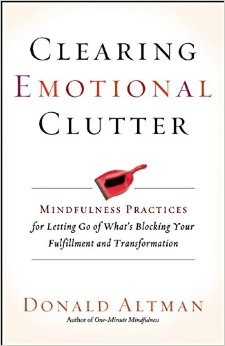
    In his new book Clearing Emotional Clutter: Mindfulness Practices for Letting Go of What’s Blocking Your Fulfillment and Transformation, author Donald Altman combines modern neuroscience with ancient practices to show how habits and patterns can be modified with only a few minutes of attention daily.

    It’s a powerful book that can hep anyone release their emotional pain to find happiness, fulfillment, and peace.

    I wish I’d found this book, and these practices, years ago, as they truly are life-changing.

    I’m grateful that Donald took the time to answer some questions about his work and his book, and that he’s offered two free copies for Tiny Buddha readers.

    Clearing Emotional ClutterTHE GIVEAWAY

    To enter to win one of two free copies of Clearing Emotional Clutter:

    • Leave a comment below
    • For an extra entry, tweet: Enter the @tinybuddha giveaway to win a free copy of Clearing Emotional Clutter http://bit.ly/1SLXcyB

    *US winners will receive a physical book in the mail; winners outside the US will receive an eBook.

    THE INTERVIEW

     1. Tell us a little about yourself and what inspired you to write this book.

    Mindfulness has helped me immensely in my life. I got on this path when I was going through a difficult life transition and found myself repeating an old, toxic pattern. It’s that idea that wherever you go, your problems always follow you. That is, unless you do something about it!

    Around that time I met a Burmese Buddhist monk—the Venerable U. Silananda—who had been teaching mindfulness in the U.S. since the 1970s. He possessed a palpable sense of compassion and availability that made me ask the question: How does someone become like that?

    When I had the opportunity to ordain with him as the head of the monastery, I jumped at it. Although I was in the monastery for a short period of time, it was an experience that changed my life direction because I was primed and ripe for the experience of looking inward.

    I wrote my first spiritual book while at the monastery, and continued to train with one of the monks afterward. I’m very grateful for the transformative experience the monks provided for me, which helped me nurture greater compassion and connect with my purpose. Now, my writing is focused on helping others find joy and fulfillment.

    Clearing Emotional Clutter is an important book for me because it integrates cutting edge brain science and research with the ancient practice of mindfulness. It shows that you don’t have to go into a monastery to transform your life, overcome past negative clutter, and rewire your brain.

    2. How do we accumulate “emotional clutter,” and why do we need to clear it out?

    No one can control what happens in life. There are losses, aging, and challenges throughout every stage of life, not to mention the daily wear and tear of stress. What we can do is to respond skillfully by not letting the emotional clutter pull us into states of dis-ease and unhappiness.

    By clearing out clutter, we can transform even difficult moments and respond to life in a way that helps us find the inherent joy that is present.

    3. You talk about getting off the emotional elevator. What do you mean by that?

    You can think of your emotions like an elevator that takes you up and down. What moves the elevator? What old programs are running in your head that push the buttons on your elevator to that it moves you up and down? Something good happens in your life and the elevator goes up. Something bad—even a perception of something being bad—and the elevator shoots down. But what if you could control that yourself?

    This book helps you decide who and what you are going to let push your emotional elevator buttons. Letting others push our mood elevator buttons can be exhausting. We’re not in control of our own elevator. Clearing away clutter means you get free from old emotional clutter programming and ways of thinking.

    4. In Chapter Two, you introduced a tool called “Inner-Facebooking.” Can you elaborate a little on this and share an example of how it’s helped you personally?

    Facebook is a wonderful way to post and put up for others what’s happening in our lives. In the same way, we are constantly putting up mental posts in our minds—through our thoughts and beliefs—that represent a kind of second Facebook: An Inner-Facebook, which shapes how we experience the world, ourselves, and others.

    If your Inner-Facebook posts are unhappy and unflattering, no wonder you feel bad and depressed. I have a whole chapter about noticing your Inner-Facebook posts so you can be more aware. Inner-Facebooking is a skill that helps you to emotionally regulate. Then you can change your Inner-Facebook posts to be more positive and accurate.

    Personally, I’ve gotten better at noticing my own inner-Facebooking posts. For example, my luggage was lost when traveling recently. But rather than respond to the highly reactive and anxious thoughts that my mind posted in that moment, I was able to step back and make a new, more realistic and helpful post that said, “My luggage is going to be found. Besides, in the big scope of things, losing my luggage isn’t that big a deal.”

    5. In Chapter Four, you wrote, “Much of the clutter of discomfort, discontent, and conflict that we experience in life comes from our unwillingness to accept things as they are.” I think we often equate acceptance with giving up. How can we simultaneously reduce the clutter of resistance while working to make positive changes in our lives?

    Acceptance is about realistically viewing your situation. It’s about surrendering to the truth that you may not have control over the situation. You recognize that it is what it is. That does not mean you are giving up. Submission, on the other hand, is about giving up.

    Acceptance allows us to surrender to the truth of our situation. So, if you’re frustrated at being caught in a traffic jam on the freeway, for example, you can have acceptance of what you’re experiencing instead of fighting with it. This means that you can then move forward in a more realistic and effective way instead of getting all stressed out and carrying the experience with you throughout your day.

    6. You devoted an entire chapter to “family emotional clutter.” How do we accumulate this type of clutter, and how does it negatively impact our lives?

    In my workshops I always ask, “Does anyone here have a difficult person in your life?” Everyone raises their hands.

    Family emotional clutter can negatively impact our future relationships and how safe we feel around others. If you’ve had negative relationship issues that have been a pattern in your life, that’s a sign you need to work on that clutter. Repairing this will lead to more loving, healthy, fulfilling, and secure relationships.

    7. What’s one thing we can do to begin releasing “family emotional clutter” to avoid these negative consequences?

    First, we can recognize that all people have suffered, even that person in your family who may have mistreated you. In fact, your family’s suffering may go back centuries. So, rather than feeling permanently victimized, it’s important not to pass on the wave of suffering in your family, and to know that you can heal.

    I believe that we can get a new brain download by finding benefactors in our lives. We can learn how to attune and alter our brain’s social and emotional rewiring. It’s a helpful process that I describe in one of the Lifestyle Tools found in Clearing Emotional Clutter.

    8. You talk about friendships as a tool to release emotional clutter. How and why can our relationships help with this, and how can we help other people release their emotional clutter as well?

    Research shows that having friends is the key to a happier life. The three seeds that make friendship grow and mature are the seeds of trust, acceptance, and empathy.

    Trust is essential, and that takes time to develop, so you need patience and real mutuality in a relationship.

    Acceptance means not being so demanding. It means accepting that everyone has flaws. Sometimes you need to let things to as a foundation for friendship.

    Lastly is empathy. Empathy is what lets you really feel connected to a friend. Develop these and you’ll develop friendship.

    9. In the chapter devoted to listening, you shared an acronym, HEAR, that can help us keep our emotional clutter out of conversations and “enter a more spacious and less defensive awareness.” Can you tell us a little about that and how it helps?

    Talking can be clutter that sometimes blocks understanding and deeper meaning. If we are to remove clutter in the moment, we need to be present with all our senses, especially listening. This acronym is designed to help us when we’ve stopped listening—like during an argument, or when we’re feeling defensive or caught up in our own opinion. It goes as follows:

    H- Hold all assumptions. Empty your ego and get curious. Set your personal beliefs and assumptions aside for a few minutes and take a more objective perspective as you listen.

    E- Empathy to engage, not enrage. With empathy, you can enter the emotional world of the other person so you can understand them better rather than try to deny or devalue what they are feeling.

    A- Absorb and accept. Understanding, with openness. Let in the ideas of the other person. Acceptance doesn’t mean you have to agree, but that you can accept this is the other’s belief.

    R- Reflect, then respect. Take time to pause before you respond. Take a step back so that you can think about what you’ve heard. Then, respond respectfully and with kindness.

    10. In Part 3 of the book, you explore ways to prevent new emotional clutter. What’s one practical thing we can all do daily to de-clutter?

    I especially like the idea of being faithful to this moment. You can be 100% committed to whatever you are doing. Uni-task, so you are fully present with this moment. This means fidelity to the breath, to walking, to eating, to working. Whatever you are doing, you can do so fully, without your mind being one place and your body being someplace else.

    That means that when you walk, walk. When you eat, eat. When you drive your car, drive. Cut down on the distractions and do one thing fully. In this way you can appreciate and savor even the most ordinary moments and that “in-between” time that is an important part of our days and lives.

    You can read more about Clearing Emotional Clutter on Amazon here.

    FTC Disclosure: I receive complimentary books for reviews and interviews on tinybuddha.com, but I am not compensated for writing or obligated to write anything specific. I am an Amazon affiliate, meaning I earn a percentage of all books purchased through the links I provide on this site. 

    Woman jumping image via Shutterstock

  • Discover Your Emotional Age: Heal Yourself & Change Your Life (Interview & Book Giveaway)

    Discover Your Emotional Age: Heal Yourself & Change Your Life (Interview & Book Giveaway)

    The Emotional Edge

    Update – The winners for this giveaway are:

    • Toni Nash
    • Katherine Poff

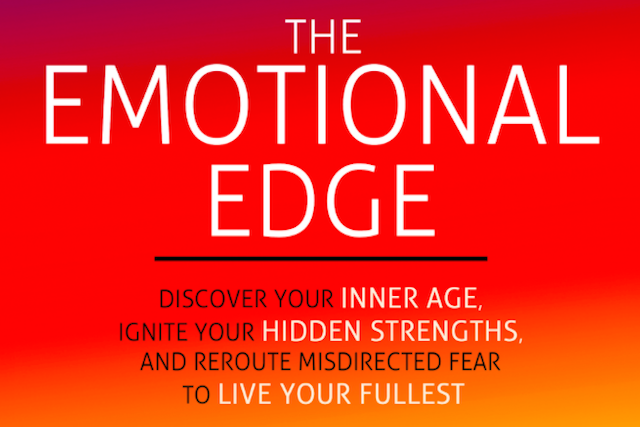
    When I first discovered Crystal Andrus Morissette’s new book The Emotional Edge, I was intrigued. I knew the book would offer a process for discovering our “Emotional Age,” a term that was new to me, but I didn’t realize it would provide a powerful roadmap for healing the wounded parts of our psyche and growing into our most empowered, authentic self.

    From the Amazon page:

    The Emotional Edge empowers you to stop reacting in knee-jerk ways that hurt and instead start expanding your life to become the greatest expression of you possible. Once you know your Emotional Age, you can take any needed steps to become an authentic adult so you stop giving your power away.

    You’ll learn:

    • Whether you’re a Parent, Child, or Adult ‘archetype’—take the Emotional Age Quiz and find out
    • When you’re inadvertently sabotaging yourself and why
    • How to channel fear and anger into courage and willingness
    • How to change your communication scale and style from passive or aggressive to assertive, accepting, and ultimately peaceful
    • Methods for fine-tuning into your unique needs mentally, emotionally, and physically
    • Ways to live your best life without guilt, shame, or blame
    • And lastly, how to rewrite and re-route your relationship, work, and bliss paths

    Never feel like a victim of circumstance, genetics, or your past again. Instead of letting your emotions get the best of you, now it’s time to get the best of them!

    Fascinating and insightful, The Emotional Edge brings you on a journey of self-discovery and offers the tools to help you break your unhealthy patterns and show up differently in the world.

    Since Crystal provided incredibly detailed responses to my interview questions about her work and her book, I’m going to keep this introduction brief and get right to them. But first…

    The Giveaway

    To enter to win one of two free copies of The Emotional Edge:

    • Leave a comment below
    • For an extra entry, tweet: Enter the @tinybuddha giveaway to win a free copy of The Emotional Edge http://bit.ly/1RDtEa2

    You can enter until midnight PST on Monday, April 11th.

    The Interview

    Trigger warning: this section mentions sexual abuse, which may be triggering to some people.

    1. Tell us a little about yourself and what inspired you to write this book.

    I’m a happily married Canadian woman with two spectacular daughters (who are now nineteen and twenty-one), a wonderful husband, and a thriving business as the founder of an international coaching institute, exclusively for women.

    I’ve written four books and I live a blessed life out in the country. But things weren’t always this peaceful, happy, and successful . . .

    I left home at fifteen after experiencing a series of devastating events: my parents’ turbulent divorce, when I was twelve, when my stay-at-home ‘Christian’ mother became a promiscuous party girl and fitness competitor who invited far too many men home. My father moved away to a new city and never seemed to worry or wonder where I was anymore.

    This is when my life turned upside down: I was sexually abused almost immediately by my mother’s new twenty-four-year-old boyfriend; stranger-raped at fourteen at my first high school party; and then raped nightly by the father of the children I was sent to take care of (to be ‘the nanny’) at age fifteen. I only stuck around for a few months before heading out on my own.

    By seventeen, I’d found out I had the early signs of cervical cancer and the HPV virus. It would take two years for the cells of my cervix to stop turning against me.

    The bad luck, so to speak, followed me into my twenties, where I experienced a traumatic head injury at age twenty-one that fractured my skull, ocular, and cheekbone and damaged the nerves in the right side of my face. This injury would later cause abnormal activity on my left temporal lobe, which left me with seizures.

    But it wasn’t until I had my own daughters in my mid-twenties and I gained over 100 pounds that I knew I had to look at myself, my life, and my inability to properly protect myself.

    I had to heal myself and my legacy to make sure my daughters didn’t go through the suffering that I did. (We know now that ‘epigenetic programming’ messes up the DNA of children of wounded mothers.)

    I needed to be the mother I needed in order to give my daughters a great start in their own lives.

    It was then I began looking at the concept of Emotional Age (EA) and how I was showing up in the world.

    2. What does “Emotional Age” mean, and why is it important that we each discover our own?

    Emotional age is a similar concept to biological age. But rather than predicting how young or old our physical bodies are, emotional age helps us understand how empowered or disempowered we are emotionally. It helps explain how we’ve been communicating, compromising, socializing, and interacting with others.

    Discovering your own emotional age is the most important step in improving your relationship with yourself, your life (health, wealth, etc.), and your relationships.

    When I was heading in my late twenties (now nearly twenty years ago), I began working exclusively with women.

    As I mentioned, I had gained over 100 pounds during my pregnancies, which was very hard coming from a ‘body beautiful’ background. (I’d previously competed in fitness shows such as the Miss Galaxy and was a Registered Holistic Nutritionist and Fitness Specialist.)

    It was then that I started doing a lot of work around the idea of ‘weight gain as protection’ rather than focusing on food/calories, which led me to the concept of emotional age.

    I began to pay close attention to patterns in the way people treated themselves and others. I noticed how their emotions and level of empowerment dictated their choices rather than their intelligence quotient (IQ) or emotional intelligence (EI).

    I noticed how some young adults seemed to carry the weight of the world (almost literally) on their shoulders in a more parenting persona.

    Regardless of their age, or if they even had children, these folks were so selfless, so protective of others but not of themselves, and so extremely giving to the point of self-abnegation that I began to refer to these people as having too much “mother or father energy”—or being in a Parent archetype.

    At the same time, I noticed others who seemed to have an almost opposing dominant emotional archetype that I called The Child—“daughter or son energy.” These people tended to be more selfish, frenetic, extremely emotional, and often more charming or coy than the parent archetypes.

    As I worked with my clients, I began really working on myself too—looking at my own patterns and my own emotional age. It was then that I not only lost my excess weight, I made peace with myself.

    I knew my weight wasn’t about calories; it was reflective of the energy or level of empowerment that I was embodying. The same is true about our finances, relationships, health, etc.

    Once I shifted into this emotional place, I noticed other successful, joyful, grounded people who also showed up in the world in what I call “woman or man energy”—the adult archetype; the fully integrated and empowered person. I knew it was time to write a book and teach others about their emotional age!

    3. Can you tell us a little about the “Empowerment Scale,” and how we can use this tool to better understand ourselves and improve our communication style?

    The Empowerment Spectrum is the tool I created to help determine emotional age. It is composed of two primary concepts.

    The first is that we each embody three dominant archetypes—the Parent, The Child, and The Adult. And the second is that we each have a style we use to engage with all those with whom we have a relationship that varies from passive to peaceful. I call this the Communication Scale. It runs up through the center of the Empowerment Spectrum.

    Our level of communication reveals how we are showing up in the world; it is the easiest indicator of our emotional age. But communicating our true needs can be incredibly difficult, and many of us fall into unhealthy and self-limiting patterns and behaviors.

    The great news is that once you become mindful of where you are resonating on the Empowerment Spectrum, you can climb the scale and show up as an Adult rather than a Parent or Child—in any and all areas of your life. Remember, emotional age has nothing to do with chronological age.

    4. In Chapter Three, you wrote, “Unhealed experiences keep triggering us into disempowering emotional places.” Can you expand on this?

    Over the course of our lives, we have trajectory changing moments that cause us to feel guilt and shame. In these painful moments, we disown parts of our self and bury them in our proverbial basement—our unconscious mind. Shame, shame, shame on me!

    We bury our Warrior. We bury our Princess. We bury our Charmer. We bury our Perfectionist. And so on. We just keep burying parts of ourselves so that we don’t have to feel badly. Who wants to feel badly about themself? No one does! 

    I never want to feel that again, so I will disown that part of me.

    Eventually, we have all these compartmentalized aspects of our lives and of ourselves. We are no longer whole. Complete. Expansive. We are little tiny fragments. Frozen. Shards of glass. Shards of light.

    We are wounded, looking out at the world trying to figure out who or what will help us feel whole, safe, and loved again. In fact, we need others to heal us because they become the mirror for us to see where we are still wounded.

    People who trigger us remind us of when we were shamed in the past. They trigger our wounds—neuro-associations to a past pain—something we haven’t yet healed and something we never want to feel again.

    In other words, something within them elicits the wounds within us. We feel a prick of that pain again in the here and now (and sometimes it’s a lot more than a prick); all the old unhealed ‘stuff’ comes flying out. This is why we have to clean up our own yards before we expect anyone else to.

    5. In your “communication scale,” you’ve shown passive and peaceful communication as opposite ends of the spectrum. I think many of us mistakenly assume these are the same things. What, exactly, differentiates the two?

    Peace isn’t about everyone being the same, thinking the same, or feeling the same. It isn’t even about everyone liking you or agreeing with you.

    Peace is agreeing to disagree. It is honoring our differences and doing our best to find common ground. Peace is acceptance expanded. But you can’t have peace if you’re afraid to speak. You can’t have peace if you’re afraid to listen.

    Passivity, on the other hand, depends upon your fear of speaking up or disagreeing, while avoiding any kind of confrontation becomes your primary concern.

    Many people think they are peaceful when, in fact, they aren’t. They’ve turned the other cheek, bit their tongue until it bleeds, while continuing to accept unhealthy behavior—often from those who claimed to love them the most!

    6. In explaining the fourth step of the WOMAN acronym—your cue for assertiveness—you wrote, “…passive people ask disempowered questions, while empowered people ask empowered questions.” Can you give us an example of a disempowered and empowered question we might ask ourselves, and share how the latter could help us be more assertive?

    The brain is a search engine. When you ask it a question, it searches through its databanks, so to speak, for the answer.

    We know that when we ask ourselves a disempowered question, our brain will find disempowered answers. The same applies to asking empowered questions. In fact, scientists from the seventies discovered that the way we speak to ourselves about ourselves changes everything!

    As an example, if you were to ask yourself: “Why am I such a loser?” or “Why am I so fat?” your brain wouldn’t say, “Sweetheart, you’re not a loser!’ or “You’re beautiful, don’t talk like that about yourself!” Nope! Your brain would search for all the reasons why you are a loser or a fatso!

    Alternatively, if you were to ask yourself: “What could I do to lose weight and feel great about myself?” Your brain would give you a list of choices that would help you. For example: exercise and drink more water, eat a salad, meditate, etc. The brain literally searches for answers to our questions without any conscience or kindness.

    Once you learn how to ask yourself more empowered questions, your life begins to shift into a more empowered place. And by focusing on your desires rather than on past letdowns, you redirect your thoughts toward possibilities rather than problems.

    7. As the last two steps in your four-step boundary setting formula, you recommend asking, “Would you be willing to ___________?” and then stating, “If you can’t do this for me, I will _____________.” Do you have any advice for people pleasers who find it difficult to share and honor their needs in this way, for fear of rocking the boat?

    When someone is afraid to set a boundary, it simply means they are still disempowered. They simply don’t (or can’t) say what they really mean and they don’t mean what they say, which is why it is very challenging to have an honest and fulfilling relationship with a people pleaser.

    Truth be told, people pleasers don’t always realize how indirect and roundabout their communication style is. They may not even realize how little self-advocacy they are doing.

    They’ve spent a lifetime being let down, abused, or ignored, so they swing between trying to be what you want them to be and wanting you to try to figure out who they really are. There is a lot of fear in this communication zone!

    The people pleaser needs to establish trust that their ideas are valid and will be heard. In other words, trust that you deserve to be listened to, protected, and respected.

    If you’re in an environment where this is not the case—where you do not feel safe—it is not your fault, whether or not you allowed it! Self-shaming and living with guilt will not empower you to make the changes you need to make. Instead, you need to find a safe place to learn how to begin expressing yourself, your feelings, and your needs. But it all begins with you.

    You have to give yourself permission to matter! Believe it or not, the most dynamic, successful, happy people have mastered self-advocacy.

    8. In Chapter Seven, you wrote, “Your relationship can only be as healthy as the unhealthiest part of you.” I imagine the same is true of our partners. What would you recommend to someone who is doing this work, whose partner will not?

    Keep doing your own work, period! Focus on making yourself and your own life happier. One of the best things that we can do is to let the atmosphere in our relationships lift and lighten.

    I know it may feel counterproductive, but stop talking about your problems with the person who seems to be at the root of them; you’re angry and need to express yourself! But let’s not kid ourselves: there is nothing new to be gained by arguing.

    Focus on radical self-love and watch every aspect of your life—including your relationship—improve. Once your partner feels this subtle yet significant change, he or she will be open and willing to help more, show you more affection, and yes, have those long talks that you desire.

    Striving to grow and to heal can be a lifelong process. But as you turn toward your partner, think about how you can provide the kind of loving support that you yourself crave.

    9. What is the main message you hope readers take from your book?  

    Whatever is repressed will find a way to be expressed. Patterns continue until they are broken. You have to face yourself and your stuff. You have to dig it up and deal with it: You have to move through it. There is no other way. You can’t go over it, under it, around it, or behind it.

    We can keep pointing the finger out there, but healing is an inside job! In fact, ninety-nine percent of our problems really have little to do with what is happening in the here and now.

    They’re all old wounds—old stories! Neuroassociations. You can even just chalk it up to ‘karma’ because that’s all it is: old toxic crap that needs to be cleaned out. Neutralized. Recontextualized. Healed. Cleared. Crystal-cleared. 😉

    You can learn more about The Emotional Edge on Amazon here.

    FTC Disclosure: I receive complimentary books for reviews and interviews on tinybuddha.com, but I am not compensated for writing or obligated to write anything specific. I am an Amazon affiliate, meaning I earn a percentage of all books purchased through the links I provide on this site. 

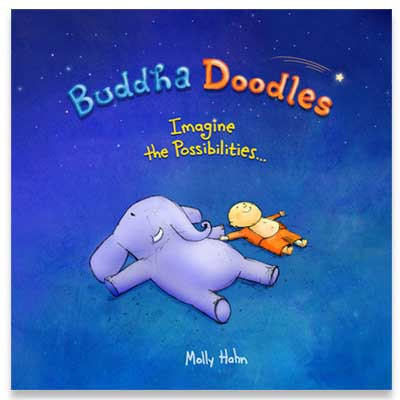
  • Buddha Doodles Review and Book Giveaway – Whimsical Drawings with Deep Truths

    Buddha Doodles Review and Book Giveaway – Whimsical Drawings with Deep Truths

    Buddha Doodles Imagine the PossibilitiesNote: The winners for this giveaway have been chosen.
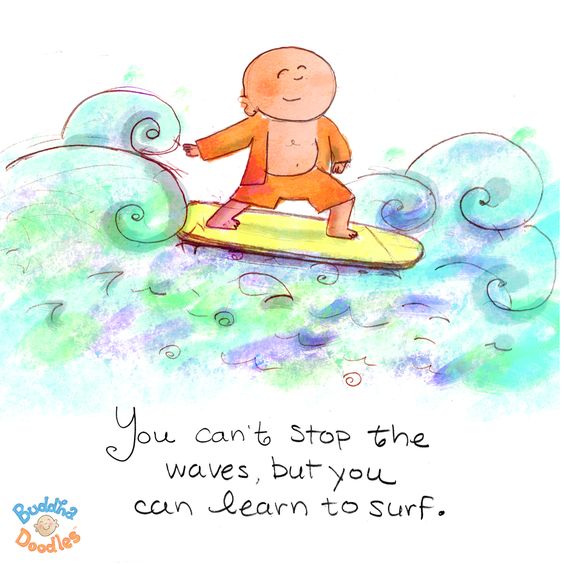
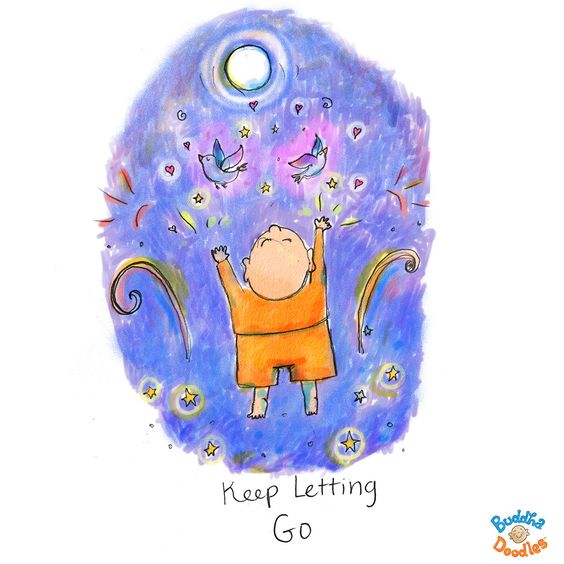
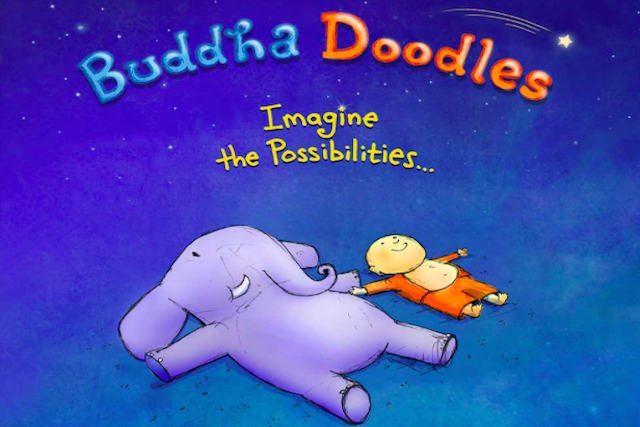
    When I first found Molly Hahn’s Buddha Doodles a few years back, I knew I’d stumbled upon something special.

    Her whimsical illustrations never failed to put a smile on my face, and they often came with just the message I needed to read on a given day.

    I was even more enthralled when I learned about Molly’s background, and why she started Buddha Doodles.

    Having endured a traumatic childhood, she began her meditative sketch practice as part of her healing process. And I, along with hundreds of thousands of other fans, couldn’t be more grateful that she did.

    “Light in heart but deep in intent,” as she writes, her illustrations uplift, inspire, and empower us all to be wiser, happier, more mindful people.

    Buddha Doodles You can learn to surf

    With ninety-six color pages, Buddha Doodles: Imagine the Possibilities would make a wonderful gift book or addition to your own library.

    To enter to win one of four free copies, leave a comment below sharing something that inspires you—a quote, a personality trait, an act you recently witnessed, anything!

    You can enter until midnight PST on Friday, February 12th.

    Buddha Doodles Keep Letting Go

    Want to grab a copy now? You can order Buddha Doodles: Imagine the Possibilities on Amazon here.

    FTC Disclosure: I receive complimentary books for reviews and interviews on tinybuddha.com, but I am not compensated for writing or obligated to write anything specific. I am an Amazon affiliate, meaning I earn a percentage of all books purchased through the links I provide on this site. 

  • Take the Love Pledge (You Could Win a Copy of Tiny Buddha’s New Love Book)

    Take the Love Pledge (You Could Win a Copy of Tiny Buddha’s New Love Book)

    Happy Thanksgiving to those of you who celebrate it! Today is a perfect day to take the Tiny Buddha love pledge if you haven’t already. Over 1,200 people have taken it over the last ten days.

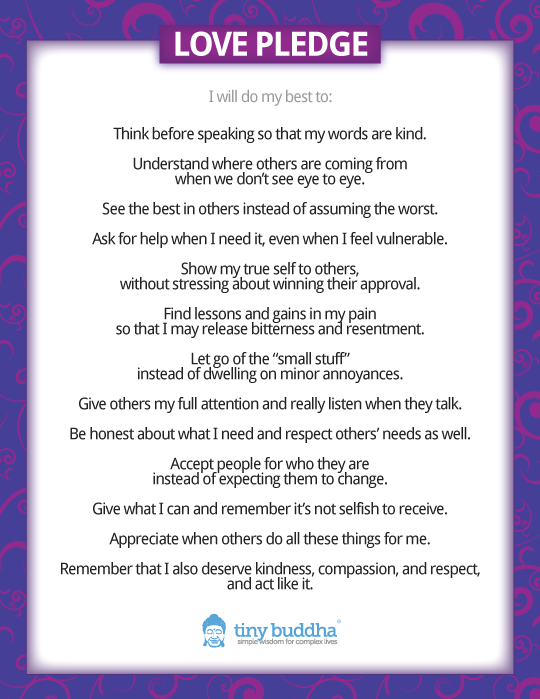
    I created this pledge to help us all be more loving, to others and ourselves. After you take the pledge by entering your email address here, you’ll be entered to win one of three free copies of Tiny Buddha’s 365 Tiny Love Challenges, which includes stories and daily activities to help us all give and receive more love.

    Tiny efforts can make a huge difference. And a tiny bit of love from each of us can make the world a far better place!

    If, like me, you value your relationships, take the Tiny Buddha love pledge here.

    tb-love-pledge540

    You can take the pledge until Monday, November 30th. The giveaway winners will be notified then.

    “What a terrific resource! This book provides so many thought-provoking ideas for simple, fun ‘challenges’ to help us live happier, more loving lives.” — Gretchen Rubin, author of The Happiness Project

    Want the book now? Grab a copy of Tiny Buddha’s 365 Tiny Love Challenges here.

  • Adventures for Your Soul Book Giveaway: Live the Life of Your Dreams

    Adventures for Your Soul Book Giveaway: Live the Life of Your Dreams

    Adventures for Your Soul

    UPDATE: The winners for this giveaway are:

    • Sarah Jane Vallente
    • Chandra Milliron

    “Just like the characters of a movie, you are a character in the show called ‘Life.’ Are you in a starring role? Or are you a supporting actor?” ~Shannon Kaiser

    Do you ever feel like could be doing more with your life? Like you’re holding yourself back in fear and not reaching your true potential? Maybe you don’t even know what you want; you just know what you don’t want, and yet you can’t seem to escape it.

    I’ve been there quite a few times myself, and I’ve recognized several unhealthy habits that keep me stuck, such as getting caught up in my head and comparing myself to other people.

    It’s not easy to overcome these kinds of habits—especially if we’ve fallen victim to them for years, or even decades.

    Bestselling author Shannon Kaiser knows this, and that’s why she wrote Adventures for Your Soul: 21 Ways to Transform Your Habits and Reach Your Full Potential.

    I’ve always been a huge fan of Shannon’s work, and not just because she’s insightful, wise beyond her years, and focused on proactive solutions.

    I admire Shannon because she’s battled her own demons—overcoming depression, drug addiction, and an eating disorder—and has emerged with an enthusiasm for life, a belief in herself, and a passion for helping others identify and pursue what they truly want.

    That’s exactly what she’s done with Adventures for Your Soul. In this powerful guide to a more fulfilling life, Shannon tackles the most common “happiness-hindering habits,” and presents exercises, questions, and action steps to help us overcome them.

    I highly recommend Adventures for Your Soul to anyone who feels stuck, scared, lost, or confused. The book will take you on a soul-searching journey of self-discovery, bringing you closer to the “you” you want to be.

    I’m grateful that Shannon took the time to answer some questions about her work and her book, and that she’s provided two free copies for Tiny Buddha readers.

    The Giveaway

    To enter to win one of two free copies of Adventures for Your Soul:

    • Leave a comment below
    • For an extra entry, tweet: Enter the @tinybuddha giveaway to win a free copy of Adventures for Your Soul http://bit.ly/20FEboE

    You can enter until midnight PST on Friday, November 13th.

    The Interview

    1. Tell us a little bit about yourself and what inspired you to write this book.

    I suppose I didn’t know what I would be when I grew up, but always knew I wanted to be extremely brave and let passion be my compass. I knew I had to express myself creatively in order to be fulfilled.

    I could share that I am writer, author, life coach, speaker, travel writer, and teacher who left behind my corporate job in advertising six years ago as well as drug addiction and depression in order to find my happiness, but that is my past.

    Today, I am more interested in who I am becoming. My life is about showing up fully and feeling all of what life has to give. I want to be a constant reminder of what courage looks like, what choosing love over fear feels like. And to remind people it is never too late to become what you dream about.

    I wrote my new book Adventures for Your Soul as a demonstration of what living a courageous life looks and feels like. It’s a manual to getting out of your own way and embracing your true self.

    2. Who would most benefit from reading Adventures for Your Soul, and how might it help them?

    People who are on mission to better themselves and who are committed to living an authentic life. People who are looking for answers for their deep, heartfelt questions, such as: How can I get unstuck? How can I learn to love more in the face of fear? How can I remove habits holding me back? How can I be more comfortable with myself and learn to love all of me? This book answers these.

    Through my own personal experience and life coaching practice I discovered the top twenty-one habits that hinder our happiness, and I found powerful ways to transform these habits so we can get unstuck and move forward with more grace and ease.

    3. The first “happiness hindering habit” you shared is “We settle because we think it’s the best we can get.” How can we begin to change our beliefs about what’s possible for us?

    In order to not settle we have to give ourselves permission to dream bigger. We can start by asking ourselves “What do I really want?” and becoming aware of the inner critic that says, “It can’t be done.” Then, instead of listening to that little voice, we can turn to love and inspiration.

    We all have a little nudge and inspiration that comes to us, insights, visions, or hopes and dreams. The opportunity is to begin to trust those little nudges, and act on them. This will quiet our fear-based mind so the fear won’t be as strong.

    Ask if your current lifestyle is giving you the results you desire. If not, take steps in the direction you want and release what doesn’t serve you.

    For example, maybe you’re in a job you no longer enjoy, and you feel as if you were made for more. Instead of staying in that boring job, begin to listen to your inner nudges, the inspiration that comes to you.

    Maybe it’s saying go take a yoga class or go to the bookstore, or go join that new community group. Follow these nudges because they are leading you to fulfillment, one small step at a time.

    When I first left corporate I didn’t know I wanted to become a writer. I just knew what I was doing wasn’t fulfilling me anymore. So I took one small step at a time, such as getting a journal, investing in travel writing books, and reaching out to life coaches to learn more about the industry.

    Each small step opened up new possibilities. All we have to do is take one step at a time and the path will reveal itself. But we must move forward and take the steps.

    4. In chapter three, you talk about the importance of trusting our heart, not our head. How can we recognize the difference between the two?

    We can get in touch with the feelings associated with each, which can help us make the right choice.

    When we listen to our heart it feels expansive, inspirational, joy-filled, and loving. When we listen to our fear, which is in our head, the rational over-thinker part of us, it often feels scary, overwhelming, critical, and heavy.

    5. In the “Lean into Love” chapter, you share Jim Rohn’s belief that we make choices from one of two places: inspiration or desperation. I suspect we’re more apt to make choices out of desperation when we feel constrained by responsibilities, financial or otherwise. What advice would you offer to someone who feels unable to access inspiration due to overwhelming obligations?

    I believe the focus on overwhelming obligations is what makes us feel like we can’t entertain any inspiration. But inspiration is with us all the time; we overshadow it with our focus on fear.

    If we are focused on how we can’t make ends meet, that becomes our reality, whereas a better way would be to focus on how we want to feel: creative, safe, free, for example. Then we can let our truth pull us forward. We get what we focus on, so focus on what you want.

    6. Your “Fear Detox” chapter was the most powerful for me, as it’s incredibly comprehensive! In your experience, which of the top ten fears is the most common, and how can we begin to overcome this?

    I believe fear of the unknown is one of the most common. We want a guarantee that things will work out, that our ventures will yield results. We need proof of concept and stability.

    Many of us don’t act on inspiration because we are unsure of the outcome.

    One way to overcome this fear is to first take a life inventory and ask where you are holding yourself back in life. Ask, what do I really want? Then take action on that desire.

    For example maybe you worry a lot and have fear-based thoughts about your future. First, address these by listing out the thoughts that worry you. Ask if believing these fear-based thoughts is holding you back, and if so, what action steps can you take to work through them?

    Maybe you want to leave your corporate job to become a wellness coach but you worry about making a living doing what you love. Maybe you also fear the unknown outcome. What if no one pays you for your services? How will you get clients?

    These are examples of fear-based thoughts. Address them, and then ask, what action step can I take in the face of these fears? When we take action we build confidence, which gives us clarity.

    Maybe you list out blogs you want to visit and wellness coaches you want to follow or meet, maybe you look into certification programs or attend yoga classes. Follow the inspiration that comes to you, and this will help you move forward with more ease.

    7. I love the HOPE acronym you shared in the chapter on finding your purpose and passion. Can you tell us a little about that?

    Many of us want to find our life purpose, but we struggle to find it. The struggle is the problem.

    Instead of trying so hard to find our purpose, we have to trust it will reveal itself to us when the time is right. You can’t find your life purpose by thinking your way into it; it can only be felt in the heart.

    I created this acronym to help you discover your passion, which will help you lead a more purpose-filled life.

    H – Habitual Happiness

    O – Open up to Optimism

    P – Purpose-filled Passion

    E – Embrace the Journey

    8. In the chapter on letting go, you wrote, “Most of us walk around feeling wounded, damaged, and guilty, when the bottom line is we just want to enjoy the things we resist.” Can you elaborate a little on this?

    I think society, culture, the world puts pressure on us to be a certain way, and when we don’t match up we feel less than. But the truth is, you are enough as you are, and just because it doesn’t fit with society’s expectations doesn’t mean it’s wrong or right.

    We walk around feeling guilty for things we actually like: eating an extra helping of ice cream, or binge-watching Netflix. We feel bad, but it makes us feel good. So we should switch to focus on how our life feels instead of how it looks.

    9. In the last chapter, you touch upon our instinct to avoid uncomfortable feelings instead of embracing them. How does it benefit us to embrace anger, resentment, jealousy, shame, and guilt?

    Once we embrace them, they can be released from us. When we avoid them or hold onto them, that is what causes the damage. But all feelings deserve to be felt.

    10. What’s the main message you hope readers take from your book?

    You matter just as you are. Don’t be afraid to show the real you because the world needs what you have.

    You can learn more about Adventures for Your Soul on Amazon here.

    FTC Disclosure: I receive complimentary books for reviews and interviews on tinybuddha.com, but I am not compensated for writing or obligated to write anything specific. I am an Amazon affiliate, meaning I earn a percentage of all books purchased through the links I provide on this site. 

  • Love Challenge #278: One Supportive Phrase

    Love Challenge #278: One Supportive Phrase

    One Supportive Phrase

    What supportive phrase do you wish you heard more growing up?

    (This challenge comes from the upcoming book Tiny Buddha’s 365 Tiny Love Challenges. Pre-order before October 6th and get $300+ in free bonus gifts!)

  • Love Challenge #47: Hurt People Hurt People

    Love Challenge #47: Hurt People Hurt People

    Hurt People Hurt People

    Sometimes the most difficult people are in the most pain.

    (This challenge comes from the upcoming book Tiny Buddha’s 365 Tiny Love Challenges. Pre-order before October 6th and get $300+ in free bonus gifts!)

  • Love Challenge #95: Don’t Dwell, Let Go

    Love Challenge #95: Don’t Dwell, Let Go

    Dont Dwell

    What are you carrying around that’s weighing you down?

    (This challenge comes from the upcoming book Tiny Buddha’s 365 Tiny Love Challenges. Pre-order before October 6th and get $300+ in free bonus gifts!)

  • Love Challenge #128: Listen Without Trying to Fix Things

    Love Challenge #128: Listen Without Trying to Fix Things

    Love Challenge 128

    From the upcoming book Tiny Buddha’s 365 Tiny Love Challenges. Pre-order before October 6th and get $300+ in free bonus gifts!

  • 1,501 Mindful Communication Tips (Interview & Giveaway: What Would Buddha Say?)

    1,501 Mindful Communication Tips (Interview & Giveaway: What Would Buddha Say?)

    Buddha with Sunset

    Update: The winners for this giveaway are Divya Rangi and Sand.

    Growing up in a loud Italian family, I learned early on to scream and speak fast if I wanted to be heard. Neither of these things is conducive to speaking mindfully. And doing these two things together, especially when angry or agitated, all but guarantees a stressful, ineffective conversation.

    I’ve had quite a few of those in my life. And more times than I care to admit I’ve hurt people with things I’ve said—to them or about them.

    I’ve offended people by speaking impulsively, I’ve damaged trust by venting to a third party instead of confronting someone directly, and I’ve insulted people to get a few laughs without really considering the impact of my sarcastic words.

    While I’ve made tremendous progress with these things, I know I still have room for improvement. If you do, as well, you may appreciate Barbara Ann Kipfer’s What Would Buddha Say?

    The book presents 1,501 mindful communication tips based on the Buddhist concept of Right Speech—speech that is useful and beneficial—including:

    It’s not just what you say—it’s how, when, and why you say it.

    Even though what you have to say is important, you can respect what others find important at the time.

    Listen with compassion, without judgment, and with an open mind.

    It’s essentially a massive list of reminders to help you give your full, thoughtful attention to your words so you’re more likely to communicate clearly and less likely to damage your relationships.

    At the back of the book, you’ll find a number of short essays that address issues related to Right Speech, including anger, criticism, and overthinking, along with several meditations.

    While you could read through the book from start to finish, I like to open to a random page in the morning and read one idea to carry into the day. (I recommend using the book this way, since there’s a lot of overlap with the teachings, and they don’t build on one another, but rather complement each other.)

    I’ve found that absorbing just a few words about watching my words helps me set the intention to speak mindfully, and that setting this intention is the key to kinder, clearer, more effective communication.

    I’m grateful that Barbara took the time to answer my questions about her book and Right Speech, and that she’s provided two free copies of What Would Buddha Say? for Tiny Buddha readers.

    What Would Buddha Say?The Giveaway

    To enter to win one of two free copies of What Would Buddha Say?

    • Leave a comment below
    • For an extra entry, tweet: Enter the @tinybuddha giveaway to win a free copy of What Would Buddha Say? http://bit.ly/1giwpOP

    You can enter until midnight PST on Friday, July 10th.

    The Interview

    1. Tell us a little bit about yourself and what inspired you to write this book?

    I am an inveterate listmaker. I started my “things to be happy about” list in 1966, sixth grade. That became 14,000 things to be happy about, which has been in print for twenty-five years and has sold more than a million copies.

    I’ve been a lexicographer for nearly forty years and at one point I was compiling a kids’ encyclopedia. When I got to the subject of Buddhism and started reading about it, I was overjoyed that the Buddha loved lists, too, and he taught others by using lists.

    From there, I decided to learn as much as I could and earned a Master’s and PhD in Buddhist Studies. That knowledge has made it possible for me to write spiritually themed books like What Would Buddha Say?

    2. How can we improve our lives and relationships by practicing Right Speech?

    Here is what I think I should have put for the first entry: If you hear a human voice…listen! That person is probably talking to you! And I am not joking: the biggest improvements we can make in the area of Right Speech are to listen more and talk a lot less.

    Think about how you get yourself in trouble, how you usually get into conflicts with others, how unhappiness is often caused. The majority of the time, the cause is what you say. This book is offered to help readers learn to speak truthfully and with lovingkindness.

    3. What have been the biggest challenges for you personally when it comes to practicing Right Speech?

    Exactly the same as everybody else—which is why I was so keen on writing this book out of the eight parts of the Noble Eightfold Path.

    As a lexicographer and listmaker, I have been awash in the world of words all my life. As a Buddhist studies scholar, I read and read and read about Right Speech. Yet, I say something boneheaded just about every day! I need a book of reminders, so I wrote one.

    I have worked from home for thirty years, so my social skills are not honed like others’ and I’m also sometimes starved for social contact. So when I go to something where there are people, I sometimes overshare or voice my opinions too boldly. I have been practicing mindfulness so that I stop myself before launching into one of these “Barbara thinks” soliloquies.

    4. Oftentimes, we say things we don’t mean to say because we speak when we are angry. How can we work on this so we less frequently say things we regret?

    Before real anger occurs, there is a mental discomfort and an awareness that something is happening that you do not want. By being mindful and aware of that momentary gap before reacting takes over, you can make a controlled, graceful response. Learning how to return to the present moment with mindfulness is like a safety net when you are provoked by anger or hatred.

    5. What, have you found, is the best approach to responding when someone else speaks unkindly to us?

    If someone is expressing anger or unkind words toward you, watch your breath and keep it slow and steady. Pause for several seconds and wait. The person may sense that they are being unkind or angry and they may stop. If you react with hurt or anger, then you yourself destroy your own peace of mind.

    It is not that we should stand there and take it. Often, there are choices. If you do not react and the person continues a tirade, you can simply walk away. You can try to change the subject or even make a joke, but that is often not as effectual as walking away.

    In the pause, remember that you, too, have acted this way toward others—maybe even the very person who is now doing it to you.

    Some compassion may arise. And in the moment of compassion, you can remind yourself that the anger the other person is expressing may have little or nothing to do with you, but has formulated due to other things that person is having trouble handling.

    6. What is one thing we can do to start speaking more kindly to ourselves?

    The most important person to speak kindly and truthfully to is yourself, with inner speech. Negative inner talk only creates a negative inner emotional landscape. Show as much compassion to yourself as you would toward others and watch your life begin to change for the better.

    Part of the reason we are unkind to ourselves is because we overthink things we have done in the past or what we will say or do in the future. Practicing the art of staying in the present moment keeps you from heading off to the past or future, where you tend to berate or prepare yourself.

    Our world is full of competitiveness and comparison. We are faced with it constantly. The expectations we have for ourselves and others create unskillful thoughts, speech, and actions. By first being kind to yourself and giving yourself a break if you say or do something “wrong,” puts you on the path toward being kind to others and giving them a break.

    7. How can we apply the teachings of Right Speech to our online communication to create more intentional interactions and less hurtful ones?

    Whenever you are about to write or say something, ask yourself if the words will result in well-being or harm. If well-being, then say it. If harm, then do not say it.

    8. One piece of advice from your book that really stuck with me was, “Resist the urge to tell others what they need.” Can you elaborate a little on this, and why it’s crucial to Right Speech?

    We like to solve problems and make them go away. We have a great aversion to problems, big or small, ours or others’.

    If someone complains about their job, rather than listen, we may suggest that they quit and get another job. It’s not like the other person does not know that! Why do we feel the need to make such a statement? The reason is, we want things to always be nice, no suffering and no problems.

    We expend a lot of effort trying to control things, to avoid unpleasantness and grasp more pleasantness.

    It is best to listen to a friend, simply listen, without feeling duty-bound to solve the person’s problems for them. Accept not understanding or being in control as a liberation and a positive choice.

    9. In addition to the challenges of speaking kindly, many of us struggle with listening fully, especially since our lives—and minds—can get so busy. What’s one thing we can do to become better listeners?

    Listening is an art. We need to practice it more! It is optimal to listen with a still and concentrated mind. Then it is possible to be responsive to what is being said.

    The combination of a meditation practice and the practice of mindfulness in everyday life is what is needed to cultivate a still and concentrated mind. That mind is capable of the pause, the thoughtful response, the silence instead of yelling or being snippy.

    If you want others to listen and understand you better, think about what makes you want to listen. A person who speaks kindly about others and the world is someone you like to listen to. A person who talks about interesting things, things of interest to more than just themselves, is someone you like to listen to.

    10. What do you hope readers take away from What Would Buddha Say? and its emphasis on intentional communication?

    Remember that Right Speech is a practice. The more you practice, the more you will feel the difference between reacting blindly and responding—being aware of what you do.

    Practice is what makes the difference between a position held in principle and its day-to-day application. Whatever you practice, you get better at.

    The more often you get irritated, the better you get at irritation. The more often you speak kindly, the more often you will default to speaking kindly. If you want to go in a different direction, you need to work at it.

    You can learn more about What Would Buddha Say? on Amazon here.

    FTC Disclosure: I receive complimentary books for reviews and interviews on tinybuddha.com, but I am not compensated for writing or obligated to write anything specific. I am an Amazon affiliate, meaning I earn a percentage of all books purchased through the links I provide on this site. 

    Buddha and sunset image via Shutterstock

  • Interview with Dani DiPirro and Book Giveaway: The Positively Present Guide to Life

    Interview with Dani DiPirro and Book Giveaway: The Positively Present Guide to Life

    Positively Present Guide to Life

    Update: The winners for this giveaway are:

    If you’re a fan of uplifting, action-oriented blog posts, you may have stumbled upon Positively Present at some point in time.

    I “met” the site’s founder, Dani DiPirro, around the time I started Tiny Buddha. Over time, I grew to admire her dedication, both to personal development and her blog.

    Since 2009, she’s shared countless helpful, inspiring posts, empowering readers to live mindfully and positively in the face of life’s inevitable challenges.

    Now she’s preparing to launch a new book, The Positively Present Guide to Life, which offers practical ideas to enhance our home life, work, and relationships for an all-around happier, more fulfilled life.

    I’m grateful that Dani took the time to answer some questions about herself and her book, and that she’s provided two copies for Tiny Buddha readers.

    The Giveaway

    To enter to win one of two free copies:

    • Leave a comment sharing one thing that always helps you stay positive.
    • For an extra entry, tweet: Enter the @tinybuddha giveaway to win a free copy of The Positively Present Guide to Life http://bit.ly/17oIQDY

    You can enter until midnight PST on Friday, February 27th.

    The Interview

     1. Tell us a little bit about yourself and your blog, Positively Present. 

    I’m an author, blogger, and designer living in a suburb of Washington, DC. In 2009, when I was at a particularly low point in my life—I didn’t love my job, my relationship status wasn’t ideal, and I was struggling a lot to feel happy—I launched PositivelyPresent.com with the intention of documenting my journey toward a more positive and present life.

    In 2012, I left my full-time job in Marketing to pursue a career as a blogger and writer. While working to create a beautiful online space for my readers, I discovered how much I loved illustrating and graphic design.

    Last year, I launched my design studio, Twenty3, where I work with individuals and business to create modern, uplifting design. My love of design and my desire to help myself and others live more positive, present lives comes together in my latest book, The Positively Present Guide to Life, which pairs inspiring illustrations with action-oriented advice for living a more positive, more present life.

     2. What inspired you to write The Positively Present Guide to Life, and how does it differ from your blog?

    Books have been my greatest teachers, and I love the tangibility of them of in our digital world. I’ve learned so much about life—and about myself—from books, and writing The Positively Present Guide to Life was the best way I could think of to take the lessons I’ve learned from PositivelyPresent.com and explore them at a deeper level.

    And my blog has inspired this book in another way: all my advice here is presented in easy-to-follow lists, to make sure this guide is as simple to use and as practical as possible.

    3. What have you found to be the biggest obstacles to being positive and present—and how have you overcome them?

    One of the biggest obstacles for being positive and present can be other people. Just because you’re trying to live a more positive, present life, that doesn’t mean that those around you are striving for the same thing, and the negativity of others can be draining.

    Overcoming this can be difficult if it’s not possible to avoid negative people. If possible, I’ve found it helps to limit your interactions with them. If that’s not an option, I recommend reminding yourself that you do not have to be ruled by others’ moods or attitudes. Even when others are negative, you can choose to focus on the positive and to stay in the moment.

    4. I think there’s a misconception that “be positive” means “don’t ever feel bad.” What are your thoughts on this?

    This is definitely a huge misconception when it comes to positivity. It’s for this reason, in fact, that I focus on positivity rather than happiness.

    When you are happy, you are in a state where you don’t feel bad and when even the not-so-great things seem bearable. Positivity, on the other hand, is not about putting on rose-colored glasses and pretending that everything is okay. It’s about accepting whatever’s happening in your current situation and trying to make the most of it.

    No matter how difficult the situation, it’s possible to find something of value—even if the value is only that you’re getting stronger by going through difficulties.

    5. In Chapter One of your book, you talk about creating a positive home. What advice would you give to someone who wants to create a positive home but lives with people who are often negative?

    Living with negative people can really challenge efforts to live a more positive, present life, but there are things you can do to make the most of the situation.

    I’ve dedicated an entire section of my book to this topic because I believe it’s something many people encounter. Even if people at home are generally positive, we all have our bad days (or weeks!). When dealing with negativity at home, I recommend trying your best to speak with love, and not to mirror the tone or attitude of those who are in a negative state of mind.

    This can be difficult (we tend to react in a way that mirrors others), but choosing loving words and tone can make a huge difference.

    Also, it’s important to try not to take others’ negativity personally. Often, stress and negativity between cohabitants is a result of issues that take place outside of the home (such as work), and it can be helpful to consider that another’s negative reaction or snippy tone might be related to something that has nothing to do with you.

    6. In the next chapter, you talk about being positively present at work. What do you think is the most important thing someone can do to stay positive and present when they’re not happy at their job?

    Even if you don’t love your job, you can learn from it. Any job offers the opportunity to learn how to cooperate with and overcome challenges.

    Being around others—some you like, some you don’t—teaches important people skills, from how to collaborate, negotiate, and compromise with those who view things differently, to how to get a job done with someone who would rather chat away the day.

    Processing so many viewpoints and opinions from coworkers opens our eyes to new ways of thinking. If you like your industry but not your position, you can also learn a lot by talking to those you admire or who hold positions you aspire to.

    7. In the chapter on relationships, you talk about learning to say no. Why is this so important to staying positive and present?

    There are many reasons why saying no, negative as it sounds, can be a more positive response. For example, it might save you from having to spend time with people who bring negativity into your life, or it might ensure that you don’t overload your schedule.

    It can also strengthen relationships because it lets other people know you have boundaries and will enforce them. It helps others know where they stand—and if they don’t cross the line, your relationship is all the more positive for it.

    Keep in mind: when you say no to one thing, you’re really saying yes to something more worthy of your time and energy.

     8. What do you think is the most essential habit for staying positive and present?

    One of the most essential habits for living a positive, present life is to cultivate gratitude. No matter how difficult a situation, there is always something to be grateful for. It’s very difficult to be negative or distracted from the moment when you’re focusing on what you have to be thankful for.

     9. What’s the main message you hope people take from your book?

    When people read my book, I hope they’ll realize how important a shift in attitude can be. It can transform all aspects of your life, from home to work to relationships to love to how you cope with change.

    I hope readers will see that, even if positivity and mindfulness doesn’t come easily to them, with the right tactics and inspiration, it’s possible to cultivate a positive attitude and stay in the moment more often.

    I’m not a naturally positive person and I work hard at staying positive and present. If I can do it, anyone can—and I hope this book will inspire readers to see that they, too, can live more positive, present lives.

    You can learn more about The Positively Present Guide to Life (and pre-order a copy) on Amazon.

    FTC Disclosure: I receive complimentary books for reviews and interviews on tinybuddha.com, but I am not compensated for writing or obligated to write anything specific. I am an Amazon affiliate, meaning I earn a percentage of all books purchased through the links I provide on this site. 

  • Review and Giveaway: In the Garden of Happiness

    Review and Giveaway: In the Garden of Happiness

    In the Garden of Happiness

    Update: The winners for this giveaway have already been chosen:

    Ken Golden

    Sandy

    Be inspired. Be strong. Be happy.

    These words pop from the peaceful imagery on the back cover of Dodinsky’s In the Garden of Happiness, nicely summarizing the benefits of perusing this uplifting illustrated book.

    If you’ve read his first book, In the Garden of Thoughts, you know what to expect from this bestselling author: whimsical imagery and powerful wisdom in a deceptively tiny package.

    His work provides encouragement when you’re feeling hopeless or helpless; reassurance when you’re feeling insecure or insignificant; and comfort when you’re feeling regretful or remorseful.

    Some of my favorite passages include:

    Whenever you manage to smile in spite of the hardships you’re facing, it means your soul is refusing to be a prisoner of your sorrows.

    To find the star that sparkles the most, you need to look inward—because not all stars are settled in the sky.

    It is sometimes the uphill struggles that will give you the best view of life’s most forgotten and beautiful landscapes.

    Colorful, insightful, soothing, and empowering, In the Garden of Happiness is the perfect gift for anyone—of any age—who appreciates vibrant art and bite-size pieces of inspiration.

    I’ve left my copy where I can easily access it for an instant pick-me-up. Simultaneously simple and profound, it never fails to comfort and uplift me.

    As a huge fan of Dodinsky, I couldn’t be more thrilled to share In the Garden of Happiness with you, and I’m grateful he’s offered two free copies for Tiny Buddha readers.

    To Enter the Giveaway

    • Leave a comment below
    • For an extra entry, tweet or post on Facebook: Enter the giveaway on Tiny Buddha to win a free copy of In the Garden of Happiness, by Dodinsky: http://bit.ly/14orN3W

    You can enter until midnight PST on Friday, January 9th. The book launches tomorrow, and is available for pre-order on Amazon now.

    FTC Disclosure: I receive complimentary books for reviews and interviews on tinybuddha.com, but I am not compensated for writing or obligated to write anything specific. I am an Amazon affiliate, meaning I earn a percentage of all books purchased through the links I provide on this site. 

  • In the Garden of Happiness: Available for Pre-Order

    Over the past year, I’ve shared countless uplifting picture quotes from the Positive Outlooks Facebook page, loved and followed by millions. It’s a treasure trove of wisdom, motivation, and inspiration, in large part due to the vision of its founder, Dodinsky.

    He’s planning to release his second book in January, a follow-up to his bestselling inspirational book In the Garden of Thoughts. If you’re looking to start the new year with a jolt of positivity, I highly recommend pre-ordering In the Garden of Happiness!

  • Be Part of the Next Tiny Buddha Book: 365 Tiny Love Challenges

    Be Part of the Next Tiny Buddha Book: 365 Tiny Love Challenges

    tb-love-post

    *The deadline to submit a story has now passed. Thank you to everyone who submitted one! You will receive an email by the end of November if I’d like to include your story in the book.

    When I started this site in 2009, after struggling for over a decade with depression, bulimia, and shame-induced isolation, I hoped it would be a place where we could all feel less alone with our struggles and more empowered to overcome them. I’m beyond thrilled to see that’s just what Tiny Buddha has become.

    Over the past five years, I’ve been honored to help over 1,000 people share their stories on the blog, and I’ve also appreciated the opportunity to write two collaborative books, sharing some of my experiences and lessons, along with stories and insights from community members.

    Tiny Buddha: Simple Wisdom for Life’s Hard Questions, published in 2011, includes 150 tweets of wisdom addressing some of life’s most complex topics, like meaning, pain, love, fate, and control.

    Tiny Buddha’s Guide to Loving Yourselfpublished in 2013, features forty stories of overcoming challenges related to self-love, including shame, perfectionism, comparisons, and the need for approval.

    The next Tiny Buddha book will hit the shelves in November 2015, and I’d love for you to be a part of it!

    The Book 

    Tentatively titled 365 Tiny Love Challenges from Tiny Buddha, the book will feature a year of simple daily activities to help you give and receive more love.

    I was inspired to write this book after reflecting on the relationships in my life and recognizing how little I’d done for so long.

    For years, I waited for other people to reach out to me, expected them to anticipate my needs, and unintentionally ignored theirs while fixating on myself, my fears, and my insecurities. It wasn’t until I started making an effort to give love that I started feeling loved in return.

    But it wasn’t simply because I got back what I gave; it was because the giving helped pull me outside of myself so I could attract and maintain healthy, reciprocal relationships based not on need, but on mutual respect, appreciation, and understanding. And that’s what this book is all about.

    It will be published by Harper One, an imprint of Harper Collins, and it will be available on Amazon, in Barnes & Noble, and in various stores where books are sold.

    The challenges will focus on increasing self-love, strengthening current relationships (romantic or otherwise), building new relationships, and taking tiny steps to help build a more loving world.

    Sharing Your Story in the Book

    The book will feature short stories related to a number of relationship themes, including:

    • Releasing Anger & Forgiving
    • Acceptance & Non-Judgment
    • Compassion & Understanding
    • Authenticity & Vulnerability
    • Attention & Listening
    • Releasing Comparisons & Competition
    • Kindness & Thoughtfulness
    • Support & Encouragement
    • Appreciation & Admiration
    • Giving & Receiving
    • Fun & Playfulness
    • Honesty & Trust

    You can submit an original short story, never before published online or in print, 400 words or less, with a related lesson, on any of these themes.

    Click here to learn more and submit your story!

  • The Ultimate Guide to Feeling Awesome & Ultimate All the Time

    The Ultimate Guide to Feeling Awesome & Ultimate All the Time

    If you don’t feel awesome or calm today, you may enjoy this cute, inspiring picture book, from Tiny Buddha contributor Lise Esile.

  • Think Like a 5-Year-Old to Start Living the Life of Your Dreams

    Think Like a 5-Year-Old to Start Living the Life of Your Dreams

    Kid Photographer

    “Don’t grow up. It’s a trap.” ~Unknown

    A little over a year ago, my brother and I decided to write a book together. At the ages of nineteen and twenty-nine, this was a really scary thing for us.

    Neither of us considered ourselves “good writers,” and we especially didn’t think highly enough of our writing to imagine that we’d ever write a book.

    I made C’s on most of my papers in high school and college and, quite frankly, my confidence in my writing was pretty low.

    Each time I tried to sit down and write even a two-to-five-page paper, I would spend countless frustrating hours banging my head against the keyboard and writing all night in an attempt to reach the page limit. For me, writing was an extremely painful process.

    I’d made myself believe that I was bad at it. All of the bad grades and papers full of red ink had me convinced that it was a lost cause. They told me I’d never be a good writer.

    So when my brother and I decided to write a book, you can imagine all of the thoughts running through my head…

    “I’m not a good writer. Why would anyone want to read my book?”

    “I can’t even write a three-page paper. How will I ever finish a book?”

    “What if nobody buys the book?”

    And the list goes on and on. These types of thoughts keep most people from going after their dreams. They keep us paralyzed in fear, afraid to take the first step.

    Seth and I had to overcome these insecurities as writers to get started. We pushed past them with childlike curiosity and channeled our inner five-year-olds by asking questions, making mistakes, and reaching out to successful authors for advice.

    I’m going to tell you a few things that helped us through these insecurities, but first I want to ask you a question. When’s the last time you truly thought like a five-year old?

    You know, thoughts like: “I’m going to be an astronaut one day” or “When I grow up I’m going to be the president.”

    As children, we tend to believe that we truly can do anything we want. But a funny thing happens: as you go to school, get a job, and eventually retire, the world’s expectations and beliefs about you shrink your own beliefs.

    This process looks a little like this…

    Belief Funnel

    The things we believed we could accomplish slowly start to melt away and become unfulfilled dreams.

    Our dreams of doing humanitarian work in Africa or playing in a band never see their start because we begin listening to others and accept that these things won’t happen.

    It’s hard not to listen because many of these people have pure intentions. Some of them are people we love, who love us back, but they have no idea what is possible because it isn’t their dream.

    Nevertheless, we follow the path they suggest based on their own beliefs of what is possible. Unfortunately, it can take years, decades, and even a lifetime to realize how our dreams were derailed and why.

    Possibilities Funnel

    What you can actually do continues to grow, even as your beliefs (what you think you can do) get in the way of that.

    So how do you push past your insecurities and start believing in yourself again? How do you take advantage of the endless possibilities available to you when your beliefs about yourself won’t let you take the first step?

    1. Start thinking like a five-year-old.

    Ignore your doubts and negative feedback from others. Five-year-olds don’t pay attention when someone tells them they might not be a princess and an actress when they grow up. They just keep believing.

    When my brother Seth decided he wanted to be a musician, many people around him suggested he try for something more realistic. Despite the insecurities and the extremely small chance of success, he believed in himself and went for it. Now he plays around the world with his band NEEDTOBREATHE.

    When you start believing and acting on your five0year-old dreams, there’s a good chance you’ll be surprised by how often they come to life.

    2. Be the biggest loser.

    The weird thing about our potential is that it often gets hidden. It gets covered up by doubt and by the discouragement we get from others. We often forget our potential exists, and it takes a friend or coach to remind us of it and encourage us to take action.

    The NBC show “The Biggest Loser” is a classic example of this principle. Before coming on the show, the contestants fail to lose weight on their own because they lack the willpower, the time and, most importantly, the belief in themselves. After getting on the show and working with trainers, they uncover abilities they never knew existed.

    If you’re looking to make a serious change in your life, find a coach or accountability partner to work with. They’ll help you tap into your childlike thinking and uncover beliefs, abilities, and innate talents.

    Because of our lack of experience, Seth and I reached out to several successful authors for help and coaching on our book. Reaching out to people you respect can be a scary process, but each time you do it you’ll learn something new.

    3. Don’t be so scared of failure.

    Many times we quiet our inner five-year-old because of the fear of failure. We fear that if we go for what we actually want, we might fail and look stupid. This was my fear before writing the book.

    The best learning moments in life are when we fail. If you never fail, you’ll never make a difference in the world.

    Think of the people who you admire the most. How many times do you think they’ve failed in their lives? Probably more than they can remember. These people are successful because they failed early and failed often. They got out there, gave it a shot, and learned with each failure.

    Failure means you’re making progress. Don’t be so afraid of it.

    When you were five, falling down and pushing yourself back up was an opportunity to build your muscles. You ran to explore possibilities because at worst you would learn something new and get stronger doing it.

    If anything is b-o-l-o-g-n-a, it’s forgetting how to run and hope and dream the way we did when we were kids. So next time you’re feeling discouraged or insecure, ask yourself: “What would my inner five-year-old do?”

    Editor’s Note: Chandler has generously offered to give away five signed copies of Breaking Out of a Broken System, his new book, co-written with his brother Seth. Each book purchased saves someone’s life through a life-saving malaria pill. Their mission is to save 10,000 lives by selling 10,000 copies.

    To enter to win a copy, leave a comment below. You can enter until midnight EST on Monday, March 10th.

    UPDATE: The winners for this giveaway have already been chosen. Congrats to M, VictoriaP, Tiffany Joi, Priya, and Alex

    Photo by Praveen Kumar

  • Win a Free Copy of Tiny Buddha’s Guide to Loving Yourself

    Win a Free Copy of Tiny Buddha’s Guide to Loving Yourself

    Tiny Buddhas Guide Cover 3D

    UPDATE: The winners for this giveaway have already been chosen. 

    The winners:

    • Antwanette Miller
    • Rebecca

    This may seem like Déjà vu, because I published an almost identical post last Friday. It’s now a new week (soon to be weekend) and a new chance to win a copy of Tiny Buddha’s Guide to Loving Yourself!

    For those of you who already bought a copy, I hope you’re enjoying it!

    And I have a special request for you: Since it’s brand new, there are currently only four reviews on Amazon. (Thank you so much to those of you who responded to my request last week and wrote one!)

    Those reviews go a long way in influencing people who may benefit from the book.

    If you’ve found the site and the book helpful, I would be so grateful if you would take five or ten minutes out of your day to support me and the site by reviewing Tiny Buddha’s Guide to Loving Yourself

    Whether you write two words, two sentences, or more, it will make a tremendous difference.

    Now on to today’s giveaway!

    This one’s a little different, in that you won’t be entering to win a copy for yourself; instead, its an opportunity to have a copy mailed to someone you love, directly from my publisher, with a special note from you. 

    About Tiny Buddha’s Guide to Loving Yourself

    Tiny Buddha’s Guide to Loving Yourself is a collaborative book featuring a collection of stories from Tiny Buddha contributors, along with tips to help you feel good about yourself and your life.

    The book shares 40 unique perspectives and insights on topics related to loving yourself. It will help you:

    • Release shame about your past and the limiting beliefs that keep you stuck
    • See yourself as beautiful and valuable, with all your flaws and weaknesses
    • Accept yourself more and judge yourself less
    • Forgive yourself for your mistakes and stop being hard on yourself
    • Minimize the need for approval to feel more confident
    • Let go of the comparisons that keep you feeling inferior
    • Feel complete so that you no longer look to others to fill a void within yourself
    • Find the courage to share your authentic self for deeper connections with others
    • Learn to take care of yourself instead of putting everyone else’s needs first
    • Believe that you’re valuable so you can start creating a life you love

    I started Tiny Buddha and created this book because I believe there is a healing power in recognizing that we are never alone with our challenges.

    And there’s nothing wrong with us for what we’ve been through or what we’re going through.

    No matter how we’ve struggled, no matter what our flaws or weaknesses, we are worthy of being fully seen—and we can make a difference in the world by doing it.

    I hope this books helps you remember, in times of doubt, that you are beautiful, imperfections and all, and you can thrive not in spite of them, but because of them.

    The Giveaway

    To enter to win one of two free copies of Tiny Buddha’s Guide to Loving Yourself, to be mailed to someone you love with a special note from you:

    • Leave a comment on the post sharing one thing you think other people appreciate about you
    • Tweet: RT @tinybuddha Enter to win a free copy of Tiny Buddha’s Guide to Loving Yourself! http://bit.ly/16yY2ru

    If you don’t have a Twitter account, you can still enter by completing the first step.

    You can enter until midnight PST on Monday, October 28th. Have a great weekend everyone!

  • Book Giveaway: Tiny Buddha’s Guide to Loving Yourself

    Book Giveaway: Tiny Buddha’s Guide to Loving Yourself

    Tiny Buddhas Guide Cover 3DUPDATE: The winners for this giveaway have already been chosen. They are:

    • Sunny Kharbanda
    • UnicaPoet

    It’s been 10 days since the launch of Tiny Buddha’s Guide to Loving Yourself, and I’m excited to share that the book has been a bestseller in Amazon’s self-esteem category since then.

    For those of you who already bought a copy, I hope you’re enjoying it!

    And I have a special request for you: Since it’s brand new, there’s currently only one review on Amazon. Those reviews go a long way in influencing people who may benefit from the book.

    If you’ve found the site and the book helpful, I would be so grateful if you would take five or ten minutes out of your day to support me and the site by reviewing Tiny Buddha’s Guide to Loving Yourself

    Whether you write two words, two sentences, or more, it will make a tremendous difference.

    Now on to today’s giveaway!

    This one’s a little different, in that you won’t be entering to win a copy for yourself; instead, its an opportunity to have a copy mailed to someone you love, directly from my publisher, with a special note from you. 

    About Tiny Buddha’s Guide to Loving Yourself

    Tiny Buddha’s Guide to Loving Yourself is a collaborative book featuring a collection of stories from Tiny Buddha contributors, along with tips to help you feel good about yourself and your life.

    The book shares 40 unique perspectives and insights on topics related to loving yourself. It will help you:

    • Release shame about your past and the limiting beliefs that keep you stuck
    • See yourself as beautiful and valuable, with all your flaws and weaknesses
    • Accept yourself more and judge yourself less
    • Forgive yourself for your mistakes and stop being hard on yourself
    • Minimize the need for approval to feel more confident
    • Let go of the comparisons that keep you feeling inferior
    • Feel complete so that you no longer look to others to fill a void within yourself
    • Find the courage to share your authentic self for deeper connections with others
    • Learn to take care of yourself instead of putting everyone else’s needs first
    • Believe that you’re valuable so you can start creating a life you love

    I started Tiny Buddha and created this book because I believe there is a healing power in recognizing that we are never alone with our challenges.

    And there’s nothing wrong with us for what we’ve been through or what we’re going through.

    No matter how we’ve struggled, no matter what our flaws or weaknesses, we are worthy of being fully seen—and we can make a difference in the world by doing it.

    I hope this books helps you remember, in times of doubt, that you are beautiful, imperfections and all, and you can thrive not in spite of them, but because of them.

    The Giveaway

    To enter to win one of two free copies of Tiny Buddha’s Guide to Loving Yourself, to be mailed to someone you love with a special note from you:

    • Leave a comment on the post sharing one thing you love about yourself
    • Tweet: RT @tinybuddha Enter to win a free copy of Tiny Buddha’s Guide to Loving Yourself! http://bit.ly/GTjqRC

    If you don’t have a Twitter account, you can still enter by completing the first step.

    You can enter until midnight PST on Monday, October 21st. Have a great weekend everyone!