Tag: beliefs

  • Raised on Their Best Intentions—Healed on My Own Terms

    Raised on Their Best Intentions—Healed on My Own Terms

    “Out of suffering have emerged the strongest souls; the most massive characters are seared with scars.” ~Kahlil Gibran

    There are two versions of me.

    There’s the one I am now—the grounded, present woman who holds space for others, who guides people toward healing, who walks barefoot through the grass and whispers affirmations while sipping her coffee.

    And then there’s the other version. The one who barely made it. The one who used to stare into her fridge not out of hunger but as a distraction from the ache in her chest. The one who didn’t feel at home in her body. The one who was certain no one could ever understand the weight she carried, let alone help lift it.

    If you’ve ever felt pain that rewired your entire being, you know:

    Trauma doesn’t just live in the mind.

    It takes root in the bones, in the pauses between conversations, in the way you flinch when someone raises their voice—even slightly.

    For years, I was operating on autopilot. From the outside, I seemed fine. But internally, I was haunted by invisible wounds and unspoken memories.

    Then came the moment I will never forget—when I confronted the very people who gave me life.

    I was in my twenties. I’d been carrying years of resentment, confusion, and heartache. Every harsh word, every time I felt small—it all built up inside me.

    And I finally let it spill out during an emotionally charged conversation. I brought up a pattern that had deeply impacted me, hoping to be heard.

    I expected remorse, maybe even repair.

    But instead, I heard: “We did the best we could.” It was calm, maybe even resigned. It wasn’t unkind, but it felt like a door closing instead of opening. In that moment, I felt both understanding and a quiet ache, realizing we weren’t going to meet in the middle.

    Those six words didn’t offer relief. They didn’t soften the years of damage. Because understanding your parents’ limitations doesn’t erase your pain. But it does offer you a choice:

    To carry it forward. Or to finally put it down.

    That was the turning point.

    I realized I didn’t want to live stuck anymore—stuck in old stories, like believing I had to suppress my emotions to keep the peace, or that loyalty meant silence; stuck in shame and in patterns I didn’t choose. I wanted to heal. Not just for myself, but for every version of me that had felt unseen.

    So I started to write.

    Not for anyone else, but for me.

    When I couldn’t speak the truth out loud, I wrote it down. My journals became confessionals. My pen, a lifeline. My pain, my teacher.

    Eventually, I found tools that helped me dig even deeper—meditation, somatic work, subconscious reprogramming, hypnotherapy.

    I learned that the subconscious mind is like a computer. It stores everything you’ve ever believed about yourself—especially the painful parts. If you don’t update the programming, you’ll keep replaying the same loop:

    I’m not enough. It’s my fault. Love has to be earned. I must stay small to be safe.

    And when you realize that you can change that inner script? That’s when everything shifts.

    In 2020, I became a certified hypnotherapist. But truthfully, that was just the official title. My real training began the day I stopped running from myself.

    Through that work, I began to rewire old beliefs, release trauma stored in my body, and speak to my younger self with compassion instead of criticism.

    I finally started to feel free. Not perfect. Not enlightened. But freer.

    Free to cry and not apologize for it. Free to take up space. Free to stop fixing everyone else so I could finally tend to myself.

    Today, I help others do the same.

    Not because I have all the answers, but because I remember what it felt like to not even know which questions to ask.

    And if you’re reading this right now, I want to say something I wish someone had said to me: You are not broken. You are not behind. You are not unworthy. You are a soul who has walked through fire—and you’re still here.

    Healing is not linear.

    You will have days where you feel like you’ve regressed, where the sadness feels fresh, where you question everything. That’s okay.

    Progress isn’t perfection. It’s presence. And your presence—your willingness to look at your pain instead of running from it—is what will change your life.

    You don’t need to hustle your way to healing. You just need to return to yourself.

    So here’s what I’ve learned, in case it helps you:

    1. Triggers are teachers in disguise. They point to wounds that need tending. For me, being interrupted or talked over would trigger an intense emotional response—one rooted in earlier experiences where my voice didn’t feel valued. I also noticed that certain tones of voice, especially condescending ones, could instantly make me feel small.

    2. You are allowed to feel anger at those who hurt you and compassion for the fact they didn’t know better.

    3. The body holds trauma, but it also holds the key to release. Pay attention to your breath. Your posture. Your gut feelings.

    4. You can forgive and still hold boundaries, like saying no without over-explaining or stepping away from emotionally unsafe conversations. I’ve also created space by recognizing when it’s not my role to carry someone else’s emotional process—especially if it comes at the cost of my well-being.

    5. You can grieve and still grow.

    And most of all: You can rewrite your story at any time. Because you are not your past.  You are the author of your next chapter.

    So let it be one of reclamation.

    Let it be the moment you stop shrinking and start rising. Let it be the chapter where you stop surviving and start living.

    You are the light you’ve been looking for.

  • How to Finally Believe That You Are Enough

    How to Finally Believe That You Are Enough

    “We often block our own blessings because we don’t feel inherently good enough, smart enough, pretty enough, or worthy enough. But you’re worthy because you are born and because you are here. Your being alive makes worthiness your birthright. You alone are enough.” ~Oprah Winfrey

    When I was a little girl, I loved making cute drawings at school and gifting them to friends and family. I’d pour my heart into them, and at the end of the day, I’d rush home, all excited to give my treasured creations. I was such a happy kid! Always running and jumping up and down the street, noticing quirky details on the road and picking flowers to bring home.

    This one, I made my mom a drawing. When I got home, I stood beside her, my eyes sparkling with anticipation, only to see her looking at it with disdain. She harshly criticized what she thought was badly drawn on paper and then tossed it in the trash. I looked at her, shocked and hurt, as she said: “What do you want me to say, that this drawing is beautiful? It isn’t.”

    I wish I could say it was the first time I had an interaction like that, but the reality is that it happened again and again. So much so that I gave it a name: “not enough notes to the self.”

    These are the moments when something happens that makes you start questioning your worth, and you begin internalizing that somehow, your being and whatever you do is not and will never be enough. If you have a few moments like these in your life, it may not leave so deep of a scar, but when the notes pile up, you start feeling differently about who you are.

    You go from being purely and authentically you to shrinking into a mold of what’s expected of you, even if the mold keeps changing and becoming more demanding each time. You realize you’re damned if you do but also damned if you don’t, and without the right tools to escape the conundrum, you feel like you have no other option but to keep going in the hopes of someone seeing you and telling you that you are enough.

    That’s what happened to me.

    Too many events, people, and circumstances told me I wasn’t enough. And I believed it. So, I spent most of my life trying to prove I was.

    I attempted to be the best at everything, with no room for error, because maybe if I were perfect, I would finally be enough. But no matter how hard I tried, the goalpost just kept moving.

    Then, after years of healing from past traumas, I heard a voice inside me that said, “To the eyes of the Universe, you are enough.” And it clicked! It does not matter what the world says, I am enough, so there is no need to prove it! I always was.

    I wish I could tell you I instantly embraced that thought. But by then, I had spent my whole life trying to prove myself, hiding behind a perfectionist facade, weighed down by anxiety and the need to please others, so it wasn’t easy to suddenly believe I was enough without all the trying and the masking.

    I had to reflect deeply and ‘do the work’ to get my mind, body, and soul to align with this newfound truth. It was such a beautiful journey of self-love and acceptance, and I cannot wait to share it with you today so you too can realize the undeniable truth that you are enough, and always were, and free yourself to bask in the happiness of knowing. And achieve your goals and wildest dreams along the way without having ‘not-enough notes to the self’ blocking you from the life you’re meant to live.

    Ready?

    The first step I took was to dig deep into my mind to find all the ‘not enough notes to the self’ I had on repeat all these years. I looked back into my past and screened for the moments that made me believe I was not enough. I had many, and from time to time, new ones pop up in my head, but I softly smile at them, like when you encounter an old friend you still care about, but the friendship is over. No hate, only love from a distance.

    Reflecting on these moments, I started to grasp why I felt so worthless. While you may know why you’re haunted by feelings of not being enough, seeing these moments reflected on paper or flying through your mind during meditation makes something click inside you. You just get it.

    And I did. But getting it is one thing, and deprogramming years, decades of not-enoughness is another. That’s where step number two enters the chat: changing the belief that you are not enough.

    Convincing myself I am enough was all about lovingly and repeatedly reminding myself of my enoughness as a birthright and showing it through actions as if parenting my inner child and undoing the parenting I received as a little girl. For that, I used daily affirmations and meditations where I would sit in the present moment and just be.

    That allowed me to constantly get back to myself and the truth of who I am: a loving and lovable individual, no perfection needed.

    I started asking powerful questions and practicing self-love. Notice I didn’t say, “I started loving myself.” Back then, I had no idea how to do that, so I just started practicing. I’d ask myself what I’d do if I loved myself. If I knew at my core that I was enough, who would I be? How would I behave?

    This shift was life-changing, and it naturally led me to the next and sort of final step of the journey: to look at my surroundings and reevaluate my relationships. As I began to treat myself with more love and respect, I inevitably started noticing how other people treated me through a different lens.

    As one should expect, when you believe that you are not enough, you tolerate certain situations and behaviors that are detrimental to your health and well-being. Embracing your enoughness leaves little room for that.

    So, I went through a painful period of reevaluating, transforming, and even ending some unhealthy relationships. But in the process, I ended up creating space for true, loving, and respectful relationships that make me feel safe, worthy, and enough.

    My list of ‘not enough notes to the self’ grew smaller. And as it did, my life expanded in ways I could’ve never imagined. But let’s get real: This is a lifelong journey, which is why there’s no definitive last step, just a powerful sort-of-last step.

    The beauty of this process is that you can revisit it time and time again to reconnect with the undeniable truth that you are enough and create the beautiful life you deserve. One thing I can tell you for sure: It gets easier and more natural every time.

    Remember, you are enough because you always were. Time to start walking and talking like it!

  • Two Reasons We Sabotage Our Joy and Success and How to Stop

    Two Reasons We Sabotage Our Joy and Success and How to Stop

    “The wound is the place where the Light enters you.” ~Rumi

    Have you ever held yourself back from going after what you truly want, or from enjoying what you have, because of a lingering fear that it might be taken away from you, or because you felt guilty for having more than others?

    For years, I found myself unintentionally sabotaging moments of pure joy and personal success without being able to embrace them fully.

    For example, when my son was born, a rush of panic would flood me every time I even imagined the possibility of losing him, and I felt guilty even having a family knowing that my friend was struggling with infertility due to her health issues.

    Also, the money that flowed into my life always seemed to vanish as if I was in a rush to get rid of it, feeling torn between my gratitude for what I’d earned and the unease of knowing that others were barely getting by.

    No matter how hard I tried, I couldn’t shake the constant sense of dread that lingered. One moment, I’d feel exhilarated and at peace, only to be hit with a wave of fear and guilt, as if my mind was plagued by relentless, unsettling static.

    It felt like an endless cycle of scarcity. A pattern of having and sabotaging. But it was something deeper that made me question my beliefs of my own worthiness.

    It took years of reading, researching, and learning to realize that this feeling wasn’t just a behavior—it was a belief that traced back to my childhood.

    I grew up in a dynamic, happy family that traveled often, cared for me, and always made me feel safe and loved. But when the war came and everything changed in an instant, my life of safety and my carefree days turned into a desperate fight for survival.

    That abrupt shift of losing freedom and the life I had before that moment left a deep mark on my young mind. It taught me that nothing is guaranteed and that having too much joy was dangerous and it could vanish in a flash.

    Later on, this belief seeped into every corner of my adult life. When I built a vibrant career, guilt kept creeping in because I knew there were others who were struggling. Even in moments of personal growth and healing, the weight of this belief made me feel as if I was betraying all the suffering and destruction I had witnessed as a child.

    It was exhausting, and for the longest time, I had no idea why I felt this way. But holding onto this belief didn’t help anyone. It certainly didn’t help me. And especially not those still fighting for survival. It kept me small and limited, trapped in a cycle of guilt and fear.

    While this mindset once served as a form of protection, I had to accept that loss is an inevitable part of life—and that fearing it only kept me from truly living.

    As I started my healing journey and helped other souls find their path to healing, I began learning about the subconscious mind and how early childhood experiences, cultural conditioning, and unresolved emotions shape us.

    When I allowed myself to acknowledge the origin of this belief without judgment, I knew I had started the healing process. I gave myself permission to grieve for the child I was and for everything I had missed experiencing as a twelve-year-old girl.

    Then I started working on how I see the world and how I, just like everyone else, am responsible for the energy I send out into the world. I started to see my joy, success, happiness, and achievements as gifts and opportunities, not things I had stolen from others.

    I reframed my story and embraced an affirmation that I still use nowadays—The more I thrive, the more I can give back. This whole new perspective shifted my energy from guilt to gratitude and inspired action.

    I changed my inner narrative through energy healing and the deep soul alignment my being was craving. I am worthy of happiness, just like everyone else, and I deserve abundance in every aspect of my life.

    Over time, these words became my truth, which I now believe deep in my core.

    It’s no surprise that, of all the emotions I worked on during the process, guilt was the hardest one to let go, because I couldn’t give up thinking and feeling what other people who were going through the same struggles felt. But when I decided to channel my abundance into acts of service, I realized I could help others without sacrificing my own joy.

    Limiting beliefs can be tricky because you may not even realize you have them. And even if you’re aware of some, they might not be the ones you actually need to work on. The root cause isn’t always easy to spot, but there are steps you can take to get there.

    1. Start by identifying areas of your life where you face challenges.

    Write down the belief you feel is contributing to your struggles. Putting it all in writing can give you the clarity you need to move forward.

    2. Explore the origin of this belief.

    Did you hear it from someone? Was it an event in your life that started it? Understanding where this belief might have started can help you detach from it.

    3. Challenge limiting beliefs with empowering truths.

    For example, you could replace “I’m not worthy of success because others are struggling” with “My success empowers others. By thriving, I create more opportunities to help and inspire.”

    Find examples from your own life when this was true and write them down. As you shift your perspective, you’ll begin to see things in a new light—one that is healthier and more uplifting.

    While affirmations can be a powerful tool, please note that they may not be sufficient if you’re dealing with deep-rooted patterns of fear, doubt, or trauma. Simply repeating the words may not be enough if you struggle to truly believe them.

    To more effectively heal these limiting beliefs and rewire the brain, a more holistic approach is often needed—one that integrates mind, body, and energy healing. This can include guided meditation to access subconscious patterns, breathwork to release stored emotions, somatic practices to reconnect with the body, and inner child work to address the root cause of past wounds.

    By combining these methods, you allow healing to happen on multiple levels, creating deeper and lasting transformation.

    4. Create a daily practice where you meditate and visualize yourself thriving to reinforce your new narrative.

    Meditation helps quiet the mind and clear energetic blockages, while visualization allows you to embody the feelings of your new reality.

    To fully integrate this shift, take aligned action each day that supports your growth. Set boundaries by saying no to commitments and situations that no longer serve you, speak your truth by expressing your needs, and engage in new experiences by exploring new places. Celebrate small wins by acknowledging and appreciating every step you take toward becoming the person you are meant to be.

    It might also help to find a guide or a coach who can help you navigate the deeper layers of limiting beliefs. You might realize that an outside perspective is what you need to break free.

    If you find it hard to let go of your conditioning, be patient with yourself. It’s not easy to get out of your own way, even when your soul is feeling a strong pull and an immense desire to break free and to awaken to a life filled with meaning, light, and purpose.

    But if you keep at it, you can let go of the limiting beliefs that hold you back. Then, when you believe that you are worthy of receiving and fully experiencing all of life’s blessings, you’ll be able to embrace each gift with gratitude while you have it, knowing that both gain and loss are natural parts of our journey.

    And remember, embracing joy and success is also a gift to everyone around us. When we honor our worth and embrace our light, we align with a higher vibration that radiates into the world.

  • The One Hidden Belief That Was Sabotaging My Business

    The One Hidden Belief That Was Sabotaging My Business

    “If you accept a limiting belief, then it will become a truth for you.” ~Louise Hay

    When I first set out to create my business, I poured all my hopes and energy into it working tirelessly, learning, refining, and investing. Since childhood, I knew I wanted to do my own thing. Something that felt meaningful to me. But despite all my best efforts, the success and sense of support and steadiness I longed for always felt out of reach.

    I chalked it to timing, or not doing enough, or missing something others had that I couldn’t put my finger on. But all along, what was behind the stuckness was a force I’d never considered—conditioning.

    Conditioning is the learned behaviors and beliefs we adopt as children to feel safe, loved, and accepted. These patterns become so ingrained that we don’t realize they follow us into adulthood. But do they ever, shaping how we approach everything, including our ambitions and relationships.

    My own deconditioning journey has spanned years and, my goodness, the layers… but one of the densest and most sabotaging was this: I was raised to believe that being misunderstood was unsafe.

    My childhood experiences taught me that expressing myself with honesty or assertiveness could come at a mega cost, and I carried this lesson into my life and business (like nobody’s business), without even realizing it.

    As I began to share my work with the world, I felt an anxious compulsion to prove myself and my approach exhaustively. I couldn’t shake the picture of a hostile audience judging every word I wrote or spoke, so instead of focusing on how my work could solve a problem for potential clients, I was caught up in an endless loop of over-explaining, justifying, and defending my ideas—before anyone even questioned them.

    I wasn’t marketing my work as much as I was making a case in a courtroom of my own projection. It was the worst. It drained my energy, sabotaged my business, and made showing up for it feel like a rerun of a past I thought I’d outgrown.

    Seeing this and other aspects of my conditioning for what it was (distinct from me and a coping mechanism from the past) took a lot work. My unique path included estranging from toxic family dynamics, moving from Brooklyn to a very calm corner of Italy, quitting alcohol and cigarettes, and hiring a coach who understood where I came from and where I wanted to go and could go as deep with me as I knew was required.

    I don’t believe it’s a fair ask to release aspects of our conditioning (regardless of how limiting they are) when our lives and relationships don’t feel safe, and it took creating safety, cogency, and self-trust to start seeing all at the ways coping had kept me from thriving.

    The first step toward breaking free of the anxious over-explaining pattern was noticing how it felt in my body. I’d feel the anxiety rise, and then survival mode would take over whenever I tried to communicate my work with directness.

    More than once, my jaw would lock, my head would go fuzzy, and my throat would collapse if too much truth, confidence, or opinion came to the surface.

    This wasn’t a personality quirk; it was an echo of the past, manifesting in the present.

    Inner child work was the medicine for this—when those feelings welled up and the impulse to shut down or over-explain would come up, I’d picture little me sitting on my lap and I’d hold her through the fear, reminding her that she was feeling the past, not the present. That she wasn’t alone in this and wouldn’t be ever again. And then I’d lean in and say the thing.

    As I sat with those feelings, acknowledging them instead of letting them direct my actions, something shifted. I was re-parenting that vulnerable part of me that had once believed it was dangerous to be seen and heard and showing her that we could walk past those fear thresholds together. And so, we have, more and more every day.

    Letting go of this need to defend myself, I found both clarity and a sturdier sense of being safe in my own skin than when I only had the conditioning to protect me.

    And when it came to my work and business, my focus could center on what truly mattered: serving my clients and making my work clear and accessible, not to the critic within but to people, real people who are looking for change.

    The impact was immediate. Communicating with clients became smoother, and even tasks I’d once dreaded—like getting on sales calls—felt natural, grounded, and friendly. It opened the door to a new kind of productivity, one fueled by purpose rather than “headless chicken” survival. Thank heavens. Really.

    If you’re finding it difficult to make things happen as you envisioned them, it may not be about working harder or finding the perfect moment. It could be that unseen patterns of conditioning are guiding your actions, just as they were guiding mine.

    The beauty of recognizing these patterns is the freedom that opens up.

    When you let go of outdated beliefs and create space to move forward from a grounded, present, clear-eyed place, ambitions start to feel within reach because the truth is, they kind of are.

    What can feel impossible or out of reach or alignment becomes so much less charged and so much more achievable when we’re no longer fighting these unseen barriers.

    It isn’t always easy work, and it requires a commitment to challenge familiar beliefs, reach for support, and sometimes make some big changes. But if you’re willing to face your hidden patterns, you might just find that what you want is far closer than it once seemed.

  • My Life with ADHD and Anxiety: A Surprising Success Story

    My Life with ADHD and Anxiety: A Surprising Success Story

    “Examine the labels you apply to yourself. Every label is a boundary or limit you will not let yourself cross.” ~Wayne Dyer

    Living with both ADHD and anxiety feels like trying to navigate life with your mind constantly racing in a thousand directions at once. It’s frustrating and exhausting, and, at times, it feels like success is out of reach.

    But here’s the truth: success is possible. Even when it feels like your brain is working against you, with the right strategies and support, you can thrive.

    As a nurse practitioner who has lived with undiagnosed ADHD and anxiety for much of my life, I’ve experienced the struggles that come with both. I’ve been labeled lazy, unteachable, and a lost cause.

    But I’ve also learned how to break through those labels and find success on my own terms. It’s not easy, but it’s absolutely achievable.

    The Early Years: ADHD and Anxiety in School

    Growing up, ADHD wasn’t something people talked about. Kids who had trouble focusing were often written off as lazy or troublemakers. I was one of those kids, but I wasn’t the hyperactive type, so my struggles flew under the radar.

    My teachers assumed I wasn’t trying hard enough, but the truth was, I was trying as hard as I could. If a subject didn’t grab my interest, my brain simply couldn’t focus.

    The frustration of not being able to retain information or focus made school incredibly difficult. Teachers labeled me as lazy or unteachable, and those labels stuck. By the time I reached high school, I was so far behind that showing up to class felt pointless.

    My grades were posted for everyone to see, and every time, I was at the bottom of the list. It felt like the world was constantly reminding me that I was a failure.

    As my anxiety grew, I started skipping class regularly. Why show up just to feel like I was being judged? I was already seen as the kid who couldn’t keep up, and every time I walked into a classroom, it felt like a reminder of how far behind I was.

    The anxiety of being judged, combined with my ADHD, made it impossible to succeed in that environment.

    Hitting Rock Bottom

    With no support system in place and a constant sense of failure hanging over me, I turned to unhealthy coping mechanisms. Drugs and alcohol became my escape from the pressure, anxiety, and feelings of inadequacy.

    The constant emotional beatdown from teachers, peers, and my own inner voice was too much to bear.

    I began to believe that I really was a lost cause. No one seemed to care about my potential, and I certainly didn’t see it myself. Eventually, I was kicked out of my public high school. At the time, it felt like the end of the road for me, but in reality, it was the best thing that could have happened.

    Finding a New Path: The Alternative School

    After being kicked out of public high school, I was sent to an alternative school, a place for the so-called “bad kids.” This school had a reputation for being where the rejects went—those who were expected to drop out, end up in jail, or get pregnant.

    But what I didn’t expect was how this environment would change my life.

    At the alternative school, the teachers didn’t care about my past failures. They didn’t look down on me for my low grades or judge me for being behind. Instead, they saw my potential. They worked with me one-on-one, offering me the chance to catch up and even get ahead. For the first time in my life, I felt like someone believed in me.

    One teacher in particular recognized my talent for writing and encouraged me to join the school newsletter. I started taking on more responsibility and eventually became the editor. For the first time, I started to see myself as capable and smart.

    College and Career: Finding Success Despite ADHD and Anxiety

    After graduating from the alternative high school, I had a newfound sense of confidence. For the first time, I believed that college might be an option for me. I started at a community college and eventually transferred to a university, where I earned a bachelor’s degree in journalism and communication studies.

    However, after working in journalism for a while, I realized that it wasn’t my true passion. I pivoted and went back to school to pursue a career in nursing. Earning my associate’s degree in nursing was one of the hardest things I’ve ever done, but it was also the most rewarding.

    For seven years, I worked in the emergency department, where the fast-paced environment kept my ADHD in check and the constant reminder of life’s fragility put my anxiety in perspective.

    Managing ADHD and Anxiety in Adulthood

    While I had found success in my career, my ADHD and anxiety didn’t magically disappear. In fact, they became even more noticeable when I transitioned to working as a nurse practitioner.

    The COVID-19 pandemic brought an intense level of pressure, and my anxiety skyrocketed. I found myself overthinking every decision, double- and triple-checking my work, and seeking reassurance from colleagues constantly.

    It became clear that I needed to develop better strategies for managing both my ADHD and anxiety. Through a combination of medication, mindfulness practices, and a strong support system, I’ve been able to keep both in check.

    What Works for Me: Strategies for Managing ADHD and Anxiety

    Over the years, I’ve found that managing ADHD and anxiety requires a holistic approach. Medication has been a helpful tool, but it’s not the only answer. I’ve also incorporated practices like meditation, gratitude, and positivity into my daily routine, all of which help me manage my symptoms.

    Meditation in particular has been a game-changer. It helps me calm my racing thoughts and stay grounded, especially when my anxiety starts to creep in. Practicing gratitude keeps me focused on the positive aspects of my life, which helps counter the negative self-talk that can sometimes accompany both ADHD and anxiety.

    Positivity is another important tool in my toolbox. I’ve learned that staying positive isn’t about pretending everything is perfect—it’s about choosing to focus on what’s going well and using that as motivation to keep pushing forward.

    The Importance of Believing in Yourself

    Looking back, I realize that one of the biggest turning points in my life was learning to believe in myself. For so long, I had internalized the labels that others had placed on me. But once I started to see my own potential and believe that I was capable of success, everything changed.

    ADHD and anxiety don’t define who you are or what you can achieve. Yes, they’re challenges, but they’re also part of what makes you unique.

    With the right tools, strategies, and mindset, you can turn those challenges into strengths.

    Final Thoughts: Success Is Possible—Keep Pushing Forward

    ADHD and anxiety can feel like insurmountable obstacles at times, but they don’t have to hold you back. Success is possible, even if it feels out of reach right now.

    You might feel like a lost cause, but you’re not. You’re capable of so much more than you realize.

    It doesn’t matter where you started or what labels have been placed on you. What matters is that you keep pushing forward, believe in your potential, and surround yourself with people who support and uplift you.

    Whatever struggles you’re facing, they are just part of your story—not the end of it.

    Keep going. Success is well within your reach.

  • The Truth Behind Imposter Syndrome: What It’s Really About

    The Truth Behind Imposter Syndrome: What It’s Really About

    “We are who we believe we are.” ~C.S. Lewis

    Have you ever caught yourself hiding behind the term “imposter syndrome”? I know I have—more times than I’d like to admit.

    We hear the phrase so often now, and it’s almost become a catch-all for our fears, doubts, and insecurities. But what if I told you that imposter syndrome isn’t what you think it is? What if it’s something deeper that has been with you far longer than your career or the roles you play in your life?

    Let me take you on a journey that may mirror your own. It starts in a place many of us know well: childhood.

    My first taste of feeling “less than” came early, in the first grade, at a Catholic elementary school in Lawrence, Kansas.

    I remember sitting on the gray carpet in a circle with my classmates, already feeling small and unsure. A boy named AJ, whose words still echo in my mind, said, “Take off your mask.” I was too young to understand what he meant, but my insecure little heart decided it was a comment on my appearance. Was my face not good enough? Did I need a mask to hide behind?

    I was already feeling uncertain about myself when my teacher called on me to spell the word “bowl.” Such a simple word, but in that moment, it felt like an impossible challenge.

    My heart raced as I struggled to find the letters, and as the giggles of my peers filled the air, I turned fire-engine red, shrinking into myself.

    The harder I tried to hide, the redder and more embarrassed I became. I don’t remember how long it took for the teacher to move to another student, but I do remember hearing a deep message from within. The message was clear: I was “dumb…and maybe ugly.” This moment became a cornerstone in the foundation of my self-belief.

    Years later, as a junior in high school, I moved from Kansas to Cleveland. Moving across the country in the middle of high school rocked my world.

    The new school was enormous, so vast that I felt like a speck, unseen and invisible. My insecurities, which had been nurtured since that day in first grade, came flooding back.

    Wearing cut-off jeans, a baggy t-shirt, and sandals—a perfectly acceptable Kansas high school outfit—I found myself just trying to survive in this new world, where the girls dressed like they were straight out of a scene from the nineties film Clueless. I felt like I didn’t belong.

    One day in math class, the teacher, Mr. Dillon, called on me. The question was simple, but I froze. My mind went blank, overwhelmed by the pressure to fit in, to be seen by the kids in the class, and to make friends. I couldn’t speak.

    As I sat there looking at him, his words stung: “Did you even pass the third grade?”

    I wanted to disappear, to escape the burning embarrassment that filled my cheeks and the tears that welled up in my eyes.

    The classroom fell silent as his words hung in the air, and I could feel every pair of eyes on me. In that moment, all I could feel was judgment. I wanted to be noticed, but not in this way. Once again, I was “dumb,” and once again, I shrank.

    These moments, though small in the grand narrative of life, became monumental in shaping who I believed I was. I withdrew, rarely raising my hand, counting the kids in front of me, then the paragraphs in novels so I could rehearse my lines and avoid any chance of being caught off guard.

    I wouldn’t listen to the world around me; I only practiced my own words, desperately clinging to the hope that I wouldn’t expose my perceived inadequacies.

    I learned that if I raised my hand for the thing I knew, then maybe I could stay quiet for the things I didn’t. I adapted. I stayed small, blending into the background, fearful of being noticed, fearful of being labeled “dumb” once again.

    But life has a funny way of unfolding. Despite this deeply ingrained belief that I wasn’t smart enough, I found proof that I was, in fact, not dumb.

    I ended up finding success when I least expected it. Fresh out of college, I landed a sales job and, without even realizing it, became the top sales account rep in the nation. I didn’t even know there was a ranking system!

    Then, in my next role, I was named “Rookie of the Year,” again, to my surprise. It wasn’t because I had set out with grand ambitions—far from it. I was simply doing my best, without the burden of expectations or the fear of failure weighing me down.

    If I had known about these accolades ahead of time, I’m certain I would have sabotaged myself, convinced that someone like me could never achieve such success. The labels I had adopted as a child were still there, lurking in the background, ready to pull me down.

    But what I didn’t realize then is that those labels, those beliefs, were never truly mine. They were the words of others, handed to me and accepted without question. They became part of my internal belief system, shaping how I saw myself at my core.

    Recently, I had lunch with a dear friend, a woman who has built an incredible business and dedicated her life to empowering young girls. She’s someone I deeply admire. When I asked her, “What’s next for you?” she paused and said, “I know where I want to go, but imposter syndrome is holding me back.”

    I couldn’t believe what I was hearing. Here was a woman who had created a thriving business and positively impacted thousands of lives, yet she was still questioning herself. I had to dig deeper. When I asked her what she felt underneath, she paused again and said, “I’m a loser.”

    There it was—the truth. It wasn’t imposter syndrome at all. It was an old belief, planted in her childhood, that had never fully healed.

    She shared how she had struggled in school, how she had been held back in third grade, and how she had defied her parents’ expectations. Despite all her success, she still believed she was a “loser.”

    And isn’t that the case for so many of us? We use the term “imposter syndrome” to describe the fear of being exposed, but we hide behind old, unhealed wounds. We’re looking for ways to stay safe and avoid stepping into our true power because, deep down, we still believe the lies we were told as children.

    It’s taken nearly a decade of healing to finally understand that the labels we place on ourselves are often the very things holding us back. It’s not the opinions of others, our circumstances, or our environment—it’s our own internal belief system. This belief system, which shapes how we see ourselves at our core, is often clouded by the layers of hurt, fear, and insecurity that we’ve accumulated over the years.

    Peeling back these layers is hard work. It requires a willingness to confront the parts of ourselves that we’ve hidden away and to question the narratives we’ve accepted as truth. But beneath those layers lies our truest self—the self that is brave, smart, strong, and so much more.

    So, I ask you: Who would you be if the world hadn’t told you who they think you are? What would you do if you let go of the labels and embraced the truth of who you are at your core?

    I’ve come to forgive those who labeled me as “dumb”—for I know now that it wasn’t their truest selves speaking. It was their own layers of pain, their own insecurities, projecting onto me. And I forgive myself for believing them and for carrying their words with me for so long.

    This is a loving call to action, a call to get curious about your true self. Your soul has a purpose, and your truest self has so much to offer the world. I know it may seem like another motivational blog, but it’s so much more than that. This is me urging you to look deeper, find your truth, and don’t believe everything you think!

    Somewhere within you are beliefs that are not true, and if you release them, you can feel lighter and more open and see the abundance waiting for you. Don’t let the labels and layers hold you back any longer. Peel them away, one by one, and step into the fullness of who you are meant to be.

    You are not the beliefs that others have placed upon you. You are so much more. It’s time to stop believing your beliefs and start believing in yourself.

  • How I Changed My Life by Becoming a Thought Snob

    How I Changed My Life by Becoming a Thought Snob

    “Loving people live in a loving world. Hostile people live in a hostile world. Same world. ~Wayne Dyer

    Driving home from another visit to the pediatrician, Mother reiterated how puny I was: “You’re just like Mommy. She was so frail. You get sick easily.” I’d say I was five years old when I wholeheartedly accepted this hogwash as fact. I’m not exaggerating when I tell you I stayed sick for three decades because I truly believed I was prone to illness.

    I come from a long line of women who never got what they wanted. They settled, conformed, and were submissive to their male spouses. I recall when I was probably eight and witnessed a heated knock-down drag-out between my parents.

    Those fights used to scare me, and I always ended up resenting my father because my mother was no match for him physically or intellectually. As she cleaned up the black mascara that had bled underneath her eyes, she told me something that ended up shaping my relationships with men.

    “Paula, if you care about a man, he’ll treat you like dirt beneath his feet.”

    And just like that, my perspective of men and where I stood with them was ill-fated. My teenage and adult relationships with men mirrored that belief that I accepted as fact when I was still getting bad perms. The bad perms were evidential proof that my brain wasn’t fully developed, so I was far too young to accept any beliefs as facts.

    Let’s flash forward a few years to when my father decided he was too much of a man for one woman. I was eighteen when my parents divorced. Two new women entered and filled our shoes one week after Mother and I left the brick-and-mortar institution we had called home.

    My father had taken on a girlfriend who had a daughter. The daughter set up shop in my bedroom and quickly adapted to answering to my nickname, “Little One.” I felt like I had been replaced because I had been. Very brutally and in true narcissistic form.

    At eighteen, I wasn’t equipped with the emotional intelligence of Mother Teresa, so I blamed myself for not being lovable, a subconscious belief that controlled my behaviors for the next twelve to thirteen years.

    During that time, I went from a size six to sixteen, bought property in Hell on Earth, and dated a drug-addicted criminal with multiple personalities, a mentally ill redneck who self-medicated, and a sex-addicted politician who had five out of the nine defining narcissistic traits. Believing I was unlovable created a string of unlovable experiences.

    At thirty, I realized I had experienced more heartache than love, and I was sick of living a life that wasn’t worth living.

    A couple of years prior, I was introduced to Dr. Wayne Dyer and was evaluating why my life looked the way it did. One day, I heard Dr. Dyer say something that changed the trajectory of my life: “Loving people live in a loving world. Hostile people live in a hostile world. Same world.”

    Holy shit. That’s when I put two and two together and realized I had been a victim of a downbringing, but that didn’t mean I had to stay a victim. Downbringing is a word I created to describe a socialization that taught me how to live in havoc instead of happiness.

    You might be wondering, “Well, Paula, what defines a downbringing versus an upbringing?”

    A downbringing happens when a young person accepts the subjective opinions (aka lies) of the people who influence them most without questioning or awareness of what is actually true (aka objective). In turn, the subjective beliefs creep into their subconscious minds and control their behaviors before they even realize what has happened. After many years, their mind is like a landfill because they have allowed any thought to live there rent-free.

    Using myself to demonstrate what a downbringing does to the mind, here is an overview of my belief systems during the first three decades of my life:

    • Women getting abused by men was normal.
    • Backstabbing friends and family members was normal.
    • Anyone who looked different than me was of lesser importance.
    • People are born lucky or unlucky, and no one has control over that.
    • I was more susceptible to sickness than others, and there wasn’t anything I could do about that.
    • Drinking excessive amounts of alcohol was normal.
    • There was one way to make money, so I had to take any job I could find, whether I liked it or not.
    • Women aren’t capable of making as much money as men.
    • Everyone was better than me.
    • It was wrong to want more. Wanting more meant I was a stuck-up snob.
    • Jealousy is a healthy response to anyone who looks better or has more.
    • Anger is totally acceptable in any situation when someone presents opposing beliefs.
    • The amount of money someone has makes them superior, and they earn the right to control people who have fewer material assets.

    I can keep going, but I think this list is the perfect Polaroid. Notice that what I stated about wanting more meant I was a stuck-up snob. There was something that was said to me repeatedly when I was still getting bad perms and on up until I was in my thirties.

    Whenever I mentioned wanting a better life, I was told I was getting above my raising. If I mentioned admiring someone who was wealthy, highly educated, or beautiful, I was quickly shot down with that statement, usually with a belly laugh from the person who said it.

    Have you ever been around someone who always found a way to humiliate the living daylights out of you? I have. I was raised by a man who used humiliation as a disciplinary tool, and he loved to pull that tool out of his pocket and use it strategically, especially when he had an audience.

    For many years, I stopped vocalizing my big dreams out of fear that he would embarrass me with a cruel, disempowering lie (aka subjective opinion), but one day, I responded differently to his humiliation tactics. This was a few years into my personal growth evolution, and I had figured out the key to living the best life possible. I wasn’t quite there yet, but I had figured it out and was heading toward a better life at the speed of an Amtrak train.

    He was intimidated by that because he could no longer intimidate me. On this day, he told me I was getting above my raising, and I loudly said, “God, I hope so.” His eyes got as big as two cannonballs, and at that moment, I transitioned from a thought slob to a thought snob.

    As I write this article, I am forty-seven. I have spent the last twenty years living the opposite of how I was taught to live. And guess what?

    I’m not frail at all. As a matter of fact, not only am I in optimal health, but I am also asymptomatic from a rare bladder condition called interstitial cystitis that is supposedly incurable. There’s more.

    My husband is the kindest, most supportive person I’ve ever known. I walked away from an employer who wanted to own my soul for a couple of bucks and thrived in my female-owned business. As it turns out, the people I was jealous of ended up being my greatest teachers because it was those people that I admired.

    If I continued behaving like a thought slob, accepting everyone’s opinions as absolute truths, something irreversible would have happened. This inner knowing caused me to pivot from my long, fruitful career in fundraising to helping people overcome a downbringing. While I worked to figure out this career change, I reflected on my past, and the core memories that surfaced made me realize two things.

    1. Young Paula’s mindset was rooted in self-loathing, and that blocked the better life I wanted.

    2. My self-loathing was the outcome of accepting the subjective opinions of others as facts.

    “Whoa,” I thought. “How simple yet so complex.”

    When I analyzed every aspect of my past existence, one word came to mind: slob. Physically speaking, I didn’t look like the stereotypical definition of a slob because I was very well put together and had excellent personal hygiene; however, I had neglected my brain hygiene for almost thirty years. It was corroded with filthy thoughts that nearly destroyed my life.

    “So, if I used to be a slob, what am I now?” As I thought through that, I came to the conclusion that what I had always wanted was better, but instead, I chose self-loathing because of how I viewed the world and my role in it. My newfound awareness led to the creation of two acronyms:

    • SLOB – Self-Loathing Overrides Better
    • SNOB – See New Objective Beliefs

    BAM! There it was—the perfect way to describe my transformation—from Thought Slob to Thought Snob. I had officially gotten above my raising.

    Awareness is the foundation of all change. When I started behaving with mindful awareness, I was able to interrupt thoughts that would turn into some crazy, scary story.

    Here is an example of how I used my Thought Snob method to reprogram my subconscious mind and train my brain to migrate away from negativity bias and toward thoughts and feelings that lifted me up instead of bringing me down.

    Before I met my husband, I had been alone for quite some time, healing from the tormented relationships I had tolerated and endured. During that time, I thought about what I had been taught as a child. Caring about a man is equated to being treated poorly.

    My awakening came from asking one question: Is this true? Always? Do all men treat women badly? Are all women punished for loving a man? The answer to all of these questions was a hard “NO!”

    I am telling you the moment I started viewing my life objectively (aka, looking at the facts), everything changed. I moved out of the hostile world I had always lived in into a loving world and sold that property I bought in Hell on Earth. I became so snobby with what I allowed my five senses to take in that I let go of 90% of the people, places, and things that had once helped create my identity.

    Bye, Felicia.

    Start here if your life isn’t how you want it to be. Examine your beliefs about the most important things to you. For demonstrative purposes only, let’s use money. If you’re broke and you desire wealth, what are your beliefs about money?

    Let’s say you discovered that you don’t believe you are capable of obtaining wealth because you were taught to believe that money was hard to come by. As you self-reflect, you find yourself feeling resentment toward wealthy people because you grew up in a household where people badmouthed the wealthy.

    Now, use SNOB and answer those questions objectively. For example, was it hard to come by when you received money for your birthday? No, it was easy.

    Are all wealthy people bad? No, they aren’t. The truth is, there are some wonderful wealthy people, and resentment comes from wanting what they have.

    Building self-awareness leads to asking self-reflection questions, and the answers that come reveal the culprit. The culprit is the lies you accepted as truths before your brain was fully developed. Those lies have controlled your behaviors, but here’s the good news.

    You’re an infinite choice-maker. At any moment, you can choose peace or hostility. That’s a fact.

    Here’s what I want you to do: Start practicing mindful awareness. Examine your whole life through an objective lens. When you see new objective beliefs, your self-loathing will no longer override better.

    Examine your life without judgment. You know where your beliefs came from. Show yourself tremendous compassion and move forward mindfully with a desire to change.

  • How to Get to the Amazing Life on the Other Side of Your Fears

    How to Get to the Amazing Life on the Other Side of Your Fears

    “As we are liberated from our own fear, our presence automatically liberates others!” ~Marianne Williamson

    Have you ever felt trapped by fear, unable to break free from the shackles of insecurity and doubt? It’s a shared experience that often holds us back from living authentically and pursuing our true passions.

    Fear comes in many forms—fear of failure, fear of success, fear of the unknown. Yet, at its core, fear is a prison of our own making, constructed from limiting beliefs and negative self-talk.

    But what if I told you that confronting your fears could lead to liberation? What if facing your deepest insecurities was the key to unlocking your true potential?

    Consider the metaphor of caged dogs accustomed to electric shocks. Despite the opportunity to escape, they remain imprisoned by familiarity, opting for discomfort over the unfamiliarity of freedom. This phenomenon is mirrored in our lives, where we cling to dissatisfaction for the illusion of security.

    Reflecting on my own journey, I recall a time when I grappled with chronic illness. Despite yearning for healing, I realized I harbored a deep-seated fear of what lay beyond the confines of my suffering.

    I had an epiphany (post-existential crisis): Did I fear failure? Or did I fear success? Did I actually fear what success and healing meant and what they came with?

    What would healing mean for me? It would mean relinquishing the safety net of my pain and stepping into a reality where I was called to fulfill my purpose and potential. The prospect was daunting, especially after being confined to the shadows and the comfort of my sofa for so long.

    As I embarked on the journey toward healing, I found myself grappling with a profound fear—one that extended beyond the confines of my illness. I yearned for recovery, yet I couldn’t shake the apprehension of what lay beyond the familiar territory of my suffering.

    Would I lose the identity I had forged amidst my struggles?

    Would I be able to navigate a world without the crutch of my suffering?

    These questions loomed large, casting shadows of doubt and hesitation on my path to recovery. It became evident that my fear wasn’t merely rooted in the prospect of being sick or well but rather in the unknown territory ahead.

    Yet, amidst the uncertainty, a glimmer of hope emerged—a reminder that growth often requires us to confront our deepest fears head-on. I realized that true healing transcends physical recovery; it demands a willingness to embrace change and step into the unknown.

    As I grappled with these uncertainties, I came to understand that the journey toward healing is not just about overcoming illness but about rediscovering ourselves and embracing the fullness of life that awaits on the other side of fear.

    We fear that the life we truly want would be too scary to bring into manifestation. But to live in such a way is doing ourselves a massive disservice. You can feel it in your soul when you abandon your desires in this way.

    Yet, as I confronted my fears head-on, I discovered a newfound sense of empowerment and freedom. I realized that true liberation comes from within, from the courage to embrace change and step into the unknown.

    Marianne Williamson poignantly remarked, “Our deepest fear is not that we are inadequate. Our deepest fear is that we are powerful beyond measure.” Embracing our innate power liberates us and those around us, igniting a ripple effect of inspiration and transformation.

    So, how do we break free from the chains of fear? Here are some actionable steps to help you overcome anxiety and step into your authentic self.

    1. Identify your fears.

    Take time to reflect on the fears holding you back. Write them down and acknowledge their presence in your life.

    2. Challenge your beliefs.

    Question the validity of your fears. Are they based on facts or assumptions? Challenge the negative self-talk that reinforces these fears. When I did this exercise, I realized I believed I wasn’t good enough and assumed it would be too much work to pursue the life I wanted.

    3. Learn and practice nervous system regulation.

    Fear is programmed into our bodies from a young age. If we don’t deal with it, then it can become trapped inside us and cause things like anxiety, depression. and chronic illness. Teaching my body how to feel fear and stay regulated was vital to my healing journey.

    One way I do this is through breathwork, focusing on longer exhales to activate the parasympathetic nervous system. I also discovered that movement really is medicine when it comes to the nervous system. And I underwent somatic trauma therapy and somatic experiencing, which was game-changing in my healing journey and recovering from chronic anxiety.

    4. Visualize success.

    Imagine yourself overcoming your fears and achieving your goals. Visualize the empowerment and fulfillment that come with stepping into your authentic self.

    5. Take small steps.

    Break down your goals into manageable steps and take action toward overcoming your fears. Celebrate each small victory along the way.

    When I knew I wanted to travel the world and work online but was housebound due to my health and anxiety, I started with going to the shops. Then months later, I went back to work one day a week. I built myself up, and three years later, I just came back from three months travelling in Bali!

    6. Seek support.

    Surround yourself with a supportive network of friends, family, or a therapist who can offer encouragement and guidance as you confront your fears. You do not have to do this alone! It takes a village!

    7. Cultivate compassion for the part of you that is scared of thriving.

    Be kind to yourself throughout this process. Recognize that facing your fears takes courage, and it’s okay to experience setbacks along the way.

    Feeling scared or hesitant about the prospect of thriving and healing is natural. After all, change can be daunting, and the unknown can evoke feelings of vulnerability. However, it’s essential to approach these fears with compassion and love, recognizing that they stem from a place of self-protection and past experiences.

    Start by acknowledging the validity of your fears and the emotions they evoke. Instead of dismissing or suppressing them, offer yourself empathy and understanding. Remember that feeling scared is okay, your emotions are valid, and you’re doing your best to navigate this journey.

    Offer yourself the same compassion you would extend to a loved one facing similar challenges.

    8. Practice self-care.

    Engage in self-care practices that nurture your emotional well-being and cultivate inner peace. This could include mindfulness meditation, journaling, time in nature, or engaging in activities that bring you joy and comfort. By prioritizing self-care, you create a supportive foundation for addressing your fears with compassion and love.

    9. Be patient with yourself.

    Finally, remind yourself that healing and thriving are gradual processes that require patience and perseverance. Support yourself through each step of your journey, knowing you deserve to live a life filled with growth, joy, and fulfilment.

    Ultimately, the path to liberation lies in embracing change, confronting our fears, and stepping into our authentic selves. It’s a journey of self-discovery and empowerment that promises freedom, fulfilment, and the realization of our true potential.

    Are you ready to embrace the unknown and liberate yourself from fear? The choice is yours.

  • 7 False Beliefs That Will Keep You Trapped in Your Head Forever

    7 False Beliefs That Will Keep You Trapped in Your Head Forever

    “There is only one cause of unhappiness: the false beliefs you have in your head, beliefs so widespread, so commonly held, that it never occurs to you to question them.” ~Anthony de Mello

    When people come to me suffering from anxiety, fear, anger, self-judgment etc., there are five things they invariably believe to be true.

    Let’s take anxiety as an example. Most (if not all) people with anxiety believe that:

    1. It’s bad or wrong to feel anxious.
    2. It shouldn’t be there.
    3. There’s something wrong with me (for being anxious).
    4. My mind should be peaceful.
    5. I can’t experience peace until my anxiety is gone.

    Pretty much everyone nods in agreement as I take them through this list.

    Few people, if any, would question the truth of these statements.

    They are, as the spiritual teacher Anthony de Mello says:

    “Beliefs so widespread, so commonly held, that it never occurs to you to question them.”

    And I’d say that these beliefs alone produce 98% (if not more) of the unnecessary suffering that most people experience.

    Maybe you’ve heard the expression “pain is inevitable, suffering is a choice”?

    Experiencing anxiety is unpleasant. There’s no denying it’s a painful experience.

    But it’s our beliefs and mental commentary about anxiety that cause most of the suffering.

    “Anxiety is awful. I hate it. I can’t go on like this. What’s wrong with me? I shouldn’t be feeling this way. I’m so screwed up. I’ll never be happy again.”

    The mind’s commentary about the anxiety adds fuel to the fire and turns a painful experience into full-blown suffering.

    Lasting peace can never be found on the level of thinking. The mind is restless by nature. It’s not wrong. It’s simply how the mind is.

    To end suffering, we need to change the way we relate to the mind.

    And to do this, we need to see through the false beliefs that hold us captive.

    As long as you believe that certain thoughts are bad or wrong, that they shouldn’t be there, and that there’s something wrong with you for having them, you will continue to suffer… not so much from the thoughts themselves but because of your beliefs about them.

    The solution is so simple that most people overlook it completely.

    Getting to Know the Mind Better

    There’s a quote from Abraham Lincoln I like to use:

     “I don’t like that man. I must get to know him better.”

    Exactly the same logic applies to your anxiety, depression, fear, or critical inner voice.

    If you don’t like your anxious thoughts, resisting them won’t help.

    The answer is to get to know them better.

    The Two Approaches to Becoming Free of the Mind

    There are two approaches we can take to find more inner peace.

    The first is to try to fix or change our thoughts through “working on ourselves.”

    I tried this approach for years and discovered that change comes painfully slowly… if at all.

    After years of effort, I had very little to show for it.

    Then I had a breakthrough.

    On a six-month meditation retreat, I stumbled upon a completely different approach to dealing with the mind—a way that was much easier, much more effective, and far quicker, immediate in fact.

    Through getting to know my thoughts (and feelings and emotions) better, I came to a completely different understanding about myself, my mind… and the path to peace.

    I saw that:

    It’s not your thoughts, feelings, or emotions that cause you to suffer. Suffering is self-created through the way you relate to them.

    See through the false beliefs that hold you captive, and your troublesome thoughts will no longer have the same power to affect your peace.

    Since then, I’ve outlined 7 false beliefs that keep most people trapped in their heads for life.

    The 7 False Beliefs That Will Keep You Trapped in Your Head Forever

    “Demand is born out of duality: ‘I am unhappy and I must be happy.’ In the very demand that I must be happy is unhappiness.”  ~Jiddu Krishnamurti

    The beautiful thing about beliefs is that the moment you see through them, they lose their grip on you. You become liberated in the seeing alone. It requires no time.

    False Belief #1: The mind should be quiet and peaceful; otherwise, there’s something wrong.

    I love the following quote from the Indian spiritual teacher Nisargadatta:

    “There is no such thing as peace of mind. Mind means disturbance; restlessness itself is mind.”

    Restlessness is the nature of the mind. Expecting it to be quiet and peaceful is like expecting water to be dry or expecting the grass to be pink.

    It’s not the restless nature of the mind that disturbs your peace. It’s the belief that there’s something wrong and that it should be different.

    You don’t suffer because the mind is restless. You suffer because you believe it shouldn’t be.

    Expect the mind to be messed up, crazy, confused, and anxious. Don’t be surprised. There’s nothing ‘wrong.’ It’s called being human.

    False Belief #2: Suffering is caused by negative thoughts, feelings, and emotions.

    What if it were possible to feel down, sad, concerned, anxious even—and to remain perfectly at peace throughout?

    Negative thoughts, feelings, and emotions, although unpleasant, are not the primary cause of suffering. We suffer because we reject them, think there’s something wrong, and believe they shouldn’t be there.

    If you don’t mind feeling sad, don’t think there’s anything wrong with it, and don’t think the feeling needs to go for you to be okay, you can be sad and peaceful at the same time.

    Most people confuse peace with feeling good. It’s not the same.

    Our thoughts and emotions are like clouds passing across the sky. It’s inevitable that there will be dark ones as well as light ones.

    The key to ongoing peace is to embrace them all. Even if they don’t feel good.

    And anyway, what makes a thought negative? Another thought that says so.

    False Belief #3: It’s bad/wrong to be anxious, down, and depressed, or feel unworthy.

    This belief definitely falls under the category of “beliefs so widespread, so commonly held, that nobody thinks to question them.”

    Most of us enjoy warm sunny days more than dark cloudy ones.

    But it doesn’t make cloudy days bad or wrong—less pleasant perhaps, but not wrong.

    In the same way, the challenging thoughts and emotions that cloud our inner sky are not inherently good or bad, right or wrong. Like the weather, they are neutral events—part of the human condition.

    The real problem (or only problem, in fact) is the notion that unpleasant = wrong.

    And this belief, in turn, triggers the mental commentary: “It shouldn’t be there, there’s something wrong with me that needs fixing, I’m unacceptable as I am, I can’t be happy until it’s gone,” etc.—in other words, suffering.

    False Belief #4: I can’t experience peace until this/that pattern is resolved.

    I talk to many people who have been waiting for twenty years for their anxiety to be healed so they can start living again.

    And I’ve seen lifelong anxiety sufferers experience deep peace within a minute or two through seeing through certain beliefs.

    I call it the path of understanding, as opposed to the path of self-improvement.

    Peace is your nature. And it’s ever-present, no matter what is going on in the mind.

    People wait, often for years, for the dark clouds of anxiety, sadness, or self-doubt to move on, before they can get back to living life to the full.

    There’s a powerful meditation called the “Noticing Exercise” that I like to share with people who believe they can’t experience peace just as they are.

    Without going into too much detail here, I ask people to bring a difficulty to mind, and then, through directing their attention to what’s happening right here, right now, I guide them to become fully present in the moment.

    When I ask them afterwards how their experience was, they usually use words like “peaceful,” “still,” or “expansive.”

    And when I then ask what happened to their difficulty during the exercise, people invariably say, “Oh, I totally forgot about it.” More evidence that you don’t have to wait for your issues to be healed before you can live fully.

    Peace is available right here, right now—no matter what is going on in your mind or in your life.

    False Belief #5: Engaging with the mind is mandatory.

    If you had told me years ago, when I was a chronic overthinker struggling to find any peace at all, that engaging with the mind is not mandatory, I would have said you were nuts.

    When thinking is unconscious and running on autopilot, as is the case with most people, it feels like it’s something that’s happening to you—as if you are an innocent victim being bombarded by an unrelenting torrent of thoughts, and that you have no choice but to listen.

    You’re not so much thinking as being thunk!

    But here’s the truth. You are the one in charge, and the mind only has as much power as you give it. It may not seem this way, but it’s true.

    As we saw previously in the “Noticing Exercise,” you are free to withdraw your attention from the mind in any moment. Thinking is a choice. It’s not mandatory.

    Mooji, a teacher I like a lot, says that we suffer because we are open for business. If you choose to close up shop, the mind becomes powerless to affect your peace.

    When you learn to step back and watch the mind objectively, you can choose whether to get involved or not. Overthinking is an unconscious habit you can learn to let go of.

    False Belief #6: I’m responsible for the thoughts in my head.

    Try closing your eyes for a moment and, like a cat intently watching a mouse hole, watch to see what your next thought will be.

    You’ll discover that you have no idea what’s going to appear.

    Thoughts are self-arising. You play no part in their appearance.

    Thinking is a different matter.

    For years, I used to judge myself harshly for the thoughts that appeared in my head. I used to think there was something wrong with me for having angry thoughts, jealous thoughts, sad thoughts, etc.

    The mind is a lot like a computer. It spits out thoughts in accordance with your programming—the cultural impressions you picked up as a child and through your unique life experiences.

    Your thoughts are not who you are.

    Which brings us to the final false belief:

    False Belief #7: I am my thoughts.

    For much of my life, I was compulsively preoccupied with the content of my mind. My thoughts were like a tight ski mask glued to my face, and they pretty much filled up my entire inner space.

    Through meditation, I was gradually able to create more and more space between myself and the thoughts and learn to observe them objectively and non-judgmentally—to see the thoughts, not be the thoughts.

    I discovered that there was another dimension of my being that was untouched and unaffected by the passing traffic of thoughts.

    The analogy of the sky and the clouds is often used in meditation practice.

    All types of cloud pass across the sky—dark ones, light ones, big ones, small ones, fast moving clouds, slow moving clouds—but the sky has no preference and always remains the same.

    I discovered that thoughts are not “me” and that, through learning to remain as the witnessing presence, they lost their power to affect my peace.

    When you leave the mind in peace to do its thing, it will leave you in peace to do yours.

    Peace is your nature; not the peace that comes and goes as passing clouds, interspersed with restless thoughts, but the unchanging peace of your true nature.

    You are not your thoughts. And knowing this is real peace.

  • 3 Things That Turned My Suffering into Blissful Peace

    3 Things That Turned My Suffering into Blissful Peace

    “To experience peace does not mean that your life is always blissful. It means that you are capable of tapping into a blissful state of mind amidst the normal chaos of a hectic life.” ~Jill Bolte Taylor

    I’d just spent over six years trapped in my own worst nightmare. Then in a split second, my whole reality shifted to an experience of exquisite peace and bliss. Walking through the streets of my home city, I seemed to be radiating unconditional love out and into everything around me.

    I didn’t know it then, but I’d just tasted the ultimate state of deep peace and presence that most people on the spiritual path long for.

    Pretty cool, right? But before I give you the low-down on what happened, let’s rewind and put this into context with the rest of my life.

    My first eighteen years on this planet led me to a place of depression, self-hatred, anxiety, and self-harm. After another five years of severe stress and struggle, my body just gave up and my life came to a grinding halt.

    I was in my mid-twenties. Having to rely on state benefits and a team of carers due to severe pain and chronic fatigue syndrome was not what I had in mind for myself.

    So I went from one doctor and alternative therapist to another, hoping that they could fix me. I saw small improvements, but not enough that I could live normally.

    I honestly don’t know how I kept going during those dark days, but I was determined to find the key to my freedom. Through many small insights, I came to see that the answers must be within me, not ‘out there.’ But how could I access them?

    Then one day in 2010, my whole life changed again. A friend gave me a copy of the book A New Earth by Eckhart Tolle. The way he spoke about consciousness and presence infused life into the depths of my exhausted soul. Then a miracle happened.

    One morning, I woke up to that state of total bliss. My mind was silent, the pain and fatigue vanished, and all of my suffering stopped for a full five days. I had just experienced what I really was beyond my mind.

    When that experience ended, I was plunged back into illness and suffering. I knew I had to find a way back home to that incredible deep peace and freedom.

    I spent the next five years devouring countless spiritual books, courses, and YouTube videos. There was a lot of fuzzy talk about that experience, but nothing that told me how to get there.

    The search finally ended when I met a group of monks who taught advanced meditation and consciousness theory. I could feel that exact same blissful peace oozing from every cell of their beings. Knowing they could teach me how to get that state back, I went to Spain to study with them.

    If you want to experience that peace too, you need to understand how to go beyond your mind. Many spiritual teachers talk about this. But what does that really mean?

    1. If you want to find peace, stop believing your thoughts.

    Let me begin with something that may surprise you. You don’t have to stop your thoughts in order to find peace.
    Thoughts don’t interrupt your peace when you learn how to watch them pass through your awareness. The suffering starts when you grab onto them and go off into unconscious thinking.

    When this happens, you’re no longer aware of what’s going on around you in the present moment. The stories in your mind have literally become your reality. Let me explain.

    Have you ever walked a route you know well and when you got to your destination, didn’t remember any of the journey? Instead of paying attention to what was going on around you, you were off thinking about another moment. Maybe it was the fight you had with your spouse that morning or the presentation you’re worried about giving tomorrow.

    Here’s the thing—these thoughts only have power over you if you believe them. If you stop believing the scary thoughts about everything that is going to go wrong, your suffering will immediately stop. Those horror stories aren’t actually happening in the present moment!

    So if you want peace, the first thing you must do is to place your attention on what is real right now.

    Tune into your senses to notice what is going on around you. Give that more attention than whatever your mind is doing. It’ll help you break out of the stress and suffering.

    2. Break the cycle of stress and negative emotions.

    Right now, bring to mind something that makes you happy. Let yourself think about it for a moment. Did that feel good? Maybe you got that warm fuzzy feeling and your body felt lighter.

    Now, think about something you don’t like. How do you feel now? Anxious, angry, stressed, heavy, sluggish, or something else?

    You feel what you focus on, so if you think about good things, you’ll feel good. If you think about painful things, you’ll experience more stress and negative emotions.

    Now, back to the unconscious thinking. Can you see how getting lost in stories about life’s dramas fuels stress and negative emotions?

    Next time you notice you feel bad, see it as a signal that you’ve been off thinking about something you don’t like. Come back to the reality of what’s around you.

    Let the remaining sensations of stress and emotion flow through your body. You should start to feel better within a minute or two.

    But there’s much more available to you than ‘just feeling a bit better.’ The truth is, you can experience peace no matter what is happening in your life. You may wish to reread that statement because the implications are huge!

    3. Connect to the permanent source of peace.
    If you want to access the permanent source of peace, you first need to practice coming back to the present moment whenever you’ve been lost in your mind. Only then will you be able to go beyond your mind entirely and experience what you really are.

    Your true self is the source of that exquisite peace, freedom, and bliss. You are pure conscious awareness, the watcher that’s beyond the mind, negative emotions, and suffering.

    You feel what you focus on. Since what you are is always still and peaceful, if you put your attention there, you’ll feel peaceful.

    You don’t need to stop your thoughts or change anything in your life to do that. You just need to give your thoughts and life circumstances less of your attention. Instead, rest more of your awareness on your true self directly.

    How can you do that? You can use the fact that consciousness is vast and spacious. In fact, it’s the peaceful space in which all things in this Universe exist.

    Look around you now. You may notice lots of objects such as a chair, a lamp, or even the building in which you are sitting. But have you ever stopped to notice the space that these things occupy?

    Right now, put as much attention on the space as you can. Notice the space between you and the objects around you. Then, allow yourself to sense the space in the whole room.

    Now imagine that space within you. Wide, open, scattering your obsessive thoughts so far in the distance you can barely hear them. Do you feel more peaceful?

    If I can connect to that ultimate state of deep peace, I know you can too. We all have the power within us to do this.

    It’s really just a case of remembering to choose where you place your attention. If you forget and get lost in your mind, no worries! Just come back to peace when you do remember.

    The more you practice connecting to the space around you and creating space within you, the more peace you’ll invite into your life. Gradually, the stress and struggle will melt away as you learn a new way of being. Over time you’ll find that you just don’t give as much attention to all the mind drama anymore.

    Keep it light by treating it like a game. Play with being aware of the space as you go through your day. Can you notice the space while you’re brushing your teeth? How about during a conversation?

    For me, this practice has been the gateway to ever deeper levels of peace. By committing to playing with this, I’ve trained my brain to stay in that state for longer periods of time. It’s become easier and easier to pull myself out of any drama when life turns upside down.
    It’s not about perfecting life. It’s about the ability to roll with whatever happens. If I need to take action, I do it from a calm and grounded state of mind. It’s in stark contrast to the desperate struggle I used to experience.

    The answers really had been within me all along. It’s true for you too. This tiny but mighty shift in attention has the power to totally transform your life.

    Since I stopped listening to that voice in my head, I’ve experienced deep and permanent healing. I no longer buy into all the self-criticism, fearful thoughts, or stories about how I’m not good enough. Sure, that stuff pops up from time to time, but I choose to smile and let the thoughts go.

    As it turns out, connecting to my true self was also the key to my body healing. Stress and negativity had been depleting my energy and vitality for years. Now that I’m much calmer, my body has been able to use the extra energy to heal.

    I want you to know that this is not a mystical adventure, reserved for a few lucky people. This experience is for everyone. Living in peace and bliss is your birth right!

    So connect to your own source of peace. I’d love to hear how you get on.
  • When You’re Ready for Change: You Need to Believe in Your Future Self

    When You’re Ready for Change: You Need to Believe in Your Future Self

    “Growth is uncomfortable because you’ve never been here before. You’ve never seen this version of you. So give yourself a little grace and breathe through it.” ~Kristin Lohr

    I was kinda sorta showing up.

    To the outside world, it looked like I was doing all of the things. I was smiling. I was talking about exercise and eating well. I was posting happy, positive vibe quotes, but I wasn’t really showing up for myself.

    I had experienced a miscarriage at thirteen weeks. This was supposed to be the safe zone. I had told family and friends. My husband and I even had names ready to go. This was baby number four, so I thought I was a pro.

    I was in a toxic work environment, but I kept going. Even after my miscarriage, I felt I had to be back there quickly so others didn’t need to deal with my responsibilities.

    After experiencing this loss, I spent quite a long time kinda sorta being serious about my well-being. But let’s be honest, I pretended for years. I was hearing “Take care of YOU!” on repeat. It was well intentioned, but I had absolutely no clue how to do that. Nobody told me how to take care of myself.

    I knew all of the shoulds and suppose-tos. But I was overwhelmed by those concepts as I added them all to my to-do list. I knew I should eat healthy and move my body, but what was I going to do about these negative thoughts of not being good enough floating through my brain every single day? The guilt was overflowing, but I just smiled.

    I took on more responsibility and wore so many different hats that it looked like I was able to do it all. In reality, I was so stressed that it was coming out physically through an annoying eye tick.

    I made an excuse of being tired when people noticed it. I defended that excuse because I needed to believe it. I wasn’t sleeping well. I was eating junk in between the occasional healthy meals kick. I was moving, but not on a regular basis. I continued to smile, make excuses, and pretend all was good.

    One morning, I realized that I couldn’t keep doing this. I opened my eyes and accepted that I was only kinda sorta showing up for myself and that I couldn’t keep sustaining this lifestyle without causing irreversible damage to those I loved and to myself. So I said the scariest words: “No, sorry. I can’t.”

    Admittedly, I only whispered these words to myself at first. Then something powerful happened: I started to say them out loud to other people.

    First, it was only to my inner circle, and then it started spilling out everywhere. I was talking about taking my power back. I was talking about an exit strategy from my toxic work environment. I was talking about how my miscarriage did, in fact, hit me hard. It rocked me to my core.

    I was open about my feelings. I was letting myself experience all of my emotions. I was shifting. I was becoming a new woman—a similar version to the happy and healthy woman I once was. I was emotional. It was scary. It was worth it. It took a lot of work and guidance. It’s still evolving. In many ways, I expect to always be growing and shifting.
    I told myself: Believe in your future self. That sounds like it should be easy to do, but it’s tough for most people. Chances are you are afraid of change. We all are. And it might be hard on your ego to admit you need to do something different.
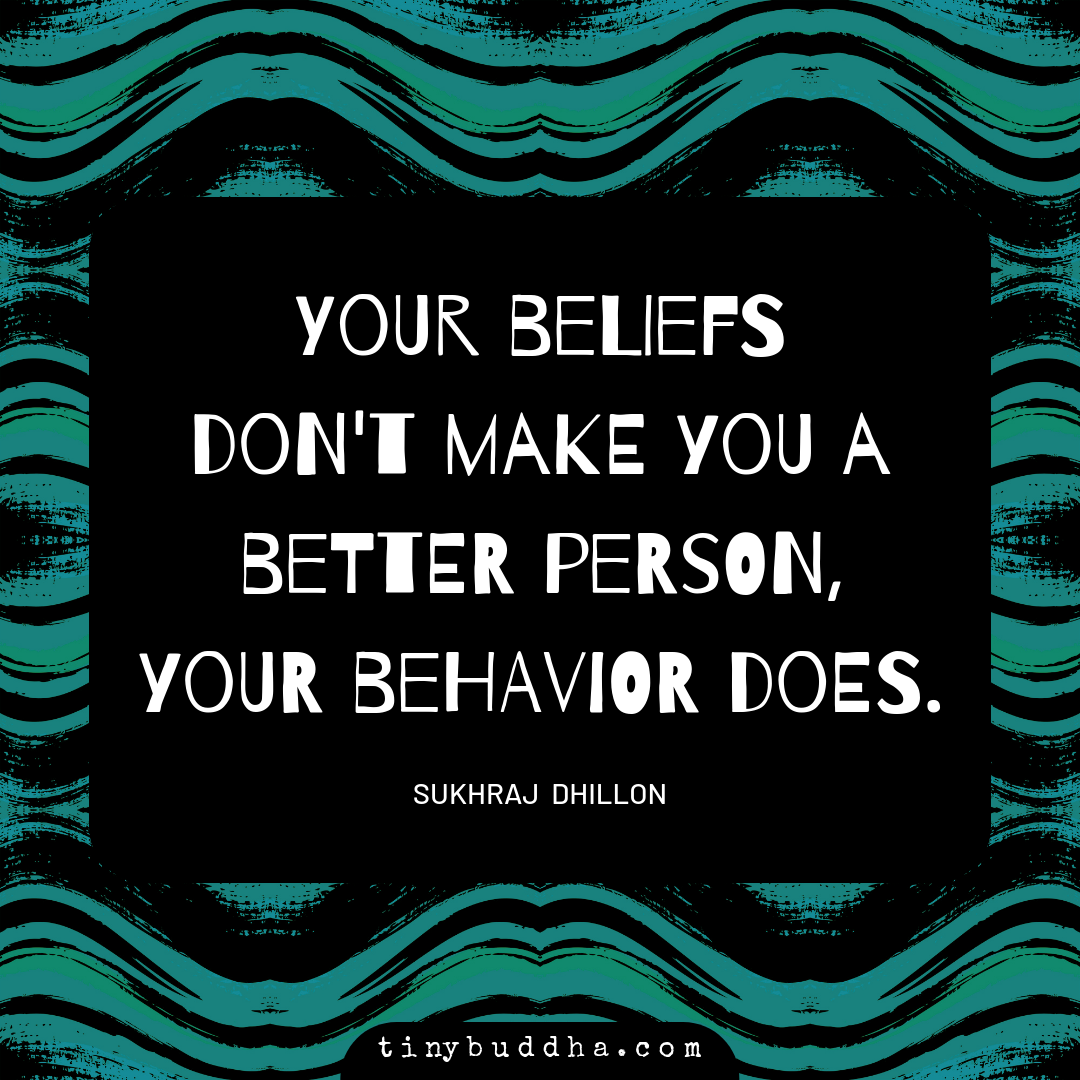
    As humans, we want to be right. We don’t want to admit a choice we made was the wrong one. We may have second thoughts and see lots of red flags going up all over the place, but we still hate to admit we made the wrong decision. So we stick with what we’re doing even if it feels wrong.

    I have a little secret to tell you: The most successful people are the ones who push through the fear of change and do it anyway—even if it’s hard on their pride. It can be done. It will be messy in the middle, but you’ll get through it. When self-doubt creeps in, you need to follow two steps to make a change.

    1. A mindset shift

    You absolutely must believe that you can and will be successful to become successful. No matter what the goal is, you must believe in yourself and see the success as a real possibility.

    For example, if you want to move your muscles more through exercise, start your morning off with the mantra of “I am making my health a priority. I will move my muscles today.” Start acting like someone who exercises. Make decisions like a person who moves on a regular basis. Schedule it in. Talk about it.

    If you want to be happier and healthier, use these I am statements to help get you there: “I am enough.” “I am worthy of happiness every day!” Many people say they want to feel happier but don’t believe they deserve it, so they end up sabotaging themselves. Say those statements out loud. Write them down. Get to the root of any traumas or past conditioning that prevent you from believing them.

    Once you shift your mindset, your choices and path will align with the new you. You will reach your goals, or at least make progress toward them. You may experience imposter syndrome along the way. Keep going. That is a part of the mindset shift process. Talk back. If you believe you can do the things you want to do, you will.

    2. A strategy

    The second part of your success journey is the roadmap to move you forward. You cannot just wish and hope for things to happen. You must do the work.

    If you’ve shifted your mindset, now you need to travel the miles to get where you want to go. How do you do this? Set realistic goals. Make a plan. Follow the plan and stay consistent. You’ll need guidance along the way. Surround yourself with people who are doing what you’d like to do. Listen to the advice of those who have traveled this road before you. Ask for help to stay accountable.

    Do not assume that this will be an easy path to travel. Most things worth having require a good bit of work. Expect roadblocks and push past them.

    Know that not everyone in your current circle will be ready for you to shift. Change is scary on a personal level. When others change around you, it’s frightening if you aren’t shifting alongside them. In some cases, your change will create positive ripple effects for those closest to you, but it will happen for them once the timing is correct.

    Your future self is waiting to meet you—you just need to get moving. The path will not be all sunshine and rainbows, but you can travel it. You can make a change, even a great big one.

    Once you are on the other side, you’ll wonder why it took you so long to get there. You’ll be happier. You’ll be healthier. Other people will ask you how you did it! Take that first step and keep going. I promise you it’s better on the other side.

  • How I Lighten My Mood by Making a Bargain with the Universe

    How I Lighten My Mood by Making a Bargain with the Universe

    “Pain is what the world does to you; suffering is what you do yourself.” ~Gautama Buddha

    I don’t expect things to be a steady state of bliss.

    In fact, I agree with the Buddha that suffering is pretty much part of the human condition. Our expectations just get in the way of our experiences. I’m talking about your garden-variety suffering here, not the kind that comes with traumatic events that take you out at the knees or devastating clinical depression.

    I see the now-and-then emergence of lethargy or melancholy as part of the whole emotional spectrum. And, like stepping in water in your stocking feet, bound to happen from time to time for most of us. Plus, for me anyway, I think recognizing the difficult days enables me to better savor the wonderful and even the tremendously ordinary ones.

    Still, knowing that the spinning wheel is going to land on grey sometimes does not mean those days aren’t tough. For me, that greyness means my mood, my gait, even my ability to recognize the full bounty that is mine just feels heavier and more arduous. Sort of like moving through muck that slows your pace and clings to your boots.

    Just as I think those emotions are due to sometimes arrive, I also know they will leave—I just want to accelerate that departure. And I’ve found a way that works for me. I make a deal with the Universe.

    I speak this pact out loud—“I’ll try if you try.”

    I commit to trying to pull my boot out the mud by first focusing on my senses.

    Under the header of controlling what I can control, I might actively focus on taking in the smell of fresh coffee—holding the cup in my hands, without expectation, and just experiencing it. The rich smell, the playful bubbles, the warm solace held in a favorite mug. I try to let that singular moment envelope me, seeking nothing specific in return.

    Or I might stand at a window until I can feel the sun’s warmth on my face. I will then imagine my breath carrying that warmth down my neck to my collar bones, down to my fingers and into my belly. I’m not looking to be instantly “fixed,” just to prime the pump to receive and interpret information differently by bringing my senses and my nervous system into the equation.

    The Yoga Sutras, a text from perhaps as early as 500 BCE that codified yogic theory and practice (yoga with  “big Y,” way more than just the poses) reinforce the role of the nervous system in expanded consciousness. We take what we experience to be the truth, but as the theory goes, if you change what you feel/believe you experience, your conception of the truth changes.

    It’s like the ancient parable of the blind men and the elephant—you build your definitions of what is based on what you experience. My rationale proceeds then that if I alter my perceived inputs, the narrative that my nervous system spits out can also be altered.

    So that’s my part of the bargain—to widen the sense aperture and find a better experience. For the Universe’s part, I imagine it sending little gifts in return for my efforts—a great parking spot, the wave and smile of a colleague down the hall, a new local tour date for a favorite band.

    I don’t actually think the Universe is moving cars or colleagues or tour schedules to accommodate me. It’s simply me noticing. That doesn’t keep me from imagining a sort of an equal and opposite reaction in play that generates goodness in response to my attempts to notice goodness.

    I think of this noticing as a reframing of the “Toyota principle.” Long ago when my husband and I got a real car, we got a Toyota. Once we had the Toyota, we suddenly noticed all the other Toyotas on the road and wondered where they’d come from. They hadn’t suddenly flooded the market. It was more about moving the metaphorical antenna to recalibrate the signal—ah, I see things now.

    Actively being open to the light and marveling at its forms still doesn’t serve up a twenty-minute fix. It does remind me of all the good standing in wait for me and reinforces that “this too shall pass.” In fact, someone wise once told me “If you want to change something, you’ve got to change something.” These are my somethings.

    And so I commit to engaging my senses and being open to the beauty and love in my cup (even if my experience meter feels set to “low”). I believe that if I can do my part, I’ll again come into alignment faster with a Universe that offers no promises, but provides plenty of opportunity and wonder.

  • When You Strongly Disagree with Someone: How to Find Common Ground

    When You Strongly Disagree with Someone: How to Find Common Ground

    “The truth you believe and cling to makes you unavailable to hear anything new.” ~Pema Chodron

    I was recently having dinner with a group of friends, and I casually mentioned that I’ve been making more effort in my life to help prevent climate change.

    Across the table, someone looked straight at me and said, “You know human-induced climate change isn’t real, right?”

    I was shocked because I’ve known this person for years, and we’ve always agreed on important topics in the past. I immediately shot back with, “Umm, yes it is!” and proceeded to tell him exactly why he was so wrong.

    I’ll spare you the gory details, but let’s just say the rest of the conversation didn’t go well. It gradually got more and more heated until we were the only two people talking (read: yelling) at each other across the table.

    In the end, someone shut the argument down by saying, “You’ll just have to agree to disagree.” We both took the hint, retreated into our corners, and glared at each other for the rest of the evening.

    A few days later, I was relating the incident to another friend. In all honesty, I was looking for an ally who would help stoke my righteous indignation. But instead of nodding and agreeing with me, she said, “It sounds a lot like you were trying to force your beliefs on him and got mad when he wouldn’t back down.”

    This comment stuck with me, and over time I was forced to admit she was correct. I was so caught up in being right that I had refused to accept anyone could believe differently. Even worse, emotion had completely taken over, and I’d made no effort to find common ground or try and see things from a different perspective.

    In hindsight, I’ve realized I was missing the larger truth that we all believe we are seeing the world as it should be. Our entrenched beliefs become part of our identity because they help us make sense of the chaotic world we live in. And when someone holds a radically different view to our own, it shakes the foundation of our own beliefs and makes us feel off balance and insecure.

    But the good news is, no matter how differently you see the world from someone else, there’s always a way to find some common ground. Here are six tips I’ve learned to help have productive, respectful conversations and open your mind to different perspectives.

    1. Focus on the outcome.

    When you get bogged down arguing about specifics, take the argument up as many levels as you need until you find common ground.

    For example, in the case of climate change, we could have both easily agreed that the environment is important and we want to leave the world a better place for our kids. We just have different views on how to get there. This is a great way to reset the conversation because you’re focused on discussing the outcome rather than winning the argument.

    2. Understand their perspective.

    Learning the underlying reason why someone believes something can help you see a different side of the issue. It might not change your mind, but it will help you treat the other person with more empathy and give you fresh ideas to discuss.

    For example, someone’s refusal to accept climate change might be caused by concern about the negative effects it will have on their life. Maybe transitioning to renewable energy means they will lose their job or be forced to change their lifestyle in ways they don’t want to accept.

    If you can understand these underlying concerns, you’ll be much more likely to find common ground and have a productive discussion.

    3. Separate emotion from logic.

    A stressful argument can hijack the prefrontal cortex—the part of the brain responsible for critical thinking and decision-making. When this happens, you go into “fight or flight” mode and become more likely to react emotionally, think less creatively, and say things without thinking them through.

    The next time you find yourself getting angry or defensive in an argument, take a step back and try to de-escalate your emotions by acknowledging them. Once you’re feeling more logical and calm, you can start to look for common ground again.

    4. Practice active listening.

    Active listening is a communication technique that involves hearing, paraphrasing, and responding to what the other person is saying. It’s an essential skill for finding common ground because it shows that you’re genuinely interested in understanding their perspective.

    The next time you’re in an argument, try repeating back what the other person has said in different words to make sure you’ve understood them correctly. Then, add your perspective to what they’ve said. For example, “I can see why you feel that way, but I also think…”

    5. Be mindful of your own biases.

    We all have biases—it’s part of being human. We want to win arguments, be right, and be liked, so it’s easy to fall into the trap of only listening to information that supports our point of view.

    In this case, I was forced to admit that I haven’t actually read any of the climate change research myself. My beliefs are almost entirely based on existing in a bubble with other like-minded people who reinforce those beliefs.

    Exposing yourself to different perspectives—even if you don’t agree with them—can help you think more critically about your own beliefs. It might even help you find common ground where you thought there was none.

    6. Remember that differing views are important.

    If everyone agreed on everything, the world would be a pretty boring place. But even more importantly, differing ideas help to push society forward. They challenge us to think critically about our own beliefs and come up with new solutions to problems.

    So the next time you find yourself in an argument with someone, try to see it as an opportunity to learn and grow rather than a chance to prove your point. You might just be surprised at how much common ground you can find.

  • Why Other People’s Comments Hurt Us and How to Let Them Go

    Why Other People’s Comments Hurt Us and How to Let Them Go

    “It’s not the events of our lives that shape us, but our beliefs as to what those events mean.” ~Tony Robbins

    Sticks and stones may break my bones, but words will never hurt me.

    Wow. That one takes me waaay back. All the way to the elementary school playground. A place where I attempted to use it as a shield. As juvenile as this saying is, I would search for comfort in its words for years to come.

    In the end, it doesn’t matter how old we get. It’s good to feel a part of something, to be understood, and to be accepted, and it hurts when we feel we’re not good enough to belong.

    Whether it’s due to the words of a schoolyard bully (with a flat-chested joke), a passing remark from a stranger (“your arms are hairy”), or an observation by a loved one (“you’re too shy), we begin to transform into a guarded version of ourselves.

    Daily interactions with others thicken our skin a bit, allowing some words to roll off our backs. But the ones that stick around change our inner landscape.

    For many of us, the physical pain we suffer come from accidents, adventures, or clumsiness. They are unpredictable events that originate from nowhere in particular. They don’t feel personal.

    Words, on the other hand, always stem from people. And they almost always feel personal. For a species that thrives on connection, acceptance, and love, words are a primary source of information about where we stand within our tribe.

    With words, we define ourselves, find our people, and take a stand. Words reinforce who we are. Words inspire. Words make us giants. With words, we feel pain, loneliness, or betrayal. Words cut us down. Words keep us small. Words plant seeds of doubt. Words deflate.

    Words are powerful. Choose them wisely.

    When it comes to delivering a message, how we say things matters.

    Words can be positive, negative, or neutral. Imagine how using the very same word creates different outcomes.

    “Quiet!”

    Spoken at a surprise birthday party, this gets everyone excited. The guest of honor is coming!

    Spoken to a questioning child, this makes her feel small, unimportant, hurt.

    Even an adult can suffer at this word. Imagine a man watching a football game. His wife runs in to share an exciting piece of news. He shouts “quiet,” and just like that she feels diminished and robbed of joy.

    Words are powerful. But is all the power reserved for the speaker?

    When it comes to receiving a message, we can feel powerless. Just as a spider’s web catches much more than dinner, our minds become cluttered with a lot of word debris. I have spent years unpacking my pain and my past, and the ickier parts are born from comments, passing phrases, and direct attacks.

    So, here’s my question: Why do some things go in one ear and out the other, while others have a way of following us around? Why do some words so profoundly affect us that we give up our joy and opt not to dance, sing, or speak?

    Here’s my revelation. Those who know me have heard me say it before: What we believe matters.

    It seems that words can become seeds planted in my brain. The ones that stick around begin to grow into something messy that tangle with my very being.

    After a lot (and I mean a lot) of soul searching, I have found my common denominator—two actually. My hurt is born from the truth or from my fear of what might be the truth. The pain is my feelings of lack that get amplified.

    Whew. That’s a bitter pill to swallow. None of us want to believe that we think we’re not smart, beautiful, fun, cool, lovable, or funny. But I’ll say it again. Almost all the remarks that have hurt me are ones I thought were true. Or ones I feared might be true. That’s it.

    When our truth is revealed or challenged it is painful. Our truth is often a part of us that we cannot or feel we cannot change. Whether it’s our laugh, our bodies, or our dreams, we are exposed.

    What do we do with this? The only thing we can—accept ourselves. Just. The. Way. We. Are.

    This doesn’t mean we cannot continue to grow and evolve as humans. It means that we are always being and becoming.

    Most of us go out into the world as ourselves and slowly withdraw into our shells as we feel less and less safe to be who we are. We become a watered-down version of our colorful selves to avoid vulnerability.

    But I’m here to challenge the idea that vulnerability has to be painful. Uncomfortable, yes, but maybe not painful. Our best defense is knowing and embracing who we really are so that when someone questions our character or motive it is either true or not true—and if it is true, being okay with that.

    If I find myself ruminating on a comment, it’s an opportunity, a chance for me to know myself better.

    Now, when a word stings, I approach the discomfort differently. I ask myself: Why am I hurt? Is this true? Is this something I can change? Do I want it to be true? If it is me, can I do more than accept it—can I love this part of me?

    I used to think my problem was that I wasn’t enough ‘this’ or needed to be more of ‘that.’ I used to think that if I could just take the best parts of other people and become those things, I would feel secure, confident, and untouchable.

    But it was exhausting, and I would inevitably fall short of my goal. My life was like a house of cards, ready to crash at any moment. Living in fear is draining. I also began to feel like I couldn’t make any forward progress. It was like treading water when I could be swimming.

    It wasn’t until I took a break and developed faith in myself that I found my full energy, optimism, and confidence return. Because in the end, we can never be great at being anything but ourselves. There is no trying anymore, only being. And the knowing that I don’t need to be all things. Just myself. Regardless of what other people have to say about that.

    And you know what? The strangest things have begun to happen. I have found new strengths, new joys, and new opportunities. When I let go of mimicking others’ successes, I have found more of my own. The kind that I’m not afraid to lose. The kind that doesn’t make me feel like a fraud.

    Sharing my voice has gone from scary and nerve-wracking to a way to create connection and joy. The transition feels like nothing short of miraculous. If you would’ve told me all this several years ago, I would never have believed that I could achieve this kind of peace and confidence. But I have come to believe in believing. And I highly recommend it.

  • How We Can Overcome Our Obstacles When We Don’t Believe It’s Possible

    How We Can Overcome Our Obstacles When We Don’t Believe It’s Possible

    “If we can see past perceived limitations, then the possibilities are endless.” ~Amy Purdy

    Nature inspires me. There are hidden messages consistently on display. On my daily walks, I find myself interpreting these messages in relation to my life.

    One day, near the end of my walk, I was paying attention to the trees. A giant one caught my eye. Its magnificence was portrayed as morning sunlight peeked through the branches and bright green leaves.

    I noticed the enormity of its trunk, and then I saw the crooked fence.

    The giant tree trunk had grown so big that it pushed a section of the fence up off the ground. The fence barely had any balance left and looked as if it could topple over at any moment.

    As I watched all of this, I remembered another tree I had seen on one of my walks. The tree’s branches had grown so long and so thick, they struck through the slats on a metal fence. Big brown wooden knobs stuck out, encapsulating the thin wires. I was in such awe, I reached out and touched the chunky parts of the tree, thinking I could unwrap it from the fence. Not a chance. The fence had become a part of the tree.

    In seeing this tree, I thought, “Trees just do what they do. They continue to grow despite any objects that happen to be next to them.”

    These objects could appear as obstacles, but that does not stop the tree from growing. The tree adapts to its surroundings and keeps on keeping on. Depending on the barrier, the tree either continues to grow around it, or the tree ends up wiping out whatever is in its way.

    How is this symbolic in the life of a human?

    The nature of our true essence is to grow. Life seems to contain many events that are beyond our control. We find ourselves in situations where it seems we are being tested. Obstacles show up on our path, and we are faced with the question, “What do I do now?”

    But it really isn’t the obstacle that is in our way. It’s our beliefs about the obstacle that can stop us in our tracks. The tree doesn’t come up against the fence and stop growing. It just keeps doing what it’s supposed to do.

    Here is how this relates to an experience I went through in my early twenties. It was a true test of following my inner guidance instead of listening to the doubts of others around me, as well as my own uncertainties.

    At the age of twenty-two, I found myself pregnant, single, and living back at home with my mother. I was working an office job forty hours a week, making ten dollars an hour. Luckily, I had good health insurance, but what I didn’t have was a lot of self-confidence. I carried around shame.

    This was in the year 2001. Times had changed, right? Why was I so ashamed of being a young, pregnant, unwed girl?

    Because even in current times, that stigma was carried around deep in the trenches of society. And my own mother and older sisters had been through it, too. You could say the feeling of shame was passed down in many generations.

    After my son was born, I knew I had to do something different with my life. I received government help for food and baby formula, and my son was on government health insurance. Again, this only added to my shame because of the looks I would get at the checkout counter in the stores.

    But I knew I wanted to provide a better life for my son, and I knew there was something inside of me that wanted to grow beyond what I thought my potential was.

    I felt an inner calling to go into the medical field. So I decided to go back to college. Many obstacles showed up on my path once I decided to go for it.

    I hadn’t even enrolled in college yet, but when I began speaking aloud about my plan, fear set in, and people’s opinions fueled that fear.

    How would I attend college full-time with a four-month-old baby, work to provide for us, and find childcare in the meantime? Could I do it?

    Some people didn’t think so. They told me it would be too hard. They told me my son was too little, that I should wait until he was older.

    Attending college and raising my son would be too stressful. How did I plan to pay for tuition? Could I even get accepted into the highly competitive program, especially since I was already on academic probation?

    Right out of high school, I proved to lack ambition, and along with poor grades, I ended up dropping out of college after just two years of study. Now, how in the world was I going to get the university to accept me back, especially as a newly single parent?

    The obstacles kept appearing, left and right. A university advisor even told me that the program I wanted into was extremely challenging. He asked me, “Do you have family who can help you with your son? Because this program is rigorous and requires a lot of time.”

    Imagine, all of these stumbling blocks could have made me believe that I was not capable of pulling it off. I could have chosen to believe what I was hearing.

    I could have formed beliefs telling me my plan wouldn’t work. I had the choice to follow my inner guidance, my true essence, which pushed me ahead to grow, or I could believe my thoughts about it all being too hard. I could buy into the shame and the collective idea that I had no future.

    But there was something deep inside of me that knew I was meant to do this. I was meant to challenge all of the belief systems put in place that could hold me back.

    Back then, I did not know the power of positive thinking. I had never heard of manifestation. There were no tools in my toolbox to help push through any doubts. All I had was my inner guidance system and the strong desire to grow and show myself that I could do something really challenging.

    Four years later, after a lot of hard work, I graduated from college with a bachelor’s degree in respiratory therapy and was already employed at a local trauma hospital. I was living out on my own with my son and supporting us with my single income. I had found my passion for life, too. I was helping people who were sick.

    Our lives are a reflection of what we believe is true and possible. The belief systems we have in place guide our thoughts, desires, and the actions we take or do not take to make things happen.

    Instead of letting your beliefs hold you back, use this process to grow around them.

    How To See Through Your Belief System

    1. Choose a specific goal you would like to meet or choose a current situation you would like to change.

    2. Write down every belief you have about that goal or situation, specifically, any beliefs you sense are holding you back.

    These beliefs include:

    “I don’t have enough time.”

    “I’m not smart enough.”

    “I’m too old.”

    “I don’t have enough experience yet.”

    “My family would never approve.”

    3. Take some quiet time to engage with these beliefs. Sometimes I find it helpful to think about these during walks, while driving, or while I’m out in nature.

    4. Question where these beliefs came from. Usually, you will see the restrictive beliefs come from somewhere outside of you. They are ingrained from childhood, simply adopted from your parents and caregivers. You will even see a lot of beliefs come from society on a collective level.

    5. Once you can see where the beliefs come from, you have a choice whether to keep believing in them. What worked for me was not to try to change my beliefs into the opposite but to keep identifying that the belief was outside myself. The belief was not a part of my inner guidance. And then I would choose to move past it, not allowing it to hold me back.

    Forward Movement

    Seeing through your belief system is not an overnight process. More than likely, the systems have been with you for a long time. It can take discipline and effort to recognize them when they arise.

    Recognition of your inner guidance during this process is vital. It will not fail you.

    Keep listening to your inner guidance, your true essence. It will take you beyond your wildest dreams. It will be the tree that grows through fences.

  • Avoid Feeling Bad: How to Stop Taking Things Personally

    Avoid Feeling Bad: How to Stop Taking Things Personally

    “There is a huge amount of freedom that comes when you take nothing personally.” ~Don Miguel Ruiz

    Oh man, if I had a dollar for every time I took something personally…

    I’d be rich by now.

    When I quit my corporate job in Paris and took a year off traveling people would often ask me, “So, what’s your plan now?” A normal question to ask, I know. But back then, I usually got offended by that question and other follow-up ones. It made me think that others were judging my decision and questioning my ability to change career paths.

    Or when I was single and people would ask, “So, are you seeing anyone right now?” Again, I’d often assume that they thought less of me if I didn’t have an interesting single life or wasn’t dating someone special.

    Or in the early days of dating my boyfriend, when he wouldn’t have time to talk or see me at times, I’d take it personally and assume the worst. Maybe I had done something to mess everything up. Maybe he didn’t think I was that interesting after all.

    Taking things personally is emotionally draining. It often makes you assume the worst and puts you into the victim corner. Sometimes, of course, it’s worth reflecting on our own behavior, which can help us develop and grow as individuals. But taking things personally, when many times they’re not, just tears down our self-esteem and makes us question ourselves.

    Here are a few ways to stop taking things personally:

    1. Question your negative beliefs.

    When we take things personally, it’s often because we hold a negative belief that is fueling our perception of a situation. For example, if you say “hello” to an acquaintance on the street and get upset because they don’t reply back, you might believe that people who don’t acknowledge you are rude or that they have something against you.

    Look at the limiting belief behind the situation and question it. Maybe they didn’t actually see you. Maybe they didn’t have time to perceive that it was you who passed by. Or maybe they were simply too occupied in their own mind to engage with anyone else.

    Many times, our beliefs make us misinterpret situations negatively and turn them against ourselves. We form negative assumptions and inevitably feel hurt if we don’t take the time to question our thoughts and beliefs.

    2. Don’t assume you know everything.

    When I left my job to travel for a year and get clear on what business to start, I was scared of what others, especially colleagues I respected, would think of me. I simply assumed that they would think I was irresponsible for leaving a good career for… well, I didn’t know yet.

    There was one colleague in particular, who I really looked up to, that I already had assumed judged me for my decision. Whenever she mentioned something about her career, I turned that against myself as a way of confirming “I knew it, she thinks I’ve made a terrible mistake.

    Then one day, when we were talking about my journey and the choices I had made, she said, “You know Maria, I think you’re so brave. I wish I had the courage to also quit and pursue my own business.” This proved to me that we don’t know what others are thinking about us, even if we think we do. So don’t assume you know everything.

    3. Know that it’s not about you.

    When someone seems harsh or insensitive it’s easy to assume it’s personal. But often, it’s really not. Someone who’s rude to you in traffic might have had a terrible morning. Someone who makes a condescending comment might struggle with their own self-esteem and self-confidence. Someone who’s cold and short in their communication might be really stressed.

    It’s worth reflecting on what we can learn when it comes to things we take personally. In my experience, there’s always a lesson. Try to extract it and then leave the rest.

    For example, when I started a podcast, a friend sent me a picture over Instagram with the message “Women doing podcasts just found a substitute for therapy.” It was supposed to be funny, but it wasn’t to me.

    My learning in that situation was to care more about what I wanted to do instead of one other person’s opinion (or joke). (And I’m happy I’ve continued because, since then, we’ve received so much positive feedback on the podcast!)

    4. Create a counter-story.

    Often, when we take something personally, it’s because it confirms a negative story we have running in the back of our mind. For example, if someone in your family makes a joke or comment about you being messy or having limited cooking skills—and you regularly tell yourself that you’re somehow inferior to others because of these things—you might get offended.

    So, what should you do? Create an empowering counter story. Maybe you’re a bit messy, but so what? You might also be really creative. And maybe you’re not so great at cooking, but you have other skills—for example, you’re the one who always sorts out conflicts between people.

    In short, tell a story that benefits you and remember that we all have flaws, quirks, imperfections, and weaknesses. Needless to say, if you don’t like your behavior, then of course, you have the power to change it. But sometimes you simply need to accept that you are who you are, and there’s nothing wrong with that.

    5. Accept that we’re all different (and not everyone needs to like you).

    You might be taking something personally because this gives you a greater chance of getting someone’s approval. If it’s about you, then there’s something you can do about it. If it’s about them, then it’s truly out of your hands, and all you can do is accept that, for whatever reason, they don’t like you or won’t let you in.

    No single person on this planet is liked by everyone. That’s just part of life, for all of us. Instead of trying to change yourself to be liked by someone, shift your focus and ask yourself why you need this person’s approval. Is it that you’re uncomfortable with disapproval in general, or do you want them to like you for other reasons, such as they are a friend of a friend?

    When you identify the root cause of your discomfort with their disapproval, you’ll be able to tell yourself what you need to hear to let it go—for example, that their opinion doesn’t mean anything about you as a person.

    6. Create space between an “offense” and your reaction.

    When we take something personally, it’s easy to lash out in anger, frustration, or pain, which only makes things worse. Before you step into action, try creating some space between the situation and your reaction. Breathe, step away, and allow yourself to calm down before acting out.

    Maybe you interpreted the situation in a negative way. Maybe this person wasn’t judging or being condescending toward you. Maybe there’s something you don’t know about the situation. Try not to react to the situation, but to respond once you have calmed down. Perhaps with a little time and space you’ll recognize your initial conclusions were wrong.

    7. Ask for clarification.

    If you know the person who said or did something that made you feel bad, ask for clarification. What did he or she really mean? What was his or her intention? Many times, we interpret situations negatively. But in my experience, after asking for clarification, we realize the other person didn’t intend to hurt us.

    So instead of letting your thoughts spin off in a negative direction, ask the person to spell out what he or she really meant. You may be surprised by the number of times you learn that you completely misread a situation.

    8. Practice self-compassion.

    This is what it all comes down to, isn’t it? Practicing self-compassion when we’re being hard on ourselves. Because even though someone else might say or do something to offend us, we’re the ones who decide how we let their behavior affect us. We can always choose not to take negative comments to heart or get down on ourselves just because someone else was rude or insensitive.

    Practice saying, “I’m not letting that in” to draw a clear line when you’ve decided not to take something personally.

    Whether you misinterpreted a situation or someone actually was rude to you, you decide whether to invite it in or not. So stand guard to the door of your mind. Keep a high standard and make sure to let in words, thoughts, and beliefs that empower and strengthen you.

  • The Fascinating Reason We Sabotage Ourselves and Hold Ourselves Back

    The Fascinating Reason We Sabotage Ourselves and Hold Ourselves Back

    Sometimes we self-sabotage just when things seem to be going smoothly. Perhaps this is a way to express our fear about whether it is okay for us to have a better life.” ~Maureen Brady

    Have you ever decided to try something new—like getting into a new relationship or doing something that would help you experience success in your career/mission or offer you more vibrant health and well-being—and you were able to follow through for a bit, but then you stopped? Was this self-sabotage? Was it procrastination?

    Did you know that self-sabotage and procrastination can be survival mechanisms, and they’re actually our friends? They’re meeting some type of need, and it happens to all of us to a certain degree.

    Every behavior we do serves us in one way or another. We self-sabotage and procrastinate for many reasons, and it’s different for everybody; most often it’s coming from a part of us that just wants to feel safe.

    The key is working with these parts, not against them, and not trying to get rid of them. When we work with them and integrate them, we experience more energy, and they become a source of great strength and wisdom.

    The “symptoms” of self-sabotage and procrastination carry important messages; most often they’re a cry out from our inner child.

    Sometimes what we think we want isn’t what we truly want. Self-sabotage and procrastination may be our inner guidance saying, “Hey, I have another way.”

    Sometimes we’ve had many disappointments in the past, so our subconscious puts the brakes on and says, “What’s the use? I never win; I always lose.”

    If we’re overindulging in alcohol and food, using distracting activities, and not doing what we say we want to do, then there’s a reason. The key to healing and shifting that energy patterning is discovering the reasons and what that part of us needs.

    We often experience self-sabotage and procrastination when our unconscious needs aren’t being acknowledged or met.

    Trying to change the outer and/or push through with positive thinking takes a lot of efforting, and it often wears us out. Why? Because we’re fighting against our own biology, which creates self-doubt, self-judgment, inner conflict, fear, and insecurity. They all play together “on the same team” in that same energy.

    Most of our programming was created before we turned seven. This was when we formed our beliefs about who we are, what we deserve and don’t deserve, and how life works.

    When we want to experience something new, our subconscious goes into its “memory files” to see if what we want is “safe.” Safety can mean many things—maybe familiarity, or not speaking our truth or sharing our creativity, or using substances, like food, cigarettes, drugs, or alcohol, to numb our feelings and/or keep pain away.

    If we’ve had painful experiences in the past that were similar to what we want now, that may be the reason a part of us is procrastinating and/or self-sabotaging. Why? We have a built-in survival system, and when we’ve had a negative/painful experience, our protector part will keep that from happening again.

    We learn through the law of association, and this gets stored in our subconscious. If, as a child, we put our hand on the stove and got burned, our brain then created neurons that associated a stove with pain, so the next time we got close to a stove, we’d remember that pain and we’d be more careful.

    Our brain operates the same with physical or emotional pain. The problem is the brain may misinterpret the amount of danger we’re really in by operating on a neuro pattern that’s outdated.

    If the experience we want brought us pain in the past or we don’t feel good enough to experience it, we’ll either sabotage it or our brain will provide us with a list of reasons why it won’t happen. (But keep in mind it may not be in your best interest anyway.)

    If we found a way to soothe ourselves or find relief through addictions in the past, then we’ll automatically go back to those substances when things seem challenging if we haven’t learned how to comfort ourselves and feel, process, and express our emotions in healthy ways.

    When I was a child, my dad constantly told me, “If you don’t do it right, don’t do it at all.” The problem was, in his eyes, I never did anything right. He also told me that I wasn’t good enough or smart enough, I would never amount to anything, and I was a selfish human being.

    He blamed me for everything that happened, even if it wasn’t my fault, and if I “talked back” or shared how I felt, he either punished me or gave me the silent treatment.

    These experiences became my blueprint; I became fearful of myself, everyone, and everything, and this affected me greatly. I ended up disconnecting from my authenticity, and I became a very lost and confused being.

    The fear became so strong that if I had a thought about buying myself anything, asking for what I wanted or needed, expressing what I was thinking or feeling, or doing anything self-loving or self-nurturing, I’d self-sabotage, procrastinate, and feel anxiety and a sick feeling in my stomach.

    I wasn’t doing this consciously; my subconscious was signaling to me that wanting anything wasn’t safe because I may be punished, abandoned, or even hurt if I did any of these things I mentioned.

    As a child, I used food for my comfort and safety until age thirteen, when I was told to go on a diet and lose weight. At age fifteen I became a full-blown anorexic. Then my new comfort and safety became starving myself and exercising all day.

    From that point on, whenever I was faced with new choices or ways of being, I would push them away. I thought I was dealing with the fear of failure or not doing it right, but it went even deeper; I recognized it was really the fear of being punished, rejected, not loved, and abandoned, and to a child that’s the worst experience.

    I was stuck in an internal prison, thinking, “What’s the use of living? If I can’t be me or do anything, why even be in this reality?” This led to almost twenty-three years of self-abuse, suppression, anorexia, anxiety, and depression.

    My mom used to say to me, “Debra, you always climb halfway up the mountain, then you stop and climb back down.”

    This is what many people do: They stop before they even start, or they start something new and don’t continue to follow through, and this is because of our “emotional glue.” What’s emotional glue? Unresolved issues “buried” in us; it’s where our energy patterning is frozen in time, and it’s from where we’re filtering and dictating our lives. 

    Most often we don’t even know it’s there; we’re just living in the energy of “I can’t,” “beware,” or “it’s just not fair.” And/or we become judgmental of ourselves because we’re not able to do what we say we want to do.

    None of our symptoms are bad or wrong, and neither are we if we’re having them. In fact, “creating them” makes us pretty damn smart human beings; it’s our inner guidance asking for our attention, to notice what’s really going on inside that’s asking for compassion, love, healing, understanding, resolving, integrating, and revising.

    When I was struggling with anorexia, self-harming, depression, and anxiety, going to traditional therapy and spending time in numerous hospitals and treatment centers, nothing changed. Why? They were more focused on symptom relief than understanding what was going on inside of me.

    I was afraid, I was hurting, I didn’t feel safe in my body, and I didn’t feel safe in this reality. I didn’t need to be forced to eat and put on weight; that only triggered my traumas of being teased for being fat and unlovable when I was a child.

    I would gain weight in treatment centers and then lose it when I left; some may have called it self-sabotage; I call it survival.

    My deep-rooted fear about gaining weight, which meant “If I’m fat, I’ll be abandoned, and no one will love me,” was the driver for most of my life journey. All my focus was on controlling my food and weight.

    I was numbing and suppressing; I was existing but not living; I was depressed and anxious. I was running away from life and myself. I didn’t want to feel hurt by those negative things that were said to me, so I stayed away from other human beings.

    I didn’t want to face the hurt and pain I was feeling internally, especially the fear of being punished and abandoned again; but really, I was doing this to myself. I was punishing and abandoning myself, but I couldn’t stop the cycle with my conscious thinking.

    Self-sabotaging, procrastination, and the anorexia, anxiety, and depression, well, they were my friends; they were keeping me from being punished and abandoned. They were keeping me safe in kind of a backwards way.

    I wish I knew then what I know now—that in order to help someone, we can’t force them to change their unhealthy behaviors; we need to be kind and gentle and notice how the symptoms of self-sabotage, procrastination, eating disorders, anxiety, addictions, and depression are serving them. 

    What’s the underlying cause that’s creating them?

    What needs healing/loving, resolving, and revising?

    What do we need that we never got from our parents when we were little beings? How can we give this to ourselves today?

    When we see our symptoms as catalysts to understanding ourselves better and we integrate internally by giving ourselves what we truly need, we’re able to heal and overcome self-sabotage.

    All parts of us are valuable and need to be heard, seen, loved, and accepted unconditionally. Each part has an important message for us.

    If you’re experiencing any of the symptoms I mentioned, please be kind and gentle with yourself. Instead of feeling down on yourself for sabotaging yourself, dig below the surface to understand what you’re really afraid of and how your behavior may feel like safety. When you understand why you’re hurting yourself and holding yourself back, you’ll finally be able to let go of what doesn’t serve you and get what you want and need.

  • If You’re Insecure and Afraid of Rejection Like Me…

    If You’re Insecure and Afraid of Rejection Like Me…

    “How brave the moon shines in her skin; outnumbered by the stars.” ~Angie Welland-Crosby

    I have this reoccurring dream where I am about to teach a yoga class. I stand to teach, and no one is paying any attention to me. They are all distracted or in deep conversation with one another and have no interest in engaging in the class.

    As I begin, one by one the students get up and leave. I am mortified and discouraged, though I continue to teach anyway.

    I wake up from the dream with a sinking feeling in my stomach and heaviness in my heart. Rather than indulge and spiral into sadness, I turn directly toward the aching.

    “Where is this coming from?” This is the question I ask myself as I dive into self-healing. Just as the body has the ability to heal itself on a cellular level when injured, we too have the ability to heal our emotional wounds.

    I have never been fired, from a job or relationship. I have always been the one to leave. This is not something I take pride in, rather I see a pattern that has developed over the course of my life since childhood.

    When I receive criticism, my insecurities are triggered. It must be because I am not good enough, as an employee, teacher, friend, partner. Clearly there is something wrong with me. My instinct in these situations is to run, to leave before anyone discovers my flaws, before I feel more hurt.

    I fear being abandoned or rejected, so at the first sign of conflict I retreat, like a turtle that goes into its shell the moment it senses danger.

    When I look back at my past I am left with overwhelming grief. As I peel back the layers further, I see more clearly the origins. Beliefs deeply rooted in childhood and cemented in adolescence. False beliefs of being replaceable, unworthy, not enough.

    Underneath the protective armor is an extremely sensitive and hurt little girl.

    A girl whose older sister locked her out of her room and refused to play.

    A girl who was teased by neighborhood kids for being weird.

    A girl whose best friend started an “I hate Shannon club” in fourth grade.

    A girl who always saw her friends as smarter, prettier, cooler, and more likeable.

    A girl who was desperate to be accepted.

    These deeply rooted wounds need proper acknowledgement in order to be healed.

    When we feel vulnerable or hurt, we tend to close off our hearts, gossip, turn to anger, or run away rather than address the discomfort. None of these behaviors will heal our emotional wounds. They are only temporary means of alleviating the pain. In order to break these old, conditioned patterns, first we must identify where the feelings are coming from.

    When We Feel Rejected

    Let’s face it, people can be mean. We ourselves can be mean.

    It can be hurtful and scarring to be left out, rejected, or on the receiving end of another’s harsh comments or behavior. But often, it isn’t as personal as we think. Often, others hurt us because they themselves are hurting. Perhaps it isn’t even intentional and the other is unaware they are inflicting pain.

    When we look beneath the surface of rejection, we ultimately discover feelings of fear and abandonment. But we can choose to change how we think about rejection, and consequently, what we feel.

    While we can’t control what other people think, say, or do, we can control how we receive and perceive. We get to choose whether we allow another’s comments to define who we are or how we feel about ourselves.

    There are some situations where walking away is the right thing to do. But not out of fear, spite, or in defense, but rather from a place of surrender and acceptance.

    We can redirect our energy to people and situations that are positive and enriching. Mutually loving relationships and situations where we treat one another with kindness, support, and encouragement. Where, rather than tear one another (or ourselves) down, we lift each other into the highest version of ourselves.

    There are countless situations that can trigger feelings of unworthiness, but I’d like to focus on two specific ones that have been particularly challenging for me.

    When a Relationship Ends

    Whether we chose to leave or not, there is often a deep sense of loss when a relationship ends. These feelings of loss can reappear at any time after we think we have moved on, especially when we witness someone else taking our place. A place that once made us feel special, valued, adored.

    I experienced this as I watched my ex’s new girlfriend move into a home that was once mine. The feeling of being replaceable. Even if ultimately, a relationship isn’t good for us and is no longer what we want for our future, watching someone move on can bring up grief and insecurity.

    Rather than indulge in these feelings, we can choose to be happy for the other. Happy they have found love and comfort in someone else. Happy at their own ability to heal and move forward with their life.

    Not always easy when we haven’t found love or comfort in another, we haven’t healed, and we aren’t moving forward with our own life. What makes it even harder is that we often reject ourselves when we feel rejected by someone we loved. The antidote? Focus on finding love and comfort in ourselves to reinforce that we are still worthy of love, and we don’t deserve to be or feel rejected—by anyone, including ourselves.

    When We Compare Ourselves to Others

    Jealousy is a destructive emotion and can be triggered by an off-hand comment, a sideways look, or a social media post.

    We are happy and content one moment, the next our ex updates their Facebook status to “in a relationship,” or we see a post from someone who appears to be doing better in life, and we are sent into a downward spiral that involves stalking profiles, comparing ourselves to another, anger, questioning our decisions, feelings of regret… the list goes on.

    In order to overcome the green-eyed monster, we must stop comparing ourselves to others and see our own unique gifts.

    Often it is the desire to be someone special that drives unhealthy behavior and thought patterns. Consider this: You already are special. You already are good enough, just as you are. Without having to change or do anything different. You can stop trying to be good enough and allow yourself to just be.

    When I recently experienced conflict in an interpersonal relationship, I was talking with my mom and I said to her in defeat, “I just try so hard to be a good person.”

    She said to me, “Well then stop trying. You already are a good person. You don’t have to try, it’s who you are.”

    The truth is, no one has come before you or will come after you with your exact qualities. You don’t need to prove yourself to anyone else or to yourself. The fact that you even exist is a miracle. What a gift. Allow who you are to shine, and allow others to shine, without insecurities, jealousy, or fear. Our true gifts are revealed when we recognize we are each perfect just as we are.

    It’s Time to Write a New Story

    Those old stories from childhood, the hateful words on the playground or rejection from others, they don’t fit any more. They never did. We unfortunately allowed them to mean something about us and replayed the same story over and over again. As adults we have the ability and awareness to see and break these old patterns.

    Just recognizing our old stories is a great first step. The next step is to create new stories that better align with who we want to be and how we want to feel. And the last step is supporting those new stories with our perceptions and interpretations.

    Instead of interpreting a breakup or layoff as proof of our unworthiness, we can tell ourselves there’s something better out there for us—and we deserve it. Instead of expecting people to reject us, we can focus on all the reasons we’re worth accepting, and recognize that if they don’t, it’s their loss.

    We can also help ourselves engrain these new stories by surrounding ourselves with people who support, value, and encourage us.

    As I continue on my own path to healing, I am so grateful for an amazingly supportive boyfriend and network of friends and family (including my sister, who has become my best friend over the years), as well as an incredible puppy who teaches me the meaning of unconditional love daily (I highly recommend a dog for healing emotional wounds). Even when I retreat or fall into old patterns, I continue to be surrounded by people who accept me, challenge me, lift me, and inspire me to be the best version of myself.

    My new dream goes like this: I show up to class to teach yoga and students arrive ready and willing to practice. They are engaged and excited to be there, and so am I. I am no longer insecure and fearful of rejection or abandonment. In this new dream, I give everything I have and allow my gifts to shine. In doing this I give others permission to do the same.

    We are the authors of our own story. The kind of story where we get to live our best life. We can rewrite our story if it no longer fits as we continue to grow and evolve on our path. What will your story say about you?

  • I Used to Be Hungry All the Time

    I Used to Be Hungry All the Time

    I mean, hungry allll the time. Basically, if I was awake, I was ready to eat.

    I’d mindlessly pick at whatever was available.

    I’d wander the kitchen feeling “snacky” all the time.

    I’d be completely consumed with thoughts of what I was going to eat next from the minute I woke up til the minute I went to bed. And behind all the desires to eat were always the arguments—what I wanted to eat versus what I thought I was “supposed” to eat.

    No matter how much I had just eaten, I could literally always still eat. I lived in a constant state of fear of putting on more weight and felt guilty and horrible about myself for all of it.

    “No thanks, I’m not hungry” wasn’t a sentence that existed in my vocabulary.

    If there was food around, I was eating it. If there wasn’t food around, I was going to get it.

    (An interesting point to make here, and something for you to think about in your own history with food and dieting, is that I was never like that until I started dieting. The harder I tried to restrict certain foods, the worse it seemed to get, but I digress…)

    Dieting and food rules were a big part of the cause, but they weren’t the only cause.

    For many years, I thought I was a pig. I thought I was just someone who loved food. I thought I was a pig with no self-control. For quite a while I even thought I was addicted to food (and more specifically, sugar).

    That was the problem, I thought. The solution then, of course, was to just try keep trying to “be good.” I had to want it more, shame myself more, and try harder to stop eating things I shouldn’t eat.

    I thought the way I felt about my body (hatred, of course) was my fault because I was too much of a pig to stop eating and I kept making myself fatter and fatter (I thought).

    I knew there were things in my past that could have been considered “issues” I’d never dealt with, but as far as I was concerned, they were in the past. I was over them. Besides, I was strong and nothing bothered me (I thought).

    That’s what I honestly believed.

    But wow, was I wrong.

    Here’s what I’ve learned in the years since I’ve “awakened” (as they say) to the truth.

    First, our thoughts are not our truth, but if we repeat the same ones to ourselves for long enough, we believe them to be true.

    What stories are you running on autoplay in your head everyday about yourself, about food, about your body, about food?

    Second, our thoughts are only the surface level chattering of a very complex computer, and that computer is constantly running (mostly) unconscious programs in the background, all day, every day.

    Beneath those thoughts, what subconscious beliefs are lingering and driving them?

    Those programs not only store our beliefs about ourselves and the world around us, but they drive a lot of our choices as a result of those beliefs.

    Our thoughts, emotions, and beliefs drive a lot of the choices we make—like, a whole lot of them.

    I thought I’d share some of the unconscious beliefs I had below the surface, because, I’m also beginning to notice that a lot of us have a lot of the same ones; and if any of this resonates with you, you may recognize some of them or it may give some things to think about it your own history.

    Belief: At my core, I am bad.

    I am darkness. I am worthless. I am a loser. This is more a general theme of beliefs, I suppose, and thankfully it’s been shifting a lot in the last few years. It does, however, still have some roots that I’m working on.

    This came from childhood, an alcoholic parent, but a number of other things as well; weight gain and food struggles contributed to it. What surprised me when I was digging into this was how many other things contributed to it as well, things that, as an adult, seem rather silly and innocent.

    For example, money was always an issue when I was growing up. That’s a fairly common issue for most families that I never would have thought contributed to so much pain in my adult years—yet it did. It contributed to the “not good enough” and “loser” stories I believed about myself. Also, something I never would have guessed in a million years.

    The takeaway point is that it doesn’t take big obvious childhood traumas to create these destructive “not good enough” beliefs.

    Belief: I am unsafe. The world is unsafe. People are unsafe.

    This one is still in there for me. It’s one of the more recent ones I’ve uncovered, so I haven’t completely cleared it yet. I frequently still feel it as a heavy ache in the center of my chest. It came mostly from having an abusive, alcoholic parent, although other things contributed to that one, as well.

    Belief: Nobody cares what I have to say and even if someone does, I don’t say the right thing anyway.

    This is one that I’ve fairly recently discovered, and it’s another one that came from what now seems like the silliest place. I used to hear, “Shhh, don’t say that! Little girls shouldn’t say things like that” and “Girls are meant to be seen and not heard” all the time from the adults around me when I was growing up. I mean, I probably said that to my own kid when she was little. It seems like such a normal, adult thing to say, yet it’s a message that affected me most of my life.

    Belief: If I gain weight, I am worth less, I am a failure.

    This one is unbelievably common because fat = bad is a message we’re programmed with from the time we’re little.

    Those are a few examples to help you start thinking about some of yours.

    I lived with and from those beliefs my entire life and had no idea they were even there.

    What do I mean I lived from them? I mean, they drove the choices I made for myself.

    Because that’s how it works.

    Every belief that stemmed from the underlying, “I’m not worthy, I’m not good enough, I’m bad” theme prompted me to treat myself and my body accordingly.

    Those beliefs fueled overly restrictive diets, starvation, over-exercise to the point of it being corporal punishment, but they also fueled the non-stop feeling of hunger. They fueled emotional eating, over-eating, and bingeing.

    The more weight I’d gain, the more it would fuel those beliefs and the more I’d try to restrict to “be good” and “make up for it,” which would result in more bingeing. It was an endless cycle.

    The other beliefs created uncomfortable feelings in my body that I not only wanted to avoid but learned to mistake for physical hunger. That’s why I was always hungry. I was always trying to numb everything I was feeling—and I didn’t even know it.

    That gnawing, non-stop hunger feeling was never physical hunger. It was an aching hole in my chest that needed to be filled with feelings of safety and my own love and acceptance, but that I instead tried to fill with food simply because I didn’t know it. I didn’t recognize my own unwillingness to simply allow emotions to exist.

    And the whole time, I thought I was just someone who had no self-control with potato chips.

    Ha. Nope. That’s not it. And that’s the good news because once you recognize that, you can start doing something about it.

    Food numbs and soothes. It just does. Constant hunger or “snacking” comes from a program in your brain running in the background that’s usually attached to the need to soothe or numb something uncomfortable—fear, pain, boredom, annoyance, etc.

    It’s also reward and punishment. It took me years to realize that sometimes, I was feeling driven to eat, not because I was physically hungry but because I felt so worthless, I was actively trying to punish myself.

    And the side effects of trying to control food intake tend to create more self-destructive habits of over-eating and bingeing (aka, feeling “hungry” all the time).

    Constant hunger, feeling like there’s a hole that just can never be filled, isn’t physical hunger. That’s why it feels like it’s a need that’s never satisfied. It’s simply misinterpreting signals and responding with the wrong fix.

    Something else I’ve learned: Our bodies are unbelievably smart. They don’t want to overeat to the point of being uncomfortably full; we’ve just unlearned how to connect with and listen to them.

    If you can relate to those feelings of always wanting to eat, start by simply pausing before you eat to ask yourself, am I physically hungry? Do a quick inventory of how you’re feeling. What sensations do you feel in your body? Where do you feel them? Emotionally, how do you feel? What were you just thinking about? What were you just doing? 

    Just pause for a second and check in with yourself. What do you really need right now? Is food the answer? (Because I know sometimes it can be hard to make yourself stop for a second when you get that urge to eat something, you can alternatively start practicing this while you’re eating)

    Awareness and body-connection are where you start. From there, learning to recognize, manage, accept, and allow emotions makes a world of difference.

    You don’t have to have all your unconscious beliefs uncovered and changed before you stop feeling hungry all the time.

    Once you start recognizing when you’re being driven by your thoughts, beliefs, and emotions rather than physical hunger, and are better able to determine how to manage those emotions or when to just accept and allow them, the constant hunger begins to fade and things begin to shift.