Tag: being

  • The Surprising Reason Many People Are Still Stuck

    The Surprising Reason Many People Are Still Stuck

    “Life is a process of becoming, a combination of states we have to go through. Where people fail is that they wish to elect a state and remain in it. This is a kind of death.” ~Anaïs Nin

    I never imagined I’d be fired.

    It wasn’t because I didn’t have the qualifications or experience. In fact, I had built a successful academic and consulting career. I had studied leadership, organizational behavior, and human development. I had read the right books, taken the right classes, built the right résumé. I was, by all appearances, doing all the right things.

    But after ten months in a role I had left my tenured university position to pursue, I was let go. At the time, it felt devastating. I remember sitting in the aftermath of that moment thinking: How did I get here?

    I had always been someone who wanted to become better. That desire had followed me since childhood—where I had a deep yearning to feel loved, connected, and seen. When I was young, I thought getting better at basketball and gaining athletic accolades would bring me that. Later, I thought studying leadership and performance would.

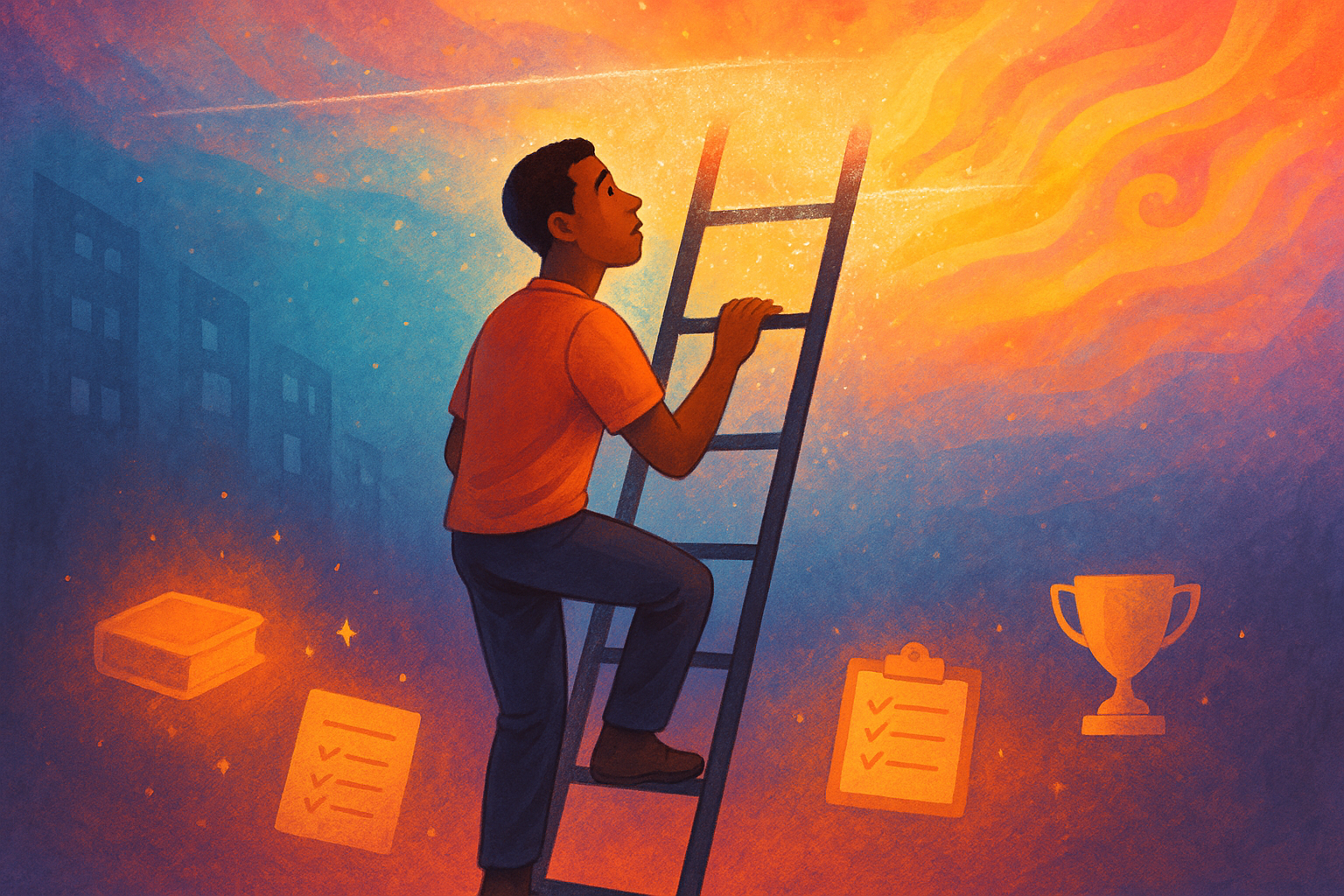
    I pursued excellence like a ladder—one rung at a time. If I could just learn more, do more, prove more, I’d be better. Right?

    Getting fired shattered that illusion.

    The Developmental Path That Most of Us Walk

    Looking back now, I can see that I was following a very common path—the one most of us are taught from the time we’re kids. I call it the Doing Better Development Path.

    This path tells us that if we want to grow, we need to learn more, improve our skills, work harder, set goals, and check more boxes. And to be fair, there’s nothing inherently wrong with this approach. It can absolutely help us improve in incremental ways.

    But the truth I’ve discovered—through my own pain, study, and coaching others—is that the Doing Better path has real limits.

    It doesn’t help us heal the parts of us that self-sabotage. It doesn’t address our fear of failure or our lack of self-trust. It doesn’t quiet the voice in our head that tells us we’re not enough.

    And it doesn’t help us become the person who can courageously show up in difficult moments.

    That was my problem—not a lack of knowledge or competence, but a way of being that was self-protective, hesitant, and reactive. I had the tools. But I wasn’t the kind of person who knew how to use them effectively when it mattered.

    What I needed wasn’t a new skill.

    What I needed was a new relationship with myself.

    The Shift: From Doing Better to Being Better

    In the months that followed being fired, I went through a season of reflection. Not just on what happened—but on how I was being in the world. I realized I had spent so much time trying to appear capable that I had stopped being curious. I had been defensive instead of open, self-protective instead of growth-oriented.

    That’s when I stumbled onto a different developmental path—one I now call the Being Better Development Path. This path doesn’t start with “What do I need to do?” It starts with:

    • Who am I being right now?
    • How am I relating to myself and the world around me?
    • What mindset or inner story is guiding my reactions?

    It was only when I started asking these questions that real transformation began.

    I’m not the same person I was when I got fired. And I don’t mean that in a vague, inspirational sense. I mean that how I experience life, how I respond to challenge, and how I see myself has fundamentally changed.

    And it all started by turning inward—not to fix myself, but to understand myself.

    Three Steps to Start Walking the Being Better Path

    The beautiful thing about the Being Better path is that it doesn’t require a job change, a spiritual awakening, or a year off in Bali. It just requires intentional self-exploration.

    If you feel stuck, or if you’ve been trying to grow but keep hitting a wall, here are the three steps that helped me begin my transformation—and may help you too.

    1. Understand Your Being Side

    Most people think personal growth begins with action—what do I need to do to get better?

    But real, transformational growth begins with awareness—specifically, awareness of your Being Side. Your Being Side is your internal operating system. It’s the invisible system that governs how you see the world, how you interpret what happens to you, and how you respond in any given situation.

    This system isn’t just about thoughts or beliefs—it’s also about how your body regulates itself. Your Being Side controls your ability to feel safe or threatened, connected or isolated, grounded or overwhelmed. In other words, it determines whether you’re operating from a place of trust, compassion, and courage—or from fear, defensiveness, and self-protection.

    Here’s the catch: most of us never stop to consider that we have an internal operating system, let alone evaluate its quality. We assume that how we react or what we believe is just “the way it is.” But it’s not. It’s just the way your Being Side is currently wired.

    When you start to observe your internal operating system—how you regulate emotionally, how you make meaning, how you instinctively react—you take the first step toward real, lasting transformation. You begin to shift from living on autopilot to living with intentional awareness.

    This awareness lays the foundation for the next step: evaluating the quality and altitude of your Being Side, so you can start the process of elevating it.

    2. Evaluate Your Current Being Altitude

    Once you begin to understand and connect with your internal operating system, the next step is to evaluate its quality.

    One powerful way to do this is to ask: Is my internal operating system primarily wired for self-protection or for value creation?

    When we are wired for self-protection, we tend to be:

    • Reactive
    • Defensive
    • Focused on avoiding discomfort, failure, or rejection
    • Concerned with preserving our ego or image in the short term

    When we are wired for value creation, we tend to be:

    • Intentional
    • Open and non-defensive
    • Willing to engage with challenge or discomfort to grow
    • Focused on long-term contribution, connection, and learning

    Here’s a simple example:

    Imagine someone gives you constructive criticism. If your internal operating system is wired for self-protection, you might feel attacked, justify your actions, or get defensive. But if your system is more oriented toward value creation, you’re more likely to receive the feedback with curiosity, reflect on it honestly, and use it to grow.

    Or consider moments of failure:

    A self-protective mindset might spiral into self-blame, shame, or disengagement. A value-creating mindset sees failure as a teacher, not a threat—and leans in with resilience.

    The goal isn’t perfection. We all have moments of self-protection. But the more we become aware of these patterns, the more we can assess where we are on the Being altitude spectrum—and begin to consciously shift upward.

    That’s what the third step is all about: the process of elevating your Being Side so you can experience real transformation.

    3. Elevate Your Being

    Understanding and evaluating your Being Side is essential—but real transformation happens when you begin to elevateyour internal operating system.

    Your way of being is like the software that runs your life. If you want to experience new results—not just in what you do, but in how you feel, connect, and show up—you have to upgrade the programming of that system.

    Elevating your Being isn’t about forcing change from the outside in. It’s about rewiring how you regulate, perceive, and respond from the inside out. And this often requires intentional, layered efforts.

    Here are three levels of development that can help:

    1. Basic Efforts: Strengthening Regulation

    These include practices like meditation, breathwork, mindful movement, or simply spending time in nature. These activities help calm and regulate your nervous system so you can operate with more presence and less reactivity. They’re foundational for building the internal safety needed for deeper growth.

    2. Deeper Efforts: Upgrading Mindsets

    Your mindsets are the lenses through which you interpret the world. When you begin to shift from fixed to growth, from fear to trust, from judgment to compassion, you start processing life in a more value-creating way. This level of work helps you move from reacting out of habit to responding with intention.

    3. Even Deeper Efforts: Healing at the Source

    For many of us, our Being Side is shaped by past experiences—especially painful or overwhelming ones that left an imprint on our nervous system. Practices like trauma therapy, EMDR, or neurofeedback therapy can help us heal, not just cope. They allow us to safely revisit and release the patterns that keep us stuck in self-protection mode.

    None of these approaches are “quick fixes.” But together, they help us shift from surviving to thriving—from being stuck in old programming to becoming someone new, from the inside out.

    The more we elevate our Being, the more we expand our capacity to create value, deepen relationships, lead with integrity, and live with freedom.

    There’s No Finish Line—But the View Keeps Getting Better

    I wish I could tell you that once you step onto the Being Better path, everything becomes easy. It doesn’t. Growth is still hard. Life is still life.

    But your experience of life changes. You become less reactive, more present. You stop chasing success to feel worthy—and instead create from a place of wholeness.

    This has absolutely been true for me.

    Over the past several years, I’ve incorporated all three levels of effort into my life. I meditate regularly to calm my nervous system. I’ve done deep mindset work to shift how I see myself and others. And I’ve engaged in trauma therapy to heal long-standing patterns I didn’t even know were holding me back.

    These efforts haven’t just changed what I do—they’ve changed who I am. I feel more grounded, more open, more aligned with the person I’ve always wanted to be. I’ve become a better partner, parent, friend, and leader. And for the first time, I feel like I’m living from the inside out—not trying to prove something, but simply trying to be someone I respect and trust.

    Ultimately, the Being Better Developmental Path is not about achievement. It’s about healing—healing the mind that spins with doubt, the body that tenses with fear, and the heart that aches for connection.

    And when we begin to heal, we become free.

    Since stepping onto this path, I’ve written books, launched a business, and built a community I care deeply about. But more importantly, I’ve become someone I’m proud to be—someone more resilient, more compassionate, more alive.

    If you’re tired of doing all the right things and still feeling stuck, consider this:

    Maybe the path forward isn’t about doing more.

    Maybe it’s about becoming more.

    Not someone different—but more you than you’ve ever been.
  • Your Worth Is Not Dependent on What You Do or Accomplish

    Your Worth Is Not Dependent on What You Do or Accomplish

    Carefree Man

    “A life’s worth, in the end, isn’t measured in hours or money. It’s measured by the amount of love exchanged along the way.” ~Unknown

    I’ve had a go-go-go personality for as long as I can remember. I think I was born with it.

    Both of my parents were small business owners who truly believed that with enough hard work and heart-and-soul dedication, you can accomplish anything.

    By the age of three, I was a gymnast; by early elementary school, a competitive one, with a coach who was constantly (and sometimes aggressively) pushing me to the next level.

    Therein began the scheduling of every minute of my time: from school, to two-hour practices, to homework on the road, to weekend competitions, to girls’ slumber and birthday parties.

    I wanted to do it all, and to be the best at all I did. I hadn’t even reached high school and had already joined the universal struggle for work/life balance!

    The especially vicious part of this cycle was that, when I found myself falling short in any one area (for example, not being quite “good enough” for the popular group of girls in school), I would drive my energy fiercely into other areas, such as academic success, which my teachers noticed and encouraged.

    I graduated from high school at the top of my class, and Suma Cum Laude in my Bachelors and Masters degrees. (Both programs were in Psychology, by the way—even then, I tried to understand and connect more deeply with myself and others).

    Following grad school, I continued the fast-paced life and entered my first corporate career as a wellness facilitator.

    I traveled all over the U.S. and internationally too, to deliver a workshop that was, ironically, based in self-care and listening to your body. I certainly wasn’t practicing either of those things, but I was receiving praise from my bosses and respected colleagues.

    One of my more memorable breakdowns came toward the end of the first year on the job. Sitting in yet another airport, for yet another delayed flight home, I’d just had it. I was chronically stressed and exhausted; pale, thin, and fragile; and physically, emotionally, mentally, and spiritually spent.

    It terrified me to imagine living life another year at this pace; it was equally terrifying to listen to what my heart was and had been calling for, for some time: to slow down.

    The Universe had been gently coaxing me toward this moment for a few years by introducing a yoga practice, essential oil use, acupuncture, and many healing modalities and healers into my life. But rather than embracing the healing fully, I turned each experience into an opportunity to do yet another thing.

    Yoga? I became an instructor. Essential oil use? I became a distributor. Acupuncture? I turned it into a working relationship and an opportunity to build my network for my healing business.

    It’s as if my ego simply wouldn’t accept or allow such radical acts of self-care without some sort of business case outside of my being.

    Deep, deep down, at my very core, I didn’t believe I was worthy of slowing down, of being taken care of, of feeling good.

    I, by myself, unattached from all the things that I did, wasn’t good enough. And how could I be? I’d built my life, my whole identity, on doing a lot, being good at all that I did, and looking for approval outside of myself.

    I was the one that took on the world, the one that could clean, cook, be a great girlfriend, friend, sister, daughter, and thrive in a successful career. And to anyone outside of myself, that is what it looked like—that I had it all, and had it all together.

    According to my boss and the corporate world, I was a “high potential”; according to societal standards, I should’ve been on top of the world happy.

    But guess what? I was massively broken, empty, and unhappy. And that’s part of what kept me looped in, continually striving for the next thing; unfortunately, because I’d learned to search solely outside of myself, that is where my worth delicately hung as well.

    Throughout life, I’d also caught glimpses of my true and inherent worth.

    I saw it in giving—sharing a special connection with a yogi during one of my classes; hearing feedback from a participant in one of my workshops that they would finally commit to taking care of themselves. And I also found it in receiving—hugs and thoughtful gestures from my boyfriend (now fiancé, whom I rarely saw at the time); an especially connected meditation or journaling session; a deeply meaningful conversation.

    And the connection that exists within each of those acts is embracing love, wholeheartedly. Believing that what we have to offer is enough, without condition, and that we are worthy of receiving such love the same way that we give it—freely.

    The truth is, our worthiness doesn’t reside in doing; it lies within our very being. It’s unchanging, unwavering, and infinite. But we can certainly convince ourselves of the former and spend our lives hustling for the worthiness that we’ll never find in doing.

    So how do we get there? How do we shift from identifying ourselves with what we do to who we are?

    For me, understanding this truth didn’t come with one massive blow to the ego; it happened in gradual shifts. Here are the practices that help me remember my unconditional worth and live a beautifully fulfilled and blessed life:

    1. Openness.

    Be willing to accept and embrace what comes, believing that it is for your own and the collective highest good.

    This really helped me release my urge to control, to come back to my inner truth, and to focus on being versus doing.

    2. Choice/perspective.

    Remember that in any given situation or experience, you have the choice to see through the eyes of fear or love.

    We are often faced with this one when we are putting our full selves out there in our careers, our relationships, and even our passions and hobbies.

    A fear mindset might keep us stuck in self-limiting beliefs, such as:

    • I really want the job, but there’s no way I’m qualified.
    • He/she is so great, but would never notice me.
    • I love to paint/sing/dance, but there’s no way I could ever do anything with it.

    A loving mindset encourages us to remain open and curious, without attaching our worth to the outcome:

    • I can’t ignore this job opportunity; I’m smart, experienced, and I owe it to myself to explore the possibility.
    • I really feel a connection with him/her; I should at least explore a conversation and see where it takes us.
    • I really feel the best of my energy comes out when I paint/sing/dance, and I’d like to share that energy with the world in a way that makes sense for me.

    3. Asking for what you need.

    Know that it is okay and necessary to say “no” sometimes, and to ask for help! And know that this doesn’t make you any less of a person; in fact, it creates space for you to keep your light shining and for others to step into their own light, as well. (This one is still an ongoing struggle for me).

    4. Surrender vs. striving.

    We are creatures of habit, and though I am totally and intentionally committed to slowing down and embracing self-care, I still find myself unnecessarily filling my time and getting dragged back into the worthiness hustle.

    Rather than beating yourself up further and digging the hole deeper, take a deep breath and surrender. Ask for guidance from the Universe and then listen and try to honor and trust what comes.

    When I fully commit to this, I usually feel a wave of calm wash over me almost instantly.

    So please, stop the chaotic and fruitless search for worthiness outside of yourself. Slow down, listen, and honor your body and soul’s cravings. Commit to embracing all that you are, and come back to your true nature—peace and happiness.

    Carefree man image via Shutterstock

  • Let Go of Shoulds and Stress and Let Yourself Do Nothing

    Let Go of Shoulds and Stress and Let Yourself Do Nothing

    Meditating man

    “When you try to control everything, you enjoy nothing. Sometimes you just need to relax, breathe, let go and live in the moment.” ~Unknown

    I am a recovering doing addict. My whole life I have been committed to getting things done. I do, do, do until I can’t do no more.

    I have a very clear memory of myself in college, sitting at an evening lecture. I am not paying attention at all. I am writing a huge, long to-do list on the back of a blue folder.

    Things keep popping into my mind, things that must get done right away. I must capture them on this folder so they don’t escape me. All that matters is the list in that moment. I don’t listen to a word that is being said.

    Scraps of memories like this one, some from earlier in my life, remind me that I have always been like this. This way of moving (or running?) through my life is not new. It is woven into the fabric of my being. And it has worked well for me in a lot of ways.

    I have lived in different cities, held many jobs, traveled all over the world, and started my own business. But there’s a darker flip side to it too, one that drives me into a frenzy of action more often than not. I am growing weary of it. It’s exhausting—the doing and the shoulds and the have tos.

    About a year ago I decided I wanted to change the way I am in the world. I wanted to transform myself from someone who was always stressed out and striven toward the next thing to a centered, joyful, fun, and more loving person.

    I had recently started my own business and was feeling devastated that I wasn’t enjoying it. Just like every other job I’d had, I was working myself into a stressful mess each day. I was at the end of my rope and didn’t know what to do. When I spoke with my life coach that week, I shared that I felt like I needed to be broken wide open for things to change.

    During our session that day she suggested I put everything on hold and carve out a week to just be. No work, no doing, no nothing—just being. “But,” I proclaimed, “what am I supposed to do?” And she replied, “Well, Megan, you’ll just have to figure that out.”

    I trusted her deeply and she had never led me astray. Plus, I was desperate. So I decided to go along on this adventure and deemed it the “Week of Being.” I wasn’t sure what to do that first day, so I went to the movies. I figured I’d ease myself into the whole doing nothing thing with some mindless entertainment.

    I sat in silence a lot that week. I meditated, listened to music and Buddhist teachings, took walks, read, and laid on the floor of my living room doing absolutely nothing. Slowly, I felt the stress and anxiety fall away. It dawned on me that none of the things I told myself I had to do in life were real. They were all completely self-fabricated.

    At the end of the Week of Being, I had a vision of myself in the middle of a labyrinth. I looked down and in my hand I was holding a smooth black stone. I had arrived at the center, and when I looked around I realized there was nothing there…nothing but me.

    In my journal from that day I wrote, “I had it backward these thirty-eight years. I thought the doing was what was most important. So the doing often led me down a path of anxiety and stress and even more doing. But it’s in the being where all of the answers lie. Taking care of myself, being in the present, accepting the now—that’s the answer. It’s the only thing I need to focus on. The rest of life will fall into place.”

    It was a powerful week. It has shifted me onto a path of allowing more being into my life and letting go of some of the doing. It’s a simple concept really, but it’s not always easy.

    It takes practice every day and sometimes I forget the lessons. But I am committed to this process, however long it may take. I know how to get things done, after all, even changing myself.

    Lessons from the Week of Being

    You can change yourself.

    If you have a vision of who you’d like to become and are committed to the work, change is possible.

    Do less. Be more.

    Practice the art of doing nothing. Take some time each day to lie on the couch or stare out the window. When waiting for a friend at a coffee shop or riding the bus, just sit and do nothing. Don’t fill every moment with action.

    Change is not a linear process.

    Sometimes you may find yourself reverting back to your old habits and patterns. This is normal. Change doesn’t happen all at once. The good news is that every time you have a relapse, it feels worse and worse. This means you are changing! Get back on course and be easy on yourself.

    When you take care of yourself, you are a better person.

    Taking time to care for yourself will help you have more energy for others. When you are calm and centered you are a better partner, sister, friend, and parent.

    Allow your actions to arise from a place of centered being.

    Mindful action is far more powerful than flitting from thing to thing. When you live your life from a deep place of peace you are able to bring about profound change.

    Photo by ChrisHayesPhotography

  • When Happiness Feels Like a Struggle, No Matter What You Do

    When Happiness Feels Like a Struggle, No Matter What You Do

    Happy

    “There is no reason to reach high for the stars. They are already within you. Just reach deep into yourself.” ~Unknown

    I left a big job at a hedge fund in New York City nearly eight years ago. I was far from certain the job was to blame for my unhappiness at that time, but it was the biggest, boldest action I could take to make me feel like I was doing something to help my cause.

    I have spent the last eight years searching for happiness, not sure at all what it would feel like or where I would find it.

    So I mostly wandered. I moved from New York City to San Francisco to Seattle to Park City. I started a business, closed the business, took a job, quit the job. I ended an engagement, moved in with a boyfriend, and then moved out. I searched for happiness on beaches, in jungles, and in the forest.

    Open to all the help I could get during this rudderless time, I also compulsively collected Top 10 lists that offered surefire ways to achieve greater happiness. (The proliferation of these Top 10 lists has given me comfort that I am not alone in my search!)

    I can’t count the number of times I have put a small notepad on my nightstand to record three things I am grateful for before bedtime, or I have started exercising more (and more, and more).

    I would eat one list up and then move on to the next. And that’s the problem. My experience has been that quality-of-life improvements can be made with these lists as guides, but the improvement is typically fleeting—as was with each of my moves, new jobs, and new boyfriends.

    What to do? After years of trial and error (and some great teachers along the way), I have come to understand that it’s that question that gets us stuck to begin with.

    Most Top 10 lists for finding greater happiness are prescriptions for what to do, actions to take, and this is their limitation. It was also the greatest limitation to my own approach—my focus was on taking big, bold action.

    What I have learned about finding happiness is that first we have to stop doing. We have to start by focusing on who we are at our core, on our being; only then can we begin to figure out what we should be doing to fully realize this beautiful person, to let the stars that are already in us shine brightly.

    So, who am I at my core? Who are you? We are each made up of a unique collection of values, the combination of which make up our being.

    The top way to live a happy life: identify your values (who you are) and act (do) accordingly.

    How well do you know your personal value system?

    Often when we talk about values, words like honesty, integrity, kindness, and thoughtfulness come to mind.

    Most of us were taught to honor these values early in life (it’s as if we were all in the same kindergarten class), and then most teachers, parents included, stopped talking about the v-word.

    In the West, ambitions and goals typically receive much more emphasis than values as young people grow and gain responsibilities.

    But your value system is like your fingerprint, full of life and wholly unique to you. (That’s what makes it so hard for any list of Top 10 lists to speak to us all.)

    My value system, for example, is made up of roughly twenty principles that combine to make me the one-of-a-kind person I am.

    My values include courage, beauty, curiosity, creativity, adventure, presence, and generosity, to name a few. When I’m in a funk and can’t figure out why, it is likely because I am not feeding one (or more) of these values.

    For example, when I’m out of touch with beauty because I’m spending so much time in front of my computer, my to-dos might include taking a walk in nature. When I feel life’s become too routine and scheduled, I might make an adventure date with myself and go rock climbing.

    Inevitably, when something’s not quite right, I can identify a value that needs more love—pronto!—and create an action item from that deep source of wisdom.

    Now it’s your turn. What values make you uniquely you? If you have not spent much time getting to know yourself in this way yet, here are a few suggestions:

    • Peruse a lengthy list of values and circle those that hit home
    • Think of your role models and consider what it is about them you admire most
    • Reflect on the values you want to pass on to your children

    Once you have your list of values, start by identifying a few that you’ve fallen out of touch with, values that for one reason or another aren’t getting visibility in your daily life. With those values as your guide, create a list of to-dos that will allow you to connect with each value more fully.

    Add on from there. (Why wait until a value is not getting visibility?)

    The more you can connect your actions to your values, the more happiness awaits you. Ultimately, you will be connecting with the beautiful being that is you and that connection is what happiness is all about.

    Photo here