Tag: beauty
-
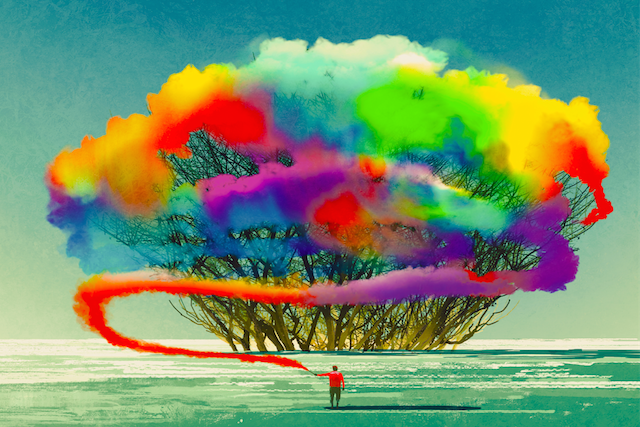
How to Be Like a Tree: Still, Strong, and Uniquely Beautiful
“This oak tree and me, we’re made of the same stuff.” ~Carl Sagan
I was hugging trees long before it was cool.
Recent research suggests that spending time in nature can reduce your blood pressure, heart rate, and stress level, not to mention cut down your risk of type II diabetes, cardiovascular disease, and premature death.
But when I began hugging trees, it was an undeniably weird thing to do.
I risked the odd looks of strangers, however, because trees felt so calm and welcoming to me. When I wrapped my arms around their broad trunks, it felt like I was being gathered into the protective embrace of a beloved elder, as if their steadfastness imparted strength, and their rootedness helped me find my own solid ground.
Recently, however, I’ve realized that their benefits extend far beyond momentary stress relief; it’s from trees that I’ve learned the most powerful lessons about how to deal with chronic depression and anxiety.
Here are the biggest and most unexpected things I’ve learned so far from trees:
1. When in doubt, don’t do.
Every time I hug a tree, I’m struck by how still it is. There’s a silence, a spaciousness, and a total lack of movement that boggles my mind.
I mean, it can’t be easy to be a tree. If you’re not getting enough sunlight, you can’t just pick up and walk a few steps to the right. If some animal builds its home too close to your roots, you can’t do anything to move it.
I, on the other hand, respond to any perceived threat by jumping into action. That’s the nature of my anxiety; when I’m afraid, I want to do something—anything.
But because I’m not acting out of clarity or wisdom, and because listening to fear makes the fear grow stronger, almost every action I take just makes things worse.
Like the time when I was anxious about leaving my therapist because I was about to move back to Atlanta after fifteen years away. Jumping into action, I decided to go off my anti-depressant medication before I left so I would have her help, but I did it at a time when I was also changing careers, starting a business, and getting ready to move cross-country. Needless to say, it made a difficult time even harder for me.
When I don’t get the results that I want, I feel even more out of control, my anxiety grows—along with my compulsion to act—and the negative cycle reinforces itself.
Trees show me how to break this cycle by demonstrating the value of not doing.
When I’m smart enough to imitate a tree, I get still. I feel. I listen.
When I do this for long enough, one of three things happens: Either the problem resolves itself, or a wise response becomes clear to me, or I realize that it wasn’t really a problem in the first place.
2. Support all of life.
I’m often awed by how much trees give to the creatures around them, from the moss that grows on their bark, to the birds and squirrels they feed and shelter, to the humans who breathe their oxygen and enjoy their shade.
When I’m depressed and anxious, I usually feel both overwhelmed by my own misery and guilty that I don’t have the resources to give more to others.
It’s another negative cycle whereby my misery makes me unable to focus on anything or anybody else, which causes me to feel horribly self-centered, which makes me feel even more wretched and less able to give. What makes things even worse is that supporting others is one of the few things I’ve found that reliably helps me feel better.
The effortless generosity of trees offers a way out.
When trees have something to give, they share it with everyone, no matter how small or undeserving. But they don’t beat themselves up for not having acorns in the spring, or leaves in the winter. They simply extend whatever’s there to extend.
Sometimes all I have to give is an apology for not being more considerate. Other times it’s a smile, or appreciation for someone’s support. Over time, if I give what I have, I have more to give, but the key is never to believe that it should be more than it is.
That way, I can support all life, including my own.
3. Don’t be afraid to get big.
I’ve never been one to take up too much space.
I’m talking physically: I’m over six feet tall and always felt awkward jutting up above most of the people around me, so I subconsciously slouched and made myself smaller.
But I’m talking emotionally and relationally as well: I never used to like to call attention to myself, ask for what I needed, or speak up about my opinions. I went out of my way not to negatively impact anybody else, even if that meant sacrificing my own happiness or well-being.
After years of always making other people’s needs and opinions more important than my own, it was hard not to feel depressed, helpless, and hopeless. By that point, however, making myself small wasn’t so much a choice as a well-ingrained habit.
When I began to hang out with trees more, I started to notice how unapologetic they are about the space that they take up. They don’t worry that growing tall will cause somebody else to feel inadequate, or that stretching their limbs out wider will mean they’re taking up too much room. They just are who they are. When I stood next to them, I could feel their expansiveness begin to bloom in my own chest.
Acting on this newfound sensation, I gave myself permission to get big. When I needed something, I asked for it. When I had an idea, I shared it. When I wanted something, I moved toward it. Not worrying about how others might perceive me, I stood tall and enjoyed the unique view.
The best part is, after a long time of feeling powerless over anxiety and depression, I finally saw that I was bigger than either of them.
4. Being crooked is beautiful.
I’ve made plenty of wrong turns in my life.
I used to feel ashamed that I had ten jobs over ten years before finally finding one that felt like a fit. Or that I had so many failed relationships before getting married nearly a decade after most of my friends. Or that fear made me wait twenty-five years to write a second novel when I knew after finishing my first at age twelve that I was born, in part, to write.
Most of us (including myself) tend to think that the straight path is the best one. We beat up on ourselves for our false starts and slow progress.
But have you ever noticed how beautiful trees are? And how crooked?
I’ve come to believe that it’s precisely because of their odd angles and unexpected curves that trees appear so graceful. A tree made of straight lines would hold no appeal.
Looking back, I can see that every job I had taught me more about what I wanted and brought me one step closer to work that I loved. Every relationship prepared me in some small way to be with the man I would eventually marry. And every time I negated my desire to write, that desire grew stronger, and I had more material to work with once I finally was ready to say yes to the call.
We can’t undo our wrong turns, but we can appreciate their gnarled beauty.
5. It doesn’t matter who you are.
When I was younger, I thought that it was what I did that made me worthy. I pushed myself hard to do well in school, excel in sports, and achieve as much as I could.
Eventually that strategy led to an unsavory mix of perfectionism, anxiety, and depression. Desperate, I got help from others and re-evaluated my beliefs. I soon concluded that it wasn’t what I did but who I was that mattered.
At first this new belief seemed helpful, but eventually it brought its own set of anxieties. I was trying my hardest, but was I really calm enough? Or kind enough? Or wise enough?
Then one day when I was hugging a tree, I tapped into a truth that made such questions irrelevant.
I’d just gotten curious about what a tree’s energy felt like. Opening up to it, I was immediately flooded by a sense of expansive serenity. Peaceful as it was, it was also vibrant and strong. Welcoming and warm, it pulled me in. Suddenly I felt as if I were filled with, made of, and surrounded by sunlight.
The energy was coming from the tree, but I realized that I could feel it because it was stirring something already within me. In other words, the tree and I shared the same true nature. Beneath my body, beneath my personality, and beneath my small identifications, I am this beautiful energy. So are you. So are we all.
Unified in this way with every other living thing in the world, even I have to admit that the idea of being unworthy doesn’t make any sense. It’s not only irrelevant; it’s impossible.
That’s when I realized that the magic lies not in what we do or even who we are, but in what we are, and how often we remember that.
-

Why We Need to Stop Hiding and Share the Beauty in Our Brokenness
“Out of perfection nothing can be made. Every process involves breaking something up. The earth must be broken to bring forth life. If the seed does not die there is no plant. Bread results from the death of wheat. Life lives on lives. Our own life lives on the act of other people. If you are lifeworthy, you can take it.” ~Joseph Campbell
Head on my pillow, tears in my eyes, a list of to-dos in my brain, I felt unable to move my body. I’d worked so hard to leave behind this person who stayed in bed avoiding life. But someone’s angry words had pierced my soul, and I once again was a prisoner to my bed, my thoughts, and my anxiety.
It wasn’t so much the disagreement that stung, but the chuckles and snide “You can’t really believe that?” More than “mansplaining,” he was patronizing and questioning my intelligence.
I tried to stop the personal attacks by “setting up boundaries,” as they say. No doubt I did not express myself in a calm, clear manner, as my blood was boiling. However, I tried to protect my integrity during the argument for the first time in this particular relationship.
What now, though? Concern for the future of this relationship was what was now spiraling out of control in my head and overwhelming my thoughts.
In retrospect, the fight hadn’t left me paralyzed with anxiety; it was the new way of dealing with belittling behavior that I had allowed myself. This was unchartered territory.
I had dared to make a change in a relationship. Now, I was awash with the resulting questions about what came next and if I’d done the right thing.
Without leaving my bed, I catapulted myself out of yet another comfort zone by reaching out to a group of supportive people. Phone in hand, I scrambled to type the message before I could think myself out of it.
A few days before, a friend and I had heard author and activist Glennon Doyle speak. She encouraged the audience to speak our truths, “Blow shit up, and walk away like Wonder Woman.” So, that morning, as I licked my wounds, I told my truth to a safe audience.
Like a dog offering up his belly in a display of vulnerability, I spoke the truth of where I was. I pulled back the curtain and said life has knocked me down. Can I get a hand up? The responding support was worth the risk.
Not long after, I heard the song “This Is Me” from the movie The Greatest Showman for the first time. I rushed home and looked up the lyrical version on YouTube. I sat and absorbed the rising beat.
I read the words as Kesha belted them out. Words like “Today, I won’t let the shame sink in,” and “I am bruised. I am who I’m meant to be. This is me.”
My soul surged. I sucked in the words and rhythm like air. I marinated in the meaning, replaying it over and over.
I wanted to announce my bruises too. I’ve battled depression my entire adult life; “this is me.” My latest psychologist diagnosed me with generalized anxiety disorder; “this is me.” No one knows about my battles with bulimia, but “today, I won’t let the shame sink in.”
I headed off to the gym with my new warrior anthem playing in my head. I’m pumped. I greet everyone with a huge smile on my face. This is my happy place.
I got to an exercise requiring balance, which I lack. My arms are flitting around being more comical than helpful. The lady next to me says, “See? You’ve worked it out!”
Wait, what is she seeing? I’m flailing around like a fish out of water, and she sees “worked it out?” This sends me back in my head thinking about the song and my story and my struggles.
I rushed home and wrote the truth about all the messiness that lies beneath what people see. I wrote about how I “worked it out” through my battles with mental illness, not despite them.
I started telling my truth and in doing so, embracing it. With every scribbled word, I accepted my wounds a little more.
I wrote about all the things that I thought I had to keep hidden in order to be presentable. My struggles had been my flaws, my “dirty little secrets.” I wanted to tidy up the pieces of my broken world before I could let anyone in.
I had it all wrong. Our scars are the proof that we are living and growing. Our strength is that we have battled with demons and are still standing.
Just look at the natural world. It transforms flaws and mistakes into beauty all the time.
The pearl starts as an intruding piece of sand. Protecting itself from the intruder, an oyster creates a thing of value.
Quartz is naturally colorless, but if iron mistakenly mixes in, it turns a beautiful purple, resulting in amethyst. The bodies of long-extinct creatures are now our fuel.
The power of the universe is on display when it turns decay into value. There are no wasted failures in nature. They are simply transformed and renewed.
What if beauty begins when the imaginary ideal is broken? What if the universe needs the messy, broken, and failed to demonstrate its power to make the defective whole? What if we have that same power to turn our battles into our beauty?
I’m convinced now of the inherent beauty of the damaged parts, and that we must resist the temptation to air brush our lives as if they are cover girls. Hiding robs us of our divine power to turn our broken pieces into something wondrous.
The broken bits don’t go back together the same way as before, though. We may have to mourn that fact. For example, life after divorce will never look the same. Mourning that loss is healthy, but shouldn’t forever immobilize.
The caterpillar has no choice but to transform into a butterfly. We, however, can impede our transformation like I did through shame, guilt, denial, and hiding. There is so much value that can come from our damaged, defeated souls if we open them up to the light.
To courageously tell our truth allows others to see the beauty and hope in the battlefield before them. We are so much more than what life has thrown our way. We are the warriors who are still standing no matter how many times we had to get off the ground. When we become vulnerable enough to illuminate our brokenness, we harness the power of the universe to create beauty out of failure.
-

What Helped Me Love and Accept My Imperfect Body
“You are imperfect, permanently and inevitably flawed. And you are beautiful.” ~Amy Bloom
“Just look at yourself!”
“That chubby face, those massive hips and thighs. The stumpy legs.”
“No wonder he doesn’t love you anymore. No wonder he left you for her! She is so much prettier than you are.”
I stood in front of the mirror. Tears streamed down my face. My body was shaking uncontrollably as I stared at it in disgust.
Resentment and anger accumulated in my chest. Heavy, dark, and painful, the all-consuming emotions tried to crush me. My throat felt tight, I couldn’t breathe, my mind was racing in desperation.
If only I was beautiful. Tall, slender, delicate, and fair. If only my body was perfect.
He wouldn’t have rejected and betrayed me. We would still be happy. The plans we made for a future together intact and alive.
I collapsed on the floor, sobbing and shivering. Blaming my flawed appearance for all the despair, the unbearable suffering, my shattered life.
I had always been insecure about my body and the way it looked. But now, I condemned it for failing me, destroying my life. Judged all its blemishes and cursed its unattractive features that were too ugly to love.
And that’s how it started.
The Miserable Consequence of Fighting Your Own Body
In the weeks after my boyfriend left me in May 2005, negativity consumed me.
I was furious at him for choosing another woman over me, and I beat myself up for not noticing the affair earlier. Toxic thoughts about my inadequate body and insufficient looks circled endlessly in my mind.
I was obsessed with the improvement of my appearance. I cut my hair, changed my wardrobe, waxed, plucked, and dyed. I considered plastic surgery to remove the visible effects of a genetic skin condition that had never bothered me before.
And I deprived myself of food, forwent sleep to have more time to exercise fanatically every day. I ignored any hunger, discomfort, and exhaustion, lashing myself on.
I was determined to make my body better. Fitter, slimmer, more attractive. I would never allow it to let me down again.
And my body reacted to the verbal and physical abuse.
Within a few weeks I suffered from a stomach ulcer, bowel issues, and frequent migraines. My hands and legs were covered in eczema. And I was plagued by hypoglycaemia that made me dizzy, faint and, on a couple of occasions, temporarily blind.
My body and I were at war. I knew I couldn’t go on like this. I had to make peace with the way I looked.
I had to accept my body for what it was to restore my health, emotional balance, and sanity.
For months, I forced myself to look in the mirror and reconcile with every part of my body. I reasoned with myself that the failed relationship had long run its course and my looks had nothing to do with the break-up. I cried as I tried to forgive myself for every flaw, wrong proportion, and imperfection.
After a while, I could look at myself and accept what I saw. Free from condemnation, shame, or judgment. Without the self-hatred, it became easier to take care of my body and my health improved together with my opinion of my appearance.
I thought I had learned to love my body. But I was wrong.
Realization #1: Accepting your body doesn’t equal loving your body.
For eight years, my body and I upheld our truce. I could walk past a mirror without criticizing myself and look at myself without disgust, upset, or resentment. I had found a loving husband who frequently told me how beautiful I was.
And I believed that he really meant it. For the most part I was okay with my looks.
But then I gained twenty pounds during my pregnancy, and the disastrous body-shaming cycle started again.
At first, I didn’t notice.
I thought that I kept my husband at a distance because I was too preoccupied with my daughter. But, in reality, I felt too self-conscious and ashamed to allow him to see my flabby body.
I deluded myself into thinking that life with a new baby was too busy to visit friends. But I just didn’t want them to think, “Blimey, she’s gone fat.”
I believed that I stuffed myself with chocolate and greasy junk food because I had no time to cook from scratch and needed the energy while breastfeeding. In truth, I punished my body for its shortcomings.
I had worked so hard to accept my appearance. But now, my new, changed body had once again become an enemy. I blamed it for my marital problems with a dissatisfied husband and held it accountable for my social isolation. I hated it for its ugliness, for letting me down again.
Because the truth was that, back in 2005, I didn’t accept my body for what it was, embracing all its imperfections.
Instead, I made peace with the fact that I wasn’t beautiful. I accepted my body as “just not good enough.” And convinced myself that, despite the inadequacies, I could live with the specific looks of the body I had back then.
But as I gained weight and my body changed, the acceptance vanished because I never learned to love my body.
Realization #2: The true reason why your body deserves your love.
As I searched for ways to truly love and accept my body, I realized what a miracle the human body is.
Trillions of cells work in harmony to perform millions of tasks that guarantee survival. Day after day, they communicate via chemical, electrical, and hormonal signals to regulate, defend, digest, filter, breathe, regenerate.
The heart beats 42 million times every year, pumping over 2.7 million liters of blood. Bones, muscles, cartilage, tendons, ligaments, and joints work together, orchestrated by the nervous system, to allow us to sit, walk, run and jump. It takes the coordinated cooperation of around 100 muscles to simply say “Hello”!
And yet, we are mostly unaware of our body’s accomplishments. It works in the background. Tireless, faithful, reliable, expecting nothing in return.
As a health scientist, I knew how bodily functions worked to preserve life. At least in theory. But somehow I had never truly understood what my body did for me every second of every day.
My body gave me life and served me unconditionally. It allowed me to experience the sunshine and all this world’s joys and pleasures. It enabled me to love, laugh, cry, and contribute.
It created my daughter.
But, instead of being grateful, I ignored and neglected it, sabotaged its efforts to maintain my health, and damaged it with abuse and negativity. Instead of loving the miracle that it was, I reduced it to its outer form, condemned its looks, which I denounced as unacceptable.
Despite knowing what an amazing marvel of creation my body was, I still couldn’t look beneath my body’s exterior appearance. I obsessed over my figure and physique.
Why did I believe my body was somehow wrong or not good enough? Why was it so difficult to love and accept it?
Realization #3: Beauty is not in the eye of the beholder.
As I looked into it more deeply, I started to understand that I had become a victim. All my life, I was bombarded with set definitions of beauty. Every TV show, movie, and newspaper highlighted the standards required to be beautiful.
Every commercial, billboard, and fashion magazine implied how I had to look to be desirable. And they established beauty, attractiveness, and physical perfection as prerequisites for happiness, success, and love.
Society seemed to prescribe specific measurements for every part of the human body.
A certain height, weight, and hip-to-waist ratio defined a gorgeous body. Symmetrical features, flawless skin, and full lips made an attractive face. And every scar, lump, blemish or departure from the perfect body proportions destroyed all prospects of ever being beautiful.
I had allowed my mind to become conditioned and accepted society’s version of beauty without questioning. I believed that I was destined to be ugly because I didn’t meet the criteria. I accepted the fact that beauty was out of my reach because my body shape didn’t make the grade.
I felt like a failure for not being beautiful.
But now it dawned on me that the society-imposed criteria were haphazard. The beauty I yearned for was a set of randomly selected dimensions, arbitrary proportions, and subjective features. Ever changing according to trends dictated by the media and beauty and fashion industries.
Yet I bowed to them. I fixated on my appearance and compared myself to photoshopped idols. I beat myself up for my too broad hips, short legs, and round face.
But these features were out of my control, genetically determined by the miraculous fusion of my parents’ DNA. My body was so much more than its looks and I was so much more than my body.
So why was it so important for me to be beautiful?
Realization #4: The true reason why we strive for beauty and perfection
I now knew that beauty was nothing but a man-made concept. A random phantasm imposed upon us by relentless conditioning.
But still I craved to be beautiful, I obsessed over my body’s appearance, I wanted others to admire my looks.
And the reason was low self-worth.
All my life, I felt inferior to others. I thought that I was inherently worthless.
Yet, I believed that, in order to deserve happiness, love, and fulfilment, I had to be worthy of them. I had to have worth.
So I dedicated my life to the accumulation of worth. And again, society had strict criteria to fulfill in order to be worthy of what I desired. Impressive possessions, qualifications, wealth, and other people’s approval increased my worth. And so did beauty.
The more beautiful, flawless, and perfect a person is, the more worth they possess in society’s eyes.
And my unremarkable looks were not good enough, leaving me with a painful worth deficit.
Because not being beautiful made me worth less compared to others. Unworthy of a happy life, undeserving of a loving relationship. And there was nothing I could do about it.
Or so I thought.
The Incredibly Irony of Our Obsession with Beauty
All my life I had been stuck in a disastrous, depressing loop.
I wanted a life blessed with happiness and love. And in order to deserve it, I had to be worthy. But I couldn’t be worthy because I wasn’t beautiful enough.
My body’s looks didn’t meet the requirements.
And that’s why I could never love my body. Because it doomed me to a miserable, worthless life full of heartache, disappointment, and suffering.
But all my self-loathing, self-condemnation, and the inability to love and accept myself were based on a mesh of lies.
Because the truth is that beauty is a myth, a random set of society-imposed criteria. And not falling into the narrow range of qualifying measurements does not make us worthless.
Our worth doesn’t depend on beauty, desirability, popularity or other people’s admiration and approval. It is an inherent part of who we are. An intrinsic, absolute feature of our being.
We are worth personified, every one of us.
We all equally deserve to be happy and loved. No matter what we look like, how tall we are, or how much we weigh.
Our body’s outer appearance will never change anything about our worth. Our scars and imperfections cannot diminish our deservedness. Excess weight won’t make us inferior to others.
Because we never were worthless. Nor will we ever be.
How to Finally Love Your Body
After these life-changing realizations, I went to work to improve my self-worth and break my mind’s conditioning.
I must have repeated the affirmations “I am worth” and “I love and approve of myself” thousands of times. I ignored my mind’s resistance to the new paradigm and forgave myself when I slipped back into old self-criticising habits for a while. I persevered.
I kept reminding myself that our commonly accepted concept of beauty was society-imposed, arbitrary, and unfounded. My body was a miracle regardless of whether its outer appearance met the criteria. As such, beauty wasn’t a prerequisite for loving it. Or for my worthiness as a person.
As my mind got used to the new way of thinking, I started to accept my body as a wonderful part of the infinitely worthy being I was. I broke free from the misguided untruths I used to bow to.
I am in a loving relationship with my body now. We are a team. I listen to its needs and allow it to look after me.
Every day I thank it for being awesome and serving me so well. When my body changes or is unwell or in pain, I bless it with love instead of cursing it for being weak or letting me down.
I still carry the twenty pounds I gained during my pregnancy. I might lose them eventually, for health reasons. But they don’t destroy my beauty; they don’t deduct from my worth.
I no longer look in the mirror and see vast hips, a flabby belly, and imperfections. I see a miracle. I see life.
I see worth.
Beauty isn’t restricted to a chosen few who happen to meet the requirements. It is an expression of the marvel of human existence. Beauty is within all of us.
Your body is a miracle. You are worth.
And you are be-you-tiful.
-
Life Is in the Little Things: Finding the Extra in the Ordinary
“The difference between ordinary and extraordinary is that little extra.“ ~Jimmy Johnson
“Write about what we did today,” my daughter said. She knows I often write once she is asleep.
Dully I thought, “What we did today wasn’t that exciting.” Yet, for her, it obviously was.
She gets lost in her experiences, deeply entrenched in the realms of her imagination that continue to weave each experience she is having.
From my perspective, I took the kids and their friends to a nature reserve so they could get muddy and play. I needed them outside, away from the house where cabin fever sets in quickly and the mess builds up even more quickly along with my stress levels.
Instead, we had a nice walk, first to see a waterfall, then for them to play in a stream and slide in the mud. After that, we had a picnic and I watched them all get lost in game after game led by their imaginations.
When we got home my daughter set about making a Lego creation; there is a national competition going on and she wants to enter. She created a platform with a throne for the queen to sit upon after she climbs the magical rainbow-colored staircase. She had been reflecting upon that staircase the night before long after she should have been asleep.
To the side of the queen was her courtier, and they overlooked a courtyard where many of her subjects had gathered so they could have a conversation. The courtyard was filled with beautiful flowers and another large plant that stands in the corner.
The nuances of this creation I am sure to have missed, but I glimpsed beyond the plastic bricks that my mind wanted to adjust here and there, resisting the urge to ‘fix’ them. It was a thing of beauty.
As is her habit every day, she also drew several pictures, each with its own story, ever evolving with lots of princesses and fairies. Then there was the Charlie and the Chocolate Factory audio book that she finished listening to, and the story of the Unicorn Riders we read at bedtime, each with their own stories and life lessons to untangle and reflect on.
Not to speak, of course, of the majestic bun she has insisted upon having in her hair these holidays, with four braids that I carefully reproduce every few weeks (after a trip to Fiji last year). My hair dressing skills seem to have unwittingly evolved in all these requests.
For me, I was just getting through another day of the school holidays. For her, though, she was a princess dreamily going about her day.
After the kids were asleep, I pulled out the journal I keep to record all the things to be grateful for, or that were uplifting. Here is the sad effort I wrote:
“The sun shining through the leaves at the reserve warmed my soul.” That was it, other than noting with thanks that my partner had gone to work all day long to provide us with money.
Yet when I’ve sat down to fill my cup with a little writing, another voice speaks from within. One that sees much more in the day than I obviously had at first glance; it sees the ‘extra’ in the ordinary.
When my daughter said to me a few days ago “It seems like I’ll have more fun when I’m young than when I’m old, Mum,” I understood why she thought that, but it also made me a bit sad.
I lamely told her adults experience fun in a different way, then I realized I was just kidding myself. While that in itself is true, I knew there was no kidding the kids; they know when you are having fun or not.
It’s time for an attitude shift. Sure, when I took the kids to the pools the other day, I did it to get it over with, since they have been nagging me for months to go. It’s an indoor pool, noisy, busy, and it stinks of chlorine. When I was a kid, I would have loved it too. Even as an adult, if I had peace to swim in the large pool it could be enjoyable.
But being responsible for the lives of two little kids who are not yet able to swim properly yet go hurtling into the depths when the wave machine comes on, and in separate directions, it’s not so relaxing.
Today, however, was more relaxing. No chlorine smell, only the smell of freshly cut grass. No loud echoing background noise, just the sound of kids laughing and playing.
Come to think of it, we passed a really tall tree with fruits scattered all over the ground underneath; they looked like lemons. Except this tree was about twenty meters tall, so it was a bit of a mystery to me, and it was quite nice just to notice it and wonder what it was.
It was also quite lovely to see the various dogs going past with their owners, clearly loving being out running around just as much as the kids were.
After our picnic I even joined in the fun by doing a pretend tap dance while all the kids sat on a bench watching and giggling.
When we got back to the house, the kids had all enjoyed their time in the fresh air and sat quietly drawing while I was able to hose down the clothes caked in mud. I have to admit to some satisfaction in seeing the colors of those clothes emerge again from the mud-brown-grey they had turned.
I enjoyed listening to Charlie and the Chocolate Factory as much as the kids did, and it was interesting to connect the dots on a recurring dream I used to have, any time my life got a bit out of control, about the lift that went sideward and upside down.
And when I came to read them their bedtime story, the Unicorn Riders pulled me in to their mythical world and left me on a cliffhanger as it was time to turn out the lights.
Now, here I am, sitting contentedly tapping away on the keyboard. My cat is curled up next to me purring away. I am now reflecting on what a joy it is to have these kids that I waited for so long to come.
Even though they drive me nuts at times, and life can be pretty intense, it is worth it to glimpse life through their lenses.
I’ve also just realized that my long awaited new pillow arrived today, contoured to cater for exactly the way I sleep; this is not just great news, it is sheer bliss. How could I have left this and all these other snippets out my journal?
All these years spent longing for things, recording my dreams, and yet once they are here somewhere in my psyche they turn to hum drum, stressful even. “This is what it is to be human,” I remind myself. “To always want something more.”
It’s the age-old paradox of noticing what about my experiences I would like to change, while still appreciating in the moment the things that I do have. Instead, I seem to have slunk down into just taking for granted what I am experiencing and getting frustrated that what I want isn’t here yet.
This is dumb, I know. It would be healthier to celebrate the sheer miracle that this life I am leading has been entirely of my own making. There is so much power in that. I remember a few years back, when my partner complained to his godparent about how hard it was to look after the kids, she reminded him that this was his dream.
It’s true, it was our dream to have a family, and we spent years trying to make that happen. My partner even wanted two girls; he had names for them and everything. After we realized we needed to stop trying so hard, our wish came true.
But it’s not just about kids; it’s about the place we live, the life we lead, the people around us—it’s all of our own making. And it’s actually pretty spectacular.
I’m reminded of a little exercise of Marisa Peer’s I did one day, where I had to imagine seven-year-old me turning up at the front door of our house in my mind’s eye. I had to invite young me in and show her around. It was quite an emotional exercise. Looking at my life today through young me’s lenses was pretty gratifying.
Thanks to my daughter, the dull response to her initial thought that I should write about today has turned to a sparkle. It wasn’t so unspectacular after all, I realize. In fact it was quite extraordinary and really quite fun.
So often we focus on what’s lacking, or what didn’t meet our expectations, but we’re a lot happier when we appreciate the little things and recognize the beauty in the ordinary.
-
How to Feel Good In Your Skin: 7 Powerful Lessons on Beauty
“Beauty is in the eye of the beholder.” ~Proverb
I struggled with body image for years while I was living in Europe because I have a very fair complexion, oily skin, and thin hair.
During my childhood, people would look at me and comment on how pale I looked and ask my mother if I was anemic. Later on, as I was growing up, people who met me would ask if I was ill, or they would say that I look exhausted, tired, and weak.
It was most difficult during the summers, when there was always a social pressure to get a tan, as I heard a lot of negative comments then. I didn’t perceive myself as beautiful, nor did I think I would ever, until I came to India for the first time.
In India, bright skin is synonymous with beauty (beautiful means fair!), and everyone complimented me there, telling me how beautiful I am, that I am “bright like the moon.”
They also admired my silky, smooth hair and oily skin—in India, they call it “glowing skin” and appreciate it because skin can get very dry, with the hot weather.
Indian women would ask me over and over to share the secret behind my glowing skin, and they wouldn’t believe that it was naturally so oily; they’d think that it must be some cosmetic product from Europe that I didn’t want to tell them about.
Suddenly I realized why all my Indian friends, who lived in my hometown back in Europe, would not leave the house without the sunscreen, why they’d always tell me that I’d be considered very pretty in India, and why they’d joke that I’d get married quickly there!
I was shocked when I realized how much money people, both men and women, spend in India for fairness beauty products. Some women even bleach their skin with hydrogen peroxide-based cosmetics. Yet, in Western countries, people spend a ton of money on tanning products and solariums to get darker skin.
I realized in India how beauty is socially constructed and started feeling beautiful in my own (fair) skin for the first time in my entire life. Or, I should say, I discovered how beautiful I am, with all my Western “imperfections.”
For last two and a half years, since I’ve been living in India, people who knew me for a long time comment on how I look much more beautiful now and ask me to share my secret.
I don’t deny that Indian vegetarian food and the abundance of tropical fruits, together with natural beauty products with neem, heena, herbal oils and sandalwood, are part of the equation. But I believe the major reason is that I started feeling beautiful and good in my own skin.
Here are seven things I learned that can help us all feel better in our skin, with all of our “imperfections.”
1. Beauty is socially constructed.
This was one of the biggest aha moments I had in India. While we may not be considered as good looking in our own country, in some other part of the world we may be perceived as a beautiful person.
In some other part of the world, our height, complexion, hair color, facial features, and body shape—things we might see as “imperfections”—would be considered attractive traits.
2. Our body is our home in this lifetime.
We should be deeply grateful every single day that we have a body, which is our home and our vehicle in this lifetime. We can do so many things with our bodies—dance, swim, run, walk, talk, sit, move, hug our beloved, smile, eat, write, type, pick up objects, work, paint, cook, be intimate with our partner, and so much more!
Instead of focusing on the color or shape of our eyes, which we may not like, we can focus on how fortunate we are that we can see. Instead of focusing on how skinny, thin, short, or fat our legs are, or how much cellulite we have, we can focus on how blessed we are that we can walk, and so on.
3. True beauty comes from within.
Although this saying may sound cliché, it’s actually true. No matter how many beautiful facial features a person may have, a sad or angry face is never pretty. No matter how beautiful a person’s appearance may be, if the same person behaves with disrespect to others, or acts rudely and arrogantly, people will not want to spend much time around him or her.
A smile can bring radiance and beauty to every single face.
An old wise saying suggests that our external beauty is often what gets people attracted to us, but it is our personality that makes them fall in love with us.
4. Stop the negative self-talk.
If we observe the thoughts running through our mind every single day and notice negative self-talk about our body image, we need to consciously stop ourselves and replace those thoughts with positive ones.
Telling ourselves that we are “fat like a cow,” “ugly as a beast,” or that we look “pale and sick” will do us no good. It will only crush our self-esteem and makes us feel insecure and less worthy.
We need to observe these kinds of thoughts and decide that we will not continue repeating the same old negative story over and over again; instead, we will embrace and love ourselves, with all of our imperfections.
It can be hard in the beginning, but the first step to letting go of the negative self-talk is to observe and notice these thoughts coming up. Once we become aware, we can replace them with more positive ones, like, for example, we can focus on what we like about our appearance, or what we like about ourselves that has nothing to do with our appearance.
5. Self-care is the road to self-love.
Self-care can help us feel better in our skin and our body immensely. Nourishing our body with nutritious food, good quality cosmetic products, and massages, and practicing some form of physical activity that we enjoy, will not only help us to feel good in our skin, but also to love and respect ourselves more in the long run.
6. Confidence is more attractive than good looks.
Imagine that you have a choice to date one of two people: The first is someone who is good looking, but very insecure, who doesn’t feel worthy and needs a ton of validation and compliments, who doesn’t feel confident enough to express their feelings toward you.
The second is someone who is average looking but communicative, funny, and courageous, who feels secure and good about him/herself and worthy of you, who makes you laugh all the time, and feels confident expressing their feelings toward you.
Which one would you choose? Very likely the second type of person, right?
7. There are lots of things we can do to feel better about our appearance, and feel better in our body.
Although we cannot change our appearance to the extreme, there are so many things that are in our control, that we can do on a daily basis to feel and look better.
We can wear clothes that resonate with our personality and make us feel more confident, we can do some form of exercise that improves our body tone, practice yoga or Pilates to improve our posture, get manicures, style our hair in a way that we like, nourish our skin, make sure we get enough sleep and drink plenty of water, decide to eat healthier, and so on.
Though we should do these things for ourselves, if we feel good in our own skin and love ourselves, other people will instantly start perceiving us as more beautiful and loving as well.
-

How Life Becomes More Beautiful When We Stop Anticipating the Worst
“Few of us ever live in the present. We are forever anticipating what is to come or remembering what has gone.” ~Louis L’Amour
These days I live in the city, but I spent my childhood in a rural English village. It was quaint and quiet and rather lovely—the sort of place you’re desperate to leave when you’re young and full of fire, but begin to hanker for when you get a little older.
Back then, to get to the local school, I had to walk down a long, winding country lane, which had rolling fields on both sides. For half an hour each morning and the same coming home, I had beautiful scenery as far as the eye could see—streams, woodlands, horses frolicking in the fields.
But I never really saw any of this.
You see, this being the countryside, it was common for residents to walk their dogs down lanes such as this one. And this also being the eighties, before people began cleaning up after their dogs, there were quite a few areas on my journey where dogs had relieved themselves.
Now, because of this you had to keep your eyes on the ground pretty much constantly—that’s if you didn’t want to be that kid who walked dog poop into school, (or worse into a friend’s parent’s house, which I did once, but that’s another, much less allegorical, story).
So there I was each morning, eyes on the path, making sure I didn’t step on anything unpleasant, ignoring everything else. Closed off from all the beauty around me.
I’m glad to say that one day I had an epiphany. I realized that by being so cautious, I was actually missing out on experiencing the amazing backdrop to my journey.
On that day I realized that I wanted to walk to school present and mindful of the wonderful world around me.
I wanted to look around more and experience life in all its glory, not just worry about whether I stepped in poop.
So I did.
And yes, perhaps on occasion my shoe may have met with something nasty, but it made that walk so much more enjoyable. I remember the feelings of oneness and freedom it instilled in me to this day.
And really, that’s what being mindful and present is. It’s saying yes to life and noticing your surroundings. Fully.
It’s saying yes, I might step in something unpleasant, I might get hurt, I might feel silly, I might expose my vulnerabilities, but at least I get to experience every remarkable nuance and opportunity life has to offer too.
I’m also glad to say that this has been a lesson that I’ve carried through to my adult life.
Sure, there have been many times in the past when I’ve stepped in something nasty; jobs haven’t worked out, relationships have ended, people close to me have gone away in various different ways.
But throughout any downtime I’ve always tried to keep looking around me, to see the scenery, the bigger picture. Even if this is just catching myself in a negative tailspin, taking a deep breath, centring myself, and realizing that there’s lots to appreciate out there.
So what if you step in something? So what if you expose the real you and then get hurt? It’s all part of the rich tapestry of life, and you’ll deal with it, because you’re living your life completely.
Mindfully.
In the present.
It’s not about pretending there is no dog poop on the path; it’s accepting that it’s there and striving forward anyway; it’s being mindful of what’s happening but enjoying life regardless.
So my advice today is to accept that you might “step in” something nasty, but do it anyway.
Remain mindful and engaged in the moment rather than focusing on what might happen.
Practice presence; give yourself to each experience fully.
When you become present in your interactions, you’ll start to enjoy every encounter so much more. You become involved in your life, fully.
You look around at the scenery and you really live.
What’s great is that presence is like a muscle that you can train. The more you work on it, the more present and mindful you’ll be.
So I’d urge you to spend a few minutes each day training your presence muscle.
There’s a few ways you can do this, but one of the simplest is to count your breaths for a few minutes each day. Taking a deep breath once in a while helps in so many ways.
All you need do is find a quiet place and slowly breathe in and out. And as you do, count the breaths. Ten in and ten out. It sounds simple but it takes a lot of focus at first to get to ten.
If your mind wanders, start again at one. Try and do ten uninterrupted, focused breaths.
I find this is also a great mini-meditation to use if I need to recalibrate and realign with myself, perhaps during an afternoon slump at work.
And of course, I still find myself, on occasion, watching the path too much. We’re all guilty, I think, of focusing inward—concentrating so much on what might happen that we miss what is happening.
I hope after reading this you might be able to catch yourself being too path-focused and try to live more fully in your current surroundings.
Begin to enjoy the beautiful scenery around you, and know that you are there, in the moment, enjoying every aspect of life, no matter what.
And if you stand on something nasty, know it’s only a small part of a much bigger picture that deserves to be experienced in all its splendor.
-
Natural Beauty Is Accepting Yourself, Just as You Are
“When you are balanced and when you listen and attend to the needs of your body, mind, and spirit, your natural beauty comes out.” ~Christy Turlington
It wasn’t until I stopped wearing makeup that I realized the hypocrisy in every “natural beauty” ad. Be natural, wear a mask, they say. Unleash your confidence by hiding your flaws, they say.
If only it were so simple.
My struggle with body image began at age five. That was the first time I threw up to make myself feel thin.
I began to heal four years ago after I almost killed myself. All the years in between, I spent at least an hour each day putting on makeup, and all the rest of my waking hours obsessing about past and future calories and wondering if my clothes made me look fat.
When I went natural, it wasn’t exactly a choice. I had spent so long altering and concealing myself, making sure that nothing real would show, that nothing real was left—including joy, peace, and sanity.
I could say it was self-hatred that led me into a suicidal hole, but that self-hatred came from something else—my obsession with how I “should” be. I was so obsessed with crafting the perfect mask that I suffocated my authentic self. So, she burst out.
To heal my fractured relationship with myself, I decided to stop hiding. I stopped putting on makeup, stopped dieting, stopped dyeing my hair. I became, truly, natural.
I tried to focus on everything that was positive about the transition—more time, more money, more freedom. I could roll out of bed in the morning, wash my face, put on comfortable clothes, and go! But such moments of gratitude were few and far between.
Every other moment, I was either unaware of my appearance or repulsed by it. The image in the mirror shocked me. Her eyebrows were too light and her skin too blotchy. She had pores. She had pimples.
I kept telling myself that it was good to be natural, but when faced with my actual natural self, my mind revolted. “Not this kind of natural!” my thoughts would scream. “Aveno commercial natural! Blemish-free natural! Not this.”
I fought those thoughts. I didn’t fight them by suppressing them. I fought them by not reacting to them—by choosing my own natural self over this fake natural self I had become so enamoured with.
It took weeks before I got my first glimpse of beauty in the mirror, and it took years for those thoughts to stop tormenting me. One moment I would be feeling fine, but then I’d see an unflattering photo of myself, and I’d be hit with an avalanche of emotion.
It’s like noticing that you have a bug on your face. It’s like—“Oh god, that’s disgusting! How long has that even been there?” Your skin crawls. Your heart races. You feel like you’re dirty.
It’s just like that, but it wasn’t a bug. It was my entire body. My face. Just me. Disgusting. Has it always been like this? Get it off me. Now.
For so long, I was trying to get myself off me, to destroy any evidence of myself from myself. To recover from these behaviors was as difficult as recovering from any addiction. Self-judgment is a cancer. It doesn’t heal overnight.
And as I was learning to love myself, I began to realize just how unhelpful the culture around me was to my healing process. I would hear people around me saying things like, “I hope my children look nothing like me.” And, “I just want to cut this stupid fat off my body.” And everyone would nod. Yes, that’s how it is. That’s how we feel.
The more I became accustomed to my own natural image in the mirror, the more I recognized its absence from the world around me. From the ninety-year-old woman in the grocery store with thick lipstick stuck in the crevices of her wrinkled lips, to the teenager in the bathroom with anxious eyes desperately rubbing concealer onto her chin, I saw the search for beauty rather than the acceptance of it. And there is nothing natural about that.
Struggling to become naturally beautiful is like struggling to become a human being. We already are human. We already are naturally beautiful.
Beauty has been ours all along, even though it was stolen, packaged, and sold back to us. We just want back what’s ours. But we can’t buy natural beauty any more than we can buy natural hair or natural toes. The moment we make a purchase, it’s not natural anymore.
The beauty companies have been criticized inside and out, and I’m not here to be another voice of opposition. I’m here to be a voice of encouragement to that part of you that’s tired of trying to be someone you’re not.
If you want to feel naturally beautiful, you have to let yourself be naturally beautiful.
You have to leave yourself alone and learn to accept what is there—warts, stretch marks, and all. It won’t be easy, but compulsively trying to fix yourself isn’t easy either. The difference is that self-acceptance will one day heal you, while self-judgment never will.
And you aren’t the only one you’ll help. By accepting yourself, you will be another image of real natural beauty in our culture. By liberating yourself, you will liberate others. You will change the world.
-

Loving Yourself When You’re Too Fat, Too Skinny, Too Tall, or Too Short
“It’s not what you look at that matters, it’s what you see.” ~Henry David Thoreau
Living in NYC, I have seen some crazy and outrageous things. So, I shouldn’t have been surprised to see an ad in the subway that read, “Overcome Your Bikini Fears. Breast Augmentation Made In NY: $3,900,” or another ad from the same plastic surgery office that showed a picture of a woman looking sad, holding a pair of small tangerines in front of her breasts, and the same woman looking happy holding grapefruits, with the same caption, “Breast Augmentation Made in NY: $3,900.”
Still, I was surprised to see that this plastic surgery office would so overtly play into the insecurities of some women, basically implying, “You’re not good enough as you are; let me make you better.”
I understand that this office is simply trying to make a buck—a big buck, that is—but I couldn’t help but be aghast that this sort of message is allowed to be out there, to be seen on the train by many women, especially young women who might be wracked with a poor self-image already.
The truth is, I get it. I grew up wanting plastic surgery pretty much from third grade into my early twenties.
I was obsessed with looking in the mirror, poking around with my fingers trying to see the “better version” of my face, when it would be somehow reconstructed magically or surgically.
My nose was too flat, my eyes were not big enough or deep-set enough, and my jaw was not defined enough. To top it off, my legs were too short and my torso too long. I was not a girl on a magazine cover.
It broke my heart that I felt ugly and plain, and that I wanted something different from what I was. I actually felt beautiful sometimes, but when I looked at myself in the mirror, it wasn’t a vision of beauty, as I understood it.
The vision of beauty was the girl in a Hollywood movie. The vision of beauty was the girl in a commercial. The vision of beauty had features that I didn’t possess.
I kept wishing that my facial and body features would magically change as I grew up, or that I would one day be able to have plastic surgery. But deep down, I knew that I didn’t want to change my physical appearance in order to feel good about myself.
Over time, through the transformational work I did in the past decade, I was able to dissolve self-hatred and the desire for plastic surgery, and give myself total acceptance for who I am.
Now I feel good in my own skin. I’ve learned that the old adage is true: “Beauty is in the eye of the beholder.” I had appreciated it as a concept for a long time, but now I get it and know that it’s true.
I used to wish that my face and body would change somehow, but in truth, what needed to change was the way I saw myself and how I felt about myself.
My hope is that every person feels beautiful and good in his or her own skin.
Beauty is not a monopoly that only belongs to Miss Universe and the like. We are all beautiful in our own unique ways.
If you’re struggling with a poor self-image like I did, these tips may help.
1. Stop comparing.
My old boyfriend used to tell me that I was beautiful over and over like a broken record, though I didn’t believe him. He said this to me one time and it stayed with me: You can’t compare a rose to a lily; they’re both beautiful and they’re different.
I was constantly comparing myself to others, and I felt inferior because I didn’t measure up to the conventional ideas of beauty.
Since I stopped comparing, I realize that no part of my body is any less beautiful than someone else’s just because it’s shorter, longer, flatter, or bigger. When I stopped seeing with a specific set of beliefs and ideas, my “short” and “crooked” legs stopped being inferior.
You will always be too fat, too skinny, too tall, too this and that, when you compare yourself to others. You will always be “too something” when you play the comparison game. Know that you are exactly what you’re supposed to be—one of a kind and beautiful.
2. Ideas of beauty differ and change all the time.
If you looked into different cultures at different times, you would see that people had (and still have) different ideas of beauty. Some like curvy, some like skinny, some like tall, and some like short.
A lot of times (or maybe all the time), the definition of beauty as we know it is just the opinion of one person or group of people. It’s just so happened that this opinion got popularized.
If you don’t fit their definition of beauty, does it mean you’re any less beautiful? Absolutely not. Don’t let the ever-changing opinions of others affect how you feel about yourself.
Take Sarah Jessica Parker, for example. Some people think she’s the most gorgeous woman on the whole planet, and some quite the opposite. So, who’s right?
The better question to ask would be: Does it really matter? It really doesn’t matter what other people say or think. What matters is how you see yourself and how you feel about yourself.
3. Change the way you see.
Have you had experiences where people you thought were attractive became unattractive in your eyes, and people you thought were unattractive became attractive? I have many times.
When I was nineteen, I met a guy who I thought was “ugly” at first sight. Then I fell madly in love with him two weeks later, and he became the most handsome guy in the whole wide world to me.
Conversely, I met another guy a few years later that I thought had the most gorgeous face. A few interactions later, his face lost all its appeal to me, as I found him to be rather obnoxious.
I’ve had so many of these experiences over the years, and I’ve realized that beauty entails more than just “pretty” features. Whenever I find something lovely about a person, whether it’s their kindness, generosity, or thoughtfulness, their external features seem to start to sparkle with radiance. It’s not that the person changed—my perception did.
Dr. Wayne Dyer often said, “When you change the way you look at things, things you look at change.” I know this to be true because I often experience this in my life.
When I go on my nature walks, I try to observe things without preconceived notions or ideas. I sometimes stop and look at a fly perched on a leaf of a plant, and when I look at it without my preconceived notion (that it’s ugly or disgusting), I can see the exquisite beauty that it is.
Now, I know that you’re not a fly, but the same principle applies. When you remove the gunk—the gunk of beliefs and ideas—from your eyes, you start to see the magnificent beauty of who you are.
4. Change your thoughts.
Recently, when I was video recording myself, I felt rather disturbed by my appearance. I didn’t want to feel this way, but a barrage of negative self-talk dominated my head, and I wanted to just give up on the whole project.
I went for a walk, and when I came back—with a little more space within myself—I realized I had allowed myself to be taken over by the negative voices in my head. I had been totally immersed in them.
Time, space, and a little bit of deep breathing helped me step back from my own drowning thoughts. Then I was able to embrace the other voices that also existed in my head, which were more affirming and kind. And I continued with my project.
How sad it would be if I allowed those negative voices to stop me from offering what I have to give: my knowledge, ideas, voice, gifts, my love, and more. I would be withholding all of those things from people who might need and benefit from them.
If you find yourself in a similar situation where you’re feeling bad about how you look, take a moment to notice what you’re thinking. Step back and take a few deep breaths so you can observe your thoughts instead of being immersed in them.
And remember, you’re more than your skin. You, too, have so much to give (even if you feel like you don’t): your unique gifts, your experience, courage, ingenuity, creativity, and so much more. Don’t let the negative voices stop you from sharing what you have. The world (your neighbors, your friends, your grandma, or whatever your world may be) needs it.
5. Give yourself total acceptance.
I admit, even with all the realizations I’ve had, there are times when I look at myself in the mirror with dismay.
Some of the old, familiar thoughts crop up in my head, telling me I’m plain and ugly. The difference now is that I catch myself falling into my old belief—that looking a certain way makes me undesirable and unlovable.
For most of us, this is the core of the issue: We believe that we would not be desirable, that we would not be loved, if we didn’t look “good.”
The truth is, there will always be someone or some people who will find me undesirable or unlovable, but the world is also full of people who will feel the opposite.
Ultimately, the deeper truth I had to find within myself was this: If no one loves me, will I love myself?
The answer was yes, I will love myself. I will not forsake me. I will not take my love away from me.
That’s the truth I needed for myself, and what I truly needed in order to feel beautiful and good in my own skin.
In those moments when I don’t like what I see in the mirror, I make a choice. I make a choice to give myself total acceptance and love for all that I am: good, ugly, bad, and all.
And that’s how I love myself when I’m too short, too tall, too fat, and too skinny.
Woman at beach image via Shutterstock
-

You Are Beautiful; Can You See It?
 “Everything has beauty, but not everyone sees it.” ~Confucius
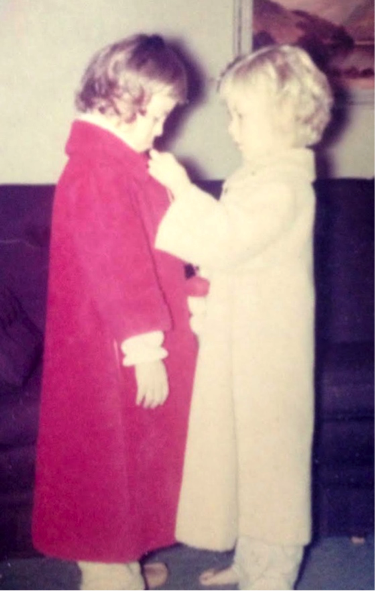
This is my sister Cindy and me when we were little. If you look closely you may be able to tell that Cindy has Down Syndrome. This was a long time ago and one of my most favorite pictures. I am now fifty-eight and Cindy would be sixty this month.
I followed Cindy into this world and I was with her three years ago when she left. I am who I am in this world because of Cindy. She taught me all of the most important things about life through being who she was.
If you have never had the privilege of knowing anyone who has Down Syndrome, you are missing something extraordinarily beautiful. My belief is that they are angels who are here on earth to teach us about beauty. True, real beauty.
I have some strong beliefs about beauty.
Real beauty is totally free. It doesn’t cost any money and it’s in abundance for everyone.
Real beauty feels good. It’s a relief when we recognize it in ourselves and others.
Real beauty is worth more than money.
We all are beautiful and beauty is all around us.
When Cindy looked in the mirror she saw extraordinary beauty, every single time.
She saw a treasure, a work of art, grace, refinement, happiness.
She didn’t see what many others saw when they looked at her. She was different looking. She walked funny. She kind of hobbled from side to side. She had a short neck and a fairly large face and her eyes were different. She often did things with her tongue and held her mouth open. Her tongue was thicker than ours so she didn’t speak with the clarity that ‘normal’ people do. She often twisted her words.
And yet, she was exquisitely beautiful.
She was nothing more and nothing less than who she was.
She was pure, precious, and tender.
She didn’t judge. There was no right or wrong or better or worse with her. No one was less than or more than anyone else in her eyes. Everyone was simply who they were. No expectations. No hidden agendas. No judgment. No measuring up. Ever.
Somehow I think she saw right into the soul of everyone she met. She saw right into me. I know that. She didn’t see my skin tone or hairstyle or makeup job or weight or size of me. She saw the real being of me. She saw my essence, and because she saw what was real in me I was authentic with her. My mask fell off every time I was with her.
When Cindy died I made a commitment to live my life with courage to see and reveal my beauty. I also made a promise to look for and see the beauty in others. I am doing that more and more.
At fifty-eight I now look in the mirror and see lots of wrinkles and fifteen extra pounds that want to stay with me. And I am okay with that. When I look in the mirror now I consciously look for love.
I look to love myself and what I see before me. I know that all those lines are paths to loving myself and others even more. They are not scars to be erased or covered up. They are lines of living and loving fully. Of sharing and caring for others, and myself, with tenderness and compassion. Just as Cindy saw me. No judgment. No criticism. No agenda.
Cindy saw me, and she loved me so that I could learn to see and love myself.
And if I can do that, you can too.
Today, when you look in the mirror, look carefully to see you.
Try to see yourself through the eyes of someone who loves you unconditionally, appreciates you for all your best qualities, and would never judge you.
If there’s no one who has ever loved and appreciated you in this way, understand that this is likely why you struggle to see your beauty, but that doesn’t mean it isn’t there.
Don’t worry about an image you think should be reflected back at you. Look for you in the mirror. Don’t focus on the laugh lines; focus on the smile. Don’t home in on the scars; remember the strength that helped you heal. Don’t look at yourself with a critical eye; look for and celebrate the light in your eyes.
I guarantee if you look carefully, you will see something, someone beautiful. Someone worth loving and caring for. Someone soft and tender and precious. Someone who has a place in this world and a gift to share.
Someone beautiful.
You.
-

The Zen of Coloring: 7 Lessons on Living a Happy, Mindful Life

“The hand can never execute anything higher than the heart can imagine.” ~Ralph Waldo Emerson
I’ve been into mindfulness for a long time but having never been much of an artist, the mindfulness coloring craze had bypassed me until recently.
I brought a book and some colored pencils to keep me amused during a recent train trip but enjoyed it so much I’ve continued the habit—and to my surprise, the work I’ve done looks quite good!
I’d heard that mindful coloring is good for reducing stress levels and being more present, but I found even more benefits. For example, after coloring I noticed that I had flashes of inspiration and ideas that seemed to come out of nowhere for someone not usually known for their creative genius.
Coloring is less about passing time now and more about helping me connect to the present moment and activate the creative part of my brain. It has also taught me a few life lessons, which I’d like to share:
1. We create what we envision.
Life is a blank canvas; we make it what we want it to be.
Like the pages of my coloring book, each new day is blank with potential and possibility, and I get to choose what colors I use, how, and when, and the attitude with which I approach the page or the day.
I can spend the day creating amazing colors and fulfilling my potential, or I can complain about the blunt pencils, going out of the lines, and the many other things that may not be going right.
2. We’re all capable of creating beauty.
We are all capable of creating beauty, even if we think we can’t draw. I’ve spent many years believing I’m no good at art, but this has showed me I am still able to create pretty pictures, despite not being ‘an actual artist’!
The same is true of other roles we might want to try in life. We might think we’re not writers, or chefs, or enterpreneurs—but we can do more than we think, if only we’re willing to try. We can create something beautiful if we’re willing to see ourselves in a new light.
3. It doesn’t have to be perfect.
Mindful coloring has taught me to let go of perfection and unrealistic expectations of myself. Like life, my drawings don’t have to be perfect. It’s okay if I go out of the lines; mistakes are just bends in the road, not the end of the road. And if I’ve really messed it up I turn the page and start again.
On the flip side, when it goes right I’ve learned to take a moment to savor this and appreciate the beauty. Sometimes in life, whether it’s on the page and our own creation or out in the world and a natural phenomenon, it’s nice to stop for a moment and appreciate what we’ve done.
4. Good maintenance increases effectiveness.
The second investment I made after my coloring pencils was a sharpener. I realized you can’t draw nice pictures with blunt pencils, and keeping the implements in good shape is critical for effective results.
The same is true for ourselves; looking after our bodies and minds and prioritizing self-care allows us to perform at our peak.
Whatever you do in your personal or professional life, you’ll be far more effective if you exercise regularly, eat nutritious meals, recharge through contemplative practices like yoga and meditation, and get sufficient sleep.
5. Doing things we love isn’t wasting time.
Mindful coloring has taught me the importance of finding time to do what we love. Most people look at me funny when I say I’ve been coloring, almost as if I must have nothing better to do and am clearly not busy enough doing ‘important things’ like other grown ups.
It’s important that we have downtime and make time not just to do the things we love, but to play and flex our creative muscles as well. For me, that’s coloring; for you, that might be dancing, playing in a band, or riding your bike.
6. We’re never too old to play.
The misguided belief that coloring is for kids or that there are much more pressing things to spend our time on made me realize the importance of play.
I hadn’t colored since I was a kid. In our grown up world of busyness we have overlooked the importance of keeping in touch with our inner child, and this is how life can get dull and boring.
Not only does play keeps this interesting, it also relieves stress, boosts creativity, and can even improve brain function.
7. Less doing, more being.
Most of all, mindful coloring has showed me the art of less doing and more being, which is crucial in a world of overstretched, exhausted adults.
Mindfulness itself in any form is fabulous for returning us to the present and making us more aware. We can spend so much time going over the past or worrying about the future that we miss the present, and this is of course our lives—the moments we are in now.
It’s too easy to let life pass us by. Mindful activities give us the opportunity to be more present.
—
I would never have thought something as simple as coloring could have brought me so much insight and joy.
Life is a lot like that—we never know what will enrich our lives until we give something a try. So go out there and create, and don’t worry about making it perfect. Just throw yourself into it and enjoy the process. And let yourself go out of the lines every now and then. Sometimes mistakes can be beautiful—and if not, you can always turn the page!
Adult coloring image via Shutterstock
-

Look for the Good and You Will Find It
“What we see depends mainly on what we look for.” ~John Lubbock
Have you ever noticed how as human beings, we tend to go negative?
Looking out into the world, we see the crumpled fast food bag in the street and the torn curtain in the window.
Looking into the mirror, we see the pores and dark circles under our eyes. We see the freckles and miss the dimple, or we hate the dimple and miss the smile.
Our eyes focus in on what’s wrong.
I’ve noticed it’s hard to undo this tendency in myself, though sometimes the veil drops suddenly, and I can see the beauty of the world around me.
Many years ago, a friend and I made a three-day visit to the Polish city where we were to live for a year while we taught English.
Arriving on the train, I was struck by the torn metal siding in the station and the crumbling rust of the ancient stair railings; as we walked along the sidewalk, how the entire city seemed one blocky stamped-out Soviet-era apartment building after the next.
Neither of us spoke, but I felt sure my roommate’s thoughts mirrored my own: This was where we were going to live? This worn foot sole of a town was going to be our home for a year?
Just as my mind headed in the direction of I don’t think I can live here, a tiny bird flew down a foot or so in front of my shoes, hopping a few inches here and there to nibble the tops of a tuft of grass poking out of the broken concrete.
I let my suitcase bump to a stop and watched. The bright saturated green of the grass, the pale orange stripe on the bird’s beak, the angle of sunlight against the cracked sidewalk… it was beautiful. And at that moment my heart gave a hopeful thump. There was beauty here, too. I only needed to look for it.
As humans, we have a built-in bias to see what’s not working, what needs fixing, what doesn’t measure up. In general, it’s not bad to see the negative… we avoid falling into pits by looking out for potholes. But seeing only the negative results in what I call “paper towel tube vision.”
When you look through the empty cardboard paper towel tube, you only see whatever shows through the little circle at the end of it, and nothing else. This is what we’re seeing when we see only the flaws on our cheeks and only the crumpled coffee cups on the curbs of life. We see whatever appears in that little circle and lose all perspective.
Seeing the good doesn’t mean we don’t see the bad, too. It means we throw away the paper towel tube and let our eyes take in what we don’t like and invite ourselves to see what’s good there, too. We let ourselves see it all, the big panoramic view that acknowledges that we are more than any mistake or flaw or misdeed.
Imagine letting your mind unfold like a vast, exquisite map laid out on a table. Seeing the bigger picture can be an awesome way to see yourself with more love.
Make a habit of looking for the good. Catch yourself looking at the world—or at yourself—with a narrow, negative view. Then step back mentally and spread out your awareness.
See with the eyes of your heart. Look for something that’s working, something sweet, something lovely, something that opens you up.
Look for the good in people, even people you wouldn’t want to sit over dinner with.
Look for the good in the mirror.
Let looking for the good become a new default for you, and give yourself credit when you’re able to hold whatever’s happening with that big perspective and big heart.
Woman with rose-colored glasses image via Shutterstock
-
We Don’t Need to “Fix” Our Appearance to Be Beautiful
“Kindness and awareness work together. Through awareness we understand the underlying beauty of everything and every being.” ~Amit Ray
We were in Yorkshire—my brother, sister, and I—driving along narrow, windy roads. Sometimes we would come up a steep incline and be unable to see the rest of the road until we got to the crest. It was a little bit scary.
It could have been worse, but that night it was a full moon and even though it was almost midnight, there was a great deal of light in the darkness. We were not normally out that late but had been to an evening theater show in Harrogate, which was about an hour and a half drive from where we were staying.
My sister and I were playing CDs and talking to keep my brother awake, although between the bright moonlight and the difficulty of the route, I imagine sleep was the last thing on his mind! Possibly it was just knowing he was uncomfortable with that type of driving that was really motivating us to stay awake ourselves.
We were chatting about the day’s events and planning what we would do for the rest of the week. Then, as we slowed down and came round a bend, right in front of us was the shell of an old abbey. We appeared to be in the middle of nowhere, so we were truly surprised by the fact that it was there.
Gazing at it for just a few moments, the three of us were awed by the underlying beauty in the remnants of the ancient building.
Eventually we made it home, after midnight. All of us exhausted, but happy to be finding our way to our respective beds. As I lay there in the dark, I couldn’t help thinking how magical the ruins of that old abbey had seemed.
Maybe it was the moonlight shining through what was left of the priory windows, or the sheer height of the building. Or perhaps it was the unexpectedness of encountering it so far away from a town or village.
Whatever it was, as I fell asleep I remained enchanted with the picture in my mind—the image of that dilapidated abbey, which still retained so much of its original majesty and beauty.
In the morning as I meditated alone in my room, I started thinking about perfection, about beauty, and the obsession that seems prevalent in our culture today.
I wondered why so many people go to such extraordinary lengths to stay looking young, to reject any signs of aging, and to “fix” those aspects of themselves that do not conform to what is considered beautiful.
I thought about the magnificence of the abbey—that despite the deterioration, the building was still exquisite. I recalled that there in the moonlight, it was easy to see the graceful lines, the lovely arches, the grandness of what it had once been. Yes, the stained glass windows I imagine it once had were long gone, but for me it did not need to be perfect; its loveliness still touched my heart.
How much more true must this be for those we know, care about, and love? Does anyone really need to hold on to what time and loving has altered? Do wrinkles need to be removed, teeth whitened, or bodies lifted and tucked?
Surely the beauty of who we are does not diminish in the eyes of those around us, because we look a little, or even a lot older?
It’s not that I am against anything anyone does. I don’t feel it is wrong to try and improve your looks. It is more that I believe it is not necessary.
Through awareness, I have learned that everything and everyone has an underlying beauty.
For a long time I was very focused on beauty. I only saw beauty on the outside, was critical and judgmental. I used the word ugly. But with spiritual awareness, I now look at things and people differently. I have become kinder—more willing to observe from my heart.
I know that true beauty does not lie in perfection, or in only looking as young as possible. I have no desire to hold onto or create an illusion of youth. I am happy to accept my face, my body the way it is, knowing this is a natural part of the experience of living.
Here in my heart is the sum of the learning I have gained and the wisdom I have acquired, from all I have gone through. Here in my heart is the peace that has come from knowing myself, from loving myself. Here too, is the love I hold—the memories I have—for all the gentle souls I have known, who touched my life in the most beautiful of ways.
These days, what I see in those I know and love are not flaws or signs of aging, but the beauty that shines through—the result of tears we have cried, smiles we have shared, and the love that binds us together.
Though my eyes may take in what time or illness has altered, my heart looks with loving kindness at the person before me. And, noticing only what has always been there—a loving, caring, supportive, accepting being—my soul acknowledges and marvels at the underlying beauty of the person I see.
Happy mature woman image via Shutterstock
-
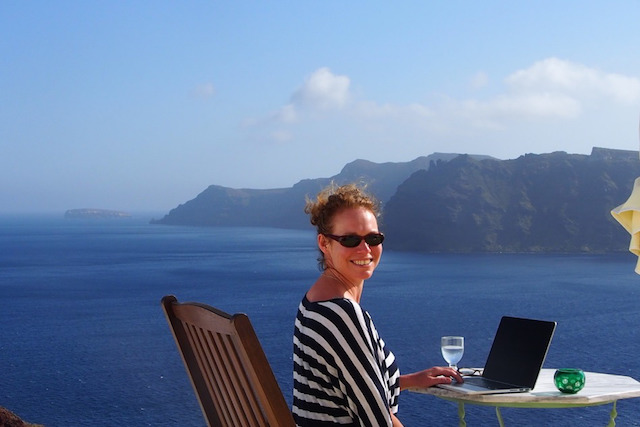
You Were (and Are) More Beautiful Than You Think
“Beauty is not in the face; beauty is a light in the heart.” ~Kahlil Gibran
Does a loved one have a favorite photo of you? A photo by their bedside or on their screensaver that reminds them of a special time and place and memory?
Can I also hazard a guess that this isn’t your favorite photo of yourself? I bet you look at yourself critically and dislike how your face looks, or maybe your body is not cast in its most flattering light. I was reminded of this recently, and it made me think of how I view photos of myself in a whole new way.
My husband and I met in beautiful Byron Bay a long, long time ago. Since we lived in different cities, and we were both young, wild (in the hair department, at least), and free, we would often meet up and spend our holidays there.
This was always a wonderful time, as my love and I reconnected and spent many happy days hiking, surfing, swimming, and discovering the things we enjoyed about each other.
I look back on these days at Byron as some of the most fun and carefree of my life. In my mind there are few better feelings than being young and in love, walking down a beautiful beach at sunset with nowhere to be and nothing to do.
Wow, I was good at practicing mindfulness without even knowing what it was!
Now, this was an era well before the age of selfies and sticks that take photos of both sides of your body. In fact, we didn’t even have digital cameras back then. (Someone pass me a stick of the walking variety—I’m so ancient!)
Therefore, there are only a few photos in existence from this time, and those I do have are all stuck in photo albums sitting at the top of my cupboard gathering dust.
However, there is one photo of me from that time that my husband has always loved. I am sitting on the beach against the rocks, and I’m not more than twenty-two. I am in my favorite purple Mambo swimsuit, with hubby’s trusty old Malibu surfboard right next to me.
I am sure if I asked him, he’d say that this photo invokes memories of some of the happiest days of his life. What’s better than being at one of your favorite spots in the whole world, enjoying the freedom of surfing the waves with your beloved, then happily sitting on the beach under the glorious Australian sun?
It will come as no surprise to you that I have never really liked this photo (hello, inner mean girl). I’ve always felt like I had a silly look on my face and my hair (which is crazy enough, at the best of times) was looking particularly wild and windswept.
However, there is no doubt that it invokes great memories, and over the ensuing twenty or more years, my hubby every now and then looks at me with love in his eyes and says, “Hey, my beautiful Mambo girl. ”
You probably just read that and thought, “Aw, how sweet.” But me, the object of such affection and love, would typically roll my eyes and sarcastically say something along the lines of “Yeah, yeah, whatever,” while feeling nothing like that young, carefree girl relaxing on the beach.
You see, I felt that somewhere along the way of getting older and becoming a mother, with the many responsibilities that entails, I had somehow lost the essence of that young girl sitting there, full of love and hope for the future.
However, I can honestly say that as a woman who is now on the other side of forty, with a newly renewed sense of self-belief and self-love (and who still has crazy hair but maybe not those long slender legs) I can look at myself a bit differently. This is what I would say to that young girl:
Hey, you beautiful Mambo girl. In this photo you are young and carefree and in love, and guess what? That nature-loving, long-haired surfie boy taking this photo will go on to be your husband and the amazing father of your three wonderful children, and you won’t believe what else. He still sees you exactly the same way all these years later. Can you believe it?
I can believe it now.
The next time you look at a photo that someone else loves of you, I encourage you to remove your self-judgment and look at it with eyes of love and acceptance. You might be amazed by what you see.