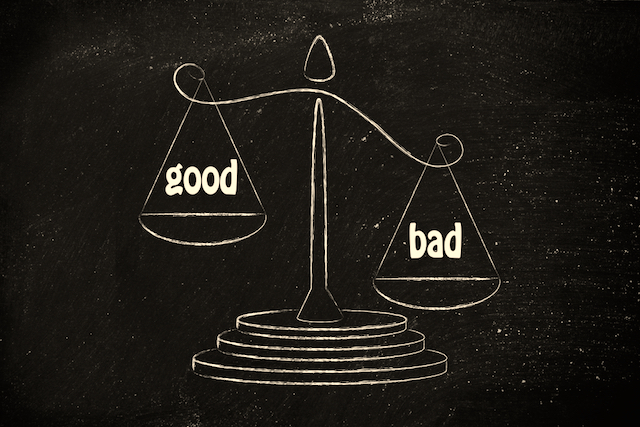
Tag: bad

  • Trauma Lies: Why Survivors Feel Like They’re Bad People

    Trauma Lies: Why Survivors Feel Like They’re Bad People

    “Trauma is not the bad things that happen to you, but what happens inside you as a result of what happens to you.” ~Dr. Gabor Maté

    I used to have this pervasive empty feeling inside. I tried filling it by eating, working, being a wife, making my life look great on socials—anything really to make it go away. I went to church, worked hard, and tried to be a good person, hoping the hole would fill and my life would feel whole and complete.

    I went to therapy for the first time when I was sixteen years old. I remember telling my therapist about this black hole in the middle of my chest. It was bottomless and hot inside. I remember drawing it for my therapist, and one day we had a session where I went inside to see what was down there.

    Strangely, I don’t remember the outcome of that session, but I do know that hole persisted for years. Well into my thirties. I would have seasons of time where I was more conscious of it than others, but nothing, no matter what I did or tried, would make it go away completely.

    I went to school and became a therapist so I could learn all I could and help myself in ways others couldn’t help. Even with professional training, it still took a long time for me to sort out the bottomless pit that sat on my chest.

    I realize now that the pit was composed of several different things, but the primary motivator behind its ever-presence was the fundamental belief that there was something wrong with me.

    I believed everyone, in general, deserved to have a good life and good things, but I wasn’t so lucky. I didn’t really have a reason for why I believed this, just that this was my reality and I had to learn to live with it.

    I didn’t believe that I deserved to have anything nice or good. My life was meant to be in service and sacrifice to others so they could advance and have a good life. Once I began to study trauma and its impact, I was finally able to put the pieces together for why I felt this way.

    When we are kids, we don’t have any control over anything that is happening around us. We don’t get to say where we live, who we’re living with, where we go to school, or when we eat dinner. Nothing. The locus of control is completely outside of us.

    We are at the mercy of the environment around us. For those of us who were not so lucky to be in an environment where we felt safe and secure and had our needs met, this presents a life-threatening problem.

    We are mammals; we need connection for survival. It’s biological. When our safety and belonging are threatened, it feels like life or death because it is life or death. We need an attachment to our caretakers, our environment, and ourselves to survive.

    Growing up, I wasn’t allowed to express emotion. If I was sad or angry, I had to pretend I wasn’t, or I would not be allowed to be in the presence of others in my home. I was abused by my cousins, and I had to keep it a secret so I wouldn’t upset the connections of the adults who were around me.

    I was taught at church that if any boy was looking at me, touching me, or treating me badly, then I must be doing something to deserve it.

    My world was completely out of my control, and I was drowning in helplessness, pain, sadness, and disconnection. This isn’t a tolerable emotional state to maintain. I couldn’t control any of it, and neither can any other child who is experiencing events that dysregulate their nervous system with no one and nothing available to help calm, soothe, and comfort.

    We have only one choice in this instance. We shift the locus of control from outside of ourselves to inside of ourselves. We decide that we deserve bad things to happen.

    There are many ways this plays out for people. Some people decide they are bad; they were born bad. Some people decide they just don’t deserve good things or to be treated kindly because there is something wrong with them. They, for whatever reason, are unlovable.

    I fell more into the latter. I didn’t know what was wrong with me; I just knew something must be wrong with me, and that’s why so many bad things were happening to me and no one noticed or cared.

    This resolved the conflict of feeling helpless and out of control. This allowed me to stay connected to my family in any way I could and removed the helplessness that left me feeling vulnerable and afraid.

    We adopt the belief that bad things happen to bad people so we don’t have to be confused about why bad things are happening to us. It’s because we deserve it.

    This is something we all do when we are young and in situations that are out of our control. We find a way to shift the narrative to make us in control. If we determine that we are bad, wrong, unlovable, weak, or in any way at fault, then the helplessness and weakness are resolved, and we can move forward creating connections and safety within our family systems and culture.

    This sets in motion a paradigm, a core belief, that shapes all of our choices, interactions, assumptions, values, and practices for our whole life. This paradigm informs how we interact with the world moving forward. Buried inside the paradigm are deep feelings of grief, loneliness, shame, fear, and abandonment. These are intolerable feelings that are too overwhelming to keep in our conscious mind.

    For me, I unconsciously dug a deep black hole in my soul and attempted to bury the insufferable feelings that had nowhere to go.

    Trauma causes our minds and our bodies to split from each other. The lines of communication are severed or distorted in order for our stress response system to work effectively at keeping us alive.

    If you experience a trauma but have the opportunity to process it and have people to help you recreate safety, then the connection between mind and body can be restored.

    For those who experience trauma but don’t have the opportunity to re-establish connection and safety, the mind and body remain disconnected. With this persistent mind-body disconnection, the paradigm shift of internalizing that we are bad or deserve bad things gives us two choices moving forward.

    One choice is to shut down all feelings and go numb to emotion. We live in our heads and work really hard to be perfect, good, lovable, pleasing, and acceptable. We become workaholics, overthinkers, perfectionists, and incapable of tolerating any mistakes we make.

    We do this because we unconsciously want so badly to prove to ourselves and the world around us that we really are lovable and good people. We really are worthy of being loved and accepted. We love others well, struggle to set boundaries, and will do anything to be seen as acceptable.

    I can relate very much to this response to the belief that there must be something really bad and wrong with me. I must have done something to deserve abuse and neglect. These weren’t conscious thoughts, just an internal shift I made as a child to resolve the unresolvable. This isn’t unique to me; every childhood trauma survivor I know has done this.

    The other option we have is to stay connected more to our body than our mind. To emote and express all the sadness, anger, and rage inside. People with this response have big emotions. They are explosive, struggle with consistency, struggle to hold down a job, or have addictions. If you ask them why they are struggling, they will usually say, “I don’t know.” They really don’t know because they are in their bodies trying to express all the energy trapped inside, but their minds are checked out.

    Some identify mostly with one archetype, and some relate to being both. This is more of a spectrum than a black-and-white response.

    For me, I was numb 95% of the time and always in my head. If something did ever really get to me, then I would switch to big emotions and not think about what I was doing. I’d get blackout drunk, smoke a pack of cigarettes, buy $30 worth of candy, and eat it all in a half-hour. My behavior would be extreme until I could get back to my head and shut it all down. Can you relate?

    While neither response is good or bad, our society definitely rewards one response over the other. We praise the children who sit in the front of the class and act like “teachers’ pets.” We reward the workaholics and praise the overthinkers. This makes me really sad now that I am in recovery from being a pleaser.

    My recovery took years longer than it should have because it took so long for me to figure out that all the things that people told me were good about me were not actually me at all. They were all an attempt to prove my worth, and as long as I stayed connected to being seen as good and acceptable, I was playing a role based in shame rather than being myself. I couldn’t see it because the role was reinforced everywhere I went.

    There are some specific steps we need to take to set ourselves free.

    The first is to accept and feel the deep pain of realizing we were innocent children who had no control over the uncontrollable things that were happening.

    We didn’t cause it and didn’t deserve it. We were innocent children who deserved love, protection, and safety. There is no reason inside of us that we didn’t get that.

    This is often hard to accept. For me, it felt like I was going to die when I began to allow the pain to surface. This is because at the time of the events, the pain was threatening my connection, which threatened my life. That isn’t true anymore, but my younger self holding all the pain inside didn’t realize that until I began to let myself feel it.

    No one cries forever, and no one rages forever; it does eventually pass. It didn’t kill me, and it won’t kill you either, even though it feels like it might.

    My favorite quote from Dr. Colin Ross, the founder of The Trauma Model Theory, is “Feeling your feelings won’t kill you; it’s your attempt to not feel them that will.” I have found this to be such a helpful reminder in recovery from trauma.

    The second step is to allow ourselves to fully grieve.

    Expand your tolerance level for being uncomfortable and sitting with uncomfortable emotions. Learn to feel all your feelings without activating your stress response and going into fight, flight, or freeze. Be present with them in mind and body.

    This can take some significant work for those who have had complex trauma in their histories. It often requires the support of a professional in the beginning. What helped me most is grieving what didn’t happen as much as what did. The connection and support I didn’t receive. The protection that wasn’t given to me, etc. Grieve the life you thought you should have had but didn’t.

    The third step is shifting the responsibility (not blame) to where it belongs.

    If we stay in the mindset of blame, it keeps us stuck in victim mode. We are working now to be responsible for our lives and how we move forward.

    I hold my cousins responsible for their behavior. I hold my family responsible for the support they were not able to provide. I don’t blame them, but I don’t let them off the hook either. I don’t need to know if they’ll “pay” for what they did or didn’t do. I shift the responsibility for their behavior onto them and am not really bothered with their consequences or lack of them. It doesn’t matter to me.

    It took me a while to be able to say that. For so long I wanted them to get it. I wanted them to understand, take responsibility, or say they were sorry. Waiting for these things to happen keeps us stuck and tied to them. It doesn’t allow us to move forward and create the future for ourselves that we want and deserve.

    I am no longer taking responsibility for their choices, and I don’t need to think about or see how their future plays out.

    The fourth step is to take full responsibility for ourselves.

    This was a difficult step for me. I wanted to blame my past for my inability to speak up, be bold, take action, or feel someone’s disappointment.

    I can’t take responsibility for myself and create the life I want to live if I refuse to accept that my life is a series of choices I make from here forward. I am empowered now to decide who will be around me, what I do with my time, and how I show up.

    I have shifted the paradigm from the belief that I’m unworthy to the belief that I am just as worthy as anyone else. I can tolerate people being disappointed in me, frustrated by my choices, not liking me, or anything else. I decide how I want to show up every day, and I am the only one who can create my life.

    I have never thought of myself as a victim. In fact, I hated the concept, but I did have to accept that living in pleasing mode meant I was also acting like a victim, and that alone was my motivation for change. It was messy and took a while, but eventually I was able to build my strength and resilience to a point where I was comfortable getting to know and expressing my authentic self.

    The fifth step is giving ourselves the tools, grace, and time to let all this play out.

    Continue to get to know who you truly are; continue to feel and express difficult emotions as they come up without pushing them away or dramatizing them. And learn to hold more than one emotion at the same time.

    I can now feel true, genuine love for my family while also being sad and disappointed by the way some things went down. For me, it wasn’t all bad or all good. It was both, and through healing I can genuinely feel and connect to both.

    I have also had to grieve the loss of time. It took many years for me to recover from the black hole that drove my choices and decisions for most of my life. I sometimes wonder what could have been if I had been able to be my authentic self earlier. When these thoughts come, I grieve them, let them pass, and then go do something I love to do.

    It doesn’t matter how old we are when we recognize the paradigm. It can shift, but we are the only ones who can shift it for ourselves.
  • A Surprising but Effective Way to Get Out Of A Shame Spiral

    A Surprising but Effective Way to Get Out Of A Shame Spiral

    “I have found that, among its other benefits, giving liberates the soul of the giver.” ~Maya Angelou

    As an aspiring daily meditator, I’ve been instructed by many a spiritual sage to think of my emotions as clouds drifting across my internal landscape. The idea here is that clouds come and go, so clinging to any one cloud is an exercise in futility.

    I like this metaphor. It overlaps quite nicely with the cloud-classification skills I learned in third grade and haven’t since put to use.

    The more time I spend on the cushion, the more I realize that some of my emotions are cirrus clouds: feathery wisps of humor, annoyance, or connection that drift away as quickly as they came.

    Others are cumulus clouds: hearty puffs of joy, nostalgia, or anger that make themselves known by casting shadows on the ground.

    In my experience, only one emotion is a cumulonimbus cloud: an angry, heaping, blackened pile that trudges sluggishly across the sky. That emotion is shame.

    Shame plants himself down in front of the sun with no intentions of leaving. He makes a god-awful racket with ceaseless thunderstorms and doesn’t move until he’s good and ready.

    Recently, I found myself in the thick of a shame spiral. I had made a series of oversights that were impacting my very new and, as such, very delicate, romantic relationship.

    The mistakes I’d made were honest, but I should have known better, and this became the mantra that fueled hours of self-blame and judgment. My mental movie was like a 1500s tragicomedy, and I was the snarling, callous villain.

    I was feeling like sh*t, and I certainly wasn’t making it any better for myself, but I couldn’t seem to stop. I couldn’t focus on my work, my social life, or even the simple task of taking out my recycling.

    As a person in recovery, I knew that a shame spiral was my one-way ticket to a first drink. So I rang up a trusted mentor for guidance. Over steaming coffee in the hidden back booth of a nondescript coffeehouse, I bemoaned my vivid ruminations.

    What’s Shame?

    Research professor and best-selling author Brené Brown is all over the shame game. She makes clear that guilt is the feeling that you’ve done something bad, while shame is the feeling that you are bad, and as such, “unworthy of love and belonging.”

    As a recovering perfectionist, I get hit with red-hot shame when I do something “wrong.” (As my mom loves to remind me, I sobbed inconsolably when I got an A- instead of an A on my fifth-grade report card.)

    As a recovering codependent person, I get hit with extra shame when I do something “wrong” in the context of relationships. Here cometh the fear of abandonment and the cold sweat of unworthiness!

    Because shame is the feeling that we are intrinsically bad, it’s particularly conducive to spirals—cycles of self-fueling negative energy that perpetuate ad infinitum.

    I know I’m in a shame spiral when I seek reassurance from my friends compulsively; don’t want to leave the house or interact with anyone; don’t feel the need to wear decent clothes, do my dishes, or other acts of self-care; and feel totally uninspired to do the things that generally give me joy.

    In reality, these actions are ways of subconsciously punishing myself. We accept the behavior we think we deserve, and when I’m in a shame spiral, I don’t feel like I deserve much of anything.

    The Solution

    So anyway, back to my conversation with my mentor. I was talking a mile a minute, running my hands through my frizzy (unwashed) hair, and articulating, in great detail, all the ways I’d done my partner wrong.

    It was not a pretty scene. But, as mentors are wont to do, she listened without judgment. When I’d conveyed the whole story, visibly deflated like a sad balloon, I turned to my mentor with wide eyes.

    “How can I fix this?” I asked her.

    She paused, digesting, and replied firmly, “Call someone and ask how they’re doing. Go to the food bank. Volunteer. Be of service somehow.”

    Her suggestion seemed so out-of-left-field that it stopped me in my tracks.

    Call someone and ask how they’re doing? I thought. But that has absolutely nothing to do with my problem or me! (Shame is a very self-referential emotion.)

    I wanted to ruminate, stew, fix! I wanted to call my best friends just one more time and unpack this whole thing, top to bottom. Also, if my intentions for service were self-serving, was it even service anymore? Shouldn’t I only “serve” if I’m really jonesing for some Good Samaritanism?

    I relayed all of this to her. She listened patiently; she’d heard it all before.

    “Hailey, you need to get out of yourself,” she said. “You are driving yourself crazy, cooped up in your mind this way. Give yourself a break.”

    So I did. And it worked. Here’s why:

    1. Shame traps us in our thoughts; service puts us into action.

    In an appearance on Oprah, Brené Brown offers three ways to stop a shame spiral:

    1. Talk to yourself the way you’d talk to someone you love when they feel unworthy.

    2. Reach out to someone you trust.

    3. Tell your story.

    Brené Brown is an absolute sage, and her research on shame and vulnerability has profoundly changed my life. But when I’m in my darkest shame spirals, these three tactics aren’t quite enough for me.

    Because my shame is so self-referential and all-consuming, I cannot think or talk myself out of a shame spiral.

    Every thought—no matter how brilliantly it rationalizes my actions or how warmly it reassures me of my own goodness—is coated with the persistent, underlying certitude that I am bad.

    My shame is like an advanced-stage, resilient bacteria; the first course of antibiotics doesn’t make a dent. I need to prove to myself, with not only my words but my actions, that there is more to me than what I’m so ashamed of. Service is an easy road out of my frazzled mind and into the world around me.

    2. Shame isolates; service connects.

    When I’m ashamed, the idea of being social sounds like torture. I’m normally quite extroverted, but when I’m spiraling, I don’t want to hang out with my closest friends, let alone strangers. In the thick of a spiral, it’s not unusual for me for cancel plans, be unresponsive to friends’ messages, and go dark on social media.

    Isolation enables my shame to fester. It keeps the scope of my world small. Service, on the other hand, does the opposite.

    Service is intrinsically connective. First, I’m connected in real time with the person I’m serving. The newcomer to the twelve-step program I call to check in on, the man whose bowl I fill with soup, the kid I read aloud to.

    Second, I’m connected to my community. Few acts of service exist in a vacuum; typically, I’m at least peripherally involved with a community organization, a church, or a grassroots group of do-gooders determined to make the world a better place. And though the unbridled optimism and rah-rah mentality of service groups can get on my nerves, there’s something heartwarming about being part of something bigger than myself.

    Finally, there’s that universal connectedness; the sensation of being human, of being one of seven billion people dancing their way through this complicated and confusing thing called life. When I’m in service, I’m helping other people with other problems who have baggage of their own. With this perspective in hand, ruminating about my shame suddenly feels far less important.

    3. Shame exhausts; service awakens.

    Self-flagellation takes a lot of emotional energy. It’s exhausting to rewind, fast-forward, and rewind the movie reel of your mistakes. Because it’s our human tendency to defend against threat, a part of us—no matter how small—will fight against the shame. This is the part that will rationalize our behavior, craft a narrative for our actions, and pepper us with positive self-talk.

    These two forces—“I am good!” vs. “I am bad!”—are at odds with each other. The result is an internal Civil War, one that rages as we try to fall asleep, as we stare at the tile wall in the shower, as we drink our coffee on the patio. It can become the soundtrack to our days.

    Service provides a respite from this turmoil. By getting us out of our own minds and into the world around us, it gives the shame soundtrack a much-needed pause. In that silence, we can gain new perspective and peace.

    4. Shame breeds shame; service breeds hope.

    Shame is self-perpetuating; it cycles ‘round and ‘round the same tired litany of self-criticisms and judgments. In such a state, there is little room for anything novel to enter our consciousness. If we respond to our shame by self-isolating and hibernating, we just make the echo chamber smaller. Shame breeds shame.

    Service, on the other hand, connects us with the newness of other people’s stories and challenges.

    Studies have shown that novelty makes us happier whether we’re shame-spiraling or not. Gretchen Rubin, author of The Happiness Project, writes, “Often we’re happier, we feel more energetic, more productive, more creative when we try something new, when we challenge ourselves a little bit, when we kind of go out of that comfort zone. That atmosphere of growth can really boost our happiness.”

    Service gets us out of our own way and offers a new palette of emotions and values to choose from: togetherness, community, connection, service, altruism, and more. It puts our personal challenges into perspective and simultaneously offers us tangible, actionable proof of our own goodness that stands in contrast to our negative self-judgments.

    It was hard for me to realize that my darkest shame spirals were also my most intensely self-indulgent moments. Even though I may have felt totally miserable, at the end of the day, it was still all about me: my wrongness, my badness, my words, my actions, my self-perceptions.

    When I mustered up the will to be of service, I was astounded by the serenity that came from relenquishing my role as the star of the show.

    Becoming a vessel for acts of goodwill opened my eyes to a greater, simpler reality, one I didn’t need to control or micromanage. From that vantage point, I was able to look back on my actions from a distance, and with that distance came the self-compassion, acceptance, and self-forgiveness I’d been hoping for all along.

  • Why “Focus on the Bright Side” Isn’t Helpful Advice

    Why “Focus on the Bright Side” Isn’t Helpful Advice

    There are so many memes and quotes out there that say, “Be positive, not negative. Focus on the bright side.” I’ve never been very good at ignoring the negatives and focusing on the positives.

    Call me a critical, over-analytical over-thinker if you want, but at no point in my journey of self-love and self-discovery have I learned to ignore all my flaws, all my mistakes, all my regrets. At no point in my journey of compassion have I learned to ignore all the times that someone has hurt me or all the destruction caused by abuse. That never felt right to me. And you know something? It hasn’t actually been necessary.

    Rewind to six years ago when I was staring at my makeupless face in the mirror. My thoughts said, “Ugly. Horrible. Pale. Look at those blemishes. Look at those hairs. Disgusting. Revolting. Put a bag over your head and hide.” But I kept looking.

    I couldn’t unsee those blemishes. There they were. I couldn’t unsee those hairs. There they were too. Plain as day. I also couldn’t stop myself from thinking that these were disgusting and revolting. Those thoughts were certainly there too! And no amount of positive self-talk was going to make them go away.

    What happened next was fascinating. In addition to observing those hairs, those blemishes, and those thoughts, I saw something else. I saw my face as pure visual information—the way I’d perceive the colors and shapes in an abstract painting. I was giving my face meaning, and I was seeing it as something meaningless.

    Those moments revolutionized my relationship with myself. I didn’t erase my negative self-image. I just added a new perspective. That new perspective balanced my view of myself.

    I think balance is a key word. What bothers me about the whole “be positive, ignore the negatives” idea is that I was abused by some very mentally unstable people in my childhood who did that very thing. They refused to see how they hurt others. They focused only on their good intentions.

    A certain amount of self-criticism, self-judgment, and self-doubt is absolutely essential. It’s what makes us apologize for hurting someone. It’s what makes us improve the areas of our lives that are lacking. It’s what makes us question idealistic, romanticized notions of the world and see things clearly. The so-called “dark side” is essential. It isn’t bad at all.

    A few years ago, my partner and I were in an argument. He was very angry, and the way he was expressing his anger to me was extremely triggering. I felt victimized, oppressed, disgusted. I thought, “I would never do this to you.”

    But then, something happened. Beneath his unhelpful delivery, I saw something. I saw him trying to communicate something about my behavior toward him. Something that hurt me to see. A huge blow to my ego. And he was trying to tell me about it. He was trying to say, “I don’t do this to you.”

    Sure, he wasn’t communicating about it well. But he was communicating something important. We ended the conversation temporarily and went to our separate corners.

    Alone, shame and self-hatred suddenly returned to me, like old friends who don’t bother to knock. My thoughts said, you’re a horrible human being. Look what you’ve done to your boyfriend. Look at how patient he’s been all this time with your intolerable actions, and look at how you treated him for trying to tell you about it.

    Extreme. It was all so extreme. And I couldn’t delete the extremism! I couldn’t remove my self-judgment, and I couldn’t remove my resentment for his angry words. All I could do was find balance.

    I told myself that just because I had made mistakes doesn’t mean I’m a horrible person. I told myself that I could acknowledge that I had room to grow and also respect myself as a human being. I could do both.

    As for him, I could admit that he had something valuable to say and that his communication needed some work. I could see our argument as something that contained pain alongside valuable feedback. It wasn’t good or bad. It was both. It was neither. It just was.

    These moments pop up for me all the time. Last month, when I was travelling, I had something stolen. I felt betrayed, angry, lost. I didn’t try to stop all those feelings, but I also didn’t stop with feeling them. I continued to explore my experience until I found new perspectives on the situation. So being robbed turned into an amazing learning experience! Not because I ignored the pain but because I balanced that pain with lessons.

    Life is paradoxical. Where there’s joy, there’s sadness. Where there is control, there is surrender. Where there is speech, there is silence. Where there’s destruction, there is growth. We do not need to ignore the so-called dark side. It’s an essential part of the way things are. We only need to add an awareness of the other side: what we call the “light.”

    I think this is especially important in these times of political and social unrest. When we try to replace darkness with light, red with blue, wrong with right, we create war. Because what we call dark and wrong exists for a reason. Sometimes, it exists because it is meant to serve us in some way. Sometimes, it exists because it’s a symptom of some bigger issue.

    No matter how much we try to triumph over and defeat our enemies (including our inner enemies), if we do not understand where they come from, they will keep returning in different forms. We need to wage peace, not war, and peace comes from understanding.

    My perfectionism, which destroyed me for many years, was not a malignant tumor to cut out of my experience. It is a helpful pattern. Sure, it doesn’t help when I’m looking at my face or my mistakes. But as I’ve learned to embrace the art of continuously perfecting something (without ever expecting it to be perfect), I’ve become a better writer and a better editor.

    My self-judgment, which almost brought me to an early death, was not a disease. It was overgrown, but it wasn’t unnecessary. My ability to look critically at things helps me expand my perspectives, open my mind, and understand people better. My ability to look critically at myself helps me work on myself, admit my mistakes, and constantly improve.

    My bouts of intense, debilitating self-loathing weren’t useless either. They always had a message. Sometimes, I hadn’t taken a break in months. Sometimes, I was ignoring my own needs while codependently following the desires of the people around me. Sometimes, I had allowed my anxiety to spiral endlessly for weeks and weeks, and my mind had just become tired. I realize now that, in my suicidal moments, I didn’t really want to die. I just wanted to rest. I wanted a break from it all.

    I’ve learned that there is no good or bad. There is only what is most helpful and useful at the time. The answers, as they say, are all within you. They are. And this also means that, in any given situation, some of your inner answers will be more appropriate than others. Everything has its time and place. Everything is a valuable part of your experience.

    This doesn’t mean we should condone rape, murder, or violence. But this attitude can help us understand these tragic occurrences more than judgment can. Why do some people feel like the right answer is to hurt someone else? I think this line of questioning will bring us to a more helpful place than calling those people heartless monsters. It can actually help us work toward solving those social issues.

    And learning to look at ourselves and, instead of asking, “How can I get rid of this horrible part of me? How can I stop doing this unhelpful thing?” We can instead ask, “What could this mean? Which needs might I be meeting with my actions, and how could I meet those needs in a way that serves me more?” We can focus on holistically understanding why something has happened and allowing ourselves to explore different, new solutions to the puzzles of our existence.

    I suppose what I’ve learned over the past six years has been more than self-love. I’ve learned balance. I’ve learned that real happiness is being unafraid of my emotions. I can be sad, angry, happy. I can feel it all, whenever it comes, and know that I won’t get stuck on it. I will let myself experience all the available emotions, and then I will come to peace.

    Instead of trying to focus on the bright side, my task is to let myself see all the sides, remove my judgment about what they mean, and try to appreciate the complexity of my experiences.

    That is the power we have as human beings. We can let ourselves be curious instead of always fearful. We can choose to work on understanding who we are instead of always trying to be who we think we should be. We can let ourselves see what is there and not only what we are used to seeing. We can choose to understand better. We can choose to be aware.

  • Maybe It’s Not All Good or All Bad

    Maybe It’s Not All Good or All Bad

    “You are the sky. Everything else—it’s just the weather.” ~Pema Chödrön

    A farmer has a horse for many years; it helps him earn his livelihood and raise his son. One day, the horse runs away. His neighbor says sympathetically, “Such bad luck.”

    The farmer replies, “Maybe. Who knows?”

    The next day, the horse makes its way back home bringing with it another horse. The neighbor says with a smile, “Such good luck.”

    The farmer replies, “Maybe. Who knows?”

    The following day, the farmer’s son rides the new horse and seeks to tame it. In the process, he breaks his leg. The neighbor says sympathetically, “Such bad luck.”

    The farmer replies, “Maybe. Who knows?”

    The last day of the story, the military comes to the village to draft all able-bodied young men to fight in a war. The son is exempt from the draft due to his broken leg. You can guess what the neighbor said, and how the farmer replied.

    This Zen Buddhist parable illustrates that we never really know exactly why things are unfolding the way that they are, and that labeling them as “good” or “bad” is useless. It only gets us wrapped up in the ups and downs.

    Riding the car of this dichotomy only takes us on a roller coaster ride while our emotions are following whatever storyline is in front of us.

    Because I’m a human, I do this all of the time. I think that something fits neatly into either category, and I place it there then try to not look back. Usually that ends with those contents spilling out all over the place. Like when I try to make certain foods “good” or “bad.” Food has no morality, and categorizing it in this way just brings me shame.

    David Allen explained that the Taoists have their own way of interpreting the complication: the yin and yang symbol. “Good” flows into “bad” and the two are even contained in one another. They can’t really be separated.

    How I’ve Found the “Good” in the “Bad”

    Not too far out of college I had a cushy tech job that I absolutely adored. I relished in the fact that I was doing what I loved, and that I had been promoted to that position after working really hard.

    The perks were great. We had flexible hours, leaving room for naps on my work-from-home days. My favorite perk was a giant snack room, full of all kinds of goodies. We were swimming in startup benefits, and by all measures, I was happy. However, I didn’t realize I was overworking myself until I collapsed.

    The long hours had taken a toll on me, emotionally and physically. My romantic relationships had also gotten me down. I’d been causing myself a lot of pain by continuously going after emotionally unavailable people. I had also been neglecting self-care, sleeping much less than my body required. My mental health deteriorated to the point where I no longer felt safe in my own skin.

    I’d struggled with my mental health throughout my life, but I thought I’d gotten to a good place. Turns out I was wrong. My mind had been slowly building up to a bipolar explosion that mixed mania and depression.

    My mania manifested itself in staying up too late, having impulsive sex, and taking on way too many responsibilities at once. My depression took the form of feeling worthless and losing interest in things I loved, and my hunger was either through the roof or absent. Suicidal ideation was a big part of the mix. This was the scariest part—the fact that I’d lost the will to live.

    As a result of all of this, I had a breakdown. I could often be found writhing in emotional pain, my brain wanting me dead. How quickly this “good” turned to “bad.” 

    Because I was deemed unsafe, I was taken by ambulance to a locked ward. Turns out when you show up to the hospital telling them you’re suicidal, they cart you away to a locked facility of some sort.

    Everyday things like my laptop cord and makeup mirrors were taken from me, lest I harm myself. I slept in a hallway of sixteen girls, and a nurse opened our doors every fifteen minutes at night to check to see if we were still breathing. The food was subpar at best.

    I wanted to die. I had a total mental health collapse and realized I had been running myself ragged at this job. I had to quit it because I knew that this hospital stay wasn’t going to be a quick fix. I had seven more hospitalizations that year, and I thought that my life was over.

    While reflecting on what had brought me to this point, I realized that not only was the job overly demanding on my time, the office had terrible boundaries, with lots of people dating one another (including myself at one point). Most harmful, though, was the unlimited stash of anytime booze. I’m a recovering alcoholic, and though I was able to stay sober, this wasn’t a healthy environment for me.

    Later, reflecting on the time I spent hospitalized, I realized my experiences weren’t all “bad.” 

    My time in and out of psych wards has reminded me how strong I am—the strength it took to get help instead of killing myself was something I didn’t know I had. I thought I’d stay on the path to destruction for much longer, but my will to live came through.

    Also, I was shown, despite my skepticism, that I’m indeed never alone; my loved ones showered me with support. People regularly visited me in the hospital, and their presence helped me heal.

    My friends showed up without judgment, holding space for all of my big feelings. They brought nothing but love (and some snacks). It was vulnerable to be seen in the condition I was in, but my friends proved they could be trusted to be with me in this state. Many of them had been in my shoes before, so they held compassion for what I was going through.

    Most of the friends that visited were AA companions. They were people trying to stay sober, just like me, and we were living many of the same values like acceptance and taking life one day at a time. With their support, I continued on the path of healing both inside and outside of the hospital.

    I’ve even managed to find the “good” in alcoholism. In fact, I now believe it’s one of the best things that’s ever happened to me. My recovery has brought me beautiful friendships, immense personal growth, and ridiculous amounts of resilience. I’ve learned to be there for another person without constantly putting myself first, and I’ve grown to be a better partner.

    It took eighteen months of rest before I was ready to go back to work. I struggled with feeling inadequate and useless during this time. I was so accustomed to working like a maniac that rest felt foreign to me. But I’m now finally well enough to work, though I’ve gotten a job that pays much less than my last one and it isn’t even close to as prestigious. I’m calling it my “get-well job.”

    I’m still working through some shame around it, wanting to call this “bad,” even though I know it’s a mix of things. Instead of calling it “bad,” I do my best to return to “maybe” with a shrug.

    I’m not saying that I’m able to be perfectly non-judgmental and unattached, living without worry at my job and feeling perfectly confident when talking about it. But some days I can just let things be what they are. I can notice that voice inside that’s yelling at me and I can soothe it. I can create a new script and I can practice radical acceptance by not fighting against what’s going on in my mind.

    Looking back, I called my job “good” and the psych wards “bad,” though there were no clear categories. Good is great, but it doesn’t last forever. Bad can hurt, but it doesn’t last forever either. There was a bit of a mix of everything. Much of life is this way.

    I don’t know why things happen the way that they do, and I never know what’s going to happen next. Perhaps this job will benefit my life in ways I could never predict. Maybe it’ll keep me where I’m at, or make things worse; I just don’t know.

    The thing is, though, once I start to move past outcomes I can be more present to and flexible with what’s happening.

    I can just enjoy learning to use the espresso machine at my new job rather than worrying about what people think of my new job choice. I can practice gentleness around my mental health, remaining non-judgmental when I have a difficult day. I can do this instead of thrashing against what is, letting my mind carry me to dreams of what could be and feeling angry about how things are.

    I can work with whatever emotions come up, knowing that it’s all the path. I can’t prevent life from happening and I can’t always force what I want to happen. What I do have control of is l how I react to everything, and today I’m trying to have a “maybe” attitude.

    No matter what happens, I know I can handle it. Being knocked down by my job and mental health reminded me that the human spirit is wildly resilient. I got back up; I did it very slowly, but I did it.

  • When Things Don’t Work Out: Who Knows If It’s Good or Bad?

    When Things Don’t Work Out: Who Knows If It’s Good or Bad?

    Good or bad

    “It’s not the events of our lives that shape us, but our beliefs as to what those events mean.” ~Tony Robbins

    I recently received a rejection letter for a voluntary role befriending and supporting a child in the care system. I was excited at the prospect of supporting a child who had likely been through a lot, and had been quietly confident that I would be great in the role.

    After all, I am an emotionally responsible, fun-loving, deeply caring adult who had lived through a ton of difficulty: addiction and alcoholism (my own and my mother’s); growing up in a single parent household; not meeting my biological dad properly until I was fourteen years old; self-harm, self-hatred, and overwhelming, toxic shame, which I have transformed into courage, confidence, and a powerful calling to be of service to others.

    I felt my stomach knot up as I read, “Some of the information you share online could be confusing for a child and might be inappropriate for their age and understanding. We have therefore regretfully decided that we will not be able to accept your application for this role.”

    First I was disappointed, and then I was angry.

    I was angry with myself and my stupid, “too-much” honesty, angry with the articles I’ve written that have gone viral in the past, leaving me with a permanent digital fingerprint, angry with the system and its red tape and bureaucracy, angry that anyone can have their own baby but in order to support one that is in the care system, you need to be bland, opaque, and un-googleable.

    Then, the wave of shame came—shame that I have shared so transparently over the years, shame that anyone can google me and can find so much… stuff.

    Next came the fear: the letter raised doubts and questions about how transparent and vulnerable it is safe to be. I noticed my mind race with fears about whether I would ever get a voluntary position or job working with children/vulnerable adults again.

    And then (finally!), some understanding and acceptance.

    The recruiters are simply doing what they consider is best for the child.

    I wrote my application in full integrity, so if it’s not happening, perhaps it is not meant to be.

    It’s okay. It’s okay. I’m okay.

    I remembered the fable of the wise farmer. Here is my own version of it:

    There was once a wise farmer, who, with his wife, had a small piece of land and one horse. One day, the horse managed to jump the fence and ran away to freedom.

    The farmer’s nosy neighbor sidled up to the fence, leaned on it conspiratorially, tutting and shaking his head. “You had just one horse,” said the neighbor, “and now he’s gone. Such bad luck!”

    The wise farmer nodded slowly, taking in his neighbor’s words. “Well, who knows if it’s good or bad?”

    The next day, the wise farmer’s horse miraculously reappeared, except that he wasn’t alone: in tow was a second, wild horse.

    The neighbor hurried over excitedly, jabbering away. “You had one horse, then you lost it, and now you have two! This is such good luck!”

    The farmer smiled sagely before replying, “Who knows if it’s good or bad?”

    The following day, the farmer’s only son took on the job of breaking in the wild horse. The horse bucked, throwing the son to the ground. His leg was well and truly broken.

    “Tut, tut, tut,” the neighbor muttered in dismay, “What a week! You lose a horse, get it back, gain an extra horse and now your only son, your only help on the farm, is injured! This is such terrible, terrible luck.”

    Once again the wise farmer shrugged his shoulders, utterly non-committal. “Who knows if it’s good or bad?”

    A week later, the army marched through town, conscripting all and any young men for military duty. The farmer’s son, in a cast and on crutches, was not required to go to war. The neighbor exhaled in relief upon hearing the news. “Oh, what good luck for you and your family! Your son doesn’t have to go to war! Such good luck.”

    Of course, the farmer responded in only the way he could…

    “Who knows if it’s good or bad?”

    I’m not about to suggest that when we see injustice, abuse, or evil in the world, we pretend that it doesn’t matter, or use the “Who knows if it’s good or bad?” line as an excuse for apathy. That would be a gross misinterpretation of the message of this story, which is really, in its essence, a teaching about curiosity and remembering that in the grand scheme of things, we really don’t know what anything truly means.

    The wise farmer in the fable may have had emotions and stories running in his head in response to each unfolding event (although he does appear to be very close to enlightenment if you ask me!), but he kept a truly open mind and consistently responded with curiosity, reminding himself and his drama-addicted neighbor that nobody truly knows what anything actually “means.”

    Since there is never really a finishing line (even death doesn’t necessarily stop the ripple effects), we can’t really declare that something was definitely good or bad. It is always unfolding.

    How many lawsuits are filed years after an actual event has taken place?

    How many terrible events have borne something beautiful and vital to our world?

    How many losses have led to triumphs?

    And how many triumphs have led to losses?

    The self-study metaphysical text A Course In Miracles guides the student to practice acknowledging that “Nothing I see means anything” and that “I give everything I see all the meaning it has for me.”

    It challenges the reader to detach from playing God and from constantly interpreting and attaching meaning to every single thing that happens, to remember that we are always only seeing a tiny aspect of the vast tapestry that is being woven throughout our lifetime.

    Detachment from meaning-making doesn’t mean leap-frogging over difficult emotions. In fact, I believe we are called to do the exact opposite, as hard and uncomfortable as that can be—to lean in and feel it all.

    When I got the rejection letter, I allowed myself to feel the anger, disappointment, shame, judgment and sadness. I gave myself permission to feel and process what came up for me—for a while, anyway.

    Then, at some point, the time came for inner vigilance, for deliberately and consciously choosing to practice curiosity and release control of needing to make anyone right or wrong.

    I believe we are all called to do this deep inner work. Not all of us answer the call, of course, because it’s uncomfortable. Our brains are wired for certainty, which makes the practice of leaning into uncertainty and curiosity spiritual black belt stuff. It goes against our inbuilt survival instinct that wants to have it all figured out.

    Deeply surrendering, practicing humility, and being willing to sit in the uncertainty of really not knowing what is going on, while also having faith that it might just be a friendly universe, are acts full of power.

    This work isn’t easy, but it’s so important.

    It is vital to tame the scared monkey mind that panics at the slightest hint of uncertainty and tries desperately to figure out what on earth is going on.

    It is critical to become conscious of the story and the meaning your mind wants to create, to allow yourself to feel the emotion that is present, and then to choose to commit to the hardcore inner work of remembering that you don’t really know what the outcome of any situation in your life will be.

    For me, it turns out that I will not be befriending a child in the care system anytime soon. This situation was a powerful reminder that I simply am not in charge. It has prompted me to ask some big questions about how vulnerable and transparent I want to continue to be online, to make a choice about whether I will continue to write and speak about uncomfortable topics, even if it means the loss of certain options.

    Who knows if what happened is good or bad. I certainly don’t. I can either roar at the universe about the injustice of this, or I can take a deep breath and acknowledge that I don’t really know what this is for.

    Perhaps one day I will look back and think, “Ah, that’s the gift that came out of this situation.”

    But for now, we only have today. And so today, I wish you a day full of conscious, genuine curiosity.

    Because when trying to figure out if what is unfolding in your life right now is good or bad, the only thing we can say for certain is that more will always be revealed.

  • Why We Need to Stop Judging Our Feelings

    Why We Need to Stop Judging Our Feelings

    Sad woman

    Your emotions are meant to fluctuate, just like your blood pressure is meant to fluctuate. It’s a system that’s supposed to move back and forth, between happy and unhappy. That’s how the system guides you through the world.” ~Daniel Gilbert

    As a highly sensitive person I experience emotions very deeply, though it’s not usually obvious to others that I’m having such strong internal reactions.

    For those not familiar with this trait, high sensitivity is not a defect or a personality flaw; it simply means that you experience sensory and emotional input more strongly than non-sensitive people.

    Of course, this is not to say that humans are really that bipolar in terms of their emotional and physical experiences; sensitivity is a spectrum, and I’ve found myself leaning to the more sensitive side.

    High sensitivity has wonderful benefits: it facilitates deep insightfulness, fosters a drive for authenticity and creative expression, and enriches the sensory experiences of life. It’s a double-edged sword, however, because just as the positive aspects are magnified, so too are the negative aspects.

    Just like with most aspects of life, this is a delicate balancing act, because it can be difficult not to become overwhelmed by emotion, whether positive or negative.

    Embodying this trait throughout my life has been a challenge: I’m always super aware of my environment (both external and internal), and processing that information on a deep level pretty much all the time.

    This causes me to have a preference for quiet environments (yet I live in New York City!), and also to need lots of alone time to recharge. This is not to say I’m a hermit or that I hate people; quite the contrary: I crave authentic connection and love engaging deeply with others.

    It’s been crucial to learn to accept this trait, to pinpoint my needs without feeling guilty for them, and to have the courage to express those needs to my loved ones.

    One of the most beneficial things I’ve been learning is the importance of non-judgment. For every high there is a low, and the only thing making a low “bad” is that we judge it as so.

    Everyone experiences a full range of emotions, and a highly sensitive person will feel it even more intensely. However, fluctuating emotions are part of life. They’re not something to be avoided at all costs, as I believed I should be able to do in order to achieve an imagined and unattainable level of perfection, which didn’t include messy emotions that only get in the way.

    When I feel “negative” emotions such as anxiety, anger, and sadness, I berate myself for succumbing to such “bad” feelings and feel the need to make them go away as soon as possible. Needless to say, this reaction does little to alleviate the distress caused by these emotions, and usually only exacerbates them.

    What I’ve realized is that it isn’t the emotions themselves causing me to suffer—it’s my judgment of those emotions and my desire to rid myself of them.

    When I am unable to make the feelings go away, it feeds my anxiety and I retreat even deeper into myself instead of allowing the emotional wave to pass and expressing my feelings to others.

    Judgments are thoughts about emotions. Emotions are simply fleeting currents that come and go and provide a compass for us to fully feel and address whatever issues may be under the surface.

    Though thoughts and emotions are related, they’re different things, and we can learn to manage both of those experiences.

    In order to do this, I practice mindfulness exercises in which I simply allow my thoughts to stream and recognize that these thoughts don’t define me unless I give them that power; I’m the one in control of my experiences.

    I also allow myself to fully feel my emotion, without judgment, sometimes naming them as they pop up if that helps.

    Self-understanding and a connection with our intuition are essential for strengthening our emotional intelligence, and this is an instance in which high sensitivity is a major benefit, because it’s highly conducive to deep introspection.

    I continually practice being mindful of my thoughts and how they cause emotions so that I can catch any spirals before they snowball.

    This act alone has had tremendous benefits for my overall well-being, as well as my ability to manage, and most importantly, accept, all the emotions that come with being human.

    A recent experience of unrequited love has demonstrated to me how far I’ve come in terms of riding the emotional waves without added layers of judgment and criticism.

    At my gym, I met a very attractive man with beautiful chin-length blond hair, deep expressive blue eyes, and a sweet disposition.

    I developed a little crush and tried my hardest to be more open, but also to accept that I do get shy and I’m slow to warm up to new people.

    I didn’t judge myself negatively for it, but rather was proud of myself for my efforts to maintain eye contact, smile, and initiate conversation.

    Unfortunately, as I was beginning to think the feeling might be mutual and trying to work up the courage to ask for a date, I saw him with another girl who frequents the same gym. It was obvious they had something going on.

    Although it felt like I had been punched hard in the gut to see them together, in the past a situation like this would have also made me spiral into a deep hole of self-hatred. I would have criticized myself for being too shy, for failing, for missing an opportunity, and for allowing another woman to snatch up my crush.

    These thoughts would then fuel intense regret, anxiety, fear, despair, and anger—which are emotions in response to thoughts, not in response to the actual situation. Then I’d criticize myself for allowing these feelings to get so out of control, and the vicious cycle would progress ad infinitum.

    But that isn’t what happened this time.

    Instead, I allowed myself to completely feel every emotion that came with this experience, not with thoughts about the experience.

    A twinge of sadness, a pang of despair, loneliness, frustration, jealousy, defeat, embarrassment, desire, anxiety, lust, and anger all passed through me in waves every time I saw them together or felt how much I still liked him and wished I could have had a chance with him.

    Without the layer of judgmental thoughts, these feelings became manageable. I’ve also developed a sense of gratitude for all the things I feel, because this is what it means to be human, and vulnerability is a beautiful thing that can connect us directly with our inner selves.

    We hurt because we love, so hurt is a sign that you’ve let love in.

    I’ve used this experience to learn more about myself, and I’m thankful that it can help facilitate my continued emotional intelligence training.

    As I began to praise myself for my efforts rather than only criticizing myself for failing and letting my emotions consume me, I began to cultivate self-love as well. Since love for others stems from love for self, I found that this not only diminished anger toward myself, but naturally flows outward to others.

    Compassion for others begins with compassion for ourselves, and high sensitivity facilitates this process.

    I’ve also learned that how we react to events is far more important than what actually happens to us.

    Unrequited love is usually seen as a negative thing, and it truly does hurt, but it’s also a window to deeper understanding and compassion. For that reason, I’m grateful to have had this experience, even though it’s painful.

    Pain has a purpose. It shines light on the most important issues we must face, as well as our biggest opportunities for growth and learning. True, my crush doesn’t reciprocate my feelings, but I still have a loving family, I still love myself, and I love being alive to have all these experiences.

    When I think about it like this, I’m grateful, and I’ve learned to love myself throughout all the fleeting emotional experiences that ultimately don’t define me anyway.

    We just have to ride the waves and recognize that our thoughts are not always an accurate depiction of reality, our emotions are fleeting, and it’s completely okay to feel the entire spectrum of them.

    We are human, and as the perfectly imperfect beings that we are, feeling the spectrum is what we are here to do.

  • How to Feel Better When You’re Down (Without Forcing Yourself to Be Positive)

    How to Feel Better When You’re Down (Without Forcing Yourself to Be Positive)

    Woman with dark cloud

    “Forget the failures. Keep the lessons.” ~Dalai Lama

    The year had finally come. I’d officially entered the “adult” world after celebrating my thirtieth birthday.

    I’d enjoyed being in my twenties. It was an incredible time for self-growth and healing after growing up in an unstable environment with a narcissistic, alcoholic father, and also a time of living life fully, having fun, and going on adventures.

    I felt pretty happy…until I hit thirty.

    I began examining my life not so positively anymore.

    Health problems had become more frequent and scary, my career path was ominous, I had not settled into a place where I wanted to live, and the answer to the big question for women my age (“Are you married with kids?”) was a definite “no.” I felt like I had nothing to show for myself.

    So, I resorted to one companion that I had known for a long time: the negativity blanket.

    We all have our times with the negativity blanket. It’s not soft, warm, or big, but it’s so familiar.

    I used the negativity blanket as protection during the times when I had no safe haven, when I had no comfort, no one to hug me and tell me it was all going to be okay. In a way, it helped me cope with the difficult aspects of my life.

    In my twenties I’d learned how to let go of that blanket. I’d learned about discarding old habits that were no longer serving me, accepting situations, fostering a positive mindset, and trying to find solutions to problems without allowing negativity to hold me back.

    The time had come to get back to that mentality—but I had to do it without shaming myself for my natural feelings.

    It’s easy to feel guilty about not being positive all the time, but we’re only human. It’s okay to have low times, so long as we don’t let them consume us.

    Below are some ways to gently move from a place of persistent negativity to more positivity.

    Go through what you have to go through.

    We all experience difficult emotions. Own them. If we do not own our emotions, we feel shame for having them and it’s harder to see the issue in front of us clearly. It may even become suppressed or internalized.

    I felt a string of mixed emotions before I turned thirty. Mostly, I felt lost and insecure because of where I was in life in comparison to a large majority of my peers. These were totally natural emotions.

    By letting myself feel them, I was eventually able to move beyond them. As they say, the only way out is through.

    Realize your triggers.

    It’s always easier to deal with something if you know what you are dealing with. Breaking down a problem and identifying your fears, unknowns, and stressors gives more clarity into what you can change, face, or let go, as well as what challenges you might have in front of you.

    For example, my triggers were fears related to being financially stable and cared for, as well as having someone to care for in the future. Realizing what was bothering me helped guide me through finding solutions, such as re-directing my life goals and working on being patient.

    Find space.

    Begin to create space between you and issues. Creating space means that you are taking a step back from your emotions and taking a look at what you’re experiencing a little more objectively.

    I began to work on shedding the shame I was feeling as a result of the narrative that I was telling myself, that I had no accomplishments when I turned thirty. Instead, I found space in between my feelings by relinquishing control over them. I stopped trying to control my future by planning or worrying, and instead focused on my hopes and intentions.

    Be grateful.

    Gratitude is a powerful tool. It’s the first step to setting a good mindset. You don’t have to be grateful for anything related to your problem; it helps just to identify three things you’re grateful for each day.

    I became aware of more value in the life I was living and began cultivating gratitude toward that. I was grateful for the opportunity to move to a different state, for my friends back home and in my new one, and for having the privilege to work as an ecological restoration technician on some of the most beautiful natural areas, I would argue, on this planet.

    Reminding yourself to be grateful allows you to see some richness in your life, regardless of what you’re going through.

    Take the good with the bad.

    It’s not that bad things don’t happen to good people, but the way we handle our issues depends on our perspective. A feeling of personal empowerment emerges when you are able to accept the bad and enjoy the good in each situation.

    Even though I had not spent my former years settling down, when I look back I see that I traveled to different countries and states, worked an array of cool jobs in the natural resources industry, got involved in various hobbies and activities that I never thought I could even do, and so much more.

    Watch for opportunities.

    During this hard time, I began to find opportunities to better myself. I started fine tuning my skills in the various activities I pursued and refined my habits into more appropriate and healthy ones. I realized that I had an opportunity to grow into a better person, and in a better direction than ever before.

    It may just take time and patience to realize what may come out of a situation; after all, to quote Joni Mitchell, “Something’s lost, yet something is gained in living every day.”

    Build strength.

    Call on your courage and see how this can make you stronger.

    I was having a terrible time traveling solo internationally at one point in my life and was reciting my woes to a hostel roommate of mine, who happened to have more bad luck than I did. Her perspective was “Sometimes the more you go through, the more you know you are able to handle.” Believe that.

    Focus on the lesson.

    If you look at past issues, are there any lessons that were learned? Did you get through them and did you feel good about that? That may be one silver lining.

    During this time, I was again reminded of how my perspective influences how I work through issues and how much I enjoy life. That negativity blanket was not as useful in the big picture of things.

    It’s not possible or healthy to be positive PollyAnna all day. Tragic events, trauma, and drama happen, and we have to go through anything that life hands us. When I felt bad for feeling bad, I reminded myself to stop being so hard on myself. This allowed me to accept my challenges and to recognize the beauty in my life.

    It’s the little things we do to motivate and encourage ourselves that bring positivity to our inner world.

    Accept all the emotions that arise, and don’t feel bad about feeling bad. Instead, gently pull yourself out of it, just as you’d offer compassion and support to a friend. With your own motivation and encouragement, you’ll feel much stronger overall, and a lot more positive.

  • The Good News About Feeling Bad (And How to Get Through It)

    The Good News About Feeling Bad (And How to Get Through It)

    “To honor and accept one’s shadow is a profound spiritual discipline. It’s whole-making and thus holy and the most important experience of a lifetime.” ~Robert Johnson

    There’s nothing worse than having a bad day (or week or years…)

    Or when emotions take over and carry us away.

    Or when our relationships bring challenges.

    Or when we endure great loss.

    Or when we wish that just once when things started getting good, they stayed that way.

    But difficult times are really offerings that show us what no longer serves us. And once they’re cleared, they no longer have power over us.

    No one, including myself, wants to feel bad. After decades of trying to overcome depression and anxiety, one day, I finally stopped trying to fix myself. I then came to the amazing realization that there’s really no problem with me.

    This is what set me free:

    Several years ago, my parents both died of cancer, I had many miscarriages, my husband and I divorced, and my dog of sixteen years had to be put down.

    It was intensely difficult, and I fell apart. I hardly recognized myself. At the same time, even in my darkest hour, I knew in my gut that I would somehow get through it.

    In the midst of my mid-life crises, wondering when and how I would get over the debilitating, soul-crushing loss, I trusted myself not completely, but enough. 

    During that time, I made a new friend whose father had recently passed. I invited him over for a bowl of my famous Italian chicken sausage lentil soup.

    He was angry and confused. He was in shock. I picked up my soup in the palms of my hands and said to him, “Grief is a big bowl to hold.”

    At any given time, without knowing why or how, grief can overcome us in a number of aching expressions.

    We get super pissed off. Or we want to hide. Or we push away those we love, and wall off. We want to numb the pain. Or cover it up.

    Seemingly insignificant annoyances trigger us. Perhaps a token, memory, or random happenstance wells us up.

    We all mourn in different ways, wanting more than anything for it all to end. And we sometimes pretend that it’s over when it’s not.

    Someone once told me that there is grief and frozen grief.

    Frozen grief is grief that got stuck like water passing from a liquid to a solid state—a cohesion of molecules holding together, resisting separation. Like a Coke in a freezer, it can burst.

    Warmth and equilibrium are what’s needed to nurture it. But there’s not a single temperature that can be considered to be the melting point of water.

    I read once that after suffering a great loss, it takes two years to heal—or at least have a sense that the trauma is now of the past, even if not “over.”

    At two years, I was doing better but I still wasn’t great. I worried then I was frozen.

    Cheryl Strayed wrote in Brave Enough:

    “When you recognize that you will thrive not in spite of your losses and sorrows, but because of them, that you would not have chosen the things that happen in your life, but you are grateful for them, that you will hold the empty bowls eternally in your hands, but you also have the capacity to fill them? The word for that is healing.”

    Cheryl Strayed knew about the bowl too.

    It took four years, and then one day, I saw the clouds disperse and the sun rise. I was frustrated it wasn’t two. It was four. But that’s how long it took me.

    In the grand scheme of things I can look back now and see all that I learned and how I grew. In my most broken hideous moments the most magical thing happened.

    I came to love my big, beautiful, messy self. I came to accept her like nothing else.

    As much as I missed my mother and father, the husband I loved, the babies I didn’t have, and the dog that replaced them, I came to a place of loving myself like my own parent, my own spouse, and my own child.

    I was all that was left. And if that was it, then by God I was going to love her.

    And what did loving myself really mean?

    It meant accepting myself enough to allow myself to be a mess.

    To not apologize 100 times for every single mistake, or kill myself over them.

    To humbly say to others and myself, this is it.

    And then, somehow, I started to accept others like myself. They got to be messes too. And my heart opened. And I could love again. And I let love into my big, beautiful bowl of lentil soup.

    Here are some tools to help you love yourself as you feel all that you’re feeling—the good and the bad.

    1. Accept feelings without judgment.

    Use this question:

    What if it didn’t matter if I felt ________ or not?

    Then, fill in the blank with whatever you’re judging yourself for. Give yourself permission to feel whatever it is.

    Let it be, without doing anything with it or trying to make sense of it, while holding a loving container for yourself and the people around it.

    2. When an emotion is carrying you away, identify the feeling by narrowing it down to one of these:

    • Anger
    • Fear
    • Sadness/Grief
    • Joy/Loving

    Our feelings are layered. Underneath anger is fear, under fear is sadness, and under sadness is our heart, where our joy and loving lies. 

    This formula can guide you in uncovering each of your emotional experiences to come to your heart more quickly.

    For example, after my mother died I was angry. I didn’t know why I felt so angry until I cleared through the layers.

    I discovered I was mad that she left me. But the anger wouldn’t have subsided until I identified the fear underneath it: I was terrified of living life without my mom, and I was shutting down my vulnerable feelings to protect myself.

    Of course, under the fear was tremendous sadness that she was gone. In order to heal, I needed to feel the tears rather than suppress them with anger and fear.

    Once I could touch the tender, fragile parts inside, my tears had permission to flow out whenever necessary.

    When my tears emptied, the sadness lifted and was replaced with enormous love, compassion, and gratitude for my mom. When I thought about her it didn’t come with pain anymore. I think of her now only with happiness and joy.

    3. Realize that spirals both descend and ascend.

    When we hit a particularly difficult downward spiral, we have the opportunity to focus on raising our frequency.

    In these times, I meditate more. I choose not to fuel the negativity by talking too much about it with friends. I clean up my diet. I go to yoga—whatever I can do to make a positive adjustment toward self-loving and self-care.

    I find something to ground me. It could be as easy as taking the garbage out (literally!), jumping into a creative project that fulfills me, or taking a walk in the sunshine—anything to find the scent of the roses.

    4. Know that after good experiences, “bad” things will happen.

    After expansion, we always contract. And that means nothing about us.

    Life brings us lemons so that we can discover how to go deeper and closer to our true selves. Once we’ve hit one level, there’s always another.

    We can have some good days where everything is great, and then WHOA, something steps in that challenges us to grow.

    I’ve come to accept that I will eventually lose momentum after being in the flow.

    The good news about feeling bad is that when we get thrown off course, each letdown strengthens our spirit when we find our way out.

    “Downtimes” are our ally. Without “bad,” “good” wouldn’t exist, and just like life, we learn to roll with it. What’s most important is how we acknowledge and validate our being human as truly enough.

  • 5 Simple Words That Can Turn A Bad Day Around

    5 Simple Words That Can Turn A Bad Day Around

    “If your heart is beating, if your lungs are breathing, if you are still alive… then it is not too late to do something kind, creative, generous, satisfying, and courageous. Today.” ~Alexandra Franzen

    It was one of those days.

    You know the ones—when nothing really bad happens, but everything just seems to go wrong. When lots of little annoying things happen and the day seems to spiral from there.

    This was one of those days.

    I had woken up with a headache and decided to hit the snooze button on my alarm (twice) so I didn’t have to face the day yet, which meant I had to rush to get ready and make it to my first university class of the day.

    I ended up getting to class late (and I’m one of those people who hate being late), and as the day went on, things got worse.

    In another class, I found out that we had a test that I had completely forgotten about and hadn’t prepared for.

    Then, later on, I was meant to be meeting up with a group of people to work on a group assignment, and no one came.

    So, by the afternoon I was pretty over it.

    “Could this day get any worse?” I dramatically thought.

    And then it did.

    When I was walking home, I got caught in a rainstorm and discovered that there must have been a hole somewhere in my shoes. I seriously felt like I was in a movie where someone was having a comically bad day.

    As I stepped in the door, I decided that the day was ruined and there was no point in trying to do anything now, but I stopped myself in my tracks with one of my favorite mantras by Alexandra Franzen:

    “Today is not over yet.”

    This mantra shifted my thinking immediately, and I realized there was still time to make the day count.

    After all, it was only late afternoon.

    So, I had a shower and put on dry clothes. I waited for my boyfriend to get home and we headed into town, where we bought mint raw chocolate and kombucha. We walked around the town and through one of my favorite parks.

    We ended up getting burgers for dinner, having a really meaningful conversation, and then going to see a movie.

    When I arrived home that night, I realized how profound those five words had been and how they had helped me completely turn my day (and attitude) around.

    Earlier in the day I could have chosen to give up on the day, but instead, I made a choice to find a way to make the rest of the day count—to do something that was meaningful for me—all because I reminded myself that the day wasn’t over yet.

    My day went from being the worst day of the week to one of my favorite days of the week, even though it wasn’t all good.

    This wasn’t just a one-off experience; I’ve used this mantra so many times, with amazing results.

    There was the time where I felt like I had wasted an entire Sunday and this mantra inspired me to head outside and go for a walk, where I ended up witnessing one of the most spectacular sunsets I’ve ever seen.

    There was the time where I was having trouble getting some writing done, and this mantra convinced me not to retreat to the couch and binge-watch my latest Netflix obsession. As a result, I ended up getting more work done than I wanted to.

    There was the time where I felt like everything that could go wrong was going wrong, and I had been in an unhappy mood for days that I just couldn’t shake. This mantra inspired me to spend one hour writing down every single thing that I could think of that I was grateful for, which turned around my day (and mood) completely.

    And this is just the beginning. Time and time again I’ve used these five words to turn my day around.

    I love using “today is not over yet” as my mantra to turn a not-so-awesome day around because:

    1. It is a powerful reminder to find a way to make the day count.

    This mantra reminds me that there is still time to make something good happen, no matter what has happened so far in the day. It reminds me that I don’t need to wait for a new day, a new week (or month or year) to decide to turn things around.

    2. It reminds me that I have a choice.

    And when I’m not having a good day, I can choose what happens from that moment. I can choose to throw the day away, or I can make a different choice and try to find a way to make the day count.

    3. It reminds me to do something (or many things) each day that are meaningful to me.

    It can be easy to fall into the habit of living each day on autopilot, but this mantra makes me re-evaluate how I’ve been spending my “life-minutes” and reminds me to be intentional about making this day—and each day—count for me.

    4. It reminds me to be grateful for each day, no matter what.  

    As Alice Morse Earle said, “Every day may not be good, but there’s something good in every day.” And this mantra helps me to be intentional at finding and creating the good in each day.

    So, no matter what has happened so far in your day, if you want to make the rest of your day count, you can!

    To make this day count you might like to:

    • Do something kind for yourself. This might look like doing something you love that you don’t usually make time for, giving yourself a five-minute break to breathe and have a cup of tea, or asking yourself, “What do I really need right now?”, then doing it.
    • Do something productive. This might look like doing that thing you’ve been meaning to do for ages but haven’t gotten around to getting it done, making appointments that you’ve been putting off, or cleaning an area in your home.
    • Do something you wouldn’t normally do. This might look like going to the movies in the middle of the week, or baking a cake even though it’s no one’s birthday, or going for a walk on a trail you’ve never been to.
    • Do something—anything—that is meaningful for you. Something that makes you feel like you’ve made the rest of the day count.

    So whatever time you’re reading this, whatever has happened today, know that there is always time to make the day count.

    The day doesn’t have to be over yet.

    It’s up to you what happens now.

  • Look for the Good and You Will Find It

    Look for the Good and You Will Find It

    Rose Colored Glasses

    “What we see depends mainly on what we look for.” ~John Lubbock

    Have you ever noticed how as human beings, we tend to go negative?

    Looking out into the world, we see the crumpled fast food bag in the street and the torn curtain in the window.

    Looking into the mirror, we see the pores and dark circles under our eyes. We see the freckles and miss the dimple, or we hate the dimple and miss the smile.

    Our eyes focus in on what’s wrong.

    I’ve noticed it’s hard to undo this tendency in myself, though sometimes the veil drops suddenly, and I can see the beauty of the world around me.

    Many years ago, a friend and I made a three-day visit to the Polish city where we were to live for a year while we taught English.

    Arriving on the train, I was struck by the torn metal siding in the station and the crumbling rust of the ancient stair railings; as we walked along the sidewalk, how the entire city seemed one blocky stamped-out Soviet-era apartment building after the next.

    Neither of us spoke, but I felt sure my roommate’s thoughts mirrored my own: This was where we were going to live? This worn foot sole of a town was going to be our home for a year?

    Just as my mind headed in the direction of I don’t think I can live here, a tiny bird flew down a foot or so in front of my shoes, hopping a few inches here and there to nibble the tops of a tuft of grass poking out of the broken concrete.

    I let my suitcase bump to a stop and watched. The bright saturated green of the grass, the pale orange stripe on the bird’s beak, the angle of sunlight against the cracked sidewalk… it was beautiful. And at that moment my heart gave a hopeful thump. There was beauty here, too. I only needed to look for it.

    As humans, we have a built-in bias to see what’s not working, what needs fixing, what doesn’t measure up. In general, it’s not bad to see the negative… we avoid falling into pits by looking out for potholes. But seeing only the negative results in what I call “paper towel tube vision.”

    When you look through the empty cardboard paper towel tube, you only see whatever shows through the little circle at the end of it, and nothing else. This is what we’re seeing when we see only the flaws on our cheeks and only the crumpled coffee cups on the curbs of life. We see whatever appears in that little circle and lose all perspective.

    Seeing the good doesn’t mean we don’t see the bad, too. It means we throw away the paper towel tube and let our eyes take in what we don’t like and invite ourselves to see what’s good there, too. We let ourselves see it all, the big panoramic view that acknowledges that we are more than any mistake or flaw or misdeed.

    Imagine letting your mind unfold like a vast, exquisite map laid out on a table. Seeing the bigger picture can be an awesome way to see yourself with more love.

    Make a habit of looking for the good. Catch yourself looking at the world—or at yourself—with a narrow, negative view. Then step back mentally and spread out your awareness.

    See with the eyes of your heart. Look for something that’s working, something sweet, something lovely, something that opens you up.

    Look for the good in people, even people you wouldn’t want to sit over dinner with.

    Look for the good in the mirror.

    Let looking for the good become a new default for you, and give yourself credit when you’re able to hold whatever’s happening with that big perspective and big heart.

    Woman with rose-colored glasses image via Shutterstock

  • How Accepting the “Bad” Can Lead to Joy and Growth

    How Accepting the “Bad” Can Lead to Joy and Growth

    Man in Field

    “The main affliction of our modern civilization is that we don’t know how to handle the suffering inside us and we try to cover it up with all kinds of consumption.” ~Thich Nhat Hạnh

    Since I was little, I’ve been taught to avoid what’s “bad” and move toward what’s “good.”

    Growing up, my mom would work day and night not only to support me and my little brother with the basic necessities, but to give us a “good” life.

    She loved us, so naturally she wanted to support us and to give us happiness, and she was obsessed with the idea that if she grew her business we would all have just that.

    She went from selling clothing she sewed in our home to interested buyers to moving millions of dollars of merchandise, made by teams of sewers, to other companies who sold it for her.

    Everything was in an effort to help keep us away from the “bad” and give us the “good.” If anything, she taught us that money was definitely a primary focus (or so I thought).

    I learned to draw a clear distinction between good and bad, and that I’m supposed to react a very specific way toward one (sadness, anger, fear toward those things I didn’t want—the bad) and a very specific way toward the other (joy, happiness, feelings of peace toward those things I did want—the good).

    I lived so much of my life trying to minimize, even eliminate, the bad and amplify the good as high as it would go, following the example that was set for me.

    But I didn’t get anywhere.

    At certain points, things looked better for a time, but then something would happen and mess it all up. At that point, I was left with no energy to continue and wondering if it was even worth it to try.

    Oddly enough, we can have some of our most peaceful moments when we give up all efforts at trying to find or acquire happiness.

    Up until now, I’ve been talking about myself. But this isn’t just about me, is it? No, this is our story—all of ours.

    We’ve all been taught to avoid the bad and do whatever we can to attract, or move toward, the good.

    We’ve also been taught to react negatively to those perceived “bad” things and positively to those perceived “good” things.

    The thing is, good and bad are concepts created in our mind; they’re not reality.

    To divide reality in this way is what’s called “duality,” and it’s the misconception that there’s this imaginary separation between things that really doesn’t exist.

    It’s harmful to live by duality, to imagine that the sorrow we feel when a loved one dies and the joy we get when we smell a flower are separate and unrelated things.

    There’s a saying that goes, “Without the mud, there can be no lotus.”

    What this means is that without our suffering, without the difficulties and challenges we’re faced with, we literally wouldn’t have the capability to experience peace and joy.

    Our pain and suffering is the very soil within which the flower of our true potential can grow. 

    Five years ago I was filled with stress, anxiety, and fear.

    My first son was to be born in a matter of months, and I had no idea how I was going to support my family. I could barely pay my bills, let alone be an example for my son, having still not accomplished anything of value in my life.

    But by accepting my challenges fully and openly, with love and compassion, I became liberated. My mind became clear and my challenges became fuel for the fire of my love to burn and become bright.

    What initially seemed like a great challenge turned into my greatest source of motivation, the motivation to get out there and do something my son would be proud of. And in that moment, my challenges were transformed into great sources of peace and joy. The bad became the good.

    It’s because of the sorrow, the anger, the fear, and the regret, frustration, and stress we feel that we’re able to experience the joys that life has to offer.

    Pain and suffering and peace and happiness are literally one and the same, more of a spectrum than two separate and unrelated things. Without one, we wouldn’t have the other. Knowing this, you must learn how to accept your pain and suffering and transform it.

    We’re the lotus bud waiting to awaken to our true potential. If we can learn to accept our mud (our pain and suffering) openly, honestly, and compassionately, we can transform our very relationship with it and realize greater peace and joy.

    Sometimes, we do things we regret. Sometimes, people do things to us. And sometimes, things happen that will effect us for years to come, or our entire lives.

    No matter how you suffer, no matter what type of pain you feel, accepting it as the bed in which you will grow is a liberating shift in how you see the world.

    Many times, simply making the conscious decision, “I accept this suffering,” instead of running from it or trying to push it away as we’ve been taught to do, can bring us much peace and joy.

    This isn’t about some special technique or practice; it’s simply about that mental shift—making the decision in your mind to honestly and compassionately accept everything that comes your way, good or bad.

    You can use this simple mantra to empower you during tough times and to remind you to accept your pain and suffering with open arms:

    I see you here ______ (fear, anger, sorrow, stress). My arms are open wide. I accept you fully, with love and compassion.

    It’s with this pain and suffering that you’ll blossom into a beautiful lotus.

    Accept these challenges as opportunities for growth and you’ll realize the true peace, joy, and freedom that exists beyond the concept of “good” and “bad.” “Good” things happen when you stop resisting the “bad” and instead allow it to transform you.

    Man in field image via Shutterstock

  • We All Have Bad Days and All Need a Little Kindness

    We All Have Bad Days and All Need a Little Kindness

    ”Be kind to unkind people. They need it the most.” ~Unknown

    A couple weeks back I had what Alexander would call a no good, terrible, very bad day.

    I’d slept poorly the night before—possibly because I had caffeine, which I usually avoid, somewhat late in the day, and possibly because I have a toddler-sized bladder that doesn’t seem to understand or care about REM cycles.

    In addition to being physically exhausted, I was feeling emotionally spent. I’d been dealing with a high level of uncertainty, as my boyfriend and I were preparing to move yet again, after months of discussion about where we’d live long term.

    Also, I was feeling a little disappointed with myself. I’d recently slowed my work down a bit, both to allow myself space to process my feelings related to the move and to work on some new creative projects.

    Turns out, it’s poor logic to expect that I can simultaneously allow a tidal wave of emotion to wash over me and create something completely unrelated to those feelings.

    So on top of fear and worry about the future, I was feeling guilty about “wasting time.”

    In an attempt to improve my mood, I asked my boyfriend if he wanted to get lunch, but first I needed to stop at the post office to mail a package.

    The line looked like something you’d see at Disneyland, except without the enthusiastic banter you usually hear when people are inching closer to Space Mountain.

    My patience was right there with my bladder—the size of a toddler’s—and I really wanted to leave; but the sooner I mailed that package, the sooner I could stop telling myself, “Why are you doing nothing? You have to mail that package!”

    I thought, “It will go quickly,” without any good reason to believe this was true other than wishful thinking. I couldn’t have been more wrong.

    There were three people working at the counter: one helping people with passports, one giving mail to people who were picking it up, and one working with a customer who seemed to be mailing holiday gifts—five years’ worth, to friends, friends of friends, and friends of those people too.

    I was four people away from the front of the line when it hit me—I really had to pee. But I’d already written on a padded envelope I’d gotten from their retail area. I couldn’t leave; I had to pay for it.

    Sweating, with the sun beating down on me through the window, I started shifting my weight from leg to leg, texting my boyfriend in the car to let him know I’d be a while.

    I felt annoyed with everyone—the postal workers, for not working more quickly; the other customers, for not having fewer things to mail; the manufacturer of my shirt, for not making it more breathable.

    By the time I finally got to the front of the line, I felt ready to explode. I hoped this would be quick—here’s my package, mail it cheaply, have a nice day.

    That’s not what happened.

    The woman behind the counter told me I didn’t write the city legibly, and then began to write, even less legibly, on top of it.

    Since I’m a perfectionist, and because this package and the recipient were important to me, this really bothered me—that it looked like I spelled “round” wrong the first time, then scribbled over it and said, “Yup, this looks good to go.”

    Exasperated, I told the postal worker, “That looks horrible. I don’t want it to look like I can’t spell ‘round.’ Can I just get a new envelope?”

    I ran to grab one, then looked at the winding line and panicked. What if she took another customer while I was writing, and it was someone else with a half-hour worth of stuff to do?

    Then, while pressing the pen so hard it almost broke in my hand, I heard “Next in line.”

    “Could you just wait one second?” I implored. It’s just such a long line, and I waited so long, and I’m like three pen strokes from done.”

    She obliged, equally annoyed—after all, the winding line had greater implications for her than me. Then, after beginning to process my package, she said, “You have the wrong zip code.”

    Thus began a ridiculous back-and-forth discussion about who was right—her computer, or my post-it note, backed by Google.

    I really didn’t want to have to come back, and I didn’t want the package to get returned to me—at a place I wouldn’t be living at for long.

    So finally, after arguing for a bit, while shifting from leg to leg and wiping sweat from my brow, I said, “Never mind. I’ll just pay for my two envelopes and go.”

    I hadn’t yelled at her. I hadn’t insulted her. But I’d been rude. I’d been frustrated, impatient, and impolite. I’d vomited “bad day vibes” all over her, then left in a huff.

    And I felt terrible about it.

    I returned home and emailed the recipient to verify the zip code, and it turns out the postal worker was right—the recipient had given me the wrong one. It showed as the right address in Google because Round Rock has multiple zip codes.

    I felt even worse then.

    “This was so un-Tiny-Buddha-like,” I thought. “I should be better than this.”

    Should. There was that word again. What’s the worst thing you can do when you’re having a bad day? Pile on reasons to feel bad.

    So I decided to cut myself some slack. Did the postal worker deserve my attitude? Nope. Could I have been less volatile? Sure. Would it do any good to beat myself up over it? Absolutely not.

    The next day, after getting a better night’s sleep, I went back to the post office again, armed with the correct address. This time, there was no line. I immediately saw the postal worker from the day before, rearranging some packing material in the retail area.

    “Excuse me, “ I said, “Do you remember me? I was here yesterday…”

    She seemed to arm herself emotionally, glancing at me, then quickly away, before saying, “Um, yeah.”

    “I was rude to you yesterday,” I said, “and I’m sorry.”

    It felt strange and vulnerable to say this to a stranger, but I was sorry.

    I was sorry because I imagine her job isn’t easy. And the sun was beating down on her too. And she didn’t get to run out when I did, to eat lunch, go home, and decompress.

    She was doing her job—and a good job at that—and I was sorry I treated her poorly.

    She looked at me, her body softened, then she reached out for a hug. I doubt she knew it, but I really appreciated that hug. I needed it.

    “It’s okay,” she said. “I know how it is when you have an important package to mail.”

    “I was just having a really bad day,” I said, “and you were right. I had the wrong zip code.”

    “It’s okay,” she said again. “We all have bad days.”

    Where I stood just yesterday, feeling rude and ashamed, I now stood feeling kind and proud. I doubt she knew it, but she gave me a tremendous gift. She reminded me that my worst moment didn’t have to define me.

    I could choose to do something different. I could choose to take responsibility, admit my shortcomings, and do better today than yesterday.

    I don’t know about you, but I’ve come to realize I’m a lot like that scribbled “Round Rock”—messy and far from perfect. I make mistakes. I’m not always kind or polite. Sometimes I let my emotions get the best of me. Sometimes I don’t deal well.

    But maybe these little mistakes are big opportunities. Maybe the worst of humanity can give way to the best.

    Maybe every moment of rudeness is a hug waiting to happen. Okay, so that’s kind of cheesy, and maybe a little idealistic. And I realize there are situations when people are far ruder than I was, and far less understanding than she.

    But I know next time I encounter someone who seems impolite, I’ll remember how I felt that day. I’ll remember I’m likely not seeing them at their best, and this doesn’t define who they are.

    Then I’ll look them in the eye and think to myself, “It’s okay. I know how it is. We all have bad days.”

  • How to Help Yourself by Owning Your “Bad” Qualities

    How to Help Yourself by Owning Your “Bad” Qualities

    Good and Bad Scale

    “Nothing is either good or bad, but thinking makes it so.” ~William Shakespeare

    Like many women, I feared my own voice.

    I feared what would happen if I acknowledged my feelings and I feared what would happen if I expressed them.

    Above all, I feared that people would leave me if I ever communicated as my true self.

    In my family and culture, feelings are things that are best when denied. I was taught they are a liability that, if embraced, would lead to fights, pain, and loneliness. I was encouraged to ignore, avoid, and push them down into the recesses of my mind.

    Not surprisingly, by thirteen I developed severe depression, resulting in poor coping mechanisms, a reliance on medication, and a suicide attempt.

    The need to express myself was natural and necessary, but my belief that it was wrong prevented me from ever owning my voice. Instead, I communicated in unhealthy ways:

    • I had angry outbursts.
    • I played the martyr.

    And while I tried to suppress and control this side of me, it came out in waves of anger and hurt. Through decades of transformation, I now understand that many of my behaviors were based on my belief that things are either all good or all bad.

    So how did I unlearn this belief and learn to express my true voice?

    By learning how I played the game of black and white.

    When we’re young, we’re taught that certain aspects of our personality are bad or wrong, while others are good and useful. And like most things we learned as kids, we need to unlearn them.

    In order to fit in, feel loved, and gain acceptance we disown the “bad” qualities we believe we have and try to express ones that are seen as “good.”

    This polarized thinking forces us to see the world in terms of black and white, right and wrong, or good and evil. And in this game of black and white, the only rule is that white must always win.

    Unfortunately, the world isn’t that simple. Most things exist on a frustrating spectrum of grey.

    Fortunately, we can learn to re-own these repressed qualities and transform them into qualities that benefit us and others.

    For example:

    • Owning our anger can lead to self-love, if this enables us to set boundaries to take better care of ourselves.
    • Owning our self-expression can lead to genuine connection, if this enables us to get in touch with and communicate our true wants and needs.
    • Owning our apathy can lead us to a passionate career, if this enables us to redirect our energy and quiet our fear of failure.

    Here’s How:

    The first step to seeing how you play the game of black and white is to determine which traits you’ve put into each category.

    What qualities in others make you angry? Often the aspects of others that trigger us are the things we don’t like about ourselves. These are frequently the areas that we need to work on the most.

    For example, when other people stated their boundaries, I previously felt threatened because I wasn’t comfortable setting my own. This taught me that I needed to address this issue in my own life in order to feel whole and attract other people with healthy boundaries.

    To begin, list several “bad” qualities. These are the traits that go in your “black” pile (i.e.: lazy, late, disorganized, loud).

    What qualities do you think of as good, desirable, and appropriate? These are the qualities that we are praised for or that we value in ourselves or others. List several “positive” qualities. These are the traits that go in your “white” pile (i.e.: honest, flexible, driven).

    Next, determine how the game manifests in your life.

    In what ways do you play the game so that “white” must win? What have been the consequences? For example, in believing that silencing my voice is good, I’ve been in unhealthy relationships, had angry outbursts, and felt depressed.

    If you were to give the disowned trait a voice, what would it say? For example: mine would tell me that it’s safe to be the real me.

    Finally, embrace the trait as neither good, nor bad, simply a part of you.

    If you were to re-own that trait, how could it benefit you? Often, qualities we view as “bad” are harsh criticisms or expressions of our own fears.

    For example, I often find that I am frustrated when I perceive someone to be lazy. This, however, is merely triggering my own fear that I am not doing enough. Owning this trait allows me to see that there are times when I should relax.

    Owning it taught me that I don’t need to overwork in order to prove that I am worthy. Owning my lazy side would allow me to live a more balanced life and cultivate self-love.

    Creating awareness around how you play the game of black and white will give you the freedom to consciously choose your behaviors instead of going on autopilot.

    It will allow you to stop stumbling through life and begin navigating it on your own terms. You don’t need to accept your false beliefs when you have the power to change them.

    Isn’t it time you mastered your life?

    Good and bad image via Shutterstock

  • How to Stop Believing You’re Not Good Enough

    How to Stop Believing You’re Not Good Enough

    Insecure

    “All that we are is the result of what we have thought. The mind is everything. What we think we become.” ~Buddha

    Have you ever heard the phrase “your thoughts create your reality”? Have you ever wondered what this means?

    Go back to your childhood and recall a time when you got into trouble. I am sure you have at least one of these memories. This doesn’t have to be a major event. It can just be a time where you were scolded for knocking over your drink.

    Now remember your parents’ reaction. Were they angry or frustrated? Did they yell or give you an annoyed look? Did they send you to your room?

    How did it make you feel? Most likely you felt like you did something really bad or that you were bad.

    This feeling, multiplied by all your other similar experiences, created a belief within you. Through this belief you probably, without your knowledge, created a reality of being bad or not good enough.

    Now fast forward to the present and watch these memories from a new perspective. Have your friends join in. What are your thoughts now? What reactions do they have?

    Through different eyes, through different perspectives, we see and experience different realities.

    Here is a personal experience of mine. I was maybe six or seven, and my family and I were sitting around the kitchen table frosting cookies. This was an annual event at our house. We had all the colors of the rainbow of sugary, spreadable, delectable frosting.

    I was using the green frosting, spreading it oh so carefully on my cookie. When I was finished with the green I set the knife back into the frosting bowl. The knife, not secure in its vessel, tipped backward, sliding gracefully out of the bowl with a loud and splattering of green onto the linoleum floor.

    I don’t remember exactly what my mother said but I do remember her being upset, and I remember feeling like I really messed up and ruined things for my mother and the rest of my family. 

    This experience, along with other similar childhood situations, created a belief that if I did something wrong I would make someone angry or ruin a situation—essentially, I would be bad.

    So what did I do? Whatever I could to not elicit a reaction, including staying silent.

    Now we are going to fast-forward to the present. I can look back at this situation with new eyes. I didn’t do anything wrong. I didn’t ruin the situation, and my mother wasn’t mad at me or even angry.

    The knife was too heavy and long for the shallow bowl, which caused it to tip. It was beyond my control.

    My mother’s reaction was one of frustration not because of green frosting on her easily moppable floor, but probably because she had a long day taking care of four kids and a house and was stuck in an unhappy marriage.

    Similar scenarios often happen to us as adults. I am a natural introvert. Walls are my friend.

    In a crowd of people I usually remain in the shadows, merely observing the happenings around me. In my observations I will notice groups of people maybe glancing in my direction while continuing to talk.

    My thoughts then go into super sensitive mode and create stories of being talked about. My thoughts go on an imaginative ride of insults and attacks, all on me, by those people across the way.

    Now I feel attacked. I am no longer having fun. I no longer want to be where I am.

    My thoughts created a false reality out of nothing. My thoughts had no basis in fact, yet they created a reality for me, true or not.

    Perspective can change the reality of any situation. Really, what is reality but an experience? And if everyone has a different experience from a different perspective, then doesn’t that mean there isn’t just one reality? That reality results from the arbitrary thoughts of many people?

    If we can acknowledge that each person’s thoughts and memories of a same experience are different, then can’t we admit that our thoughts of our experience are no more valid than the next person’s?

    If we have formed opinions about ourselves through the eyes of our thoughts and we have concluded that thoughts have no basis in truth, then aren’t our opinions of ourselves based solely on our thoughts, not truth?

    Is it possible to re-look at our thoughts and see them as just thoughts formed from different perspectives of memories?

    Are you willing to redefine your opinion that you’re not good enough with re-formed thoughts of being more than enough?

    Can you choose to see your thoughts as the controlling factor of your self-worth?

    If you can acknowledge that they are arbitrary thoughts, then the reality formed by said arbitrary thoughts are no more valid than a stranger’s thoughts about you.

    From here on out choose your thoughts wisely, because in some way they will be your reality.

    Insecure man image via Shutterstock

  • Radically Accept What Is Instead of Labeling it “Good” or “Bad”

    Radically Accept What Is Instead of Labeling it “Good” or “Bad”

    Peaceful Woman

    “The boundary to what we can accept is the boundary to our freedom.” ~Tara Brach

    I was in the heart of my Ph.D. program when I received the diagnoses: OCD, depression, and binge eating disorder.

    It explained a lot, of course. All those years of anxiety, self-doubt, and intrusive thoughts were not normal after all. Eating to the point of gaining forty pounds in a few months was foreign to most people.

    I wanted an explanation. Why me?

    I had done everything right: I made a decent living, I was kind to everyone, and I was presenting my scientific research at international conferences. Why was I being punished?

    I turned to my past and looked for an explanation—something I could pin the blame on. Was it my parents? Had years of moving from place to place as a military child scarred me?

    What about my peers? Those uncomfortable years of being teased and bullied for my grades and general good-girl behavior must have led to this.

    Perhaps I was to blame? Had I overachieved my way to a mental health breakdown? Had I failed myself?

    Those first few months of therapy were the most difficult. I was forced to face all these questions and more, digging into my past and present with both fervor and hesitation. What if I didn’t like the person I found underneath all these layers of expectations?

    As I stripped away the beliefs I held about myself, I watched as my worst fears came to life. It appeared that I was to blame after all. I had allowed myself to take on everyone else’s feelings about me and make them my own.

    My self-identity was a conglomeration of things I had been told over the years. I was smart, I was capable, I was good, I was bossy, I was sweet, I was stubborn, and I was so many other adjectives.

    There was nothing inherently wrong with these descriptors, particularly the positive traits, but I didn’t necessarily relate to all of them.

    My family saw me as “a sweet girl,” when I felt more tart than saccharine.

    People told me I was book smart, when I knew that I was a good mix of both academic intelligence and common sense.

    Some who were uncomfortable with women in power called me bossy, when really I was assertive.

    I had brought this breakdown on myself, I thought. How could I have let others define who I would become? Why was I so weak?

    It was around this time that one of my therapists introduced me to the idea of radical acceptance.

    It’s a concept based in Buddhist philosophy that is used by psychologists to help their clients heal and accept challenges in their lives.

    Rather than encouraging us to decide whether something is good or bad, as we often do automatically, radical acceptance encourages us to simply accept that things are.

    We have a tendency to apply labels to things. In my story, I had been labeled as smart, an overachiever, a worrywart, and other things. In turn, I labeled my newfound mental health situation as a misfortune, a major obstacle, a life changer, and other (mostly negative) things.
    Imagine how much more freeing it would be to live a life apart from labels! The key to this mindset, of course, is to realize that your feelings about an event do not change the event itself.

    Let’s say you got into a car accident. You may feel angry, hurt, frustrated, and many other emotions. Those are all valid feelings, and you have a right to experience them.

    But your anger won’t undo the accident. The accident happened. The accident is.

    Let’s take this one step further, however.

    After the accident you become angry that you have become frustrated. How could you allow yourself to get worked up over something that you can no longer control?

    You can also attempt to radically accept your feelings.

    Your emotional reactions are natural, and it’s counterintuitive to get worked up over what you “should” be feeling. What you are feeling is neither a bad nor a good thing, it simply is.

    What situations might you apply radical acceptance to in your daily life?

    • You wake up later than you planned to.
    • Your cat throws up on your new rug.
    • You fail a test that you prepared for extensively.
    • Your partner overdrew the checking account.
    • You didn’t get the raise you were expecting at work.

    Imagine accepting each of these events as something outside your control and training yourself to not get worked up over unexpected circumstances.

    This is not an easy task, and it will take time to incorporate the practice into your daily life. Be gentle to yourself.

    I dropped out of my Ph.D. program after my first year of therapy. My journey into my brain showed me that I was heading down a path that others had set for me, one that I had not bothered to ask myself about.

    This major change in my life was labeled by others. To outsiders, I was a quitter, I couldn’t handle the pressure of academia, and I was not living up to my potential.

    But for me, this was simply a change. It was neither good nor bad, it was merely different.

    Since my mental health breakdown, I’ve experienced a lot of changes, both in my life and in my career. Some of them have been good changes, and some of them have been bad.

    But I don’t allow myself to fall into that black-and-white thinking as easily anymore.

    I have learned to own my story and my circumstances, and I love myself more because of it.

    Change can be good; change can be bad. But, most often, change simply is.

    Peaceful woman image via Shutterstock