Tag: authentic

  • How Overthinking Ruined my Relationships and How I Overcame It

    How Overthinking Ruined my Relationships and How I Overcame It

    “Overthinking ruins you. It ruins the situation. And it twists things around. It makes you worry. Plus, it just makes everything worse than it actually is.” ~Karen Salmansohn

    I grew up with parents who believed a kid shouldn’t have friends and should be indoors always. Because of that, I never had real friends in my childhood, except those I met in school and church.

    Since my early teenage years, loneliness has been my forte, and I have learned to pay too much attention to details. When people talk, I look at them, how they react, their facial expressions, etc. I try to draw out details from the tiniest cues and put a lot of thought in them.

    Conversations, of course, are meant to be enjoyed; however, for me, that isn’t the case. During a discussion, I think of a million ways it could go wrong. I wonder what I’ll say next after I get a reply. And a slight change in a listener’s facial expressions makes me think I’m bothering them—they dislike me, I’m boring, I need to stop talking.

    Having real friends has been difficult for me. I find it challenging to maintain a friendship for long. When I meet with someone for the first time and we both “connect,” I start fantasizing about how we might become everyday gist mates, lifetime buddies, and even in a romantic relationship (for ladies).

    Sometimes, I get tired and want to stop overthinking, but it always seems impossible. The tiniest of details always want to be thought of and processed. And instead of taking action on what I think, I continue thinking about it.

    So many opportunities have slipped through my fingers, making me not confident enough to take action. Except this one time I wanted to enroll in a writing competition. I tried every possible way to discourage myself from applying. I reminded myself of harsh critics and writing rejections I’ve faced in the past, but I never gave in to the voice. I tried to shut it up and applied for the competition—and I won.

    I don’t think I’ll ever fully stop overthinking. I’ve accepted it as a part of me I have to live with, but I’ve also made great progress in getting past it.

    If overthinking has affected your confidence and held you back as well, perhaps some of my techniques will help.

    1. Acknowledge that you’re overthinking.

    When overthinking starts ruining your mood or stops you from taking action, acknowledge it. Don’t beat yourself up or hate yourself for it.

    If you’re anxious to do something because you’ve been obsessing about it, acknowledge that you’re afraid. When we acknowledge something, our brain has a way of providing solutions for us.

    In fact, I started making real progress when I accepted myself as a big overthinker and this helped me love and accept myself instead of hating myself.

    2. Declutter your mind regularly.

    Decluttering your brain is the key to having a settled mind. You could speak to someone—it helps—or write down every thought running through your mind (my favorite technique to calm my mind).

    If, for instance, someone offends you and you can’t get it off your mind, talk to them about it. If you’re obsessing about an interaction with someone you can’t talk to, journal about it. The goal is always to take action whenever possible instead of ruminating on things that are bothering or worrying you.

    3. Don’t expect too much from people.

    The truth is, people will disappoint you. And this will hurt you even more when you place high hopes on them.

    To be on the safer side, don’t place so many expectations on people. People change; things happen, and people go back on their words.

    If you expect that people will disappoint you sometimes, you’ll be less likely to overthink things when they do. Instead of wondering why it happened and if you did anything to contribute to the situation, or if you should have done something differently, you’ll simply accept that people often don’t keep their promises, and you don’t need to take it personally.

    4. Work on developing self-confidence.

    Most times, overthinking is caused by a lack of self-confidence.

    There were times when I found it hard to connect with people. I believed I was a boring conversationalist, so whenever I was talking with someone, I’d always try hard to prove my belief wrong—sometimes unnaturally—to keep a pointless conversation going when I could end it.

    If you aren’t confident in what you bring to the table, you will always overthink your way into believing it’s always your fault if a conversation or something doesn’t go as expected. So instead of telling yourself that you’re lacking in some way, work on believing in your worth, and this will help you question yourself less in difficult situations.

    5. Know when to take a break.

    During a stressful day, it’s normal to have a lot running through your mind.

    Whenever you start worrying about mistakes you’ve made with other people or find the thoughts in your head feel overwhelming, take a break. Take nap, take a walk, practice deep breathing, or do an activity you enjoy to help you get out of your head.

    6. Resist the urge to impress people.

    Most overthinkers have a strong urge to impress and please other people. When in a conversation, they may carefully pick their words, and then obsess about whether they’ve said anything stupid or wrong.

    That said, a friendship based on trying to impress or please another person will be one-sided and may not last.

    People don’t want to feel like they’re being worshipped in a friendship. They want to know the real you—both the exciting and boring parts of you—so it turns them off when you make a conversation about them alone.

    When talking with people, say what you mean in the way you want to say it and trust that the right people won’t pick apart everything you say and will actually appreciate you for being you.

    7. Accept that you can’t be friends with everyone.

    Even as you try to make friends, you should know that not everyone will like you.

    You may try hard to make someone acknowledge you and be friends, but you won’t click with everyone, and you don’t have to overthink it.

    You aren’t meant for everyone, so if someone disrespects or ignores you, it isn’t your fault. You have to find people who like you and let go of the ones who don’t.

    8. Enjoy the moment and try not to think about tomorrow.

    In all you do, make sure you’re present in it. You can’t be in two places at the same time. In the same way, you can’t expect to enjoy the present if you worry too much about the past and future.

    Make it a rule to always be in the moment, focusing on the people right in front of you. If you let yourself be fully in the moment with them, you’ll worry a lot less about what they’re thinking of you (and about everything else, for that matter).

    Ever since I started practicing all I mentioned above, I’ve been happier in life than ever before. Making friends with people and holding conversations has become much easier for me.

    I failed many times when trying to rewire my brain, but I never gave in. I made the end goal, to make good friends and enjoy life as much as possible, my mantra. Now I overthink a lot less and connect with people more, and I believe you can do it, too!
  • Why I’d Rather Be Vulnerable with People Than Pretend I’m Perfect

    Why I’d Rather Be Vulnerable with People Than Pretend I’m Perfect

    “Give up being perfect, for being authentic. Give up the need to be perfect, for the opportunity to be authentic. Be who you are. Love who you are. Others will too.” ~Hal Elrod

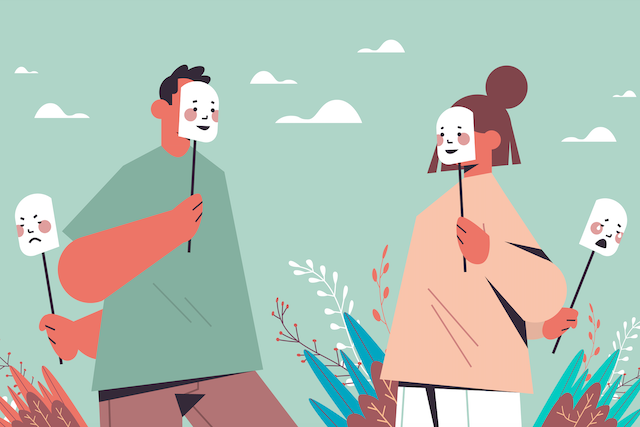
    I’m not perfect. Not that this would come as any kind of surprise to anyone who knows me. But I often feel pushed in the direction of trying to represent myself as someone who has it all together. Especially because of the nature of my work as a coach and facilitator. What about you? Do you ever feel like you’re putting on a show for others?

    The more I find myself trying to represent a perfectly put-together person, the less confident I feel in who I am because I know I am being inauthentic. It’s a big part of what took me off social media a few years ago.

    I don’t like that social media has the ability to mold what you think about yourself by way of comparison and encourage posturing. It’s a slippery slope, as we’re hardwired to yearn for love and connection as part of our survival. For me, it didn’t feel like the kinda place I wanted my love and connection to come from.

    Having the ability to talk about our flaws, what’s going wrong in our lives and where we’re getting stuck, is a huge part of human evolution that we often forget about. If we don’t have an environment to talk about our vulnerabilities, the wounds never get a chance to heal.

    Before getting into therapy, my life was a bloody mess because I pretended like these wounds didn’t exist.

    I don’t remember a period in my life without depression. Even as a teen it followed me around like a shadow.

    I believed the world would be better without me. I felt worthless—like I shouldn’t even have a seat at the table with other humans. I should have been in an alley eating scraps of food with sewer rats. No matter what I did or how hard I tried, the shadow mocked me for dreaming of a better future. My unwillingness to unpack those thoughts meant the infection spread to all areas of my life.

    I grew up in the nineties, when no one was talking about mental health. You struggled in silence.

    I battled demons in high school. I only lasted till eleventh grade before dropping out. I couldn’t stand the thought of spending another day being somewhere that made my life hell—but really, hell was inside me.

    The voice inside my head was (and still is at times) vicious. Every day it was like the Vikings raided and settled into my thoughts to destroy my existence. Those thoughts have left scars that would look like battle wounds of lobbed-off arms if you could see them.

    The voice inside my head was a reminder that I sure as hell would never do anything my parents would be proud of. It was easier to do nothing so that nothing was expected of me. I didn’t feel stupid if I didn’t try, so it made my reality an easier pill to swallow.

    I did graduate and made my way to university, but my life became increasingly dysfunctional. My love for being black-out drunk on Sailor Jerry rum became the perfect way to cope with a chaotic mind I didn’t understand.

    This comes back to not treating open wounds. Everything I resisted continue to persist.

    I had next to no insight into what I was going through because I wasn’t willing to share that I was struggling.

    At the time, my problems took on the weight of the world because I didn’t let people stand by my side to support me. I burned through relationships like a brushfire. I had no idea how to be in an open and communicative relationship because I barely had a relationship with myself.

    Once the wounds became visible through therapy, I could stop the infection from poisoning my ability to think and function. Vulnerability saved my life. I have no doubt that if I didn’t get that support, I would not be here today.

    We forget that our survival depends on being vulnerable. Author Brad Stulberg talks about this in his book, The Practice of Groundedness. He writes, “Our ancestors who survived weren’t those who were the strongest by traditional measures, but those who were most effectively able to share their weaknesses with one another and work together to overcome them.”

    If I didn’t share what I’ve been through, would you still be reading this? Probably not. It would be just another fluff piece on embracing your vulnerability.

    Without openness, there is no love and connection.

    Without openness, you and I wouldn’t be sharing this moment.

    Without openness, you and I can’t heal and grow together.

    The idea of being vulnerable scares the sh*t out of most of us. No one wants to be perceived as weak or admit they have flaws. We’re afraid that the lions of the world will sense our weaknesses and pick us off one by one.

    Except I’ve never actually been mauled by a wild animal when I’ve asked for help, or taken responsibility for a mistake. It’s actually had the opposite effect. Through my writing and vulnerability, I’ve connected with people on every continent of earth.

    It becomes impossible for me to pretend my vulnerabilities are mine alone if people from all over the world have said I’ve captured what they’re struggling with.

    This idea is backed up by research from The University of Mannheim, in Germany, that Stulberg references in his book.

    He writes, “They repeatedly found that the individual doing the sharing felt that their vulnerability would be perceived as weak, as a negative. But the person on the other end of the conversation, the listener, felt the exact opposite: the more vulnerable the sharer was, the more courageous they perceived him or her to be. The listener viewed vulnerability as an unambiguously positive trait.”

    And I think this is why a lot of us continue to feel stuck. We’re so damn wrapped up in worrying about what others will think of us when we open up that we miss the chance to connect.

    When we feel we need to be perfect, it becomes impossible to grow because we’re not being honest with ourselves about how we’re struggling and what would help. My life couldn’t move forward if I refused to see the reality that partying, substance abuse, and pleasure chasing was an attempt to escape depression.

    When you choose the illusion of perfection over vulnerability, you become a stunted version of who you’re capable of becoming.

    The first place you get to take the armor off is when you’re staring at the reflection you see in the mirror.

    Are you willing to be vulnerable with the person staring back at you?

    Are you willing to admit that life is not going the way you want it to?

    Are you willing to put aside judgment so you can get the help and support you need?

    We all want changes, but are we willing to make the choices that give us that change?

    These questions have the potential to shake the core of your foundation free from all the bullsh*t that accumulates over the years. It’s bloody liberating to let go of stories that no longer serve you—stories about who you need to be and what you need to do or have in order to be happy and loved.

    I didn’t need to achieve a promotion or drive a sports car to receive love from my parents. I didn’t have to do anything to show the world that I mattered. I needed to ground myself in vulnerability, rather than an image of perfection, so I could show up as my authentic self and make a difference for other people by being the real, imperfect me.

    Pretending to be somebody you’re not is exhausting work. Not to mention it does the complete opposite of what you want it to do. If vulnerability gives you the power to connect, lead, and grow, that means the inverse is also true. A lack of vulnerability means you end up feeling disconnected, a fraud, forever stuck with a fragile version of what you’re capable of because your ego is afraid of getting hurt.

    Putting a name to what you’re facing puts the power back in your hands. So recognize that you too may be pretending to be perfect to avoid admitting you’re struggling and feeling vulnerable. That single choice to embrace vulnerability could be the most important decision you ever make in your life. And it just may give you the confidence to know you can face anything and rise above it.

  • Why I Despised My Skin Color & 5 Strategies That Improved My Self-Image

    Why I Despised My Skin Color & 5 Strategies That Improved My Self-Image

    “Beauty begins the moment you decide to be yourself.” ~Coco Chanel

    I believed I was ugly and blamed it on my dark skin. I hated my skin color. Looking back, I realized it’s because I didn’t fit in with the white kids, nor did I fit in with the black kids.

    I am mixed race. I have a black father and a white mother. Until I started school, I never considered myself different. My family and I were close, and I felt love and acceptance.

    When I started second grade, I developed a crush on a boy, who never noticed me and fawned over the pretty blonde girl in class. She was beautiful, with springy blonde curls and a soft, feminine voice. She wore colorful dresses that enhanced her beauty. I felt drab and plain next to her. Thus, began my dislike of my dark, frizzy afro.

    As I grew older, the name calling occurred. I was called zebra, Oreo, and n*gger. I spent a lot of my youth in tears.

    I wish I could say that it got easier as I grew older. I grew envious of the blonde girls, who caught the boys’ attention. I even envied my two sisters. One had no trouble getting boys to like her, and the other had beautiful hair that fell naturally down her neck in wavy curls.

    However, entering the seventh grade solidified my hatred of my skin color and frizzy hair.

    I sat in the back of my math class working on my assignment, while passing notes to my friends. Exhibiting a form of bravery, I tossed a note to my secret crush named Mike. He wrote back which pleased me.

    In one particular note, I asked him why he didn’t like me. As I handed it to him, I hoped with all my might that he’d tell me I was wrong. When he gave me the note back, he smiled, and I grew hopeful. I opened it and tears formed in my eyes. My heart plummeted to my stomach and bile rose to my throat. His words seared my brain as if he said them aloud.

    “Because you’re ugly.”

    Devastation enveloped me. I crumbled up the note, but the words couldn’t be as easily destroyed like the piece of paper. It sat in the back of my mind as an explanation to me why boys didn’t like me.

    In ninth grade, I was called a dog and had spitballs spat at the back of my head. I left them there, too embarrassed to even rummage through my thick frizzy mass to find them.

    “Why did you let them throw spitballs at you?” the substitute teacher asked me after class, as she removed the wet globs from my hair.

    I shrugged and left the room thinking, “Why didn’t you stop them?”

    By the time I graduated from high school, I pretty much gave up on finding somebody to love me for me. I did go on dates, but I had to do the asking. Even as I went out with them, I could tell that they’d have preferred to be anywhere else but with me.

    I struggled with my self-esteem but hid it all behind a smile. I decided to just be myself, be friendly, be kind, and smile. In private, I would cry as I wrote my feelings in stories and journals.

    Then one day at the college computer room, I met Rick. He spoke to me and showed an interest in me. When he asked me out, I accepted. Unfortunately, my life never went like I had hoped. I got pregnant. He left me.

    Deciding to keep my baby, I raised him with the help of my parents and went back to college to get my degree. I decided then to focus on myself and my little boy. Naturally, obstacles surfaced, but I chose to be myself and incorporated five strategies that slowly helped me start liking myself.

    1. I practiced self-care.

    Although self-love needs to come from within, I knew I’d feel better about myself if I put more effort into my appearance, so I bought new clothes and changed my hairstyle. This reinforced that I was worth the effort. Wearing flattering clothes and makeup enhanced my skin tone and body shape.

    I also took care of myself mentally by reading books that centered on personal growth and following steps to keep my thoughts positive, such as reciting positive affirmations and being more aware of my negative thoughts so I can reframe my thinking patterns.

    Taking care of my mind and body really helped me see myself differently. When I felt more comfortable in my skin and more at ease in my own mind, my self-confidence grew.

    2. I stopped worrying about what people thought.

    I had always been shy and introverted, and I was afraid of being judged. Being in college helped me break out of that shell. I spoke up in class and asked questions. I stopped worrying what people would think about me because I knew this was holding me back. My entire focus centered on what I wanted to learn and get from the classes I took.

    My best friend at the time told me that I should walk with my head up and back straight. She taught me that with my shoulders back and my head held high, I’d appear confident, and when I felt confident, no one’s opinions could hurt me. I adopted that form, and believe me, it felt great to walk with extremely good posture and feel the confidence exude from within me.

    3. I focused on the positive.

    Being positive had always been hard. I would wallow in self-pity and then wonder why I didn’t have many friends or couldn’t get a date. I changed my mindset and focused on the good things in my life and positive changes I wanted to make.

    I spent a lot of time with my son and worked on my writing skills, because being a writer was very important to me, and still is! I learned everything I could about business management and continuously developed my skills. I also started hanging out with positive people with healthy self-esteem and emulated their free spirit and vivacious personalities. Spending time around people who see the world through a positive, empowering lens has helped switch my mindset and feel better about myself and life.

    4. I started smiling more.

    By smiling more, I felt positive and happy more often. I wanted people to view me as someone approachable and friendly, so I smiled and showed my courtesy to those around me. It’s amazing what a smile can do for yourself as well for others. Smiling at someone in passing could touch that person and ease whatever pain they’re enduring. It could brighten their day and, and in turn help you feel good about yourself.

    When I was on my way to work one day, after picking up a hot chocolate at a nearby food court, I walked down a few steps toward the exit. An unkempt man entered and held the door open for me. I flashed him a smile and thanked him. He did a doubletake and then smiled hesitantly at me. It was then that I realized the power of a smile. It made me feel good to acknowledge this man because of a courteous gesture on his part.

    By being kind and grateful, I shared a moment with a complete stranger and it felt good.

    5. I found the courage to be myself.

    After practicing the steps above, I was no longer afraid to be myself. I broke out of my comfort zone and even spoke in public at church and seminars I took. Being myself freed me from living in a shell, where the walls I had built at a young age came crashing down.

    Today, my skin color no longer bothers me. I still hate my hair, but that’s beside the point. The fact is I realized that it wasn’t my skin color that was stopping me from making friends and finding love. It was me all along. I need to love and take care of myself first before anyone else could love me.

    I now have a wonderful, gorgeous husband who treats me the way I’ve always wanted to be treated by a man. He values me and loves everything about me—flaws and all!

    Exercising these five strategies created a life for me that I’m quite proud of. In retrospect, I wish I could tell my teenage self that life will get better, just be patient, and enjoy your naturally built-in tan.

    I’m proud to be half black and white. It is a blend of both my parents, who I love very much. Without them, I wouldn’t be the woman I am today.

  • 5 Tips to Stop Comparing Yourself to Other People

    5 Tips to Stop Comparing Yourself to Other People

    “No matter what you do, someone won’t be pleased. Someone will think your choices are wrong. And someone will tell you what you should do instead. No matter which path you take, someone will seem to be doing better. Someone will have more than you. And someone else’s life may look more impressive on paper. If you’re being true to yourself, none of that will matter because you’ll have something more satisfying than approval and the illusion of “success”: a life that feels right for you, based on your own wants, needs, values, and priorities.” ~Lori Deschene

    Have you ever walked past a grand-looking house, or driven through an upmarket neighborhood and thought, “I wish I lived here” or “The people living here are so lucky”?

    If you have, then we’ve been part of the same club! I used to do this a lot.

    While walking my dog, I’d look at a house and assume that the people living in that house must have been very happy with life. My assumptions were based on nothing more than the look of the front yard and the frontage of the house.

    When I think about it now as I write this post, I wonder, “How could I have been that naive?” Despite being aware of the expression “never judge a book by its cover,” that’s exactly what I used to do. How can one ever guess what lies behind the grand entrance of a home? Who knows what stories the plush homes of exclusive neighborhoods hold inside them?

    My regular bouts of comparisonitis got jolted by a sobering dose of reality through a shocking and tragic news story some years ago.

    One of the homes that I used to admire became the location of a horrific murder-suicide that wiped out an entire family! I could not believe my ears and eyes as I read the news and watched the coverage on television.

    My mind was thinking, in all its naivety, “How is that possible? What could have gone wrong for residents of that beautiful home? They had everything anyone could ever want, didn’t they?”

    Do I Know You?

    Have you heard the expression “human beings are like onions”? We have so many layers that hide our core self. As you peel away one layer, another appears!

    It is extremely difficult to know another person deep down to their core. How often have you found yourself wondering about the unexpected or puzzling behavior of someone you thought you knew well?

    The reality is that each one of us is unique, and it can often take a whole lifetime for us to understand our own selves. So, is it any wonder that we never manage to truly understand another person?

    Yet, we compare! We do it day in and day out, without even being aware of how easily and how often we slip into comparison mode.

    Humans are naturally prone to comparisons because this phenomenon begins quite early in our lives.

    As young kids, we might have experienced the feeling of being compared to other children—by parents, teachers, relatives, friends, peers, etc. As we grow into adults, we start comparing ourselves to other adults. Sometimes the comparisons might be in a favorable light, and at other times, the comparisons could be unfavorable. Either way, it leads to feelings that are unhealthy—a sense of superiority or inferiority.

    Feelings of arrogance or bitterness are never healthy, are they?

    Whether your comparison results in thoughts of “Oh, I’m so much better than this guy!” or “How does she do it? I’ll never be as good as her!”, there’s little doubt that “the thief of joy,” as coined perfectly by Roosevelt, has taken residence in your head and is busy ransacking your mind of all joy, happiness, and contentment.

    Why is it so difficult to avoid falling victim to the tendency of constant comparison?

    Social Comparison Theory

    Psychologist Leon Festinger proposed in his social comparison theory that the human species engages in comparison as a way of evaluating ourselves, like a benchmarking process. We get to know more about our own abilities, attitudes, or skills by comparing ourselves to our peers.

    Festinger’s theory contends that human beings can only define themselves in relation to other people. I wonder if that’s why the age-old existential question “Who am I?” seems so difficult to answer, as we seem to be incapable of defining ourselves independent of others.

    As mentioned earlier, social comparison can work in two ways.

    1. Upward social comparison

    This is when we compare ourselves to those who we believe are better than us. This type of comparison can lead to two kinds of thoughts, emotions, or outcomes.

    The first kind is where we might want to improve ourselves to reach the level of the person that we are comparing ourselves to, or even go past them. This is one possible benefit of comparison if we’re prepared to learn, as it could lead to personal growth.

    If comparison can be seen in this positive light, then “the thief of joy” might be entitled to a change of title and live inside us as “the giver of motivation.”

    The second and more common outcome of upward social comparison is envy, jealousy, and bitterness—obviously an undesirable outcome that can only lead to disappointment and frustration.

    2. Downward social comparison

    This happens when we compare ourselves to people who we believe are worse off than us. This is like an “artificial boost to self-esteem” exercise. The “at least I’m not as bad as him/her” attitude might help us feel better about our talents, achievements, or life situation, even if only temporarily.

    Social comparison begins early in life (for instance, a child in a kindergarten wanting the same toy that another kid has in his hands), gains momentum through school (new fads, fashions, and gadgets that kids want to follow or possess), and becomes deep-rooted in adulthood through comparisons in career, family, wealth, status, and lifestyle.

    This tendency to compare completes a full circle when the phenomenon moves on to adults comparing their children on how well they’re doing in academics, sports, or any other activity.

    Escaping the Comparison Trap

    To feel mentally and emotionally healthy, it is essential to free ourselves from the comparison trap. I’m sure none of us wants to experience the feeling of unworthiness from upward social comparison, or superiority from downward social comparison. So what can we do?

    Here are five simple ideas to get better at saying NO to the disease of comparisonitis:

    1. Define what success means to you.

    If we nailed down our own definition of success, the number of times that we indulged in comparisons would be significantly reduced. For instance, if our success definition were about raising healthy, happy kids, we wouldn’t really be bothered about someone else’s thriving business, would we?

    2. Discover your own strengths.

    Becoming aware of our strengths will help in minimizing the tendency of comparing our weaknesses with other people’s strengths. The great physicist Albert Einstein failed his French exams. Fortunately, he didn’t let that failure define him, as he was aware that his strengths lay elsewhere!

    3. Think of the big picture.

    Whenever you find yourself slipping into comparison mode (which will inevitably happen… we are human after all!), just remind yourself that there’s always more to a person’s life than what you’re seeing or hearing.

    Don’t let a peek through a small window into someone’s life lead to disillusionment or disappointment with your entire life. In other words, don’t compare your whole movie with another person’s highlights reel!

    4. Always be a student.

    Develop the “continuous learning” philosophy. If you always think of yourself as a student with lots more to learn in life, it becomes easier to think in terms of collaboration, not competition, with peers. If you think of yourself as an artist who is still painting his/her masterpiece, you might not be tempted to feel inferior when you view other people’s paintings because your job’s not done yet!

    5. Focus on small successes.

    When comparisonitis strikes, take up a small project that you can complete in a relatively short time, and do well. It could be something that you might’ve been putting off for a while.

    For example, let’s say you’ve started a new online business and you start to feel unsatisfied about the lack of progress. Maybe you’re looking at peers in your industry who are at a similar stage of the business cycle but seem to be gaining a lot more traction.

    Instead of letting this get you down, how about you focus on something small—like writing a blog or doing a podcast? Doing that specific task well could help lift your spirits.

    Unique Journeys

    Have you seen pieces of driftwood floating in a river? They come together at some point due to the action of the waves, might stay together for a little distance, and at some point down the river, the force of the waves separates them and they go their own ways.

    Our lives are like that.

    People come into our lives and go out of our lives at different stages of our life’s journey.

    We all begin our journeys at different points, end them at different points, and often our paths take different routes. Why then should we compare ourselves to others? After all, we are not running the same race.

    Try this exercise…

    Take a little trip down memory lane by rewinding your life some fifteen to twenty years. Think of someone that you always compared yourself with back then. It has to be someone that you’ve lost all contact with for many years. You also haven’t heard about them from anyone.

    Do you have any idea what they’re doing now? In fact, let’s go one step further—do you know if they’re still alive? Chances are your answer is “I don’t know.”

    So, my friend, in the long run, do comparisons really matter?

  • It’s Okay to Feel Scared: How to Stand Up to Fear by Standing Down

    It’s Okay to Feel Scared: How to Stand Up to Fear by Standing Down

    “It’s okay to be scared. Being scared means you’re about to do something really, really brave.” ~Mandy Hale

    When it comes to plane travel, I frequently quip: “I’m not a nervous flier, but my bladder is.”

    In a way, this is true. Aside from brief freak-out moments when there’s a patch of turbulence or when a flash from my catalog of gruesome “what-if” scenarios forces its way into my mind’s eye, I remain blissfully disconnected from my fear. Meanwhile, my bladder takes the brunt of it, with hourly pit-stops to the lavatory alongside a persistent, dull ache.

    While this is physically annoying, my strategy has its utility: it conveniently shifts the blame and shame for my irrational fear onto my bladder so that I don’t have to face up to it. (Otherwise known as somatizing my emotions, if you or my therapist want to get technical.)

    So, as you might imagine, when I recently boarded my first plane flight in two years amidst a still-very-present Covid pandemic, my bladder felt even twitchier than usual. Especially at the abrupt jolt of going from socializing at a distance to being packed like sardines into a confined space with a bunch of breathing, coughing, possibly infectious humans.

    At least, that is, until a little boy said something heart-stopping.

    A Cry for Help

    No more than six years old, the slender boy with a mop of golden-blonde hair had just clambered into the window seat of the empty row in front of me, trailing his white satin-trimmed fleece pillow and blanket.

    While the boy fiddled with his seat belt, I noticed that his mother and grandmother—each equally youngish-looking with lemony hair and tanned skin—were still lingering in the aisle, conversing in hushed tones. As I casually eavesdropped, I learned that they were debating which of them would sit with the boy versus with the rest of the family located several rows up.

    At first, I cursed my luck to be seated right behind a kid too young to be vaccinated or keep his mask up. Thanks a lot, universe, I grumbled internally.

    But as his mother began walking away to sit with her younger child (presumably expecting that her older son was in good hands with his grandmother), the boy wriggled upward in his seat, shoulders tensed, assessing the situation. Then, he called out quite loudly, without a hint of self-consciousness or shame: “Mom, I want you to sit here with me, because I’m scared and I need you.”

    Instantly, the radius of chatter around Row ten fell mute.

    Like a silent lightening strike, the boy’s words charged the atmosphere with an almost electric energy. For two long seconds, they hung there in the air above us, almost too sacred to desecrate with sound. During that time, I swear, you could practically feel our collective hearts opening. Then, a sincere chorus of “Awww”s and “Bless his heart”s rang out, cushioning the silence.

    A Permission Slip

    As I marveled at what had just transpired, I realized that, in one simple sentence, this young boy had done something remarkable: he’d given us permission to be human.

    After all, how many times had many of us felt just as fearful in life yet pretended we didn’t? How many times had we wanted to cry in the midst of overwhelm (if not wail like hell for our mommies), yet told ourselves to “buck up” or “be an adult”? And how many times had we rushed to the side of a friend in need yet readily denied ourselves this small grace?

    Perhaps the reason the little boy’s words stirred us so deeply, it struck me, was that he reminded us of what we already knew yet stubbornly denied: Of the power in vulnerability. Of the courage in asking for support. Of the importance of honoring our feelings, especially our fear—meeting it with acceptance, rather than my preferred method of hastily swatting it away like a poisonous wasp.

    Meeting Fear with Acceptance

    Fortunately, the boy’s mother was much more adept at dealing with fear than me.

    Making a beeline back to her son’s side, she enveloped him in a warm embrace, murmuring, “I’m so sorry, honey. It’s okay, I’m here for you,” (a relational repair that was powerful in itself).

    Spying through the narrow slat between our seats, I watched as the boy’s shoulders immediately unknotted. Seconds later, he began chattering to his mother about the character on his video game player—his fear a seemingly distant memory.

    It was then that I realized something even more remarkable: to the boy, the preceding moment was likely just an ordinary moment.

    Too young to be fully conditioned by our cultural garbage around fear or gender “norms,” he had no idea that he’d done anything profound, much less impacted a plane full of people much older and “wiser” than him. He was simply acknowledging his fear and taking care of himself.

    Okay, Lisa, I told myself. If that little boy can unabashedly proclaim for all to hear that he’s scared, then the least I can do is acknowledge my own fear to myself.

    Especially considering that, the very day before, a beloved teacher of mine had providentially reminded me about the power of acknowledgement. How, oftentimes, just acknowledging our feelings can considerably ease our unease. And sometimes, she claimed, it’s the only thing we need to do.

    Huh, I realized with a wink to the universe. You’re giving me an opportunity to practice this right now, aren’t you?

    And so, I did. Closing my eyes as the plane taxied down the runway, I felt into my fear and whispered: Okay, fear. I see you. I hear you. And it’s okay that you’re here. In fact, it would probably be abnormal not to feel you on my first post-pandemic plane ride after two years of semi-hermitude.

    From there, I stayed quiet and present in my body. I didn’t try to do anything with the fear, other than “stand down” so that its stifled energy could move through me.

    A minute or so later, wouldn’t you know it, the tight ball of yarn that was my bladder muscle magically slackened. Even my abdomen, I noted, no longer bloated out like I was carrying a small fetus. My entire body felt lighter too, as if I’d released a leaden weight I didn’t know I was carrying. Holy moly! I boggled, gazing down at my body in both awe and glee.

    “Alrighty, folks,” the captain’s disembodied voice announced over the PA system just then. “We’re about to head out, so sit back, relax, and enjoy the flight.”

    Grinning to myself, I silently replied in my head: You know what? I think I will.

    *A Magical Postscript*

    Incredibly, the story doesn’t end there.

    Toward the end of the flight, I tentatively caught the attention of the boy’s grandmother, whose name I’d soon learn was Beverly.

    “Um, pardon me,” I started, “but I’m a writer, and I was so inspired by what your grandson said before the flight that I actually just wrote an article about it!”

    “Oh, really?” Beverly replied in surprise, my unanticipated admission taking a few seconds to sink in. Then, her surprise gave way to delight, as her eyes crinkled into a smile above her mask and she added, “Wow, that’s so wonderful!”

    “I’m happy to email it to you if you like,” I continued, “but I really just wanted to thank your family. For providing such a powerful moment for me—as I’m sure it was for many others.”

    “Well, let me tell you something,” Beverly responded, leaning toward me with an unanticipated admission of her own. “That moment was a bigger deal than you know. You see, my grandson has autism, and for him it was a very big deal to express his feelings like that.”

    Straightaway, goosebumps traveled up and down my arms. Of course, the writer in me couldn’t help but be tickled by the added significance to the story. But the real eye-opener for me was the extent of my own ignorance. That I assumed the moment was important to everyone but the boy. That I assumed there was only one “giver” and one “receiver” in the equation. As if the universe ever worked that way.

    When the plane touched down soon after, tears sprang to my eyes as the full-circle nature of the experience hit me.

    Thank you, universe, I humbly mouthed—this time meaning it.

  • The Vault in Our Hearts: How I’m Learning to Fill It with My Own Love

    The Vault in Our Hearts: How I’m Learning to Fill It with My Own Love

    “If you don’t love yourself, you’ll always be looking for someone else to fill the void inside you, but no one will ever be able to do it.” ~Lori Deschene

    This year I have fallen in and out of love. Not once, not twice, but three times.

    Firstly, I fell deeply into being held, being heard, and being supported. For the first time, in a long time, I understood what it meant to be loved.

    Secondly, I flew quickly into a spontaneous soul, who lit up my world and reminded me who I was.

    Thirdly, I surrendered earth-shatteringly into something that would force me to grow; someone who would crack my heart wide open and inspire my soul.

    And each time I fell a little more softly than the last; a little more tenderly, a little more lovingly, and a little more openly from my soul. Yet, with all this falling and flying, laced with twisted heartstrings and crying, I am still here trying to feel my way through the vault in my heart.

    The black hole that is almost instantaneously filled with the love of another, like stardust filling my heart. The black hole that is continuously expanding and shifting, then engulfing itself.

    The love also expands and shifts, it swirls and grows—I feel temporarily full until I begin to lose my glow. And then I wonder, how I am sat here again with tears in my eyes and a chest full of doubt? And it hits me, like a meteor of light—gold dust running through my veins and lightning in my heart.

    My vault is to be filled, not by the love of another, not by the way I think it should feel, but by my hopes, my wonder, and my soul-powered dreams; the technicolor life I have always wanted to lead.

    And so, I sit here, laughing and crying and sentimentally smiling at the irony of life, as I realize that the love that I have always wished for will never be enough. No one will keep me cradled in my heartstrings and permanently high on love.

    This person, your person, may light up your soul, but they will never fill the vault of your full-blown world. And so, we must vow to ourselves—we must allow ourselves—to fall in and out of love, not just with another, but with our true selves. Not with synchronizing with another but with aligning with our hearts, every single day.

    We must vision our life, our way, the way we want it to be. We must trust that it will yield to us everything we need. And on our paths, others may unlock our souls with golden keys of hope, vulnerability, longing, loss, and growth. But we must stay true to our paths, investing our time in a love that will last.

    The vault in our hearts needs to be filled, with visions of desire and hopes and dreams. Because in all this loving, I refuse to be stagnant. I refuse to let someone fill me and take away my passion. I want to feel it all, even if it means constantly falling and flying, contracting and expanding.

    This is the only way to stay true to my highest self, where my pain meets my madness, and my perspective shifts itself. My vault keeps unlocking and shimmering with gold, but this gold will always fade if I do not feed my soul. And now, I know. It doesn’t just have to be a temporary glow.

    I don’t want to be loved. I want to BE love.

    I want to feel it all, see it all, be it all. I want to journey with another, yet stay true to myself.

    And so here I am again, falling deeply and completely into the path of love; navigating a new relationship, and remembering what I have learned. They will never be enough unless I stay aligned with my true self. But who is my “true self”?

    She is creativity and joy, freedom and passion. She is travel, she is adventure, she is writing and compassion. She is singing from my heartstrings and rolling around in hugs, she is feeding my body good food and taking naps at lunch.

    She is grounding my body and rooting my earthly soul, she is reminding myself to take it easy and schedule in time for myself. She is having space to reflect, to vision, and to create—to live my best possible life every single day.

    She is dancing around my bedroom with a full and open heart, she is appreciating little flower buds and gazing at the milky way above. She is stopping for a moment to enjoy the simplicities of life and dancing in the rain even when storms rage outside. She is crying from my heart center, even when I don’t know what it’s about, she is cleansing my body with long baths and bucket loads of Epsom salt.

    She is moving my body and releasing emotions from deep within, she is letting go of yang and settling into yin. She is expressing my soul in a way that feels good to me, birthing zesty creations that fill me with energy. She is being honest with others even when it hurts, she is sharing my story and lighting up the world.

    She is diving into oceans with sweet and salty hair, drowning in my sorrows and shooting up for air. She is bathing in the sunshine and filling my body with light, allowing myself to rest when my eyes feel dim and tired. She is asking for guidance and praying from my heart, she is surrendering softly and letting life take its course.

    She is asking for help when I feel lost and broken, calling up a friend and sharing what I’m feeling. She is connecting with source and being committed every day, to filling up my cup and sharing it along the way. She is spending time with others who value my time and soul, who give with equal balance, and are committed to the path of growth.

    She is shining so bright that it blinds passers-by, inspiring others gently to shake up their own lives. She is standing bravely, boldly, and oh so lovingly so, when conversations are had and pain begins to show. She is forgiving the past, and not running to the future, living in the now and creating life from a balanced center.

    This is my love, my infinite love—my true self.

    And while I am open to falling into another, I will fall softly and deeply while honoring my center. The journey of love has taken me so far, but what it always teaches me is that I am capable of creating from my heart. And until it stops beating, I will allow it to shimmer and glow, igniting my dreams and letting my vault know—I will fill you. Every single day.

  • The Most Important Questions to Ask Yourself If You Want to Be More Authentic

    The Most Important Questions to Ask Yourself If You Want to Be More Authentic

    “Authenticity is the daily practice of letting go of who we think we’re supposed to be and embracing who we are.” ~Brené Brown

    Have you ever just wanted to relax, let go, and let yourself be?

    Why is this so challenging for so many? Why don’t we just live naturally and allow our authenticity to be felt, expressed, and seen?

    Well, when many of us were little, being authentic was not okay, so we focused on trying to do things the “right way” according to what others had to say, because our survival was at stake. The more we did this, the more we disconnected from our true essence.

    We’re not bad or wrong, we needed to do this in order to be loved and accepted instead of rejected, because to a child, being rejected is like death.

    The more we were shamed for how we were feeling, what we were doing, or how we were being, the more we learned that being true to ourselves was not okay. This was the beginning of self-abandoning—disconnecting from our authenticity and believing that there was something wrong with us.

    When I was growing up, if I did or said anything that my parents didn’t like, they would punish me, scream at me, or give me the silent treatment; that was the worst one to me.

    I used food to comfort myself because no one validated my feelings or comforted me. This was the consistent trauma I experienced as a child—not being seen, heard, or acknowledged for how I was feeling. This was especially hard when I was afraid or crying.

    I would often hide in my closet and under my bed with food. Eating was how I self-soothed and how I created my own safety.

    Eventually I would have to come out and interact with my family and society, which made me anxious and afraid because I was always trying to figure out the “right things” to do and say.

    And even when I thought I was doing and saying the right things, my father often screamed at me and said, “Damn it, Deb, you never do anything right.”

    Soon enough I became so afraid of speaking, sharing how I was feeling, and asking for what I wanted or needed that I suppressed that energy and turned into a people-pleaser. Then, when I was thirteen my doctor told me to go on a diet, and at age fifteen I became a full-blown anorexic, living in severe deprivation.

    I created a shield around me to protect myself. And no matter how much I tried to let go of the anorexic behaviors of depriving and denying myself of everything that was nourishing—even after twenty-three years of going to therapy and being in hospitals and treatment centers—I still held on tightly, or maybe “it” held onto me for survival and safety.

    This is what happens with our coping mechanisms, they serve at a time but then keep us in a bind; we want to let go but something inside says no.

    How did it keep me in a bind? I judged myself and got mad at myself for doing the eating/starving/exercising routine, and then I judged myself and got mad at myself for not being able to stop, which created even more self-hatred and feelings of hopelessness.

    I also had severe anxiety and depression because I was suppressing my true feelings. I wasn’t allowed to be me; instead, I had to be how everyone else wanted me to be. I resisted this internally and then needed relief from all that conflict, which the eating/starving/exercising routine gave me.

    Eventually I got so tired of fighting against my own biology and not being allowed to be me that I became suicidal. I thought that if I took my life, I would finally be free, but all those attempts just made my family even more mad at me, and they put me in another hospital for “not behaving.”

    I felt so lost, lonely, and confused; trying to fit into a mold of other people’s opinions, putting all my attention on trying to be the right person, which created fear in my system and a sense of separation from my true essence; my authentic expression.

    Being authentic in a world where social consequences are at stake if we don’t behave according to what others say isn’t easy; it takes a lot of courage, strength, and feeling comfortable with who we are.

    Being authentic is being vulnerable and real, sharing how we truly feel. Some of us don’t even know what that may be, because we’ve spent our lives numbing, protecting, or projecting, and/or telling ourselves we shouldn’t be feeling how we’re feeling—just as our parents may have done.

    When people ask me, “Debra, what did you want to be when you were growing up?” I always reply with “I just wanted to be me,” but I didn’t even know who “me” was, I was so disconnected from my true essence.

    It’s been a process to get to where I am today, living in a more authentic way; however, it wasn’t easy. I experienced rejection, pain, and people getting mad and leaving me for not meeting their expectations.

    At the beginning it was challenging to honor and take loving care of myself because it went against my family’s rules and the ways I was used to being. It was challenging to share so openly and honestly, realizing not everyone will agree or like me; however, being authentic is one of the greatest blessings I’ve ever experienced on my life journey.

    It’s helped free me from the eating disorders, self-harming, and depression, and it’s helped me find ease with my anxiety because I no longer hide how I‘m truly feeling—my fears, pain, shame, and insecurities. By embracing them, I started feeling more at peace with myself.

    I’ve “come out of the closet” in many ways. I’ve embraced that I’m gay. I’ve uncovered and am still discovering some of my natural talents, gifts, and abilities. I share openly and honestly about how I’m feeling and about my life journey—the things I’ve learned along the way, the things I’m still learning today. And I flow in my natural, authentic way. In “essence” I’ve come back home to myself.

    If you’re struggling with any type of addiction, an eating disorder, depression, anxiety, or self-harming, please be kind and gentle with yourself. Those symptoms are often responses to our childhood traumas. Those symptoms are not the problem, and neither are you.

    The real trauma isn’t what happened to us; it was a disconnection from our true essence, our authentic expression, and the stories we concluded about ourselves and our life experience that may still be running the show.

    In order to heal and feel at ease internally, so we can shine authentically, we need to heal the trauma and shame we’ve been carrying. We need to make peace with ourselves and what we’re experiencing. And we need to embrace all parts of our being with the understanding that everything we do is meeting a need. Finding healthy ways instead of unhealthy ways to get those needs met is key.

    If you’re like me, you may be afraid of noticing and feeling your deep shame; however, it was in my shame that I uncovered some of my greatest qualities that make me uniquely me—qualities I once needed to hide so I would feel loved, accepted, and safe.

    This was where the healer in me lived. This was where the poet in me lived. This was where the author, writer, artist, speaker, singer, and dancer in me lived. This was where my inspiring, fun, creative, wild and free spirit lived. This was where the honest explorer and curious part of me lived, where the one who knows how to be compassionate and loving with myself and others lived

    This was where I met my authentic self—by going into my shadows and embracing those fearful and tender parts that had been hurting and hiding. By making them feel safe by embracing, understanding, hearing, loving, and seeing them, and giving them permission to express themselves naturally.

    We need to forgive ourselves for abandoning ourselves to be loved and accepted by others. We did what we needed to do at the time, and now we can give ourselves permission to flow with our authentic rhyme—by discovering/uncovering our unique ways of expressing and learning how to meet our needs, physically, mentally, emotionally, and spiritually.

    To be authentic is to be vulnerable, and to be vulnerable is to soften our heart, to let down the walls of armor and protection and allow ourselves to feel, process, and express how we’re truly feeling; this allows us to have truer and deeper connections with ourselves and others.

    To be authentic is to connect with our inner child. They hold the keys to our talents, gifts, true joy, creativity, and natural ways of being and expressing. This is healing, allowing our true revealing, feeling safe in our bodies and allowing ourselves to fully be ourselves again, blooming from the inside out.

    I love this quote from Jim Carrey: “We have a choice to take a chance on being loved or hated for who we really are.” I would add, or we can suppress who we truly are and just add to our wounds and scars, and never get to experience the sincerity and divine greatness of who we can be.

    When we start to live authentically, we can enjoy life in the present moment because our mind is no longer trying to figure out how we “need to be” or trying to protect us from our pain, shame, vulnerabilities, and insecurities. By embracing them we feel more at ease, and we don’t have a need to numb or suppress with coping strategies that may not be healthy

    Here are a few questions you can ask yourself to help you identify what’s standing in the way of your authenticity:

    • What were you rewarded for as a child?
    • What did you get punished for as a child?
    • How did your parents want you to look, dress, wear your hair, etc.?
    • What were you told that success looks like?
    • What were you judged and criticized for?
    • What were you told not to be like? For example, “Don’t be loud, don’t cry, don’t get angry, don’t do or say or feel…, etc.”
    • What were you told was wrong or bad about you? For example, “You’re too sensitive, you’re too needy, you never do anything right, you ask for too much, you’re not good enough, etc.”

    Here are a few questions you can ask yourself to help you find your authentic expression:

    • What comes easy and natural for me?
    • Who am I when no one is looking?
    • What do I value?
    • What am I inspired to do but my head tells me not to?
    • What did I love to do as a child?
    • What do I truly enjoy doing now?
    • What is real about me, regardless of whether I judge it as good or bad?
    • What are my best qualities? “I’m caring, I’m loving, I’m empathetic, etc.”

    Here are some questions for self-inquiry:

    • Am I enjoying what I’m doing, or am I doing what I think I “should” be doing?
    • Do I always try to find the right things to say, or do I say how I truly feel?
    • Do I pretend to not be bothered when I really am?
    • Do I try to look good to others and create a false self-image, so I’ll be loved and accepted?
    • How do I feel about myself? Do I feel like I’m being true to who I know myself to be?
    • How do I relate to myself when I’m happy?
    • How do I relate to myself when I’m feeling sad or angry?

    Here’s the simple truth I know about beautiful and amazing you: You are inherently good, you’re naturally valuable and lovable, your uniqueness is a gift, you are divinity perfect. You’re worth taking up space, you’re an important part of this human race, you matter. This isn’t about striving for perfection, it’s about embracing your authentic expression.

  • How Accepting That We’re Ordinary Opens Us Up to Love

    How Accepting That We’re Ordinary Opens Us Up to Love

    “Hardships often prepare ordinary people for an extraordinary destiny.” ~C.S. Lewis

    I was talking to a mentor of mine several months ago, and they cut me off midsentence and said, “Zach, it sounds like you’re trying to be extraordinary. How about you just work at being ordinary?”

    I paused then promptly broke into tears. Yep. Tears. Not ashamed to admit that.

    Tears because the meat of the conversation was about self-worth and being enough. In that moment my deepest childhood wound was tapped into, and ordinary sounded horrible to me.

    Who wants to be ordinary? Not this guy.

    My mentor asked what was coming up for me, and I said my mom. Let me explain.

    My mom was a celebrity. She was an Emmy award winning actress that was on the cover of TV Guide, and she dated one of Hollywood’s biggest stars.

    She died tragically of cancer when I was three-and-a-half years old. One day she was there, the next she was gone.

    I interpreted her death the only way I knew how: I made up a story to make sense of it all. Mom left me because I’m not special.

    Ever since then, for as long as I can remember, the thought of being ordinary hasn’t agreed with me.  Like a taboo subject, I’ve treated ordinary like something society considers a no-no. To me, ordinary equals “not enough,” and not enough equals rejection, aka, abandonment.

    In my mind…

    Ordinary doesn’t get me love and affection. Ordinary doesn’t get me Facebook or Instagram “likes.”

    Ordinary doesn’t get me acknowledged at work. Ordinary isn’t talked about at parties.

    Ordinary isn’t interesting. Ordinary is abandoned just like when I was as a little boy.

    The thought of being ordinary scares the you-know-what out of me. So much so that I’ve spent most of my life trying to be something more.

    It’s been an insatiable quest to fill an empty cup of not enough-ness. It’s been me putting on a mask every day and trying to be someone else. 

    My hair has to look just right out of fear of you judging me. I have to say all the right things out fear of sounding stupid.

    I have to wear the right outfits because I only have one chance to impress you. I have to be the ultimate people pleaser or else you might not like me.

    I have to be extraordinary out of fear of you rejecting and leaving me. I’ve been afraid all these years that if you knew the real me, the ordinary me, you would turn around and go in the other direction.

    Note to self. Hustling for my worthiness all these years has been exhausting.

    And here’s the kicker. The act of me trying to be something is what keeps me alone in the first place because I’m not letting anyone see the real me.

    The definition of ordinary is normal. It doesn’t mean rejected or not enough. Just normal.

    In other words, it’s me being my normal self and not trying to be something else. Ordinary is authentic. Yet for some of us being authentic doesn’t feel safe. So we put on a mask and try and be someone else.

    It’s what our culture does to us and social media glorifies. Status is such a big thing in our lives today.

    But when you try to be something other than your ordinary self, whatever you’re attracting isn’t real because it’s not the real you. You’re not attracting real love or adoration.

    Therefore, you keep looking and you continue the cycle. Once you change your mind about this (and yourself) you will see change.

    Look, I get it. It’s easy to get wrapped up in the stories we tell ourselves. I need to be (you fill in the blank) to be liked and loved.

    But here’s the thing, when we do this, we show up differently in life. People don’t want to be impressed, they want to be understood.

    At the end of the day this was all about me being disconnected from my own inner wisdom. My inner wisdom is the core of my essence, and I was disconnected from this when I was on the call.

    When we try and be something we forget who we are and what love is. Ordinary is your return to love. It’s not you out there looking for love.

    It’s a return to what you were born in to. It’s like a return to grace.

    Here are four questions that I have found to be extremely helpful in shining a light on this subject:

    • Where in your life do you feel like you are struggling to be extraordinary?
    • Where in your life do you want to apply the healing balm of normalcy?
    • Where are you putting pressure on yourself to be extraordinary?
    • Who are you comparing yourself to?

    If you want to explore this area of your life, in a very human and grounded way, journaling around these questions might serve you, if you’re open to it.

    Put down the weight of extraordinary and be your beautiful, ordinary self. Extraordinary people exist within people with the most ordinary lives.

    We’re all unique in our own right and that’s the beauty of being human. We’re all ordinary and we’re all extraordinary.

  • Afraid of What People Think? Free Yourself by Realizing How Unimportant You Are

    Afraid of What People Think? Free Yourself by Realizing How Unimportant You Are

    “You wouldn’t worry so much about what others think of you if you realized how seldom they do.” ~Eleanor Roosevelt

    It’s natural to think that we’re always in the spotlight.

    We think that people care about the way we dress, but they don’t.

    We think that people notice our nervous habits, when in reality, they’re worried about whether people are noticing their own.

    We tend to go through life as if our every move is being watched, judged, and evaluated on a moment-to-moment basis by the people around us. Here’s a reality check—you’re not that important.

    I don’t mean that in a brash way. This shouldn’t make you feel small or inferior, it should liberate you. And if it doesn’t, I have a feeling that what I’m about to talk about will.

    The Truth About Funerals

    As you guys know, a funeral procession is broken up into two parts: the funeral and the burial.

    During the funeral, spiritual leaders read various snippets from religious texts about the meaning of death, and close family members are allowed to get up and say a few words about the deceased.

    The burial takes place directly after the funeral, although some religions operate on a different procedure. During the burial, the body is transported outside, and the deceased is put to rest in the grave site.

    Now, you’re probably wondering why I’m spending so much time talking about funeral procedures. I’d probably be asking myself the same question reading this article, so here’s the bottom line.

    The burial takes place outside on grass.

    Do you want to know the number one factor that determines how many people attend the burial after the funeral procession is over?

    The weather.

    If it happens to be raining outside, 50% of people who attended the funeral will decide not to attend the burial and head home.

    That doesn’t mean those people don’t care, just that they’re first and foremost focused on themselves and their own lives and needs, as most of us are. Which means they’re focused on what they’re doing than what you’re doing.

    So why would you worry about what others think of your life choices? Why would you care about what other people say about you if you haven’t done anything to harm them?

    Why would you live life being bogged down by the opinions of others if half of the people attending your funeral will skip the burial because of bad weather?

    Coming across this information struck me like a lightning bolt. And no, I’m not going to sit here and lie to you by saying that reading this factoid about funerals led to some life-changing epiphany and now everything is sunshine and rainbows.

    What I will say is that it had an impact on my mindset. It forced me to really look at my day-to-day life and analyze where my actions were being driven by the opinions of others.

    Realizing just how little people cared about the decisions I made was one of many factors that influenced me to start shutting down the inner critic—that voice that tells you that everything you do is being judged by others.

    The Confessions of a Chronic People-Pleaser

    For most of my life, I let the opinions of other people stop me from living a rich, fulfilling life.

    In social situations, it was more comfortable for me to agree with what was said than express my own beliefs.

    It was more comfortable for me to sit back and watch instead of calling one of my friends out for something that he shouldn’t be doing.

    It was more comfortable for me to avoid the situations I was afraid of instead of diving into them head-first and stretching my limits. The fear of failing publicly in front of other people was absolutely terrifying to me.

    One particular instance from my high school years illustrates this perfectly.

    It was my freshman year, and our first dance of the year had arrived. I showed up in all-white, trying to keep consistent with the “white-out” theme that had been planned for the dance.

    As the dance started and music started playing, students began rushing to the middle of the gymnasium and dancing their hearts out.

    That’s when the fear hit me. My insides felt like they were twisting around each other.

    My breathing matched my heartbeat. It wasn’t calm and collected, it was frantic.

    My mind went into full “stop him from taking action” mode by conjuring up a bunch of scenarios in which I look like a total idiot on the dance floor.

    For the rest of the night, I was glued to that wall. Only thirty feet away, there was a bunch of care-free teenagers having the time of their lives.

    I went to the bathroom about seven or eight times just to make the time go faster. I talked to other people who weren’t really dancing, and we were all playing it off like we were too cool to express ourselves in public.

    The truth is that we were all just terrified of being ourselves in front of other people.

    That moment set the trajectory for the rest of my high school experience. I wish I could go back in time to my fifteen-year-old self and tell him to wake up. I wish I could tell that shy, insecure person that rejection, public failure, and the opinions of other people don’t matter.

    I wish I could tell him that at the end of someone’s life, the biggest factor in determining whether or not people attend their burial comes down to whether or not the sky cries more than the congregation does.

    But I can’t do that. I can only look forward to what’s in store for me now that I’ve finally realized how unimportant my actions are. It’s not a shameful thing to admit that you’re unimportant, it’s liberating. It gives you the freedom to take risks and challenge yourself.

    Life becomes a lot more fun when you realize that everyone around you is so absorbed with their own thoughts and feelings that they couldn’t care less what you do.

    So next time you see someone that you want to talk to, don’t let the fear of rejection stop you, go introduce yourself. I promise you that if you embarrass yourself and the conversation goes nowhere, the person won’t even remember your name tomorrow.

    The next time you feel the urge to call a friend that you haven’t spoken to in a while, but feel like it might come across as “weird,” I promise you there’s a 99% chance that the person will be extremely grateful for the call.

    And if the person isn’t grateful and gives you the cold shoulder? Well, let’s just say that you’re not the one with the problem if you’re trying to be friendly and warm and are flat out dismissed.

    I encourage you to write down the things in your life that you’re scared to do because you’re afraid of what other people will think. And then each day, cross one of those things off your list.

    Constantly remind yourself that everyone is busy thinking about one thing—themselves.

    Going through life with this mindset will make you much more likely to face down the demons that are stopping you from living the life you want.

  • What’s Really Important: 3 Things I Realized When I Lost My Grandmother

    What’s Really Important: 3 Things I Realized When I Lost My Grandmother

    “We forget what we want to remember and remember what we want to forget.” ~The Road

    “Okay grandma, we’re going to run away!” I wheeled my grandma Jeanne in her wheelchair into the sunlight, through the courtyard, after we exited her nursing home. She knew though that she couldn’t leave, but she went along with the game. She knew she was stuck there. But we had fun with it, nonetheless.

    I really did want to run away with her. I’d had a dream the night before that she told me, “I’m at the end of my life. You will be judged for how you take care of me.” That shocked me. I felt fear and worry about the potential of losing her and not doing a good enough job at helping her through her last days. She’d had a stroke and then was diagnosed with dementia. I wanted to care for her and make her proud of me.

    “Do you work here?” My grandma looked at me, and suddenly I felt like I was failing her. It wasn’t my fault she didn’t recognize me. But I still felt like it was, like I wasn’t doing enough, especially due to that dream.

    “No, it’s me. Your granddaughter, Sarah.” I pleaded in my heart that she would recognize me. She looked confused then said, “Oh.” I knew she felt ashamed she didn’t know it was me.

    It was bittersweet when I left her. We had so much silly fun together. I knew I brightened her day. But it was darkened by her dementia and not knowing who I was at the end. It made me feel sad and defeated. Life’s unfairness hit me. Why did it have to be so hard for so many?

    Losing your memories seems like the worst thing to happen, and that was at times her reality. She could only escape it with me so much.

    If I could go back in time, I would visit her every day. I had already lost my other grandparents. She was the one who was there through to adulthood. I missed her so much after she passed.

    It made me think of what would happen to me as I got older. Would I look back and be proud of myself? What would my future self say to me now? Who would I become?

    Would I be an old woman wheeled around in a wheelchair by her granddaughter in a silly way? Was that success? That moment of love we shared was everything.

    And like that, it was also gone. Little moments like this can be so fleeting. Happiness can be so hard to hold onto. But her spirit stayed with me.

    That was also a time when I truly let go. I’d had a guard against love all my life due to the trauma of abusive boyfriends and more. I didn’t know how to truly feel it. But my grandma’s love sent me wisdom.

    Her love made me realize that I was special, worthy, and enough. I didn’t have to try to become someone. I was already someone. I was loved by her, and it was the type of love that changes you.

    I may have lost her to dementia and then death, but she taught me my value when I couldn’t see it myself. Even when she didn’t recognize me in the end, I knew that she was guiding me in this realization.

    That day with my grandmother made me think about life and what was really important. Here’s what I found.

    Life is a Gift

    And one day, you have to give it back. You’ve heard this a thousand times, but it’s short too. It goes by fast. This makes you think you have to hold on tighter, fight harder, and become better. What you should be doing is the opposite of that: letting go.

    Let go of the reasons you are afraid to be real in a relationship, go somewhere new, or be happy with yourself.

    Embrace the fleetingness of it all so you can make the most of your life while you have the chance. It’s okay to feel like things are not in your control. None of us can truly control anything or the outcome of a life.

    I couldn’t control my grandma losing her memories, but I made each moment with her count. That’s all I could do.

    Instead of trying harder, try softer. Release and surrender to the fact that you can’t make everything last. But some things do. The most important things do.

    Love is what stays when everything else has left us. Love is what we know even when we lose our memories of the past. The feeling remains even when the knowledge of it is lost. At least, that’s what happened with my grandma. I knew she felt my love even if she didn’t remember me. And that’s why I was able to see the impact of our time together anyway.

    You Are Enough

    When we look back at our lives, we will not say, “I should have had more achievements, greater wealth, more popularity, higher status, or a perfect body.”

    So why do we focus on these things?

    Society makes us feel like we have to be a celebrity or a massive success to be important. It makes us feel like we have to have a huge Instagram following to be an influencer. It makes us feel like we have to perform at all times on social media, only showing the highlight reel of our best moments. It makes us feel like we have to be thinner, richer, younger, more successful…

    Where is authenticity in all of this? Where are the poets, the artists, the ones that heal a hurting world?

    That’s what it really means to be important: to embrace our authentic selves so we can make a genuine difference in our sphere of influence, however big it may be. We don’t need to reach millions. We just need to reach into the hearts of the people we encounter knowing that truly is enough.

    Don’t feel like that’s enough—or that you’re enough?

    Do it anyway.

    Love anyway.

    Risk being yourself anyway.

    Forgive anyway.

    Show kindness (despite having experienced cruelty) anyway.

    Choose happiness anyway.

    Surrender anyway.

    That’s what saves the world. It’s not about being known and admired by everyone. It’s about being authentic in a world that makes us think we are not enough. Because authenticity connects us. And genuine connection is what heals.

    Very Little Matters in the Grand Scheme of Things (and That’s Okay)

    The missed opportunities, the exes you had to leave behind, that perfect situation you thought you had to maintain… none of it matters. I’m not saying these things didn’t matter to you, or that they shouldn’t have mattered. Just that in the grand scheme of things, our circumstances aren’t as important as our character.

    What really matters is who you are in those moments in between waiting for the next best thing to happen to you. It’s how you treat the people in your own little world when you’re wishing your world would change.

    What really matters is your attitude when you feel lost and confused. It’s letting yourself find reasons to smile even though you’re not sure where you’re going or what you’re even doing. It’s being happy with what you have, even if you aren’t where you want to be. And it’s loving life even when you don’t know what to live for.

    Cherish each second you are alive. Muster the strength to comfort and to be comforted. Inspire and lead whoever you can, help others through shared problems, and remember to talk about that which is hardest to talk about.

    Forgive who you can, most of all yourself, and remember that it is the small moments that make up our lives. It’s the little joys we share with the people who take up the biggest place in our hearts. I may not remember everything at the end of my life, but I know I’ll remember I loved, and that I was loved in return.

  • The Only Way to Form Meaningful Relationships with People Who Get You

    The Only Way to Form Meaningful Relationships with People Who Get You

    “A friend is someone who gives you total freedom to be yourself.” ~Jim Morrison

    When I left my full-time position at an ad agency and ventured out on my own, I had a clear goal in mind—to connect with like-minded people who align with my highest good. As far as how I was going to do that, I had little clue.

    My life was full of relationships built from forced, sometimes toxic circumstances where we found each other out of need or convenience. I am grateful for each of those people because they were there when I needed them most, but there was always a part of me that felt unknown or misunderstood. They did not speak my language.

    After a couple of decades of those experiences, it became natural to think that no one understood who I was, and no one ever would.

    Being an idealist, I’ve always believed in true heart-to-heart connections with other human beings as the most fundamental component of strong relationships, above cultural backgrounds, titles, properties, or romance.

    Most of the people around me, however, seem to pursue relationships to either avoid being alone or to create financial security, without the desire to form a deeper connection with others. Perhaps they don’t believe in the type of connection I know exists and think of it as a fantasy. In the past, I was often criticized as being naive and impractical.

    My idealistic nature often shows up in work environments, too, unguarded and without an agenda, while I watch others focus only on their own goals.

    I’ve always cared about coworkers as well as clients, and I’ve been enthusiastic about creating great designs to help them succeed. Those efforts were often seen as an agenda to get promoted, even perceived as a threat at times by supervisors fearing I was after their job. So, I finally gave into conformity and kept these idealisms to myself and pretended I had the same drives as everyone else.

    I wanted to be perceived as professional, to have friends, and to live every day drama-free, so I showed the world just enough of me in order to fit in comfortably.

    It is no wonder, in hindsight, I never met anyone who truly got me, because no one really knew about the existence of that part of me. And if I ever mustered enough courage to share those deep thoughts and visions, the slightest pause in our conversation or a split-second blank stare would scare me back into my shell all over again.

    Interestingly enough, after my “release” into the ocean (as I like to call it) from the corporate pond, and since taking full advantage of my freedom to work with whomever I choose, I find myself attracting more and more like-minded people. Whenever I marvel at the miraculous synchronicities, I begin to realize more and more why that is…

    I unknowingly started to come out of my shell and show the world all that I am.

    I was no longer met with judging eyes, passive-aggressive statements, and indirect criticisms that conditioned me to refrain from expressing myself in ways that I wanted to. Without having to deal with constant judgment and negativity, I naturally opened up and let my walls down.

    I spent the three-month grace period I granted myself following the leave nurturing feelings of self-appreciation and comfort and self-reflecting. What kind of relationships did I want moving forward? And what type of professional relationships would I want to build for my long-term success? The answer from deep within brought tears to my eyes—whatever business endeavors awaited, I always wanted to be as happy as I was right then.

    This morning, on an introductory Zoom call with a client who came to us for marketing and PR services, I had déjà vu listening to her echoing my own recent experiences.

    She is a veteran in her industry, well-educated across all subjects, has a rich cultural background, and is already a highly successful entrepreneur; yet she expressed discomfort in telling her personal story because she felt she would be seen as weird and unrelatable, at the same time wondering how her unique perspective and her desire to better the world could come across to the right clients.

    I immediately felt my pulse a little stronger, blood flowing, and wasted no time in sharing what I had just gone through.

    I gave her the following advice in hopes she would be encouraged to share all that she is with the world and build the clientele she truly desires. I got my confirmation immediately when her eyes lit up and her wonderfully mischievous childhood stories began to flow out naturally and comfortably… (Joy!)

    Your “weirdness” is your uniqueness.

    Since I’ve allowed myself to be more authentic, I’ve crossed paths with many people who share the same fear of being seen as “weird.”

    Many of us carry this heavy weight, the shame we felt perhaps from a young age of being judged, reprimanded, or made fun of, just for being ourselves. We then spent decades trying to fit in, prove we were “normal,” and worthy of love and respect. We diminished all the amazing qualities that make up exactly who we are as unique individuals.

    If you ever feel the need to hide your history, struggles, or emotions to appear “normal” to the rest of the world, consider this: You are actually depriving the world of getting to know you.

    What if the world needs your unique personality? What if the world is waiting to hear your personal story? Every single one of your qualities, even those some may consider “weird,” is a contribution to who you have become and what you have to offer the world.

    If you have read this far, you most likely have a desire to be known, to be acknowledged, and you are likely already sharing pieces of yourself with others, at least on a surface level. I encourage you to gently peel off another layer and share a deeper part of yourself. Because not doing so will keep you wondering and feeling caged.

    Like-minded people are trying to find you, too.

    Finding people who click with you can seem like a challenge, even if you lead a dynamic and interesting life and/or have a rich inner world.

    As I get older, I value deep connections more and more because I enjoy getting into a state of flow over effortless, meaningful conversations. I spent many frustrating years trying to figure out how exactly to meet the right kind of people, but it had never occurred to me they were looking for me, too. And I hadn’t made it easy for them to connect with me.

    When I met new people, I stuck with superficial conversations because, again, I didn’t want to be perceived as “weird” and be rejected. When I formed a friendship, I tried to maintain it the same way I had earned it, by not being who I truly am. Needless to say, those relationships were unfulfilling and short-lived.

    Sharing who you are authentically in each present moment not only helps connect you to those similar to you but also filters the relationships that are incompatible from the get-go. By bringing your inner world to light, you acknowledge your own uniqueness and allow others to fully see you, thereby making a connection with you.

    The more you let other people in, the deeper the connections you will form.

    The levels of connection you can create with another person can be exhilarating but also a little intimidating. Relationships can form from a fun-loving, surface-level interaction into something that touches the most intimate parts of your souls. But you have to be willing to risk discomfort and rejection in order to find the right people.

    If you are tired of superficial relationships that bear little fulfillment and want deeper connections you can build on, then your only option is to be brave, open up about your inner world, and let other people in.

    How deep the connections are will depend on how vulnerable you allow yourself to become and whether or not others reciprocate. Not everyone will, and that’s okay. It’s worth opening up to people who’ll reject you to find the one who won’t.

    Conversely, you need to be prepared to reciprocate just the same when someone else trusts you enough to show you their inner world. While this may take some courage to build up to, it’s also well worth the risk.

  • How I Stopped Feeling Unworthy of Love (And Finally Learned to Receive It)

    How I Stopped Feeling Unworthy of Love (And Finally Learned to Receive It)

    “I hope you find love, but more importantly, I hope you’re strong enough to walk away from what love isn’t.” ~Tiffany Tomiko

    When I was in my early thirties, I briefly dated someone right after my divorce.

    It was one of those fast and furious things that had no label and left me wondering if I made most of it up in my head.

    It wasn’t the first time and it wouldn’t be the last. How many times had I ended up feeling rejected and abandoned? I was trying so hard to impress a partner, but no matter what I did, I only seemed to push them away.

    Tearfully, I shared my pain with a spiritual advisor and psychic and asked for her guidance.

    She suggested I consider the joy that might come out of pleasurable and easeful partnerships. She asked me, “Briana, why don’t you shift your energy and focus to that aim?”

    But it wasn’t so easy. I was attached and hung up on this guy. Why didn’t he love me like I loved him?

    Another thought popped into my head, which I hadn’t realized was there before.

    Before I could voice it out loud, she said, “Oooohhhh, Briana. I can hear you already. You think if you’re not in pain, then your art and other creative works won’t be any good.”

    I burst out into another round of sobs.

    Because it was true. I did think that way.

    I thought I performed at my best when I was at my most miserable, and if you took away my misery, I would not only be common, but worse yet… mediocre. I would truly be the bad artist I always thought I was.

    Every aspect of creative expression would become cliched, trite, and uninteresting. There wouldn’t be anything special about me.

    And so I would become unlovable.

    The drama proved my worth, one way or the other; the drama of performing well enough to earn love. 

    It wasn’t until four years after that conversation that I finally stopped clinging to my pain.

    Because I realized that pain didn’t make something (love) more authentic—it just made it more difficult.

    Maybe you know where I’m coming from. Maybe you feel that you, too, need to “chase” a relationship and suffer for it to really matter. For you to really matter.

    That’s just not true. There is a far better way to build relationships, and that’s what I would previously have called “boring” and “too easy,” but actually is about respecting your own, authentic self and opening up to love.

    Here’s what I’ve learned about letting go of feeling unworthy of love and finally learning how to receive it.

    1. Take off your mask.

    Like me, you might believe that to attract a lover and be worthy of love, you have to pretend to be a perfect partner, through things like making them feel wanted and desired, looking beautiful, and being funny, witty, smart, and interesting all the time.

    All of these tactics might very well appeal to a potential partner. Certainly, it might make them interested enough to get to know you better, and maybe even date you for a while.

    But none of that means it will soften their heart and make them fall into a soul-shaking relationship with you.

    In fact, while I used to think that I needed to pretend that I was something I wasn’t so that I’d be worthy of love, I just kept deterring the other person.

    Why?

    Because while the glitz and glamour are appealing, it also, on a deeper level, left me completely unavailable.

    In the same way, you are pushing away a partner by performing all the time.

    You see, your partner is going to feel as if they have to perform just as well, and while that may be exciting in the beginning, unless the mask comes off, it also gets exhausting very quickly.

    A loving partner will be less concerned about how many degrees you hold or how much you make at your job and more concerned that you’re passionate about what you’re doing.

    A loving partner doesn’t care how many facts you can recite. They may enjoy your company if you’re a great conversationalist, but that won’t necessarily make them feel something for you.

    The way to a partner’s heart is to make them feel safe enough to explore and experience their own authentic self.

    You do that by feeling safe enough to express yourself—without someone else’s permission.

    Because if you don’t communicate that you’re comfortable in your own skin, this partner won’t feel comfortable or safe opening up to you, either.

    And if a person can’t open up to you, warts and all, they can’t fall in love with you. It’s as simple as that.

    When you put on a performance instead of taking off your mask, you unconsciously communicate a fantasy of reality, because that feels safer than vulnerability. And then you energetically and non-verbally tell your partner that you can’t handle their vulnerability, either.

    And isn’t it freeing? You, in all your vulnerability, are the person they want and need in order to be their own, true self.

    2. Get in touch with your own feelings.

    What many of us do when we feel unworthy of love is numb our emotions and pretend we feel something other than we actually do.

    But a loving partner wants to know you’re angry when you’re angry and why you’re angry.

    Guess what happens if you’re acting one way, while feeling something else? That’s right, drama.

    If they think you’re angry, but they are not sure, because you’re trying hard to plaster a smile on your face, say, “I’m fine,” and stuff it down, you’re not really fooling anyone, just confusing them.

    Your energy and your verbal expressions are going to contradict one another, and that is the seed of dramatic conflict.

    And this type of drama is so annoying because you are effectively keeping a partner at bay, and refusing to connect with them, for fear that they wouldn’t like the “real” you.

    But because they can’t access “the real” you, there’s no real glue holding them there, and they wind up leaving you anyway.

    So show them what you feel, while letting go of the fear that they will reject you for doing so. By reconnecting with your emotions, you show up as your authentic self and make it safe for them to love you.

    3. Be open to meeting someone with the same level of consciousness.

    Around the end of August last year, I started dating someone. He wasn’t originally what I would have imagined for myself, but he turned out to be exactly what I need.

    Right from the get-go, things went really well; we talked for hours on end, and I felt an instant connection.

    There were butterflies, yes, but not the kind of gut-twisting, obsessive sensations I have had in the past, which usually means I should run.

    This was more like, “Ah, you fit nicely… and kinda feel like home. What took you so long?”

    He shows up with fresh flowers, texts me “good morning,” and sees the humor in situations like that time my cat got jealous and bit him when he tried to kiss me.

    While before, I would have instantly dismissed this type of relationship as being too easy (and the lack of drama would have shown me that it wasn’t real love), I now see it for what it is:

    A relationship in which partners join together from a place of inspiration, as opposed to a fear-based need to be filled up with the other.

    This is a partner who already has a higher level of consciousness and is looking for purposeful building. There’s no drama, there’s no chasing, and there are no games or acts.

    This is the key to feeling worthy of and receiving love—finding a partner who is open to the same. The criterion for attracting such a partner, however, is that you are ready to meet them.

    I wasn’t ready four years ago. It took me that long to go from believing that relationships had to be a rollercoaster of emotions to opening up to a loving partnership.

    Ultimately, it’s about you finding your authentic self and realizing that this version of you (the real version) is so worthy of love and should be loved. That’s the premise for a relationship that, instead of being soul-sucking and anxiety-ridden, is the perfect space for self-growth and joy.

  • Why I Never Fit in Anywhere and the One Realization That’s Changed Everything

    Why I Never Fit in Anywhere and the One Realization That’s Changed Everything

    “Don’t force yourself to fit where you don’t belong.” ~Unknown

    When I was young, I was a real daddy’s girl. He was so proud of me and took me everywhere with him.

    When my parents got divorced and my dad moved away to start a new life with a new family, I didn’t understand why he left, as I was still a child. I thought that he didn’t love me anymore. I felt abandoned and rejected. Perhaps if I’d been better behaved, prettier, cleverer then he wouldn’t have left me?

    Until recently, I didn’t realize the impact that this has had on my adult relationships.

    Because I fear abandonment and rejection, I’ve struggled to fit in and make friends.

    I had a relationship with an older man who was very similar to my dad. I hoped that he would provide me with the love and affection that I didn’t get from my father and would heal my wounds. However, while things started off great and I thought I had found the one, since the relationship felt like home and was so familiar, he was actually emotionally unavailable, just like my dad, and unable to commit.

    When he started to pull away, this triggered my insecurity. This caused me to pursue him more, as I desperately wanted this relationship work.

    I tried to change myself into what I thought he wanted. I became clingy and jealous, which only drove him further away. When the relationship finally ended and he found someone else, I couldn’t understand why he could love her but not me. What was wrong with me? It confirmed my greatest fear, that I was unlovable and unwanted.

    This pattern continued to follow me in my relationships, which left me feeling more unloved and rejected.

    So I threw myself into my career. I had done well academically, however, I struggled to fit in and make friends there too.

    I was good at my job, but I didn’t feel valued or appreciated and I was often ignored, excluded, and ostracized by my fellow team members. My workplace became a toxic environment. I was bullied, which led to anxiety and depression, and I couldn’t face going into work. Eventually I was let go, as they said I could no longer do my job.

    Since my identity was tied up with being a successful career woman, when I no longer had a career, I didn’t know who I was. What was my purpose in life now? I was at the halfway stage of my life with no family of my own and no job. I took everything that other people had said and done to me very personally.

    I shut myself away at home. I didn’t go out or socialize. I was on medication for anxiety and depression, and I just wanted to stay in bed. What was the point of getting up? I was worthless, I had no value, no one wanted me, I didn’t fit in anywhere. I couldn’t love myself, as others didn’t love me. I had no self-esteem and no confidence to try to start again.

    I had therapy, read lots of self-help books and articles, and did guided meditations. Although I could relate to everything, I struggled to apply the things I had learned to myself.

    As I spent time alone, listening to relaxing music, I had a lightbulb moment. I couldn’t see straight before then because I was so emotional. However, I am naturally a very logical and analytical person, and good at solving problems, which is why I was good at my job.

    The idea came to me that if I took the emotions out of my issues, then I could see them in a logical and rational way and try to solve them like any other puzzle.

    And then I thought, what if I saw my whole life as a jigsaw puzzle? It’s a perfect analogy, really, since my lifelong struggle has been fitting in.

    Visualizing Our Lives as Jigsaw Puzzles

    Each of us start with just one piece—ourselves.

    When we start the puzzle at birth, it is easiest to join the first two pieces together—ourselves and our family.

    As we grow up, we try to find other pieces that fit—friends, romantic relationships, jobs. We may be lucky and find other pieces that fit perfectly straight away, but more often than not we struggle to find the right pieces, and in our frustration, we may even try to force two pieces together that don’t actually fit. However, if we do this, we find over time that none of the other pieces seem to work together.

    No matter how much time we have already invested in this ill-fitting piece—be it an unhealthy relationship or a job that doesn’t align with our purpose and values—we will eventually realize that we have to accept reality and remove the piece that we tried to force to work. This is the only way to make room for a new piece that will fit perfectly into place. A piece we won’t even try to find if we’re too attached to the one that doesn’t fit.

    This doesn’t mean there’s something wrong with us, or the other piece we tried to force to fit, which means we don’t need to blame ourselves or them. We simply need to recognize we don’t fit together, and then learn the lessons we need to learn to stop repeating the same patterns.

    This also doesn’t mean that we made a mistake with the ill-fitting piece. Every time we try to make the “wrong” things fit, we learn the value of taking our time to find the right piece.

    Sometimes we learn that we need to focus on another area of the puzzle first—if, for example, we realize we need to take a break from relationships so we can build up our self-esteem and learn to love ourselves first.

    And sometimes when we’re having difficulty with one section of the puzzle, like love, we recognize that we need to focus on a different area instead, where it might be easier to find the right pieces—like our career or social life, for example.

    When we connect with like-minded people who have similar hobbies or interests and enjoy our company, we feel better about ourselves and start to realize how great we truly are.

    If we change jobs to something we love, that shows off our strengths and enables us to succeed, this improves our confidence and helps us realize that we’re good enough and we do add value.

    Once we become happier with ourselves and other areas of our life, we’ll send out more positive vibes into the world and attract the right kind of people. And we’ll have enough self-worth to recognize people who are not right for us and not waste our time.

    If we don’t do these things, we may complete the puzzle, with all the elements of our life neatly in place and find that we have a piece left over. That piece is you or me, and it doesn’t fit because it was in the wrong box and never meant for this puzzle.

    That was why we struggled to fit in—we chose things in all areas of our lives that were never right for us. So the problem wasn’t us, it was where we trying to force ourselves to fit.

    It may feel daunting to start over, but when we find the right puzzle we belong to, everything stops feeling like a struggle because we slot easily into place. We will end up with a different picture than we originally imagined, but it will feel much better, because our piece will finally fit.

    Where Am I Now?

    After spending half my life struggling to fit in and complete my jigsaw puzzle, I have realized that I am the piece left over, and it’s now time to start again and find the right puzzle that I belong to. This time, I’m starting with the most foundational pieces first—self-love, self-confidence, self-worth.

    There was never anything wrong with me. I just needed to recognize my patterns so I could stop trying to force things that weren’t right. I know my pieces are out there. And so long as I let go of the wrong ones, I know, in time, I’ll find them.

  • How I Saved Myself by Surrendering When Everything Fell Apart

    How I Saved Myself by Surrendering When Everything Fell Apart

    “And here you are, living despite it all.” ~Rupi Kaur

    “I surrender!” I said this mantra out loud as my life was spiraling out of control.

    I had spent a summer in college as a camp counselor separated from my fiancé. He sent me no letters and did not keep in touch. Still, I held on. By the time I came back home, we were broken. I had also realized he was emotionally abusing me. It took that separation to make me see it.

    I realized I had been truly alone in the relationship. I was never lonelier than being with someone who refused to listen to me. A summer of independence brought me a new love of solitude, but it also made me realize I didn’t have a soulmate in him after all.

    I was forced to face that this life wasn’t perfect. I wasn’t perfect. But… I was enough. I needed to believe that to keep moving.

    When I said my mantra of surrendering, I was on a rollercoaster of emotions. I didn’t know where my life was going. The wedding planning ended. He called it off through text. I was left emotional and without closure. I didn’t know what would happen next. I just decided to be curious rather than try to control it.

    I woke up to the fact that I didn’t have to know everything. I had to just trust. This both terrified me and propelled me forward. I didn’t know if things were going to be okay, but I knew I would make meaning out of whatever would happen.

    I wanted to teach youth how to surrender too. I figured that would be my legacy since it had healed me of so much in life.

    I had already applied to graduate school, and I would start at Brandeis very soon. I was worried about being on top of it all while going through this heartbreak. I was a Type A student, president of four clubs and an honors student. I didn’t exactly have time for love back then, but I didn’t realize I had a choice to let my ex go if I wasn’t satisfied. I put too much effort into trying to make it work when it wouldn’t.

    I didn’t see that my effort to make everything work was actually blocking better things from coming my way. In other words, I had to stop holding on so tightly to life. I had to let go. I had to surrender to survive. I had to go with the flow to find my flow. I had to learn how to be happy for no reason other than to simply be.

    When I did that, my whole life opened up for me. I practiced radical acceptance and realized my place in this world mattered. I stopped white-knuckling through my problems and pain. I stopped waiting for love and decided to love myself. I started to see myself as capable and good no matter how others mistreated me. I decided by letting go, I would not give up. I made a promise to myself to always be authentic.

    Life didn’t go as planned. I left Brandeis MAT program for teaching because I realized I didn’t want to be a high school English teacher anymore. It was the hardest decision of my life because I also did not have a backup plan.

    So, I surrendered again. And again and again through it all.

    I surrendered when I found other ways to help youth. I surrendered through a bipolar breakdown and a relapse to the hospital years later. I surrendered when I went on disability and all expectations of my life were changed. I surrendered through bad side effects to meds and awful doctors. I surrendered all through my life because I knew despite how hard things could be, I was still doing good. I was still helping others. I was still waking up each morning appreciating being alive.

    It came down to the simple things. I didn’t need certain labels or popularity. I needed to rest, to do nothing sometimes. To breathe. To just live.

    I saw myself as rising in my own ways.

    I realized I couldn’t look back. Here’s what I held onto instead:

    1. Finding Purpose

    When I let go of my need to control, I became more mindful. I started to think about how I wanted to spend my time. Was it for achievements or authenticity?

    I had nothing, so I had nothing to lose when I left Brandeis. Serendipitously, I had a branding internship the same time a brand manager of a large TV personality discovered me. The internship taught me how to manage my own image and ideas while the manager wanted to simply own me like a puppet master.

    I had a choice. I could live on my own terms or have someone take over my life. I turned down advances from this man. I wasn’t going to fall for the same red flags as I did with my ex-fiancé. I let go; I surrendered.

    I decided to make my own way and live authentically as a person, not a brand, sharing my story along the way. I used my mental health journey to help end stigma and my writing for sharing insights on life.

    I did not let walking away from the brand manager stop my story. Instead, I redefined it for myself. I was enough as I was. I didn’t need anyone to discover who I was meant to be. I would live my life for me.

    My purpose became in proving him wrong, that I could make it on my own. Then, it became for me, to show myself I was worth it. I focused on living in the moment and just following my passions without a plan. That’s what saved me. But it wasn’t the only thing.

    Purpose dawned on me one day while I was simply walking my dog through the woods in my backyard. I listened to birds chirping. I grounded myself by looking up at the blue sky. I touched the bark on the trees. I felt my inner voice beckoning me to love this life as it was, not as I wanted it to be. I didn’t have to do anything. I just had to be in this moment. That’s all life was asking of me.

    It took simplicity to make me realize my purpose wasn’t just a to-do list. It wasn’t fixing everything. It wasn’t mastering every skill. It wasn’t making things work when they wouldn’t.

    I had to separate myself from the “shoulds.” I had to find the gift in what I was going through. In taking the time to do nothing but think, far away from a stressful schedule, I realized that my purpose was to be happy without needing a reason to be. That took a different kind of bravery.

    2. Forgiveness

    I wasn’t able to move on from the injustices of my life very easily. I had anger in me from living under others’ control and abuse. I had loss, which I felt every day, etched into my skin. I knew what it was to be alone. I had settled too often and always saw the best in people.

    I grew up walking on eggshells surrounded by abusers. It was an endless pattern I stopped in my twenties. After my ex-fiancé left me, I found a new type of strength. I realized the only power anyone could ever have over me was the one I consented. No one could steal the core of who I was. No one could take certain things away. No one could define me but me.

    I took my power back through forgiveness. It didn’t happen right away. I meant “I love you” to my ex, but then I realized it was governed in fear. Fear of doing this life on my own.

    Sometimes life makes you continually face the very thing you’ve been avoiding. You keep getting redirected to it even as you resist. You find yourself with the same lessons you needed to learn before.

    There’s a quote that reads “You repeat what you don’t repair.” Well, I was there. I was back there constantly in my anger and hate of those who I thought stole something from me.

    But when I decided to forgive them, I released it. I gave it back to the universe and pulled my heart from the chaos. They didn’t deserve it. It wasn’t for them. It was for me. I had to let them go and surrender so I could heal myself. I forgave myself in the process, too, for not knowing enough, for not seeing the truth.

    My heart wanted to hold onto the anger so that I could do something with it. I soothed it, though, with self-compassion. I made meaning of the events of my life by helping others through similar things.

    That meant I had to say goodbye. Goodbye to those who didn’t know me enough to love me right. Goodbye to the me that was in survival mode and didn’t know I could just let go and live. Goodbye to the dark nights of the soul where I felt like giving up and suicidal ideations crossed my mind. Goodbye to the past. Goodbye to the insecurities. Goodbye to the pain. Goodbye to the worst of it all.

    And then I said it. “I forgive you.” I salvaged myself from the wreckage of the storms I had suffered. I pulled myself out of the ruins of an old life. I realized I was the one who decided my fate. I was the captain of my soul. I was finally free.

    3. The Reason

    I found my way by allowing myself to go on the detour. I realized that I was meant to go down the wrong road so I would be sure of the right one. My road was brilliant, one of authenticity, that uplifted me above all that I had gone through. I was able to look at my life and see what really mattered. I suddenly knew what I was here to do.

    I was here to share my gift. Any insight I could. To love.

    I started volunteering, writing, speaking to youth, and advocating for mental health awareness.

    I stopped living in the stigma of struggling and became open about my story.

    I surrendered to what was happening.

    I stopped fighting every little thing that came my way.

    I didn’t need to know what would happen with the lives I touched and the good things I did along the way. I just had to follow my path hoping others would follow it too, making it a little easier for someone else.

    All I had to do was surrender—be still, quiet my mind, allow rather than resist, let go, and find myself even when losing it all.

    Surrendering isn’t easy. In fact, it’s one of the hardest things we can do. That’s because we want control. But sometimes, surrendering is seeing uncertainty as beautiful. We don’t have to know what lies ahead in order to move forward.

    What will you do when you surrender, stop fighting reality, and allow yourself to live in your life as it is?

    Can you improve a situation, share a kindness, give to a greater cause, become a better you, and build a better world? Can you dream of doing such things? That is the first step to resilience. Focus on the beauty found in the broken situation and in you. Focus on the light you can bring into the darkness.

    It doesn’t take away from the horror of any hardship to believe in yourself and your ability to make change from it. That takes its own grieving time. But during that time, you can’t let it consume you. The tragedy that befell you, the heartbreak that happened, the hurt inside that you can’t let go… they are indeed senseless. Hence, it is imperative you don’t get stuck on asking why, as many do.

    Instead of viewing yourself as a victim, it’s time to be a victor. Overcome the odds. Let what hurts and irks you be the fuel to your fire.

    Hardships do not define us.

    What you have been through, your circumstances, do not define you.

    There will be days where you need to prioritize self-care and forgiveness for who you had to be to get to this point. Maybe you were white-knuckling through the pain in your self-care journey, maybe you did what you did in order to survive, but the good news is that today is a new day for you.

    Hold space for the sacred gift of simply being alive on those days.

    It works like a cycle. You will feel all the emotions on the spectrum, which means you will feel anger and sadness and doubt, but you will also feel joy and love and hope again the longer you hold on, the more patience you practice with yourself.

    A reason not for why this happened but why to go on will come to you.

    That reason is everything.

    When you want to give up, that’s when you say, “I surrender,” which isn’t the same thing. Giving up is shutting down. Surrendering is letting go.

    When you surrender, you don’t need things to work out a certain way. You accept life as it comes, which leads to a breakthrough. When you give up, you breakdown. Surrendering is the sacred step to realizing your full potential. It’s realizing you are your own hero, and you must not stop now.

    When you let go, you realize everything could change tomorrow. All it takes is choosing this very moment and living it. Mindfully surrendering is about releasing your fears and doubts so you can see clearly and letting the light come through.

    Don’t wait for life to change to create peace, joy, and purpose. Choose to make the best of what you have in your life, right now as it is. Surrender. Say the words, and it will change your life.

  • The Freedom of Being Ourselves (Whether Others Like Us or Not)

    The Freedom of Being Ourselves (Whether Others Like Us or Not)

    “Be yourself. Everyone else is already taken.” ~Oscar Wilde

    “Cringey” is what my kids called it. Me? I was just being Sam.

    After hitting “post” on my highly emotive Instagram video—one of those more-than-one-minute jobbies that winds up on Instagram TV—I closed the app and had a brief moment of panic. Maybe I said too much? Maybe I screwed myself by being too honest? Too open? Too… vulnerable?

    A few hours after sharing that five-minute, tear-filled video on not giving up on our dreams, I still didn’t have the courage to log back in to see how many followers I’d lost. Or to even delete the thing, because that would also require logging back in. I pressed on with my day and chastised myself for this classic case of Sam Oversharing.

    Dammit. When will I learn?

    To combat my feelings of anxiety, I usually resort to hitting the trails. The very act of putting one foot in front of the other soothes my worrying soul, infusing me with renewed perspective. So that’s what I did, the day I thought I shared too much: I went for a walk.

    And as is often the case, I began to see things a little more clearly after asking myself three questions:

    1. What were my intentions in sharing the video?

    2. Did I have something insightful and authentic to offer?

    3. Why did it matter what anyone else thought?

    Let me break it down for you, because I had an epiphany that seems so on the nose, I’m almost embarrassed to write about it. How could it not be more obvious?

    The answer to those three questions all circled back to one simple truth: I was just being myself. That’s it. 

    In the process of being ourselves, we let others see us for who we really are. Turns out, I’m an over-sharing, comfortable-with-vulnerability, sometimes dramatic, heart-on-sleeve gal, fraught with insecurities and rich in idiosyncrasies.

    I eat way too many chips, talk openly about my hormones and hairy legs, and appear to care deeply about the validation of others. It’s nice to meet you.

    Look, it isn’t the first time I’ve put myself and all my weirdness on display. I’ve a long history of posting about my Gong Show life and subsequently surviving the fallout.

    That time I was trapped in my new boots at the Toronto airport, yanking on a broken zipper while holding up the line as exasperated travelers sought to help pull them off. I wrote about it.

    That time I thought the dog was missing but had merely forgotten him in the car after he accompanied me on a midnight procurement trip for junk food. Shared it.

    Or when I left my sixteen-year career in finance. I wrote a short novel for that Facebook status, carefully crafting the narrative in case anyone decided to judge me for starting fresh.

    Other times, I’ve taken to the socials to passionately air my opinion on topics near and dear, like shaming the local news media for missing a triumphant story of international competitive success with my kids’ gymnastics team. Turns out, there was something printed after all, I just didn’t see it. So, let’s add “impulsive” to the list of adjectives defining me, and “one who doesn’t always do her homework.”

    My point is this: I’ve come to the conclusion that instead of wincing every time I share something, or show how I actually feel, I’m going to embrace it. I am who I am, and if it makes you uncomfortable, then you can move on. No hard feelings. 

    Since accepting that my unfiltered ways are simply me, I’ve felt unsurpassed freedom. If I get to be me, and it turns out that you like me, well, alright then! If I get to be me, but you shuffle along, that’s cool, too. The people who understand me are the people who are still here. I don’t need everyone and their damn dog to like me. I’ve been there, tried to do that, and it’s exhausting.

    But if we aren’t hurting anyone in our quests to truly be ourselves, why aren’t more people living this way? Maybe it’s because we assume that being ourselves just doesn’t cut the mustard. We’ve been conditioned to believe we aren’t shiny enough, young enough, rich enough, educated enough, or informed enough to exist in today’s performative world.

    And I’m tired of it, quite frankly.

    Part of the reason I left my career last January was this deep yearning I felt to live unapologetically. As myself.

    Although much of my time as a financial advisor was rewarding, I often felt stifled, required to behave as a version of myself that didn’t line up. I had to shove the real Sam back inside myself. Keep a lid on her. Keep her quiet for compliance and reputational reasons. I maintained this through all of my thirties and half my forties until I nearly broke.

    Over this last year, however, I’ve discovered a tremendous shift in what matters to me. Now unencumbered, I’m exploring my true self without any muzzle or handcuffs.

    If I want to submit a piece I’ve written and say how I really feel, I’m going to do that. Because I can. If I want to dive deep into my creativity to see where it leads, I will.

    For me, the pandemic has also illuminated some habits that were inadvertently hurting me. Being stuck at home has shown me that I’m actually quite introverted. I enjoy time to myself and often find it challenging to give my energy to people outside my family. This is just the truth. Pre-pandemic, however, I’d say YES to almost any invitation because my boundaries around my own mental health were not prioritized over the feelings of others.

    Now, if I don’t feel like Zoom-zoom-zooming, I’m more empowered to just say it like it is. “You know what? Not feeling it today. Still love you, but no. I’ve got a date with Netflix and a bowl of Tostitos. Let’s talk next weekend.”

    I used to view this as selfish. But what I’ve learned is I’m not doing anyone any favors if I show up cranky for something I really don’t want to be at. Because I’m a terrible faker—let’s add that to the list of why I am the way I am.

    I’ve also discovered that I am legit a wandering soul. I know this for sure, because the travel embargo has wreaked havoc with my natural tendency to hit the road. And I will no longer apologize for this passion of mine. Yes, I’m grateful for all the blessings and beauty of my own backyard, but you know what? I’m allowed to miss the wider world. It’s part of what makes me me, and I will no longer water it down.

    Because I don’t want to be an actress. Contrary to the world we live in, where every dish we eat, trip we take (okay, the ones we used to take), outfit we assemble, animal we groom, it’s all up for display, but we showcase only the best versions of our lives.

    We don’t want people to see behind the curtains… The dirty dishes strewn everywhere (check). The dental floss we tossed on the floor instead of in the garbage (check). The bottom half of our attire (long undies with holes in them). We take great pains to ensure that how we represent ourselves is attractive, enviable, and meeting a standard that says we have it all together.

    The thing is, I’ve decided wholeheartedly to embrace my obvious not having it all together. See, I know the truth—nobody has it all together. The second I accepted this universal tenet I became far more comfortable just being me. 

    And that has led to a feeling of freedom I’m just now starting to taste.

    I believe this is what everyone wants: freedom. If we are privileged to live in a world where we can show up as ourselves, that is a gift. For sure, not everyone has access to it. Some live in a world where they must hide their beliefs, their gender identities, dilute their dreams or worse, battle through atrocities the likes of which we have nary a concept.

    So, if we are lucky enough to live in a society where we can show up as ourselves so long as we aren’t hurting others, shouldn’t we be rushing to do so? Isn’t it our duty to interact with people in a richer, more authentic, more emboldened way? Aren’t you tired of trying to be someone else?

    It’s not that I don’t value growth. As long as we’re human, we will always strive for improvement. But there isn’t anyone else in the whole wide world like us. Everyone else is already taken. Therein is our own version of a superpower: an essence of what we can contribute because we are ourselves, not in spite of it.

  • How a Numb, Phony Zombie Started Singing Her Own Song

    How a Numb, Phony Zombie Started Singing Her Own Song

    “Alas for those that never sing, but die with all their music in them!” ~Oliver Wendell Holmes

    Six years ago, I came across a line from an old poem that punctured my present moment so profoundly it seemed to stop time.

    On an average Tuesday, there I was, sitting at my desk, ignoring the stack of papers I was responsible for inputting into a spreadsheet and procrastinating as usual on the Internet instead.

    At this particular time, Pinterest was my drug of choice—anyone else?

    As I was aimlessly scrolling through wacky theme party ideas and spicy margarita recipes, suddenly, here came this old-school poet Oliver Wendell Holmes with these words that leapt off of my laptop screen and stung me like fourteen different bee stings to the heart:

    “Alas for those that never sing, but die with all their music in them!”

    I was floored. It was as if Oliver’s invisible hand had reached into my day and popped the protective bubble of my well-established comfort zone, sending me crashing down to the ground of an uncertain reality that I had so expertly managed to hover above for years.

    When I landed inside of the truth of my life for the first time in a long time, here’s what I saw:

    A recent college grad whose dad had died in the first few weeks of her “adulthood,” who took a job in the marketing department of a reputable company because it “looked good,” who spent her time outrunning looming fears of growing up and grief by seeking refuge in extraneous purchases, greasy slices of pizza, late nights under laser lights, and the bottoms of bottles of wine.

    A numb, phony zombie in red lipstick who had forgotten her own song.

    As a little girl, effortless music oozed from my pores. I could laugh, cry, dream, question, create, and believe in magic, and other people, and myself, with such abandon; it was like I was a tiny conductor leading a spontaneous orchestra of full self-expression, always unrehearsed and totally freestyle.

    And I didn’t just speak, I SANG! And I didn’t just walk, I DANCED!

    Had I put no soundproof walls up around my being then? I could recall what it was like to feel that free. But the memory of my smaller, wilder self marching proudly to the beat of her own drum felt so distant from where and how I was living.

    So instead of continuing on with the endless spreadsheet that I was responsible for completing that afternoon, I decided to take a break. A long break. I found a sunny bench outside of my building where I could go to sit and think.

    Then suddenly, The Little Mermaid swam right into my stream of thought. I closed my eyes and saw the scene where Ariel trades in her powerful voice to the evil sea witch, Ursula, for a pair of legs. She is so certain that becoming a part of the human world is more important to her than speaking her own truth and singing her own song. And I wondered…

    In what ways am I living at the expense of my own inner music? 

    I began to examine the situations in my life where I found myself exchanging an authentic piece of who I was out of fear, in order to achieve a particular outcome in the world. Here are just a few places in my life where I discovered this was so:

    I’d sacrificed my passion, by accepting a job I merely tolerated, because I was afraid of failing and wanted to give the appearance of being successful.

    I’d pushed down my grief, numbing it with shopping, food, and alcohol, because I was afraid of breaking down and wanted to give the appearance of being “fine.”

    I’d sacrificed authentic connection for toxic friendships because I was afraid of being lonely while I found the right friends and wanted to give the appearance of being liked.

    I’d sacrificed my authenticity and ended up living a small life because I was afraid of vulnerability and wanted to give the appearance of being in control.

    That was the moment when I decided I was ready to ditch the legs—everything that was just about appearances—and dive deeply into my own true passion, grief, and longings for connection and authenticity.

    I quit my job and enrolled in a spiritual studies certification and celebrant ordination program.

    I hired a therapist to help me heal and a coach to help me dream; these two women would become some of the fiercest advocates for me and my inner music that I’d ever meet.

    I started taking courses in personal development, joined a business mastermind, and got myself into as many meditation circles and yoga classes as I could.

    I began to play around with my expression again, belting my favorite songs from my childhood, wearing colors that sparked aliveness in me, scribbling lines of poetry till I fell in love with my own heart’s language again, and dipping my fingers in rainbows of paint without a plan.

    It felt so good to seek for the sake of seeking, and to create for the sake of creating!

    I finally started to let some of the people that I loved and trusted in enough to really see, hear, and hold me.

    And I got present, like really, really present, slowing down for long enough to fully inhabit whatever moment I was in. From that place, it became so natural to tap into the very real magic that had always existed within and around me.

    I recognized the miraculousness of my two feet on the ground, the blessing of my breath, and the rhythm of my heartbeat. I started to notice the sound and sensation of my full-body NO and YES. This new level of awareness polished my lens of perception, allowing me to see my life through my child self’s eyes once again—from a place of curiosity, excitement, imagination, and hope!

    My dive has brought me to terrifying places where I’ve wanted to sell myself out to the sea-witch over and over again, but still, I keep on swimming.

    For my song cannot be silenced, and neither can yours, though both of us will spend months, if not years living in fear of what it will take to truly sing.

    There is so much music inside of you and me. And to be the highest expression of who we are here to be, we’ve gotta sing our songs and sing em’ loud! But to live like that, we’re going to have to give ourselves permission to feel, say, and do what’s true.

    So, maybe owning your truth doesn’t look like finally quitting a job or grieving the loss of a loved one. But I challenge you to really take some time to stop and scan through your life with no judgment, just wide-open eyes and a loving heart, and ask yourself:

    What do I desire? What fear arises in the face of my desire? Where am I selling myself out to run/hide from my fear? And what must I do to express the full potential and possibility of achieving my desire?

    Do you remember the fierce and fearless drive that you had as a child to learn and grow? Can you imagine how many times the little you tried and failed and tried again at mastering the skills you needed to really engage with life—walking, reading, writing, using your words to ask for what you want, feeding yourself, tying your shoes, wiping your own bum, etc.? Where does that invincible tenacity go?

    The answer is: YOU’VE STILL GOT IT!

    It has been and always will be within you. You and I have the capacity to thrive in any and all areas of our lives. How? By becoming brave enough to stop and listen to our own music, then allowing ourselves to be truly guided by it as we go!
    Belt out your song like your life and the lives of future generations depend on it, because they do. And if you miss a beat or sing a note or two out of tune, don’t be afraid to own it. It’s all just a part of the dance. 

    If you’re looking for me, I’ll be here, diving deep into the depths of my being, tuning into my own music, swimming through fear, and daring myself to sing. Over and over and over again until my very last breath.

    And you? It is my hope that you will have the courage and the willingness to go deep and begin unleashing the divine music that only you were born to sing.

  • The 6 Personalities of People-Pleasing and How I Overcame Them

    The 6 Personalities of People-Pleasing and How I Overcame Them

    “The truth is, you’re never going to be able to please everybody, so stop trying. Remember, the sun is going to continue shining even if some people get annoyed by its light shining in their eyes. You have full permission to shine on.” ~Unknown

    I used to be a rebel. I was the girl at the party who would waltz into a room and have everyone in awe, their attention and curiosity caught by my presence. I felt it, they felt it, it was magnetic. I loved it—I had become the girl I wanted to be.

    That was until one night at a party, while I was making a batch of popcorn in the kitchen, someone came up to me and asked, “Why do you need to prove yourself all the time?”

    This question caught me so off guard. I was instantly confused. I was staring into space trying to figure out how I was proving myself all the time. So, I asked exactly how I was doing this.

    It turned out that when someone shared a story about themselves, I would share one of my own, and it came across as bigger and better. This person went on to tell me, “Actually, no one likes it, and it’s totally not necessary to win over your friends.”

    Holy moly. My blood started pumping faster through my veins, my face was burning up, my gut was wrenching at the thought of these people who I called friends not liking me. I thought I had finally found my community of like-minded souls.

    In this exact moment, I made the biggest decision of my life.

    It was time to squash down who I was, again. You see, I was in my mid-twenties, and I finally felt free from my childhood patterns. I was confident. I had friends. I could finally be me—who I was without the filter.

    They needed a toned-down version of me.

    So, I began to hide.

    I would sit in the corner or behind someone else. I wouldn’t share stories of my life adventures. I stopped dressing to impress. I apologized for silly things, and I watched every move I made around these people. It was exhausting, but the fear of them not liking me was crippling.

    Over the years I perfected these new behaviors of how to not be “too much” for the people around me. I went from being a wild, carefree soul to someone who was filled with anxiety in every social scenario.

    These new patterns overflowed into my work, family, relationships, and friendships. I became oversensitive, reactive, and uncomfortable to be around.

    After a decade of self-punishment, I was on a call with someone who I was working with, and they called me out for apologizing for not getting something right, even though it was the first time I had tried what they were teaching.

    Then the words that flew out of my mouth were: I did it again.

    Seriously, here I was, thinking I had it all figured out. I had adapted my behaviors, beliefs, patterns, and values to get through life, all in order to please other people. This was the slap on the face that I needed.

    So, I went on a deep soul journey that involved journaling daily. I took a real good look at myself and what I had created in my life. I began evaluating friendships, my work, the people in my day-to-day life, my family, and my environment.

    I had created a reality where I was no longer happy.

    My life revolved around everyone else’s needs, and I placed them before my own. I had become so aware of people’s energy, reactions, body language, and tone that I felt like I was suffocating.

    And for what?

    To not have friends, to not have people like me, to sacrifice my life for others.

    From that moment forward, I chose me.

    In order to do that, I needed to recognize how I’d formerly denied myself and my feelings so I could become aware of when I was tempted to fall into old patterns.

    Let me share with you the six personality types I lived through for a decade, how they play out in our daily lives, and how I overcame them.

    The Six People-Pleasing Personality Types

    The Approval Seeker

    When I was living in approval-seeking mode, my actions were geared toward praise. I would do anything to be the best employee in my jobs, from working overtime to taking on extra responsibility. I would play by the rules when it came to my family. I would make an effort to be noticed by my friends, all while chasing that sense of belonging.

    Praise was the fuel that kept me going. It reinforced the things I was doing right.

    The remedy to being an approval seeker is self trust, owning my values and my beliefs instead of looking for external validation. I simply started by questioning my motives in my actions.

    If I suspected I was doing something solely or primarily to receive approval, I asked myself, “Would I make this choice if I were being true and fair to myself?”

    The Busy Bee

    As a busy mumma of two, wife, business owner, sister, daughter, and friend, there was a time when I thought I had to keep it all together for everyone around me. I was the person who organized all the parties, Christmas dinners, birthday celebrations, family get-togethers, kids’ school activities, groceries, holidays, and anything else you can think of.

    The people around me saw me as dependable and organized, and they knew that I would do any task to help out. Of course without any fuss because I was being of service to the ones I loved.

    After I spotted a yoga class I really wanted to attend and realized I needed to make time in my schedule, I started to review my weekly routine. I realized I didn’t have to be everything for everyone at all times, which was hard to accept since “acts of service” is one of my love languages. But I knew being less busy was an act of kindness and love for myself.

    The Conflict Avoider

    When people raise their voice or assert their authority to me, I tend to crumble. It looks like I am still standing there, but in my mind, I’m in the fetal position on the floor.

    Speaking up for what I believe in is sometimes easy when I am fueled by passion for topics I love, but there are a few people in my life who turn me back into the conflict avoider in a second.

    In tense situations with these people, I often observe what is about to play out and create an exit strategy. I ask myself, “What do I need to do? Who do I need to be? What do I need to say to get me out of here?”

    When I recognize I’m doing this, I now take a few breaths to ground myself before leaning into the discomfort I’m feeling. I consider how I can stay true to my values and respond in a way that opens the space for discussion.

    The Self-Sacrificer

    This is the most common form of people-pleasing because it’s driven by love. It happens with our nearest and dearest.

    I once had a boyfriend who was into punk music, and slowly, over time, while dating him, I turned into a punk chic. I listened to his music, I wore all black, I tore up my clothes, and I went from blonde to black hair. I would have done anything for his love.

    Self-sacrificing is when we put others’ needs ahead of our own, fitting in with their agendas and adapting to them, yet in this process we lose small pieces of ourselves.

    It’s a personal crime when this happens because it takes years to rediscover all the things we once loved.

    Experimenting is the cure to finding that feeling of pure happiness we once held. I took belly dancing and various yoga classes, went for walks in different places, and challenged myself to try new and old things to see if they lit me up. I also reminded myself that I don’t need to sacrifice my interests and needs for anyone else because, if they truly love me, they’ll want me to honor those things.

    The Apologizer

    Sorry! Oops, sorry. Oh yes, I would apologize for everything from accidentally bumping into someone at the grocery store to taking a long time getting drinks at a bar.

    I eventually realized I apologized all the time because I believed I was at fault in each situation—not just super observant and sensitive to other people, as I’d formerly believed. I blamed myself for all kinds of things, from meeting my needs to taking up space.

    One day I decided to walk the busy city streets with my head held high, no more side-stepping to get out of other people’s way or apologizing for almost bumping into them. I bit my tongue and simply reminded myself that it is okay to have my own agenda, I am not to blame for things that are out of my control, and I have a voice.

    The Sensitive Soul

    Often, I would guard myself against the world, even though I wanted to trust it, because I had a hard time creating emotional boundaries. The word “should” always hung over my head—I should always be available, I should be able to listen whenever someone needs me. But this took a huge toll.

    Everyone would come to me to share their story, offload their junk, and then move on, leaving me with a negative energy load. I would push down my feelings and pretend everything was okay. Also, I felt like I couldn’t share my story with others because they were in a bad mood, feeling sad, or the timing wasn’t right. I was a doormat.

    I needed to address my conditioning in order to stop taking on other people’s problems. Why did my feelings come second to others’? Why were their stories more important than mine? I discovered that I had been putting others on a pedestal and that I needed to dig deep into the “shoulds” and start tackling them one at a time until I was able to speak up and set limits.

    I started people-pleasing because someone told me I was always trying to prove myself, but ironically, that’s what people-pleasing is—trying to prove you’re a good person by doing all the right things so no one will be upset or disappointed. Ultimately, though, we end up disappointing ourselves.

    Since I’ve started challenging these personalities, I’ve slowly offset my need to please. It hasn’t been easy, but I’m now a lot closer to the person I used to be—someone who likes who she is and has nothing to prove to anyone.

    Do any of these personalities sound familiar to you? And how are you going to tackle it?

  • How I Found My Place in the World When I Felt Beaten Down by Life

    How I Found My Place in the World When I Felt Beaten Down by Life

    “Some people are going to reject you simply because you shine too bright for them. That’s okay. Keep shining.” ~Mandy Hale

    After I finished school, I was excited about moving forward with life.

    I thought about the career that I hoped to have, where I hoped to live, and the things that I wanted to accomplish.

    After starting off as a secondary high school English teacher and becoming disappointed with the ongoing changes in the public school system, I went to graduate school for law. I thought it would open up a lot of possibilities, but it did not.

    I never had any dream of being an attorney in a courtroom. Instead, I always wanted to work in Europe or South America with people from different cultures, nationalities, and backgrounds. I wanted to make a positive difference in a humanitarian way by working with people personally to implement change and improve their lives.

    Life had something different in store for me, though. I ended up being rejected endlessly, well over a thousand times for every application that I sent out over a period of years.

    Disillusionment set in. There was the feeling of “why even continue to try anymore?” As the rejections piled up, friends that I had known for years began leaving as well. Their calls and visits became less frequent. They moved on with their lives, careers, marriages, and kids.

    I felt left behind and rejected not just by jobs, but by life in general. The hurts and betrayals were leading me to lose my passion and enthusiasm. Then there were the callous remarks from friends, people in the local community, when I asked if they knew of a position, former professors who couldn’t assist in any way now that I’d graduated, college career center advisors, and even extended family members.

    It took time, but I finally came to the realization that those who were endlessly rejecting me weren’t the ones who really mattered. I would keep shining brightly with or without them.

    Here are the four things that helped me to finally “reject” the non-acceptance and rejection that I was experiencing from others.

    1. Realize that “there is no box.”

    Our background, degrees, friends, teachers, families, and the larger culture as a whole try to get us to conform to a narrow set of parameters. If you went to school to be a teacher, you have to be a teacher.  If you studied to be an auto mechanic, you have to be an auto mechanic. And you have to live in this place or this country, because that’s where your family have always lived.

    Someone once told me, “there is no box.” Society tries to “box” us in and to restrict us to defining ourselves within certain narrow limits. However, I realized that there really is “no box,” and that I could apply my skills and talents in other ways and in other places.

    I didn’t have to conform to where I was or seek acceptance from those who were currently around me.

    I started meeting new people and looking at other places and countries, and I stopped trying to seek the acceptance of those who had already decided that they weren’t going to accept me for who I was. The employers, institutions, and agencies told me I was  “overqualified” or that that there were “many qualified candidates” and I hadn’t been considered, or they’d keep my resume on file.

    It was as though no matter what I accomplished and no matter how hard I worked, it was never “the right skill set” or “enough” for the particular place or person that I was submitting to.

    In a way, I came to accept their rejection, because I knew that the answer was getting out of my box and realizing that someone else would be more than happy to accept me for who I was.

    2. Let go of the need for approval by others.

    Letting go of the need for approval opens up exciting new doors. We are finally free to be who we really are.

    I wanted to live up to the expectations of family and society. I think that’s why it hurt so much to receive so many rejections over such a long period of time. I wanted to be “successful” according to society’s expectations. I wanted to follow the path of what everyone told me was a “regular” and “secure” life.

    I’ve since realized that I get to define success for myself.

    Success, for me, means doing what I love—teaching, reading, traveling, meeting and working with people from throughout the world, studying languages, and experiencing different cultures.

    Everything changed for me when I decided to live my life on my terms now rather than looking for a company, agency, government institution, or some other entity to provide me with the chance or opportunity. I wasn’t going to wait for permission from someone or something else.

    I also realized I can use my skills in the world outside of the narrow and limited context of the jobs and people who were rejecting me.

    For example, I can teach, and I can work to help others, but it doesn’t have to be within the rigid structure of the public education system.

    I can use the skills that I’ve acquired to be a global citizen and to learn and grow every day without confining myself to the parameters of one place, country, or culture. I can be an amalgamation of all of them, as I continue to grow as a person, both personally and professionally, but on my own terms, not those that are dictated to be by someone or something else.

    As I let go of the need for others to approve of me, my world expanded, because now I could go after those things in life that I was passionate about rather than just trying to conform and satisfy others.

    3. Start journaling.

    Journaling and connecting with our true selves, and what really brings us joy, can make us value ourselves again in spite of any opposition and rejection that we experience from the world.

    It can also help us reconnect with the things we used to love when we were younger—the passions we lost after going through years of school and trying to do what we thought we had to do in order to be successful in the eyes of society.

    Journaling helped me get back to my uniqueness as a person and was what really motivated and inspired me. It helped me pay attention to what made me happy again and those things that I’d really like to do or accomplish.

    I was inspired by my experiences in the world that were outside of my comfort zone and by the rich and varied cultures and experiences that were waiting out there. As I continued journaling, I also realized I’d always been inspired by the possibility of teaching and helping others, but in an international capacity.

    As a result, I’ve had the opportunity to help students with autism, to teach English to students and adults internationally, and to write for a variety of places abroad that did accept and value my work. However, I would never have explored these aspects of myself if I had been accepted by those who were rejecting me. Which means really, their rejections were blessings in disguise.

    4. Support those who support you.

    “Your circle should want to see you win.  Your circle should clap the loudest when you have good news.  If they don’t, get a new circle.” ~Wesley Snipes

    We can reject rejection by supporting those who support us through both the good and the more difficult times in our lives. Why support those who are only there for you when life is good?

    The hard times made me realize who really was on my side. The people who stayed with me and continued to believe in me supported me through both the victories and the disappointments. There was a tremendous difference between those individuals and others who no longer answered calls or emails, except when I was “successful.”

    Now, I may not have as many friends as I once did, but those that I do have are an important part of my circle and people that I can rely on.

    Someone once told me, “Now I know who the true believers are.” I feel that way about those who have proudly celebrated my successes and have also been there for me during my darkest moments.

    I hope you’re fortunate enough to have people in your life who genuinely support you, even if it’s only one person. If you don’t, try to open yourself up to new people, and stop giving your energy to people who accept you conditionally or regularly disappoint you. Creating a supportive circle begins with that first step of making a little room.

    It wasn’t easy for me to overcome rejection and non-acceptance, and I still struggle with it at times. No one wants to feel left out or like a failure. But I’ve realized I can only fail by society’s terms if I accept them—and I don’t.

    Instead, I’ve rejected the “box” other people tried to impose on me, gotten outside my comfort zone, let go of the need for approval, started rediscovering what excites me, and shifted my focus to those people who have always supported me, regardless of what I’ve achieved. And I’m far happier for it.

  • My Attraction Experiment: Why I Created a Dating Profile with No Pics

    My Attraction Experiment: Why I Created a Dating Profile with No Pics

    “Being attracted to someone’s way of thinking is a whole different level of attraction.” ~Unknown

    I have been divorced for ten years now and thought it would be fairly easy to find “the one” once I was set free from the ties of the wrong one. To my surprise, it has been harder than I thought it would be. I have found many but not “the one.”

    I have been on Match, Bumble, Plenty of Fish, and blind dates, and even dated a longtime friend to only find myself single going into my fiftieth year on this planet. It has taken me a long time to figure out what I have been doing that has attracted what isn’t right for me.

    I have been in years of therapy, talking out my thoughts and recognizing patterns that don’t serve me. After my marriage, I was in a two-year relationship with a guy who cheated on me. I was in a four-year relationship with a guy who stole a quarter of a million dollars from me, and my fifteen-year marriage was not a friendship.

    With all three partners there was one common denominator: I put a lot of energy into my looks to connect with them. In other words, I wasn’t an innocent party in these crimes of the heart. I got charged when a man was really turned on by me. I was addicted to someone wanting me. I needed to be desired.

    These men were overly visually stimulated and easily physically distracted. They all fixated on my physical and tolerated my mental. I never had a friendship with any of these guys. I had lustship.

    They questioned my deep, soulful emotions. They turned a cheek to my equanimity mindset. They made a face to my immense empathy. They shrugged at my compassion toward others.

    After my last relationship ended, I made an oath to myself. I was going to be celibate and single until I turned fifty. I had been holding onto a really nice bottle of champagne, reserving it for a special occasion. I went to the fridge with a sharpie and wrote, “Drink October 2021.”

    One restless Monday night, I decided to write out who I was and what I was looking for. I started writing with the mindset, “If I were going to go on a dating site . . . this is what I would write” sort of thing.

    As I was writing and reading and editing, I started to really like what I was reading. I thought to myself, “Damn—I am a good writer!”

    I wrote about the good, the bad, and the ugly in a charming, humble way. I was honest to the core about my shortcomings and my endeavors. I left out nothing because I had nothing to lose.

    It became a cathartic experience for me. I rewrote it and reread it until I said to myself, “Damn—I am a really good person!” I got to a place where I wasn’t embarrassed to share the raw truth, yet wasn’t at the total other end thinking, “I don’t give a f*** what you think.” I was in a good place.

    I was proud of myself and wanted to share my story. I felt very accomplished for just being able to put into writing my love life and be able to read it like it was a heartfelt story. It made me smile.

    That Monday night I decided to do an experiment. I got a one-month membership to Match.com and paid extra to only allow people I “liked” to view my profile. I created my profile calling myself “AbbieNormal,” a reference to the hilarious Mel Brooks movie Young Frankenstein.

    I answered all the questions about myself even filled out the random topics Match prompts to help people to get to know you. I typed out the long summary I had created, and when it came time to upload a profile photo, I chose not to. This was the experiment.

    The experiment was to see if any man would be interested in my mind before seeing my body. I was a single woman looking for a single man with a profile that had a novel to read and no photos.

    What guy would read instead of view? What guy would trust without being shown? What guy would take the depth without superficial bait? Who was going to buy the cow without seeing it was a cow?

    There is no doubt that my last guys wouldn’t respond. My ex-husband would think I didn’t post a photo because I was fat. The boyfriend that took my money would think I was some woman trying to get away with cheating on her husband.

    I looked through profiles of over one hundred men and chose about twenty to view my profile, or as Match calls it, “liked” them. I had very little faith that any man would message me. It was an experiment for which I had already fabricated the conclusion.

    My write up started like this, “I have never been single longer than a blink, and I think it’s partially because men are visual creatures. I am taking a gamble with no photos. I would prefer you to read about me and decide if you want to continue than to see me and make my words fit into the pretty little package that I am, emphasis on pretty, not ego :)”

    I went to bed feeling at peace with myself for allowing people to read about the real me, and confident that this experiment would not disrupt my champagne oath. I woke up the next morning, Tuesday, to find three men had messaged me. I was shocked!

    Each one mentioned how refreshing it was to read such an authentic profile. One man did say that a photo would be nice, but no pressure, which I thought that was sweet. Another one mentioned that he too was a big Young Frankenstein fan. He got points for recognizing the reference.

    I wanted to write them back, but apparently on Match you cannot message people unless you put at least one photo up, which is silly because I already gave them money. The site must be owned by men. I was hesitant to post a photo, so I waited another day.

    Wednesday morning one of the three men messaged me again asking to connect. I felt the need to respond so that my intentions didn’t seem like a ruse. I posted a photo and responded to the three men saying the same thing to each one, “Thank you for taking the time to read my profile.”

    On the Wednesday after I posted my photo, I received messages from the rest of the twenty men that I had “liked.” Before keeping track of them became a full-time job, I gave the first three guys my attention. They were my priority.

    Guy 1 – fizzled out after a few texts  :/

    Guy 2 – asked for more photos  :[

    Guy 3 – we texted, talked, and met  🙂

    I did give some time to a handful of the second-round guys that messaged me after the photo went up. One guy didn’t understand how I wasn’t bitter about losing a quarter of a million dollars. Another made a comment that I should post more photos because I am so beautiful. And most of them wanted to meet right away.

    I also kept looking through all the profiles that Match sends daily as their algorithms do their matchmaking. Although I have to say, they always sent me my ex-husband’s profile as a “Super Match,” and he is by far not that.

    The experiment was pretty much over. I had a photo up, and now I was acting like I was dating or something. I needed to focus on my champagne oath and just stop.

    My experiment surprised me.

    I gained a new appreciation for the male species / human race. Who knows what intentions the three guys had when choosing to message me solely on the basis of my words and no photo? I would like to believe that they were genuinely interested in what they read and wanted to ride with faith that there would be a physical attraction. That is my final answer.

    The experiment taught me a lesson.

    I was being hypocritical as I looked at every man’s photos picking out who was going to have access to my profile. As painful as it is to say that I was looking at men’s physical attributes, my attraction always came from what they wrote. I do know without a doubt, if a man “liked” me with no photo and his words moved me, you better believe I would message him back.

    The experiment gave me a new perspective.

    Like I said, I was not innocent in how men viewed me or what type of man I ended up with. I wanted someone to see me for who I really was, but my shell was sparkly and shiny while my center was elaborate and profound.

    I realized I had longed for someone to want, desire, and be turned on by the elaborate and profound and then be happily pleased with the sparkly and shiny.

    For all of my dating life, men wanted me for the sparkly and shiny then tolerated, challenged, and ridiculed the elaborate and profound. The experiment allowed me to feel wanted for who I truly am for just a brief moment, and it was an incredible feeling.

    I will forever remember this experiment as the moment I learned who I really am in terms of a partner. I had been blaming the men or the quality of humans or my poor judge of character, and it wasn’t any of those things. I had to learn who I am to understand who I wanted.

    I bet you are wondering what happened to Guy 3, right? I am still dating him. As for the champagne oath—that I’d be celibate and single until I turned fifty—let’s just say when I told Guy 3 about my oath he said, “That’s not going to happen, you better just drink it.”

  • 7 Reasons I Was Scared to Take up Space and How I Boosted My Confidence

    7 Reasons I Was Scared to Take up Space and How I Boosted My Confidence

    “You are allowed to take up space. Own who you are and what you want for yourself. Stop downplaying the things you care about, the hopes you have.” ~Bianca Sparacino

    I deserve to take up more space. Plain and simple. By taking the space I deserve, I further build the confidence I need to live a rich life that resonates with who I truly am.

    Over the past several years, I’ve had to navigate a new life after hard breakups, difficult career transitions, and moving back home. I’ve had to face the feeling that I’m not doing enough. That I am not enough. That I don’t deserve to take up space. To be seen, felt, and heard with all of the faults that scatter among all my strengths.

    I know I owe it to myself to show up. I know I owe it to myself to be present as I am. I know I owe it to myself to finally come out from the back curtains and take center stage where my heart can shine.

    I deserve to take more space in my presence around others and to be truly seen.

    I deserve to take more space in my voice in a loud world and to be truly heard.

    I deserve to take more space in my heart and take care of my needs first.

    Because I know these things, I now try not to make my voice small when I want to speak so loudly that it hurts.

    I try not to be apologetic for taking the time to express what I feel to others when the person I should be accommodating first is myself.

    I try not to bottle up my emotions because the longer I do, the longer it will take to get past ignoring them.

    After taking moments to pause and breathe, I gently remind myself again that I am enough. That I deserve to speak from the heart and to be heard. That my thoughts, opinions, and voice matter.

    Over time, I’ve recognized the reasons why I lacked the confidence to take the space I deserved, and I’ve also identified what I need to do to change.

    7 Reasons I Was Scared to Take up Space (And How I Changed)

    1. I lacked confidence in my communication and overused apologetic terms, which minimized my opinions.

    I used to say sorry a lot in my interactions, if I thought I’d made a mistake or I interrupted a conversation, for example.

    Research shows that when you say sorry, people tend to think less of you. I may have thought that I was displaying myself as a nice and caring person, but I was actually sending the message that I lacked confidence.

    “Sorry” isn’t the only word I needed to watch out for. These 25 limiting words diminished my statements. For example, with the word “just”—if I was “just wondering” or telling someone it will “just take me a minute.”

    There’s no need to use minimizing words. My needs and opinions are as important as others’. I built more awareness and confidence by flipping the script and being firmer in my conversations. I started saying phrases like “Thanks for pointing that out” or “Here, let me get out of the way” or “It will be a minute.”

    2. I thought it was unkind to say no, even if something didn’t align with my priorities.

    By consciously saying no to one area, I am confidently saying yes to another more important one. I don’t want to give my space away without consideration of what the true cost is. I need to protect my time like it is my most valuable commodity.

    Saying no is not a natural response for many of us, though. We often feel nervous about creating conflict with others and tend to value others’ needs more highly than our own.

    At least for me, I have learned to please others by being kind and helping those who ask for it. I tend to say yes because I want to be seen as caring, selfless, and generous. I didn’t realize that the ability to say no is closely linked to self-esteem.

    So how did I start to say no without feeling bad about it? I kept my responses simple and to the point. I learned how to strengthen my delivery and not over-apologize.

    Sometimes, when I provide too many details, I get caught up in the why behind my decision to say no. I’ve learned that there’s no need to overanalyze, and that I have the right to say no as much as yes. I just need to remember that I’m not saying no to the person, I’m saying no to the request. Also, I’ve learned not to take someone else’s no personally. Sometimes their no means “no for now.”

    3. I didn’t realize my thoughts can contribute to a richer conversation.

    Sometimes, it’s been easier for me to keep quiet and listen to the entire conversation without saying a word. I’ve learned that I have a seat at the table, and with every word I speak, the more confidence I gain.

    I know I have many valuable thoughts that could add a new perspective to the conversation at hand. Whether it’s in a work meeting or hanging out with friends, I consciously remind myself not to hold back my voice.

    The world benefits when we all find our voice. Whether it’s to elevate good ideas or discuss alternatives to bad ones, speaking up is how we arrive at the best outcomes.

    4. I struggled with being vulnerable because I worried about what people thought of me.

    Vulnerability is consciously choosing not to hide your emotions and desires from others.

    Being vulnerable with others is scary and uncomfortable for me because it’s letting go of what people think of me. When I’m not afraid of what other people think, that’s when true confidence begins to grow.

    Vulnerability bridges connections and helps me build confidence in the relationships I am creating. Vulnerability frees me up to share personal stories that others can relate to. Vulnerability sparks conversations that allow me to move beyond fear to a place of shared experiences.

    Connecting with others by being vulnerable—as opposed to overcompensating and trying to get everyone to like you—will result in some of the best interactions and relationships of your life.

    5. I felt insecure about sharing my dreams and achievements along with my mistakes and failures.

    I needed to let myself be excited and proud in order to build confidence in what I’ve accomplished. Sometimes I have to be my own cheerleader to keep the confidence going and be okay with that.

    By sharing my successes, I hope to inspire others and kickstart them in a direction that helps them on their journey.

    By sharing my failures, I accept the mistakes I’ve made along the way. I’ve built confidence by taking the lessons learned and continuing to strive toward my dreams.

    6. I felt uncomfortable asking for help.

    It’s hard to ask people for help. Like most people, I’ve been taught to carry all the weight on my own. To be independent. To be self-sufficient. When you ask for help, people may say no, but it doesn’t hurt to simply ask. Each ask will give you confidence for the next.

    Most people like helping others by sharing their time, knowledge, and experiences. I realized I am in a village where others look to help me, which in turn helps the entire village.

    Asking for help isn’t a sign of weakness, it’s a sign of strength. Asking for help is uncomfortable because it’s a behavior I wasn’t used to. But it gives me the confidence to know others are there along the way to support my dreams and goals.

    7. I didn’t realize how much I have to offer.

    There are times I thought I didn’t have much to offer to others, but I now know I do. I possess a wealth of experiences that can help others live a brighter, more confident life. Whether it’s sharing how I aced a job interview or how I created a fine-tuned budget, there are people out there seeking my help.

    As I started to offer my knowledge to others, I was surprised by how many people I began to help. By being of service to others, I built confidence that I have more to give than I realized. I am a wealth of knowledge and experience that can help others build their own confidence.

    I’ve learned that my thoughts and needs matter—that I matter. That I can speak up unapologetically, say no when I need to, share my successes and failures, ask for help when I need it, and make a real difference for other people. I just need to let myself take up space, knowing I deserve it, and the world is better off because of it.