Tag: Attitude

  • How I Found Hope in my Father’s Terminal Cancer

    How I Found Hope in my Father’s Terminal Cancer

    “Without realizing it, the individual composes his life according to the laws of beauty, even in times of greatest distress.” ~Milan Kundera

    When my father received a terminal cancer diagnosis, I went through a wave of different emotions. Fear, anger, sadness. It opened a completely new dictionary that I had not had access to before. A realm of experiences, thoughts, and emotions that lie at the very bedrock of human life was suddenly revealed to me.

    After the initial horror and dread at hearing the news had subsided, I was surprised to find a new sense of meaning and connection in the world around me.

    In part, dealing with this news has been profoundly lonely. But the truth is, cancer is a human experience, and it’s been overwhelming and humbling to walk into a reality shared by so many people across the world.

    I was immediately confronted with how much I had avoided other people’s experiences because cancer frightened me.

    Our minds are fickle when confronted with terminal illness. It can be difficult to untangle the horror and pain we associate with cancer from someone’s very rich and dignified life despite it. 

    We see cancer as a deviation from what human life is supposed to offer. A part of this can be found in the values we hold in our culture and our idealization of productivity as proof of our worthiness, with pleasure as the ultimate symbol of success. In this fast-paced, luxury-crazed world, there’s no room for hurt, pain, and mortality.

    On a personal level, I understand that it can be difficult to avoid thinking of cancer as an evil intruder that steals away the ones we love, that disrupts any chance at a good life with its debilitating symptoms and treatments. Cancer is a frightening reminder of limitations and loss.

    I was greatly affected by my expectations of cancer, in that when I found out about my father’s terminal diagnosis, I instantly began grieving a person who was still very much alive. As if life with cancer wasn’t really a life at all.

    After all, terminal means there is no cure. It means that if left untreated, it kills you. It also means that treatment won’t keep you alive forever. You will die of it, unless you die of something else in the meantime, which is likely, considering the risk of infection and complication associated with the aggressive treatment and a deteriorating immune system. It’s a death sentence.

    My first reaction to the news was that my parents had to make the most of the time they had left together. They have always been ardent travelers, and as far back as I can remember, talked excitedly about the trips they were going to take when they were older.

    I instinctively felt existential dread on their behalf and encouraged them to take out their bucket list and start packing their suitcases, to start traveling while they still had the chance.

    Now I see how misplaced my reaction was. To my parents, the whole appeal of traveling vanished when it was motivated by the ticking clock of imminent death. In telling them to go travel, all they heard was “you’re going to die, and you haven’t gotten to the end of your bucket list!”

    It turns out, life is so much more than the collection of ideas we have about what we’re going to do and where we’re going to go. Life is not about getting through a list. Sometimes only the gravest of situations can show us what is sacred in our lives. 

    By living through a pandemic and then receiving a cancer diagnosis, my father’s life came to a bit of a standstill. But despite my original anxiety on his behalf, it wasn’t really the sad ordeal I thought it would be.

    On the contrary. My father woke up from a life of constant traveling and planning for the future, only to find that he loves the life he is already living in the present moment.

    The abundance of life is not out there on a beach in Spain, it’s in the first home he ever owned, next to the forest he loves, where on a wind-still day you can hear the ocean; it’s drinking coffee in the garden with his wife, and reading books in the company of a devoted, purring cat; it’s using the fine china for breakfast and playing board games on rainy evenings.

    I’m sure that my father has moments of fear about his disease and about death, but for the most part, he’s just dealing with the existential and human need of wanting to be treated with dignity, of being more than a disease he happens to have, being more than a symbol of a death that comes to us all eventually anyway.

    Cancer brings with it a whole new world of thoughts and feelings; a lot of it is heavy, a lot of it is fear and pain, but there is also dignity, humility, connection, love, and acceptance. It demands new ideas about life and death, about people, about where we come from and who we are. 

    I cannot imagine anything more human and more dignified than that.

    As I led with, I have gone through a wave of emotions since I found out that one of my favorite people in the world has terminal cancer. It has in no way been easy, but life doesn’t always have to be easy to be good. I have journeyed somewhere deep and unfamiliar and found something there that I never expected to find—hope.

    Hope doesn’t always mean the promise of a better future or of finding a cure to our physical and psychological ailments. Hope is knowing that we are flawed, that we suffer, that we are finite. It dictates that every moment is sacred, and every life has dignity.

    Before we die, we live. The cause of our deaths will be any number of things. Cancer could be one of the reasons we die. We might have cancer and die of something else. That’s not what defines us. And we must make sure not to define each other by it either.

    When someone looks at you and utters the word “terminal,” you might be surprised to find hope. Hope, it turns out, wears many hats. Personally, I found it in the insurmountable evidence of human dignity.
  • What Happiness Means and How I’m Boosting My Day-to-Day Joy

    What Happiness Means and How I’m Boosting My Day-to-Day Joy

    “Don’t let this silly world trick you into starving your soul for material things. Cause someday you’re gonna be sitting out under the sun and realize how little you actually need to be truly happy.” ~Brooke Hampton

    Three years ago, at the height of pandemic, I made many pitchers of lemonade from scratch. This newfound ritual was one of the better things about being on lockdown.

    I’d hand squeeze a big bag of lemons for about one-third cup of juice, and experiment by adding vanilla extract, mint, and tablespoons of honey. I’d bring my drink outside, where I sat for as long as I dared in a lawn chair, sipping the elixir and daydreaming. It made me oddly happy, and even after a return to normal, I still like to indulge myself this way.

    My family wanders outside to check on me when I burn up a Saturday—and sometimes dinner—doing this. I’m just as annoyed as they are by the intrusion, little decorated paper straw sticking out of my glass, open book from Target on my lap.

    Isn’t that kind of expensive, my mother asked me once, and I had to laugh because the answer to that question is both yes and no.

    Does self-care cost the same as going out to a really nice meal, a vacation, clothes shopping? No. Then again, sitting for long periods, with a cold drink in your hand and doing absolutely ‘f-ck all’ as my teenaged son would say, isn’t how you’re going to afford a full and active lifestyle.

    I began to wonder if having fun and happiness are the same thing.

    I interviewed about a half dozen people on the subject, from therapists to friends—most were of the opinion that having fun and being happy are not mutually exclusive.

    “We don’t talk about our happiness. When we’re happy we’re busy being happy, and the unimportant things fade away. I never could keep a journal outside of the bad periods, because I forgot to write it down when the good was happening,” wrote a friend on Twitter.

    Dr. Sigmund Freud boiled happiness down to instant gratification:

    “What we call happiness, in the strictest sense, comes from the (preferably sudden) satisfaction of needs which have been dammed up to a high degree.”

    I think when I was a kid, I embodied Freud’s words. At age ten, I was the proverbial lab rat, pressing again and again on the same bar, hoping instant gratification would come out.

    Benny’s Oyster Bar in 1983 was that pellet. My family didn’t have much money at the time, so it was a real treat when we ate out.

    A hole in the wall, Benny’s was about two blocks from my Dad’s office, yet I can’t remember if we walked there or drove. In my unsophisticated mind, that restaurant—now a bike repair shop—was the best place on earth for hotdogs and crinkle cut fries drenched in ketchup that you squeezed from a bottle, while listening to a jukebox that competed (and lost) to noisy air-conditioning.

    We always chose to go there on a whim, and it only happened about four out of every ten times we were dragged to my dad’s place of business.

    He sold insurance, relying on my mom for clerical help. If we went to Benny’s, it usually meant my dad was having a good day.

    Thinking back on Benny’s makes me see that one of the main components to happiness is feeling safe and loved in equal measure.

    It didn’t have to be a trip to Benny’s Oyster Bar to make me practically swoon with happiness as a kid. Sometimes it was pretending to be mermaids in my friend’s pool, binge watching The Smurfs, or spending time with my cat.

    As an adult, my happiest moments remain just as uncomplicated.

    I’m a good guinea pig for this happiness experiment since I’ve never actually been depressed. That being said, I’ve only been “truly happy” a handful of times—my it doesn’t get any better than this moments slipping through my fingers before I’m aware they ever happened.

    I asked a psychologist, who works for a Florida county school board, how he’d define happiness.

    “Happiness can be one of the four core emotions. It involves dopamine hits to your hypothalamus. Easy. Then you have the cerebral cortex interpreting that which makes humans more of a pain in the ass to understand,” he said.

    What I took from this is that human happiness can be as unique as our thumbprints. It’s difficult to define, no matter who you are or where you come from.

    An artist I know put it this way:

    “Personally, I believe happiness is fleeting. I’m trying on using the idea of contentment instead. Am I content? Are there ways I can work on aspects to be more content in my life?”

    She may be on to something.

    I’m sure we’ve all heard expectation is the root of suffering, so maybe instead of expecting anything to make us happy all the time, we just need to prioritize the things that bring us joy—even if they look like “wasting time” to everyone else. Then we could visit our happy places more often and stay as long as we like when we get there.

  • When You’re Ready for Change: You Need to Believe in Your Future Self

    When You’re Ready for Change: You Need to Believe in Your Future Self

    “Growth is uncomfortable because you’ve never been here before. You’ve never seen this version of you. So give yourself a little grace and breathe through it.” ~Kristin Lohr

    I was kinda sorta showing up.

    To the outside world, it looked like I was doing all of the things. I was smiling. I was talking about exercise and eating well. I was posting happy, positive vibe quotes, but I wasn’t really showing up for myself.

    I had experienced a miscarriage at thirteen weeks. This was supposed to be the safe zone. I had told family and friends. My husband and I even had names ready to go. This was baby number four, so I thought I was a pro.

    I was in a toxic work environment, but I kept going. Even after my miscarriage, I felt I had to be back there quickly so others didn’t need to deal with my responsibilities.

    After experiencing this loss, I spent quite a long time kinda sorta being serious about my well-being. But let’s be honest, I pretended for years. I was hearing “Take care of YOU!” on repeat. It was well intentioned, but I had absolutely no clue how to do that. Nobody told me how to take care of myself.

    I knew all of the shoulds and suppose-tos. But I was overwhelmed by those concepts as I added them all to my to-do list. I knew I should eat healthy and move my body, but what was I going to do about these negative thoughts of not being good enough floating through my brain every single day? The guilt was overflowing, but I just smiled.

    I took on more responsibility and wore so many different hats that it looked like I was able to do it all. In reality, I was so stressed that it was coming out physically through an annoying eye tick.

    I made an excuse of being tired when people noticed it. I defended that excuse because I needed to believe it. I wasn’t sleeping well. I was eating junk in between the occasional healthy meals kick. I was moving, but not on a regular basis. I continued to smile, make excuses, and pretend all was good.

    One morning, I realized that I couldn’t keep doing this. I opened my eyes and accepted that I was only kinda sorta showing up for myself and that I couldn’t keep sustaining this lifestyle without causing irreversible damage to those I loved and to myself. So I said the scariest words: “No, sorry. I can’t.”

    Admittedly, I only whispered these words to myself at first. Then something powerful happened: I started to say them out loud to other people.

    First, it was only to my inner circle, and then it started spilling out everywhere. I was talking about taking my power back. I was talking about an exit strategy from my toxic work environment. I was talking about how my miscarriage did, in fact, hit me hard. It rocked me to my core.

    I was open about my feelings. I was letting myself experience all of my emotions. I was shifting. I was becoming a new woman—a similar version to the happy and healthy woman I once was. I was emotional. It was scary. It was worth it. It took a lot of work and guidance. It’s still evolving. In many ways, I expect to always be growing and shifting.

    I told myself: Believe in your future self. That sounds like it should be easy to do, but it’s tough for most people. Chances are you are afraid of change. We all are. And it might be hard on your ego to admit you need to do something different.

    As humans, we want to be right. We don’t want to admit a choice we made was the wrong one. We may have second thoughts and see lots of red flags going up all over the place, but we still hate to admit we made the wrong decision. So we stick with what we’re doing even if it feels wrong.

    I have a little secret to tell you: The most successful people are the ones who push through the fear of change and do it anyway—even if it’s hard on their pride. It can be done. It will be messy in the middle, but you’ll get through it. When self-doubt creeps in, you need to follow two steps to make a change.

    1. A mindset shift

    You absolutely must believe that you can and will be successful to become successful. No matter what the goal is, you must believe in yourself and see the success as a real possibility.

    For example, if you want to move your muscles more through exercise, start your morning off with the mantra of “I am making my health a priority. I will move my muscles today.” Start acting like someone who exercises. Make decisions like a person who moves on a regular basis. Schedule it in. Talk about it.

    If you want to be happier and healthier, use these I am statements to help get you there: “I am enough.” “I am worthy of happiness every day!” Many people say they want to feel happier but don’t believe they deserve it, so they end up sabotaging themselves. Say those statements out loud. Write them down. Get to the root of any traumas or past conditioning that prevent you from believing them.

    Once you shift your mindset, your choices and path will align with the new you. You will reach your goals, or at least make progress toward them. You may experience imposter syndrome along the way. Keep going. That is a part of the mindset shift process. Talk back. If you believe you can do the things you want to do, you will.

    2. A strategy

    The second part of your success journey is the roadmap to move you forward. You cannot just wish and hope for things to happen. You must do the work.

    If you’ve shifted your mindset, now you need to travel the miles to get where you want to go. How do you do this? Set realistic goals. Make a plan. Follow the plan and stay consistent. You’ll need guidance along the way. Surround yourself with people who are doing what you’d like to do. Listen to the advice of those who have traveled this road before you. Ask for help to stay accountable.

    Do not assume that this will be an easy path to travel. Most things worth having require a good bit of work. Expect roadblocks and push past them.

    Know that not everyone in your current circle will be ready for you to shift. Change is scary on a personal level. When others change around you, it’s frightening if you aren’t shifting alongside them. In some cases, your change will create positive ripple effects for those closest to you, but it will happen for them once the timing is correct.

    Your future self is waiting to meet you—you just need to get moving. The path will not be all sunshine and rainbows, but you can travel it. You can make a change, even a great big one.

    Once you are on the other side, you’ll wonder why it took you so long to get there. You’ll be happier. You’ll be healthier. Other people will ask you how you did it! Take that first step and keep going. I promise you it’s better on the other side.

  • How to Wake Up Smiling: 5 Daily Habits That Made Me a More Positive Person

    How to Wake Up Smiling: 5 Daily Habits That Made Me a More Positive Person

    “You create your future based on your energy in the present.” ~Unknown

    I’m usually a pretty happy person, but about a year ago—perhaps due to a lack of social connections and laughter—I experienced a few dark months. During those months, I spent most of my waking hours (and probably nights as well) consumed with negative thoughts.

    I woke up feeling angry in the morning, continued having negative thoughts most of the day, and went to bed in that same state of mind.

    Luckily, I didn’t have many opportunities to spread my negativity to others because we were in confinement.

    On one of those moody mornings, I played a video of a spiritual teacher that a friend had recommended listening to while getting ready for the day.

    Halfway through the video, he said, “Humanity is ascending into more loving and conscious states of being. You are becoming more of who you truly are, which is love.”

    At that moment, I caught my eyes in the mirror and stared at my unhappy face.

    “I’m not ascending. I’m descending further and further into the ‘hell’ in my own mind.”

    My negativity was eating me alive, but, strangely, it was so addictive.

    Since it had been escalating for some time (a few months by then) and had acquired a good bit of momentum, I really didn’t know if I’d be able to shift all that negativity into a more positive state of being. I knew that the longer I waited, though, the harder it would be.

    Still looking at my face in the mirror, I noticed the corners of my mouth pointing slightly downward.

    “If I continue like that, I’m going to get grumpy face wrinkles.”

    I made my bed and then went to the kitchen. As the coffee was brewing, I grabbed my laptop and Googled “how to be a more positive person,” and I scribbled down a few ideas that resonated with me.

    Later that day, after mixing and matching advice from different articles, I created what I called my “emotional hygiene routine.”

    It’s a series of simple habits that I committed to doing most days of the week for an entire month (and still continue to do today on most days) and that, over that month, took me out of my depressive state and made me wake up smiling in the morning again.

    I’d like to share them with you.

    1. Fall asleep in the “vortex.”

    One idea I came across in my research on being more positive came from Abraham Hicks:

    “If you go to sleep in the vortex, you wake up in the vortex. If you go to sleep not in the vortex, you wake up not in the vortex.”

    Being in the “vortex” refers to a state of pure positive energy. The idea in that quote is pretty straightforward: go to bed thinking positive thoughts and feeling happy feelings, and you’re more likely to wake up thinking and feeling positive in the morning.

    I knew this had to be true. I knew it because when I went to bed thinking angry thoughts, I usually dreamed that I was unhappy and then woke up grumpy (and exhausted) in the morning.

    So, I decided to try something. As I closed my eyes to sleep at night, I scanned the day from the moment I woke up until the present moment when I was lying in bed, and I tried to recall all the positive things (even tiny things) that had happened that day.

    I could have thought about the delicious mocha latte that I drank that morning, the fact there wasn’t snow on the ground and that I was able to run outside in the afternoon, or a nice comment someone left on one of my videos.

    I spent a few seconds remembering a happy moment before moving on to the next one. After scanning the entire day, I would do it again, trying to find even more subtle positive things, and I did this until I fell asleep.

    This exercise is probably the number one thing that helped me (and still continues to help me) wake up happier in the morning.

    2. Have something to look forward to on the following day.

    Something else that has helped me wake up happier is having something to look forward to every day, even if I have a busy day ahead and have minimal free time available.

    Still to this day, every evening, I schedule at least one activity that brings me joy for the following day. It can be going for a walk with a friend, baking cookies, or watching the sunset. It can also be as simple as wearing my favorite outfit.

    Scheduling one activity that brings me joy for the following day gives my mind something fun to anticipate and puts me in a good mood in the evening.

    And again, how the day ends is a good indicator of how the following day begins.

    3. Absorb uplifting ideas in the evening.

    We all know that what we feed our minds affects our mood. I don’t have a TV and don’t follow the news, but my Facebook feed is often enough to get me irritated. So, I decided to stop scrolling mindlessly on Facebook (or at least do so less often) and consume positive-only content instead.

    For the past few months, first thing in the morning and before going to bed, I’ve been reading a few pages of an inspiring book—usually something spiritual. I just finished reading the entire Earth Life book series by Sanaya Roman, and right now, I’m reading Wishes Fulfilled by Wayne Dyer.

    Reading those kinds of books brings me peace. I can notice a significant difference in my mood and stress level if I just take even fifteen minutes to consume uplifting content in the morning and evening.

    (If you have any book recommendations, you can share them in the comments.)

    4. Make a gratitude list—with a twist.

    After reading in the morning, I write down three to five things I’m grateful for—and why I appreciate each thing.

    I used to write gratitude lists of fifteen-plus items and do it very quickly—almost mindlessly—just to “get it done.” It made the practice sort of mechanical and not very effective.

    I’ve found that writing fewer items on my list and taking the time to dive into the reasons each thing makes me happy intensifies the feelings of gratitude and makes the exercise more profound. I try to do this daily, although I do forget sometimes. When I forget several days in a row, I can feel the difference in my general mood.

    Gratitude is perhaps the lowest-hanging fruit for cultivating a more positive attitude.

    5. Choose your state of being as you open your eyes.

    The last thing that has helped me is a piece of advice from Dr. Daniel Amen, one of the leading brain health experts. In an interview on The School of Greatness Podcast, he talked about the importance of setting a positive intention from the very start of the day to cultivate what he calls “a positivity bias.”

    An affirmation he uses himself and recommends using is: “Today is going to be a great day.”

    When we tell ourselves this in the morning, our unconscious mind then looks for things that are going right to prove that this is true. This isn’t toxic positivity—ignoring or denying the negative. It’s training our brains to see what’s positive instead of focusing on the negative by default.

    I’ve taken the habit of saying this affirmation (or a similar one) just after waking up and before opening my eyes in the morning. It’s a bit like choosing and declaring from the very start of the day what attitude you’ll adopt that day. It’s easy to do, and it sets the tone for the day.

    In the beginning, I didn’t always remember to declare my intention until later in the morning, but it didn’t take long before it became automatic. Now, just remembering to think about my intention (and then mentally saying it) makes me smile as I wake up.

    . . .

    Our lives don’t need to be perfect to wake up smiling in the morning; they just require a conscious effort to develop a positive attitude, which is what the five habits in this article have helped me accomplish.

    I hope they serve you well, too, if you choose to implement them.

  • The Power of Reframing: 3 Ways to Feel Better About Life

    The Power of Reframing: 3 Ways to Feel Better About Life

    “Some people could be given an entire field of roses and only see the thorns in it. Others could be given a single weed and only see the wildflower in it. Perception is a key component to gratitude. And gratitude a key component to joy.” ~Amy Weatherly

    I grew up in a deeply negative environment. My parents separated acrimoniously when I was seven, and they were a grim example of how not to do divorce.

    They brought out the worst in each other, and sadly, over time, they also brought out the worst in me. I was depressed as a teen, and had been conditioned to believe that my problems were an unfortunate family trait—one that I had simply to accept and live with.

    And I did, for many years. But of course, I was not happy. And yet I didn’t know enough about the world to understand that my environment and upbringing were very largely to blame.

    I now know that while genetics can account for up to around 40% of the happiness we experience, the rest is within our control.

    I’m aware of this because studies have shown it to be the case. But I know it because I’ve also lived it.

    Deciding to Change My Life

    Over the last ten years, I’ve dramatically changed my life, and I’m the most at peace I’ve ever been.

    When my eldest daughter was a baby, I finally had an important enough reason to want better. I was determined that she would grow up in a fun and positive home. And if I was going to make that a reality, I had to put in the work to make it happen.

    Plus, it had become especially vital at that time since my daughter’s difficult delivery had been traumatic and left me with extreme postnatal anxiety. I was in a very bad place, and I needed to get out of it; I needed, in fact, to get out of my own head. And I didn’t want to rely on medication for that.

    While my husband had already saved me in many ways, the rest was my responsibility—my state of mind, my outlook.

    Desperate but determined, I began an activity that, over time, changed my life.

    While I appreciate that sounds like an exaggeration, it’s really not. Because my life truly has changed. Although it also hasn’t. Allow me to explain…

    The Power of Reframing

    I inadvertently learned how to reframe, and it’s possibly the most profound skill there is for increasing happiness.

    It’s so incredibly powerful because it can change your experience of life—without changing your actual circumstances.

    Here are a few examples of how reframing helped me to feel more positive about my own life…

    A few weeks ago my dad moved, and I planned to visit with my girls during half term to take him a plant.

    We live in the UK, and while the weather is changeable, it’s usually fairly mild. But on the day it so happened to be spectacularly windy. I told my dad we’d make our way and I’d let him know if we couldn’t get there.

    We made it! And after dropping off my dad’s plant, we drove a short way to a restaurant.

    Before we’d even ordered drinks, the winds brought down a pylon and there was a power cut. The kitchen closed, and my young daughters ate crisps for lunch, and I still had to get us safely home.

    But, instead of being mad that the entire day turned into a farce (we encountered fallen trees on the way home!), I was glad I’d made the effort. Most importantly, we were safe, but also it reinforced to my dad that we cared enough to get there despite the challenges.

    Another example is that since Christmas we’ve had one illness after another in our home. First was COVID, and since then we’ve had viruses and two bouts of chicken pox.

    When my eldest succumbed to COVID, I was worried about her, but also on a practical level how I’d get my youngest daughter to school (until my husband also tested positive, at which point I was able to leave the house). The fear that had been silently there for two years had finally caught up with us, and it had the potential to be an enormous source of stress.

    But during the COVID episode—and later with chicken pox too—school mums stepped up without me even asking. I’d never really felt like I’d integrated with the school mum crowd, but as it turned out, I was wrong:

    They totally had my back.

    I felt and continue to feel so incredibly grateful not only for them, but also knowing that I have a support network I did not even realize was there.

    These are just a couple of recent examples which spring to mind, of situations that previously I probably would have experienced negatively and complained about—but I’m now able to reframe to find the silver living.

    So you see, my life is different in terms of how I experience the world, and yet it’s really the very same as it always was. But I feel vastly different.

    I feel at peace.

    And now I want to share my process so others can also learn how to do this for themselves, because it’s basically free therapy, available to everyone, that we can implement alone, and without guidance.

    But how did I do it, without professional help—and without medication?

    How to Tap Into the Benefits of Reframing

    For me, there were really three steps to my journey, which happen to work together in perfect harmony.

    1. Practicing gratitude

    First, I began writing gratitude lists.

    With no comprehension of their value—but with a deep desire to start appreciating the good things in my life, and a desperate hope it was a good starting point. Good enough to help me do better for my daughter.

    I started writing a list of the positive things that had happened each week. Not realizing that this is actually an effective therapeutic exercise, I wasn’t expecting very much to happen.

    But I knew that the fundamental change I wanted to see in my life was more positivity. So I figured the “fake it till you make it” approach might just be beneficial.

    Incredibly, it didn’t just help—it was the turning point of my life to such a degree that it now feels like before and after.

    Writing gratitude lists isn’t difficult. It can be as simple as jotting down three, or five, or ten things you’re thankful for. This can be done when you wake up, to start the day on a positive note, or at the end of each day if you prefer.

    If you have a hectic schedule and can’t find time to do this daily, just be sure to do it regularly.

    And if writing it down seems like too much effort at the end of the day, you could try saying your list of things for the day quietly and privately in your own mind.

    It doesn’t need to a formal practice; it just needs to something you do practice. Because over time, something magical happens…

    2. Positivity

    As time goes by and you continue to acknowledge the good in your life, your default mindset will begin to switch over to a more positive one.

    For me, it was like a spiritual awakening, and I like to use an analogy to describe my experience.

    The idea of rose-tinted glasses is a familiar one for most people. But sometimes they’re actually a blessing. After spending several months practicing gratitude regularly, I felt like I’d removed the only pair of glasses I’d ever known, and the world suddenly looked brighter.

    I also began to appreciate that positivity is often a self-fulfilling prophecy: the harder you look for it, the more you will find.

    And your mood tends to be reflected back to you by others, too. Just as negativity is draining, positive people energize those around them!

    I was recently waxing lyrical to somebody about the positive impacts of gratitude and reframing, but they insisted that offloading onto friends or family is necessary sometimes. I didn’t completely disagree, but I had something important to add:

    By default, increased positivity leads to a decrease in negative experiences, which in turn leads to less often feeling a need to offload. And that’s the magic of this whole concept.

    There’s one final step in my toolkit…

    3. Journaling

    Unfortunately, when you’ve grown up in a negative environment, it can be all too easy to slide back into ingrained behaviors—old habits die hard.

    For that reason, even though I feel very mentally robust these days, I know that if I stop practicing these new skills, it’s almost inevitable that I’ll return to the mindset I developed as a child. (I’ve learned this the hard way.)

    Journaling is my favorite way to stay on track and accountable, because it can easily incorporate each of the above ideas, plus so many more.

    Depending on my mood, I love journaling for its mindfulness, or state of flow, or as a creative outlet. Or all of the above!

    Essentially, these skills each feed into and reinforce one another. And together, they really are life-changing.


  • 5 Questions I Ask Myself Nightly Since My Father’s Sudden Death

    5 Questions I Ask Myself Nightly Since My Father’s Sudden Death

    “Life is for the living. Death is for the dead. Let life be like music. And death a note unsaid.” ~Langston Hughes

    Nine years ago, I was sitting mindlessly in my office cubicle in Omaha, Nebraska, when the receptionist called to inform me that my dad was in the lobby.

    I walked out to greet him: He was happy, smiling, and donning one of his favorite double-breasted suits. He was there because he needed my signature on some tax preparation forms before he handed them over to his accountant. My dad always took care of things like that.

    It was a Friday in February, late morning. We briefly discussed getting lunch but ultimately decided not to in the interest of time. We would see each other over the weekend, anyway. After all, we were planning a trip.

    A week prior, my dad told me he wanted to take me to Vegas for my thirtieth birthday. I’d never been to Vegas. There were things to discuss, hotel rooms to book, concert tickets to buy.

    I signed the tax forms, thanked my dad, and walked back to my cubicle. I don’t remember anything else about this day. It was, in fact, just like any other day. It was ordinary. Humdrum, you might say.

    But the next day…

    The next day is forever seared into the pathways of my hippocampus, every detail a tattoo on my mind’s eye.

    Because the next day…

    That’s the day my dad died.

    I remember the morning phone call I got from my sister.

    9:38 a.m.

    I remember running to my car, half a block up Howard Street, and then another block down 12th. I remember the whipping wind and the stinging cold. I remember the saplings lining the streets of downtown, their branches brittle and bare, scratching the ether like an old lady’s fingers.

    I remember the seventeen-minute drive to the hospital.

    I remember the hospital, the stairs, the front desk, the waiting room, the faces, the hugs, the tears, the complete and utter shock.

    I remember that my mom wasn’t there.

    Three times we called. Where is she? Why isn’t she answering? Who’s going to tell her?

    It seems like our lives are defined by days, even moments, like these—the most joyous or the most unbearably tragic.

    I miss my dad.

    I miss his ridiculously big heart, which we were told was the thing that killed him.

    I miss the lingering scent of his cologne, a sort of woodsy, leathery blend that comes in a classic green bottle. I miss his laugh, which could range from a barely discernible chuckle to a jolly, high-pitched guffaw. I miss seeing him in my clothes—the shirts and shoes and jeans that I wanted to throw away because they were clearly going out of style.

    I miss the things I never thought I’d miss, the quirks and ticks and peccadillos that drove me crazy—like the way he’d crunch his ice cubes or noisily suck on a piece of hard candy in an otherwise quiet movie theater.

    I wonder if I chose to write this today instead of tomorrow because writing it tomorrow could prove too difficult. Or if I chose to write this after nine years instead of ten years because ten years is one of those nice, round numbers we use for milestone birthdays and anniversaries and other such occasions we’re supposed to celebrate. Or maybe because ten years is a whole decade and a whole goddamn decade without my dad just seems too strange to fathom.

    When I think of the last time I spoke with my dad, I can’t help but also think of that Benjamin Franklin quote—the one about how nothing is certain except death and taxes.

    But only one of those things comes with any sort of predictability.

    Studies have shown that our brains are wired to prevent us from thinking about our own mortality. Our brains shield us from the existential thought of death and view it as something that happens to others but not ourselves.

    So, most of us, perhaps because of our biological wiring, rarely even think about the unfortunate truth that we’re going to die, and we have no idea how or when.

    On the other hand, some of our greatest ancient philosophers actually practiced reflecting on the impermanence of life—otherwise known as Memento Mori, which literally translates to Remember you must die.

    “You could leave life right now,” wrote Marcus Aurelius in his Meditations. “Let that determine what you do and say and think.”

    Personally, I don’t think about my own demise a whole hell of a lot.

    But there’s a reason I decided to pack up my things and move to a new city six years ago.

    There’s a reason I decided to make a career pivot five years ago.

    There’s a reason I decided to quit my day job at almost forty years old and start working for myself two years ago.

    Because nine years ago, death did a number on me. I had one of those unbearably tragic days that seems to define our lives.

    And now, before I go to bed each night, I ask myself:

    Was I a decent person today?

    Did I challenge myself today?

    Did I have any fun today?

    What am I grateful for today?

    If I were on my deathbed, would I have regrets?

    Asking myself these things helps me live a more fulfilling life—the kind of life that I want to live. And I’m proud of what I’m doing here, right now. I think—at least I hope—my dad would be too.

    I still haven’t been to Vegas, though.

  • The Two Sides of Gratitude: When It Helps Us and When It Hurts Us

    The Two Sides of Gratitude: When It Helps Us and When It Hurts Us

    “When life is sweet, say thank you and celebrate. When life is bitter, say thank you and grow.” ~Shauna Niequist

    Imagine if you had a tool that, with no effort or change on your part, could cast a glow around you, exposing hidden gems within your everyday life.

    You do! It’s called gratitude.

    It has the power to light your way through tough times. And it can multiply the good. Of the many tools I use daily, I love gratitude the most. It is so simple to implement and immediately effective. It’s a powerful way to change the world—through seeing, not doing.

    I’ve invested a lot of thought, time, and deliberate action into creating the life I want. But building a life is one thing; relishing it is another.

    Having gratitude allows me to squeeze every last bit of joy from what already exists around me and within me, creating more with no extra effort. Few things in life are simple, practical, and magical.

    Without gratitude, our tendency is to focus on what’s missing. Life is what we choose to see. Without gratitude, we might waste a lifetime searching instead of enjoying.

    Using this practice keeps me out of dark places. There are days when I find myself in an emotional fog for reasons I cannot explain. I used to dwell in those moments, or days, weighted down and powerless. Though I wanted to feel like myself again, I would retreat within rather than allow myself to engage with the world and resurface.

    Gratitude has forever changed that. I possess a knowing (stemming from a consistent gratitude practice) that gifts are all around me, and I use them like a ladder to climb out of my hole. Gratitude shows me I always have choice.

    I choose to want to feel better and then I ask for what I need—a hug, time, inspiration—and then I allow myself to move on. Spending so much time in awe and appreciation for life allows me to see beyond my temporary state. I no longer confuse my present state with my true state of being—joyful, grateful.

    Gratitude doesn’t eliminate all the icky feelings and thoughts, but it absolutely makes me more resilient. It is my springboard. Not only am I aware of my shifting mood, but I actually take the action I need to take in order to come back to my true self.

    Gratitude and I go way back. As a first generation South Asian, it was instilled in me to always see the blessings around me. My family worked hard to give me a leg-up in life: a life with love, education, and opportunity.
    Gratitude also complements my positive nature. But it took me years to realize gratitude also appealed to my younger self because I was a pleaser, a peacemaker, a don’t-rock-the-boater. It turns out gratitude was also a great tool to keep me small. I used it as a ceiling.

    As my dream job turned into a nightmare, I confused fear for gratitude. I could not bring myself to seek a solution because it felt ungrateful. I was so thankful for the opportunity that I endured a hostile work relationship with a superior that belittled and disrespected me. I am not a complainer, I told myself. This is the price I pay for my dream, I thought.

    Gratitude allowed me to settle for less.

    I have avoided conflict by exercising gratitude. In difficult situations, it gave me an out. Have you ever said or thought the following?

    “It could be worse.”

    “At least they didn’t …”

    “I’m so grateful for this job/partner/friend. Who am I to complain?”

    In all of these scenarios, I wasn’t wrong to see the upside. Things absolutely could’ve been worse. But they also could have been opportunities to practice enforcing boundaries, to see my own self-worth, and to imagine new possibilities.

    I wasn’t able to see it then, but it’s clear now. Gratefulness is a powerful tool, but it should never be a way of accepting less than we deserve. It should amplify us, not diminish us. It should be our springboard.

    Gratitude is a way for each of us to find joy, not a way to make excuses for others.

    Yes, I have a loving family, but that’s no excuse to allow or accept disrespectful behavior. Yes, I work for an amazing company, but no, I don’t have to accept a toxic work environment. Yes, I love my partner, but I am worthy of a healthy relationship and love.

    It can be so easy to slip into limiting beliefs, tricking ourselves into thinking we are grateful when we are actually unhappy. Many of us have more than we need and are aware of how many are in need in our communities, near and far. But we serve no one by making ourselves small.

    How do you know when gratitude is limiting or a springboard? Know this: More is never made from less. Putting yourself below someone won’t create lasting joy, love, peace, or happiness.

    Practicing true gratitude requires understanding that we are equals. No one is better. If you hold yourself to the same (not higher or lower) standards as someone else, then gratitude will be your springboard.

    Gratitude is also a way to find what you’re looking for within your current life. It often requires little to no change. When we’re unhappy or unfulfilled we often think we need to get rid of things, maybe start from scratch somehow.

    But the truth is, what we’re looking for is often already in our lives. We must simply possess (or practice) the ability to see it.

    Gratitude also slows things down for me which, in this day and age, is precious. Being able to identify the gifts I have means knowing what’s important to me and taking the time to cherish them. It’s the ability to find my why—why I work hard, why I sacrifice and give of myself… why I am here.

    That’s a lot to gain from one simple act of seeing. How grateful I am to gain so much from a simple practice.

  • The Science of Happiness: 9 Feel-Good Tools to Boost Your Mood

    The Science of Happiness: 9 Feel-Good Tools to Boost Your Mood

    “Remember, being happy doesn’t mean you have it all. It simply means you’re thankful for all you have.” ~Unknown

    I remember sitting on the New York City subway, tears streaming down my face, armed with valium and lithium along with other antidepressants that my psych had just prescribed.

    I was desperate, in that cave I had come to know as depression. Dark, hopeless, fearful depression. The cold metal seat of the subway made me feel raw and exposed. I couldn’t function. I couldn’t stop crying. I was panicked that I would be like this forever.

    That was an example of one time in my life. Yeah, I got over it. And there were other episodes of this beast. I gradually became sick and tired of being sick and tired.

    I remember the day. I had been in depression again, and from what seemed like nowhere I started to feel the light of gratitude. I was actually feeling grateful! And it felt so very good! I knew I could start to think and feel differently.

    Then and there I finally vowed to find out how to bring happiness into my life on a consistent basis. Sure, there would be the hard times, but my goal became to live my life in the most positive way I could. I discovered that happiness is an inside job and a process. There is a science to being happier. And I’m here to tell you, it can be done.

    Maybe you’ve never been that down. I hope not. But if you’re feeling low or blue, there is help for you.

    So let’s look at the science of happiness.

    Sonia Lyubormirsky and colleagues have discovered that we can actually raise our happiness levels. According to their research, 50% of our happiness is genetic, hardwired, we are born with a happiness set point. This might explain why your sister is always happy, while you struggle to make it through a day at times. Unfortunately, this set point cannot be changed.

    The next thing to consider: 10% of our happiness is due to life circumstances—our gender, our age, where we grew up, our occupation, significant events in our lives, whether we are married or single, etc.

    For instance, you might think that having more money or having that new car would make you happier, but it only would make you happier up to a point. Then the effect of “hedonic adaptation” takes over. That is the tendency we all have to get used to what we have, causing our happiness levels to go back to the way they were before we got that “new thing.”

    If you’re worried about survival, then having enough money would be critical. But studies show that the rich aren’t any happier than the rest of us. In fact, it’s been reported that they claim they have more headaches and worries. Again, happiness is an inside job.

    Now the good news: 40% of our happiness is left for intentional activity. This is where we have choice. We can change and manage our state of mind. This 40% is where we have control over our happiness levels. We may not be able to change our set point, but we can change our happiness levels! It’s up to us.
    There are many things we can do as intentional habits. We can practice acts of kindness, learn to forgive, connect with others, take care of our bodies (through both physical activity and meditation)—and these are just a few.

    One of the best places to start is with a daily gratitude practice. Write down three things that make you grateful daily. Choose different things each day. Write down why they make you grateful. The why is very important.

    Studies done in corporations like Google have shown this practice increases positivity levels. Make this a daily intentional practice. It may seem corny at first but, hey, science has shown that it works. Guaranteed to change your mindset.

    There is a whole science to happiness, and it consists of daily, (what I like to call), “happiness hygiene habits.” You do these things like you brush your teeth. They keep your happiness levels higher. You choose what works best for you and you make it a daily practice.

    For instance, Harvard Health Publishing has reported that moving your body, be it exercising, walking, dancing, or practicing yoga, has in most cases been as effective as an antidepressant. Low intensity exercise sustained over time spurs the release of proteins called neurotrophic or growth factors, which cause nerve cells to grow and make new connections. The improvement in brain function makes us feel better.

    Back when I was so down, I had an insight and realized that if I wanted to have better days I was going to have to do for myself. I was going to have to understand what helps me change my mindset from negative to positive.

    Happiness isn’t something you go after and then once you get it, you have it for good. It’s an ongoing process of daily maintenance using the tools that the science of happiness has uncovered. 

    Some of these tools:

    1. Setting realistic, achievable, and personally significant goals has given me a purpose.

    My goals become projects that inspire and excite me. I set intrinsic goals versus extrinsic goals. These pursuits make me happier and keep me young. I no longer set goals about money, ego, or power. I value and truly “own” my goals; they are not handed down by what society dictates or what my parents, neighbors, or anyone else externally thinks are worthy

    2. Savoring positive moments has become a real source of joy.

    When I find a sunrise with a glowing moon that is awesome, I hold onto that awe and revel in it. Catch the beauty, savor the positive.

    3. Connecting with people can make a huge difference.

    Reaching out to good friends, (even when I don’t want to) has helped me stay more connected and therefore more content.

    4. Sharing with a close friend what’s going on in my life helps to take the weight off my shoulders and I get to share my secrets.

    You’re only as sick as your secrets. Sharing is caring. Listening to good friends is just as healing.

    5. Practicing random acts of kindness (letting someone go first in a line or writing a “thank you” letter) has shown me compassion.

    These small acts get me thinking along the lines of being of service. Being of service takes the focus off of me and onto others. Where can I make a difference in someone else’s life?

    6. Increasing my spiritual connection has become a source of hope and strength.

    Through meditation, prayer, and contemplation, I have found a connection with the universal source which I tap into daily.

    7. Catching my negative self-talk has been huge in helping me to stay positive.

    Catching negative talk such as: catastrophizing (“This is terrible”), all or nothing thinking (“It always turns out like this”), negative predictions (“My finances will be in ruins”), labeling (“I’m so stupid”) and so on has been a big turnaround.

    Catching these thoughts is not always easy, but I’m on the lookout for them now. I immediately stop myself and switch the thought to a positive, more accurate statement. Our negative thoughts aren’t the truth of the situation; they’re lies and distortions the ego tells us. It’s all in how we perceive it.

    8. Paying attention to the little things helps me maintain a healthy mental space.

    Even something as simple as listening to my music and getting up and dancing will almost always lift my mood.

    9. Finally, living in the moment as much as I can, without bringing the past into it or dooming and glooming about the future has allowed me to be free of torment.

    The “now” is where true peace lies. Present moment awareness is simple but not always easy.

    So all of these actions and more can make up our 40% choice point. We can raise our state of well-being through practice of the happiness hygiene habits. Science has proven that practicing these habits has helped in raising low-level pessimists into low-level optimists.

    Hey, if I can do it, anyone can. And that means you!

  • The Beauty in Her Baldness: Why My Mother Was Still Radiant with Cancer

    The Beauty in Her Baldness: Why My Mother Was Still Radiant with Cancer

    “Beauty doesn’t come from physical perfection. It comes from the light in our eyes, the spark in our hearts, and the radiance we exude when we’re comfortable enough in our skin to focus less on how we look and more on how we love.” ~Lori Deschene

    For as long as I can remember, my mom had long shiny silky black hair down to her knees. It was magical in the way that it attracted people and inspired curiosity and connection.

    Everywhere we went, strangers approached her, usually timidly at first with a brief compliment, and then, after receiving her signature friendly head nod and open smile, they relaxed and the questions and comments would pour in as if an unspoken invitation to connect was made and accepted.

    “How long did it take you to grow your hair?”

    “How long does it take to wash it?”

    “It must take forever to dry.”

    “Can I touch it?”

    “Wow, it feels like silk! Annie, come feel her hair!”

    “Does it ever get caught in anything?”

    “You must spend a lot of money on shampoo.”

    Regardless of the comments or the duration of the conversation, everyone always walked away smiling, their step a little livelier, as if the world had suddenly become a better place.

    My mom has a warm, open aura about her. When we’re out in public, she has a way of making people feel instantly valued and appreciated. My sisters and I call it “mom’s juju,” some kind of mystical power that brings out the good in everyone and everything.

    She makes eye contact with strangers and if someone doesn’t avert their eyes away quickly, she nods her head slightly, as if bowing down to them in respect, and offers them a big, generous smile that immediately warms them, causing them to smile back.

    She has a radiant inner happy glow that’s contagious, and over my fifty years of knowing her, I’ve witnessed people shift from closed off and rigid to open and free in a swift, instantaneous moment. It’s almost as if they’ve suddenly been released by a heavy clamp that was holding them down and they stand up taller, happier, lighter… even if only for a moment.

    Mom’s juju makes people come alive.

    It’s ironic that she’s an introvert like me, and I often think about this when I’m out in public.

    I confess that I go into “robot mode” where I forget I’m human and that everyone around me are humans too. I usually do this when I’m short on time and have a specific, focused goal, like grocery shopping.

    I avoid eye contact and deliberately close off my energy, especially when I don’t want to be approached, bothered with small talk, or exchange energy with others. I just want to shop; I don’t want to connect, chat, or stay any longer than it takes me to get my food and leave.

    But my mom, she’s different. She reminds me that I love people and enjoy connecting with them too. She reminds me that it’s more important to connect soul to soul, human to human, than to check off that next thing on my to-do list. She reminds me of the true meaning of the word, “Namaste,” and is the living, breathing embodiment of it.

    The divine in me sees the divine in you.

    When she nods her head upon greeting someone, she’s bowing to the divine in the other person.

    Most people think she’s bowing because it’s an Asian tradition, but to my mom, it’s more than a rote action imposed by a tradition, it’s a gesture of genuine love and respect because she truly does recognize the divine in everyone. And in her recognition of them, they too recognize it in themselves, even if only for a moment, even if they can’t explain it or understand it. They feel different after having the exchange with her.

    My mom’s hair was often the icebreaker for this exchange. It provided an opening for people to approach her.

    Like the sirens in Greek mythology whose singing lured unwary sailors on to the rocks, her hair lured people into a glimpse of their own divinity. They thought they were drawn to her hair, but they were drawn to their own beauty and divinity inside them. The hair was just the seductive song.

    No one knew this, of course, not even my mom.

    To my mom, her hair became something that defined her and her beauty. In a world that has the capacity to tear down anyone’s value, my mom’s hair made her feel unique, exotic, special.
    She enjoyed the attention that people lavished on her hair, and eventually, her self-worth became wrapped up in it, in the same way she would wrap her hair around her neck several times when she was cold.

    In late 2011, my mom was diagnosed with breast cancer.

    Beyond the fear of dying, my mom said that the idea of losing her hair was more difficult than having cancer, and she visualized not only surviving cancer, but surviving it with all her hair intact, despite what the doctors and nurses said.

    If anything could break the rules of science and chemotherapy induced hair loss, we thought, mom’s juju could.

    But after several weeks of chemo, her beautiful long hair started falling out in clumps. It left bald spots that made her look even more sickly and frail, and we realized there are some things mom’s positive juju couldn’t affect.

    Cancer has a way of ravaging you and it doesn’t care who you are or how you feel about it

    On one ceremonious and tearful morning, my mom surrendered to cancer’s command and asked my oldest sister to shave her head.

    It was an emotional, traumatic, and beautiful moment of loss, acceptance, and renewal, all swirled into one, as she watched her hair fall from her head onto the floor, piece by piece, like pieces of her identity falling away from her, and in its place, something different.

    Something clean and pure and unhidden.

    She looked in the mirror and saw herself for the first time—the person she was without the thing that she’d thought made her, well, HER. There was a bald woman staring back at her and she looked even more special, unique, and beautiful.

    I don’t know what my mom was expecting to see after losing her hair. Perhaps there was a part of her that didn’t expect to see anything, as if once she lost her hair, she’d somehow cease to exist. Her identity had been so entwined with her hair that she thought she might be gone too, once the hair was gone.

    But she wasn’t. She was still there. She survived.

    This realization freed my mom. She no longer wrapped her identity (and uniqueness and beauty) around her hair. Cancer made sure of that, it had given her no choice. Any illusion of an old, outworn identity had been swept away with the dead hair on the floor and tossed in the trash.

    She found her new identity—an identity that was based off her inner beauty, not her outer beauty. She discovered she was unique and beautiful without it, and she radiated an inner knowing of this so much so that people started complimenting her on her baldness.

    And she responded with the same signature head nod and grin, but this time, as a free woman, no longer bound by physical illusions of beauty.

    She had become truly free.

    This was the gift of mom’s cancer.

    Cancer has a way of ravaging your false identities and reminding you of what’s real and true.

    Now, eleven years later and cancer free, my mom’s hair has grown back. It’s not the same as it once was, thick and shiny black silk. It’s now thin and gray.

    But a renewed person has emerged, with an even more powerful and radiant juju, and the beauty inside her shines brighter than ever.

  • How I Created Opportunities in a World Full of Obstacles

    How I Created Opportunities in a World Full of Obstacles

    “I really want to, but I can’t because [add semi-valid reason here].”

    That’s a template sentence to let yourself off the hook.

    It’s not copyrighted, so feel free to use it any time you want to let go of your dreams and not feel bad about it.

    Honestly, it hurts me every time I hear someone say it. I see it for what it is—an excuse.

    Every single one of us has ambitions, hopes, dreams, and goals. We fantasize about them on our commutes to work and before we sleep. We talk about how we will one day achieve them, but when it comes time to put them to action, we use that template sentence.

    I had every reason to use the template sentence. I live in a third-world country in the Middle East. We suffer from a lack of water, electricity, security, and opportunities—especially for girls.

    In the Western world, if you want to learn a new skill, you sign up for a training course, get a book, find articles online, or join a club. It’s different here. Here, we don’t have training courses, libraries, or clubs, and the internet is slower than a snail crawling through peanut butter.

    During my teen years, I felt stuck in my life. I wanted to learn so many things and achieve my wildest dreams, yet I couldn’t. How was I supposed to impact people when I would only leave the house to go to school on the weekdays and grocery shopping on the weekends?

    I read stories of kids my age winning science fairs and inventing devices to solve the world’s leading issues. Yet, there I was, wasting my time at home, waiting five minutes for a single webpage to load.

    I had always imagined what my life would be like, and this is not what I had pictured. Time was passing me by, and my talents and ambitions were going to waste.

    I wanted to have an impact, but I couldn’t because I didn’t have the opportunities to learn and gain experience and feedback. (Notice the template sentence.)

    This way of thinking was eating away at my soul. Day after day, I found myself sinking into a pit of misery. I would spend my days lying in bed, staring at the ceiling. There was nothing I could do to change my life, so why try?

    One day, I had had enough. I had been lying in bed for days. It had been years since anything amazing had happened to me. I couldn’t take it anymore. I couldn’t accept the fact that this would be my life. There was an itch under my skin to make my life worth living.

    “Life is too short to waste it moping about the hand of cards life had served me,” I thought. I didn’t care what it would take. I would do whatever I could to get myself out of the hole I was in.

    I decided to use the resources I had to create the future I dreamed. “Bloom where you are planted” became my life motto. What I had access to at the time was the internet.

    In order to get out of the country I was in, I concluded that I’d need a scholarship. I set my mind on getting the Japanese Monbusho Scholarship. I found blogs, articles, and books online to become fluent in Japanese. I practiced day in and day out. I tried a plethora of different methods to learn new words and perfect my grammar. In a few months, I was able to hold a simple conversation in Japanese.

    I also realized that I would need money. I wasn’t allowed to go out and get a job. This was an obstacle I had trouble accepting. I tried to convince my parents to let me work, but they refused for my safety. My mother introduced me to the concept of passive income and showed me blogs that were making six figures every month!

    I set out to build a hedgehog care website. Every day, after school, I would research hedgehogs and write detailed articles about how to feed them, groom them, play with them, and anything else one would need to know. I went on like this for 3 years, studying Japanese and writing about hedgehogs.

    I’m sure you’re expecting a spirit-lifting ending where I travel to Japan and live off my flourishing website. That’s not how this story ends.

    I didn’t get the scholarship. The fact is, I didn’t even get the chance to apply. I ended up studying in my third-world country. I was crushed. I didn’t want to, but it was either study here or not study at all. Unwilling to accept the facts, I started an online university the next year. I now study at two universities simultaneously.

    As for the hedgehog website, it made me a total of $60 for the three years of work I put into it.

    I can stand here and tell you that I tried, but it didn’t work out. That’d be a lie. It did work out—just not the way I expected.

    I’m not in Japan, but I know how to speak Japanese and have met many interesting people along the way. I learned from them and gained experience just as I hoped I one day would. And instead of one major, I now have two, both of which I enjoy learning about.

    My hedgehog website didn’t succeed, but I created a new one that’s even better with the expertise I gained. I interact with my readers often, helping them find ways they can live their dreams. I love hearing their stories and learning how I helped them build better habits or make their goals a reality.

    I still live in the same country I did before. I still have to wait five minutes for a webpage to load. However, I know that even though the obstacles are always there—and always will be—they have nothing to do with happiness, fulfillment, success, peace, and satisfaction. Some people have it better than others, and some have it worse, but every single person, regardless of circumstance, can control their mindset.

    I didn’t let my obstacles stand in my way, and I created my own opportunities when I found none. In an instant, anyone can decide to embrace the cards they’ve been dealt and create their own unique way to shuffle, redistribute, alter, or mold them into a winning hand.

  • When Things Go Wrong, I Remember This Day

    When Things Go Wrong, I Remember This Day

    “There is no such thing as a problem without a gift for you in its hands. You seek problems because you need their gifts.” ~Richard Bach

    I’d wanted to visit Alaska nearly my entire life. I’d always wanted to see the vast landscape, majestic scenery, and awesome wildlife. So as a single, middle-aged mom with two boys aged fourteen and twelve, we went.

    It was going to be an epic trip—travel from our home in the Midwest to Anchorage, a few days to Denali and back, then down to the coast and a cruise all the way to Vancouver. So much to see, and I was finally there! I was thrilled to experience it all with my boys.

    The first few days of the trip exceeded my expectations. The train ride to Talkeetna was amazing, the lodge we stayed in was perfect, and one clear morning, we got to see Denali! I could practically hear the angels singing when the clouds parted and the mountain was visible.

    After the Denali leg of the trip, we returned to Anchorage to catch a bus to Seward, where we were going to board our cruise ship and head down the coast for the wonders ahead. We had eaten breakfast and were supposed to have lunch at a wildlife rescue center, and then board our ship. It was a lovely sunny day.

    But only an hour or so outside Anchorage, all the traffic on the two-lane highway came to a dead stop. Right there in the middle of nowhere, with the Cook Inlet on our right and the mountains on our left, we were stopped along with all the other traffic in both directions on the highway.

    The bus driver learned there had been a terrible accident up ahead that had involved seven vehicles. Some people were transported by helicopter back to Anchorage with serious injuries; some died. It was truly horrible.

    After the first hour of being stopped, passengers on our bus started getting anxious about how long we’d be stuck and if the cruise boat would leave without us, ruining our vacations.

    The driver told us the traffic jam was many miles long. My kids were hungry for lunch and starting to get stressed about missing the boat. I knew they were trying to figure out my reaction, and they’d probably catch my mood. If I was upset, angry, or anxious, they would be too.

    I realized at that moment that the universe had sent me a test! I think I actually chuckled to myself.

    I’d been interested in spirituality since my youth, reading and studying and pondering a lot. But I hadn’t expected to be tested in front of my kids on my long-awaited dream vacation. I decided in that moment to make some choices in accordance with all that I’d learned, and here’s how they played out.

    1. Acceptance of what is

    I told my kids that I didn’t know for sure if we’d miss our cruise, but that even if we did, we’d find a way to salvage the vacation. They were hungry and bored—their cell phones didn’t work out here. What should we do, Mom? How are we going to pass the time?

    I told them I was going to talk to people, and they should, too. They resisted at first. What will we talk about? We don’t know these people. But we were allowed to get out of the bus and stand beside it with the others, so we did. Wow was it beautiful there—water glimmering with sunlight, green fields in front of gorgeous mountains. And miles of vehicles standing still!

    2. Gratitude

    After a few hours, the wreckers started coming by on the opposite side of the road carrying the crushed vehicles back to Anchorage. One was flattened; another had its roof missing. Awful. My boys and I said a silent prayer for all the people who had been in the cars, and gave thanks that we weren’t among them. None of those people expected their day would end this way.

    3. Calm

    As the hours passed, people were getting hungry and thirsty and more anxious. The tour company sent water, and we had a working restroom on the bus, so we were okay. The boys were hungry, but we’d eat again later.

    We heard stories about people on the other busses yelling at their drivers, threatening, cursing, and acting badly. No one on our bus was doing that, which was another reason to be grateful.

    Before it got dark, our driver told us the cruise line was holding the boat because eleven busses were stuck in the traffic jam. We truly had nothing more to worry about.

    It got dark out and the moon was shining when the bus started moving again. We had been stopped for ten hours! The boys fell asleep on the bus, and we finally got to the boat at midnight. They had a big buffet for all who had been stuck and we were on our way.

    Sometimes when we anticipate something for a very long time, it turns out much differently that we’d imagined. I’m so glad I recognized a test when it presented itself. Now whenever I find myself being tested, I try to apply the lessons that served me so well in a traffic jam in the most breathtaking spot you could ever be stranded.

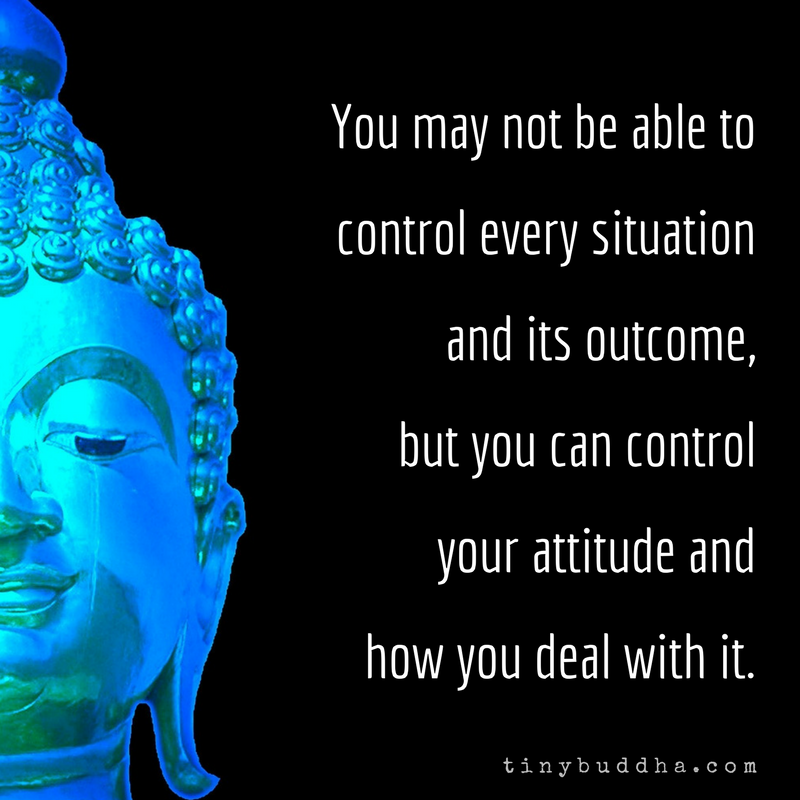
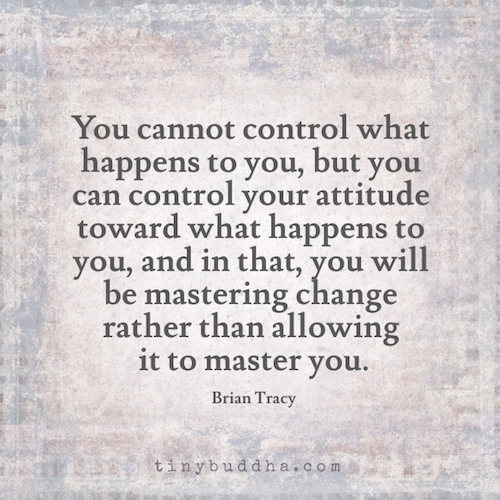
    Acceptance, gratitude, calm. Embrace the situation for what it is. Find something to appreciate. Keep things in perspective. Things often aren’t as bad as they seem, and even when a lot is beyond our control, we can always control our attitude and how we respond.

  • How Gratitude Journaling Can Boost Your Mood and Change Your Life

    How Gratitude Journaling Can Boost Your Mood and Change Your Life

    “Gratitude unlocks the fullness of life. It turns what we have into enough, and more. It turns denial into acceptance, chaos to order, confusion to clarity. It can turn a meal into a feast, a house into a home, a stranger into a friend.” ~Melody Beattie

    A few years ago I had an ulcer and I would get dizzy after almost every meal. There was a point when I was afraid to eat. I lost twenty pounds when I didn’t need to lose weight.

    I wasn’t sleeping well.

    I was a complete wreck inside.

    It took me two and half years to get my stomach back on track. I tried one thing at a time until I found what worked well for me. I can no longer drink coffee or eat tomatoes or other acidic foods. And man, did I did love a good cup of coffee to help get my morning going.

    Still, I’m actually grateful for my ulcer. It was one of the best illnesses to ever happen to me because it helped me become a healthier person.

    I was only able to overcome it because of my gratitude journal. Each day, I thanked the foods that didn’t cause me to feel dizzy. As I journaled more and more about these foods, I began to see patterns, which helped me ascertain which foods to eliminate.

    I put my energy into appreciating the foods that helped me feel good instead of complaining about the foods that made me feel sick to my stomach. And that helped me both heal and keep a positive attitude.

    This is why I suggest everyone keeps a gratitude journal. It helps you see things that you missed before. It encourages you to focus your attention on things that are making your life better.

    The best part is gratitude not only helps you live longer because it helps reduce stress, it also helps you build stronger relationships because you are more likely to share your appreciation with others. And when you regularly practice gratitude, you’re generally more empathetic and less prone to envy—great for your mental health and your relationships.

    The Power of Gratitude Journaling

    It took me some time to turn gratitude journaling into a daily habit. When I first started, I would miss days at a time. It took almost a year to get a consistent habit going. Once I made gratitude a regular practice, it helped keep me sane since I was focusing on the things I had in life instead of wanting a situation to be different. This was a huge mindset shift for me.

    As I got busier I started getting away from my journal again. Then, as my father was passing, I leaned back into it, but I wanted to go a little deeper. I started writing stories in my gratitude journal, which helped me uncover details I hadn’t really processed before.

    I noticed him getting grumpier as he got older. My journal helped me see that I didn’t want myself to fall into the same bad habits. And I didn’t have to. I had a path to build a better attitude.

    I quickly noticed my new attitude changed how people responded to me. For example, coworkers started gravitating toward me because I was letting them know that I appreciated them. Who knew that a little appreciation would help you build friendships?

    I also noticed that the migraines that used to start at the base of my neck weren’t as intense. Gratitude was not only improving my attitude and my relationships, but also my health.

    I felt like I’d stumbled upon a magic formula for life. I know that people have been talking about gratitude for thousands of years, but it felt so refreshing to me.

    I did some research on gratitude and found some amazing studies.

    In one book, Why We Do What We Do, researcher Edward Deci explains that when someone has six positive interactions to one negative, they are 31% more productive.

    When you have positive thoughts and interactions, it’s easier to focus on what matters. That may be spending time with your family, traveling, or writing. Positive interactions free you up to have the energy to do what matters to you.

    Start Small

    The intense focus of finding some small bit of gratitude in every situation really changed me.

    When I was stuck in traffic, I thought about how I could appreciate the situation and write about it. When I was stuck in another meeting, I thought about how lucky I was to be in the situation and asked myself, “What is one important lesson that I can take away from this meeting?”

    Sometimes the lesson was to breathe into my belly more. Other times it was learning from a really smart coworker who handled the meeting very well, kept us all on track, and helped us get a lot accomplished.

    Because I started small, I planted seeds to be able to go deeper into gratitude.

    If you too would like to create more positive feelings and interactions, I highly recommend starting a gratitude journal. And it can actually be really simple.

    Each day this upcoming month, just write a few things you are grateful for and why, for example:

    • I’m grateful for my coworker because she is always willing to listen and help.
    • I’m grateful for my ability to dance in my car seat when I’m stuck at a traffic light, because it allows me to release my stress.
    • I’m grateful for my pets because they make me feel loved and needed.

    The key component here is your why. This is important because it helps you actually feel grateful, as opposed to just listing things you think you should appreciate. Soon you’ll likely start to feel a lot better about your work, your relationships, and even yourself. And before you know it, you’ll probably notice an improvement in your attitude—and major changes in your life.

  • Someday This Will Be Funny

    Someday This Will Be Funny

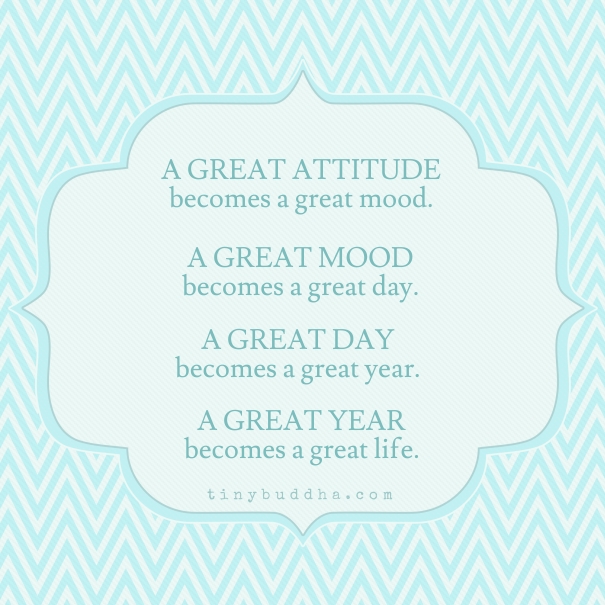
    “A great attitude becomes a great mood. A great mood becomes a great day. A great day becomes a great year. A great year becomes a great life.” ~Unknown

    I was already in a terrible mood by the time we arrived at the hotel around 7:30pm. It was Thanksgiving, and my family and I had spent four hours in the car in order to visit out-of-town family. My daughter had an accident in car seat on the way out there, and my husband and I were both battling colds. Oh, and it was my birthday.

    We’d spent the afternoon with my husband’s family, and had enjoyed the meal and the visit, but left on the early side to give ourselves time to get to the hotel before our three-year-old daughter could get overtired.

    We’d stayed at this hotel before; it offered a suite at a reasonable rate, which allowed our daughter to go to bed at her normal bedtime and for us to be in a separate room and be able to stay up until our own normal bedtime. I’d called months in advance to book a room, as soon as we knew we’d be making the trip to Raleigh, as I wanted to have that box checked off in my mind.

    In other words: I thought the hotel would be no problem.

    Unfortunately, it didn’t go as smoothly as I’d imagined. The person at the desk was new, and I had difficulty figuring out what he was trying to tell me; I just understood something was wrong. Finally he said it: We overbooked the suites and you’ll all have to be in one room together.

    One room together? On my birthday, when I have a cold and am exhausted and frustrated and grumpy? I have to go to bed before 8pm? With no chance to talk to my husband or read a book?

    Yup.

    I didn’t find this acceptable, and the front desk clerk half-heartedly called around to see if any other hotels were available, and I did the same. Being a holiday, though, there was nothing. Meanwhile, my daughter was getting more and more irritable and tired, actually asking when we could go upstairs and go to bed.

    My mood got worse and worse, and I’m not proud of the way I behaved. I was surly to the hotel employee, something I try to never, ever do after my own years in the hospitality industry. I was rude, unpleasant, and downright mean.

    It changed nothing. Well, we did get a discount on the room, but we probably would have gotten that either way. I felt terrible.

    We went upstairs, rushed to get unpacked and settled, me grumbling and agitated the whole time, then put our daughter to bed. She passed out instantly, out so cold that my husband and I were able to whisper in the dark for more than an hour, which was actually kind of fun.

    At some point during our talk in the dark, I realized this moment, this experience, this exact second, was an opportunity to stop and ask myself how I wanted to feel and behave.

    I told myself something that shifted my attitude in just one moment: “Someday this will be funny.”

    I felt an enormous energy shift and actually began to smile. My mood was completely changed.

    I saw that not having the right hotel room was so, so not a big deal. Yeah, it was an inconvenience, but it wasn’t worth being so upset over.

    And having a minor cold? And spending a lot of the day in the car? Also not big things to worry about.

    All of this happening on my birthday? It’s not like it was my sweet sixteen or the big four-oh. It was just not worth getting upset over.

    I wish I could let you feel the way I felt in that hotel room, because the shift happened so quickly and so completely. One minute I was stewing over everything that had happened in the past hour, getting more and more upset, and the next I felt complete and utter peace and relief.

    Looking back, I can also see that there was so much space for gratitude and appreciation, and not just because it was Thanksgiving.

    My family could not only afford to stay in a hotel, but we could afford to switch to a more expensive one the next night (one with a suite!). We have family to celebrate the holidays with. We have an awesome, reliable, and safe car to get us to wear we need to go.

    Appreciation is such a beautiful thing, and it goes hand in hand with shifting negative thoughts to more positive ones. Once you start looking around for things to appreciate, letting go of anger and frustration is much easier.

    This experience was really powerful and important to me, so I wanted to share what I’ve done differently since then. Perhaps these tips will help you improve your mood when dealing with inconveniences that aren’t a big deal in the grand scheme of things.

    Use the power of words to bring yourself back down to a calm place.

    I’ve started saying “someday this will be funny” whenever I can, because it brings me back to that hotel room and the way it shifted my mood. I also regularly ask myself if whatever is happening will matter tomorrow, or in a week, or in a month. Those all help me put things in perspective.

    Remind yourself things will turn out fine.

    Depending on your belief system, you may even take the long view and know that your spirit is completely safe and protected regardless of what happens in this life. If that doesn’t do it for you, simply ask yourself if this incident will even matter in a week or a month; often you’ll see that this isn’t going to have much of an impact on your life or well-being.

    Remember THIS IS IT.

    This thing that’s happening right now, even as you read this article, is your life. If you spend it going from sour mood to sour mood, your life is going to turn out pretty sour. You are the only one who has the power to change that.

    Think of the Chinese parable that teaches there is no good or bad.

    I’ve heard a few different versions of it, but the gist is that no matter what comes our way, it can be good or bad, who’s to say? Something may seem bad on its face, like losing a job, but it may bring something wonderful, like a new career you’re more passionate about.

    Use every possible opportunity to take a few deep breaths and reset.

    I know I get stuck in patterns, and feeling sorry for myself is one of them. I have to really, really work to notice when I’m getting sucked down into bad feelings and take the time to shift my perspective, so do it every single time you think of it.

    Remind yourself that like attracts like.

    You’ve probably noticed that when you’re in a bad mood and acting grouchy or defensive, other people react to you with that same energy, which doesn’t feel good and can put you in an even worse mood. You’re also more likely to notice negative things happening all around you when that’s what you’re focused on. Likewise, when you’re noticing the good stuff, you’re calmer and happier, and people you encounter reflect that back to you, too.

    This incident happened more than six months ago, but it’s stuck with me. You and I both get to decide how we will react in any given moment, in any given situation. Let’s take a collective deep breath and try to laugh.

  • 10 Ways to Cultivate a Positive Mindset and Change Your Life

    10 Ways to Cultivate a Positive Mindset and Change Your Life

    “Each morning we are born again. What we do today is what matters most.” ~Buddha

    I remember how I used to think; it was always, “People suck” and “I hate (fill in the blank).” I was constantly focusing on the bad side of humanity, so that was all I could see. It cast a shadow, which took the joy out of life.

    It should have been obvious that I was creating my own misery, but I wasn’t able to see how my own thoughts affected my mood.

    I had to change my entire outlook by training my mind to see things in a new light. It would have been easy to stay on the same path. After all, I had chronic fatigue, no money, and nothing to look forward to because I didn’t have a compelling vision of the future. I felt the present situation was permanent.

    Eventually, I’d had enough and started thinking about what I could do to change my situation.

    Change was slow, but a new path that wasn’t clear to me before started to appear as I worked on my mindset. As things progressed, my goals and dreams became bigger and more ambitious. I started imagining being fit, healthy, running my own business, and traveling the world.

    These are some of the things I did to change my mindset and my life.

    1. Seek positive friends.

    A negative social circle will act as an echo chamber for bad ideas. A positive social circle will also act as an echo chamber, but one that supports your dreams, so choose your friends carefully.

    Find people who reflect the values you want to adopt. Join groups online and go to networking or social events focused on personal growth. As your own mind starts to change, it’ll become easier to connect with more positive people.

    I’m not suggesting that you ditch friends who are going through a hard time and need your support, but rather that you evaluate whether some of your relationships are persistently draining and unhealthy.

    I left my old social circle because it was an echo chamber for negativity. Instead of focusing on a great future, everyone was talking about the things they didn’t like about life.

    It was hard to make new friends at first. The problem was that I couldn’t offer any value to people with much more positive mindsets—the kind of people who I wanted to emulate.

    That changed, but it took time. Once you find your “tribe,” progress will come much more quickly because of your new influences.

    2. Challenge your thoughts.

    When old thinking comes up, as it will, it’s not enough to try and ignore it. We need to challenge our beliefs.

    Is everything too expensive, or is it just that I can’t afford it? Do “people suck,” or am I just looking for things to criticize?

    Weigh your thoughts against the evidence. If they crumble under scrutiny, then explore why you believe them in the first place. By challenging your thoughts, your mindset will begin to evolve.

    3. Consume positive media.

    Consuming positive media daily will alter your perspective through osmosis. “Positive media” is anything that emphasizes the good in life, or how to improve our living standards and the living standards of others.

    We all know that the best way to learn a new language is through immersion. If you hear this new language every day, it starts to stick and become easier to remember. Soon, you’ll not only understand that language but you’ll speak it too.

    New mindsets are exactly the same; if you immerse yourself in personal growth content every day, it will change the language of your mind. That language is your self-dialogue, the way you speak to yourself at every moment, and it’s habitual.

    Learn a positive self-dialogue and you’ll see the world in a different way.

    4. Volunteer.

    Volunteering to help other people can make a huge impact on how you feel about yourself and your view of the world.

    By focusing on how you can help someone else, you’ll draw your attention away from your own woes. It becomes easy to develop a positive mindset when you’re looking for new ways to make someone else’s situation better.

    You can’t focus on the bad while focusing on the good.

    5. Abstain from all “bad news.”

    Wars, murders, and politics all add baggage to our thoughts.

    It makes sense that most of the mainstream media focuses on bad news, though, because tragedy sells. It doesn’t make sense for us to sit around stewing over this bad news. It’s certainly not going to allow for an optimal mindset, one that’s focused on the best that life has to offer.

    By tuning into the news about a plane crash thousands of miles away, we’re putting our mental energy into something that won’t help. We can’t change the bad things happening at any given moment, but if we put our attention into things we can change, our lives will improve.

    6. Write out your action plan.

    This is about looking at the possibilities and then doing something to make it happen. Forward thinking will move your focus away from where you don’t want to be to where could be.

    But it’s not enough to simply write it out, because we only grow when we take action. It’s just a thought until we do something to make it happen.

    Don’t know what the right steps are? Don’t worry, just identify the first thing you could do to start on the path, then do it. Even if it’s a mistake, you’ll still make progress, and that will keep you focused on creating positive change. Never allow paralysis by analysis. You have the vision; go with it.

    7. Adopt a healthy lifestyle.

    A healthy body will support a healthy mind. During the most difficult time of my personal struggles, bad health was a major obstacle. Chronic fatigue could wipe me out for whole days.

    Nonetheless, getting into action, changing my diet, and working out set the foundation for all other changes to take place. Slowly, my energy levels started to rise till the point that my health no longer was an issue.

    Look at how you sleep, what you eat, and your activity levels to identify anything that could be sapping your energy. Sometimes laziness is just fatigue.

    8. Send thank you notes.

    The simple gesture of sending a thank you note can be empowering. Not only does it feel good, a thank you note creates goodwill in other people.

    Thank you notes will also strengthen your relationships and connections, because people like to feel appreciated.

    It doesn’t really matter what they did; any small gesture you appreciated, from good service to a favor, is a candidate. Send a quick email or a card in the mail to let them know you appreciated it.

    9. Create a morning mindset routine.

    A great way to start the day is by making a mental list of each thing we’re looking forward to; it creates a feeling of anticipation and excitement that creates momentum for the entire day.

    Every morning I play personal growth videos or audio books. By focusing on the positive messages coming from this content at the beginning of the day, it’s much easier to be happy and focused. My work gets done more quickly, and it doesn’t seem so hard either.

    10. Write a wins checklist.

    So you started on good note; now finish on a great note by making a mental list of the day’s wins. It doesn’t have to be monumental; the point of the exercise is just to keep your focus on the best your day’s experience.

    Keeping track of losses can help you improve, but dwelling on them will kill your motivation and momentum. Finish strong and it will be much easier to wake up feeling happy.

    Improving your life starts with improving your mindset. Like me, you may find that these steps are a great start.

  • A Change That Leads to Unconditional Self-Confidence

    A Change That Leads to Unconditional Self-Confidence

    Confident Pose

    Kindness in words creates confidence.” ~Lao Tzu

    Does your life feel like an endless experience of struggle and stress? That while you have moments of reprieve, they are transient and short lived?

    It may be that the problem lies with your confidence—in your belief in your ability to bring about successful outcomes when you experience challenges.

    For many of us, our attitudes toward ourselves continually undermine our confidence.

    That was my experience for most of my life. My confidence was dependent on how I felt I was doing.

    If I did well, I felt good. If I struggled, I lost confidence very quickly.

    It didn’t seem to matter how many times I succeeded, doubting myself was just one slip up away. And I was exceptionally hard on myself when I failed.

    So I drove myself harder and harder. I overworked. I was determined not to feel that awful feeling of not being good enough. So I read, studied, and experienced. My confidence was always on the other side of the next book, course, or program.

    Until I burned out.

    I couldn’t keep up the pace. And I’m so grateful for that. Recovering from the health difficulties that come with burnout required that I change the way I was relating to myself and challenge the basic assumptions that I was making about what I was capable of.

    I had to pay close attention on a minute-by-minute basis to the choices I was making and my self-talk. How was I treating myself? How did I respond when I made mistakes?

    Most of us have been taught to have conditional confidence. We can feel good and confident when things are going well, but we struggle to keep motivated when things are hard. We are hard on ourselves when we slip up. We are critical, judgmental, and harsh.

    So we up the effort. We overwork, over-prepare, needing to keep ahead of the possibility of failure that we imagine is just around the corner.

    We become anxious and risk-averse. When we experience success, we don’t fully allow ourselves to experience the joy of accomplishment.

    Changing our attitude toward ourselves is the key to building confidence that is not dependent on external signs of success. An unshakable confidence that allows us to be resilient in the face of adversity and to trust ourselves enough to keep taking the next step, even when circumstances look dismal.

    Imagine that you could go through life trusting in your capability, in your ability to meet the challenges in a way that could bring about a successful outcome.

    What a relief that would be!

    Instead of trying to control the world and avoid failure, you could take risks and stretch yourself outside of your comfort zone. When you made mistakes (which you inevitably will as part of the growth and learning process) you would pick yourself up quickly, acknowledge yourself for your effort, and make any changes that we needed, based on your new learning.

    And you would keep going.

    Life would be full of possibility and hope.

    So how can you do that?

    Changing your attitude toward yourself is essentially about changing habits. So it requires patience, attention, and effort.

    Kristin Neff, self-compassion researcher, believes that changing from self-criticism to self-compassion is the key to resilience in the face of challenge.

    People who respond to themselves with compassion are far less likely to be depressed or anxious, and they have greater confidence in their ability to succeed.

    Self-compassion involves three components:

    • Being kind and caring toward yourself rather than harshly self-critical
    • Framing imperfection in terms of the shared human experience
    • Seeing things clearly without ignoring or exaggerating problems.

    How to Become Kinder to Yourself

    1. Start by noticing the way you speak to yourself.

    Especially when you slip up (in your eyes). Increasing your awareness of existing patterns is an important first step. Don’t be tempted to skip it. Most of us want to rush ahead and make changes instantly.

    2. Gently start practicing a different response.

    This may seem a bit silly at first, depending on how deeply entrenched your critical and judgmental response is. Mine was very well practiced, so it did feel awkward for a long time. But do persist. Even tiny changes can make a huge difference to how you feel and what you are able to do.

    3. Surround yourself with kind and supportive voices.

    Sometimes when you are stuck in a judgmental pattern, it can be very hard to make changes in the moment. What I found worked in these times was to have someone else hold that voice for me, so I would spend time with someone who embodied kindness, compassion, and self-acceptance.

    4. Practice, practice, practice!

    Change happens with the consistent efforts made over time, not the big once-off attempts. Stay with this; it will make all the difference in the long run.

    This is the path to unconditional confidence. Put in the effort. Pay attention and develop new ways of relating to yourself. Surround yourself with encouraging people who can help you remember your intention.

    Confident pose image via Shutterstock