Tag: attention

  • Meditation: A Simple Way to Show Up Fully in Your Life

    Meditation: A Simple Way to Show Up Fully in Your Life

    “The real meditation is how you live your life.” ~Jon Kabat-Zinn

    I never saw myself as someone who would meditate. It wasn’t even on my radar until my wife suggested it while we were both working on our wellness. I chuckled. Like a lot of people, I assumed meditation meant sitting still, trying to clear my mind, whatever that even meant. It sounded impossible and, frankly, frustrating.

    I grew up in the rust belt, part of the baby boomer generation, and I’ve spent my life working hard, showing up, and taking care of my own. I love hard and play hard. I enjoy a good bourbon, an occasional cigar, and being a little stupid with my friends and family. That’s always been part of my life.

    That’s who I was when I started this practice, and that’s still who I am today. Meditation didn’t change me into someone different. It didn’t make me soft, overly serious, or turn me into some enlightened guru. It just made me more aware. The same things I’ve always loved, I still love. The same challenges I’ve always faced, I still face. The only difference is that now, I experience it all with a little more presence. Life didn’t change. I just stopped rushing through it.

    At the time, I dealt with stress the way a lot of people do—by staying busy. If I felt overwhelmed, my instinct was to distract myself. I would work harder, scroll through my phone, watch TV, or find something to keep my mind occupied. The idea of sitting in silence with nothing but my thoughts sounded like torture.

    At the same time, I couldn’t ignore the fact that I was constantly drained. Even when I wasn’t actively dealing with a problem, I carried this low-level tension everywhere I went. My mind was always racing, thinking about what needed to get done, replaying past conversations, and worrying about things that hadn’t even happened yet. It was exhausting.

    So, I gave meditation a shot. Not because I believed in it but because I figured I had nothing to lose. What I learned along the way completely changed my perspective, but not all at once.

    I think a lot of people expect some kind of breakthrough moment with meditation, like flipping on a light switch where suddenly everything feels calm and clear. That never happened to me. Instead, it was more like a dimmer switch—subtle, slow, and almost unnoticeable at first.

    The biggest misconception I had was that meditation was about emptying the mind. That’s not the point at all. And honestly, if that was the goal, I probably would have quit on day one.

    Meditation isn’t about forcing thoughts away. It’s about noticing them without getting caught up in them. It’s about observing what’s happening inside rather than constantly reacting to the outside world. Think of it like sitting on the side of a busy road, watching cars pass by. Cars are your thoughts. You don’t need to chase them or jump in. You just watch.

    Once I stopped trying to clear my mind and instead focused on simply noticing my thoughts, the practice became much easier. More than that, it started to make a difference in my daily life, but not in some dramatic, life-altering way. There was no single moment where I thought, “This is it. Meditation has changed everything.” It was far more gradual than that.

    I started noticing small shifts. I felt shorter bursts of calm in my day, even in stressful moments. Instead of immediately reacting when something frustrated me, I had a split second of space to breathe first. I became more present and less lost in overthinking.

    I realized I wasn’t spending as much time stuck in my head, replaying past mistakes or worrying about the future. And perhaps most importantly, stress didn’t grip me the way it used to. It still crept in, but I caught it earlier and let it go faster.

    That, I’ve come to understand, is what meditation really does. It doesn’t erase stress. It just helps you see it sooner so it doesn’t take over.

    One of the most unexpected benefits was that I became much better at recognizing when I was running on autopilot. Before, I would get lost in thought without realizing it. I would stress about everything, scroll through my phone, or half-listen to conversations while my brain was somewhere else. Meditation helped me break that habit. I started to realize how often I was going through the motions without truly being present. That awareness alone made a difference.

    At this point, meditation isn’t just something I “do.” It’s something that shows up in how I go about my day. And that, more than anything, has been the biggest shift. It’s easy to sit in a quiet room and meditate. The real challenge is remembering to breathe and stay aware in everyday moments. That’s where the practice really matters.

    I’ve also realized that even when I don’t feel like meditating, that, in itself, is a form of meditation. The fact that I check in with myself, notice whether I’m avoiding something or just not in the mood, and allow myself the freedom to choose—that’s awareness. And that’s the whole point. I don’t pressure myself to meditate at a specific time every day because I know awareness isn’t confined to a cushion or a set routine. I am free to be free.

    If you’re skeptical like I was, here’s what I’d recommend. Forget about clearing your mind. Trying to shut off your thoughts is like trying to stop the wind. It’s not going to happen. Instead, just notice your thoughts without getting carried away by them. You don’t have to control or judge them. Just observe.

    Keep it short. You don’t need to sit for thirty minutes. Start with two to five minutes. That’s it. You wouldn’t expect to lift heavy weights on your first day at the gym, right? Meditation is the same. It’s mental muscle that gets stronger over time.

    Make it easy. There’s no need to sit in a perfect cross-legged position or chant mantras unless you want to. Just sit comfortably, whether on a chair, couch, or even lying down, and focus on your breath. No need to overcomplicate it.

    Expect your mind to wander. That’s normal. Meditation isn’t about having a blank mind. It’s about noticing when your attention drifts and gently bringing it back. That is the practice. Stick with it. The benefits sneak up on you. You might not notice a difference at first, but over time, you’ll realize you feel a little calmer and a little more grounded. Give it time.

    Over time, I stopped thinking of meditation as something separate from the rest of my day. It became less about sitting in silence and more about paying attention. Noticing my breath when I felt unsettled. Feeling the weight of my body in my chair while working. Catching my mind when it started spiraling into stress. It all counts.

    At the end of the day, I’m still the same guy. I still work hard, love hard, and enjoy a good bourbon and laugh with my friends. Meditation didn’t make me a different person. It just helped me show up for my own life in a way I never had before. And for me, that’s been enough.

    What moments in your life are slipping by unnoticed? Where can you slow down, even for a breath, and truly be present? You don’t need to change who you are or chase some perfect version of mindfulness. Just notice. Just pay attention.

    As Jon Kabat-Zinn reminds us, “The real meditation is how you live your life.” It’s not about sitting still or doing things a certain way. It’s about showing up—fully—for the life you already have.

    So, take a deep breath, bring a little more awareness into your day, and let the rest take care of itself.

    Always remember to JUST BREATHE.

  • Are You Paying Attention to the Beauty of this World?

    Are You Paying Attention to the Beauty of this World?

    “’I got saved by the beauty of the world,’ she said to me. And the beauty of the world was honored in the devotion of her attention. Nothing less than the beauty of the world has become more present, more redemptive, for more of us in the encounter with her poetry.” ~Krista Tippett, on interviewing poet Mary Oliver

    The act of paying attention seems rather simple. Simply being aware of life happening all around us. And yet most of us are what we might call asleep at the wheel. We perform daily tasks and engage ourselves in human interactions without a moment given to the here and now taking place in the present.

    Instead of enjoying the scenery while on a drive to finish the day’s errands or the conversation with a person directly in front of us, our bodies perform rote tasks while our minds ruminate over discussions that already took place or those that we feel we must mentally rehearse for future preparation.

    I can think of nothing worse than choosing to plan a future conversation that may or may not take place instead of deciding to be present for whatever the moment brings. Yet we are all guilty of this and other forms of past and future thinking, and we do them quite frequently.

    I really need to get more bottled water/pasta sauce/rolls of toilet paper from the basement.

    I wish she would call me back.

    How long before I need to start worrying about this? Can I do something to change it?

    What should I make for dinner tonight?

    This is just a sampling of the daily thoughts taking up precious space in my head. Our habit is to be lost in a trance. Thinking. Planning. Striving. Worrying. We forget why we’re here, and in the forgetting, there is suffering. Each day requires a gentle nudge back to our true nature. The nature that exists only in the here and now.

    “Before going to bed, I glance back over the day and ask myself: Did I stop and allow myself to be surprised? Or did I trudge on in a daze?” ~Br. David Steindl-Rast

    Our attention to the present moment is what helps us enjoy a life of meaning and purpose. It can keep us from feeling as if life is devoid of any significance. This is why remembering is so important.

    Caught in that state of nonstop thinking, believing we are alone and separate with our egos and internal chatter, we may wonder: Is this all there is? Am I anything more than a hamster running on a wheel of thoughts in some crude experiment?

    Because it doesn’t really appear all that special when our life seems to exist as a series of repeating thoughts between the ears (many of which seem punishing and unkind), rather than a kaleidoscope of sensations and experiences—along with moments of pure wonder, heartbreak, beauty, pain, and awe.

    So how can we find meaning in our lives when we are repeatedly lost in our own thinking? A beautiful place to start is with intention. Intentions help us to remember our true nature and keep us aligned with our higher selves.

    Tara Brach, renowned psychologist and teacher of Buddhist meditation, once gave a beautiful lecture on intention. She says that the more you focus on your intention, the more you pay attention. These two work together, back and forth, in a circular manner.

    The caring and compassion that comes from an increased attention to this world deepens your desire of intention, and the two feed each other in a beautiful reciprocation. What results is a habit of being more awake and alive in this world. We begin to think less, and to become more present in the here and now.

    Tara reminds us that having an intention alone is not enough. We must pay attention in order to manifest our intentions. We cannot just meander along and fail to pay attention to what is in front of us.

    “When you start setting your intention and pay attention, they actually allow your Heart and Spirit to manifest.”  ~Tara Brach

    The power of intention has helped me train my brain to be aware of my surroundings in a new and profound way. Since I know that my brain is hardwired for thought, I recognize that I must be intentional about paying attention to the world around me.

    And my intention should be to see the whole of my environment and the person or people around me, in all their messy and magnificent layers. Therefore, my intention is this: see people and my surroundings, in all their beautiful joy and struggle, and send my love and compassion to all.

    This increased awareness certainly didn’t happen overnight; it takes repeated training and subsequent brain rewiring. I still get lost in thought from time to time, but fortunately now I can catch myself falling into the trance of thought and return my attention to the here and now. This attention allows me to live from my intention, and the two dance together in a beautiful waltz, just as Tara suggested.

    When I was first getting started, I learned of a simple idea from Eckhart Tolle that resonated with me immediately. He said that when you get into your car to leave your home, take just thirty seconds to become aware of your immediate surroundings. No thinking, just observing.

    What do you see? Items in your garage, or on your driveway? Things inside your car? Or nature just outside your car window?

    Unless you are on your way to the hospital with an emergency, Eckhart says that each of us have thirty seconds to stop and take notice. I was glad he mentioned that, because most often we feel like we have no time to spare when all we are talking about is just half a minute of our day. This simple practice serves as a gentle reminder to be more present and aware as you leave your home and embark on your day. It also helps me set my intention. It was a great beginner lesson for me and one I still use today.

    Meditation and other mindfulness practices have also helped me increase my attention to this world. Study after study shows how meditation practice can not only increase focus and reduce distractions but allow us to bounce back from those inevitable distractions as well. Since the aim of many meditative practices is to help us sustain attention while letting thoughts pass through awareness, it seems logical that meditators would have an increased level of focus and attention.

    Meditation also teaches us to slow down. The tendency in our culture is to do everything at a rapid pace–whether that is driving, grocery shopping, cooking dinner, or any number of activities both inside and outside the home. When we slow down, however, we notice much more of the world that we failed to see while we were in overdrive.

    Slowing down our bodies slows down our brains. Once the brain is moving at a gentler, less frenetic pace, it removes the heavy charge of thinking and makes room for the present moment.

    “When I move half as fast, I take in twice as much.” ~Tara Brach

    Our brains are made for thinking. Lots of it. This fact makes mindfulness practices and setting intentions difficult. However, each of the practices above help us to rewire our neurons by doing a series of actions on purpose.

    Every second spent being mindful and living out our intentions helps our brains to internalize these actions by creating pathways in the brain. What begin as thin and barely recognizable trails you may see in an overgrown forest become deeply grooved track beds after repeated and daily rewiring. The key to maintaining mindful attention then, like most things, is practice.

    I desire a life of meaning. In order to have that, I know that I need to keep myself awake for all of life’s moments. There are some moments that I may not want to see. However, I must not shy away or tune out from anything I may be averse to. It is in the paying attention that I get to understand all of life in its richness and complexity. Its heartbreak and beauty.

    Some of us experience pain in the present moment that is just too great, and because of this we fall below consciousness in an attempt to ignore the deep and profound heartache that exists in the here and now.

    Anesthetics used to numb the pain, such as alcohol, drugs, food, or compulsive shopping, alleviate the feelings associated with grief, bullying, physical or emotional abuse, divorce, and many other forms of distress. However, though these feelings may temporarily subside, they return once again when we awaken from our unconscious state. And the negative feeling or emotion is often more intense each time it resurfaces. It’s begging for our undivided attention and care.

    Previously, I had no awareness of the fact that falling below consciousness was my go-to move. Perhaps because society has somewhat normalized this tendency, or because I did not want to sit with my act of ignoring what felt too difficult to face.

    Years of spiritual and mindfulness teachings slowly worked their way into my psyche, and I learned that beneath the illusions of daily life, both good and bad, there is an unshakeable inner peace that always endures.

    I didn’t need to develop this peace by hours of sitting meditation or any number of courses, retreats, or books on spiritualty; I only needed to uncover what had been there all along, waiting patiently to be discovered.

    Difficulties, both great and small, continue to present themselves. This, of course, is life. Though I have been tempted at times to return to a comforting salve, my awareness of these feelings and the nature of them (transitory and not part of my true being) allow me to sit and be with the experience, even when that experience is unpleasant.

    Author Parker Palmer once said: “My heart is stretched every time I’m able to take in life’s little deaths without an anesthetic.”

    Personal growth occurs not when we are warm and cozy and everything seems to be going all right, but when we are able to be present with the painful moments of our lives.

    We can take refuge in the fact that, no matter our situation or circumstance, our infinite beings of light cannot be harmed. They can only grow in the comforting surroundings of the great and eternal love that never leaves, lessens, or places conditions upon us. Let the storm rail on as we watch its cloud formations swirl and feel its thundering presence, patiently waiting for it to pass like all the others that came before..

    Like Mary Oliver, I want to honor the smiles, the kind gestures, the sweet surprises, the expressions of nature outside my window. I want to equally honor the catastrophes, the grief-stricken tears, and the everyday struggles in our lives—whether that is the loss of a loved one or a broken refrigerator.

    It has taken me a while to get there, but I now know there is beauty in the latter too. By remaining attentive to what is happening right in front of me, without needing to change it, I open myself up to a peace that is timeless and enduring.

    The year 2021 presented me with the most difficult experiences of my life to date. Personal injury, family hospitalizations, the loss of grandparents, crippling stress, and unimaginable anxiety filled most days of the calendar.In the final weeks of that year, I lost my mother-in-law to COVID, and the very next day I was scheduled to appear at my sibling’s court sentencing.

    Nearly two and a half years later, I only need to exercise some mental time travel to recall the still vivid scenes from that brief period—the toughest part of an already difficult year—and the corresponding emotions that came from this double whammy heartbreak.

    An anguished cry, muffled under someone’s fist. The cold and blinding snow squalls that froze my feet and stiffened my body in place; finding myself somehow unable to turn around and return inside to wade in further waves of grief. Anger being expressed as misplaced love with nowhere to go. The chains and handcuffs clinking with each step taken in the courtroom. The wad of tissues, wet and crumpled, in my free hand.

    And this. A long overdue embrace between estranged brothers. The offering of one’s home as a place of respite after burial. The gesture of love that presented itself in homemade casseroles and desserts. The joining of warm hands on a cold courtroom bench. The final look at my brother through the window of the courtroom door, our eyes meeting one another. The beautiful and bittersweet reminder that my love for both of them was greater than I’d ever imagined.

    The beauty of the world, as Mary Oliver describes it, includes everything. There are no exceptions or exclusions. When we remain aware, we are witnessing life as it unfolds and changes from one heartbreaking moment to the next jubilant occasion.

    It all belongs. And, though it may seem counterintuitive, it all needs to be celebrated. This is life, and we can experience joy and divine love in each moment of attention. Though some moments may appear too difficult to bear, we must always remember that beneath each tragedy is an inner spaciousness that gently carries the weight of it all.

    I don’t want to miss a thing. The beauty or the heartbreak—both of which make me feel alive and actively participating in life’s unfolding. For that reason, I’m striving to be awake for as much of it as I can.

  • 3 Simple Words to Help You Feel Present, Grounded, and Nourished

    3 Simple Words to Help You Feel Present, Grounded, and Nourished

    “The little things? They’re not little.” ~Jon Kabat-Zinn

    Remember Halloween, 2018? No? We wouldn’t, either, except that it happens to be the day our mindfulness journey—and our lives—changed forever.

    First, some background. We (Deborah and Willow) met when our boys played on the same fifth-grade soccer team. We connected quickly through our shared love of books, writing, dogs, hiking, and strong coffee.

    Something else we had in common: We were both failed meditators. To be honest, we were a bit embarrassed that we couldn’t make a mindfulness practice stick.

    Thank Goodness We WEREN’T Paying Attention 

    Now, back to the story. In 2018, October 31st landed on a Wednesday (an important detail, as you’ll soon discover). That morning, we drove to San Francisco to see a new exhibit at an art gallery.

    Parking spot secured, coffee in hand, we were first in line as we waited for the museum doors to open.

    We waited. And waited. And then it dawned on us.

    Was the museum closed on Wednesdays? Yep.

    Had we paid attention to the schedule beforehand? Nope.

    As usual, we’d been too distracted and busy—and now our plans were ruined.

    Before heading home, we decided to walk around and explore downtown San Francisco. As we set off, we decided to try an experiment: We would slow down and tune in to, well, anything and everything.

    We’d notice what was happening around us. We’d notice what was happening inside us. And we’d notice what happened when we intentionally paid attention.

    Oh, the things we noticed! Little pink flowers poking out through a crack in the sidewalk. A tiny dog in a pale blue sequined jacket. A sweet older couple holding hands as they shuffled across the street together, which instantly warmed our hearts.

    Two hours later, we realized that intentional noticing was making us feel present and grounded. Nourished and aware. We were totally engaged with our lives—and we loved it.

    A Three-Word Invitation to Slow Down and Be Present

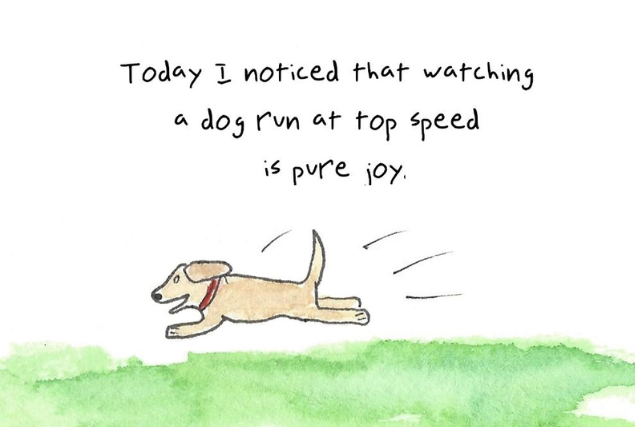
    We decided—on the spot—to each start a daily journal based on the prompt “Today I noticed.” We’d write a sentence and draw something (anything!) about an observation. Nothing would be too small or mundane to be worth noticing.

    A few weeks later, we shared what we’d been recording. As we paged through our journals, we found ourselves saying things like, “I noticed that!” and “I feel the same way!” As we laughed and talked, we realized how much of everyday life we’d been missing out on because we were too distracted to notice.

    Here are just a few precious moments we might have missed if it wasn’t for our “Today I Noticed” mindfulness practice:

    Today I noticed that just two stalks of freesias make the whole room smell divine.

    Today I noticed how easy it is to practice “lovingkindness” on my dog.

    Today I noticed how happy it makes me to hear my husband unloading the dishes.  

    Today I noticed I love coffee so much that I imagine my second cup while still drinking my first cup.

    Our day-to-day lives were becoming richer and brighter simply because we were paying more attention.

    2000+ Days of Mindfulness—and Still Counting 

    Now, five-and-a-half years later, we’re still observing, writing, and drawing about some of the funny, surprising, sweet, and ordinary moments that we all see but rarely take the time to notice. This daily practice leaves us feeling tuned in, present, and connected—just like any other mindfulness practice.

    Unlike meditation, for us, this approach to mindfulness has stuck. Noticing and recording has become a way of life—and we don’t plan on ever stopping.

    Here are five reasons why we’re convinced that “Today I noticed” is the secret to lasting mindfulness.

    1. It’s 100% natural.

    We’re all noticing things, all the time. The key is noticing yourself noticing. Paying attention doesn’t require a meditation pillow, a yoga mat, or a mantra. It just takes a simple prompt—”Today I noticed”—to shift your mindset.

    2. It makes us feel present.

    As Jon Kabat-Zinn so wisely stated in the quote above, the little moments aren’t little because they’re what make up our lives. When we move too fast or feel too overwhelmed to notice them, we miss out on an essential part of daily life. Intentional noticing is a way to instantly feel grounded in the here and now.

    3. It sparks gratitude.

    When we slow down and pay attention, even for an instant, we stop taking things for granted. Today I Noticed reminds us how easy it is to find things to appreciate if we just slow down and look for them.

    4. It boosts compassion.

    As we discovered during our very first session of showing each other our observations, the little moments are evidence of our shared humanity. Whether we’re seeing a new bud blossom into a beautiful flower, hearing a beloved dog snoring, or appreciating a smile from a stranger, such “ordinary” experiences feel downright extraordinary when we realize they’re part of a bigger collective experience.

    5. It’s a creative outlet.

    If you’d like to have a creative practice but can’t find the time, “Today I Noticed” mindfulness is for you. You can spend as much or as little time as you’d like writing and drawing about an observation. This bite-sized break is an easy way to tap into a delicious right-brain experience and feel both completely focused and completely relaxed. And wonderfully creative!

    Here are some tips and ideas to keep in mind.

    6 Tips to Start a Noticing Practice Today 

    1. Start paying attention to little things—thoughts, feelings, observations—as you go through your day. Nothing is too “small” to notice and appreciate.

    2. On a piece of paper, starting with the words “Today I noticed,” write about your observation with a sentence or two.

    3. Create a sketch or some kind of visual to accompany or illustrate what you wrote. Remember, everyone is an artist in their own unique way.

    4. Find a buddy to share your observations with. Start a “Today I Noticed” club and host monthly sharing sessions. Or hold a weekly noticing session with your team at work.

    5. Instead of asking your kids, “How was school today?” (“BORING.”), ask them what they’ve noticed. It’s a guaranteed conversation starter!

    6. As you notice more and more things (and you will, we promise), keep track of your observations in your phone or a notebook. Then, when you’re ready for a creative break, you can dive right in and start writing and drawing.

    Go Forth and Notice!

    Have we convinced you to try noticing your way to mindfulness? We hope so!

    When you simply let three words, “Today I noticed,” inspire you to pay attention to the little things that usually slip away unnoticed, you feel present, grounded, and nourished. Small things become more interesting and memorable when we simply take the time to notice them.

    We’ll end with what may be the most powerful discovery of all: The more you notice, the more you notice. And that, friends, is where the real mindfulness magic happens.

  • What Carrots Are You Chasing, and Are They Worth the Sacrifice?

    What Carrots Are You Chasing, and Are They Worth the Sacrifice?

    “Not to arrive at a clear understanding of one’s own values is a tragic waste. You have missed the whole point of what life is for.” ~Eleanor Roosevelt

    I promise this essay isn’t an attempt to convince you that you’re living inside The Matrix. (Okay, maybe it is a bit.)

    But do you ever find that days, weeks, or even months have passed that you didn’t feel present for? I describe this odd sensation as feeling like you’re going through the motions like Bill Murray trapped in Groundhog Day.

    Every day bleeds into the next because you’re future-focused, and what you’re doing right now only feels valuable insofar as it’s laying the groundwork for something else; the next stage of your career, the renovation that means the house is “done,” a number in the bank account that means you’ll never have to worry about money again.

    I think it’s fair to say we both know this is total BS. We’ve climbed enough mountains in our lifetime to know that as soon as we get what we want, we’re already planning what’s next.

    The problem is not with the aim or the goal but with the belief that we can cross a finish line that will magically make these uncomfortable feelings disappear. In psychology, they call this the hedonic treadmill.

    You know that promotion that would change your life?

    You know that new kitchen you obsess over because it would make life much better?

    You know that extra cash that would mean all of life’s money troubles would disappear?

    Will they provide everlasting happiness?

    Doubtful.

    We can blame this on the hedonic treadmill.

    It’s in our human nature to quickly return to a relatively stable level of happiness despite major positive or negative events or life changes.

    Put another way: No matter what we do, buy, or hope will change our life permanently, it’s a short-lived shot of happiness injected into our life.

    I understand why people don’t want to believe this. Because it forces us to question why we’re working so damn hard to change things and to be present with what is right now.

    When I realized this, I began to reflect on what it meant for my life in a way I couldn’t when I was lost in the chase. Accepting that we have a baseline is liberating. Most of what we’re chasing is nothing more than stupid carnival prizes in a game we didn’t know we were playing.

    If the $40,000 kitchen renovation will give you a flash-in-the-pan taste of happiness, is it worth the years of your life you need to sacrifice to pay that off?

    Is it worth more hours in the office?

    Is it worth less time with your family?

    Is it worth the crippling stress?

    You have no control over the hedonic treadmill. Still, you can control how much of your life you’re willing to trade for a future that won’t make you any happier in the present.

    It’s a hard habit to break because, as philosopher Alan Watts explains:

    “Take education. What a hoax. As a child, you are sent to nursery school. In nursery school, they say you are getting ready to go on to kindergarten. And then first grade is coming up and second grade and third grade… In high school, they tell you you’re getting ready for college. And in college you’re getting ready to go out into the business world… [People are] like donkeys running after carrots that are hanging in front of their faces from sticks attached to their own collars. They are never here. They never get there. They are never alive.”

    It’s drilled into us from the day we’re born to always think of what’s next.

    You end up chasing carrots to eat when you’re not even hungry. Hell, you probably don’t even like the taste of carrots.

    This lack of presence is toxic for our children. They end up repeating the same cycle we do when we role model the idea that we need to prioritize a future self (that may never come) over time spent with them.

    Life only feels short because we burn much of our alive time on shit that doesn’t matter.

    Do you want to experience a deep, rich, and fulfilling life?

    Start by asking, what carrots are you chasing? Are they worth the sacrifice? And what values would you honor in the present if you stopped living for the future?

    I can say family means everything to me, and I’ll do whatever it takes to support and provide for them. But if I’m consumed by my phone when I’m with my ten-month-old daughter, what value am I reinforcing? To make more money in my business so I have the freedom to do exactly what I’m too busy to enjoy right now?

    To honor my values means putting the phone down, looking into her eyes, and giving her literally the only thing she wants and needs from me. My presence. And that right there—being present enough to enjoy our lives—is what will give us the happiness we crave.

  • 5 Meditation Retreat Practices to Try at Home for a More Mindful Life

    5 Meditation Retreat Practices to Try at Home for a More Mindful Life

    “Meditation is the ultimate mobile device; you can use it anywhere, anytime, unobtrusively.” ~Sharon Salzberg

    It was the fifth night of my first silent retreat, and 100 of us spilled out of the meditation hall into darkness, flashlights swinging as we made our way along the path to our dorms and sleep.

    Suddenly the wind picked up and quiet excitement rippled through the group as we looked up to see a bank of clouds move and reveal a full moon, beaming a bright white light from the night sky. We stopped and stood, some of us for hours, gazing upwards.

    This is a painfully obvious metaphor, I wanted to say to someone.

    Despite my natural cynicism, despite the sleepiness and agitated thinking that had haunted my meditation for days, as I looked up at the moon I thought: In a world this beautiful, how can I not pay attention?

    Days later, when my weeklong retreat ended and I came home, I was reminded that being on a retreat is a lot different from regular life.

    I can’t see the sky let alone the moon from my house, and my time is punctuated by the sound of email notifications instead of gongs. But is it possible to recapture some of the mindfulness you can cultivate on a meditation retreat? Here are five strategies I am trying, and you can try too.

    1. Enjoy a daily meditative meal (or snack).

    On the first day of our retreat one of the teachers gave an inspiring talk just before lunch. Every mealtime is an opportunity to practice, he said. Try smelling each spoonful of food before you put it in your mouth. Put your silverware down between each bite.

    Lunch that day was the longest meal I have ever experienced. We considered each bite of salad, noting the whiff of vinegar in the dressing and the crunch of the greens. I grew to know the subtle flavor of plain brown rice, and the multisensory experience of holding a mug of hot tea to my lips and inhaling the lightly scented steam before sipping.

    It was reinforcing to be in such a large group enjoying meals together so slowly and quietly, but everyday life presents multiple mindful eating opportunities as well.

    Post-retreat, I try for at least one meditative meal. Where I would once wolf down lunch while scrolling through Twitter, I create space to experience the flavor of the food and note the texture. It works for snacks too—you can really taste the salt on your lips from the first bite of a chip. An added bonus: All that chewing is great for digestion.

    2. Ground yourself by walking.

    Much of the retreat schedule can be summed up as “seated meditation followed by walking meditation.” The sitting-walking pattern helps break up the day and ideally prevents us from dozing off on the meditation cushion.

    Slow meditative walking, with its noting of the “lift, move, step” motions of our feet, felt like a close cousin of seated meditation. Normally paced walking in the hills of the retreat center was still more inspiring, as I tried to tune into each step connecting me to the earth.

    At home, where sitting at a desk dominates my awake time, I am incorporating periods of mindful walking—even if it is just down the hall. Between meetings or projects, I get up and feel the floor under my feet with each step, noting the swinging of my arms, and the way the fabric of my pants moves across my legs.

    Longer walks, taking in the sights of the neighborhood without a distracting podcast, is also part of my new routine. With or without the mental noting of “lift, move, step,” walking can effectively bring our minds back into our bodies.

    3. Befriend a tree.

    One retreat teacher encouraged us to select a tree from the surrounding forests and forge a connection with it. We each considered our tree’s solidity, the sap running through it, the wind in its branches bringing constant change, and the co-arising circumstances that led to its growth. It was common to round a path in the woods and come across someone standing looking up at a tree, seated at its roots, or even swaying in rhythm to its movements.

    Back in the city, I can simply sit on my front steps and contemplate the river birch in the yard without alarming my neighbors. I pay attention to the subtle grays and whites of its bark, the way its leaves almost shimmer in the breeze. I have lived with it for years, but this tree is now a brilliant object of meditation in my daily life. Cheesy as it sounds, the tree has become a friend I greet with a smile every morning.

    4. Embrace mindful chores.

    Just like the summer camp I attended as a kid, my retreat required us all to sign up for a job. My work meditation was to chop vegetables in the afternoon. It became a highlight of my day to carefully peel parsnips or work my way through a box of eggplants, guiding the knife into the flesh to create slices then cubes I would eventually see in the evening meal.

    In everyday life, chopping vegetables can feel like a boring imposition, something to rush through between more exciting activities. But when you have been meditating all day the subtle pleasures of chores become clearer.

    I try to invoke some of that mindfulness at home, feeling the weight of the knife in my hand as I chop, and taking the time to focus all my attention on removing the peel from a carrot. Using vegetables as my gateway I am now experimenting with mindful dishwashing. Soap bubbles can be a revelation if you really pay attention.

    5. Take a break from needing to “be” someone.

    When you are on silent retreat, you’re not just quiet, you’re existing anonymously within a large group of people. It was enormously relaxing not needing to “be” someone for a week—and eye-opening to recognize how much effort goes into conjuring up the ideal “me” to present in social situations.

    In not speaking to one another, or even looking each other in the eye, my fellow retreatants and I could co-exist, focusing on our experiences in the moment instead of mentally rehearsing what we would say at dinner.

    I admit to secretly pondering the backstories of my fellow retreatants, and I was certain that people were judging me whenever I forgot to take off my shoes inside or made other newbie mistakes. But overall, our shared silence created much more space to do what we were doing without extra mental labor.

    The relaxation of silent co-existence can be harder to achieve in the regular world, where our work and family lives can hinge on being visible and vocal.

    Taking “non-being” home for me has meant noticing the relaxing qualities of being alone, rather than looking for distractions, and recognizing the temptation to needlessly make an impression in passing interactions as I go about my day. That jokey comment to the barista might be less about being friendly and more about being noticed.

    I’ve also brought a new kind of attention to gathering places like the grocery store or library, asking myself: Can I navigate among people without comparing, judging, fixing, or asserting an ego that demands attention?”

    As Sharon Salzberg so wisely says, we can use meditation anywhere. I had the privilege of dropping out of the daily grind for a weeklong retreat, and literally saw the clouds part for a moment of insight. In the time since returning, however, I see that many of the retreat’s greatest gifts were the less flashy moments—the practices that provide tools for the other fifty-one weeks of the year.

  • How Shifting Your Attention Can Be the Cure for Anxiety

    How Shifting Your Attention Can Be the Cure for Anxiety

    “Anxiety was born in the very same moment as mankind. And since we will never be able to master it, we will have to learn to live with it—just as we have learned to live with storms.” ~Paulo Coelho

    “Am I focusing too much on my anxiety?”

    This very question weighed heavily on my mind as I found myself in yet another bout of anxiety. I was playing professional baseball at the time, and I just couldn’t seem to free myself from the constant and unending worrisome thoughts racing through my head.

    A lot of these thoughts centered around how I would perform the next game. What my teammates were thinking of me, whether they saw me as a valuable part of the team. I often thought about why I was playing baseball and if I was wasting my time.

    All of these worries did nothing but lead to further thoughts, centering around much of the same, leading to a terrible cycle.

    This was not the first time I realized the presence of anxiety in my life. It has been something I’ve dealt with for as long as I can remember.

    In college, I even worked with a sport psychologist who taught me coping mechanisms to alleviate the anxiety I felt surrounding baseball.

    We addressed my self-talk, with him generating a routine I could use the night before games. He also focused heavily on process goals. As focusing on the process, rather than the outcome, is a major way to reduce anxious thinking.

    After completing a master’s in psychology and beginning work as a mental performance coach, I felt as though I had a solid understanding of how to cope with anxiety. Why was it then that I once again found myself in its grasp?

    Well, the truth is, no matter how strong you build your mind and how much work you put in, anxiety will still find its way into your life. Some time or another, those pesky worrisome thoughts will enter your head.

    What matters is how long you allow those thoughts to stick around. And what’s interesting is, sometimes the more we try to rid ourselves of anxiety, the more we invite it to stay.

    That is the mistake I made, and why, after all my years of work and learning, I found myself faced with great difficulty.

    Energy Flows Where Attention Goes

    Have you ever heard this saying before?

    I’ve heard different interpretations of its meaning, but one I really resonate with is, wherever we place our attention will be amplified.

    This means the more we focus on our anxiety, the greater the strength we give it.

    So if we want to not feel anxious, one of the worst things we can do is try to not feel anxious.

    When I recognized I was giving my anxiety too much attention, I realized what needed to happen instead. The decision I made involved the same techniques I’m going to show you later in the article.

    For now, I want to address just a little bit about why we focus so much on anxiety in the first place.

    Can’t I Just Will It Away?

    I’m the first to admit to having fallen into this type of thinking in the past.

    Whenever I would grow overly anxious before a game or experience anxiety in my daily life (which was all too often), my natural response was to try and force the anxiety out.

    But that only worsened the problem. I remember feeling the anxiety actually grow within the more I tried to get it out.

    So why do we continue to believe we can rid ourselves of anxiety through focusing on it?

    The main reason is due to the fact we are anxious people in the first place. Do you know how hard it is to stop thinking about something? Especially when that which has captured your attention is as powerful an emotion as anxiety.

    So, one, the easiest option is to grow anxious over the anxiety, thus focusing on trying to will it away. Two, anxiety is a scary feeling. Having uncontrollable thoughts that lead to a dizzying feeling of dread is not fun.

    As a result, we try to get rid of it as quickly as we can. Removing our attention from the anxiety and trusting in some other technique does not feel as safe as simply focusing on how terribly we feel and hoping the anxiety will go away.

    But as I already said, giving too much attention to our anxiety only makes it worse. So, what can we do instead? The answer lies in attention, the shifting of attention that is.

    The Power of Shifting Your Attention

    Since we know where we place our attention is where our energy will be directed, a shift in focus can drastically improve our mental state.

    When I questioned whether I was focusing too much on my anxiety, it became clear to me that I was obsessing over why I experienced it, where it came from, and how I could get rid of it.

    So, I decided to make a switch and instead, give my attention to how I wanted to feel. This meant focusing on ways to feel confident, relaxed, and so on.

    Do you see the major difference? Understanding that everything is heightened based on how much attention we give it, you realize it’s only hurting you further to focus on what you don’t want.

    Once you accept the anxiety you feel, it’s now time to turn your attention onto how you wish to feel instead. Always focus on things in the affirmative rather than the negative. Pay attention to how you want to feel, not how you don’t want to feel.

    To become more relaxed and confident I employed the use of meditation and visualization.

    Using Meditation and Visualization to Train Focus

    I sit for mindfulness meditation twice a day and just relish in the moment.

    I have found the practice so powerful in training my mind to focus on the present moment. Not only has it taught me to give attention to feeling relaxed and calm, but the more present I am, the less anxiety I feel.

    That’s because anxiety, by definition, is a child of the future. To feel anxious means you are worried about what may happen or something not happening the way you wish.

    To practice mindfulness meditation, simply follow these steps:

    1. Get into a comfortable position with your back straight. I prefer sitting on my knees, but feel free to sit in a chair if that’s more comfortable.

    2. Set your timer. You do not want to be wondering if you’ve meditated long enough. Give yourself five to ten minutes if you’re a beginner. Choose a calming alarm, as you don’t want to be startled out of your mindful state.

    3. Close your eyes and begin breathing deeply and rhythmically. Focus on your breath and as your mind wanders, simply return your focus, without judgment. Thoughts will keep coming. The goal isn’t to stop them. It’s to allow and observe them, then let them pass.

    I also use mindfulness is during the day. Whenever I feel anxious, I’ll pause and take a few breaths to center myself in the present.

    I usually add some count breathing into this—breathing in for a count of five and out for ten.

    Visualization has been an equally powerful tool in training my mind to manage worrisome thoughts.

    After my meditation is complete and I’m relaxed, I visualize myself full of confidence, calm, and relaxed in different scenarios where I typically feel anxious.

    Once again, I am not seeing myself as not anxious, but rather as the way I wish to be.

    Usually, I’ll decide on one situation each day and visualize it in detail—what’s going on in my environment, who’s around me, what they’re doing. This allows me to mentally practice facing these situations with ease.

    Throughout the day, whenever I feel anxious, I bring this image back into my mind, reminding myself to operate off my ideal vision of myself rather than my past conditioning.

    These techniques have been tremendously helpful in shifting my attention off anxiety. And the less attention I give to feeling anxious, the less hold anxiety has on my life.

    If you are struggling with anxiety, I encourage you to ask yourself the same question I did, “Am I focusing too much on my anxiety?” You might be surprised by how your anxiety eases when you stop giving it so much attention.

  • What It Really Means to Be There and “Hold Space” for Someone Else

    What It Really Means to Be There and “Hold Space” for Someone Else

    “A healer does not heal you. A healer is someone who holds space for you while you awaken your inner healer, so that you may heal yourself.” ~Maryam Hasnaa

    I was sobbing quite hysterically, huddled into myself sitting on the kitchen floor.

    It literally felt like my life was falling apart. And so was I.

    I had been striving so hard to start a meaningful business that would change the world and help others, as well as heal myself from intense ongoing physical symptoms. But it seemed the harder I tried, the less things worked.

    My head bobbed slightly off my knees as I took ragged breaths.

    What the hell was wrong with me? The thought that was driving my meltdown was unintelligible in my brain, due to the crashing waves of my emotional reaction.

    But somehow, eventually, I found myself able to fully lift my head and stare straight on at my distorted reflection in the stainless steel door of the dishwasher.

    The whole while, he sat with me.

    My endlessly loving partner, Jonathan, held space.

    I remember when I first turned to a friend and said, “What does holding space really mean?” I asked with the inquisitiveness of a child, like a small human who does not yet know what a word means.

    Because with something like this, can any of us really find the words to accurately explain it?

    She used a story in an attempt to define it, “When I was really freaking out about something, I went over to my friend’s house and just let it all out. My friend was able to just listen to me and just you know… hold the space.”

    “Holding space” is a concept that is hard to define without using the exact same words to define it. But as she explained it to me, I realized I’ve been lucky to have many experiences of people holding space for me, and I for them.

    When it comes down to it, what are we really doing when we are “holding space?”

    The interesting thing about this term is that we aren’t actually “holding” anything.

    When your daughter comes home from school and wants to tell you all about her day, and you listen intently… you are holding space.

    When your boyfriend vents about how hard work was that day, and you give him your full attention… you are holding space.

    When you are flipping out over one thing or another or all the things, and someone looks at you with complete acceptance… that is holding space.

    When you are both recognizing what is currently is going on, and open to stepping into a new reality… that is holding space.

    Holding space is about being in the space. 

    It’s about being fully present with the experience. Holding space is viewing someone without judgment and seeing him or her through loving kindness. Holding space is recognizing that although we all may stumble, we are all also so powerful.

    Holding space is like holding the door open for someone to walk through to experience a new model of the world. Instead of feeling like the walls are caving in, holding space literally gives breathing room to express, open up, and simply be where we are.

    What we are really doing when we hold space is nothing but pure acceptance—of ourselves, of others, and of the moment.

    As Brene Brown says, “When we are looking for compassion, we need someone who is deeply rooted, is able to bend, and most of all, embraces us for our strengths and struggles.”

    Those compassionate, rooted people in our life are invaluable to help us weather the storm and stand in the light again. But what happens when that other person just is not available to you in that moment?

    Holding space doesn’t have to involve anyone else physically being there with us or listening to us directly. You can each hold space for yourself. When you are going through something big (or seemingly small), you can hold space for yourself by tapping into self-compassion. 

    Dr. Kristin Neff defines three components of self-compassion as self-kindness, common humanity, and mindfulness.

    Self-kindness entails being warm and understanding towards ourselves when we suffer, fail, or feel inadequate. Instead of ignoring our pain or hurting ourselves with self-criticism, self-kindness involves being gentle with yourself when you encounter a painful experience.

    Common humanity is that reminder that we all suffer. We are all mortal, vulnerable, and imperfect. This suffering is part of the shared human experience. Realizing that can help us feel less isolated and more connected within that space.

    Mindfulness is taking a balanced approach to our challenging emotions so that feelings are neither suppressed nor exaggerated. Instead of “over-identifying” with our thoughts and feelings, mindfulness is a willingness to observe our negative thoughts and emotions with openness, clarity, and equanimity. It’s a non-judgmental way of becoming aware of our inner experience as it is, without trying to suppress or deny.

    We cannot ignore our pain and feel compassion at the same time. This means, the more you can hold space for yourself, the more you can hold space for others. In that space, we all experience what it means to feel unconditional love. 

    When you feel unconditionally loved, you are able to fully own your own experience and truly be who you are. There is a calmness and clarity and an ability to also love the world as it is.

    This is where true power comes from. When we are able to be in unconditional love, all of our thoughts, words, and actions flow from it. We are bringing more of that love into the world.

    Which means holding space isn’t just beneficial for one. It benefits all.

    By loving ourselves, we also hold space for the world.

    **This post was originally published in March, 2018.

  • How I Stopped Dismissing Praise and Started Believing Compliments

    How I Stopped Dismissing Praise and Started Believing Compliments

    “I’ve met people who are embattled and dismissive, but when you get to know them, you find that they’re vulnerable—that hauteur or standoffishness is because they’re pedaling furiously underneath.” ~Matthew Macfadyen

    It was impossible to miss the dismissive hand gesture and distasteful look on her face in response to my comment.

    “You ooze empathy,” I had said in all sincerity to my therapist.

    “And what’s it like if I blow off or disregard that compliment?” she countered. Then, as usual, she waited.

    “Ah, it feels terrible,” I sputtered as the lights of insight began to flicker. I was acutely aware of an unpleasant feeling spreading throughout my chest and stomach. I sensed I had just deeply hurt someone’s feelings.

    That experience hung in the air for several moments, providing plenty of time to push the boundaries of awareness.

    Was I really so unaware and quick to disregard compliments? Was that the terrible feeling others experienced when I didn’t acknowledge or subconsciously snubbed what they offered in the way of a compliment or kind word? Was that what it felt like to be on the receiving end of dismissiveness?

    Leaving that session, I began the usual reflection of mulling over all that had transpired and the feedback I’d received. Growing up with minimal encouragement, I was beginning to see it was taking an enormous amount of time for me to recognize that compliments from others were genuine. I tended to be skeptical and often did not actually hear them.

    I hadn’t realized compliments could be accepted at face value and didn’t always come laden with hidden agendas and ulterior motives. I hadn’t thought that compliments were given as a result of merely wanting to offer appreciation. Something great was noticed—something great was acknowledged. Period.

    So where did such a suspicious nature come from?

    As a kid, I didn’t readily trust the motive behind a well-spoken piece of praise, as it often was a double-edged sword for me. I’d receive a compliment from my mom, but it quickly turned into a way for her to talk about how wonderful she was and how the great parts of her trumped mine by leaps and bounds.

    I recall an experience when I was feeling great about interacting with student leaders. I started to share my feeling of pride with my mom and got out a few sentences before she interrupted.  The topic changed to the ways she worked with her students and influenced them. The message I had internalized: sharing doesn’t mean you will receive validation or compliments for what you share.

    After excelling academically, my dad dismissed my master’s degree as “Mickey Mouse garbage.” He rarely acknowledged positive experiences with more than a, “Hmmmmm” or “Oh.” The message I had internalized: sharing doesn’t mean there’s and understanding or appreciation for what you share.

    Without a lot of experiences that offered encouragement, acceptance, or recognition, I lacked a backdrop on which to deal with compliments. My strengths and talents were unacknowledged, and I hadn’t learn to appreciate them. I tended to mistrust sincerity and downplayed positive input.

    With the assistance of an attuned therapist, I started on a journey of learning to trust what was offered to me rather than dismissing it. With a delicate offering of insight, I was able to repair my automatic deflect button and understand others were genuinely recognizing and affirming my strengths when they offered compliments.

    Here are several ways that helped me repair dismissiveness after I became much more aware of my tendency to deflect positivity.

    1. Pay attention to the positive.

    I started to observe anything good around me, challenging myself to see and focus on what was positive instead of indulging our natural negativity bias (the tendency to focus more on the negative, even when the good outweighs the bad).

    I looked for examples of encouraging feedback and genuine compliments that came my way or that were given to others. I kept a gratitude journal, reminding myself of what I appreciated each day. I was training and rewiring my brain to truly see and focus on positivity.

    2. Recognize when my old conditioning is resurfacing and how this may affect someone offering a compliment.

    I consciously challenged myself to believe other people had only good intentions instead of projecting feelings from my childhood experiences with my parents. I challenged any inner suspicious dialogue that came along. And I remembered how good it would make others feel if I allowed myself to feel good when they praised me instead of dismissing what they’d said.

    3. Receive and acknowledge compliments.

    I practiced listening more carefully when I received compliments and risked absorbing and feeling delighted by them, allowing warmth, pride, and happiness to settle internally. I watched for them and I became less inclined to snub what I heard.  I practiced offering an appreciative and gracious “Thank you” instead of allowing my mind to doubt, dispute, deflect, or dismiss the positive feedback.

    A wonderful by-product of working against dismissiveness is that I am more naturally positive and appreciative of others. I spontaneously offer more heartfelt and earnest appreciation, thanks, and compliments to others. I actively look for ways to do that in my everyday interactions and work to express empathy.

    Just recently, having watched a mom interact positively with her young boys in the local park, I risked offering a compliment. “Excuse me. I just wanted to let you know I noticed how wonderfully you interacted with your sons and how happy they seem.”

    The woman was delighted to receive the feedback said how pleasant it was that someone noticed. She then turned to her boys and shared with them what had happened. All four of us felt encouraged!

    I am grateful that I am now much more able to hear, believe, and absorb positive feedback. I make a deliberate effort to relish positivity, and I feel a lot more appreciative of myself and life as a result.

  • Why Presence, Not Time, Is Your Most Important Asset

    Why Presence, Not Time, Is Your Most Important Asset

    “Wherever you are, be there. Lifestyle is not something we do; it is something we experience. And until we learn to be there, we will never master the art of living well.” ~Jim Rohn 

    I have been told again and again that our time is our most precious asset. But I disagree.

    The blogosphere is filled with tips on time management—how to get more for our time. I am willing to bet my life that you have come across many such tips online yourself.

    You have probably even adopted some of them.

    I myself am notorious for scouting the internet to find any new tip to help me manage my time better. And yet I find that I am struggling. Yet I find myself constantly being a prisoner to my devices.

    There is one thing that will beat time any day—presence. Time might be important, but our presence is paramount.

    Tell me if you can relate: You are at a family gathering or a reunion, and you cannot help but notice how disengaged everyone around you is. Your cousin is busy taking selfies while your aunt is on the phone with her friend. Your dad is catching up on all the Donald Trump tweets and your sibling is making a TikTok video.

    So, what do you end up doing? You pull out your phone and start checking Instagram.

    I know it because I have been there myself.

    Social gatherings are no longer what they used to be a decade ago. We are constantly connected now. Anxiety kicks in if we cannot find our phones or if the battery is about to die.

    I am sitting in a cafe typing this, and when I look around, I see a bunch of people sitting but busy on their phones. Present but only physically. Technology has made our worlds smaller, yet at the same time made us more distant.

    We have come to believe that just showing up is enough. As if just being present physically will make things better. It rarely ever does!

    It is infuriating and frustrating at the same time—being there, yet not being present.

    We show up to fit in, but if given a choice, we would rather not be there. Physically, we are in one place, but mentally, we are busy wondering how life might be greener on the other side.

    Mentally, we are busy trying to stay “up to date” with god knows what.

    Presence is a big deal.

    Imagine you’ve made a reservation at a fancy restaurant for a special night. You’ve heard good things about the food and the ambience of the place. You’re excited for one hell of a night, only to be served by a preoccupied server who ignores your table, messes up your order, and ruins your dining experience.

    We have all been there, haven’t we?

    Now, think back to the last time you got someone’s full attention. How did that make you feel? Tell me that the experience wasn’t memorable and pleasant.

    It’s easy to tell the difference when someone is mentally absent versus when someone is fully present because presence cannot be delegated. You simply cannot hand it off to someone and get away with it. 

    You also cannot cut corners with your presence, because then you are as good as not there. You are either there or you are not. There is no in-between!

    All of us have to own our presence and choose to be in the moment.

    In a world that is becoming more isolated, presence becomes a big deal because it is now a scarce commodity. There simply isn’t enough of it going around, which makes it more valuable than time.

    As Maya Angelou said:

    “I’ve learned that people will forget what you said, people will forget what you did, but people will never forget how you made them feel.”

    Unlike gifts, our presence cannot be copied, imitated, or replicated. Just like our fingerprints, our presence is unique to us, and without us, there is a void that nobody can fill.

    Every opportunity you get—and trust me, they get fewer and fewer as you grow older—you should make a choice to be present.

    Your relationship doesn’t need time; it needs you to be present. It needs you to take notice of the smiles, the laughter, the hugs, the sadness. It needs you to be an active participant in the uncomfortable moments, the difficult conversations, and the embarrassing pictures.

    Next time, when you find yourself reaching for your phone, reach for it, switch it off, and put it away. This will allow you to, one, be present and, two, catch up with the people present in the room rather than stay up to date with the ones outside. In most cases, the ones that matter are right there with you.

    Next time, choose presence because time only matters if you’re really there to enjoy it.

  • 10 Ways to Give the Gift of Your Presence (The Best Gift You Can Give)

    10 Ways to Give the Gift of Your Presence (The Best Gift You Can Give)

    A couple weeks back I shared a quote on Facebook that really spoke to me:

    “A child is going to remember who was there, not what you spent on them. Kids outgrow toys and outfits, but they never outgrow time and love.”

    I love this quote because it puts things in perspective, and it’s true not only for kids but for all of us. Sure, shiny things are nice and appreciated, but what we all really want is love, and time with the people who mean most to us.

    For those of us who are fortunate, the holidays are all about connecting with family—whether that means the family we were born into, the one we married (or chose not to marry) into, or the one we pieced together with a ragtag group of misfits just like us.

    But being with the people we love isn’t the same as being present with the people we love. Especially if we see these people all the time, it’s easy to be there but not.

    I know, because I’ve fallen into this trap myself. I’ve listened to my boyfriend talk while wondering about completely random, inconsequential things, like when my favorite show will start up again or whether I should cut my bangs.

    Or, on my worst days, I’ve held a full conversation with someone while rehashing painful memories in my head or worrying about the many things I can’t control.

    It’s human nature to sometimes do these things, but there’s no denying it can make a huge difference for the people we love when we’re fully present with them, and that presence is the best gift we can give. How can we do that? Read on…

    1. Take care of your own needs.

    This may seem like an odd start to this list, since the point is to be present with other people. But it’s much more difficult to be present when we’re exhausted, overwhelmed, or deprived of the things we need to function at our best.

    I know this from recent experience. For a number of personal reasons, I haven’t been sleeping well lately, and I haven’t been getting as much exercise as usual because I’ve felt so drained.

    As a result, every time I talk to someone I have to consciously repeat what they said in my head, because my tired brain often interprets their words as something sounding like the teacher from Peanuts. I also have to resist the urge to be short with them, which, I’m embarrassed to admit, I sometimes do when I feel tired and sluggish.

    Especially if you have kids, it might be tough to get a good night’s sleep, tonight in particular. But do what you can to take care of your needs. Eat a healthy breakfast. Get out for a solo walk to clear your head. Set boundaries with people who drain you. As the saying goes, “You can’t give from an empty cup.”

    2. Fully listen—even if it’s a story you heard a million times before.

    Everyone wants to feel important, seen, and heard. Give your full attention instead of just waiting to talk, even if it’s a story you could repeat verbatim because you’ve heard it many times before.

    We often retell the stories that bring us the most joy—or alternatively, rehash the situations that have brought us the most pain.

    You don’t have to be an all-day sounding board for repetitive complaints (boundaries, remember?), but it could make a huge difference to lend your ear, your compassion, and your support, even if just for a while.

    3. Drop the judgmental story and accept people for exactly how they are in the moment.

    I shared a Winnie the Pooh-related meme on Facebook the other day that really resonated with me. The quote reads:

    “One awesome thing about Eeyore is that even though he’s basically clinically depressed, he still gets invited to participate in adventures and shenanigans with all his friends. And they never expect him to pretend to feel happy, they just love him anyway, and they never leave him behind or ask him to change.”

    Accept the people you love who are depressed. Accept the people you love who struggle with anxiety. Accept the people who can’t seem to get into the holiday spirit, maybe because they’re grieving or coping with a pain they never discuss.

    I don’t know about you, but I’ve been all of these people before. And I appreciated the people who didn’t expect anything more than I could be and give.

    It’s such a massive weight off our shoulders to know we can simply show up as we are, without pretending or having to justify why we feel how we feel.

    4. Talk first, tech later.

    These days we’re all essentially living double lives—the one where our feet take us from place to place and the one we’re our hands swipe from dopamine hit to dopamine hit. (For those who are unfamiliar, dopamine is essentially the “feel good” chemical that gets activated when we experience some type of reward—e.g.: social praise.)

    I know how seductive tech connection and social media can be, but try to be fully available to the person right in front of you—even if you’re tempted to text other people “Happy holidays!” during a real-life conversation, or post your ugly Christmas sweater pic on Instagram.

    As I’ve said before, your texts will be there later, but the person in front of you will not.

    5. Don’t be the Ghost of Christmas Past.

    If you’re reliving happy Christmas memories, then sure, go for it. But if you’re comparing this year to years past unfavorably, try to let it all go. Especially if you’re feeling bad about what you did last year versus what you did this year.

    So what if you gave more expensive gifts last year? No one reflects with a calculator in hand; they remember the love and thoughtfulness. So what if more people showed up last Christmas? Time with anyone you love is precious, whether it’s one, ten, or more.

    This is something I’ve had to work on this year. I’ve only missed one Christmas with my family in my entire life, but for personal reasons, I wasn’t able to fly back this year.

    Given that this is my favorite annual tradition, I’ve resisted, at times, that I won’t get to join “the ginzo convention,” as our gatherings have been called. (My apologies to any Italians who are offended; we actually find this more endearing than derogatory.)

    But this year I’ll be with my boyfriend and his parents. And it will be different but no less wonderful. There will be other Christmases with my family, but this is the only opportunity to appreciate and enjoy this year’s plan.

    6. Notice the little things.

    When we’re caught up in our heads, dwelling on the past or anticipating the future, or otherwise distracting ourselves from the moment, we miss the details.

    You can only compliment your sister’s taste in holiday décor if you look up, look around, and take it all in.

    You can only notice your grandmother’s new brooch (or is it only mine who had an impressive gaudy Christmas pin collection?) if you’re not just looking at her but really seeing her too.

    We all love compliments, and the best ones come from people who pay enough attention to notice the little things.

    7. Let people know their presence matters.

    Okay, so this one isn’t really about giving presence but rather appreciating someone else’s. Because really, that’s what this all comes down to—showing people they’re important to us.

    As I mentioned, I didn’t go home this year, and my family knows this has weighed on me. So each of them sent me Christmas cards with gift cards inside. My brother sent his with a Disney gift card, because he knows my boyfriend and I are annual pass holders. But that’s not what touched me most.

    Inside the card, he wrote, “Not home, but not forgotten.” Cue the waterworks.

    Not that I didn’t already know this, but this reinforced that I’m an important part of my family. My presence matters. I matter. I can’t think of a better gift than that.

    8. Sing a song, play a game, watch a home video, or do something that becomes a tradition.

    I don’t know about you, but I look forward to certain holiday traditions every year, and because these are things that only happen once a year, it’s instinctive to be fully present.

    For example, my brother and I watch A Very Brady Christmas—an incredibly cheesy movie that we enjoy nonetheless. And, though this one isn’t an annual tradition, my family and I regularly re-watch one specific home video from my grandmother’s house, from when I was about five.

    My sister, cousins, and I all sang songs (mine being Wudolph the Wed-nosed Weindeer—I was five, remember), and my grandmother had us reenact the story of Jesus’ birth, which she narrated.

    Though I no longer hold the same religious beliefs, it still touches me to watch this, especially since my grandmother’s now gone.

    If you don’t have a holiday tradition, start one now—something everyone will love and look forward to, or love to mock but fully show up for nonetheless.

    9. Get people talking about their passions.

    While it’s a beautiful thing to give people the gift of your presence, it can be equally beneficial to give them the gift of their presence—and most people find it much easier to be in the moment when they’re talking about something they love.

    When someone’s passionate about something, it’s like everything else falls away, kind of like in the movies when the spotlight turns on, the background noise fades, and it’s just the star, the light in their eyes, and they story they can’t not tell.

    One of my cousins is really into theater, and she’s in her early twenties, so she’s just coming into her own and figuring out who she wants to be. Whenever she talks about plays or auditions or the many impressive things she’s doing to give this a go, her enthusiasm is magnetic.

    And not only does this get her excited, it reminds me to keep pursuing what sets my heart on fire—to keep dreaming, keep trying, and keep filling my life with possibilities. So really, this is a gift we give and a gift we get.

    10. If you have trouble being present, just be present with yourself.

    Sometimes, despite our best intentions, we struggle to do all the ‘right’ things. I’ve often been hard on myself when I struggle because I want to do everything perfectly. I want to be perfectly considerate. Perfectly open-minded. Perfectly compassionate. Perfectly present.

    But we’re only human. Sometimes all these great practices are just plain hard to apply. Sometimes we’re tired, or sick, or overwhelmed, or anxious. Sometimes we can’t let go of the pain someone once caused, or can’t stop thinking about pain that might come.

    And I’ve decided that’s okay. It’s okay to not be perfect. It’s okay to briefly be present and then get lost in our head for a bit. It’s okay to accept someone in front of us then judge someone else—so long as we eventually recognize what we’re doing.

    All we can really do in these human moments is be aware, accept ourselves as we are, and give ourselves permission to be perfectly imperfect. The best way to get present again is to accept that we sometimes won’t be, let go when we struggle, and then try again.

    Happy holidays everyone—and thank you for your presence here on Tiny Buddha! You make a difference, and you’re appreciated.

  • Why I Was Addicted to Attention, Lies, and Drama

    Why I Was Addicted to Attention, Lies, and Drama

    I’ve done a lot of things for attention that I’m not proud of. I’ve created drama. I’ve bragged. I’ve exaggerated. I’ve hurt people. I’ve hurt myself. I’ve lied and lied and lied.

    No one wants to be labeled as an “attention seeker.” When people say, “She’s just doing it for attention,” they don’t mean it as a compliment. I knew this. And I knew that people said these things about me.

    And still, I couldn’t stop.

    I spend a lot of time around animals, especially cats. It’s easy to see which ones have experienced starvation. They have constant anxiety about food. They meow and meow when it’s feeding time. They scarf their portions down without breathing. If the bowl is left full, they’ll eat whatever’s there—even if it’s a week’s worth of food!

    I was that cat with attention. I could never get enough.

    But compulsive behaviors aren’t about what we’re consuming. Attention seeking isn’t about attention. Food addiction isn’t about food. Really, it’s about control.

    When you’ve been starved of something, you develop a fear of losing it. You begin to cling to every morsel of what you’re desperately afraid to live without. Survival mode.

    That’s what it was like for me: constant survival mode. I felt like, at any moment, I was going to be abandoned, left alone, forgotten. I fought to be noticed. Fought to be heard. Fought to be “loved.”

    But despite my constant attention-seeking efforts, I never got what I truly wanted. I never felt loved for exactly who I was because I never showed her to anyone! I showed the world the person I thought it wanted to see, and I used other people as characters in my personal drama.

    So that is the biggest irony: because I was so desperately hungry for love, I couldn’t have it. Because I so deeply craved attention, I repelled people away from me. Then, these experiences reaffirmed my biggest fear: there wasn’t enough. I wasn’t enough. So I’d grasp more, cling more, lie more.

    Too often, people talk about attention seeking like it’s a character flaw. I see it as an addiction.

    When we’re trying to fill a love-sized hole, it doesn’t matter what we’re trying to stuff into it: drugs, money, alcohol, approval, sex. If it’s not love, it won’t truly satisfy us. We’ll keep wanting more and more.

    My journey of healing my attention-seeking patterns has been long and painful. One of the most painful things has been realizing that most people weren’t reacting to me the way I thought they were.

    I used to brag loudly in public, imagining people around me admiring and envying me. Now, I realize that most of them were either ignoring me or annoyed by my antics.

    I used to stretch every accomplishment, imagining people respecting me. If it was two, I’d say five. If it was 100, I’d say 300. If it was one minute, I’d say an hour. Now, I realize that most people either didn’t believe me or used my lies to reinforce their own insecurities.

    I used to make a tragedy out of every pain and a drama out of every inconvenience, imagining people pitying me. Now, I know that most people either felt stuck in the cloud of toxicity that surrounded me (because of their own unhealed traumas), or they avoided that cloud like the plague.

    The world, I’ve discovered, isn’t quite the place I thought it was.

    I was so busy talking and talking, lying and lying, that I never sat down just to listen. And that is what helped me heal: looking within myself, looking around me, and embracing reality.

    Attention seeking, for me, was a kind of self-protection. On my journey of healing myself, I’ve found that self-love and self-protection aren’t the same thing. I had to remove my armor and my mask. I had to face the truth.

    Beneath my defense mechanisms, I found a fragile, wounded part of me that was traumatized by childhood experiences—by emotional starvation. But this part of me wasn’t fragile because of the wounds I incurred as a kid. It was fragile because I tried to protect it.

    After I got hurt, I tried to hide myself away. I tried to create an elaborate fantasy world to protect myself from rejection and abandonment. I piled layers and layers of bandages on top of my wounds, but wounds need air to heal. I tried to keep myself safe, but I ended up suffocating myself instead.

    I wasn’t lying and creating drama “just for attention.” I was doing it to survive. I was grasping for scraps of approval to replace my desperate hunger for real love, for authenticity, for happiness.

    On the outside, it seemed like I wanted other people’s attention. That’s what I thought I needed too. But what I really needed was to pay attention—to be able to just exist in each moment without struggling. To be able to look at myself without running away. To look at people without being afraid of them. To have peace of mind.

    Maybe you know someone who’s stuck in these patterns. Maybe that someone is you. However this applies to you, I hope to communicate one important thing: attention seeking is a symptom of a bigger cause.

    It’s not something to be dismissed. It’s also not something to be judged and criticized. It’s something to be accepted, understood, unraveled, and forgiven.

    Healing these patterns takes time. Every step along the way, it’s been difficult for me to invite reality to replace my delusions. It’s been hard to allow myself to be raw and open instead of trying to protect myself from pain.

    But this healing journey has also allowed me to enjoy real affection: from myself and from others. And that has been worth all the hard work.

  • How to Get Started with Meditation

    How to Get Started with Meditation

    “Attention is the rarest and purest form of generosity.” ~Simone Weil

    It’s so easy in our busy, results-driven world to lose track of ourselves in a drive to address the needs of others. What with your work performance demands, evening dinner preparation, the Facebook post from a friend that requires your response before the sender gets upset… Wow, I’m feeling overwhelmed just writing about it!

    The world demands our constant attention, and we willingly give it. But what about attention to ourselves?

    Underneath every hood is an engine, behind any piece of artwork is the artist, and beneath your ability to respond to the world is your mental and physical energy stores.

    Have you ever said or heard someone say that you just “don’t have the energy”? Well, it may not be as metaphorical as you think. Giving attention to the ‘noise’ in your daily life takes energy, and unless you devote time to a restorative practice, such as meditation, your energy stores run low.

    So, if you’re like me and have nurtured the compulsive desire to cast the majority of your attention outward rather than inward, what happened? What was the result of your mental energy running low?

    After focusing most of my energy outward for years, I developed a series of self-destructive traits.

    I became short-tempered and negative, lost hope and mental drive, became ungrateful, introverted, and moody, lacked energy, and was in an unhappy and unproductive state for much of my day.

    All this changed when I discovered meditation. It was the dose of self-love and attention that I needed to recharge my emotional tank so I could determine what was important, get the most out of my day, and achieve the success that I wanted, not what others wanted from me.

    Aside from a mental recharge, there are plenty of other benefits that I’ve experienced from my practice, including:

    • Relief of anxiety
    • Providing clearer thoughts
    • Slowing down reaction to stimulation—being more patient
    • Increase recognition of compulsive behavior patterns
    • Gain in confidence and self-assurance
    • Increase in productivity
    • A happier, more positive outlook

    Meditation really is, in many ways, maintenance for the mind. Think of your mind as your car. You could put off changing the oil, thinking, “Well, if I just let it go another few weeks to save some money, it’ll be fine.”

    Yes, it could be fine, but chances are you’re going to keep putting it off again and again, since you’ve had no reason to worry so far.

    What you can’t see is that your oil accumulates carbon and wear particles, and undergoes degradation so that eventually, it causes a critical failure of your car. You haven’t given your car the attention it requires to serve you effectively, and as such, the poor oil quality has led to a ‘meltdown’ of the engine.

    Your mind requires similar attention—maintenance to keep it running effectively, efficiently, and without risk of a ‘meltdown’ (think depression or anxiety attack).

    How can you expect to access your true inner brilliance if you constantly have a mess bouncing around inside of your head? The key is to quiet the buzz with the attention your mind deserves through meditation, and let the quality thoughts roam free in the space that’s created.

    5 Foolproof Steps to Meditation

    There are many types of popular meditation practices, but the one that I use is a form of mindfulness and Zen meditation based on the book The 8-Minute Meditation, by Victor Davich. The following is a step-by-step guide that I use each and every morning, with excellent results.

    1. Clear your mind.

    As part of my morning routine, I like to perform stretching in the form of the yoga Sun Salutation sequence. This releases the tension in my body and enriches my blood with fresh flowing oxygen, which is essential for building strong neuron bonds in my brain. This assists in clearing my mind before my meditation practice.

     2. Get seated.

    You may think meditation is all about being cross-legged on pillows, surrounded by candles and the strong smell of burning incense. Not true.

    I find a comfortable, quiet place to sit normally and comfortably so that I don’t become overwhelmed with tingling in my legs, sore muscles, or anything else that may prove a distraction. My favorite places are either a flat chair or the edge of my bed.

    3. Set your goal.

    I use a stopwatch app on my phone to set the duration of my meditation practice at ten minutes. I’m busy, as I’m sure you are too, so I don’t like to sit and meditate for long periods of time. I’ve got stuff to do!

    I recommend starting out small at first. If you think you can meditate for five minutes, go for three instead. Picking a goal that lies below your expectations sets you up to win, which is important when building a new habit.

    After two years meditating, I find that ten minutes works well, and longer is even better (if you have time for it). You’ll achieve noticeable results at five minutes and above. TIP: Make sure your phone is on Airplane Mode to ensure you’re not interrupted.

    4. Relax into position.

    Once you’ve set your stopwatch, get seated and relax into position. Sit with a straight back, relaxed limbs, feet flat on the floor, palms face down resting on your knees. Part of meditation is creating a sense of grounding yourself with the here and now, so focus on the pressure applied through your buttocks and feet as they intercept the physical world.

    Do a few neck rotations and when you’re ready, start your stopwatch, gently close your eyes, and relax.

     5. Meditate. (Warning: Your mind will wander, and that’s perfectly fine.)

    In the early stages of developing your practice, be patient. You will likely encounter resistance from your busy mind as it rejects your attempts at finding peace. If you’re finding it hard to stay focused on your practice:

    • Pretend you’re cross-eyed and staring at the end of your nose. This is used in yoga as a point of focus, and it can help centralize your thinking, bringing it back to neutral.
    • Focus on your breath. Pretend you’re watching air enter your nostrils. Feel its cool, oxygen-rich presence as you inhale and exhale slowly and steadily.
    • Watch your pressure points. The pressure you’re applying to the physical world is another great focal point to centralize your thoughts. While you’re sitting, these might be the soles of your feet, the palms of your hands, and your buttocks. Notice how the pressure feels, and picture its integration with the earth to which you are intimately connected.
    • Picture yourself from above. If you find yourself caught up in a thought, practice pressing pause and then picturing yourself looking down from a high location, say from a hot air balloon. As you watch, place your thought inside a bubble, and watch it float up toward you, then pop it, making it disappear. In doing this you’re seeing yourself from an outside perspective, and removing yourself from the thought.

    You Need Self-Love and Attention; Meditation Is the Answer

    If you thought meditation was an airy-fairy thing that only spiritual people or monks do, think again. There are many successful people that have realized the power of a meditation practice in their daily lives, including Oprah Winfrey and Steve Jobs, and many more that attribute their success to this essential morning habit.

    Meditation will recharge your mental tank and give you the edge. It is a purposeful time in the day for you to focus on nothing in particular and in the process, give your mind some much needed time off.

    Above all, giving yourself attention through meditation is the only way to truly recharge your mental capacity and address the root cause of your destiny—your power of thought and decision.

    The silence will help you gain perspective on what’s truly important in the moment, and prioritize your time according to thoughts of success, not of mayhem.

  • 4 Secrets to Falling in Love Every Day

    4 Secrets to Falling in Love Every Day

    Girl with Heart Shaped Glasses

    “It is astonishing how little one feels alone when one loves.” ~John Bulwer

    I am very fortunate to have come from a loving family. My family members have a wide range of personalities, and even though they’re all very opinionated, they are not judgmental in the least.

    Growing up around these amazing people allowed me to recognize that superficial differences don’t matter much when people share a profound love.

    Regardless of whether you’ve experienced this type of bond, you’re probably familiar with the benefits of love.

    Love acts as a buffer against stress and helps you avoid being overcome by negative emotions.

    Even when you feel frustrated, anxious, or annoyed, you can still be aware of a certain blissfulness that exists outside your current mood. Studies have shown that love helps you feel more nurturing, socially connected, motivated, and inspired; it also fosters a feeling of overall happiness.

    What Is That Loving Feeling?

    All these benefits are amazing, but what about romantic love? You know, that heart-pounding, butterflies-in-your-stomach feeling you get when you’re around your beloved? Those romantic sensations come from the brain’s dopamine-rich reward center. Romantic love also triggers brain regions rich in oxytocin, which is a chemical that helps us bond with others.

    These areas of the brain are the same as those associated with desire, addiction, and euphoric states, so it’s no surprise that new love really can feel like being under the influence of a drug.

    Now, you might think that love—or the feeling that we perceive as love—doesn’t last.

    Just as your body builds up a tolerance to a drug, the feelings of arousal, fear, and reward that come with the anticipation of something new can fade as a relationship matures. However, to say that the feeling of love itself disappears would be a mistake in perception.

    As time goes on, those butterflies are replaced by more trust. It’s still love, but it’s a different stage of love.

    Your initial focus on compatibility turns to a more complex understanding of what you like and don’t like about your partner as you get to know him or her better. The process of falling in love is really meant to serve as a way into this deeper, more complex understanding of another human being.

    How to Fall in Love Every Day

    Staying in a loving state isn’t a matter of finding your soul mate; it’s a state of mind or being. It’s a willingness to purposefully connect with another person, and it’s not nearly as difficult as it sounds. If you want to feel connected and in love every single day:

    1. Look for the good.

    Deliberately focus on things you like about three to five people in your life, and write down those things. This act of gratitude can boost your happiness, and focusing on what you like about a person can bring you closer to love by triggering positive feelings.

    2. Find commonalities.

    Sometimes I joke that I want to hug everyone at an airport. On a literal level, this sounds a little intrusive, but it’s just a metaphor for my delight in the connections we have to one another. When you recognize your connections to other people, the love you feel for them is the same love you feel for your family and friends.

    Ask yourself what you have in common with the people with whom you spend a lot of time, either in a personal setting or a professional one. This will help your brain feel more synchronized and in a state of harmony.

    3. Pay attention.

    Too often, we take important people for granted. If you already have someone you love in your life, deliberately attend to him or her in person, or keep a reminder of your love nearby. Deliberate attention stimulates the brain’s reward center and makes us feel good.

    4. Meditate.

    Meditation calms the mental chatter and helps your brain feel less anxious. Love will come more easily as you find yourself at peace with the world through this practice.

    Imagine the beauty of a world where people experienced love daily, a world in which the connection between beings was recognized and celebrated by all. That world would be filled with people who were engaged, tolerant, and less violent.

    The idea of “falling in love” is most valuable if we view it in terms of how we are all connected by a unified consciousness. Use the above techniques to find greater compassion in challenging circumstances or simply as your contribution to improving a world in need.

    This is not a fake state of pretending to be connected, but rather a genuine effort to express the full power of connection that you possess. Love is the gateway to a much larger consciousness if you use it to transcend rather than simply appease the self.

    Girl with heart-shaped glasses image via Shutterstock

  • 70 Ways to Make Others Feel Special

    70 Ways to Make Others Feel Special

    Finger Art

    “Be the person that makes others feel special. Be known for your kindness and grace.” ~Unknown

    There is someone in my life that has an extraordinary talent for making people feel special. I would call him out by name, but he’s a fairly private person, so we’ll just call him “E.”

    It’s not that E makes people feel that they are somehow greater than others. He recognizes what’s special about everyone he encounters, and through his attention, kindness, and generosity, brings out the best in them.

    He doesn’t do this through grand gestures, and not with expectations of receiving anything specific in return.

    He does it because he enjoys making people feel good, and because he sees the good in them, he knows that they deserve it.

    In a world where it’s easy to focus on ourselves—our goals, our desires, and our plans—there’s something inspiring and, well, downright special about anyone who makes it a priority to truly see and acknowledge the people around them.

    I haven’t always done this well. Sometimes I’ve been too self-involved to shift my focus outside myself.

    But with help from some special people who’ve seen the best in me, I now know that every day—no, every moment—I have a new opportunity to do the same for someone else. And you do too. 

    How do you make someone feel special? 

    Pay Attention

    1. Stop what you’re doing and look directly into their eyes when they’re talking.

    2. Make a note of their likes and preferences so you can recommend joint activities you know they’ll enjoy.

    3. Recognize when they’re feeling down on themselves and say, “I think you’re awesome, and I hope you know it!”

    4. Compliment them on their appearance, especially if it’s something others might not recognize (like a small weight loss).

    5. Praise them for a job well done—especially if it’s a tiny victory that others might not think to acknowledge.

    6. Let them know what you find interesting, rare, or admirable about them.

    7. Take an interest in their hobbies and passions, and give them a chance to light up in sharing why they enjoy them.

    8. Compliment them on their skills as a parent or their thoughtfulness as a son, daughter, brother, or sister.

    9. Start a conversation with, “It’s really amazing how you…”

    10. Say, “I want you to know you make a difference in my life. Thank you for being you.”

    See Potential

    11. Tell them you believe they can achieve their dream—and why.

    12. If they don’t have a clear dream, recognize and acknowledge their skills and talents.

    13. Ask them questions to help them uncover how they can leverage their strengths to make a difference in the world.

    14. Encourage them to go for something they want but are scared to pursue.

    15. Comfort them after a failure or misstep and let them know it isn’t representative of who they are or what they’re capable of.

    16. Ask them to teach you how to do something to reinforce that this is something they excel at.

    17. Offer to teach them something you know they’ve wanted to try, and let them know why you think they’d be good at this.

    18. Give them something to help them get started on their dream—like a journal for an aspiring writer, or a design book for someone interested in fashion.

    19. Tell them you want to be the first one to buy their product or service when they inevitably start making a living off their passion.

    20. Give them a hand-made card and write inside what you see in them.

    Give Generously

    21. Give your time—to listen, to support, or to just enjoy each other’s company.

    22. Give them a job referral and say, “You’re the first person I thought of when I saw this—no one could do this job as well as you!”

    23. Give an introduction to someone they’d enjoy knowing—and introduce them with a compliment (i.e.: This is my good friend Avery, who’s a fantastic chef and one of the funniest people I know).

    24. Give them the benefit of the doubt. Instead of assuming they’ve done something thoughtful or insensitive, remember their goodness, and let them know.

    25. Give them your approval—nod your head when they’re talking and commend their thoughts and ideas.

    26. Give them space to work through thoughts and ideas out loud, even if you’re tempted to bring the conversation back to yourself.

    27. Give them credit for something they were right about.

    28. Give them the opportunity to shine in front of others when you’re tempted to dominate the conversation.

    29. Give compassion when you’re tempted to judge, and let them know what you admire about the challenges they’ve overcome.

    30. Give them your honest opinion and say, “I value you too much to tell you anything but the truth.”

    Be Affectionate

    31. Give them a hug when they’re feeling down, and hold it just a little longer than usual.

    32. Give them a playful nudge when joking around to show you’re tight like that.

    33. Literally pat them on the back when offering praise.

    34. Squeeze their hand when they’re anxious.

    35. Cuddle up to you partner instead of maintaining distance on the couch.

    36. Offer to give a massage to someone you know would be comfortable receiving it.

    37. Actually kiss someone on the cheek instead of giving an air kiss.

    38. Hold hands with your partner when walking outside (or, if you have friends who enjoy holding hands, go for it!)

    39. Sit comfortably close together to show you’re not avoiding physical connection at all costs.

    30. If you know they don’t enjoy too much affection, give them a handshake when greeting them to show you understand and respect their preferences.

    Share Yourself

    41. Share your fears with them to let them know you’re not afraid to be vulnerable with them.

    42. Share your feelings with them and let them know you value their guidance and support.

    43. Share your honest opinions instead of censoring yourself to show them you’re comfortable enough to be authentic with them.

    44. Share your dreams with them and let them know you appreciate their advice and encouragement.

    45. Share your resources with them—especially if they’re scarce—to show they’re worth the sacrifice.

    46. Share something you cooked for them to show them they’re worth the effort.

    47. Share your spirituality with them, and invite them to join you in practicing yoga or going to church.

    48. Share a secret with them to show them your trust.

    49. Share something that will become an inside joke between just the two of you.

    50. Share something you value with them to show them you value them more.

    Do Together

    51. Invite them to join you in doing something important, like picking out something for your partner’s birthday.

    52. Ask if you can help with something important they’re planning to do.

    53. Plan a surprise event for them, either to celebrate a tiny victory or just because you care.

    54. Invite them to something that will be a bonding experience, like a spa day or a sporting event.

    55. Buy an extra ticket to something you know they’d enjoy, and offer it to them.

    56. Ask them to join you in doing something regularly, like joining a bowling league, and let them know why it would be way more fun with them there.

    57. Include them in a group event to show you consider them part of the gang.

    58. Ask for their input in planning a group event to let them know you value their thoughts and ideas.

    59. Devote a weekend day or night (or both) to spending time together instead of squeezing them in for a quick lunch.

    60. When you’ve been busy, say, “I haven’t had much time lately, but I miss you! When can we get together and catch up?”

    Be Together

    61. Invite them to sit around with you, just to relax and enjoy each other’s company.

    62. Ask them if they’d like to enjoy the outdoors with you, whether that means lying in the beach in the summer, or drinking hot chocolate near a snow-covered window in the winter.

    63. Ask them if they want company when they feel drained after a long week, to show you don’t need a formal plan to be there for and with them.

    64. Offer to come over, while they’re home, so you can be an extra set of eyes to watch their kids.

    65. Sit in comfortable silence instead of needing to fill the air to show you’re comfortable enough to do this.

    66. Offer to stay with them when they’re sick, just in case they need anything.

    67. Invite them to join you in a technology free day—one without any distractions from simply being, together.

    68. Ask them to share their favorite way to relax on a day off, and then ask if they want to do this together.

    69. Invite them to join you in meditating. (If you don’t meditate, invite them to try it with you, at home or in a group environment.)

    70.

    I left the last one intentionally blank for you to fill in. What do you do to make others feel special, and what makes you feel special when others do it for you?

    Finger art image via Shutterstock

  • Why We Talk More Than We Listen and What We Gain When We Stop

    Why We Talk More Than We Listen and What We Gain When We Stop

    Conversation

    “What makes you vulnerable makes you beautiful.” – Brene Brown

    I like to talk. A lot.

    It’s how I get ideas and work through concepts I’m not quite clear on. It’s how I get myself motivated or calm myself down.

    If you let me, I would probably talk your ear off all day. As a creative grasshopper, my mind runs a mile a minute, and has no shortage of ideas to explore.

    But a conversation in which people are talking, but not listening, is not really a conversation. It’s selfish, unsatisfying, and does absolutely nothing to build real connections.

    As much as I like to talk, what I really want is to connect.

    I talk about what I do because I crave appreciation and admiration. I want to inspire someone.

    I talk about what’s on my mind because I want to know that I’m not alone. I want to feel accepted and validated.

    I talk about what I know about anything because I want to show that I have something to offer. That I’m worth listening to, and wanting to be around.

    But no matter how much I want to be accepted, loved, and appreciated, over the years I have learned that talking is not always the way to get these things.

    For a talkaholic, talking is asking: for attention, praise, acceptance, love.

    But talking is not really giving. It feels like giving to us, but it isn’t.

    I may think that by telling my friend about what I do I’m inspiring her, but she has other worries and blocks that are keeping her from ever applying what insights she may gain from my overly generous monologue.

    I may think that by espousing my opinion about everything under the sun I’m showing that I’m a worthy conversation partner, but people have their own opinions, and feeling like their opinions are heard is much more valuable to them than listening to mine.

    It took many years of being bullied and feeling alienated before I realized that my strategy for getting me the things I wanted was backfiring and getting me the opposite.

    I used to kick myself for that. Why couldn’t I learn faster? Why couldn’t I just be there already?

    Just like every engrained habit, I realized that talking too much and listening too little was comfortable, even if it didn’t feel that way.

    The reality is that listening is much more vulnerable for me than sharing even my best kept secrets.

    When I’m listening, giving the other person my full attention, holding space for them, I feel vulnerable because they have control over the conversation.

    All of a sudden, I’m left open and naked.

    My thoughts are free to race, and keeping them focused on the other person is tough, just like meditating. Talking a mile a minute is so much easier.

    By not spouting out my ideas and beliefs, I’m letting the other person form their own opinion of me. Instead of trying to direct it. I am “just me,” and I can’t put on a mask through my words, opinions, and knowledge.

    A long time ago I made a commitment to be minimalistically myself—naked and raw, unapologetically open and authentic. No excuses. No drama. No frills.

    On this journey of rediscovery I learned that my true self does not need a mask.

    I don’t need to let my ideas and systems march forward to create a better impression. I now know that everyone else is just as broken as I am, and the cracks only have as much importance as you give them.

    I don’t need to always share a story of my own in order to connect. My heart knows how to connect without my help.

    I don’t need to give everyone the brilliant solution they need. I’ve learned that I can be most helpful when I just give people the space they so desperately need; then they are free to discover their own solutions, and are much more open to seeing and implementing them.

    Learning to listen is a lifelong journey, one that is definitely not easy for a talkaholic like me. But the joy that comes with the rewards makes up for the pain and effort. Achievements are, after all, only worth as much as the time put in.

    Talking about my achievements, opinions, conclusions, and lessons learned is a lot of fun. But listening for an hour, really connecting, fully being there, and watching the other person relax, unfurl, and bloom is priceless.

    What changes have you made to become a better listener? What have you learned about yourself along the way?

    Photo here

  • How to Share Your Feelings and Be Heard

    How to Share Your Feelings and Be Heard

    Conversation

    The most precious gift we can offer anyone is our attention. When mindfulness embraces those we love, they will bloom like flowers.” ~Thich Nhat Hanh

    Not so long ago, a dear friend of mine approached me wishing to be heard for some overwhelming grief and anger she was carrying.

    I gave her my full ear and attention, but as I listened to her, I noticed a worry begin to stir inside me—a worry surfacing around a great deal of violent intent I heard in her words. Could she really want to hurt someone I believed she loved?

    After another twenty minutes of listening, I decided to authentically voice my worry to her until I felt fully heard around it, and together that evening we came to a place of deeper understanding and care.

    You may be thinking, “Wow! Your friend sure took it well despite being so angry. You must have been pretty careful in how you worded it, though.”

    But what if I told you that I managed to voice my truth without stimulating further anger or a sense of disconnect in her precisely because I did not try to be careful about what I said?

    Most of us, in first learning greater compassion and becoming aware of our needs and inherent worth, are not unlikely to come off sometimes as careless in how we express ourselves to others. We’re finally finding our voice, after all, and in standing up for our precious needs, such “carelessness” is no too high a price to pay for it.

    Our desire for authenticity at this stage outweighs our tact, you might say.

    As we become more adept to compassion over time, however, our awareness extends and reinforces the importance of other people’s needs, as well as our own. And thus, another phenomenon occurs: We transition from being careless to being careful compassionate speakers.

    But therein lies a tragedy.

    For while we may have genuine intentions to recognize others’ needs and feelings—knowing that our feelings and needs are not the only ones in the room—exercising careful consideration of our words in that respect can easily pose a whole new barrier to our ability to authentically communicate with others.

    We can end up, as they say, throwing out the baby with the bathwater.

    How does this happen? How do we regain the fuller authenticity we finally became able to express without seeming careless to otherswith our words?

    Well, first, it happens for the simple reason that withholding the honesty of our experience from others in a careful way too often tends to stem from a fear of the consequences (that might either befall us or bring further pain to someone else) in voicing ourselves.

    So what other resort do we have?

    What I’m recommending here is neither the obnoxiousness of careless honesty, nor the caution of careful consideration at the expense of sharing our whole truth, but the mindful awareness of everyone’s needs and the potential effect of our words—a mindfulness that incorporates the best parts of the former two.

    Returning to the case of my friend, I took my time to be sure that there was a deep sense of connection between the two of us, and a ground of empathy around her pain for me to stand on, before I expressed my concern around her intentions—holding nothing back.

    But before even expressing that concern, I conveyed to her what makes the crucial practical difference in what I’m talking about: the depth of my care for her, and the worry I felt in how she could potentially receive my words in a way other than as caring.

    You see, through mindful awareness, all needs—both yours and mine—can be given full consideration while one of us expresses their two-fold truth.

    It’s two-fold because we’re not only sharing the truth of our pain or problem, but also the care that we feel for the other person around how hearing our concern could land in them. When I told the friend my concern, I honestly expressed the worry rather than making the decision to speak honestly or not based on the worry.

    Let me give you four basic steps for compassionately sharing that, for me, allow for the fullness of our painful truth while also speaking to the fullness of our care:

    1. Be sure you’ve self-empathized before sharing.

    Sharing either our pain or our care without being in a place of empathic understanding could indeed result in “careless” self-expression. Sometimes such clarity doesn’t come easily, but if you can practice waiting for it before committing to expressing yourself, you’re way ahead of the gang.

    2. Be sure as well that you’ve empathized and connected with the other person.

    This is as much for our sake as theirs. If I listen to someone but then choose to share my truth while still holding a grudge or judgment against them, then it may be the case that I don’t actually care that much how it lands in them at this time. It could save you loads of unintended ordeals to realize this now than later.

    That said, I also highly recommend not empathizing with someone for the purpose of getting heard for your truth. “Empathy with an agenda” isn’t really empathy, nor does it effectively open us up to a space of acceptance and true listening around what’s happening for either of us.

    3. Share the truth of your care.

    By letting someone know you have something important to share and that you really care how it will be received, you give yourself an amazing opportunity for vulnerability to open between you. It will also quickly tell you whether the other person is even in a place to hear you or not.

    Knowing that allows you the choice and power to decide to maybe empathize with them more before sharing, or to process together what could be making it difficult for them to really hear you.

    4. Share the truth of your pain or problem, fully and authentically.

    Having conveyed your care to someone, you now have the opportunity to deepen into even greater vulnerability—and deeper sharing of your experience—thanks to the more open understanding facilitated by the depth of the care you expressed.

    To be sure, none of this guarantees that your truth won’t be difficult to hear.

    However, you do stand a far greater chance of being heard and held. I myself discovered that sharing in this way offers an amazing gift to those I love, as my willingness to be vulnerable also expresses to them the extent of my trust in them to receive it, whether either of us handle the dialogue gracefully or not.

    Compassion-based speaking and listening, done skillfully over time, has cultivated greater intimacy and deeper care with those dearest to me. At the end of the day, the degree of love and intimacy between you can only stand to be increased with the ability to authentically share your experiences with mindful awareness and care.

    So rather than be careful, why not be “care-full”? Let mindfully aware communication be your guide, and watch the natural love and connection grow!

    Photo by Garry Knight