Tag: approval

  • 10 Surprising Reasons To Stop Trying To Please Everyone

    10 Surprising Reasons To Stop Trying To Please Everyone

    Girl in darkness

    Lean too much on other people’s approval and it becomes a bed of thorns.” ~Tehyi Hsieh

    Let’s be honest with each other.

    You’re a people-pleaser

    So am I.

    And so is Oprah, the President of The United States, and the guy next door.

    We’re all people-pleasers to some extent. And that’s okay. Wanting to be approved of—and loved—is as natural as wanting food and shelter.

    It’s when you try to please everyone that it becomes a problem. In fact, more than a problem, a disease. Harriet B. Braiker called it “the disease to please.”

    And it’s making you ill.

    Why?

    Because you want everyone to like you. To love you.

    You dread disapproval. Pleasing everyone seems to be the answer, the safe way to inoculate yourself against conflict and confrontation in relationships, whether family, friends, or work.

    So you fail to speak up, fail to say what’s on your mind, fail to allow yourself to be the real you.

    Instead you become the go-to person:

    • The one who will always take on more work and stay late.
    • The one who will always say yes.

    The one who never says no.

    The Disease To Please

    I know exactly how that feels.

    From what I wore to where I lived, I couldn’t live with anyone’s disapproval, so I spent my days stressing and second-guessing what to do or say.

    But every time I sought someone else’s approval, a little piece of the real me died inside.

    And it made me ill. Which was ironic, as my cure to conflict and rejection of always saying yes never worked anyway, for reasons I’ll explain later.

    Oh, help!

    How was I ever going to make it through life with that much stress and anxiety every day?

    But the alternative seemed impossible. If I gave up saying yes to everyone and every request, if I put my needs before theirs, if I stood up for myself and learned to say no, they’d reject me, surely? There’d be rows, repercussions. They’d disown me.

    The very idea was enough to bring on a panic attack.

    But by now I was literally sick with the constant anxiety and stress over what to say and do, over who to be. I had to do something. So I set out to understand why the disease to please had taken over who I really was, why it consumed me.

    I soon noticed that there were those who seemed immune to this disease. Indeed, many of the people I was constantly trying to please said what they thought, did what they wanted and yet were still popular, loved, respected even.

    And not despite standing up for themselves, but seemingly because of it.

    I started taking notes from them, learning ways to stand up for myself, to give a straightforward answer, to say no. It wasn’t easy at first, and I still need to check myself to stop falling back into my old people-pleasing ways to this day.

    But the amazing thing is, there have been very few rows or repercussions. And far from disowning me, apart from a few people who were better out of my life, I am more liked and respected than I ever was before.

    This week, for instance, I said no to my boss…without passing out in fear! I politely refused to do something I felt strongly was an unfair request. Standing my ground that morning removed a situation that had been hideously stressful for three years.

    And far from falling into a fire pit of angry responses and reprisals, my boss simply respected me the more for speaking out.

    Are you trying to please everyone? Are you afflicted with the disease to please?

    Read on to find out why it will never bring you the approval and love you seek and what to do instead to reclaim the real you and cure yourself.

    Why Trying to Please Everyone Doesn’t Work

    1. You attract people less.

    I had always looked up to anyone who had the strength to go out and be themselves. But all too quickly that admiration would turn to adulation. I found myself never speaking up, always going along with whatever they said and did, the eager puppy on their heels.

    And then, when I looked dispassionately at how they really saw me, there was one overriding word that hit me—weak. Strong people seek strong people to be around, so it was not surprising they were polite but always chose their true friends elsewhere.

    2. You love yourself less.

    Because those very people you wanted to admire, respect, and love you now reject you, you tell yourself that you cannot be a lovable person. In desperation you increase your people-pleasing behavior and it becomes a depressing spiral.

    The gap from the way you act to the way you really want to act widens with every people-pleasing act. This leaves you feeling disappointed and ashamed of who you have become.

    3. You become more manipulative.

    I would often feel resentful when a friend or colleague was asking for yet one more favor. They seemed to be manipulating me, taking advantage. Boy, that was hurtful.

    But you know, once I’d looked logically at the way they treated me, I realized it was more down to the way I’d treated them. I’d set the rules for their behavior toward me. I’d been the one to say, “Hey, that’s absolutely okay, go ahead.”

    In reality, I’d actually been the one doing the manipulating. Gulp!

    4. You’re seen as less trustworthy.

    Always agreeing or saying the “right thing” seems to be well-intentioned, but however you dress it up, hiding what you think isn’t telling the truth. And as humans we hear alarm bells when we sense that someone is being false.

    It might seem like just a little white lie to flatter someone’s ego, but would you trust someone who only ever told you what you wanted to hear? Someone who hid their true feelings?

    5. You end up with less confidence.

    People find you untrustworthy because you only tell them what they want to hear, so they are hesitant to confide in you. So you never know what they are really thinking either, which leads you to feel less confident in dealing with them.

    6. You end up with fewer friends.

    Trying to please everyone is rooted in the fear of rejection. The irony is, because you end up seeming less attractive and less trustworthy, the very people you are trying to get approval from are often the people who reject you. Maybe not to your face, but in their hearts.

    Without intimacy, relationships wither and die. And no one wants to be intimate or vulnerable with someone who hides their true feelings.

    8. You end up with the worst of both worlds.

    And what happens if you are trying to please two people who do not like each other? If you ingratiate yourself with one person and offer friendship, how do you now please that other person without un-pleasing the first? How do you decide who to please?

    It ends with up both of them disliking you as they believe you must be betraying them behind their backs. Who wants a two-faced friend?

    9. You become more resentful.

    I have found this out for myself: you end up resenting the very people you’re trying to please. You feel they are taking advantage of you. However, when you are being honest, you also beat yourself up for trying to get them to like you by putting their needs before your own.

    You imagine they only like you because you say yes to their every whim. And in truth, you have no real way of knowing whether this is true or not, so you become more and more resentful of them.

    9. You hate the things you used to love.

    Again, this is something I found from personal experience. For instance you may love cooking, maybe making cup cakes. So you offer to cook some as a way of getting love and appreciation.

    But soon you are either cooking them all the time for one person or, once again, you become the go-to person and you end up cooking them for everyone. What used to be an enjoyable pastime now becomes a chore you hate.

    And you’re not even sure any more if people actually like your cup cakes or if they are just seen as something free and easy they don’t need to put any effort into. Which is how you think they see your relationship with them.

    10. You fail to please the one person that matters.

    But the most important reason to stop trying to please everyone has nothing to do with everyone and everything to do with just one person—you.

    Trying to please everyone is tied into the fear of rejection and the fear of failure. But the biggest failure in life is failing to be yourself. And the biggest rejection in life is rejecting yourself.

    By trying to please everyone, you make both these fears come true.

    Cure Yourself Of The Disease To Please

    Trying to please everyone is a disease.

    Learning to be the real you, to stand up for yourself, to say no, is the only cure.

    Make a promise to yourself to start today.

    Gently and with kindness, tell just one person no. .

    Not everyone will like or love the real you, and that’s okay. You can cope; you are stronger than you think.

    Because when you stop seeking the approval of others, you’ll find that you never needed it in the first place.

    The world doesn’t need another insincere people-pleaser, the world needs the real you.

    So step up and let the real you shine.

    The world’s approval is waiting for you.

  • Do You Constantly Think and Worry About Your Relationships?

    Do You Constantly Think and Worry About Your Relationships?

    “When you say ‘yes’ to others, make sure you’re not saying ‘no’ to yourself.” ~Paulo Coelho

    Sometimes it’s easy to define ourselves by our roles and relationships.

    We can look at ourselves as a daughter, or someone’s employee, or so in so’s husband. These things mean a lot to us, and we often subconsciously use a variety of behaviors and mental constructs to protect these roles and relationships.

    It can take form in innocuous ways, like buying clothes you don’t really want or feigning interests in order to fit in. (Go sports team!) But it also affects more serious things, like how we view ourselves, what we think we’re capable of, and what goals we pursue.

    A common theme in movies is the mid-lifer who suddenly realizes they’ve made all of their decisions in life to please other people. It’s reflected in the zeitgeist so often for a reason—because it’s a common occurrence, and an easy trap to fall into.

    My realization that I was doing this started taking shape with several ah-ha moments over the last several years, but it became palpable during an entrepreneurial workshop almost a year ago.

    We all were assigned a personality test to take at home before returning the next morning. Mine said something like: You think with your heart and are excellent at building thriving relationships.

    I thought that was a lovely-sounding result, but the next morning I got a bit of a jolt from the woman putting on this portion of the workshop.

    “Ah, you’re a blue!  You constantly think about yourself in relation to everyone else.”

    “I do not,” I replied, embarrassed.

    “But you do. What are you thinking about when you fall asleep at night?  Your relationships. You wonder if everyone’s okay. You wonder how you affect others. You wonder what they think of you.”

    I must have been nodding, because she said, “See? That’s thinking about yourself in relation to everyone else. Their approval means a lot to you, and that’s how it manifests in your mind.”

    That irritated me in a huge way.

    I ignored her for the rest of the day, fuming about how someone could say something so mean—and because of a silly little test that didn’t say anything about wanting approval! I was still thinking about it when I got home, all riled up with indignance.

    Then it hit me. I’m a fan of Jungian psychology. I’m not an expert or anything, but I like the way that dude thinks.

    He espouses the philosophy that our irritations and overreactions point to key truths about ourselves; when something or somebody really gets to us, it could be because it’s pointing to a truth about ourselves that we don’t want to see.

    I had noted people-pleasing tendencies before, and I had made great strides! I no longer fake-laughed at things that I didn’t find funny.

    I no longer thought of others, or their judgments, when making personal style decisions. And I no longer cared about being as thin as others, after struggling with eating disorders for years.

    These things were a big deal to me, and it took focused effort to make these changes. I thought I was done! Then some random person goes pointing out the other-focused thought constructs in my brain like she can see them? What the what, man? Pssssch.

    I tried to ignore it. Tried to pretend that it wasn’t there. But once something like that is pointed out, life tends to keep pointing it out to you.

    I eventually leaned in and decided to do something about it. I’m a lover of meditation and mindfulness in all forms, so invented a mindfulness game of it.

    I started watching my mind for other-oriented thoughts, and then I imagined shooting them down with the gun from the 80’s Nintendo game, Duck Hunt. Pew! Pew! I shoot them thoughts right down:

    Imagining an argument with a family member: Pew! Pew!

    Comparing myself to someone else: Pew! Pew!

    Wondering how I’d explain myself for doing something: Pew! Pew!

    Overanalyzing lack of reactions to my Facebook post: Pew! Pew!

    (A few things that don’t count: non-judgmental relationship reflection, hoping people are happy, and forgiving others and myself.)

    It might sound silly, and maybe for you it would be, but for me, it’s worked wonders.

    It’s helped me find my center. I feel like my whole life I’ve been off, getting tossed about in the storm of others’ wishes, real or imagined; flung around in subtle manipulations, others’ or mine; and thrashed into the ground by judgments, spoken or merely assumed.

    The benefits of cultivating a centered perspective like this are immense. For one thing, it leaves us free to cultivate inner-direction—to focus on the things that really matter to us, the things that we love to spend time on, the things that make us sparkle.  

    I’ve discovered that we can adopt a centered-perspective as homebase. It had been there the whole time, this calm and peaceful mind, this quiet in the eye of the storm.

    I had frequently visited it, usually while meditating, or by way of painting, or even via chore lists done in a zen-like fashion; but we can learn to operate from this place all the time.

    My mind still swerves into the storm, but less and less. It’s noticeable, and feels odd, far from being a filter for life or a perspective to see it from, like it was before.

    And once we spot mental constructs in this way, we stop identifying with them, and they can’t sweep us up like they used to. They lose power as new neural pathways are created, bringing with them new ways of thinking and of approaching life.

    Try to spot your other-focused mental constructs going forward. Recognize when you’re dwelling on arguments, comparing yourself to others, or looking for their approval, and shift your focus back to yourself. Find your center.

    Know that you’re more than how you affect the people around you. You’re more than what other people think of you. If you can focus a little less on who you are in relation to everyone else, like me, you might find yourself less stressed and far more fulfilled.

  • Why We Worry About What Other People Think of Us (And How to Stop)

    Why We Worry About What Other People Think of Us (And How to Stop)

    “When I look back on all these worries, I remember the story of the old man who said on his deathbed that he had had a lot of trouble in his life, most of which had never happened.” ~Winston Churchill

    I often play a little game with myself when I’m feeling bad. The game is a simple one, and maybe one that some people might find slightly morbid, but it cuts to the heart of the matter.

    I ask myself if this thing that is making me feel bad will matter to me when I’m on my deathbed. Ninety-nine percent of the time the answer is no.

    The things that matter to us when we’re contemplating our demise are the things that are actually important like, Did I love enough? and, Did I do all of the things I wanted to do?

    No one on their deathbed has ever said, “Man, I really wish I hadn’t stumbled over my words during that job interview.” Or, “I wonder why no one complimented me at that party when I was twenty-two.”

    We spend a lot of our time worrying about things that won’t matter to us later.

    You might be thinking, but it matters to me now, and it does. But there are two reasons why it shouldn’t: The first is that worrying is counterproductive, and the second is that worrying about what other people think of you doesn’t serve you.

    Worrying is the most impractical way to use your energy. There has never been a time when worrying if so-and-so would like you, give you the job, or want to be your partner in life contributed to you getting what you want.

    Not only does this not solve your problems, it typically leads to anxiety and overwhelm.

    When things are outside of our perceived control, like when we’re meeting people for the first time, worry kicks in.

    Our minds are wired for negativity—an evolutionary tool designed to keep us safe. But today, this process doesn’t serve us. We’re not meeting bears that might kill us at the event tonight, but our bodies are responding as if we were.

    Just like anything that isn’t serving us, worry can act as a signpost for where we need to dig more deeply into ourselves.

    Worrying about what other people think about you is a key indicator that you do not feel whole without the approval of others. 

    You’re looking outside of yourself to fill something only you can fill. No amount of approval from an outside source will ever make you feel whole. You’ll get it once and need it again and again and again. It’s an addictive cycle that turns you away from yourself.

    I remember when I began dating in my early twenties. I was super nervous because I wanted to make a good impression on whoever I was going out with. I was so focused on appearing likable that I didn’t even consider whether or not I liked him.

    This, in the simplest of terms, is disempowerment.

    We disempower ourselves when we’re more concerned with how other people perceive us than we are about how we perceive ourselves.

    When you are truly content with who you are, you stop being concerned with whether or not other people like you.

    You deserve to live your life for you instead of chasing an ideal your mind has created.

    You deserve to discover who you truly are, and show that incredible person to the world.

    You deserve to have people around you who love and admire you for who you are instead of who you are trying to be.

    There are two techniques that have alleviated my worry about what others think of me. The first is my breathwork practice, a powerful active meditation that gives me clarity, connection to my deeper self, and lightness of being.

    The second is mindfulness, the act of being conscious and nonjudgmental of my thoughts. Once I’m aware of my thought process, I work on actively shifting my focus to something that serves me.

    I recently went through a shocking breakup. It was shocking because the person I had been dating led me to believe he was committed to me, and we were planning our futures together.

    Without warning, he decided he didn’t want that. Of course, there is a natural grieving process when we lose someone we love dearly, but part of my challenge has been letting go of what he thinks about me now.

    I will have thoughts about how he doesn’t hold me in the high regard he once did, and it will leave me feeling deflated.

    In these moments, I am disempowering myself. I am allowing his thoughts about me to matter, and they shouldn’t.

    It’s not that we shouldn’t ever care about what people think about us, but we should care what we think about ourselves first. So in these moments I ask myself who I am and place my attention there.

    If he doesn’t think I’m amazing anymore, it doesn’t matter, because I know I am.

    We disempower ourselves far too often. A simple shift in our thinking can bring us into connection with the truth.

    When you find yourself concerned about what someone thinks about you, bring the focus back to yourself. If you’re thinking, “I hope she doesn’t think I’m a flake.” Ask yourself, “Am I a flake?” If you know the answer is no, then you’re good. Release it and move on.

    If the answer is yes, then take note and forgive yourself for it.

    When you spend time wondering how other people perceive you, you create stories that are often far from the truth. In order to change, we have to be able to see ourselves, accept who we are by giving ourselves love, and then make new choices.

    Worrying about everyone else’s possible thoughts doesn’t contribute to positive transformation.

    When I’m on my deathbed, the people who are going to matter to me are the ones who chose me, the ones who really saw me, the people who chose to give me love even when I fumbled.

    These are the people who matter.

    And it will matter to me that I lived a life I was proud of, that I was able to get to know myself and share that person with the people I love.

    So, you have to learn to be your own advocate. You have to stop giving your power away to other people.

    Like meditation practice, each time your mind wanders to the thoughts of other people, bring it right on back to yourself. Fill up that void with your own love. Stand in your own power. Show people who you really are, unapologetically.

    Don’t wait for someone else’s permission to be amazing. If they don’t see it in you, it doesn’t matter.

    The truth is that if they don’t see it in you, it’s because they don’t see it in themselves.

    We are all acting as mirrors for one another. Don’t try to be the broken version of someone else. Be the best version of yourself and your own biggest fan.

  • You Are Not for Everyone, and That’s Okay

    You Are Not for Everyone, and That’s Okay

    Quirky Woman

    One of the most freeing things we learn in life is that we don’t have to like everyone, everyone doesn’t have to like us, and it’s perfectly okay.” –Unknown

    I grew up a people pleaser. It was drilled into me from childhood that it was very important to be aware of what other people thought of me and my actions at all times. Growing up in the south, keeping up with appearances is something that becomes a part of your identity.

    While I enjoy the part of Southern upbringing that taught me to always be polite, the part that teaches you to put others’ opinion before your own is something that I came to resent.

    Before I made any decision, I was to carefully weigh out how it would affect others and their thoughts of me.

    As a kid, it worked out pretty well. (The whole reason I stayed out of trouble mostly, eh?) As an adult…not so much. The constant need to have everyone like me came back to kick me in the butt, again and again.

    It started out through middle and high school when I was figuring out my interests and passions. In my heart, I felt one way. In person, I obviously leaned toward whatever I thought was “cool.”

    I remember still having the childish awe and passions at that time, but I tried to grow up far too quickly to fit in.

    Before long it got to the point where every decision in my life involved me heavily weighing what other people would think. Obviously as a blogger, this was amplified. You can’t build an online presence without being well liked and doing what’s “popular” on the Internet, right?

    I built myself completely around others’ expectations, from the way I looked, to my friends, to my relationships, passions, personality, and more.

    When people would ask me about myself, I had carefully figured out answers, but they weren’t the same for everyone.

    I became an expert at analyzing people and situations so that I could figure out the person I needed to be for those certain people in order for them to like me. I had no one true self, but instead, many different versions of me made to please everyone and anyone.

    In relationships, it hurt me the most, possibly. I never revealed my true self to anyone—friends or significant others—as I didn’t want to drive them away. If we got into arguments, I would either apologize and take their side or simply pull myself away from them further as I convinced myself that we were not meant to be.

    The journey to my own self-discovery and wanting to please myself most of all came in something unexpected in the last few months—when a friend pulled away from me after I had upset her.

    You see, in the past I had pulled away from everyone else first if they got too close to me, never the other way around.

    It struck me in the healing time that I was not upset because of how close we had become or because I valued them so deeply as a person.

    It turned out, what upset me the most was knowing that there was someone out there who did not like me and was harboring bad feelings toward me. The thought of that tore me apart.

    It wasn’t until I was talking to another friend, and she pointed out that there was most likely a great deal of people that didn’t like me, that I had a revelation.

    There will always be people who don’t like me, possibly people who outright dislike me. By trying to cater my life and decisions to everyone else besides the only person whose feelings mattered (me), I drove myself into an unhappy place in an impossible attempt to make everyone happy. I’d never be able to make everyone happy, and it turns out that that’s fine.

    I spent so much time trying to get everyone to like me that I never figured out that’s not actually what’s best for me. Surprisingly, I figured out that in my life, as well as my business, it’s a good thing to drive people away! That may sound weird, but let me explain:

    It started with this amazing quote from the book Light is the New Black by Rebecca Campbell, which goes like this:

    “You are not for everyone, and that’s okay. The world is full of people who, no matter what you do, will point blank not like you. But it is also filled with people who will love you fiercely. You are not for everyone, and that’s okay.

    “Talk to the people who can hear you. Don’t waste your precious time and gifts trying to convince them of your value, they won’t ever want what you’re selling. Don’t convince them to walk alongside you. You’ll be wasting both your time and theirs and will inflict unnecessary wounds, which will take precious time to heal.

    “You are not for them and they are not for you; politely wave them on, and continue along your way. Sharing your path with someone is a sacred gift; don’t cheapen your gift by facing yours in the wrong direction. Keep facing your true north.”

    As you “drive people away,” you only get closer to your ideal people. Those who love you, who want to be close to you, who truly value you, are one step closer.

    Each person who criticizes your ideas and business draws you closer to your ideal clients. Each friend that walks away draws you closer to the people who share your beliefs and passions.

    Being disliked by some is simply a byproduct of being authentic to who you truly are.

    The more you embody your true personality, the more incompatible people will pull away from you.

    That’s okay, because at the same time, the more you adopt your true self, the more like-minded people you’ll draw toward you.

    You are not for everyone, and that’s not just okay, that’s amazing.

    Photo credit: gratisography.com

  • You Don’t Have to Adjust Who You Are to Please Others

    You Don’t Have to Adjust Who You Are to Please Others

    Six Faces

    “If you are busy pleasing everyone, you are not being true to yourself.” ~Jocelyn Murray

    Do you say yes to things only to keep people happy?

    Do you fear saying and doing what you actually want?

    I know how that feels.

    From a young age, I was the polite, good girl. I rarely rebelled. I wanted to keep everyone happy. I thought that if I was honest I’d be rejected. That those closest to me wouldn’t love me. I thought I’d end up alone.

    At friends’ houses, asked what I’d like to drink or eat, I would always respond with “Whatever’s easiest.” I never wanted to be a burden.

    At twenty-one I met my boyfriend’s parents. Dinner was fresh sardines complete with tiny bones. I was vegetarian and hated fish, yet I said nothing and ate away.

    I fought the urge to be sick. I followed each revolting bite with a gulp of water. I should have spoken up, but I feared disapproval.

    After college, the desire to keep everyone happy led me into jobs I thought people would approve of. By my mid-twenties I had a job in management. I was successful. But inside I was miserable.

    Living my life according to the word “should” was gruelling. When I finally stopped, I felt empty and unsure of who I was.

    One day it became too much. I didn’t want to get out of bed. Everything was an effort and I spent hours sobbing.

    I looked in the mirror. I was disgusted by my reflection. I’d roll my hand into a fist and hit myself around the head. I thought I deserved to suffer.

    I knew I needed help, so I reached out to a doctor. He put me on antidepressants and I started to talk to a counselor.

    After I started to understand my motivations and explored my values, I started to believe I was enough. I didn’t need to hide who I was to gain people’s approval. I started to feel less depressed.

    I still have my days when I worry what others think, but I don’t feel the urge to adjust who I am, or to follow paths that aren’t right for me.

    This process didn’t happen instantly, but looking back I see the steps I followed.

    1. Start with the root.

    It’s tempting to ignore people pleasing. You feel in control. You feel comfortable .

    But until you start to examine the root of your behavior, it’s likely that you’ll continue to constantly want to please others. This comes at a cost to your own happiness.

    Instead, take some time to explore the motivations behind your people pleasing.

    How does it benefit you? What belief does it show that you hold about yourself?

    I believed that by not speaking up, people would love and accept me. This all stemmed from the root belief that to be accepted and loved I needed to be someone else.

    As a small child, there was a lot going on in my parents’ lives. They were loving and caring but they were young, new parents with a lot of financial pressure on their shoulders. Life was busy.

    I didn’t want to be another thing that they needed to worry about. If I was polite and kept everyone happy I thought this would create less stress for them.

    So that’s what I did. Over the years, it became an ingrained habit that showed up in all areas of my life. I associated being loved with people pleasing and the truth as rejection.

    2. Ask yourself these two questions.

    Letting go of the belief that lies at the root of your people pleasing can seem impossible. It’s scary to step away from something you have held onto for so long.

    One way to make it easier is so examine your belief further.

    I find these two simple questions help:

    Can you absolutely know that it’s true?

    In Katie Byron’s The Work, she suggests we use this question to investigate our beliefs. When I first read this question, I struggled with it.

    My people pleasing was so ingrained that the belief that I needed to be someone else to be loved felt so real. Of course it was true.

    What helped me was to consider the word “absolutely.” It implied there was no room for doubt. So I searched my brain for examples that would 100% prove this belief.

    There weren’t any concrete examples. I realized I had created the belief myself. There was no way I could know that it was absolutely true.

    Is it helpful?

    We often pursue harmful behaviors and beliefs because we believe they offer us something. In reality, they drain us of time and energy.

    So ask yourself is my root belief helpful? Does it help me move further toward my life goals?

    When I asked myself these two questions, I realized that my belief was neither absolutely true nor helpful. This made it easier to let go and to move onto something new.

    3. Get to know yourself.

    When your life has been full of people pleasing, it’s hard to know what to replace it with. It can be tempting to let the habit creep back in. To fill the space it left.

    I felt this way. At first, it was painful to confront the fear that perhaps I didn’t know who I was. It felt like I was moving closer to a trap door about to take a peek inside. What if there was only darkness?

    I fought the urge to run the other way. Instead, I slowly started to take note of my reactions to things. I let my intuition guide me.

    As I did I started to rediscover things about myself, things I had known but had remained hidden beneath the trap door.

    I remembered my love of helping and supporting people. My curiosity for different cultures. The draw toward acting and improvisation.

    I realized I would never be happy in my job, stuck behind my desk working with data rather than people.

    4. Sow new seeds.

    Giving up people pleasing is challenging. It can seem overwhelming. Instead of thinking of it as planting acres of maize, think of it as sowing a seed. One small seed. That’s all.

    What’s one tiny thing you could do to take yourself away from people pleasing and closer to authenticity?

    Could you express your true opinion about something?

    Could you be honest that you don’t want to go to that social event?

    As you start to sew a new seed and nourish it with action, new shoots and roots will appear. Yes, you may feel guilty for being honest at first, but it will get easier.

    As you practice, the old root and belief will naturally start to wither. You’ll feel more assured and confident.

    Constantly trying to please others is exhausting, particularly when it leads you to live a life based on what you think you should do rather than what you want to do. But taking small steps to understand this part of you can have dramatic effects on your life.

    Imagine not having to constantly adjust who you are to please others.

    Imagine feeling more confident in expressing who you are.

    Start with step one. It doesn’t mean you have to give up doing things for others. It does mean giving up a toxic habit.

    Adjust less to others. Listen more to yourself.

    Six faces image via Shutterstock

  • Confessions and Lessons from a Former Approval Addict

    Confessions and Lessons from a Former Approval Addict

    “It’s not your job to like me. It’s mine.” ~Byron Katie

    I’m short. I’m stumpy. My nose looks like a pig’s. My inner thighs touch when I walk. My gums show too much when I talk. I have to change the way I look. Maybe then you’ll like me.

    I obsess. I overanalyze. I get caught up in my head. I dwell on things I should let go. I can never simply go with the flow. I have to learn to be laid back. Maybe then you’ll like me. 

    I’m shy. I’m anxious. I’m dependent on reassurance. I ask for advice way too much. I look for validation as a crutch. I have to be more confident. Maybe then you’ll like me.

    Day in, day out, plotting away—that’s how I spent my life. I didn’t like who I was, so I hoped you’d do it for me.

    If only you’d tell me I was okay. If only you’d confirm that I didn’t have to change. If only you’d give me permission to be myself. Maybe then I’d like me.

    It’s what led to more than a decade of self-torture.

    I’d cut myself to feel relief and create a physical representation of the pain I feared no one else could see.

    I’d stuff myself with food to the point of bursting, then hide myself away to purge it, up to thirteen times day.

    I’d curl up in my bed and cry for hours, hoping maybe my tears would wash away the most offensive parts of me.

    I remember once, when I was in a residential treatment center for bulimia, an art therapist asked me to draw a self-portrait.

    I drew a bag of vomit with me curled up inside. That was how I saw myself.

    I know why I grew into this needy, insecure person. I can trace the moments that, bit by bit, eroded my self-esteem and caused me to question my worth.

    But it doesn’t really matter why I learned to feel so small and insignificant. What matters is how I learned to tame the fears that once imprisoned me.

    Notice I wrote tame, not destroy. For some of us, the fearful thinking never fully goes away.

    I have never seen myself as a before and after picture, because it’s never felt black and white to me.

    There wasn’t a distinct turning point when my life went from painfully dark to light.

    It’s been a slow but steady process of cleaning layers of grime from the lens through which I view myself—and sometimes, just after chipping away a massive piece of dirt, I catch a splash of mud in the spot that was briefly pristine.

    I live, day in and day out, in a messy mind that, despite my best efforts, has never been fully polished.

    But it’s far clearer now than it once was, and I have the tools to clean it a little every day—and to accept the times when I simply must embrace that it’s still dirty.

    Perhaps you can relate to the lost, lonely younger me, desperately seeking approval. Or perhaps you’ve come a long way, but you still struggle with confidence every now and then.

    Maybe you sometimes feel like a fraud because you’re human and imperfect.

    Maybe you still want to fit in and belong—who doesn’t? We’re social creatures, and wired to seek community.

    But there’s a difference between looking for connection and looking for permission to be.

    There’s a difference between depending on people for support and depending on them for self-esteem.

    Here’s what’s helped me shift from seeking praise and approval to knowing I deserve love and support.

    Become aware of the layers of grime on your lens.

    You may see yourself as someone else once saw you, years ago when you were too young and impressionable to realize they weren’t viewing you clearly.

    Or perhaps your grime built up later in life, when people close to you projected their own issues onto you and convinced you that you were somehow lacking.

    Most likely, a combination of both led you to form a harsh, critical view of yourself, backed up by caked on beliefs, reinforced through consistent self-critical thoughts.

    Understand that, much like those other people, you are not seeing yourself clearly—or fairly.

    You may see small mistakes as evidence that you’re unworthy. You may interpret your challenges as proof that you’re incompetent. Neither of these things is true, and you don’t have to believe them.

    Learn how to clean your lens daily.

    While I wish I could say I know how to power wash that lens, I’ve yet to discover such a process. But I can tell you how I’ve slowly chipped away at the mud:

    Change your beliefs.

    Once you identify a limiting belief—such as I’m not lovable—you can start to change it by looking for evidence to support the opposite belief.

    Once upon a time I believed I was ugly. I truly believed my face was offensive when not covered in makeup, because I have light features.

    I know where this belief came from—when I was a kid, someone told me light-skinned blonds are homely. And because this person valued physical appearance, and I desperately wanted them to accept me, I started caking on layers of paint.

    Over the years I’ve met people with varied looks who I found to be incredibly beautiful, and it had nothing to do with the color of their skin, eyebrows, or eyes.

    It had to do with the light in their eyes and the joy behind their smile.

    I, too, possess the capacity to shine from within and exude joy. More importantly, I feel good about myself when I access my inner spark, and how I feel about myself matters far more than what I look like.

    Challenge your thoughts.

    While you can identify evidence to support a new belief, it’s likely you’ll get stuck in engrained thought patterns from time to time. It’s a process, not a one-time choice.

    My mind will occasionally formulate reasons I am not good enough.

    You aren’t where you should be professionally.
    You didn’t respond to that conflict wisely.
    You reacted too emotionally.  

    As often as I can, I catch these thoughts and challenge them with compassion:

    There’s nowhere you should be professionally—and you’ve done a lot more than you give yourself credit for.
    You could have responded better to that conflict, but that’s okay; this is an opportunity for growth.
    You reacted emotionally, but that’s okay too—you’re not a robot. And at least you’re self-aware enough to recognize when there’s room for improvement.

    You may not catch every self-critical thought, but over time you’ll catch more and more, and tiny bits of progress add up.

    Slow your thoughts. 

    It’s all well and good to challenge thoughts, but if they’re coming at you like baseballs from a pitching machine, you’ll probably end up feeling too overwhelmed to be effective.

    I’ve come up with a list of mindfulness practices that help me find relief from my loud, persistent inner monologue. These are the ones I’ve found most effective:

    • Five minutes of traditional meditation or deep breathing
    • A five to ten minute walk, focusing on my senses and the experience of being in nature
    • A yoga class or five to ten minutes of deep stretching, synced with my breath
    • Listening to music (on YouTube) with subliminal messages for confidence
    • A repetitive creative outlet, like crocheting
    • Anything that gets me into a state of flow, like dancing

    Take a little time every day to clear your thoughts, and it will be a lot easier to tame the fear-based voice that makes you feel bad about yourself.

    Change for the right reasons.

    With all this talk about accepting yourself and taming the voice that makes you feel unworthy and dependent on approval, you may assume you should never again strive to change.

    When I considered that possibility, I came up against a lot of internal resistance. But it wasn’t because I felt I needed to become someone else to be lovable. It was because I realized growth provides me with a sense of possibility and purpose.

    In much the same way I wouldn’t berate my child, if I had one, for having more to learn, I didn’t have to motivate change from a place of self-disgust; instead, I could encourage myself to continually grow into a stronger, wiser version of myself.

    I could regularly identify areas for improvement without concluding I needed to change because I was intrinsically flawed.

    If you’re not sure how to tell the difference between change rooted in shame and change rooted in self-love, ask yourself: Do I want to make this change because I know I deserve the results, or because I fear I’m not good enough unless I do this?

    Take power back from others.

    I still want you to like me. I do. I want you to think I’m witty, and funny, and wise, and interesting, and worthy of your attention.

    But these days I focus a little more on you and a little less on your approval. I think back to times when you were witty, and funny, and wise, and interesting, and I’m grateful that I get to give you my attention.

    And if you don’t feel the same about me, well, it can hurt. On days when I’m at my strongest, I’ll acknowledge the pain and let it run through me.

    Then I’ll remind myself that I can like me even if you don’t. Because that’s what happens when you learn to view yourself through a clearer, more compassionate lens: You start seeing how lovable and wonderful you really are.

    I am imperfect in so many ways. I’ve made more mistakes than I can remember or count. I have struggles that I sometimes think I should have completely overcome.

    But I’ve been through a lot. I’ve been beaten down. And I’ve risen up every time. I’ve kept playing my hand when it would have been easier to fold. I’ve learned and grown when it would have been easier to stagnate.

    I am no longer ashamed of where I’ve been; I’m proud of the journey through it.

    I am no longer ashamed of being imperfect; I’m proud that I’m brave enough to own it, and humble enough to continually grow.

    That shift in perception has helped me accept that you may or may not accept me.

    I’m going to show you who I am, in every moment when I find the strength and courage to be authentic. Maybe then you’ll like me. And if you don’t, it might hurt, but that’s okay. Because I’m going to love myself through it.

  • 5 Tips to Help You Stop Being a People Pleaser

    5 Tips to Help You Stop Being a People Pleaser

    “One of the most freeing things we learn in life is that we don’t have to like everyone, everyone doesn’t have to like us, and it’s perfectly okay.” ~Unknown

    I have a confession to make: I am a recovering people pleaser.

    If I had a dollar for every time I did something that I didn’t want to do because I didn’t want people to be angry or disappointed if I said no, I would be a rich woman.

    I say that I am recovering because, as with any ingrained pattern, sometimes I slip back into the tendency to put other people’s wants before myself and my needs.

    When I talk about putting other people’s needs before your own as a pleaser, I don’t mean being there for someone or helping someone in a way that you want to. If you want to help someone, or you compromise with someone that you care about to come up with a solution that works for both of you, that’s healthy.

    Pleaser behavior goes beyond this and becomes unhealthy when:

    • You say yes to something that you really don’t want to do just to keep someone happy and have an ‘easy’ life
    • You feel uncomfortable about a situation that you’re in but carry on regardless; for example, being asked to do something dishonest or that isn’t in line with your values
    • You feel exhausted and depleted from putting everyone else’s needs before your own and not taking the time out to practice self-care
    • If you do say no (for whatever reason) then you make excuses and spend a lot of time feeling guilty afterwards.

    Luckily, there are some ways that you can start to manage your people pleaser tendencies. Here are five of the most effective actions and mindset shifts that have worked for me:

    1. Make peace with the fact that not everyone is going to like you—and actually, that’s okay.

    The quote at the start of this article says it all. It certainly set my own mindset shift into motion a few years ago when I decided enough was enough and that I was going to start putting myself first.

    When I feel my own pleaser instincts kick in, I always take the time to remember that it’s okay for people not to like me; I don’t like everyone and everyone isn’t going to like me.

    As a pleaser your main drive will be to do everything in your power to make someone like you. For me, and for many other pleasers, this comes from a place of severe low self-esteem. Basically, when people like you, you like yourself; when they don’t, your opinion of yourself drops.

    The best way to lessen the need for validation from others is to start working on loving yourself and increasing your self-esteem.

    As a starting point list all of the things that you love about yourself. Aim for at least ten things initially, and refer back to it and add to it regularly. Also, start treating yourself as you would a loved one or really good friend, and start connecting with people who love and accept themselves as they are. Model their behavior until it becomes your own.

    2. Learn to say no in a way that feels okay to you. (No making excuses allowed!)

    “No” is a word that many of us could stand to use a little more often. How many times have you said no only to go back on your decision when put under a little bit of pressure from another person?

    I used to do that all the time, or I would say no and then make a number of excuses to justify my decision (many of these were white lies to make saying no more feasible).

    The thing with making excuses rather than offering a firm and honest no, complete with a truthful reason that you can stick to, is that it opens up the possibility of negotiation with the other person. If that happens, your inner pleaser is likely to give in and you’ll once again find yourself doing things that you don’t want to do and putting yourself last.

    So, how do you stop this behavior? Say no in a way that feels good to you, but in a way that is strong.

    You don’t have to use a one-word answer, but you should be truthful; for example, “I would love to help, but unfortunately I have booked a me day that day,” or “That sounds like a great opportunity, but I think someone else would be better placed to help.”

    Stick to the original answer and if someone tries to enter into negotiation them simply but firmly repeat it.

    3. Accept that you will feel guilty when you say no to something the first few times.

    Pleasers often feel guilty when they say no to a request. You probably feel that you are being selfish or that you have let someone down. This is misplaced guilt. You have done nothing wrong, and that person will most likely find another solution to their problem.

    When you feel guilty, honor the feeling, but think about how much worse you would feel if you said yes to yet another thing that you didn’t want to do. The likelihood is that this would feel worse. Remember that the guiltily feeling will fade quickly.

    If you feel that bad, grab your journal and list all the pros and cons of your decision. I bet the pros list is longer!

    4. Start setting some boundaries.

    It’s okay to put yourself first. In fact, you will be a happier, more productive, and more amazing person for it. The best way to do that? Set some boundaries. When we stand for nothing, we will fall for everything, as they say!

    Find somewhere quiet, where you won’t be distracted or interrupted, and list all of the things that you’ve done over the past three to six months that you didn’t want to do.

    Once you have your list, go through and write down the reasons that you didn’t want to do each thing. You will probably notice some recurring reasons; for example, it cut into my time with my family, it made me too tired, it wasn’t something I was comfortable doing because…

    Use these reasons to start setting some boundaries for yourself. For example:

    • Getting enough sleep is important to me. If it stops me getting eight hours a night I will say no.
    • I don’t want to be around negative energy. If something is going to expose me to negative energy, I will say no.
    • If something goes against my values of honesty and integrity, I will say no.

    Start by setting yourself four or five boundaries at first, and then practice upholding these over the next few months. You can then add more and gradually build up knowing what you will and will not accept in your life.

    5. Let go of the people who use your people pleaser tendencies on purpose.

    As with anything in this life, there are people who will try to take advantage of your good nature.

    As you begin to raise your levels of self-esteem and start to assert yourself, you will begin to see those who are trying to trigger your inner people pleaser for their own benefit.

    They will be the ones who deliberately try to push your buttons, no matter how many times you say no. They will continue to overstep the boundaries that you set.

    The best thing to do here is to let them fall away from your life and accept the lessons that they’ve taught you about who you are and what you want in life.

    If it’s not possible to let someone go completely, if they are a family member for example, simply create some healthy distance and prepare for any meetings that you may have with them by reaffirming your boundaries to yourself.

    Remember, this is a process and if you slip back into old behaviors don’t be too hard on yourself. But do keep going and making progress, your life and self-esteem will be much better as a result!

  • A Powerful Guide for People-Pleasers (and a Giveaway!)

    A Powerful Guide for People-Pleasers (and a Giveaway!)

    You Can't Please Everyone

    Update: The winners for this giveaway are Galit Erez and Granny Nate.

    I’ve often wondered if I suppressed my tears when I was born, in fear of upsetting the doctor and my parents.

    I wouldn’t be surprised to learn this about myself, as many of my childhood memories involve a fear of causing trouble, and an even greater fear of the consequences.

    As I grew older, I began to shape-shift to please the people around me. It was exhausting, but I frequently tried to control their perception of me so I could feel confident I was likely to receive their approval.

    I was always hyper-vigilant in a group dynamic, monitoring the room for signs that someone may be angry, annoyed, or otherwise bothered by me.

    Since I was highly empathetic, and paranoid—and I couldn’t read people’s minds—I often recognized emotions in others and attributed them to something I said or did “wrong.”

    Thus began the draining dance of trying to win them over again. But because they were likely feeling something that had nothing to do with me, I’d ultimately feel even worse after trying to earn some type of validation and failing.

    Very few people knew the real me—and I wasn’t sure I did, either—which meant I felt incredibly alone.

    It’s taken me years to understand the roots of my people-pleasing instincts, and to challenge them so I can form authentic relationships based not on fear and need, but rather love and mutual respect.

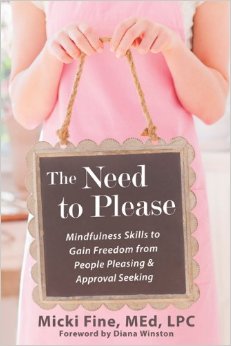
    Since I still struggle with this from time to time, I was eager to read Micki Fine’s book The Need to Please: Mindfulness Skills to Gain Freedom from People Pleasing and Approval Seeking.

    A certified mindfulness teacher, Micki Fine has written an insightful book that delves into the causes of people-pleasing, and offers tools to overcome it with non-judgment and self-compassion.

    If you’re tired of worrying about what people think of you, and beating yourself up when you fear you’ve lost their approval, The Need to Please could be life-changing for you.
    I’m grateful that Micki took the time to answer some questions about her book and people-pleasing, and that she’s offered two free copies to Tiny Buddha readers.

    The Need to Please

    The Giveaway

    To enter to win one of two free copies of The Need to Please:

    • Leave a comment below
    • For an extra entry, tweet: Enter the @tinybuddha giveaway to win a free copy of The Need to Please http://bit.ly/1CQUh66

    You can enter until midnight, PST, on Friday, July 24th. 

    The Interview

    1. Tell us a little bit about yourself and what inspired you to write this book.

    My childhood taught me in many ways to be a people pleaser, and I lived it unconsciously for a long time.

    In my mid-thirties a series of events helped me wake up a bit. As a result, I decided to follow my own path and went back to school to become a psychotherapist after being a CPA for many years. I also started meditating.

    In 1994, when I saw Jon Kabat-Zinn on the PBS series, Healing and the Mind, I had a deep sense of knowing that I wanted to teach mindfulness and eventually became a certified MBSR teacher.

    The idea for the book came during meditation. I ignored that idea for some time but at a certain point I simply had to pay attention.

    2. What causes some people to become people-pleasers and others to feel less dependent on external validation?

    When our parents reflect our goodness back to us appropriately and accept us as we are, we can grow to trust our own experience and feel worthwhile. The greater the love and acceptance, the less we feel the need to look outside ourselves.

    When love and acceptance is inadequately shown, our hearts are wounded. (We all share some level of this wounding.) Because of this treatment, we can grow up feeling insignificant, unworthy, and fearful and then look to others for the love and acceptance we didn’t get enough of as children.

    The experience of abuse, neglect, and abandonment are obvious indicators that we have not been treasured as children. Other experiences affect us too: having parents make all decisions for us as if we don’t matter, being told we need to be different than we are, and having love withheld if certain conditions are not met.

    3. How can mindfulness help us overcome the need to please?

    Mindfulness is the awareness that arises when you bring open-hearted, non-judgmental awareness to the present moment. Mindfulness helps you wake up to life.

    When you know you have only this moment to live, you might be moved to live life as if it matters. This helps you get off autopilot, like when you’re in the shower but thinking about someone’s opinion of you.

    If you decide to be present, you might catch your mind wandering to worry and intentionally decide to experience the pleasant sensations of the shower.

    Mindfulness can be practiced at any time, whether you set time aside from your daily activities to meditate or intentionally experience the present moment as it is.

    Through mindfulness practice we come home to ourselves after having our focus on others and what we think they want from us. We gain an intimacy with the body, our thoughts, and emotions instead of running away from ourselves.

    As we come to know ourselves better, mindfulness asks us to let go of judgment and allow things to be as they are, instead of struggling to make things different.

    This attitude helps us to relate to life and ourselves with kindness and compassion, making it possible to befriend our lives. We develop the capacity to relate to things in a radically different way: less reactivity and more lovingly.

    A wondrous thing that can happen through this allowing, kind-hearted, present-moment attention is that we come home to our inner loveliness through which we begin to trust ourselves instead of relying on others.

    Mindfulness and loving-kindness meditation can help us value ourselves after spending years thinking we are not okay. When we know our true nature of love we can truly feel at home.

    4. What do you think is the key difference between generosity and unhealthy self-sacrifice?

    I think a big difference is whether a caretaker behavior is motivated out of love or fear. Of course there can be a mix of motivations; our lives are complex. With mindfulness we can help discern more skillfully our feelings and motivations.

    I think it’s important to say that sometimes we do have to and want to make sacrifices for others. But, once again, is the behavior motivated out of love or fear?

    5. What are some of the most common people-pleasing behaviors, and how do these negatively impact our lives?

    The main behavior is doing whatever others want you to do even to the detriment of your well-being. In addition to the behavior, there is constant worry and hyper-vigilance to determine others’ imagined needs and what we should do.

    Another behavior is the inability to say no when you want or need to. A particularly sad behavior is not following your own path.

    The people pleasing cycle fuels feelings of anxiety, shame, and resentment. It is exhausting, as we focus almost completely outside ourselves, making it difficult to know our inner loveliness and wisdom, which in turn keeps us from valuing and trusting ourselves in order to act of our own volition. It is a self- perpetuating cycle.

    There are two important ideas here.

    One is that people pleasing is, at its core, an attempt to find love and to be free. To remind ourselves of that deep loving intention when we get caught up in people pleasing can help us to have compassion for ourselves and not be so self-critical.

    Another important thing is that our attempts to please others can never yield the experience of unconditional love precisely because our effort involves doing something to earn love. But since it is a self perpetuating cycle we keep trying in vain to earn love.

    6. I found the section on “the unspoken contract,” in Chapter 4, particularly eye-opening. Can you tell us a little about this and how people-pleasing creates an imbalance in relationships?

    One might think that being the partner on the receiving end of people pleasing would be great. You get everything done for you! However, the “unspoken contract” is that the receiver of all the caretaking is obliged to love the people pleaser unconditionally and never abandon him or her in return for all the caretaking.

    This is an impossible task because both partners have human hearts that are wounded and thus rarely capable of giving and receiving perfect love. Not only is this contract unspoken but it is unconscious and creates resentment, anger and disappointment for both partners due to the untenable expectations.

    7. In Chapter 6, there’s a heading that reads, “It’s not the thoughts that drive us crazy.” Can you expand on this?

    Two things come to mind. One is that a thought is simply an event in the mind (even the one that tells you it’s not). As we meditate we begin to find that thoughts simply come and go without our bidding and most of them are not true. The mind simply has a mind of its own. In other words, thoughts are not our fault.

    The other idea is that what we resist persists. We struggle with our thoughts, either trying to think “good” or “happy” thoughts or get rid of difficult thoughts. This can elicit a fair amount of discontent because the mind is like a two-year old who is having a tantrum.

    The harder you try to control the child having the tantrum, the more he or she kicks and screams.

    Taking our thoughts personally and struggling with them only serves to make the mind more agitated. So it is not the thought itself that makes us suffer, but how we relate to the thought.

    Through the active process of mindfulness, we practice kind, accepting observation of our thoughts so we can see thought as events in the mind that are not you.

    8. What’s one simple thing we can do to ground ourselves and get out of our head when we feel overwhelmed by people-pleasing thoughts?

    When you feel overwhelmed with thoughts, give yourself a chance to regroup by grounding your awareness in sensate experiences. Precisely notice your moment-to-moment physical experience.

    For example, if you’re taking a sip of water, notice your arm muscles moving as you reach for the glass, the feel of the glass as you touch it, the temperature of the glass on your lips, the feel of the water in your mouth, and the sensations of swallowing and the water flowing down your esophagus.

    Notice how you feel afterward. You may be more grounded and able to access a more independent perspective.

    9. In the chapter on befriending your emotions, you shared a helpful acronym, RAIN, from mindfulness teacher Michele McDonald. Can you share a little about this and how it can help us deal with difficult feelings?

    RAIN is a non-linear process of Recognizing, Allowing, Investigating, and Non-Identifying.

    To work skillfully with our emotions we first need to release ourselves from autopilot by taking a conscious breath and bringing awareness to the present-moment experience of the emotion.

    We recognize the emotion is present perhaps by silently saying “anxiety is here.” Allowing the emotion means that we let go of struggling with the emotion. Most of the time we try to make difficult emotions go away and hang on to the pleasant ones. Instead we cultivate a kind, friendly attitude toward the emotion.

    Then we investigate the emotion by dropping into the body to explore the sensations with compassionate curiosity. We non-identify when we remember that everyone suffers and that we are not alone. This can help us feel comforted because it helps us take the emotion less personally.

    Practiced together we can bring a friendlier attitude toward our emotions.

    It is important to practice RAIN with patience, kindness, and non-striving. For example, sometimes it is not possible to allow an emotion to be present, but we can allow the resistance. We need to be charitable with ourselves.

    10. What’s one thing we can do daily to develop self-compassion so we can give ourselves the approval we’ve so desperately sought from others?

    Offering ourselves compassion can be a beautiful thing. It can interrupt the harshness with which we treat ourselves and provide an opportunity to choose more wisely what comes next.

    For those of us experiencing people pleasing difficulties, it is important to do things that focus us inward, recognize perfectionism at work, and give kind understanding and compassion to our humanity.

    Here is one such practice. When you notice a people pleasing or other stressful moment, stop and take a breath. Then speak to yourself in a way that recognizes the moment as being difficult and also offers kind words toward you.

    Using a pet name that reminds you of your goodness can add a touch of kindness. Also, adding a physical gesture such has putting your hand on your heart or cheek can help foster gentleness.

    For example, with hand on heart, you could tell yourself “Dearest, this is really hard. How can I take care of you now?” My book has many suggestions about self-compassion.

    You can learn more about The Need to Please on Amazon here.

    FTC Disclosure: I receive complimentary books for reviews and interviews on tinybuddha.com, but I am not compensated for writing or obligated to write anything specific. I am an Amazon affiliate, meaning I earn a percentage of all books purchased through the links I provide on this site. 

  • We Are All the Same, So There’s No Reason to Hide

    We Are All the Same, So There’s No Reason to Hide

    Woman in a Mask

    “One of the most calming and powerful actions you can do to intervene in a stormy world is to stand up and show your soul. Struggling souls catch light from other souls who are fully lit and willing to show it.” ~Dr. Clarissa Pinkola Estés

    It’s taken a long time for me to be comfortable with being completely myself.

    Most people who meet me now see a strong and confident woman. Yet, underneath that confidence there is still a little girl in me that is scared. I’ve accepted that she is always going to be a part of me; however, I have learned to take responsibility for her care instead of giving that to other people.

    When I meet new people, I suspect either they are relieved to talk to someone who is transparent and real, or they are uncomfortable with my directness.

    I imagine it’s not always a matter of instant like or dislike on their end, but sometimes it feels that way to me. Either way, I’ve had to learn to not let others’ reactions influence how I show up in the world.

    I spent a good part of my life as a chameleon, changing myself to try to fit in and be accepted.

    Being the youngest of four in my family meant I was left out, teased, picked on, and blamed by my older siblings. As a result, I turned out to be a geeky kid in junior high and high school, lacking any confidence or sense of self-worth.

    I walked with a funny lurch, had a bit of a speech impediment, and tried so hard to be liked that I achieved the opposite. In high school the kids all called me a dog and barked when I walked down the hall. I was the brunt of the jokes for every classroom clown.

    The late 1970’s in the heart of Southeast Texas was not a good time or place for a pre-teen to question her sexual orientation. My science teacher, who had become a friend, no longer wanted me in her class when she suspected I had a crush on her.

    The vice-principal of the school said I was sicker than I thought I was and needed professional help.

    My chemistry teacher told the group of popular girls if they didn’t stop talking he was going to make Shannon sit with them.

    We all know kids are cruel, but in Bryan-College Station, meanness wasn’t limited to by age.

    I’d make out with boys in the hallways or back of the school bus trying to prove I wasn’t gay. I started seeing a psychologist. I put up with the cruelty of my teachers and students because there was nowhere to escape.

    If people look closely they can still see glimpses of the young girl who kept her head down and slumped her shoulders trying not to be seen. She is still with me today. Defeated without any outs, however, she had only one choice if she wanted to live. And that was to stand up for herself.

    Because it’s difficult for me to do this, I can sometimes come across kind of loud, directive, or bossy. Early on I learned to put on a good show and convinced myself that self-confidence is the key to success. Years of trying so hard not to care whether people liked me eventually integrated into a strong persona.

    Underneath it, however, still lived that little girl in me desperate for love and approval. For most my life she’s been in control. Like a puppet master, she’s pulled the strings behind my mask, seeking out someone or something to be her salvation. She was great at staying well hidden but in control.

    All she ever wanted was an end to her suffering. All her searching and orchestrating was always been about finding a way to stop the pain. She didn’t know the strings she pulled were putting me right back into the frying pan. How could she know that by latching onto other people she’d end up more hurt?

    It took a lot of personal development, self-help, spiritual woo woo reading, seminars, retreats, workshops, relationships, therapists, self-analysis, journaling, crying, screaming, pleading, praying, rationalizing, and running for me to finally understand: Latching onto anything will only bring more suffering.

    When we keep parts of ourselves locked away and behind a mask, we only give them more power and control.

    Finding my authentic voice has meant holding myself with compassion and learning to accept all of who I am.

    Letting go of my need to be perfect and my self-judgment isn’t something I’ve been able to do once and be done with. It’s something I have to do over and over again.

    I can let down my mask and be real because I believe at our core we are all the same.

    I believe we all want love and approval. I also believe that it is only by giving that to ourselves that we can give it to each other.

    Woman hiding behind mask image via Shutterstock

  • Saying Yes When We Mean No: How to Break the Habit

    Saying Yes When We Mean No: How to Break the Habit

    No

    “Half of the troubles of this life can be traced to saying yes too quickly and not saying no soon enough.” ~Josh Billings

    Have you ever encountered a situation where you found yourself agreeing to do something that you had no interest in actually doing?

    When we find ourselves saying yes when we mean no, we are essentially saying no to ourselves and giving our personal power away. The classic archetype of the People Pleaser.

    So why do we do it?

    I believe it is learned behavior. I have yet to see a toddler hold themselves back from the brink of a temper tantrum and tell themselves, “You know what, mum is really tired today. She doesn’t need another one of my meltdowns. The diaper aisle in Target is not the right place for this type of behavior.”

    It simply doesn’t happen. Children tend to express their emotions as they feel them, which is why they are generally such emotional-baggage-free zones. They typically express those emotions freely and with complete abandon, regardless of who’s looking at them.

    Throughout the course of our early life, when our mother, father, or parental figure approves of what we do, it feels good. Therefore, we learn to keep doing things that will meet their approval to keep feeling good.

    The problem is that every time we continue on this pleasing path, we are ultimately taking ourselves off our own path. We are closing down from what we want, focusing on what others want from us, and effectively handing them the reins to our lives.

    One analogy I like to make for this type of behavior is renting a car in a new city with a GPS device.

    You are entirely reliant on that device getting you to where you need to be. All well and good, but what if the device isn’t given the correct instructions or doesn’t take into account the new one-way system recently implemented in the city?

    When you relinquish control and hand your power over to someone or something outside yourself, you are cutting yourself off from you.

    But what if you also had a map of the new city and worked out your correct location and intended destination?

    You’d start to get a sense of where you are and a feel for the direction you need to be headed in.

    The GPS system is a shorter route to get there and a very useful aid, but in handing over your power completely, you are at the whims of the GPS and at risk of driving the wrong way down a one-way street.

    I learned from an early age that life would be simpler if I just did what I was told. In turn, people started to expect that nice behavior from me. But what about the situations where I wasn’t feeling like being nice? What if being nice felt the polar opposite of the emotion that I wanted to express?

    By choosing people pleasing behavior, I was giving everyone else what they wanted and in turn, denying myself.

    I was stuffing down my emotions and instead, learning to say what was expected of me. After a while, this behavior starts to feel normal and you no longer even question why you behave a certain way; it becomes ingrained, a habit.

    So how do we break the habit?

    The first step is simply awareness.

    Notice when you start to engage in people pleasing behavior.

    There is no need to beat yourself up when you notice this. You are essentially starting to retrain the neural pathways in your brain. It may take some time. Go easy on yourself and be forgiving. But don’t stop paying attention.

    By becoming aware, we can no longer stay in denial about our behavior; we know exactly what we are doing.

    The next step is to ask, “Why am I doing this?”

    Once we are aware of our behavior, we can start to question it. One of my people pleasing habits is just to give the other person what they want so I don’t have to feel any emotional discomfort. This is called avoidance.

    For example, a friend invites me to dinner and asks if we could go to a fondue restaurant she loves. I hate fondue. The idea of soaking pieces of bread into a vat of swirling melted cheese makes me feel slightly nauseous.

    Yet, instead of just telling my friend this, I hear myself saying, “Sure, sounds great.” Fast-forward a few days and there I am, stuffing melted cheese into my mouth and plastering a grin over my face to try and conceal my disgust.

    I asked myself, why am I doing this? The answer was clear. I would rather put myself through a few hours of discomfort and line my intestines with a cheese glaze rather than tell my friend I wasn’t into it.

    As I looked back on this experience I realized that the only person suffering in that experience was me. I willingly put myself into a situation I didn’t want to be in rather than being honest.

    After becoming aware of our behavior and figuring out why we’re doing it, we can then address the problem.

    The last step is to set emotional boundaries.

    Setting new boundaries with the people you love is never easy, and it takes time. The key is to take a deep breath and step back when you find yourself entering the people-pleasing zone.

    Saying “I’m not sure yet, can I get back to you?” is a step in the right direction. This gives you time to think the issue through so you don’t feel pressured into making a decision.

    Ask yourself what you want, not what the other person wants from you.

    If you don’t want to do what is being asked of you, it’s okay. You can be loving and kind about it but remain firm.

    Creating boundaries provides an emotional comfort zone for yourself. When we are clear on what we will and wont accept, people respect us for it.

    At the end of the day, we all want to be loved and accepted by those closest to us. But it’s important to know that loving someone doesn’t mean doing everything in your power to please them. This is called being a doormat.

    By shifting focus and starting to love yourself first, you learn to step into your authentic self and conduct your relationships from a place of equal footing.

    We begin to reaffirm to ourselves that we have the right to live our lives on our own terms.

    Stand tall in your own skin and be who you are meant to be, not what somebody else expects you to be.

    No blackboard image via Shutterstock

  • 5 Beliefs About Happiness That Make Us Unhappy

    5 Beliefs About Happiness That Make Us Unhappy

    “There is only one cause of unhappiness: the false beliefs you have in your head, beliefs so widespread, so commonly held, that it never occurs to you to question them.” ~Anthony de Mello

    Do you believe in soul mates?

    I did. I also believed that the only way to be blissfully happy was to be with mine.

    At a New Year party, I finally found her. As we chatted and danced through the evening, we fell in love. It seemed perfect.

    Life, however, had other plans. Soon after, she moved to another city. I never saw her again but continued to be in love with her for the next four years.

    Why? Because I was consumed by the belief that she was my soul mate, and that fate would bring us back together someday.

    It’s strange, isn’t it? How each of us have our own beliefs about the “secret to happiness.” We live our lives in accordance with those beliefs, rarely questioning them.

    Over those four years, my belief that I could never be happy with anyone else held me back from finding love and happiness elsewhere.

    But I was so wrong. I did meet someone else later and have been gleefully together with her for ten years now!

    We define our reality by what we believe.

    Our beliefs make us who we are and determine the choices we make. Very often, those beliefs, far from leading us into happiness, bring us truckloads of pain and trouble.

    The good news? We can be far happier and contented simply by altering our beliefs and looking at the world differently.

    Here are five beliefs about happiness that actually make us unhappy:

    Belief 1: I need other people’s approval to be happy.

    Do you often do things only to please other people?

    Human beings are driven by “social proof.” Approval is extremely important to us.

    We wait to buy the latest gadgets to look cool. We attend boring office parties to fit in. We don’t pursue our dreams because our families don’t approve.

    But just ask yourself: Are these actions (or inactions) bringing you any real happiness?

    The pursuit of approval is very different from the pursuit of happiness. Let’s not fail to distinguish between the two.

    Belief 2: I will be happy when I have…

    …a bigger house, a promotion, a baby, awards, respect, those designer shoes!

    Dr. Tal Ben-Shahar calls this the “arrival fallacy” in his book Happier. It’s the belief that when you arrive at a certain destination (or attain a specific goal), you will be happy.

    The reason why this belief is so strong is because it’s partly true. Yes, you will feel happy when you get promoted or buy a house.

    The question is: Is this happiness lasting?

    While you will escape your landlord’s ranting, you will have to pay new taxes and spend good money maintaining your new house.

    Each level of accomplishment will bring its own set of problems.

    Does this mean you stop working toward your goals? No! Goals are important, and one needs to be ambitious.

    However, think about this: You can be happy now and also when you get the promotion.

    Do you really need to postpose your happiness?

    Belief 3: I can’t be happy unless everything goes right.

    Have you ever lost your luggage on a vacation? It upsets everything, doesn’t it?

    Instead of enjoying the charms of a wonderful new city (or countryside), you’re running around buying clothes and other stuff, wondering if the airline will ever return your luggage.

    That’s what happened on a vacation with my family.

    Strangely, now when we think about that vacation, the trouble we faced because of the lost luggage doesn’t bother us. We just talk about the wonderful time we had.

    The vacation didn’t have to be perfect. The only thing that really mattered to us was that we had an opportunity to have a great time together.

    Think about it: are vacations, parties, dates, or any other special occasions ever perfect? If something goes wrong does that mean the entire trip or evening is a failure?

    Yes, it is a failure, but only if you believe so.

    Let’s extend the discussion further: Is anything in life ever perfect? We have ups and downs every day.

    Life is imperfect—perhaps that’s what make it more interesting!

    Belief 4: I can’t be happy because of what’s happened in the past.

    The past controls us in mysterious ways.

    You might have lost a loved one to misunderstanding or death. You might have failed to achieve your dreams. As a result, you may have developed one of these beliefs: “I am not meant to find happiness” or “It’s not my destiny to be happy.”

    Personally, I haven’t lost much in life, but I know someone who has. I used to wonder how she could enjoy life despite such tragedies, until she revealed her simple secret…

    She believes that she has the right to be happy, despite her past misfortunes.

    Your past doesn’t control your future unless you let it. Millions have turned their lives around. If they can be happy, why can’t you?

    Belief 5: Happiness is not a habit that can be learned.

    Can you actually learn to be happy? Like learning baseball or the guitar?

    Yes. Happiness is a skill—one that you build through a number of daily choices.

    Numerous studies have indicated that people who are happier have certain habits: they exercise, meditate, pay attention to their relationships, pursue their goals diligently, lead balanced lives, are grateful.

    Research shows that by thwarting negative emotions, such as pessimism, resentment, and anger, and fostering positive emotions, such as empathy, serenity, and gratitude, the brain can be trained to become happier.

    Happiness does not depend on fate; it depends on our habits—habits that anyone can learn.

    ____

    Our beliefs can bring us happiness or sorrow.

    Question your beliefs about yourself, your life, and happiness from time to time. See if they still serve a positive purpose. If not, change them.

    What beliefs do you think you need to change to be happier?

  • Overcoming Approval Addiction: Stop Worrying About What People Think

    Overcoming Approval Addiction: Stop Worrying About What People Think

    “What other people think of me is none of my business.” ~Wayne Dyer

    Do you ever worry about what people think about you?

    Have you ever felt rejected and gotten defensive if someone criticized something you did?

    Are there times where you hold back on doing something you know would benefit yourself and even others because you’re scared about how some people may react?

    If so, consider yourself normal. The desire for connection and to fit in is one of the six basic human needs, according to the research of Tony Robbins and Cloe Madanes. Psychologically, to be rejected by “the tribe” represents a threat to your survival.

    This begs the question: If wanting people’s approval is natural and healthy, is it always a good thing?

    Imagine for a moment what life would be like if you didn’t care about other people’s opinions. Would you be self-centered and egotistical, or would you be set free to live a life fulfilling your true purpose without being held back by a fear of rejection?

    For my entire life I’ve wrestled with caring about other people’s opinions.

    I thought this made me selfless and considerate. While caring about the opinion of others helped me put myself into other people’s shoes, I discovered that my desire, or more specifically my attachment to wanting approval, had the potential to be one of my most selfish and destructive qualities.

    Why Approval Addiction Makes Everyone Miserable

    If wanting the approval of others is a natural desire, how can it be a problem? The problem is that, like any drug, the high you get from getting approval eventually wears off. If having the approval of others is the only way you know how to feel happy, then you’re going to be miserable until you get your next “fix.”

    What this means is that simply wanting approval isn’t the problem. The real issue is being too attached to getting approval from others as the only way to feel fulfilled. To put it simply, addiction to approval puts your happiness under the control of others.

    Because their happiness depends on others, approval addicts can be the most easily manipulated. I often see this with unhealthy or even abusive relationships. All an abuser has to do is threaten to make the approval addict feel rejected or like they’re being selfish, and they’ll stay under the abuser’s spell.

    Approval addiction leads to a lack of boundaries and ultimately resentment. Many times I felt resentment toward others because they crossed my boundaries, and yet I would remain silent. I didn’t want to come across as rude for speaking up about how someone upset me.

    The problem is this would lead to pent up resentment over time, because there’s a constant feeling that people should just “know better.” When I took an honest look at the situation, though, I had to consider whose fault it was if resentment built up because my boundaries were crossed.

    Is it the fault of the person who unknowingly crossed those boundaries, or the person who failed to enforce boundaries out of fear of rejection?

    Looking at my own life, I actually appreciate when someone I care about lets me know I’ve gone too far. It gives me a chance to make things right. If I don’t let others know how they’ve hurt me because of fear of rejection, aren’t I actually robbing them of the opportunity to seek my forgiveness and do better?

    This leads me to my final point, approval addiction leads to being selfish. The deception is that the selfishness is often disguised and justified as selflessness.

    As a writer, I’m exposed to critics. If I don’t overcome a desire for wanting approval from everyone, then their opinions can stop me from sharing something incredibly helpful with those who’d benefit from my work.

    Approval addiction is a surefire way to rob the world of your gifts. How selfish is it to withhold what I have to offer to others all because I’m thinking too much about what some people may think of me?

    As strange as it sounds, doing things for others can be selfish. On an airplane, they say to put the oxygen mask on yourself before putting it on a child. This is because if the adult passes out trying to help the child, both are in trouble.

    In much the same way, approval addiction can lead a person to martyr themselves to the point that everyone involved suffers.

    For instance, if a person spends so much time helping others that they neglect their own health, then in the long run, it may be everyone else who has to take care of them when they get sick, causing an unnecessary burden.

    Selfless acts, done at the expense of one’s greater priorities, can be just as egotistical and destructive as selfish acts.

    How to Overcome Approval Addiction

    The first way to overcome approval addiction is to be gentle with yourself. Wanting to feel connected with others is normal. It’s only an issue when it’s imbalanced with other priorities like having boundaries.

    What approval addicts are often missing is self-approval. We all have an inner critic that says things like, “You’re not good enough. You’re nothing compared to these people around you. If you give yourself approval, you’re being selfish.”

    You can’t get rid of this voice. What you can do is choose whether or not to buy into it or something greater.

    You also have a part of yourself that says, “You’re worthy. You’re good enough. You’re just as valuable as anyone else.” The question becomes: “Which voice do I choose to align to?”

    This often means asking yourself questions like, “Can I give myself some approval right now? What is something I appreciate about myself?” The next step is to then be willing to actually allow yourself to receive that approval.

    To break approval addiction, remember to treat yourself the way you want others to treat you.

    In much the same way, you can overcome approval addiction by equally valuing other important things, such as your need for significance and control. While wanting to control things can be taken too far just like wanting approval, it is the Yang to approval-seeking’s Yin. Both are necessary for balance.

    Questions that typically help me are: “Do I want other people’s opinions to have power over me? Would I rather let this person control me or maintain control over my own life?”

    Finally, there is the ultimate key to overcoming approval addiction. It’s by using the greatest motivator— unconditional love.

    Worrying about what other people think masquerades as love. In reality, when you really love someone, you’re willing to have their disapproval.

    Imagine a parent with a child. If the parent is too concerned about the child’s opinion of them, they might not discipline their child for fear of the child disliking them. Have you ever seen a parent who lets their child get away with anything because they don’t want to be the “bad guy?” Is this truly loving?

    To break approval addiction, I realized I had to ask one of the most challenging questions anyone could ask themselves: Am I willing to love this person enough to have them hate me?

    If you really care for someone, telling them, “You’re screwing up your life” and having them feel the pain of that statement might be the most loving thing you can do.

    This comes with the very real possibility they will reject you for pointing out the truth. However, if you love someone, wouldn’t you rather have them go through a little short-term pain in order to save them a lot of pain down the road?

    On the upside, many people will eventually come to appreciate you more in the long term if you’re willing to be honest with them and prioritize your love for them over your desire for their approval.

    If you have to share a harsh truth, a mentor, Andy Benjamin, taught me that you can make this easier by first asking, “Can I be a true friend?” to let them know what you’re about to say is coming from a place of love.

    I’ve found that everything, including the desire for approval, can serve or enslave you depending on how you respond to it.

    Do you use your desire for approval as a force to help you see things from other people’s perspective, or do you use it as a crutch on which you base your happiness?

    Do you use your desire for approval as a reminder to give yourself approval, or do you use it as an excuse to be miserable when others don’t give you approval?

    Finally, are you willing show the ultimate demonstration of genuine love—sacrificing your desire for approval in order to serve another?

  • Do You Think You Need to Be Perfect to Be Accepted?

    Do You Think You Need to Be Perfect to Be Accepted?

    Hiding Behind Hood

    “What you resist, persists.” ~C.G. Jung

    There it is: Perfection, Eureka!—the holy grail of achievement, like an elusive mirage in the middle of a desert or that pesky little pot of gold we are always hunting for at the end of the rainbow, purring with all of its possibilities, protection, and promise.

    Yet, despite its charm and the value we tend to assign to the trait, as well as on those who possess it, perfectionism ultimately leads to the same destination. In striving for perfection, we may soon find ourselves disappointed, dissatisfied, and even sometimes, knee-deep in suffering and denial, like I did.

    What does it really mean to be perfect? To do things perfectly? To be a perfectionist?

    For me, perfectionism is best described as a constant striving—the sense that you or the circumstances in your life are unacceptable as they are. This also goes far beyond a healthy desire for excellence or improvement.

    The chance to do more and to be more consumed me. And ultimately, the chance to become the living, breathing, endlessly disciplined and carefully retouched image of my actual self was just too tantalizing.

    It seemed to offer me the ability to control the circumstances as well as the people around me, shaping them all and living life according to my own terms and conditions.

    We are often taught that along with perfectionism, and its corresponding high level of accomplishment, comes an automatic sense of admiration, security, certainty, and predictability—all acting as some sort of insurance or safeguard against the painful, frustrating, and seemingly unavoidable irritations and nuances of our day-to-day lives. 

    What I realize now is this: I longed to be admired by all, yet truly seen and known by none. For me, perfectionism became a way to mask all those less-than perfect, too different or undesirable aspects of my self.

    Growing up, I felt fundamentally different from my peers, which at the time, translated to feeling inferior and never quite fitting or blending in. I had decided I stood out like a sore thumb.

    Being biracial and heavily influenced by my Peruvian culture growing up, I remember longing to fit in or to be more like those around me—to watch American television shows, to listen to American music and radio in the car, and to eat American food every night for dinner.

    At school, I desperately hoped to fit in and be accepted, but despite my best efforts, oftentimes, I felt like I was on the outside looking in.

    I did not understand then that what made me different actually gave me insight, depth, openness, compassion, and the ability to empathize with others.

    I longed to push my differences deep down, far enough that I could just about convince myself that they had actually vanished, and that I was victorious.

    Later on, my obsession with perfectionism and its illusion of control took up most of my time, consumed my mind, yet left me riddled with feelings of anxiety, depression, unworthiness, shame, guilt, and several increasingly unbalanced and unhealthy relationships in its wake.

    It was never enough. The harder I tried, the more I felt sure I was failing, and the pain inside grew stronger. I came to better hide my true self, feeling ashamed of the parts that did not measure up.

    I had already decided I was unworthy, because I was simply too bossy, too sensitive, too shy, too fearful, too quiet, too reactive, too emotional, too unfocused, too messy, too raw, and entirely too quirky. I was too imperfect as I was.

    In being so judgmental of myself, it is no wonder that this critical perspective began to spread and apply to everything and everyone around me.

    Once I am perfect, or closer to perfect, we find ourselves thinking, I will finally be that much closer to being able to truly and wholly accept and love myself. At last, I thought, I can be safe, decidedly removed from all judgment and ridicule—no longer vulnerable or ashamed.

    I was no longer forced to see and accept things as they were—the good and the bad, all braided together into one and, always already beyond the span of my control.

    The incessant worrying, people pleasing, and the constant search for external validation through the approval of others all culminated in the implosion of a four-year romantic relationship that I had been doing just about everything in my power and beyond to maintain—even at the expense of my overall well being.

    This was my misguided attempt to ensure everything appeared seamlessly and seemingly picture perfect for everyone around me.

    Nights spent crying and mornings where I could not bring myself to get out of bed, I knew I was drained and broken down. I could not keep pushing forward and denying myself, and I could no longer disguise or deny the chaos lurking only inches below the perfectly polished façade.

    I had been denying my true self, my needs, my wants, and my feelings to the point where they became unintelligible to me. In fact, I am still working to decode, understand, and listen to them.

    But I do know this much: What I was craving more than anything was to be seen and accepted for who I was—without all that extra effort and perfectionism piled on top.

    I wanted to belong, to be desired, and to be loved for who I am already. And I was looking for that stamp of approval outside of myself and from others.

    When I looked around me, all I could see were my unrealistically high expectations mirrored back at me. The seeds of expectation and subsequent suffering had now firmly taken root.

    With reality on one side and my demands and expectations on the other, I found myself bridging the chasm, clinging to both sides, exhausted, and using nearly every last bit of energy in my reserve to unsuccessfully close the gap between expectation and reality.

    The solution: complete and total acceptance of what is—of your present set of circumstances: self, feelings, wants, and needs, for better or for worse.

    Here is the key: you don’t have to be happy with or even have chosen your present set of circumstances in order to acknowledge them or to simply see them as they are in their unfiltered state.

    Not you, nor your circumstances, nor the people in your life need to be perfect (or even any different than they are at this exact moment) in order for you to accept them.

    You can accept uncertainty, and you can accept that sometimes, temporarily, you may not be feeling happy, and you might even be feeling pain inside. Allow it. Feel it. Listen to it.

    The reason this is possible is because everything changes—all circumstances and feelings are constantly rearranging, changing, and forever in flux. Nothing is truly permanent, fixed, or secure. And perfectionism does nothing to change that.

    To accept means to see and to acknowledge what is—with brutal and unflinching honesty. It means seeing without resistance and reserving the desire to control or to change what you see. No more hiding from or resisting reality.

    Fortunately, this is the foundation for genuine and enduring self-love, self-compassion, and being truly grounded and in touch with your true self. This in turn, becomes the most natural way of authentically being able share boundless and replenishing love and compassion with others.

    Hiding man image via Shutterstock

  • We Don’t Need to Change to Please Other People

    We Don’t Need to Change to Please Other People

    “One of the most freeing things we learn in life is that we don’t have to like everyone, everyone doesn’t have to like us, and it’s perfectly OK.” ~Unknown

    I am thankful from the bottom of my heart to that relative who dislikes me.

    As Mother Teresa famously said, “Some people come in our life as blessings. Some come in your life as lessons.”

    She came in my life as a lesson. The more she dislikes me, the more I love myself and appreciate those who love me.

    This carefree attitude didn’t come overnight. I had to go through a tough phase first. Each day I felt bad about myself, cried a lot, and blamed myself for this messy relationship, and for failing to save it.

    “There are hundreds of people who like me for who I am, so why doesn’t she like me?” I asked myself several times.

    I practiced being who I thought she wanted me to be. Still, despite giving my best to that relationship she always criticized me, and I never received a single word of appreciation. I allowed myself to take it because I thought that one day she’d realize her mistake and start liking me. “One day” never came.

    The day she used disrespectful words while talking to me, I decided not to let her drain my energy anymore.

    During this phase of my life, I lost connections with all my friends and relatives because I was so unhappy with myself that I didn’t feel like engaging with anyone.

    Thankfully, some relationships are beyond formalities. Even if you don’t make the effort to connect with them, they are always there for you to love you, support you in your tough times, and bring you back on track. I call them soul-to-soul connections, and I am lucky to have those people in my life.

    Sometimes it becomes important to see yourself through the eyes of people who truly like you and accept you wholeheartedly.

    I shifted my attention to them and started analyzing why they like me. I even made a list of things people like about me.

    I desperately wanted to be that person again who was known for her smile, warmth, and jovial nature. I didn’t want to spend the rest of my life feeling upset and bad about myself.

    Being a psychology graduate, it’s my hobby to study and analyze others’ behavior. I couldn’t resist doing that with the person who dislikes me. I noticed that she has a habit of complaining about everything in her life. And everything has to be her way.

    Everyone in her family conformed to her way of doing things because they wanted to please her. Since I never did that, I couldn’t fit in her idea of a perfect relationship.

    It reminds me of something my boss once said: “Don’t make your problem my problem.”

    I realized that it wasn’t me; it was her insecurities.

    She wanted to maintain her authoritative style of leading the family. She thought that if I did not follow her, she would lose her importance. That’s why she wanted me to change my lifestyle.

    She expected everyone to follow her ideologies and prioritize things she wanted. She compared me with those who always followed her and never questioned her way of doing things. And she started disliking me just because my lifestyle, priorities and ideologies were different from hers.

    It was wrong on my part to expect that everyone should like me. It’s human nature to want people to like us, but it’s not healthy to dwell if they don’t.

    I learned from this bitter experience that you cannot force anyone to like you, but you can like yourself for who you are. How others will perceive you is none of your business. As long as you are happy and satisfied with yourself, you are good to go.

    Change yourself if you have a good reason, but not to please anyone else.

    Another important lesson I learned that if someone is not happy with herself and her life, no one can make her happy. As Marcus Aurelius correctly said, “The happiness of your life depends upon the quality of your thoughts.”

    I learned my lesson and decided to move on. My life started rocking again. I started connecting with my old friends, family, and made new friends.

    The moment I changed my actions and started doing things that make me happy I noticed a ripple effect. I became the same old person, laughing, giggling, and enjoying life to the fullest. The same can happen for you if you stop focusing on others and start focusing on yourself.

  • How to Stop Saying Yes When You Want to Say No

    How to Stop Saying Yes When You Want to Say No

    “Live your life for you not for anyone else. Don’t let the fear of being judged, rejected or disliked stop you from being yourself” ~Sonya Parker

    I am a sucker for saying yes.

    Sometimes I even find myself thinking, “No, no, no, no” and then I blurt out, “Yes.”

    Why is it so difficult to say the word “no”? It’s just a word, right?

    After feeling trapped for some time by my excessive urge to be agreeable, it got me thinking.

    I asked myself why it was so important for me to please everyone, to the point that I would feel resentful and stressed because of it.

    I realized I was afraid of saying no because my biggest fear is rejection. I was afraid that every time I did this, I would disappoint someone, make them angry, hurt their feelings, or appear unkind or rude.

    Having people think negatively of me is the ultimate rejection. Whether they say what they think of me, out loud or not, does not matter to me. It is the thought that they look down on me.

    And so I realized exactly why I found it so difficult to say no.

    I realize this is not just a challenge that I face but one that many people go through every day. It’s a heavy burden to carry because with the urge to say yes also comes a lack of self-confidence and self-value.

    If, like me, you’re having trouble saying no, this may help.

    Saying No Doesn’t Mean You’re a Bad Person

    Saying no doesn’t mean that you are being rude, selfish, or unkind. These are all unhelpful beliefs that make it hard to say no.

    Learning where these beliefs have come from is a great way to learn to let go of them.

    Did you ever wonder why it was so easy to say no when you were a little kid and why it has become so difficult now? What happened?

    Well, as children, we learned that saying no was impolite or inappropriate.

    If you said no to your mom, dad, teacher, uncle, grandparents, and so on, you were most certainly considered to be being rude, and you would have probably been told off for it.

    Saying no was off limits, and yes was the polite and likable thing to say.

    Now that we are all adults, we are more mature and capable of making our own choices, as well as knowing the difference between wrong and right. Therefore, no shouldn’t be an off-limits word but rather something that we decide on ourselves, based on our own discretion.

    But sadly, we hold onto our childhood beliefs, and we continue to associate no with being dislikeable, bad-mannered, unkind, or selfish. We worry that if we say no, we will feel humiliated, guilty, or ashamed and will end up being alone, rejected, or abandoned.

    Knowing Your Value

    The second step to learning to say no is realizing that you are valuable and choosing your own opinion about yourself over others.

    I have learned that if you live your life depending on other people’s approval, you will never feel free and truly happy.

    If you depend on other people’s approval, what you are basically saying is, “Their opinion of me is more important than my opinion about myself.”

    If your opinion of yourself is actually quite low, remember that:

    • Your problems do not define you.
    • It’s okay to make mistakes—nobody is perfect, and everybody does things that they regret; this is what makes us human.
    • What makes a person great is not their looks or achievements, but their willingness to love others, be humble, and grow as a person.
    • You are unique, valuable, and important. No one else in this world can offer what you can.

    Is It Really Worth It?

    The third step to learning to say no is deciding if saying yes is really worth it.

    After committing to something, doubt eventually sets in, and you may begin to think of ways you can get out of it.

    And if you don’t have any good excuses, you then have to decide if you are going to tell the truth or come up with a lie.

    Think about the anguish, stress, and resentment that saying yes has caused you. Wouldn’t it be so much easier and straightforward to just say no in the first place?

    I remember this one time that I said yes to something and then later felt so bad about it that I ended up lying my way out of it. I still feel bad that I lied.

    My boss called me one day and asked if I could work the following Saturday. As usual, I blurted out a polite “Yes, of course, that’s no problem at all.” I actually had plans with my boyfriend, which I was really looking forward to.

    Later, I found myself feeling absolutely terrible about having said yes, and I wished that I had just had the guts to say no from the beginning.

    Dreading the idea of having to work that day, I called my boss back with the best excuse I could think of. I told her that I had completely forgotten that it was my dad’s birthday that Saturday and that we had a family get-together (which was certainly not the case).

    Looking back, I realize that it really isn’t worth it to say yes when you don’t want to. I have a right to say no and shouldn’t be afraid of letting other people down at the cost of my own happiness.

    If you have also decided that it’s worth it to you and want to learn to say no, try these simple yet effective tips for doing so with confidence.

    Helpful Tips for Saying No

    • Be direct, such as “no, I can’t” or “no, I don’t want to.”
    • Don’t apologize and give all sorts of reasons.
    • Don’t lie. Lying will most likely lead to guilt—and remember, this is what you are trying to avoid feeling.
    • Remember that it is better to say no now than be resentful later.
    • Be polite, for example, saying, “Thanks for asking.”
    • Practice saying no. Imagine a scenario and then practice saying no either by yourself or with a friend. This will get you feeling a lot more comfortable with saying no.
    • Don’t say, “I’ll think about it” if you don’t want to do it. This will just prolong the situation and make you feel even more stressed.
    • Remember that your self-worth does not depend on how much you do for other people.

    Learning to say no has been one of the best things I have done for myself. Not only has it challenged me to overcome my fear of rejection, it has helped me feel in control.

    I don’t feel trapped, resentful, or guilty anymore. Instead, I feel empowered and free.

    If you want that same feeling of freedom and empowerment, then take control, challenge yourself, and learn to say no.

  • The Key to Happiness: Accept Yourself & Stop Seeking Approval

    The Key to Happiness: Accept Yourself & Stop Seeking Approval

    Happy Woman with Dandelions

    “Acceptance is not submission; it is acknowledgment of the facts of a situation, then deciding what you’re going to do about it.” ~Kathleen Casey Thiesen

    I think many of us get caught in a vicious cycle of thinking that leads us to believe we can only be happy if we gain acceptance from others. We think to ourselves, “The only way I can ever love myself is if others do.”

    This leads us down a path of self-deprecation and hopelessness. We end up making decisions purely for the sake of gaining approval and acceptance, when really we should make decisions that reflect our authentic self and life goals and aspirations.

    This was me just one short year ago. I was in school full time and I was working so hard that I was pushing myself to the brink of destruction.

    I’m a cancer survivor, and since I got sick at fourteen, my health has never quite been the same.

    I pushed and pushed through school because it made others happy. I ignored the important task of taking care of my mind, body, and spirit because I felt that there was no time in my life for any of these things.

    Acceptance and love from others was paramount in my mind, and love and acceptance from myself took a back seat. However, this sort of thinking is a slippery slope. Eventually, I got the wake up call I needed.

    When I was seventeen I developed a chronic and relentless case of insomnia and was prescribed Xanax. I was severely physically dependent on this medication until I was twenty-one. It distorted the way I perceived the world in ways I am only just now beginning to understand.

    When I turned twenty-one in September, I finally could see the forest for the trees and saw that my life was falling apart.

    I sought treatment for my substance abuse issues and suddenly I began to experience moments of clarity that helped me understand what I had been doing wrong for so many years.

    Ever since my cancer treatments I have been chronically ill. It has made walking a traditional path in life very difficult. But I never really wanted to walk a traditional path; I only did so because I was caught in the trap of seeking approval from others.

    I spent many years having a pity party for myself and wondering why I was such a good person who had to endure such a bad thing. I spent thousands of dollars on medical treatments hoping that I could one day be the person I was before I got sick.

    This led to a deep depression when I was at the crux of much of my substance abuse issues. It wasn’t until I went to treatment that I realized that accepting my situation didn’t mean I was giving up; it meant I was granting myself the right to have some peace in my life.

    I finally surrendered to the fact that there were aspects of my life I just couldn’t change, and trying would only further the insanity. I finally realized it was time to move on.

    So, once again, I need to stress that accepting your situation does not have to mean you become complacent. In fact, for me, it was quite the opposite.

    For the first time I met myself where I was and loved and nurtured myself in a way I never had known how to before.

    Stemming from this self-love and acceptance something magical happened. For the first time I stopped looking at myself as a broken, sick person with no future, and I saw positivity, power, and abundance in my life.

    I started focusing on what I would like to cultivate in my life and what sort of path I could walk given my circumstances. I started making lists of things that I had wanted to do but had put off because I believed I would never be well enough.

    As my confidence grew, I started to envision a positive and wonderful future for myself. I had always wanted to move to Berkeley ever since I was sixteen, and so I set out to do that. I had always wanted to sell on eBay but was too fearful of failure to try it.

    For the first time I decided to take a risk and so I started to do that too. I had wanted to take a break from school and so I granted myself permission to do that as well. The end result? I now have a successful eBay store and just moved into a cute little apartment in Berkeley.

    I took some time off from school to gain clarity and will be returning next semester. However, I will only go at the pace that is reasonable for me, and I will no longer compare my path to the path of others or do things a certain way purely for approval and acceptance.

    I will do what I can while still leaving plenty of time to care for myself in this deep and powerful way that has led me to my current situation. These are the kinds of changes that you can make in just a few short months, and all you need is a little self-love and self-acceptance.

    So what have I learned this year that perhaps can be helpful to you? First and foremost, I have learned that we should never compare our path to the path of others. Our focus should be on walking the path that is the most reasonable for us while still having time to genuinely love and take care of ourselves.

    Further, I learned that sometimes the biggest risks in life reap the greatest rewards.

    Lastly, I have learned that cultivating a deep sense of happiness and well-being from within will ultimately provide us with the strength to manifest what we want in our lives.

    When you focus on the internal, rather than trying to directly influence the external aspects of your life, inevitably the external aspects of your life also change for the better. It all starts with you.

    Girl with dandelions image via Shutterstock

  • Doing What’s Best for Us Even If Other People Don’t Like It

    Doing What’s Best for Us Even If Other People Don’t Like It

    “What other people think of me is none of my business.” ~Wayne Dyer

    I got the call late one Sunday afternoon while sitting at work. “Babe, your toilet tub and shower are backed up.” What?

    “It’s bad babe, and getting worse.” Okay, I thought, I’ll call my landlord.

    “Hello, this is so and so and you’ve got my voicemail. Please leave me a message and I’ll call you back as soon as I can.”

    Damn. Answering machine. Message left.

    Text message time. Left that one too.

    I wrapped up work and raced home. Yuck. It was bad. And like my partner mentioned, getting worse by the second.

    Another call to my landlord gave me another voicemail. Another text followed this time by an email. Still nothing.

    “Babe, you should call a plumber.” My landlord doesn’t like the idea of me calling a plumber on my own. I know this from past experiences.

    “But babe, she’s not returning your texts or calls.” Good point. And it was getting worse. For all I knew my landlord was on a plane heading to Europe.

    Plumber found. One last text to my landlord before I called, saying if I didn’t hear back from her that I was going to call a plumber on my own. Fifteen minutes later I made the call. Anxiety rising.

    Plumber said they would be there in thirty minutes. Ten minutes later my landlord called. No exaggeration to what I’m about to quote.

    “You’re threatening me!?” I wasn’t threatening you. “You call and text and call and text and threaten me!?” I didn’t threaten you.

    “I’m at a Christmas party and I have to deal with this!?” I was shaking. Like a scared little kid getting yelled at by an angry parent.

    “Maybe you should find a new place to live!” I couldn’t even get a word in. “If that plumber comes out that’s on your dime, not mine! It’s probably not even that bad.”

    The plumber showed up. Said it was that bad. That it was a health safety hazard and he couldn’t leave me like that, even after I told him about my landlord, who by the way showed up ten minutes later. Still pissed and blaming me for interrupting her evening.

    “I’ll have someone out in the morning,” she said in a not so nice tone.

    Someone did come. Problem was fixed. Life went on. Comfortably uncomfortable.

    Earth to Zachary. Come in Zachary. This is your wake up call.

    Do you copy? Zachary, do you copy? It’s time to move out of your apartment!

    You don’t deserve to be treated like this! Deep sigh. I copy. I think.

    My girlfriend asked why I didn’t end the phone conversation while the landlord was yelling at me. She said most people wouldn’t let someone speak to them like that.

    I’m not like most people. In fact, for the better part of my adult life I’ve stayed in and returned to painful relationships.

    Four months later and I’m still here. Still comfortably uncomfortable. A prisoner in my own apartment. The apartment I pay for on time each and every month.

    I’m a good tenant. Probably too good, as I allow myself to get pushed around. Almost like I’m bullied.

    Instead of my milk money, I’m giving the bully my rent money. Same thing. Different age.

    Where’s my voice? It’s time for me to stand up for myself. To show up as a man.

    See, I’m always afraid of how the other person is going to react, in this case, my landlord. I can see clearly how fear reverts me to a child like state, afraid of the angry parent. It paralyzes me.

    I have to remind the precious inner child that he did nothing wrong. That he wont get spanked for being a bad kid.

    Okay. Moment of truth. I’m about to send an email finally giving them my thirty-day notice.

    Check in time.

    My body has a surge of adrenaline racing through it. My fingers are almost shaking while I type. Heart beating quickly. Head feels like it’s in a vice.

    It’s just an email Zach. Just an email.

    My landlord can’t hurt me. I’ve done nothing wrong. I have the right to pick and choose where I’d like to live, as well as how I’d like to be treated.

    Deep breath. Let it out. Press send.

    Sent. The part of me that lives in fear is waiting for a quick response. For punishment. “How dare you!”

    I don’t like this part. It’s where I wait for the repercussions of my actions, the part where I drift off into assumption. Like this random thought: My landlord showing up at my place and changing the locks on my apartment. Why? Because I’m leaving and she’s mad at me.

    Wow, that’s a whole lot of assumption. A great big ugly pool of it. Yep. And if I’m not careful I’ll be swimming in it for hours.

    Zach, it’s okay. You sent a kind and heartfelt email thanking her for letting you live there. Someone else’s thoughts and feelings are not your responsibility.

    How is this growth for me? Hyper sensitive to another’s feelings, I’ve stayed in relationships way longer than I should have. A lot of us do.

    Out of fear. Fear of someone being mad at us. Fear of someone being hurt and disappointed. Folks, when we do this we’re only hurting ourselves.

    Bottom line, we can’t be the best person we can be if we are always putting someone else’s thoughts and feelings before our own. What the other person thinks of us is none of our business. If we can detach with love and our side of the street is clean, the rest is up to the other person.

    All we have to do is suit up, show up, and walk through our fears. Lean into our discomfort if you will. Walking through our fears will set us free from the bondage of our minds.

    It’s called having faith and knowing that we are enough, just we are. Faith that we will be just fine so long as we show up and do the work. It’s an everyday practice, and we are worth it.

  • Stop Worrying About What Other People Think and Be Yourself

    Stop Worrying About What Other People Think and Be Yourself

    Be Yourself

    “Be yourself. Everyone else is already taken.” ~Oscar Wilde

    Confession: I’m a master wallflower.

    In high school, a friend and I decided to skip our dreary computer class and roam the halls instead. The following day, our crabby teacher immediately reprimanded my friend for skipping class. I sat directly next to her, giggling and rubbing it in her face.

    The teacher didn’t even know my name, let alone that I had skipped his class the previous day. I rejoiced in my anonymity thinking, “It pays to be unknown.”

    To an extent, it was true. My friend was so disruptive and chatty that she couldn’t avoid trouble if her life depended on it. However, I didn’t just get away with things; I missed out on things.

    You can’t float through life anonymously. If you try, you’ll simply be dubbed as whatever people assume you are. (Spoiler alert: It’s usually inaccurate.) Sometimes you just have to be an active participant instead of an idle observer.

    The problem for me was that my needs always felt too obscure and alternative to everyone else’s.

    I attended a school where the teachers were keen on force-feeding us religious beliefs, which went against my need for tolerance and openmindedness. Thus I began to feel defensive expressing myself, assuming I’d be met with blank stares or opposition.

    Stop Tiptoeing

    You’d be hard-pressed to find a self-improvement resource without an encouraging reminder to “be yourself.” Why is that such a common struggle? What affects us so pervasively as we age, that remaining our “true selves” becomes a cryptic chore?

    Other people. We become more and more aware of other people: what they expect, what they want, what they think.

    Before you know it, that incredibly simple act of “being oneself” suddenly becomes a muddled minefield, where each person’s opinion of you is a potential explosion.

    So, it’s best to just tiptoe around, right?

    Not really. Being closed off is unsustainable, ineffective, and quite frankly, exhausting. It leaves you with a surplus of protection, but very little fulfillment and growth.

    Consider this liberating fact: You’re allowed to need things. You don’t have to apologize. It’s an obvious but effective reminder if you find yourself neglecting your needs.

    Some people only realize this after decades of failed tiptoeing, and sadly, some never realize it at all. But what does being yourself have to do with your needs? From my experience, when you don’t unveil your authentic self, you don’t get what you need.

    While others will occasionally know what’s best for us before we do, we’re often far more capable of deciding what we need. No matter how intelligent or well intentioned someone is, they may not understand what’s best for you.

    Assessing Your Needs

    Over time, I’ve realized that one of my greatest needs is good communication. When I’m detached and don’t have a solid circle of people to confide in, I get stressed very quickly.

    When our needs are fulfilled, we’re able to be who we are without restraints. Whether emotional or physical, our needs will make themselves known if we pay attention.

    1. Stop right now and think of something that you need and don’t have.

    It can’t be materialistic like a TV or a new purse, but something that the “real” you deeply needs. Maybe you’ve never even admitted it aloud to anyone, for fear they’d reject it or talk you out of it.

    2. Now give yourself complete permission to obtain whatever it is.

    If you’re anything like me, you may feel a peculiar weight being lifted from you—one that should’ve never been there in the first place.

    To assess yourself, just think of the people in your life who have achieved fulfillment. If you have any negative feelings like resentment or envy towards them, you’re probably not getting what you need. Otherwise, wouldn’t you be happy for them?

    Back to the Basics

    It’s hard for us to be our “true” selves because our true selves are innocent and vulnerable. Nowadays, vulnerability is about as fashionable as a fanny pack collection.

    We can edit photos of ourselves in Photoshop or post brief statuses about our lives that give the impression of flawlessness. We reject vulnerability in favor of impressions, making it harder for our authentic selves to emerge.

    As adults, it’s easy to let fear, anger, and sadness fill the hole of our unfulfilled needs. This can throw us off course, causing us to forget the original direction we once had in our youth. Thus, it’s primarily about piecing together the fragments, and as a wise baboon named Rafiki once said, “remembering who you are.”

    Being your authentic self doesn’t require you to add anything new to your life. It only requires you to subtract the things that are harmful, distracting, and unaligned with your goals.

    Your ability to be yourself is proportionate to how well you know yourself. For many of us, it may require a serious assessment and difficult decisions.

    In short, if your only reason for not achieving something is that other people won’t understand, that’s no reason at all. If what you want will help you grow, it’s your right and your responsibility to obtain it.

    Photo by Carlos Pantoja

  • What Self-Love Means: 20+ Ways to Be Good to Yourself

    What Self-Love Means: 20+ Ways to Be Good to Yourself

    “Self-love requires you to be honest about your current choices and thought patterns and undertake new practices that reflect self-worth.” ~Caroline Kirk

    If one more person told me to “love myself” I was going to levitate into the air and pull one of those impossible martial arts moves from Crouching Tiger, Hidden Dragon. I was sick of it!

    What the heck does loving myself mean? Were they talking about bubble baths, pedicures, and cucumber masks? It turns out there is so much more to self-love than just pampering ourselves. I found this out the hard way.

    About a year and a half ago, I almost died after a bad breakup. I had devoted so much of my energy to making the relationship work that I had completely neglected my own needs, and had given away my power and my responsibility for happiness.

    As I wrote about here, when I finally developed the courage to end an addictive and painful relationship, I had to live with the effects of lack of self-love.

    I struggled to eat, sleep, or continue my daily functioning. I spent every waking hour to myself, trying to understand how and why I had gotten there. I had to know, because whatever it was, if I did not attend to it, this was going to be the end of the road for me. I knew it.

    I made mixed media collages, journaled, watched The Notebook five more times, cried, and called up friends to keep me company while I ate my few bites each day.

    During this whole time, I found places in my story where I was not present to my own life, my body, or my spirit. I was just there. I found the places where I had abandoned myself and then gotten mad at the other person for not meeting my needs.

    The truth was, I did not have a big enough inner container to hold the love I so desired even if I received it, because my self-love tank had shrunk down to the size of a bottle cap.

    It finally became very clear to me that there was one core reason I had gotten there: I did not know anything about self-love.

    This realization launched me into a relentless search for the meaning of self-love, internally and externally.

    I found that self-love is a not a destination; it’s a practice. Self-love is the foundation on which we build a happy life. Without self-love, we have nowhere to put the love or abundance that comes to us.

    Not sure what it looks like to love yourself? Here is what I’ve learned. Self-love is…

    1. Choosing ourselves, even if it means upsetting others and not being popular anymore. Even if it means we leave a party before anyone else because we feel tired, overwhelmed, or just plain feel done with the crowd.

    2. Telling what is true for us, not swallowing words that express what we truly feel, think, or want to do.

    3. Giving our body the nurturing, rest, exercise, and comfort it needs to the best of our ability.

    4. Wearing clothes that make us feel good and fit our personality instead of wearing clothes that are in fashion that we use to impress others.

    5. Building a life that we love while we are single instead of waiting for our prince/princess to show up to explore life and to be happy.

    6. Accepting ourselves with the good, the bad, the ugly, the sexy, and the smelly—all of it—and appreciating ourselves as whole people.

    7. Making time to do whatever we love, just to play, without worrying about wasting time.

    8. Owning our inner and outer beauty and complimenting ourselves without feeling guilty, arrogant, or entitled.

    9. Not rehashing our past mistakes and dragging ourselves to a dark place when we know that we can only learn from the past; we can’t change it.

    10. Spending some quality, connected time with ourselves instead of always watching TV or wasting time on the Internet.

    11. Using discretion when sharing our heart, self, and dreams with others.

    12. Trusting the path that our soul is on and making a genuine effort to become a conscious co-creator of our destiny.

    13. Not blaming our parents for our current issues, and looking for ways to heal our wounds and change our dysfunctional patterned behaviors by reaching out to ministers, therapists, coaches, and healers.

    14. Following what our gut/intuition says instead of living out of our brain and ego.

    15. Staying in our integrity, both when it comes to ourselves and when interacting with others out in the world. This includes keeping ourselves in check regarding patterns such as lying, manipulating, co-depending, withholding, and pretending.

    16. Allowing ourselves to dream big, without contaminating these dreams with judgments, our perceived limitations, or a lack of sense of deserving.

    17. Knowing how we’re spending our emotional, mental, financial, and physical energy, and whether these activities bring back joy, connection, nurturing, rest, and creativity to our lives.

    18. Taking responsibility for all of our experiences. Knowing that we have the ability for deeper self-awareness and access to our intuition when it comes to making life choices.

    19. Not labeling ourselves with others’ opinions of us, while having the courage to look inside to see if there might be some truth to them.

    20. Learning to set boundaries that protect and nurture our relationships, with ourselves and others.

    21. Allowing ourselves to make mistakes and not berating ourselves for making them. Instead, choosing to appreciate our desire to learn and grow.

    22. Refusing to seek permission or approval to be ourselves. Recognizing that we, like everyone else, deserve to take up space on this planet just as who we are right now.

    And lastly, self-love is:

    23. Loving and accepting ourselves even when we fail miserably at some of these self-love goals.

    No one else can offer these things to us. No one else can take our vitamins for us or prevent us from going into a self-loathing attack.

    Even if we land the best partner on the planet, this person won’t be able to make us happy and feel loved unless we create the space for it inside by practicing self-love. This is why self-love is an inside job.

    From my heart to your heart…

  • How to Overcome the Pain of Rejection

    How to Overcome the Pain of Rejection

    “Live your life for you not for anyone else. Don’t let the fear of being judged, rejected or disliked stop you from being yourself.” ~Sonya Parker 

    Hearing this word probably makes you think of not being good enough or not reaching certain standards. As unpleasant as it is, rejection is part of life, and my life is no exception.

    From being the last to be chosen to join the volleyball team to receiving a college admissions response in the dreaded “thin envelope,” I quickly learned that not everybody thought the highest of me.

    As years went by and I took on more risks, I invited more rejection into my life. The boy I crushed on for months only wanted to be friends. Another candidate was selected for my dream job. Many literary agents thought my manuscript wasn’t a good fit for them.

    And eventually, I endured the ultimate form of rejection: The man who promised to be by my side till “death do us part” changed his mind.

    One of the most famous statements by renowned psychologist Abraham Maslow is that self-actualizers are “independent of the good opinion of other people.”

    Even though so many of us have heard Maslow’s or a similar statement, rejection continues to bring up our most negative emotions. We feel ashamed and inadequate, and wonder whether something is seriously wrong with us.

    A recent social research study shows that the same regions of the brain that become active during painful sensory experiences are also activated when we experience social rejection.

    Rejection literally hurts.

    What to do? How do we lessen the pain? How do we join the ranks of Maslow’s self-actualizers?

    Here is what I’ve learned.

    Rejection is negative judgment manifested, and judgment is subjective by nature.

    This means you can decide to interpret rejection as evidence of someone’s perception rather than as evidence of your flawed nature.

    The area rug that is beautiful to your best friend might be hideous to you, and that’s okay. Everyone is entitled to his or her own opinion, but an opinion doesn’t determine whether a rug is truly pretty or ugly. The rug just is.

    The same principle applies to opinions about everything else, including people’s opinions about you.

    People who reject you are the minority.

    Estimate how many people you’ve met in your entire life. Count the number of people who have severely rejected you. Divide the second number by the first, and you’ll see how the result rarely exceeds 1%.

    Is 1% significant? If you only drink 1% milk, you feel your diet is healthful because after all, 1% milk fat is almost nothing, correct?

    I’ve met thousands of people throughout my life, and even though I have received a fair deal of moderate rejection, only a couple of people have rejected me in such a way that seriously challenged my self-identity.

    Bottom line, extreme rejection is usually the exception.

    The intensity of your negative emotions will depend on the degree of attention you place on the rejection.

    You can be aware of the unpleasant experience, but if you don’t focus on it, you’ll take away its power.

    Place your attention on the positive feedback and support you receive from others. Being consciously aware of the people who have encouraged you will allow you to align with high-energy emotions and positive situations.

    Rejection can be an instrument for learning and growth.

    Although rejection is subjective, you could decide to use the experience as an opportunity to contemplate your current behaviors, and determine ways to grow and become a better person.

    Rejection from potential employers became my motivation to review my resume and enroll in professional development courses.

    The feedback I received from literary agents propelled me to bring my writing craft to the next level.

    My husband’s decision to leave our marriage moved me to help others going through a similar situation.

    Rejection is a sign you’re experiencing life to the fullest.

    Chances are, if you had chosen to hide under the covers and had not pursued the friendship, career, contest, or relationship, you wouldn’t have experienced rejection.

    But you wouldn’t have completely experienced life either.

    Learn to see rejection as proof that you’re brave enough to take on risks and to participate in the wide realm of experiences available on this planet. Feel empowered by what you have accomplished.

    The only approval that truly matters is your self-approval.

    Your self-love and respect for your uniqueness will trump the negative emotions brought up by rejection.

    Once you’re conscious of your magnificence, rejection will lose its power.

    You might not feel happy about being rejected, but you will bounce back quickly.

    Most importantly, you’ll continue embracing life, pursuing your truth, and focusing on the many gifts in your past, present, and future.