Tag: Anger

  • I Forgive Forcefully (An Act That Takes Great Strength)

    I Forgive Forcefully (An Act That Takes Great Strength)

    “You don’t have to rebuild a relationship with everyone you have forgiven.” ~Unknown

    “Forgive” and “forcefully” are not two words I have ever joined together before.

    My idea of forgiveness involved kind and gentle meekness.

    Goodness.

    Altruism.

    Compassion.

    But never forcefulness.

    Well, not until I waded through the choppy waters of forgiveness after I had the courage to leave my abusive marriage.

    Forgive is a Verb

    Forgiving isn’t an emotion. It’s an action. It’s a process that has no time limitation or expiration date.

    It can’t be ordered, demanded, or rushed.

    When I first discovered that my husband had been lying to me, we had been married for thirty years. Out of the blue I discovered he had lost his job…over fifteen years previously.

    You read that correctly—fifteen years.

    For fifteen years he led me to believe that he was going to work every day. I thought we were saving money for college for our three children, “rainy day” needs, and retirement.

    But there was no accumulation of money at all. He didn’t contribute anything to our family. Consequently, his financial betrayal had devastating, long-lasting effects on me.

    We didn’t have health insurance. Going to the doctor or dentist was a luxury. We couldn’t afford a lot of the basic necessities for our children and relied on help from our families. He caused all this while criticizing my concerns, saying I was too needy and materialistic, and that I should be grateful for what I had.

    Little by little, I discovered that most of our marriage had been built on a mountain of lies. My ex-husband is a pathological liar. He is also a sex addict. He cheated on me routinely and without regret because he felt like life ‘owed’ him whatever he desired.

    Looking back, I see how he moved us away from my friends and family, isolating me. He belittled me until I had no self-confidence left. He used me like a worthless piece of trash.

    It’s impossible to put into words how it feels to discover that most of my life was completely out of my control.

    The story of my life was written by someone else. Someone who is selfish, greedy, and power hungry.

    Is forgiveness possible?

    Victim Bullying is Real

    Our first marriage counselor beamed proudly at my husband (ex-husband now.) She praised him for his willingness to attend counseling with me and for his acceptance of his faults.

    I listened to him manipulate the facts of the story to present himself in a better light, and I marveled at how blind I had been for so long.

    And then the counselor jumped into the topic of forgiveness, and I felt like my head was spinning.

    This man had abused me.

    For thirty years I was abused emotionally, sexually, and financially.

    Yet now everything was in my hands. He had done his job and apologized, so I needed to meekly accept it. Right?

    But I couldn’t.

    That first session, our marriage counselor gave me three homework assignments: a book to read, a list to write of things he could do to rebuild my trust, and a letter to write expressing how hurt I felt.

    My abuser’s homework?

    Nothing.

    I felt further victimized. I was trying to uncover and measure the piles of dust that were being swept up. At the same time, he was handing me a can of Pledge to clean up his mess.

    We need to stop bullying the victims by pushing them to forgive before they are ready. If the forgiving is completely up to me, then I need to do it my way. Period.

    By the way, this same counselor eventually pulled me for a private session one day and encouraged me to have a bag packed and an exit strategy planned. The blindfold eventually was lifted. She was the first person to validate to me that my experience was abusive.

    One Right Doesn’t Fix Bunches of Wrongs

    Once my husband started admitting to all the wrongs he’d done, he acted as if I should naturally just forgive him right away.

    It doesn’t work like that.

    “I’m sorry” isn’t the magic eraser of bad deeds.

    Three decades of purposeful abuse can’t be wiped away with a simple child-like apology.

    I left my husband and began working with a therapist alone. She helped me see what forgiveness really is. It isn’t absolution for the abuser. It isn’t a free pass. It certainly isn’t a reset button to give my abuser a second chance. In fact, it has very little to do with my abuser.

    Forgiveness means I am releasing the hurt and anger I feel so that it holds no power over me.

    What Needs to Be Forgiven?

    To forgive is to let go of the hurt that crushes my heart.

    Truthfully, I will probably never know the full extent of what my abuser did to me under the guise of being a ‘loving’ husband.

    So forgiveness can’t hinge on knowledge.

    Even though I’ve learned that my abuser was himself abused as a child, I can’t accept that as a good reason why he treated me badly.

    So forgiveness isn’t understanding or compassion.

    What is forgiveness for me?

    It’s forceful action to reclaim my life.

    Forcefulness Is Real Action

    New memories pop up to haunt me all the time.

    The time my ex-husband missed my son’s winter concert. I know he wasn’t working, so where was he? Who was he with? Was he using the money I had earned at my job to go to a strip club?

    The time he fought against taking me to the hospital because we didn’t have health insurance. I was having a hypertensive crisis, and he tried to get me to somehow ‘fix’ my problem at home. I ended up driving myself to the ER, where I was whisked away for a CT scan immediately because the doctors feared I was having a stroke right then.

     My husband put my health in jeopardy by not ‘allowing’ me to go to the hospital, by not having medical insurance, and by not being around to help. Thankfully, I have fully recovered. But it’s something I had to forgive him for, even though he never specifically apologized for that particular instance.

    I’ll never know the full story.

    I won’t hear apologizes for every single betrayal.

    These are the ghosts of my past that linger in the air.

    And with each new spotlighted transgression, I must forgive my abuser all over again.

    This goes on and on, repeatedly. But I no longer view it as re-victimization. I see it as my empowerment to direct my future.

    Forgiving Is Not for The Weak

    So, as an abused person, forgiveness is not a single act for me. It is a continuing action.

    I can try to give a blanket forgiveness, but when bleak memories attack me in the dark hours of the morning, I find myself needing to release and let go of all that hurt again. If I don’t, I risk being weighed down with anger.

    It’s exhausting.

    But it’s also empowering because I’ve learned I can’t rely on the gentle meekness displayed during schoolyard apologies. To forgive is hard work.

    It takes force, which includes:

    • Strength
    • Determination
    • Power

    No, forgiveness is not for the weak.

    Are you struggling with forgiving something that is hard? I understand. Try to take the power into your hands and forgive with forcefulness. You have the strength to do it. And the freedom you uncover is well worth the effort.
  • 7 Steps to Deconstruct Your Anger So It No Longer Controls You

    7 Steps to Deconstruct Your Anger So It No Longer Controls You

    “Holding on to anger is like grasping a hot coal with the intent of throwing it at someone else; you are the one who gets burned.” ~Buddha

    For as long as I can remember I’ve struggled with anger.

    My earliest memories of my anger are from junior high school, but it was around much earlier than that.

    The only emotion that was ever shown in my house growing up was anger. My dad had an anger problem, and my mother showed no emotion at all. This is what emotional normal looked like to me—either nothing or anger.

    I was the quiet, reserved kid, keeping my emotions locked away. I buried my feelings, especially the touchy ones, trying to hide any expression of vulnerability. Not knowing what to do with my feelings other than ignore them.

    It was obvious to the teachers that paid attention and cared that I was hurting, and my anger showed it, but I didn’t know it. I was sarcastic and had an edge to the way I talked and interacted with others. One day, while standing in line to leave the classroom, I got bumped from behind, and without hesitation, I turned around and punched the kid behind me to the floor.

    As I went through my twenties trying to figure who I was and what my place in this world could be, anger spewed out of me at unexpected and awkward times. It confused others, but it was all normal to me.

    It wasn’t until I got fired from a job because I was too confrontational toward the owner that I started to see my anger as more about me than others or my circumstances.

    One of my favorite sayings that best describes my view of my anger back then is, “I don’t need anger management. I need people to stop pissing me off!”

    Acknowledging my problem with anger wasn’t easy. It required admitting shortcomings and facing deeper issues within myself, something I’d worked years to avoid. But I finally realized and accepted that my future relationships, happiness, and mental health depended upon understanding and resolving those feelings and beliefs.

    My First Step in Healing – Not as Easy as I’d Hoped

    The journey toward healing started with self-reflection and seeking support. Ironically, this journey to understand myself began as I was completing my undergraduate degree in psychology.

    I found a psychologist to help me unravel the complex emotions I’d been suppressing for so many years. I’ll admit, I was hoping he’d give me a few quick tips and tricks to keep my anger under control and send me on my way.

    No such luck.

    He explained that to truly resolve anger issues, I had to:

    • Deconstruct my anger response
    • Create a healthy framework for processing my feelings
    • Learn new methods for communicating and expressing emotions

    The process wasn’t as quick and easy as I’d wanted.

    What It Looks Like to Deconstruct Your Anger

    Deconstructing your anger means breaking apart and examining the elements that have created it.

    The process requires analyzing and understanding the underlying factors, triggers, and emotions contributing to your anger and its eruptions. Although it takes work and a hard look at some ugly parts of yourself, doing this leads to the effective management of all emotions, which is an essential skill for happiness.

    The key steps for deconstructing your anger are:

    1. Evaluating past experiences

    Past experiences and traumas contribute to how you respond to certain situations and influence the formation of anger. Reflecting on these experiences can help you recognize patterns and triggers.

    For me, it was the influence of my father. He was both emotionally disconnected from our family and blisteringly angry. Any response could be cold or hot, or simultaneously both.

    Unknowingly, like every kid, I was psychologically influenced by him. And although I would have told you I wasn’t going to be anything like him, it turned out that I followed in his footsteps (until my thirties when I began to really do this work).

    2. Understanding your emotions

    Anger is a complex emotion that often masks other feelings. Fear, sadness, frustration, and hurt are all difficult feelings to face. For many, including me, it was easier to get angry than deal with the intensity of these feelings I didn’t know how to face or process.

    These emotions also created feelings of vulnerability and weakness in me that I didn’t want to see, experience, or admit to. And I certainly didn’t want to show them to anyone else.

    But examining these underlying emotions is a necessity for understanding anger and learning how to lessen and control it.

    3. Identifying your triggers 

    Everyone has things that trigger a seemingly automatic emotional response. Identifying triggers, the emotion that follows a trigger, and how your anger rescues that emotion is crucial.

    Triggers can be external (e.g., someone’s actions, words, situations, or events) or internal (e.g., negative thoughts or memories).

    When I looked closely, I discovered that most of my triggers involved my expectations of others. One such expectation is rule following—doesn’t everybody know you don’t drive slow in the fast lane? Or that you treat others the way you want to be treated?

    4. Analyzing responsive thoughts

    Most of us have reinforced certain thought patterns. And these thoughts significantly influence our emotions and emotional response. Deconstructing anger involves examining these thoughts and the resulting emotions that fuel your anger.

    For instance, are you jumping to conclusions, catastrophizing, or personalizing situations? If so, your emotional response may be disproportionate or even inappropriate for the situation.

    I began to understand that my expectations led me to make assumptions about others that were incorrect. If you look in the rearview mirror when driving and think about how your speed is impacting other drivers, you’d move to the right, but some people don’t use their mirrors and aren’t aware of what’s going on around them. They should, but they don’t.

    Changing my expectation that everyone drives like me helped me reduce the buildup of anger.

    5. Assessing responsive behavior

    Responsive thoughts often initiate responsive emotions and behaviors, such as getting angry. By examining your behavioral responses and how they impact your relationships, and others in general, you’ll better understand why it’s helpful to consider new and healthier alternatives. 

    I realized that my inclination toward aggressive driving was a result of my anger at others for not following the “rules,” and this was only fueling more anger and negatively impacting me, not changing anyone else.

    6. Exploring new coping mechanisms

    If you’re struggling with anger issues, your current coping mechanisms for the deep emotions that trigger anger aren’t working. You need to find more constructive ways to respond to and express your feelings. Doing so will help break the negative thought-behavior cycle.

    Part of my process was to write down what triggered me, along with my responsive thoughts and behaviors. Looking at them on paper and away from the emotion of the moment allowed me to see them accurately as unhelpful and unhealthy for me.

    I could then write out a more balanced and healthier response. Once on paper, I would practice those more positive responses, and then weekly look back and reread what I’d originally written and my new better coping response to assess my progress.

    7. Setting boundaries and prioritizing self-care

    Recognizing your limits and establishing healthy boundaries will help prevent you from being drawn into situations that trigger anger. It’s also critical to prioritize self-care to ensure that you have the emotional resources to handle challenging situations.

    One of the more effective practices for me is walking away for a few minutes when I feel my frustration or anger rising. By removing myself from a triggering situation I am better able to refocus more on myself internally and less on the external situation.

    These steps aren’t an overnight fix and really need to become a life-long practice. But by following these steps to deconstruct your own anger you’ll gain self-awareness and emotional intelligence that can empower you to respond to difficult emotions more constructively.

    The Transformative Result of Deconstructing My Anger

    As I worked through these steps, I was able to develop and incorporate new ways to cope with my emotions.

    This path of personal growth coincided with my pursuit of multiple degrees in psychology. So, as I learned how to help others change, I was able to first help myself change. Now I’m the doctor giving the advice, which comes from years of training as well as my own personal experience.

    Mindfulness and internal reflection have allowed me to respond to my feelings with greater emotional intelligence. I’ve learned to recognize my triggers and the warning signs of building anger in the moment and implement calming techniques as a response before an eruption.

    But perhaps the most profound transformation came from learning to show kindness and compassion toward myself. I am now able to acknowledge my mistakes, forgive myself, accept that I am a work in progress, and recognize the need for regular emotional check-ins with myself.

    Deconstructing my anger has opened the door to my being more understanding and patient with others. The process has also helped me better empathize with my patients, as I’ve sat where they sit and done the work I recommend they do too.

    I still feel anger at times—it’s a natural emotion, and it can be beneficial in certain situations. I will always be more prone to it than others. But anger doesn’t control my life or negatively impact my relationships any longer.

    My journey toward addressing my anger issues has been long and challenging, but it’s also been profound and life-changing. We all carry burdens, and we heal and grow through acknowledging and addressing them.

    Deconstructing your anger can be a transformative process, empowering you to understand your emotions better and respond to them more effectively. Remember, although anger is a natural part of being human, how you choose to manage it determines its impact on your life and the lives of others around you.

  • How I Freed Myself from Anger by Owning it Instead of Blaming Others

    How I Freed Myself from Anger by Owning it Instead of Blaming Others

    “The opposite of anger is not calmness. It’s empathy.” ~Mehmet Oz

    In December last year, I went to India to study yoga and meditation. About a week into my training, I noticed I was becoming increasingly angry.

    I thought that coming to this peaceful and supportive place would be all about gentle healing while perfecting my yoga practice. Instead, I was furious, very negative, and frustrated with everything.

    Eventually, I talked to my teachers and shared what I was going through since I was becoming worried. They explained that since the training was intense and we were doing lots of activities to purify the mind and body, any stuck energy within would want to be released. This cleansing process could manifest in unwanted negativity, fatigue, emotional imbalances, and more.

    Although it comforted me, I had no idea what to do with this anger and how to deal with it. So I asked myself: “What am I thinking when feeling angry?”

    The answer was quite straightforward—other people.

    Since I removed myself from everything and everyone I knew and was familiar with, there was a sense of silence around me. This allowed my anger to become extremely loud.

    My initial thoughts were about everyone who didn’t support my decision to go to India, at least not at first. I replayed all the scenarios when people tried to change my mind or tell me I should do something else.

    A few days later, older situations began to come up. Things that happened six months ago, when someone said something that hurt me, and I stayed silent. Or when people told me I couldn’t do something, and I believed them.

    After two weeks of this internal rage, I thought my head was about to explode, then one day, it felt as if it did. I woke up with an extreme fever and sinus infection that hurt my face. I was crying all day and couldn’t even attend classes. Eventually, I ended up in the emergency room.

    I remember meeting an Ayurvedic doctor with orange hair and a gentle smile. He gave me some ayurvedic medicine and said I would feel 100% in four days. I couldn’t see how that could happen, but I felt too weak and mentally defeated to protest, so I took the medicine.

    I spent the first two days in bed with a high fever and almost zero energy to even move. On the third day, the fever was gone, and I could eat. On the fourth day, I felt energized and ready to continue my studies.

    The most amazing feeling was the lightness I felt after I got healthy. My anger radically decreased, and I was more patient and happier.

    This state of peace and joy prompted me to look at what had happened to me. First, I knew that my sickness manifested because of accumulated negative energy seeking its way out. Frankly, I was grateful that I was able to release it.

    However, the anger still dominated my days. At first, I began looking at everyone who I believed had wronged me in any way. I tried to forgive them and rationalize their behavior while developing the understanding that everyone acts from their level of perception. Although I could ease the feeling of anger, it was still very present in my life, and I felt it every day.

    Then one day, as I was sitting in meditation, a profound realization came to mind. I couldn’t let go of the anger because I wasn’t angry with others but myself.

    Since I’d allowed things that I didn’t like and never spoke up about them, deep down, I knew I was betraying myself. However, my need for validation and inclusion was stronger than my desire to stand up for myself.

    Since taking responsibility for enabling such behaviors was confronting, I turned my anger toward others and blamed them.

    Although this realization was uncomfortable, it gave me a sense of strength. Realizing that my power was in self-responsibility made me feel empowered.

    Over the next few days, I battled with myself, feeling like a victim at times and, at the same time, refocusing on my new epiphany.

    Here is how I decided to proceed and begin letting go of my anger once this emotional turmoil slightly settled and I could think clearly.

    1. I focused on where my power was.

    Since I had a habit of feeling like a victim, taking responsibility for what I tolerated was new, unfamiliar, and uncomfortable. Therefore, I often slipped into victimhood.

    Once I observed it, I refocused and reminded myself how amazing and freeing it was to live from a place of responsibility. Eventually, I felt less like a victim and more like a healthy individual who could make her choices.

    The most common reason why we shy away from taking responsibility for our thoughts and emotions is because we think it means letting people off the hook. We want them to realize how they wronged us. We want them to validate our feelings, and we believe it will happen if we just stay angry long enough.

    Ironically, we are the ones who suffer. The word responsibility is derived from the word response. And that, we can choose. In the same way, we can choose to set boundaries while defining what we tolerate and being responsible for ourselves.

    After a few weeks of this mental ping pong, I knew there was a component I was missing.

    2. I decided to forgive myself.

    There was no way I could go through this process without forgiveness since I judged myself profoundly for what I had allowed.

    Self-forgiveness was the hardest step. Although I practiced self-forgiveness in the past and was quite familiar with it, forgiving myself for sabotaging my mental and emotional health was a hard pill to swallow.

    Every time I closed my eyes and began speaking my forgiveness affirmations, I started crying. I realized that I didn’t believe I deserved forgiveness—a belief that stemmed from my traumatic childhood—so I decided to incorporate inner child work into this practice.

    I created a vision of my adult and younger self meeting on a bench. Every time we met, I would ask her to forgive me for letting her down and hurting her so much.

    After one week of this conscious practice, my heart began to soften, and I could look at myself with more compassion and empathy instead of harsh criticism.

    This created a huge shift within my healing since I realized a fundamental truth when healing anything in our lives. In order to let go of anger, guilt, shame, judgment, or any other negativity we feed, we must go on the other side of the spectrum and embrace emotions of care, nurturing, understanding, and empathy.

    Inner child work, practicing self-forgiveness, or loving-kindness meditations are only a fraction of what we can do to ease into our healing.

    As I was preparing for my return home, I knew there was one more thing I had to put in place to make this process lasting and successful.

    3. I chose my non-negotiables.

    It was time to boundary up and decide what I would tolerate going forward. I remember feeling so scared and uncertain. It wasn’t the boundary itself that scared me as much as the reactions from people who weren’t used to them.

    At first, I felt like a toddler taking their first step. I went back and forth, contemplating whether my boundary was good or bad, right or wrong, and whether I really needed to put it in place. Then I realized something—there is no right or wrong when it comes to our boundaries. We set them, and that’s it. They are our non-negotiables, and they are not up for debate.

    The moment we begin setting boundaries, we act with respect toward ourselves. We are sending a message to our brain saying, “I love and value myself enough to honor what feels right and let go of what isn’t.” We are also ready to build relationships with a strong foundation underneath.

    It’s important to acknowledge the fear that comes from setting boundaries. Do we fear the loss of people? Are we worried that we won’t be validated or that others will get upset with us?

    Although these concerns are valid, and we all battle them, it’s important to remind ourselves of the cost of self-sabotage and self-betrayal. This way of life isn’t sustainable or healthy, and eventually, it will bring us back to facing the same challenges.

    It has been a few months since I made changes within my relationships and how I navigate them. Although some of them radically changed, I was able to work through my anger and let go of lots of negativity in my life.

    I still fall into my victimhood and try to let myself off the hook. However, I am now better at recognizing it while understanding the privilege I hold to be responsible for my life, and how empowering it feels when I act on it.

  • Why Forgiveness Is the Ultimate Act of Self-Love and 3 Lessons That Might Help

    Why Forgiveness Is the Ultimate Act of Self-Love and 3 Lessons That Might Help

    “The practice of forgiveness is our most important contribution to the healing of the world.” ~Marianne Williamson 

    When you hear the word “forgiveness,” what do you feel?

    Forgiveness used to make me feel uncomfortable. I would physically contract when I thought about forgiving someone who hurt me. I felt like forgiving meant letting them off the hook while I was the one paying for their hurtful words and actions.

    I would play a scene in my head about what it would look like for someone to apologize and admit to their wrongs… and only then would I be ready and able to forgive. I put a moment that hadn’t happened on a pedestal. And in doing so, I outsourced my power to another person.

    This kept me in a prolonged state of anxiousness, resentment, and heartache. I thought that I could bypass forgiveness because there was never an apology.

    While apologies are helpful in healing, they aren’t always guaranteed. You can’t control what other people do or don’t do.

    When you wait for an apology or project high expectations on what it should look like, you’re letting another person’s actions have too much control over your healing. And even if an apology is given, it can never fully take back what happened.

    When I grew the courage to walk away from my partner last year, I felt so much anger for how I’d been treated throughout our relationship. He admitted to emotional cheating, he’d talked down to me, and he’d disrespected my time and energy.

    The last text that I received from him was an apology, and yet I still didn’t feel like it was satisfactory. That’s because the ego will never be fully satisfied. True forgiveness has little to do with what the other person does for you; nobody can truly give you closure but yourself.

    My path to forgiveness began when I received his text. In my final text to him, I was loving and wished him the best. It didn’t involve me trying to say one more piece to gain a reaction or salvage the relationship again.

    It was me listening to the wisdom of my highest self that whispered in the depths of my pain: 

    “I am loving and loved.” 

    “It is for you, future you, and the people that love you that you take this experience of heartbreak and alchemize it into love, acceptance, and peace.”

    My old story of forgiveness was that it was naive and unrealistic.

    But my new story? Forgiveness is empowering and healing. And my future health, well-being, and relationships depend on it.

    Here are three lessons about forgiveness that my breakup taught me.

    1. Forgiveness is a process.

    Forgiveness is not like following the exact route on your GPS to spend a Saturday at the beach. It ebbs and flows. We can’t rush or force it, but we can be willing to welcome its healing effects over time.

    It didn’t feel right to jump right from my breakup into a place of forgiveness. I needed to process the sacred anger, rage, sadness, and bitterness that I was feeling. Because I let myself move through these emotions in healthy ways, I was able to release a lot of energy.

    I then decided I was ready to forgive. I made a conscious choice to forgive internally every time I was triggered or reminded of something painful. At first, it felt nearly impossible. But I reminded myself that it was going to feel hard, and I loved myself where I was at.

    I started with small moments of putting my hand on my heart and wishing peace for my ex. Then I began writing about my forgiveness in my journal. One day, I wrote a forgiveness letter to my ex (not to send) and then burnt it.

    Over time, forgiveness feels more natural and reflexive, but it still requires intention. Be gentle with yourself in the process.

    2. Forgiveness is for you.

    Forgiveness is not about condoning, excusing, or minimizing someone’s behavior and actions. And it’s not about forgetting what happened or giving someone more chances.

    Unlike reconciliation, forgiveness does not necessarily mean letting someone back into your life, although some people may choose that path to rebuild something stronger. But that requires conscious commitment from both parties involved.

    When we resist forgiveness and harbor resentment, the only person we hurt is ourselves. In my case, forgiveness was an act of self-love and acceptance.

    First, I had to forgive myself for staying longer than I should have. Then it was easier to energetically extend forgiveness to my ex and let go of uncomfortable emotions, like anxiety and resentment, which were keeping me stuck in a victim mindset.

    I took my power back through forgiveness because it gave me permission to move on and created space for something more aligned with the highest version of myself.

    When I welcomed the feelings of forgiveness, my energy had a ripple effect. Once I forgave my ex, I saw the best in other people and situations instead of projecting resentful, negative energy, which had previously kept me in a lack mentality.

    Since I started to forgive and love myself more, I have attracted more abundance, love, and success.

    Gratitude now radiates from me and has helped me align with connections, business opportunities, and experiences that have been for my highest good.

    3. Forgiveness invites compassion for all.

    The by-product of forgiveness is an equally healing expression: compassion. When you forgive, you welcome full, compassionate presence as you’re releasing the chains of judgment, blame, and shame. You begin to see the situation or person with a more loving lens.

    As I started forgiving my ex-partner in my heart, I could clearly see that his behaviors were a reflection of his own internal struggles and pain. This gave me pause.

    The feelings of anger and resentment slowly melted away as I saw a side of myself—someone who has also struggled, suffered, and made mistakes. And I couldn’t help but feel compassion for him, myself, and everyone who has felt pain because of pain caused by others.

    Compassion is the antidote to the judgment that poisons our world and creates more suffering. It’s the greatest gift we can give and receive.

    Forgiveness isn’t easy, but neither is carrying the pain in the long run. See forgiveness as a non-negotiable act of healing, empowerment, and self-love. It is the ultimate closure you seek, and it will radically change your life and the lives around you.

  • Riding the Wave of Rage: How Mindfulness Became My Lifesaver

    Riding the Wave of Rage: How Mindfulness Became My Lifesaver

    “Letting go gives us freedom, and freedom is the only condition for happiness. If, in our heart, we still cling to anything—anger, anxiety, or possessions—we cannot be free.” ~Thich Nhat Hanh

    My anger has gotten the best of me more than I care to admit. I’ve smashed windows, broken chairs, had movie-worthy brawls on the beach, and said gut-wrenching stuff that has brought people I care about to tears.

    I grew up when mental health was not taken seriously, nor was it even on my radar. I just took my wild nature to mean I was screwed up and hopeless. And sadly, the thought of seeking support only brought up more anger. It felt like I was weak, pathetic, and a loser for being unable to sort my life out.

    So, without understanding why my emotions were such a rollercoaster (undiagnosed depression and type II  bipolar disorder), I didn’t know where else to turn except to my dear ole friend Sailor Jerry, the purveyor of fine spiced rum. Alcohol only fueled my emotional outbursts, exacerbating the problem.

    Knowing that kind of anger lived inside me brings on an emotional blubbering mess of a show. Because overcoming the guilt that came from identifying with those actions and feeling like that’s who I was as a man took years of therapy.

    It feels so different than the person I am now.

    I understood in therapy that it’s not my fault per se, but it is my responsibility to do something about it.

    Nothing has driven that lesson home more than being a dad.

    And if my daughter is anything like my wife and me, we got ourselves a wild child ready to test our limits.

    Living with Canadian winters means it’s inevitable that, at some point, you’ll lose control of your car. I once did a complete 360 on the highway on the way to work as I lost control on black ice. I didn’t think; I just acted based on what I learned in driving school.

    If you’re driving your car and it starts to skid, you go with the flow of your vehicle and move in the direction of the skid, not against it. That’s how you regain control, even if it seems counterintuitive.

    Anger is the black ice of emotions. You’re often thrown into a spiral of anger before you even have the chance to mindfully be aware that you’re losing control. That’s why I’ve found the practice of mindfulness and daily meditation life transforming.

    The anger never goes away because you never stop experiencing the emotions of life, but through the practice of mindfulness, you create space between the stimulus (my wife and I fighting, exhausted from a sleepless toddler, and businesses to run) and the response (thinking it’s time to end the marriage).

    You can choose to respond and act differently because you see the trigger for what it is for you.

    Think of it like a gigantic pause button that allows you to slip into Matrix mode. You see the stimulus, pause for presence, and respond with intention. My daughter is not purposely trying to throw our lives into chaos. My wife and I aren’t fighting because we no longer love each other. We’re dealing with the tornado nature of a toddler, running businesses, and being pushed to our limits.

    It’s better to respectfully and constructively communicate your feelings with your partner if you plan to stay married. I get it. Easier said than done, but we need to believe that we’re not inherently flawed and beyond help.

    My previous relationships all had their fair share of fights (stimulus), resulting in my doom spiralling into believing it was time to burn it all down (response). Without a pause between stimulus and response, the middle became a breeding ground for an unconscious poison cocktail of guilt, shame, and a need to escape the uncomfortable reality of what I was facing.

    Let’s be honest. I wasn’t making any effort to change. Repairing a relationship without tools is damn near impossible. Through therapy, I gained a deeper understanding of my emotional struggles and the root causes of my anger. Now, I have a fully stocked toolbelt that I feel comfortable using.

    And that’s where the power of mindfulness comes in. You learn to know and trust yourself well enough to tap into a greater energy around you, and you become calm in any situation. You see the black ice, grip the wheel, and control the situation by keeping yourself present with the stimulus.

    When faced with a challenge, do you possess the mental flexibility and self-awareness to remain centered and connected with that space between stimulus and response, and move forward in a way you can be proud of?

    Or do you struggle against challenges, only to give up because negative self-talk and conditioned thinking compel you to repeat the same destructive pattern, leaving you guilty and ashamed?

    I’m not saying I never get angry anymore. But I sure as hell try my best not to throw rocket fuel on the fire. Addressing the root of the problem—undiagnosed depression and type II bipolar disorder—helped me better understand how to cope with a rollercoaster of emotions and feelings that previously felt beyond my control.

    Life is a lot like being in a high-stress athletic event. The ability to react to another player’s actions without emotional triggers often makes the difference between making a wise or a poor decision and ultimately winning or losing the game.

    The only difference is that the game of life truly never ends. We will only lose if we stop improving and holding ourselves to a higher standard for how we show up in the world. Taking full responsibility for our lives can be terrifying, but it also creates a sense of personal freedom. This is because it allows us to take action toward becoming the people we know we’re capable of being.

    To thrive, you must mindfully choose to go with the flow of your emotions and drive toward anger, shame, and guilt, not away from them. You must sit with these feelings, pause to recognize how you’ve been triggered, and consciously choose a response you’ll feel good about. This way, you regain control of your life by releasing yourself from a pattern of actions that no longer serves you. Remember, practice makes progress.

  • How I Calm and Release Intense Emotions of Anger, Sadness, and Frustration

    How I Calm and Release Intense Emotions of Anger, Sadness, and Frustration

    “You don’t have to be positive all the time. It’s perfectly okay to feel sad, angry, annoyed, frustrated, scared, or anxious. Having feelings doesn’t make you a ‘negative person.’ It makes you human.” ~Lori Deschene

    In November, I was on an emotional roller coaster full of sudden, unexplainable fits of anger—hysterically crying for no reason, barely sleeping, feeling urges to physically kick, hit, and scream.

    One of the main triggers was when my partner would go out without me.

    He’d go out with his friends to play pool, and I would immediately shut down, shut him out, and turn inward.

    Lying in bed, my thoughts would spiral out of control.

    What if he gets hurt?
    He’s a grown man playing pool; he’s not going to get hurt.

    Is he picking up other women?
    No. He loves me.

    Why didn’t he invite me?
    Having time to ourselves is something I value.

    We’re in a loving, committed relationship and have been together for four years, so why hasn’t he proposed?
    Wait, do I actually want to get married? Or has society just told me I want to get married?

    Why hasn’t he texted me?
    He’s being present with his friends. That is a good thing.

    What is wrong with me? Why am I being petulant, controlling, and jealous? Why can’t I support his time with friends like he does for me? On and on and on…

    Then the physical sensations would take over my body.

    I’d feel hot, my heart would beat quickly, and I wanted to escape my body. I’d have the urge to kick and scream and punch. I could not relax.

    I tried to quell my emotions and rely on the quiet, calm part of me to remedy the situation with my go-to tactics of meditating, focusing on breathing, and reading, but all of those failed miserably.

    I could not figure out why my usual calm, optimistic self, who is able to quickly pinpoint negative thoughts and change them, was not doing her job.

    My inability to understand what the hell was happening made me feel even more angry, frustrated, and helpless.

    So, through talk therapy, coaching, and journaling, I turned to my inner child, who I know wants to be seen, heard, and loved but who has erected walls to protect her heart.

    Communing with my inner child offered me a giant release and a few discoveries:

    In my relationship (and in my new business), I had a deep fear of abandonment and fear of the unknown.

    My fear of abandonment was being activated because my partner and I had just finished eighteen months of travel during which we were together most of the time. I grew comfortable in our little refuge, secluded from the rest of the world.

    And now, we were back in the real world, hanging out with people, adjusting to a new city and new jobs.

    I felt like we didn’t spend any time together anymore. I had expected him to propose during our year of travel, but he didn’t. I thought he was pulling away from me.

    The truth is, all of these were made-up stories in my head.

    In reality, we still spent a lot of time together, and we had gotten to know each other even more intimately and deeply during our year of travel. (And a proposal was right around the corner!) We were simply adjusting to a new way of living.

    I also started to realize that I was desiring to express a part of me that I had never expressed.

    The tears and physical discomfort were a sign that a part of me was being suppressed. Those parts that I was suppressing were the parts of me that I had been told were too much… too emotional, too loud, too big.

    I was taught that being stoic and quiet is a virtue.

    I was taught that showing emotions is a sign of weakness.

    I was taught that women are meant to be seen, not heard.

    I started to realize that it is actually a strength to express emotions and that I am worthy of taking up space.

    And I realized that my anger, frustration, and sadness could not be quelled and calmed through breathing and meditation; rather, I needed to become fortified in these intense emotions and express them in a healthy way.

    Three tactics I use to be fortified in the difficult emotions of anger, frustration, and sadness are:

    1. Shake it out. I bring my whole body into this and shake and stomp. It offers an instant release of tension.

    2. Yell it out. I go in my car, turn up some music, and yell until my vocal cords feel tired. Afterward, I always think, “Wow, that felt good.”

    3. Run it out. I never feel worse after a run, especially a run in the rain.

    Each of these tactics is of a physical nature, because sometimes, our emotions are simply energy that needs to be moved through the body. (I suggest pairing these three somatic practices with mindset work to understand and move through your beliefs, doubts, and fears. In other words, get into the body and the mind!)

    So, if you’re feeling intense emotions that you are unable to quell and calm, I invite you to match that emotional intensity with a healthy physical release.

    And please know that fear of abandonment in our relationships is totally normal (it’s a survival instinct, which might also be exacerbated by childhood trauma), so release the self-judgment and give yourself a little grace.

    (Also, I am happy to report that, at the time of writing, my fiancé is at his bachelor party, and I am one hundred percent not freaking out. Which is a result of therapy, mindset work, and somatic practice!)

    We get to explore what is going on and transmute that fear into a deeper love, more pleasure, and expanded intimacy.

    So here’s to getting to know and expressing your full, perfectly imperfect self!

  • How I’ve Navigated My Grief and Guilt Since Losing My Narcissistic Father

    How I’ve Navigated My Grief and Guilt Since Losing My Narcissistic Father

    “One of the greatest awakenings comes when you realize that not everybody changes.  Some people never change.  And thats their journey.  Its not yours to try and fix it for them.” ~Unknown

    In 2021 my father died. Cancer of… so many things.

    Most of the events during that time are a blur, but the emotions that came with them are vivid and unrelenting.

    I was the first in my family to find out.

    My mother and sister had gone on an off-grid week-long getaway up the West Coast of South Africa, where there’s nothing but sand, shore, and shrubs.

    I was living in China (where I continue to live today), and we were under Covid lockdown.

    He called me on WhatsApp (which was rare) from the Middle East, where he lived with his new wife. Asian and half his age.

    The cliche of the aging white man in a full-blown-late-midlife crisis. Gaudy bling and all.

    He looked gaunt and ashen-faced. That’s what people look like when they’re delivering bad news. He dropped the bomb.

    “I have cancer.”

    What I am about to admit haunts me to this day: I cared about him in the way one human cares for the well-being of any other human. But at the time, I never cared at the level that a son should care for a father. I had built a fortress around myself that protected me from him over the years.

    He’d never really been a parent to me. He wasn’t estranged physically, but emotionally, he’d never been there.

    He was emotionally absent. He always had been.

    I was the weird gay kid with piercings, tattoos, and performance art pieces.

    He was a military man. The rugby-watching, beer-drinking, logically minded man’s man.

    We were polar opposites—opposite sides of completely different currencies.

    I sat with the bomb that had just been delivered so hastily into my arms and ears. Information that I didn’t know what to do with. It felt empty. I didn’t know how to feel or how to respond. 

    Six years earlier, in 2015, I had flown back to South Africa to sit with my mother on her sofa for two weeks while she grappled with the complexity of the emotions of being recently divorced after forty-something years of marriage.

    My mother and I always had been close. She had spent her life dedicated to a narcissistic man who had cheated on her more than once, who was absent a lot of the time during our childhood because of his job in the Navy, and from whom she had shielded my sister and me.

    He had hurt her again. And I hated him for it.

    She had been devoted to him. Committed to their marriage. Gave him the freedom to work abroad while she kept the home fires burning. She’d faithfully maintained those home fires for over a decade already. She had planned their whole future together since she was sixteen years old and pregnant with my sister, who’s five years old than me.

    And this is how he repaid her.

    He’d taken it all away from her and left her alone in the house they’d built together before I was born.  Haunted by the shadows of future plans abandoned in the corners.

    She descended into a spiral of anxiety and depression, resulting in two weeks of inpatient care at a recovery clinic with a dual diagnosis of depression and addiction (alcoholism) that wasn’t entirely her fault.

    He caused that.

    I remember lying in bed when I was about six or seven years old; I was meant to be asleep, the room in deep blue darkness. Hearing my father in the living room say, “That boy has the brains of a gnat.”

    I assume I hadn’t grasped some primary math homework or forgotten to tidy something away. Things that I was prone to. Things that annoyed him to the point of frustrated outbursts and anger.

    “Ssh! He can hear you,” my mother replied. I still hear the remorseful tone of her voice.

    He was logical and mechanical. I am not.

    I don’t remember my crime that day, but I still suffer the penalty of negative self-talk, a lack of confidence, and a fear of being considered “less than” by others.

    It’s one of my earliest memories.

    And there, in 2021, I sat with the news of his diagnosis. I didn’t know what to feel.

    Guilty for not having the emotional response I knew I was meant to be having?

    Shouldn’t I be crying? Shouldn’t I be distraught?

    How do other people react to this kind of news?

    I’ve always been a highly sensitive person. It’s my superpower. The power of extreme empathy. But there I sat, empty.

    I felt trapped.

    I was in China in 2021, and we were under Covid lockdown. There were zero flights.

    I was emotionally and physically trapped.

    Gradually, more feelings started surfacing.

    At first, I felt compassion for a fellow human facing something utterly devastating.

    Then I started to feel fear for my mom, who had held onto the idea that maybe, one day, they’d get back together.

    I was terrified about how she would take this news when she returned from her holiday.

    Within a few weeks, a “family” Facebook group was set up—cousins, uncles, people I’d never met before, myself, my sister, and my mother.

    And the “other woman” and her kids from previous relationships, none of whom we’d ever met.

    Phrases like “no matter how far apart we are, family always sticks together” were pinging in the group chat.

    I didn’t know how to absorb those sentiments.

    Family always sticks together? Didn’t you tear our family apart? Where were you when I was lying in a hospital bed in 2011 with a massive abdominal tumor?  Family always sticks together? What a convenient idea in your hour of need.  

    More guilt. How could I be so jaded?

    A month later, in January 2021, he passed away.

    It happened so quickly, and for that, I am grateful. No human should ever suffer if there is no hope of survival.

    That’s when the floodgates of emotions opened.

    I cried for weeks.

    I cried for the misery and suffering he caused my family, my mother’s despair, and my sister’s loss. I shed tears for my grandfather, who had lost two of his three sons and wife. I wept for my uncle, who had lost another brother.

    I cried for the future my mom had planned but would never have.

    And I cried for the father I never had and the hope of a relationship that would never be.

    I sobbed from the guilt of not crying for him.

    Then I got angry. Really, really angry.

    I got angry with him for never being the father I needed. I got mad for the hurt he caused my mom. I blamed him for never accepting me for me. I was angry with him because I was the child, and he was the adult.

    Being accepted by him was never my responsibility.

    In the weeks and months that followed, the wounds got deeper. My mother’s drinking got worse, to the point of (a very emotional and ugly) intervention.

    We found out that my father had left his military pension (to the tune of millions) to his new, younger wife of less than a year and her four children from different men. 

    While I want to take the moral high ground and tell you it’s not about the money—it’s solely about the final message of not caring for his biological children in life or death—I’d be lying.

    My sister and I have been struggling financially for years, and that extra monthly money would’ve offered us peace of mind, good medical insurance, or just a sense that he did care about our well-being after all.

    But there’s no use ruminating on it.

    Accept the things you cannot change.

    It’s been two years since he passed away.

    I’ve bounced between grief, anger, and acceptance, like that little white ball rocketing chaotically around a pinball machine, piercing my emotions with soul-blinding lights and sound.

    The word “dad” never meant anything to me. To me, it was a verb, not a noun. It never translated into the tangible world.

    My mother once said, “Now I know you were a child who needed more hugs.”

    She hugged me often.

    But I also needed his hugs.

    I’ve found a way to accept that he would never have been the father I needed. I will never have a relationship with my father. Even if he were still alive, he would never have been capable of loving us the way we needed him to.

    You cannot give what you don’t have.

    He was a narcissist. Confirmed by a therapist in the weeks and months after their sudden divorce.

    He was never going to change. He didn’t know how to.

    Using NLP (neuro-linguistic programming) techniques, I’ve been able to reframe the childhood memories I have about my father.

    That fateful night all those years ago, lying in bed, hearing those words that have undermined my confidence and self-worth for thirty-four years: “That boy has the brains of a gnat.”

    Through visualization and mental imagery, I’ve found a pathway to healing.

    Through NLP, I became the observer in the room of that memory. I could give that little boy lying in bed, his head under the sheets, the comfort, protection, and acceptance he needed.

    I wrapped golden wings around that little boy and protected him.

    I became my own guardian angel.

    During the same session, my NLP coach gently encouraged me to look into the living room where my father sat that night.

    What I saw in my mind’s eye took my breath away.

    I saw a broken and withered man. His legs were drawn up close to his chest. I saw the pain inside him. I saw a man who didn’t know how to love or be loved.

    I saw a man who was scared, confused, and deprived.

    In that moment of being the observer, the guardian angel in the next room, a brilliant light forcefully rushed from me and coiled around him. A luminous cord of golden energy.

    I don’t know if the surge of energy wrapped around him was to heal or restrain him. Frankly, it doesn’t matter. It was pure love, compassion, and light. And it was coming from me: I was my own Guardian Angel.

    At that moment, all the past yearning for his love, acceptance, and approval dissipated. I didn’t need it from him; I needed to give it to him—filled with empathy and compassion. I needed to release him from the anger, hurt, and pain he had caused.

    I needed to do it for myself, but I also needed to do it for him.

    I’ve accepted him for who he was.

    It took a lot of journaling, visualization, mindfulness and meditation, listening to Buddhist teachings (Thich Nhat Hanh in particular), and sitting with the emotions.

    It took the desire to heal myself and him—to be happy and whole again.

    He was painfully human. But aren’t we all?

    He was a narcissist. He drank too much, cheated on his wife, never took the time to have any meaningful connection with his kids, and loved Sudoku.

    He caused my mother pain that still haunts her to this day.

    She still dreams about him.

    I like to think that if he had one more chance to reach out from The Great Beyond, he might say something along the lines of what Teresa Shanti once said:

    “To my children,  I’m sorry for the unhealed parts of me that in turn hurt you.  It was never my lack of love for you.  Only a lack of love for myself.”

    He was a deeply flawed man—but he was my father.

  • How I Found Forgiveness and Compassion When I Felt Hurt and Betrayed

    How I Found Forgiveness and Compassion When I Felt Hurt and Betrayed

    “I can bear any pain as long as it has meaning.” ~Haruki Murakami

    I’ve always felt like someone on the outside. Despite having these feelings I’ve been relatively successful at playing the game of life, and have survived through school, university, and the workplace—although, at times, working so hard to ’survive’ has impacted my emotional well-being.

    I have been lucky enough to have healthy and supportive relationships with a few loved ones who have accepted me as I am (quirks and all). To anyone else I’ve come across, I suspect I’ve been perceived as inexplicably normal and inoffensive.

    Like many of us who have suffered with our mental health, I’ve always been curious to learn more about who I am beyond the surface level experiences of life. Spirituality is a big umbrella, and in my quest for truth I explored various modalities. I eventually found a home within a small yoga community.

    I find many of us seekers feel deeply and have a tendency to overcomplicate things that just are. In my mind this style of yoga worked; quite simply, I followed the practices and life felt a little bit easier, I felt more acceptable as I was, and I believe it made me a better human being to people around me.

    The deeper I went into the practice, the more I began to observe its pitfalls. As is common in many spiritual lineages, it’s quite often not the methods and the teachings that are fallible, but how humans interpret and relate to them.

    In my particular lineage, the leader was found to have physically and sexually assaulted students over a period spanning decades. Those who were brave enough to come forward were silenced, and it took many years before the evidence became so undeniable that the community (by and large) finally acknowledged the truth.

    The revelation and realization that the leader was fallible caused significant pain to many during this time, and is sadly an experience not unique in spiritual sanghas.

    At this time some conversations were had regarding the student-teacher dynamic, and the propensity for abuse in our lineage, but no cohesive and collective safeguards were established or defined. Small fringe communities developed during this time in an apparent greater commitment to change; however, it was by no means the status quo.

    The leader, at this point, had left his body, and it appeared as if many felt it was this man alone who was the problem, and therefore the problem was no more.

    I loved the practice, and I felt my knowledge of the history of the lineage equipped me with an awareness of the propensity for harmful power dynamics to occur. I was fortunate in the early years of my journey to have teachers whose only objective appeared to be to support students by sharing what they knew.

    For the first time ever, I didn’t feel like I was an outsider—I felt acceptable as I was. Sadly, however, due to a teacher relocating, I joined a new community with a new teacher, and this is where my story of pain begins.

    My new teacher must have been suffering. The specifics around my experience are not relevant for this article, but I understand now I was bullied, belittled, and manipulated. Maybe it was a misunderstanding? Maybe I asked too many questions? Maybe I was too direct? Maybe I wasn’t obsequious enough? I went over and over in my head to try to understand, why me?

    I still loved the practice and wanted to be welcomed like everyone else. Throughout my experience I remained respectful to the teacher, but it was a confusing time. Eventually, I can only assume, the teacher got bored with playing with me and played her final card, banning and ostracizing me from the group. I was also labelled to the community as abusive and an aggressor.

    And, oh boy, did that bring up a cycle of emotions. Written down on paper like this they are just words, but I can promise you they felt intense and consuming and relentless. I felt…

    -Humiliation: I have been misrepresented. I can’t show my face ever again. People don’t believe me that I did nothing wrong.
    -Shame: Why am I the person who has been ostracized? There really must be something really wrong with me.
    -Rage: How dare someone cause me this much hurt? How dare they claim to be a spiritual leader?
    -Resentment: No one else in the community has stood up for me; none of them can be good people to let this happen.
    -Grief: I have lost a practice I really loved. My heart is broken.
    -Depression: My path gave me purpose, now what?

    Subsequently, my life unraveled, and I can honestly say the period following was the darkest of my life. Family, friends, and my therapist allowed me space to explore and accept my pain.

    We all experience the world through our own lens, and I appreciate I may have personal defects that clouded my experience of the situation. However, I do see now that I was wronged. No teacher will perfectly match my personal disposition, and that’s okay. However, they should offer a safe and inclusive space for spiritual discovery. I wasn’t given that, and that wasn’t good enough. 

    So many times, well-being supporters would tell me, “You need to move on, forgive, forget, find another yoga space.” I understood but I didn’t know how to go about that.

    At the time, a good friend was going through recovery from alcoholism and working the twelve steps. She told me that she was praying every day for people who had harmed her.

    “How can you do that?” I remember asking her. “I couldn’t wish well for those who have harmed me.” My friend told me that, to begin with, she didn’t believe what she was saying, but that over time she began to feel compassion and forgiveness toward those people.

    So that’s what I did. I made a commitment to myself to start practicing daily forgiveness meditations.

    To begin with, I worked on forgiving the teacher. I learned more about this teacher’s past and learned about a significant life event that I believe may have caused great pain. We all have shadow sides, and I spent time reflecting on the occasions where I may have hurt people to project my own suffering. With time, I was able to see and accept that her actions towards me came from a place of hurt.

    I also spent time reflecting on the positive things the teacher gave me. I acknowledged how she’d held virtual space for our community through covid lockdowns, which undoubtedly helped many of us during those isolating times. I appreciated how she had introduced me to several authors whose words I continue to find great richness in, and whose books I have since recommended to others. The teacher also helped me to advance my physical asana practice, through encouraging me to find possibility in movement which felt impossible.

    It didn’t happen overnight, but I was gradually able to find space in my heart for compassion toward this teacher. However, I wasn’t fully healed.

    I began to understand that there lay deeper hurt and anger directed at other community members, some of whom were aware of this abuse and either denied it or chose to do nothing, believing it had nothing to do with them.

    It was through those interactions that I began to understand the pain of victim denial and gaslighting. I felt angered by the lack of collective action by the community to hold harmful teachers accountable, and to enforce better safeguards to ensure greater student safety. I knew there were others who, like me, had been hurt, and that broke my heart.

    So that’s what my current practice is focused on—healing and forgiving institutional betrayal.

    I am lucky to have joined a new community that feels much kinder. It has taken time, but I am now able to separate my feelings toward yoga from the hurt I felt from individuals in the yoga community.

    I recognize now that many of those who silenced me when I tried to speak up about my teacher were just ignorant; they weren’t cruel. There is still pain, but with time I can see how this experience is a gift; it has taught me how to find forgiveness and reminded me of the importance of compassion toward all beings.

  • How I Changed My Perspective When I Was Too Angry to Be Grateful

    How I Changed My Perspective When I Was Too Angry to Be Grateful

    This is not your usual piece about gratitude.

    I am sure you’re familiar with all the benefits of having a regular gratitude practice.

    Chances are you, as a reader of this blog, have a gratitude routine of yours. I was one of you. I have been regularly gratitude journaling for over a year now. I have experienced all the promised benefits of it myself.

    Gratitude journaling has helped me reduce my stress, get better sleep, and feel more energized. It improved my mental well-being so much that I even started a social media page to encourage others to practice gratitude.

    However, one day, things changed. Expressing appreciation for what I had started making me feel bad, selfish, and guilty.

    What happened? On the sixth of February, my home country was hit by two immense earthquakes. A region where millions reside was completely destroyed. Thousands of buildings collapsed. Hundreds of thousands of people were trapped under the remains. Cities were wiped out. In the entire country, life just stopped.

    Shortly after, my social media feeds were flooded with despair. People who could not get in touch with their families… People who tweeted their locations under the remains of their collapsed houses, begging for rescue… People who lost their homes, families, and friends.

    I was heartbroken. I felt helpless and useless in the face of this tragedy.

    A few days later, like any other day, I sat down to write in my gratitude journal. I couldn’t do it. You would think that after seeing all the unfortunate people who lost everything they had, I would have had even more to be thankful for. After all, I was so lucky just to be alive. But no, I couldn’t do it. Instead, I got stuck with guilt.

    Today I feel grateful guilty for being in my safe home.
    Today I feel grateful guilty for having a warm meal.
    Today I feel grateful guilty for hugging my loved ones.

    It has been almost two months since the earthquake. I couldn’t get myself back into gratitude journaling. Then it hit me. Underneath my grief, there was another emotion: anger.

    Because you know what? This disaster wasn’t just a completely unexpected incident. The scientists had been warning the authorities about this earthquake for years. The geologist said it was inevitable. The civil engineers said the strength of the buildings was too low. The city planners said the right infrastructures in case of such a disaster were not in place.

    Over so many years, we all heard them repeatedly warning the authorities, but nothing was fixed. I was very angry with the broken system that did not care.

    I couldn’t let go of my guilt because I was afraid that if I did, I would let go of my anger with it. I don’t want to let go of my anger. I want to hold onto it so that I keep fighting for a change, a better system that cares about its people.

    I know it’s not just me or this one earthquake disaster. Many people all around the world suffer from the actions of governments. People who live under war, oppressive regimes, or corrupt states would very well understand the anger I feel.

    Rage toward an authority, a government, or a broken system is not the same as being angry with another individual. The rage gets bigger in scale to the number of lives affected. And maybe the worst part is that this type of rage is harder to let go of because history shows that such rage fuels the actions for change in broken systems.

    So I wonder: Is it possible to transform the rage that is harming me inside into something else without losing the desire to fight for change?

    And again, I find my answer in the path I know the best—gratitude. But this time, instead of being thankful for the things I have, I’m thankful for the things I can provide.

    Today, I am grateful for having a safe home because I can accommodate someone who lost theirs.
    Today, I am grateful for having a job because I can afford to donate meals to people in need.
    Today, I am grateful for having my arms because I can hug someone who lost their loved ones.
    Today, I am grateful for accepting all my feelings and having the wisdom to transform them.

  • The Secret to Letting Go (And Why It’s Okay if You Can’t Right Now)

    The Secret to Letting Go (And Why It’s Okay if You Can’t Right Now)

    “It’s not a matter of letting go—you would if you could. Instead of ‘Let it go,’ we should probably say ‘Let it be.’” ~Jon Kabat-Zinn

    When I was in my twenties, I went to see an acupuncturist because I’d been through a bad breakup and felt uncertain about my life path and purpose. “Went” is a kind way of saying it; I was dragged. I didn’t want to go, but my family was going and thought it might be supportive with all that I was going through.

    I was dealing with a lot of rough emotions and felt like I was on a daily roller coaster of lows. The ride took me from anger, to sadness, back to regret, and to general disappointment in myself and life. I felt so angry that life had taken me down that path and that I hadn’t seen the breakup coming.

    I continued repeating this mental narrative for months, and my biggest trigger was thinking about the mistakes I’d made—starting with choosing a relationship that looked good on paper because I’d been hurt in the past when I’d followed my heart. 

    It was a whirlwind of an unhealthy relationship, and when I looked back, I wasn’t sure how it happened, but I knew that I was untrue to myself and to others.

    It felt like my boyfriend wanted me to change and didn’t accept me. When I started the relationship, I felt confident in myself and shared my opinions and ideas openly. Over time, I got quiet and began to take on his opinion of how I should be. Whether it was my style of clothing, weight, or even sense of humor, I felt so afraid that I would lose him that I tried to change myself to please him.

    I now realize that his controlling and manipulative behavior stemmed from his own insecurities and fears of losing me, but at the time I had no idea. I thought it was my fault and that there was something wrong with me.

    About a year later, when I went to the acupuncturist for the first time, I was surprised when she wanted to talk to me about letting go. I told her I didn’t know how, and she put a bottle she was holding in my hand and told me to let go. This, of course, led to the bottle dropping on the floor.

    I needed to let go of all the emotions and thoughts of the past and how things didn’t work out the way I wanted. I’ve realized that, contrary to what the acupuncturist suggested, letting go is easy to say and hard to do. Letting go isn’t a one-time thing. It takes time.

    Looking back, I see that there were many layers in letting go, including: seeing the situation from a different perspective (realizing we all want love, so it makes sense we sometimes stay in unhappy relationships), forgiving myself and others (because we’re all doing our best), taking space from the world and spending time alone, and directly working at releasing my feelings through movement.

    There were a lot of emotions to process, and it helped to talk about it with others, write unsent letters to say what I needed to say, and eventually, dream up a healthier future so I could experience a new present.  

    However, none of these actions provided instantaneous relief. It wasn’t the same as opening my hand and dropping the bottle. It was more like shedding layers and discovering new ones as the old ones disappeared. It was like seeing myself through new eyes and discovering more about my heart and soul.

    Letting go wasn’t about getting over it or feeling nothing at all. It was about learning more about myself and pulling at the seams, which took time. It wasn’t about not caring anymore because some pain never fully goes away, but it does evolve.

    I see now that this is true for many of life’s painful experiences and learnings. They often repeat themselves, and each time I get disappointed that I am in the same space or frustrated that I haven’t let go of something that hurt, I remind myself that evolution, growth, and expansion aren’t one-time things—they’re constant.

    If there’s something important for me to learn, it’s likely to take time and include many elements.

    If you, like me, have a hard time letting go and want to move forward, remember that many streams lead to the sea. And remove the thought that there’s an end point or that letting go is instantaneous so that you can embrace your learnings and move on from the past naturally, one tiny step at a time.

  • If You Stuff Your Emotions Down: You Gotta Feel It to Heal It

    If You Stuff Your Emotions Down: You Gotta Feel It to Heal It

    “Sit with it. Sit with it. Sit with it. Sit with it. Even though you want to run. Even when it’s heavy and difficult. Even though you’re not quite sure of the way through. Healing happens by feeling.” ~Dr. Rebecca Ray

    I’ve spent much of my life resisting my true feelings.

    Anger made me feel wrong. Sadness made me feel weak. Neediness made me feel “girly.” Love made me feel scared.

    I became an expert at hiding when I was feeling any of the above.

    Some people numb their feelings with alcohol, drugs, shopping, or sex. I numb with control. Being in control. Exerting control. Maintaining iron-will control over everything in my life, including my emotions.

    The thing about the  illusion of being in control is that it really only works for so long before emotions bubble up to the surface, erupt like a dormant volcano, and explode onto someone or something unintended. And trust me when I tell you, that ain’t pretty.

    One of the most famous quotes of every twelve-step program is: “You gotta feel it to heal it.” As someone who absolutely hated feeling anything that made me uncomfortable, this was the best advice I’d ever heard and the single most important tool I started using over the years to heal from anything in my life that was hard.

    It was in that twelve-step program for an eating disorder I had many years ago where I learned that all my ‘self-control’ tactics were an illusion.  If I would just allow myself to feel “it,” whatever “it” was, I could make peace with a lot of things, including myself.

    My mom was the role model I grew up with. Strong. Resilient. Positive and always in control. I strived to be like her. Positive and happy no matter what life threw my way.

    We were raised to not be weak, negative, or ungrateful because (we were told) somebody out there had it worse than us. The way through life was to remain positive. I mean, if she could do it, why couldn’t I?

    But I was different. More sensitive. Overly sensitive. A tad too empathetic. A chronic people-pleaser who didn’t like to rock the boat or risk anyone not liking me. When I had big feelings, I thought it best to push those feelings right down.

    Anger got me into trouble and cost me my childhood best friend. Sadness and tears (especially if, God forbid, they happened in the workplace) were “unprofessional,” I was told. And being anything but positive cramped my Supergirl vibe because people had gushed to me my entire life how “strong and resilient” I was, and I wanted to live up to their perception of me.

    But pushing down my feelings led to things that, for periods of time, wrecked my life: Depression. Anxiety. Secrets. Migraines. Illness. Chronic fatigue. Binging. Purging. Lies. And ultimately, not feeling I could be who I truly was and still be loved.

    And like every human being that walks this earth, I wanted to be able to be me and still be loved.

    So I started to do work on myself. And that work, let me tell you, was hard. But as one of my very favorite authors, Glennon Doyle, likes to say, “We can do hard things.”

    The hard thing for me was surrendering to the discomfort, the judgment of others, the judgments I had about myself, and owning the truth of who I was and how I actually felt about things.

    So I went to therapy. I signed up for yoga/meditation retreats. I dove deep into spirituality. I prayed and sat in silence for hours listening for God and then writing what I heard Him say.

    I traveled to Peru and then Costa Rica, where I was introduced to sacred plant medicine, and purged out all the feelings I didn’t realize I had been carrying for years in ceremonies that literally changed my life. Wisdom and visions guided me to make changes I don’t think I would have had the courage to make on my own.

    If you’re brave enough to step outside your comfort zone and try different things to open your heart and hold a mirror up to yourself, you’ll uncover one simple truth: You’ve got to feel whatever it is you’re running from to heal that thing for good.

    For those people who think I have it all together all the time, I want to set the record straight…

    None of us has it together all of the time. And to believe that you should, that there is anybody in this world who has “it”—whatever “it” is—together all the time, well that’s the very thing that’s causing any of us to feel sad, angry, overwhelmed, depressed, anxious, (fill in the blank with whatever emotion you think you shouldn’t be feeling today).

    I have it together most days. And others I’m completely overwhelmed.

    I’m sometimes sad for no reason at all.  But still, I allow myself to cry.

    I feel sorry for myself some days, knowing that somebody out there has it worse than me. But I no longer try to shut that feeling down. I let it come. Feel it. Let it pass.

    We all have something in our lives that makes us feel sorry for ourselves. Let’s stop declaring to the world “I’m fine” when we really aren’t and, instead, accept it’s just a feeling—and feeling anything other than fine is not admitting we’re weak or pathetic, but human.

    I get angry. And when I do, I  don’t make myself out to be a villain because of that anger. I just ask it what it’s trying to show me about myself or someone else and then I listen to it. I approach it with compassion instead of judgment. Maybe I have a right to be angry. Maybe someone is doing something hurtful, and the anger is inviting me to stand up for myself, or walk away, or learn how to set a boundary.

    Every feeling we have is trying to teach us something. I’ve learned to listen to the teacher and ask, “What are you trying to show me?”

    I’ve been through loss. Betrayal. Divorce. Depression. An eating disorder. All things that others have been through. We all have our things we need to heal from. Mine aren’t any harder or less hard than yours.

    But you can heal. You can be happy even if you’ve been through something sad. You can be you and still be loved. But you’ve gotta feel it to heal it if you want to get there.

    I’m grateful for all of my life. Not just the good stuff.

    I’m grateful for the hard things. The hard things are what have shown me who I am, what I’m made of, and pushed me to create the best life possible for myself and my children. The hard things pushed me to heal things that needed to be healed for decades.

    If sharing my story encourages just one person to find the courage to do the hard things to help them heal… well then, the hard things, in my opinion, have been totally worth it.

  • Mindful Forgiveness: 4 Steps to Unlock the Healing Power of Your Mind

    Mindful Forgiveness: 4 Steps to Unlock the Healing Power of Your Mind

    “The truth is, unless you let go, unless you forgive yourself, unless you forgive the situation, unless you realize that the situation is over, you cannot move forward.” ~Steve Maraboli

    The key to healing is learning to let go of negative thoughts and feelings. Mindfulness will allow you to be aware of your thoughts and feelings; forgiveness will help in letting them go.

    Simple as it is in theory, putting it into practice may be harder.

    Mindfulness, being aware of your thoughts and feelings in the present moment, is not that difficult. But the trick is to do it amidst the chaos of our modern way of living.

    Forgiveness is even harder. Our mind sees the events of the past as lessons that are beneficial for our survival and wants to hold on to painful and irritating memories.

    But in the modern world, we rarely need this primal safety mechanism, and the grudges we hold hurt us more than they do good.

    What’s worse, the things we have done, or others have done to us, often make us angry. Anger can be a severely damaging mental condition; not only damaging to our minds but also to our bodies.

    However, taking the time to consciously combine mindfulness with forgiveness will open the way to profound emotional and physical healing, and will eventually lead to a joyful and healthy life.

    Being mindful of your thoughts and feelings will allow you to confront them instead of repressing them. Once confronted, the events that cause those thoughts and feelings can be examined and forgiven.

    I learned this the hard way, but now I want to share what I know so that you can skip the painful part.

    Pain is Often a Prompt to Grow

    Just a few years ago, I thought I had life figured out. I had done everything ‘right,’ succeeded in achieving my goals, and therefore, I expected to be happy.

    After years of rigorous studying, I landed a job at a corporate bank. It was everything I had ever dreamed of. I could finally afford a fancy car. I was surrounded by amazing people. I went to parties, traveled, and had fun. Life was (supposed to be) pretty sweet.

    As fun as it was, it was not healthy in any way. My health started to deteriorate quickly. I gained over thirty pounds, started to have pains in my back and legs, and was always tired.

    What’s worse is that no matter what I did, I could not be happy. I was constantly irritated or anxious and had no idea what was causing these feelings.

    Then one day a realization hit me: I was completely miserable.

    Why was I not feeling any joy in life? I could not understand what the matter was. There was no reason for me to feel how I did. I was doing everything that I had learned was supposed to bring me happiness, yet I still wasn’t happy.

    So there I was: a young man in my mid-thirties, gaining weight, feeling miserable, and losing my mental and physical health in the process.

    I had no idea how to deal with any of this. How was I supposed to deal with my anxious and angry mind when I had never learned to deal with my emotions, let alone express them in a healthy way? The only solution for me was to not confront my feelings at all.

    Before long, I developed a heart arrhythmia, which felt really uncomfortable, especially when trying to sleep. My pulse rate went up to 120 bpm and did not come down no matter how I tried to relax. Sometimes it felt like my heart would stop beating for brief periods of time.

    So I went to a hospital, but the doctor who examined me told me that he couldn’t determine the cause. Physically I was fine, and my EKG was perfect. Like taken from the pages of an anatomy textbook.

    This was, of course, very puzzling. How could my heart seem to be healthy when I was clearly suffering from arrhythmias?

    Lying there in the hospital bed, I had time to think deeply about life. And after some pondering, the answer became obvious.

    Illness Is Created First in the Mind

    My condition was psychosomatic. I understood that my inability to deal with my emotions was piling up negative thoughts and beliefs in my mind, which caused my body to react in a negative way. I had refused to be mindful of my thoughts and feelings, thus being unable to let go of them.

    Only when I was forced to stop and listen to how I truly felt could I find this answer. It was a hard and mandatory lesson in mindfulness, one that still sticks with me today.

    So I decided to confront my negative thoughts and emotions. The process was simple: Stop and take a deep breath. Be still and focus on breathing in and out slowly. Then tune in to how I feel. What are these feelings? Why am I feeling them? What are they trying to tell me?

    I noticed that under the surface, my most dominant feeling was anger.

    I was angry with myself. Why was I not able to deal with my emotions? Why hadn’t I listened to how I felt and tried to repress my emotions instead? Why did I let the situation get so bad?

    I was angry with my parents and teachers. Why didn’t they show me how to express emotions in a healthy way? All I was ever told was “crying is weakness,” and “being angry is not okay; go to your room until you calm down.” Sometimes it was not even okay to show love or affection. So I learned to repress my emotions.

    I was also angry with society. I felt that the only thing I had ever heard about how to be happy was wrong. I did not find happiness by achieving goals or getting material wealth, as is so often taught by society (and everyone else around us for that matter). I had the education, the career, the money, the car, and so on. Yet I was miserable.

    But I knew that it was not necessary to be angry with myself or others. I was only doing what I had learned was right. Likewise, what others had taught me about life, feelings, and happiness was what they had learned themselves. They did not know any better, and their intentions were good.

    So I decided to start forgiving. I used mindfulness meditation to connect to my thoughts and feelings.

    And when I was deeply immersed in my mindfulness meditation and focused on a feeling, often a memory popped into my mind. It was something that someone had said or done that had made me feel angry or afraid.

    I then “healed the memory” through an exercise where I forgave the people involved.

    And wouldn’t you know it, when I started to forgive the things that I or others had done in the past, I healed almost instantly.

    I got rid of all the pain in my mind and body, and there was no sign of arrhythmia anymore. I almost couldn’t believe it. With this simple combination of mindfully identifying thoughts and feelings, then forgiving the people that caused them, I healed my body in two days.

    Two days. That’s all it took to heal over ten years of neglect.

    I also found my mental well-being improving by leaps and bounds. I felt peaceful and happy. I started to see the joy in everyday moments, which I hadn’t for years. I realized that the opportunity to feel joyful was always there, but I’d been so occupied with the past and the future that I was unable to see it.

    The 4 Levels of Forgiveness

    This is what I did, and you can try this too.

    1. Forgive yourself for what you did to yourself.
    2. Forgive yourself for what you did to someone else.
    3. Forgive others for what they did to you.
    4. Forgive others for everything they have done.

    Start with level one and work your way through the levels. With this exercise, you will start to feel better in a matter of days.

    For levels one and two, forgiving yourself, try this simple exercise:

    Think about something you regret. Stand in front of a mirror, look yourself in the eyes, and say, “I forgive you. You did the best you could at the moment. You didn’t know any better.” Repeat this in your mind, or even better, say it out loud. Do it at least five times. After you are done, close your eyes and take a deep breath. Relax.

    This might be the hardest one of the exercises. For some reason, we tend to hold a grudge against our past selves. But it doesn’t do any good to be unforgiving. For a long time, I was guilty of thinking, “I’ll never forgive myself for what I did!” But as I started to do this exercise just once a day, I quickly started to feel like a weight was being lifted off my shoulders.

    For levels three and four, forgiving others, try this quick meditation:

    Close your eyes and relax. Breathe in and out slowly three times. Think about a memory that’s bothering you. Imagine the situation as vividly as possible and pay close attention to the person that’s the cause of your negative feeling.

    Then, imagine the scene you are in starts to fill with bright, warm light. Like the midday sun on a beautiful summer day. Imagine yourself approaching the person that’s causing the suffering and saying to them, “I forgive you. You did the best you could at the moment. You didn’t know any better.” Then imagine giving them a warm, loving, forgiving hug.

    If you feel like you need help with this, you can imagine anyone you want, even multiple people, there with you to give their support. If you so choose, you may even bring to the scene a higher power to help you.

    Done! Open your eyes and take a deep breath. Relax. You may already feel a little lighter, but don’t worry if this takes several tries. It may not be instantaneous or easy, but it’s definitely worth it.

    Everyone Is Doing Their Best (Including You)

    Forgive yourself for not knowing any better at the time. Forgive others for acting the only way they knew how. You acted the way you had learned, and so did everyone else. Please don’t blame yourself and try to forgive others for their behavior. By holding on to fear, anger, or hate, you will ultimately hurt yourself.

    Forgiveness will give you peace of mind. It will allow you to live mindfully and enjoy the moment, which you now understand as a perfect opportunity to express who you are. You will be able to let go of the past and stop worrying about the future, and your life will start to fill with peace and joy.

  • How My Anger Helped Me Learn to Speak Up About My Needs

    How My Anger Helped Me Learn to Speak Up About My Needs

    “If we are holding back from any part of our experience, if our heart shuts out any part of who we are and what we feel, we are fueling the fears and feelings of separation that sustain the trance of unworthiness.” ~Tara Brach

    This morning I received a WhatsApp message, and I found myself immediately blown into a state of fury. On the surface the message didn’t seem inflammatory or dramatic; it was a simple request from another parent asking me to do something that wasn’t convenient for me. On the surface it didn’t seem like this message warranted such rage.

    The anger exploded inside my body, and I immediately wanted to ring the person who had messaged me. I wanted to shout and scream at them. And I wanted to blame.

    I didn’t ring them. I hate the anger, but what I hate more is conflict. To ring someone up and start throwing blame and anger at them would be deeply terrifying to me.

    I also wanted to stomp and shout, “This isn’t fair! I hate you! Why are you so selfish?”

    I didn’t do that either because I felt so silly having this reaction to a small, insignificant message. The flood of judgment was quick to come: “Why should I, a grown woman, get so ridiculously upset over a small social arrangement organized over text message? What kind of stupid person am I?”

    Oh, how emotions can judge and belittle!

    In the back of my mind, in a small but annoyingly reasonable voice, someone was saying, “You’re angry. Even if you want to shout at that person, it wouldn’t help. The anger isn’t about them really, is it? You know that about emotion, don’t you? Don’t you…?!”

    The anger was so alive in my body, I would have loved to punch something, or scream, but I started pacing instead. I started ranting in a small, quiet, but persistent way, about how annoying and horrible this person was. I attempted to talk to my husband to get some relief from the pressure inside me, hoping he’d say, “Oh, they are awful! You’re right.”

    But he was working. And to be honest, I should have been too.

    But still, this anger that was in my body—so uncomfortable! So unpleasant! I find it so scary to have the energy in my body because to let it out feels so wildly dangerous. Yet to confine it inside me feels like a bull smashing a china shop to smithereens.

    After a while I settled into myself and started actually doing what I know to do with anger—feel it and work with it instead of trying to remove it from my body by complaining or ranting. I stopped focusing on the situation that activated the anger and instead started to notice how it was playing out in my body.

    What I know about anger, and all emotions, is that they are rarely caused by what’s happening in the present. The emotion is there before a situation activates it. If we don’t work to release it, it will be there after the situation, waiting for something else to activate it, on the off chance we’ll finally pay proper attention to it and release it in another way.

    No one is making us angry. That’s not to say people don’t do hurtful things sometimes, but they are not to blame for the unprocessed emotion that was already there. Not even the person who sent me the text message that screamed to me of selfishness.

    Emotions come up over and over, usually around the same frustrations and challenges in our lives. When we don’t know how to release an emotion, it gets stuck in our body and is activated again and again, because we don’t work deeply, at the very core, to release it.

    Emotions often get activated where there are unmet needs. Because this feeling of anger has come up again and again over this same issue, I know that on the other side of my anger, something is waiting to be attended to. There is a need that I have that I am not acknowledging or expressing.

    The anger was so physically uncomfortable that I stood up—I needed space to fidget and move around—and I tuned into the sensations in my body. I thought about how the anger was showing up.

    It felt like there were a thousand fires in my chest. All raging with big intense energy. Underneath the fires, it felt like a bottomless pit of fear and sadness.

    This was all so uncomfortable, so to help me stay with these sensations, to have the opportunity to work with this feeling, I started to hold myself and rub my arms. I gave myself a lot of tenderness, love, empathy, and comfort.
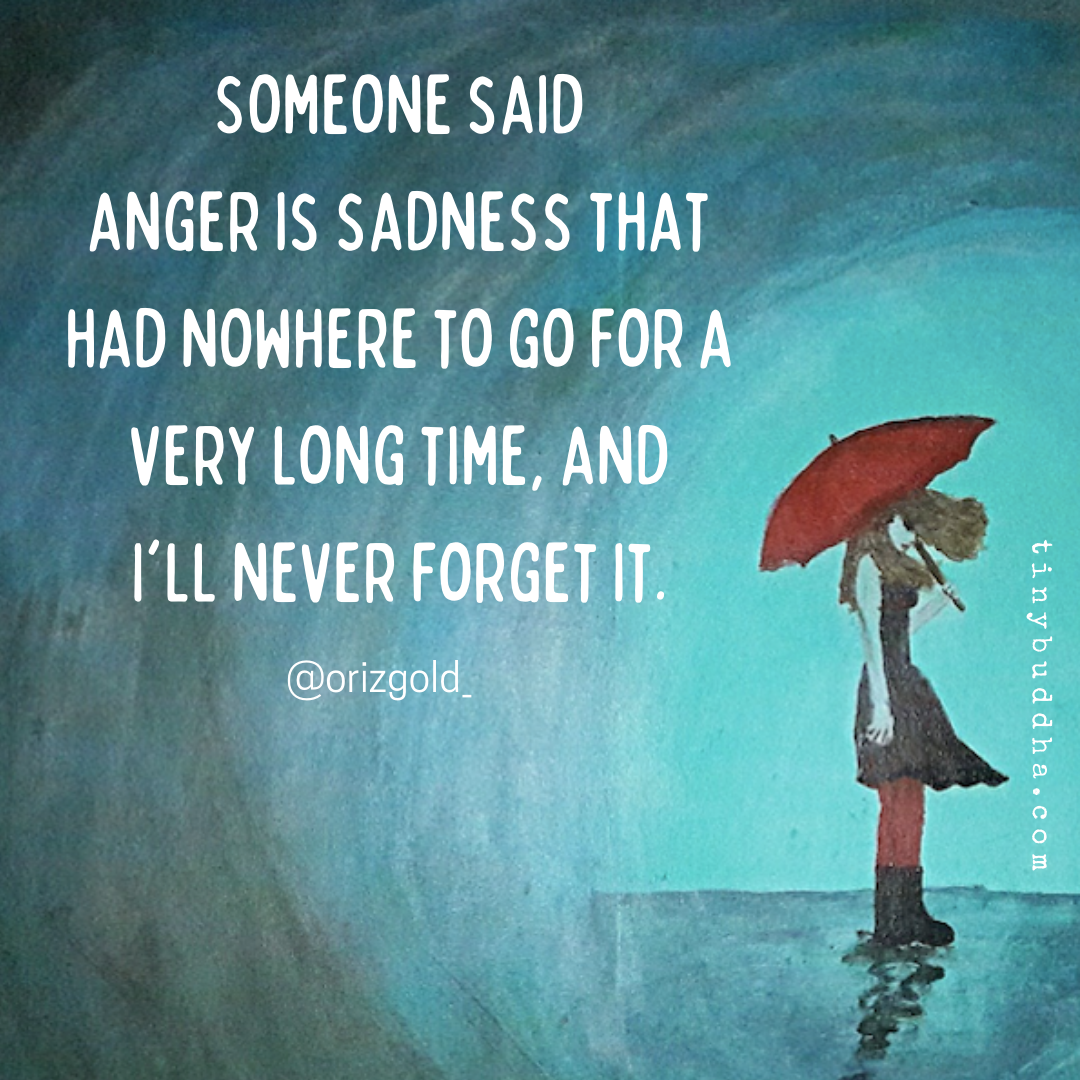
    “I’m here for you,” I said to myself. “This is really tough, Di. I totally get how uncomfortable this anger is in your body. I get how hard this situation is for you, how it brings up such big, deep, old feelings.”

    And as I was holding myself and giving myself love, the sensations started to shift. A little.

    I put my hand on my heart and allowed myself to be with it all. The horror of the anger. The deep, nauseating sensations of fear.

    All emotions want to be held; they want to be seen and heard. And they need to be felt. But in our society, feeling emotions is uncommon. When we tell a friend we are feeling sad, they try to cheer us up. When we feel upset, we might try and distract ourselves. When we hear our partners are upset, we might try to convince them out of it.

    Or we often blame and judge others: They made me upset! They irritated me! They scared me! We rant and complain. Or we suppress ourselves, ignore the emotions. Run far, far away from them.

    The truth of it, though, is that the feelings just want to be felt. They want us to say, “I see you! I’ll stay with you.” Emotions want to just be allowed to show up in our bodies and to move through them, like clouds in the sky. This is the really tricky, painful, or scary part for most of us—learning to be with those sensations that emotions bring.

    As I stayed with the feeling of anger and met it with love and patience instead of judgment, the intensity of it lessened.

    As the fires of the anger started to fade, I asked it what it was trying to tell me. And I heard that it was trying to tell me to stand up for myself, to say to the person who messaged me, “No, I am not happy with that arrangement.”

    I have learned that so often my anger is trying to give me the courage to say “no.”

    It wasn’t about blaming another person; it wasn’t about forcing someone to do what I want or disagreeing with their requests. There was nothing I could do about anyone expressing themselves, and that’s okay. My anger just wants me to state in a clear, strong voice, “No thanks, that doesn’t work for me.”

    My anger wanted me to be comfortable expressing what I wanted and needed. That’s what the anger was trying to help me do.

    I saw, though, that the reason I didn’t just say what I wanted and needed was because underneath the anger there was fear—fear of saying what I needed.

    I saw how much I wanted to say what I wanted, but how scary it felt in my body. But why would I feel scared about saying what I wanted? What I needed?

    Many of us, myself included, learned to deal with our emotions and needs in early childhood by not expressing what we wanted. We learned to defer to other people’s emotions and needs, to allow their  emotions to take up more space. It felt safer, and still feels safer, to think about other people’s needs and emotions rather than our own.

    But our emotions don’t want us to defer to others; they don’t want us to not express ourselves. They want us to be fully expressed humans who say what we need and who we are.

    And that is why anger kept showing up in my life over and over again when I was asked to do things for people—because my default would be to agree and do whatever anyone asked of me. And anger wanted me to say instead “NO!”

    Until I listened to the anger, until I started to say what I wanted, this anger around being asked to do things would keep going on repeat.

    I saw that I needed to spend time tending to myself, working with my emotions, and helping myself become more comfortable with saying what I deeply, truly wanted to say.

    To be all that I am in the midst of these emotions. Authentically me.

    I checked in with my body again and felt the anger had subsided somewhat; the flames were small now, just a little pile of glowing embers. There was a small pool of sadness and fear still near the fire, and I walked over and sat with it.

    I said, “Fear, I get it. I get why you feel like this. It’s hard. Thank you for trying to protect me. I get why you don’t want to say what I need. You’re afraid I will be rejected, right? Well, I really need to say what I need, even if there is the chance of rejection. Otherwise, I will feel angry again.”

    In this admission of what I needed to do, the fear and sadness seemed to breathe a sigh of relief, and all at once the emotions eased out of my body. The fire was gone, the nausea and bottomless pits. All gone.

    I sat with myself, put my hand on my heart, took a deep breath, and calmly and confidently replied to the message.

  • When You Strongly Disagree with Someone: How to Find Common Ground

    When You Strongly Disagree with Someone: How to Find Common Ground

    “The truth you believe and cling to makes you unavailable to hear anything new.” ~Pema Chodron

    I was recently having dinner with a group of friends, and I casually mentioned that I’ve been making more effort in my life to help prevent climate change.

    Across the table, someone looked straight at me and said, “You know human-induced climate change isn’t real, right?”

    I was shocked because I’ve known this person for years, and we’ve always agreed on important topics in the past. I immediately shot back with, “Umm, yes it is!” and proceeded to tell him exactly why he was so wrong.

    I’ll spare you the gory details, but let’s just say the rest of the conversation didn’t go well. It gradually got more and more heated until we were the only two people talking (read: yelling) at each other across the table.

    In the end, someone shut the argument down by saying, “You’ll just have to agree to disagree.” We both took the hint, retreated into our corners, and glared at each other for the rest of the evening.

    A few days later, I was relating the incident to another friend. In all honesty, I was looking for an ally who would help stoke my righteous indignation. But instead of nodding and agreeing with me, she said, “It sounds a lot like you were trying to force your beliefs on him and got mad when he wouldn’t back down.”

    This comment stuck with me, and over time I was forced to admit she was correct. I was so caught up in being right that I had refused to accept anyone could believe differently. Even worse, emotion had completely taken over, and I’d made no effort to find common ground or try and see things from a different perspective.

    In hindsight, I’ve realized I was missing the larger truth that we all believe we are seeing the world as it should be. Our entrenched beliefs become part of our identity because they help us make sense of the chaotic world we live in. And when someone holds a radically different view to our own, it shakes the foundation of our own beliefs and makes us feel off balance and insecure.

    But the good news is, no matter how differently you see the world from someone else, there’s always a way to find some common ground. Here are six tips I’ve learned to help have productive, respectful conversations and open your mind to different perspectives.

    1. Focus on the outcome.

    When you get bogged down arguing about specifics, take the argument up as many levels as you need until you find common ground.

    For example, in the case of climate change, we could have both easily agreed that the environment is important and we want to leave the world a better place for our kids. We just have different views on how to get there. This is a great way to reset the conversation because you’re focused on discussing the outcome rather than winning the argument.

    2. Understand their perspective.

    Learning the underlying reason why someone believes something can help you see a different side of the issue. It might not change your mind, but it will help you treat the other person with more empathy and give you fresh ideas to discuss.

    For example, someone’s refusal to accept climate change might be caused by concern about the negative effects it will have on their life. Maybe transitioning to renewable energy means they will lose their job or be forced to change their lifestyle in ways they don’t want to accept.

    If you can understand these underlying concerns, you’ll be much more likely to find common ground and have a productive discussion.

    3. Separate emotion from logic.

    A stressful argument can hijack the prefrontal cortex—the part of the brain responsible for critical thinking and decision-making. When this happens, you go into “fight or flight” mode and become more likely to react emotionally, think less creatively, and say things without thinking them through.

    The next time you find yourself getting angry or defensive in an argument, take a step back and try to de-escalate your emotions by acknowledging them. Once you’re feeling more logical and calm, you can start to look for common ground again.

    4. Practice active listening.

    Active listening is a communication technique that involves hearing, paraphrasing, and responding to what the other person is saying. It’s an essential skill for finding common ground because it shows that you’re genuinely interested in understanding their perspective.

    The next time you’re in an argument, try repeating back what the other person has said in different words to make sure you’ve understood them correctly. Then, add your perspective to what they’ve said. For example, “I can see why you feel that way, but I also think…”

    5. Be mindful of your own biases.

    We all have biases—it’s part of being human. We want to win arguments, be right, and be liked, so it’s easy to fall into the trap of only listening to information that supports our point of view.

    In this case, I was forced to admit that I haven’t actually read any of the climate change research myself. My beliefs are almost entirely based on existing in a bubble with other like-minded people who reinforce those beliefs.

    Exposing yourself to different perspectives—even if you don’t agree with them—can help you think more critically about your own beliefs. It might even help you find common ground where you thought there was none.

    6. Remember that differing views are important.

    If everyone agreed on everything, the world would be a pretty boring place. But even more importantly, differing ideas help to push society forward. They challenge us to think critically about our own beliefs and come up with new solutions to problems.

    So the next time you find yourself in an argument with someone, try to see it as an opportunity to learn and grow rather than a chance to prove your point. You might just be surprised at how much common ground you can find.

  • My Dad Died From Depression: This Is How I Coped with His Suicide

    My Dad Died From Depression: This Is How I Coped with His Suicide

    “Grief is really just love. It’s all the love you want to give, but cannot. All that unspent love gathers up in the corners of your eyes, the lump in your throat, and in that hollow part of your chest. Grief is just love with no place to go.” ~Jamie Anderson

    When I was seventeen, my dad died from depression. This is now almost twenty-two years ago.

    The first fifteen years after his death, however, I’d say he died from a disease—which is true, I just didn’t want to say it was a psychological disease. Cancer, people probably assumed.

    I didn’t want to know anything about his “disease.” I ran away from anything that even remotely smelled like mental health issues.

    Instead, I placed him on a pedestal. He was my fallen angel that would stay with me my whole life. It wasn’t his fault he left me. It was the disease’s fault.

    The Great Wall of Jessica

    But no, my dad died by suicide. He chose to leave this life behind. He chose to leave me behind. At least, that’s what I felt whenever the anger took over.

    And boy, was I angry. Sometimes, I’d take a towel, wrap it up in my hands, and just towel-whip the shit out of everything in my room.

    But how can you be angry with a man who is a victim himself? You can’t. So I got angry at the world instead and built a wall ten stories high. I don’t think I let anyone truly inside, even the people closest to me.

    How could I? I didn’t even know what “inside” was. For a long time, my inside was just a deep, dark hole.

    Sure, I was still Jessica. A girl that loved rainbows and glitter. A girl that just wanted to feel joyful.

    And I was. Whenever I was out in nature. I didn’t realize it at the time, but whenever I was on the beach, in a forest, or even in a park, I’d be content and calm.

    Whenever I was inside between four walls, however, I felt restless, lonely, and agitated. This lasted for a very long time. I’d say for about twenty years—which, according to some therapists, is a pretty “normal” timespan for some people to really make peace with the traumatic death of a parent.

    But during that time, alcohol and partying were my only coping mechanisms. I partied my bum off for a few years. I’d drink all night until I puked, and then continue drinking. Couldn’t remember half of the time how I got home or what happened that night.

    Hello Darkness, My Old Friend

    Unfortunately, all that alcohol came with a price. I had the world’s worst hangovers—not only physically but also mentally. At twenty-one, hungover and alone at home, I had my first panic attack. Many more followed, and I developed a panic disorder.

    I became afraid of being afraid. I didn’t tell anyone, because I was scared they would think I was crazy.

    Those periods of anxiety never lasted longer than a few months. But they were usually followed by a sort of winter depression. In my worst moments, I felt like the one and only person that understood me was gone. I felt like nobody loved me, not as much as my dad did. And I did think about death myself. Not that I actually wanted to die, but at times, it seemed like a nice “break” from all the pain.

    Acceptance and Spiritual Healing

    Finally, in my mid-twenties, I went to see a therapist. She helped me tremendously and made me realize that the panic attacks were nothing more than a physical reaction to stress. Yet, it wasn’t until I did a yoga teacher training a few years later that I finally learned how to stop those panic attacks for good.

    Wanting to know more about the mechanisms of the body and mind, I dove into mental and physical well-being, and started researching and writing about mental health.

    I understand now that self-love, or at least self-acceptance, and a solid self-esteem are crucial for our mental health. And I know that people with mental health issues find it so, so hard to ask for help. Their lack of self-love makes them think they are a burden.

    I understand that, at that moment, my dad didn’t see any other solution for his suffering than stepping out of this life. It did not mean that he didn’t love me or my family.

    The pain from losing my dad actually opened the door for me to spiritual healing. It brought me to where I am now. It taught me to live life to the fullest.

    It taught me to follow my heart because life is too precious to be stuck anywhere and feel like crap. And it made me want to help others by sharing my story.

    I have accepted myself as I am now. I know that I’m enough. I’ve learned what stability feels like, and how to stay relaxed, even though my body is wired to stress out about the smallest things due to childhood trauma.

    Let’s Share Our Demons and Kill Them Together

    But honestly, the pain from losing him will stay with me for the rest of my life. And sometimes it’s as present as it was twenty years ago. I don’t feel like covering that up with some positive, “unicorny” endnote.

    I feel like being raw, honest, and open instead. Depression and suicide f@cking suck. What I do want to do, however, is to help open up the conversation about this topic. I want to make it normal to talk about our mental health, as normal as it is to talk about our physical health.

    There are way too many people living in the dark, due to stigmatization and fear. Life is cruel sometimes. And every single human on this planet has to deal with shit. It would be so good if we could be real about it and share our stories so other people can relate and find solace.

    I do hope that my story helps in some way.

  • How I Healed My Mother Wound and My Daughters Are Healing Theirs

    How I Healed My Mother Wound and My Daughters Are Healing Theirs

    “Your children are not your children. They are the sons and daughters of Life’s longing for itself… You may give them your love but not your thoughts, for they have their own thoughts. You may house their bodies but not their souls, for their souls dwell in the house of tomorrow…” ~Kahlil Gibran

    Now that my daughters are in therapy trying to heal their relationship with me, I have more compassion than ever for my mom. I haven’t felt angry at her in years. But when I was a teen, I earnestly desired to kill her more than once.

    I was in my forties when my mom died. Afterward, I had frequent dreams about her chasing me around, telling me I wasn’t good enough. The dreams lasted nightly for about six months and occurred for a few more years when I felt stressed. The last one I remember, she was chasing me under the covers of the bed, screaming my worst fears—that I was unlovable and unworthy—reinforcing my wounded child.

    About twelve years after she died, I was able to come to a place of comfort with her. While in deep meditation I saw a vision of her spirit bathed with light and love. Freed from her mental and physical sufferings, I saw her as I had seen her when I was a child—my universe.

    Unfortunately, she couldn’t see herself as I did in those days. I knew that she was beautiful. I remember thinking about it as a young child, and when she was dying. How often I’d searched her face, looking for her to see me.

    Like my dad, I have prominent facial features. I wished I had her cute small nose and her pretty lips that always looked beautiful in her Berry Berry Avon lipstick. She had blue eyes, which I rarely saw straight on. She was uncomfortable with her looks. I don’t remember any direct eye contact with her unless she was angry, though I realized there must have been.

    She was born with a crossed eye. Her story was that her parents were accused of having a sexually transmitted disease that caused it, which brought great shame. My mom was also dyslexic. Sometimes at school, she had to wear a dunce cap and stand in the corner or hall because she couldn’t spell. These challenges shaped her self-worth from a young age.

    I loved looking at pictures of her in her twenties with long dark wavy hair, stylish glasses, and a beautiful smile.

    When she died, I didn’t cry. I proclaimed that her reign of terror had ended, and I held on to my anger for twelve more years. That day in meditation, when I was able to break through the veil of outrage that kept me in my darkness, I saw her as a bright light in my life. 

    I had known for years that some of my healing depended on letting go of the story of my time with my mom—one of mental health issues, abuse, and unhappiness. I needed to take time to process our relationship and see her beyond her earthly life. When I was finally able to, I felt better than I expected.

    Through my experience and my work with other women, I’ve learned that the mother wound—our unresolved anger at the flawed woman who birthed or raised us—is two or threefold.

    Our first challenge is processing the actual events that happened as we were growing up.

    The second is letting go of our reluctance to be fully responsible for our mental and physical health as adults.

    And, if we have children, the third is not wounding ourselves—realizing that there was never a scenario where we could be the perfect parent we had hoped to be, no matter how self-sacrificing we were.

    Processing Our Childhood

    Our work as adults is to make a conscious effort to process the hurt, anger, and betrayal that we endured from the female authority figure that raised us (or the figure who was our primary caregiver).

    Even if we resolve that our mother did her best, we are still left to sort through our shame over not feeling loveable or good enough, and the feeling that we missed out on the experience we should have had growing up. Processing and healing could mean seeing a therapist, journaling, or even stopping all contact with our mother.

    I moved far away from my mom, which minimized my contact and gave me space to process. But I kept the past alive in my thoughts. Now when I look back, I see that holding on to my anger well into adulthood added to the years of feeling like I was missing out on a normal life. In the end, I was responsible for my own healing, and it didn’t happen overnight.

    Now, at this place in my life journey, I see the hard parts of my life as the foundation for my life’s purpose, and I don’t feel like I’m missing out.

    I’ve met enough people to know that even those who had the perfect parents—like we all wanted—also have challenges as adults. My work to heal has led me to a deep understanding of the human condition and fueled my passion to love and to help uplift the suffering of all.

    How Our Commitment to Self-Care Helps Heal Our Mother Wound

    We looked to our mother to provide emotional and physical nourishment. Her inability to do this (or do it consistently) created our feeling that we were wronged by our mother. Now, as adults, we need to let go of thinking our mother will take care of us and do our own nurturing work for ourselves. That might seem like a harsh statement, but it enables us to move on.

    The second part of healing my mother wound was letting go of the part of me that doesn’t take care of myself. That little voice in my head that apathetically whispers, “I don’t care” about little things that would improve my health, help me sleep better, or feel successful.

    That little voice doesn’t have as much power over me anymore. So instead of overeating in the evening, which would affect my ability to sleep well, I can override it—most days. I’m also able to notice that when I don’t take care of myself, I open myself up to being the wounded child again.

    We didn’t have a choice when we were young, but now the choice is ours. We need to decide when and how we take up the torch.

    When Our Mother Wound Becomes a Mothering Wound

    My mother wound turned into a mothering wound when I didn’t live up to my hopes of being a perfect parent. Of course, I had intended to be the loving, nurturing, protecting mother, who produced adults without any challenges, but alas, I was not. How could this happen? I tried so hard. 

    I was able to find alternatives to the punitive, violent punishments, shaming, and blaming tactics that my mother used, but as a young parent, I was still challenged with low self-worth issues and an eating disorder.

    Although some of the things that occurred during the three marriages and two divorces that my daughters and I experienced together were horrific, we were luckily able to process a lot of them in real time with therapy and tears.

    Now, with their adult awareness, my daughters are processing their childhood, including my addictions, insecurities, and mistakes. It is almost torture to watch them do that, even though I know they must. And they are so busy with their lives now—as they should be. I miss them.

    To weather this time of my life and continue to grow, I need to employ my practices of understanding, compassion, and detachment, and take deep care of myself. Continuing to love my daughters deeply, to be on call whenever they need me, and at the same time be detached from needing them, has called me to deeper depths of my character.

    We all deserve to be treated respectfully and kindly. As daughters and mothers, we can role model compassion—empathy in action—and boundaries with our mother and our children. We can strive to create relationships that mutually nourish loving-kindness.

    We can focus on healing our past and taking care of our future. We all need to communicate this clearly to our mothers, partners, and children. And, although we can’t walk away from our underage children, we can set boundaries that facilitate healthy relationships now.

    We can be clear—our children don’t need their lives or their mother to be perfect. They need to know that they are loved, and they need to see us love ourselves. Holding on to this love for them and for ourselves when our children are troubled, distant, or even estranged is one of our biggest tests as parents. My heart goes out to any mother dealing with these challenges, especially if you are dealing with them alone.

    I never stopped wanting my mom to be happy. She is now at peace, maybe even joyful. I strive to let myself be at peace. I let myself live in this place of deep tenderness for her—and now for me. I understand that my experience is universal. I needn’t feel alone.

    I realized that this confident and peaceful version of me is the best I can do for my daughters as they heal their mother wounds and take care of themselves, as I am doing for myself.

    To heal our mother wound is to remember that it is ultimately a spiritual journey. Not only are we trying to figure out the depths of our own purpose, but we are bound to the journeys of our kin.

    As with all spiritual journeys, there will be rough passages that tear our heart open and ask us to become more. The journey of the mother is the journey of love. We need to remember, no matter what rough journey is behind us, we are the designers of the path ahead.

  • My Mother’s Abuse and the Two Things That Have Helped Me Heal

    My Mother’s Abuse and the Two Things That Have Helped Me Heal

    “I love when people that have been through hell walk out of the flames carrying buckets of water for those still consumed by the fire.” ~Stephanie Sparkles

    I have a tattoo on my back of Charles Bukowski’s quote “What matters most is how well you walk through the fire.” It spoke to me as I had been walking, often crawling, through a fire for much of my life.

    At times, I took different paths, skipping through fields of flowers, but eventually I would find my way back to what I knew, which gave me a strange sense of comfort—the fire whose roots had begun in childhood, with my abusive mother.

    I used to be consumed by this fire. I have another tattoo on my foot that reads “Breathe.” For years I lived with a very dysregulated nervous system, constantly alerting me to the threats of the flames forming around me, and breath was something that eluded me.

    How could I breathe when at any moment she could walk up the stairs and find something to lash out at me over?

    How could I breathe when no one wanted to hear how I felt, and my emotions were something I did not understand, nor know how to handle?

    How could I breathe when everything was so frightening?

    How could I breathe when no one ever showed me how?

    Those entrusted to my care were in their own fires that they had never learned to come out of. So of course, as I grew, I felt unsafe and uneasy. And I learned to ignore my breath, ignore that others were able to feel it move through their body, and learned to see only flames everywhere. 

    I grew up in a traditional home as a child of immigrants who had come to the USA for work and to give their children a better life. I went to Catholic school, where I threw myself into academics as a way to be seen, and excelled. My parents were excellent cooks and displayed their love for us through the kitchen table. I had all of my physical and academic needs met.

    I spent my early childhood playing with my brother, who I latched onto as a support system. My mother’s inability to soothe us as babies and toddlers created very sensitive, shy children, deeply afraid of the world around us and deeply connected to each other.

    Unfortunately, my brother and I began to distance during our preteen years. We had created different survival strategies to navigate my parents, and he began to view me as the problem, as my mother was teaching him. I then began to view myself through the same lens.

    I was ridiculed, abandoned emotionally, shamed, and made to believe the dysfunction of the family lay entirely on me. There was a period of physical abuse as well, but during these situations, I at least felt seen.

    I was gaslit to question everything I believed to be true and found myself in imposed isolation in my childhood and teen years, later self-imposed. The world felt too frightening to face. As I grew older, I rebelled against the isolation by looking to others to help soothe me, especially romantic relationships.

    If they didn’t soothe me as I wanted, I grew angry and hurt, isolating myself more and more, or lashing out internally or externally.

    I looked to ease the suffering inside with external gratifications, shopping, traveling, and sex. Unfortunately, nothing could soothe the pain I was feeling.

    In my early twenties I went to a therapist and could do nothing but cry. After a few months of not being able to communicate, she insisted I take benzodiazepines or we would be unable to continue working together.

    My symptoms worsened both emotionally and physically, and I now needed “saving” from both. The helplessness I learned early on continued, as did my need to have others make me feel safe. Both my body and brain became impossible to withstand, and proved to me that I was a victim of life and no one cared about me.

    I found relationships to validate this idea, with addicts, narcissists, and codependents who all eventually grew tired of my need to be loved and soothed out of my pain.

    I was attracting the familiar in these people, who could not show me the love and safety I needed. In other words, I was attaching myself to others to regulate, but they too were stuck in a cycle of dysregulation.

    I found various ways to hurt myself, overspending, starving myself, overexercising, and on more than one occasion taking too many medications to calm myself down, and finding myself in an emergency room. The familiar was living in my nervous system and demanded to be entertained.

    After decades of chronic health issues due to emotional and physical trauma, they finally hit a peak when I was forty-seven and no longer able to work, the one area of my life I’d had some control of. I had to learn to breathe or be completely extinguished by the flames. During this time, I began to learn how to put out the fires.

    I worked hard on retraining my nervous system out of the fight-or-flight state it had entered when I was not soothed as a baby, and rewiring thoughts and behavior patterns created as an extension of that state. In this process, I found the authentic part of myself, the inner child, which brought a deep peace, the peace of integration.

    An integral part of my healing came from practices of forgiveness and compassion. As I rewired old patterns living in my nervous system, I learned about how the brain works, how trauma is stored there, and how our realities are shaped by early experiences.

    Each day in my practices I discovered new associations, when new thoughts and behaviors had started, and had to look at these strategies and their results with self-compassion and forgiveness.

    At first, this was difficult, as it was new to my brain, but as I practiced it became easier, and I started feeling self-compassion and self-love for the first time.

    As I worked with my own toxic personality in these practices, I experienced deep grief for the past and what I was not able to enjoy as a result. Anger was holding on, and I knew it was time to let go. So, I began a practice of curious empathy for the woman who had started my fires, my mother. Awareness of my own dysfunction, self-compassion, and now self-forgiveness allowed me to do the same for others, including her.

    In this case, curious empathy meant becoming aware of her patterns and where they came from by connecting to my own experiences and empathy.

    I had observed her throughout my life to learn about what I was experiencing and how to navigate her, as well as others in the world. I also read tons of self-help books about personality disorders and toxic people, but cognitive knowledge wasn’t enough to understand my mother.

    I watched, listened, and heard stories from my father about my mother’s childhood. I drew upon my own strategies and where they originated. I opened myself up to curiously knowing her, at first from a distance (during this time of healing), and then I incrementally exposed my healing nervous system to her with empathy.

    When I felt balanced and regulated enough, I rejoined our relationship, but with strict boundaries—for both of us. And I found a somewhat different human in front of me, one who had softened in her old age but still retained old behaviors when “triggered.”

    I began to identify her triggers and remained strong when she reacted. I now knew no other way; my nervous system and heart had been retrained into compassion.

    I came to understand that she had created toxic survival strategies because of an inability to communicate and soothe emotions and needs in an effective way. She had been stuck in a fight-or-flight state that prevented her from seeing the world as it was, and seeing the motivations of others clearly.

    And I had learned (and now unlearned) similar methods of interacting with the world.

    I often pictured her as a child or a teen and connected with this version of her through my own inner child. In the moment, I was able to change the hurt and anger I felt to compassion for the way she was trying to get what she needed. This was followed by an inner forgiveness and releasing of the negative emotions.

    I made it clearly known what I would accept, and often joked with her about the way she was acting. She responded with smiling or laughter.

    It became clear that she reacted when she felt vulnerable, and I understood that throughout her childhood, vulnerability was not acceptable, and she was shamed in it. 

    In identifying her methods of showing love, I felt loved and seen, and it was easier to react to her with forgiveness and compassion. It became natural to me to speak as the “parent” (adult) when her old armor of defense came up.

    In daily forgiveness and compassion practices, I find enormous love for the woman still stuck in a fight-or-flight state created in her childhood. There are times I pull away to reinforce that her behavior is unacceptable, but these times are not as prevalent as before.

    As I changed my behavior toward her, she began to change hers toward me. As I regulated my nervous system into safety, it seemed to soothe hers, and she inched closer to the idea of vulnerability with me.  As I let go and replaced the anger with compassion, she felt safe. It is with this safety that she is able to chip away a tiny piece of her armor in our interactions.

    I cannot ever change her, and she will pass with the trauma state she is in as her identity. But, for my own well-being, I chose forgiveness and compassion, to bring her a small drop of water each time I see her. Remaining in the fire with her, by being angry, was not an option any longer. 

    I found my way out of a fire that had nearly taken my life and hope to continue sharing my experience of healing. These days I find myself skipping through fields of flowers on a regular basis, and feel it is a blessing to share it with those who have not yet gotten there—and those who may never.

    **I am not suggesting that anyone should keep people in their lives that they feel are “toxic.” We all need to do what we feel is best for us based on our own unique experience.

  • How to Mindfully Temper Road Rage and Make Driving Less Stressful

    How to Mindfully Temper Road Rage and Make Driving Less Stressful

    “Smile, breathe, and go slowly.” ~Thich Nhat Hanh

    As a Lyft driver, I once spent significant time out on the road—a setting rife with provocations and stressors.

    Driving can feel like a constant challenge to employ mindfulness instead of giving way to destructive emotions like impatience and frustration. Meditation can be difficult to practice when you’re navigating a vehicle (demanding as both activities are of your full attention)—try channeling all your senses into it, and you’ll likely plow over a pedestrian or end with your car in a ditch.

    Navigating the road mindfully, though, doesn’t have to mean closing your eyes or adopting any of the other classic “meditative” stances. I think it involves something simpler: momentary detachment—both from everything that’s happening around you and from your own internal reactions as you watch from an ever so slight distance while they ebb and flow.

    Here’s some of what I’ve learned about maintaining equanimity when out there on the stress-inducing road.

    The importance of keeping in mind that sometimes there’s something we’re not seeing.

    Driving down Market Street through downtown SF, I once noticed a number of pedestrians stopped inside the crosswalk in the middle of the street. They didn’t have the right of way; the light was red for them and green for us drivers who were trying to get through. Cars were honking.

    For maybe a second my impulse was to add to the honk melee. Then I took a closer look and saw what was actually going on: a lady had dropped her bags, causing their contents to spill to the pavement. The people in the street were passersby who had run to help her pick them up.

    Once they were finished, I noticed how they stood and raised their hands in apologetic gestures [to the perturbed honkers] that seemed to say both “Just wait one minute please” and “Sorry, sorry, sorry.”

    Witnessing this got me thinking about how often in this fast-paced world we jump to reactivity before even understanding what’s going on first. We’re especially primed to do this out on the road, I think.

    As Shankar Vedantam said on his podcast Hidden Brain, “This woman didn’t bump into you maliciously; she’s blind. This soldier standing in formation didn’t pass out because he doesn’t have what it takes; he’s diabetic and needs his insulin. This woman isn’t heartless because she didn’t help the elderly person who had fallen; she’s paralyzed from a spinal cord injury.”

    Often in life, crucial pieces of a larger whole are unavailable to us—yet sometimes we act or respond as if under the assumption that we have access to all of them.

    Particularly when a driver in front of me is moving very slowly, or randomly stops, I sometimes feel the impulse to honk. I wonder why they’re being “so inconsiderate.” I ask them, in my head, if they’ve forgotten where the gas pedal is located. My immediate instinct is to cast blame on whoever’s holding me up.

    Yet I have to remind myself that I’m missing information. Maybe the driver in front of me is stopping to let someone cross the street. Maybe there’s a red light in front of us that I can’t see. Maybe… [insert any other number of possibilities here].

    I can’t see any of that though.

    I’ve also been on the receiving end; for instance when I stop to let a baby animal cross the road. Unable to see the road-obstructing animal, the cars behind me get annoyed and honk their disapproval.

    Willingness to admit when I am wrong (similar to the point above).

    Once when driving home across the Richmond Bridge, I thought there were only two lanes, which led me to assume that the guy next to me was cheating by driving along the shoulder.

    In response, my mind wove an entire narrative involving an entitled driver that does whatever he wants—weaves in and out, causing near collisions; uses the shoulder as his own lane, so that he can accelerate past the mass of stopped cars before cheating his way back into the pack once he’s gained a clear edge.

    To the driver he has endangered [through this behavior], who has responded by honking, he says, “Why don’t they just chill out?”

    I pictured the people out there who engage in similar behavior when not in their cars. The ones with blinders on to their own actions, who maybe call out others for “being too sensitive” while refusing to acknowledge their contribution to eliciting this supposedly sensitive response from them.

    Outraged, I honked at the driver—yet he kept driving along the “shoulder.” I shot him a look of disbelief; he didn’t look back. He seemed to not have even registered that my honk was directed toward him.

    That’s when I realized why: the “shoulder” was actually a legitimate lane.

    Remembering I’ve been wrong in the past helps me practice equanimity when I’m tempted to get outraged on the road.

    Practice forgiving mistakes.

    I think about those cars that get stranded in the middle of the intersection during high-traffic hours—usually because the light turned red when they were halfway through it. I think about how the cars around them often unleash an ambush of honks to signal their disapproval.

    I say this to myself when I’m about to become an angry honker: The trapped driver made a mistake. He or she is probably already aware. Your honk won’t teach him something he doesn’t already know.

    I realize that all my honk would have added was more noise to an already overly raucous road, compounding the driver’s shame while maintaining my own stress and self-righteousness.

    On somewhat of a side note, I’ve noticed how at times the most reckless drivers can also be some of the most intolerant of other drivers’ mistakes. One time a man who’d been driving eighty on a commercial street seemed very disgruntled when I changed into his lane (even though my doing this wouldn’t have been a “near miss” to someone who’d been following the speed limit).

    First he slammed the brakes. Then he wove theatrically around me into the lane next to us. From there he proceeded to change lanes three more times in the course of one block, dodging cars like they were opponents in a high-speed chase video game.

    If we can remember we all make mistakes, it will be easier to offer other drivers grace.

    Practice gratitude. When you do have a smooth ride, acknowledge it to yourself. Hold onto that moment and remember how it felt.

    A metaphor comes to mind each time I drive over a trafficless bay bridge (which happens very rarely but when it does, feels magical). Cruising over the smooth pavement without a car in sight conjures a wintery, white Christmas feeling.

    This calming and cleansing sight contrasts starkly with the default state of the freeway: normally a long stretch of cars, constant reminders of overpopulation and limited resources. It feels similar to gliding down a ski slope when the snow is fresh, pristine, newly plowed, and un-scuffed by other skiers.

    I made a note to be grateful for it.

    Even machines like Siri can be recipient to your gratitude. When traffic clogs the freeway, for example, I appreciate how she escorts me onto an alternative route. On one, we drove down bucolic side roads past fields of sunflowers while country music played from my car speakers (and bugs splattered against the windshield). On another, a river gushed a few feet away from us, providing a peaceful backdrop both visually and auditorily.

    Don’t force it, but when a moment that might be worthy of some gratitude does present itself, register it (even if it’s extended toward an inanimate object). Acknowledge it, if only to yourself.

    Humanize the other drivers around you.

    I think part of what exacerbates and heightens road rage is the ease with which we’re able to dehumanize the drivers we’re sharing the road with because we see cars first, people second. Attuning to certain visual cues, though, can reinstate a human component.

    I’ve found that making eye contact with another driver can at times quell any road rage that’s starting to bubble on my end. Other little things, like keeping my corgi stuffed animal visible, also help (when drivers get mad, the sight may calm them).

    One time when driving, I came upon a car stopped in the middle of the road. Just as I was about to get annoyed at the hindrance, a little Latino boy eating an apricot stuck his head out the car window. Juice dribbled down his chin while he waited for his dad to fix their car (which was why they were stopped). The innocent sight instantly calmed me. It was almost Hallmark-card level of sweet and centering.

    Another “tempering” visual cue: when a dog sticks its head out the window to feel the breeze against its face. Irritation was beginning to mount one day when I saw them: those big, brown eyes—opened wide, earnest, and slightly damp—shining above a golden snout in the back window.

    Once again I was calmed, my anxiety diffused by our eye contact—reminded that we’re are all flesh and bone, even when stress pushes us to reduce each other to the metal contraptions we cart ourselves around inside of.

    Take your time, Sir. I’m just going to have a moment with your sweet fur baby in the meantime, if that’s okay…

    In the absence of visual cues, use your imagination.

    Whenever I start to feel impatient with the slow driver in front of me, but I can’t see their face (or no other visual cues are present to temper the impatience), I take a deep breath. Then I gently counsel myself to envision the human inside the car.

    The specifics of whichever person pops into my head don’t really matter. What matters is that I recognize their humanity and extend patience toward whoever does.

    If that doesn’t work, try picturing one of your family members. What if the driver was your uncle, or your kind elderly neighbor, or your mom? Use your imagination to see inside the 2,000 pound metal machine that’s obstructing your path. Draw features onto the faceless foe inside it. De-objectify its operator.

    Driving and traffic can be stressful and draining. During the times when it feels like the surrounding cars and I are basically just crawling to our destination, I feel like I might as well be outside the car, pulling it with a rope—at least that way I’d get some exercise and Vitamin D.

    Sometimes I wish someone would invent a car feature that would allow the driver to switch to “pedal mode.” It’d be a great way to release endorphins through exercise (thereby reducing stress levels) during these inherently stressful situations.

    Until those innovations get brought into existence, though, we can work on controlling our own internal responses to whatever external road frustrations come our way.