Tag: alone

  • 5 Reasons You Feel Alone (And How to Change That)

    5 Reasons You Feel Alone (And How to Change That)

    Alone

    “Two possibilities exist: either we are alone in the Universe or we are not. Both are equally terrifying.” ~Arthur C. Clarke

    “You are not alone” is a phrase we speak, hear, and read over and over again.

    Testimony and statistics prove that others have lived our types of misfortune. Given that evidence, why is it that so many of us feel as if we are somehow different than all the others who have triumphed over tragedy or are climbing those proverbial mountains?

    The seed was first planted ages ago when I was having a conversation with a loved one during a difficult time in her life. “I know how you feel,” I said, “I’ve been there.” How many times have you given or received this type of comfort?

    “You’ve never been where I am!” she shouted back at me. “My life’s a living hell.”

    Right then I had an AHA moment. “You’re right,” I said. “I’ve never been in the exact same place you’re in, but I’ve been right next door. Everyone’s hell is different, but everyone has their own.”

    In that moment I realized that, though others have experienced similar hardships and emotions, we can’t fully understand because we are nothing more than bystanders, albeit neighbors who can somehow relate.

    Years after that epiphany, something continued to plague me. Why, when we understand that we aren’t alone, do so many of us still feel alone?

    We are often faced with short-term situational aloneness. A job, school, or home relocation takes us away from friends, family, and associates, often causing a short-term sense of separation. Divorce often creates a shift in our relationships with others as we try to navigate a new social normal.

    Aside from these obvious forms of separation are more subtle, complex, and longer lasting causes.

    Here are five reasons we feel alone and what we need to know about them.

    1. We feel alone because we are alone in our heads and in our hearts.

    It might seem pretty basic, but for those of us who were introduced to “You are not alone” at a young age, or those like me who gravitate toward more straightforward interpretations, we might still internalize the quote more literally. The truth of the matter is that no one other than us can occupy our thoughts or the feelings that are our heartbreak.

    The key to overcoming this type of isolation lies in two things: 1) changing how we identify with the quote and 2) understanding that we are not alone in being alone in those areas. Though we can relate to one another’s situations and suffering, the details, breadth, and depth of every person’s experience is equally similar, yet as unique as our fingerprint.

    2. We compare ourselves to others.

    At some time, every single one of us has compared ourselves to another in a way that shut us down. We say things like “I wish I had her body/ brains/charm/courage/way with words/people.” Comparison comes from one of two places: an inner drive to improve ourselves or some unspoken/unidentified need to discount our abilities.

    When we balance ourselves against others in a way that says we don’t measure up, we invite such feelings as jealousy, resentment, and anger. It’s hard to cover up these types of emotions when we’re trying to connect with those we envy.

    This is an area I struggle to regularly reign in. I am surrounded by people I respect and wish only the best. Sometimes, however, I find myself thinking things like, Maybe if I’d finished my college degree—she graduated while raising a family/working two jobs/insert your whatever—I’d be further along in achieving my goals.

    In other words: I’m not good/ fast/smart/motivated enough/insert your whatever.

    Whether we’re avoiding intimate interaction due to intimidation or we’re pushing others away because of our misguided feelings, we place ourselves outside the circle in which we’d like to be.

    In an attempt to regain our position, we often resort to other problematic behaviors like hiding our vulnerabilities. Covering up who we are further feeds our feelings of isolation because, fundamentally, we are social beings who need to relate to others.

    When we use contrast in a healthy manner (recognizing admirable qualities we want to emulate), we can be motivated and inspired to make life changes. Identifying the underlying emotion (jealousy versus admiration) empowers us to change our thinking and position ourselves back inside that social circle.

    3. We are our own worst critics.

    We all have that inner critic who lets us know when we’re on the wrong path, when we’ve messed up, or aren’t measuring up to the standards we set for ourselves, or those adopted from other’s expectations.

    Common self-deprecating talk often contradicts truth and what we’re hearing from the outside world.

    I’ll never get this right. I’m such a screw up. What is wrong with me?

    This inner critic also masks itself as a protective partner, one that encourages us to feel good about giving up, which adds to our confusion about where and how we fit in. Ah, it’s not that important, anyway is an expression that lulls us into a false sense of security and persuades us to abandon people and purpose. This type of maladaptive comfort is a breeding ground for the comparisons mentioned above, further isolating us from others.

    In her article, Are You Sabotaging Your Relationship?, Lisa Firestone, Ph.D. encourages us to confront the dominating critical inner voice “as a third-party threat.” She writes, “Make sure to identify it and separate it from your real point of view.”

    Firestone goes on to say that acknowledging our power and challenging our defense mechanisms allows us to work on the only thing we have any real control over: ourselves.

    A therapist once asked me if I would hold another person to the same standards and treatment I was employing on myself. Being mindful of how we view ourselves and making room for constructive criticism incites productive change. This sort of kind evaluation allows us to realize that we are, like everyone else, human.

    4. We are filled with emotions such as guilt, shame, or self-loathing.

    These types of feelings attack our very character, our thoughts, and our worthiness. Unresolved remorse over something we said, did, or didn’t do can manifest itself into a perpetual state of shame or low self-esteem, which can morph into hatred for oneself if left untreated.

    When we think badly about ourselves, we often assume others are viewing us the same way. The fear of being judged poorly by others often causes us to conceal our true self.

    We might hide our flaws, cover up our mistakes, and sometimes go so far as to blame others as a way of avoiding ownership. This creates a vicious cycle that creates more internal conflict, pushes people away, and further separates us from social circles.

    In her article Shame: A Concealed, Contagious, and Dangerous Emotion, Mary C. Lamia Ph.D. wrote, “Hiding often accompanies behaviors that are themselves a trigger for further shame, such as addictions, compulsive behaviors, harsh self-criticism, or self-denigration.”

    Lamia goes on to suggest that recovering from shame requires a different perspective, one where we accept responsibility for our actions and are willing to recognize certain triggers.

    There was a time in my life where I shoplifted bizarre items like tuna fish. Despite overwhelming shame and fear, I never understood what compelled me, until I finally opened up to my long-term counselor. After numerous questions, he informed me that sometimes people do destructive things to reinforce their beliefs about themselves.

    An active community member on all fronts, people regularly exclaimed how valuable, loving, helpful, and intelligent I was, a direct contradiction to my beliefs that I was unworthy, unlovable, lacking, and not smart enough. That’s why I stole: to prove to myself that I was flawed. When I recognized this disparity and understood my subconscious motivations, the desire disappeared.

    When we stop hiding, take responsibility for our actions, and start to recognize those things that illicit our destructive thoughts and behaviors, we can begin to break down the conflicts that create our lack of confidence. Self-belief allows us room to trust in others, which in turn, makes us feel less alone, and makes us more welcoming and welcomed.

    5. We are distracted.

    This, too, might seem basic, but distracted behavior is often a major cause of separation.

    Think about all those times you’ve tried to have a conversation with your partner, your children, or a friend who is constantly checking a cell phone for social media updates. The message we often read into such behavior is that our time isn’t respected, or that the phone call, text, or update is more important than we are.

    How many times have you been involved in a conversation where someone hears only part of what you say or constantly asks you to repeat yourself? We begin to feel like the other person doesn’t really care. If this type of exchange is habitual, we might find ourselves not wanting to hang out with that individual simply because we want meaningful relationships.

    Many factors could cause us to act this way: We could be avoiding something; we could be bored; or we could have some physiological or psychological condition that makes it difficult for us to focus. Either way, when we are disengaged, people often don’t feel wanted, needed, or important, and they will eventually quit calling and coming around.

    Paying attention to how we are interacting with others and watching for signs that indicate we aren’t engaged will help keep us plugged in to our own availability and help us initiate and maintain active, healthy relationships with others and with ourselves.

    Being aware of our actions, emotions, and thoughts helps us stay connected to others.

    It is the sum of our human experience that can create our loneliness, and it is the sum of our shared human experiences that can unite us with other members of the human race. In the end, as long as there are others to interact with, we are not alone. We simply have to realize this and choose to connect.
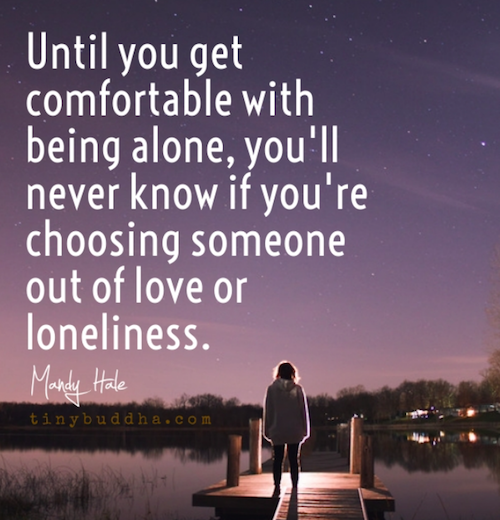
  • The Beauty of Being Single: 6 Benefits of Solitude

    The Beauty of Being Single: 6 Benefits of Solitude

    “I never found a companion that was so companionable as solitude.” ~Henry David Thoreau

    Shock. Rage. Sorrow. Excitement. Terror. These are just a handful of the emotions one experiences in the aftermath of a separation or divorce. Emotional rollercoaster? It’s more like being hit with the speed and velocity of a bullet train.

    I should know. After twenty-five years of marriage to a kind and accomplished man, I found myself alone.

    Our decision to divorce was neither acrimonious nor cruel; neither sudden nor impulsive. Rather, our decision to file for divorce was an incremental process.

    We had more disappointment than hope, more unease with each other than affection and contentment. As difficult as it was to recognize the wrong turns we’d made in our two-plus decades together, we both realized that it was time for each of us to draw a new map.

    While my husband remained in the home we had lived in together throughout our marriage and the raising of our daughter, the path on the new atlas of my life led me back to Italy, the country of my birth.

    In retrospect, it was far easier to relocate to somewhere radically different from the place I’d called home for thirty years than it was to sit with the equally radical emotions aroused by separating from the person who knew me best.

    Once the bags were unpacked, the boxes unloaded, and the small apartment I’d rented in the heart of Rome redecorated, I had to contend with the alien feeling of a naked ring finger and a heart full of pain.

    The relief of our separation—no longer would I have to tiptoe around the mounting frustration and disenchantment between us—was short-lived; the rush of excitement at the idea of “a fresh start” evanescent as a shooting star.

    With a job from home, only a shoebox of an apartment to tend to, and no wifely duties, motherly chores, or social commitments, I had only one thing to do and one place to go—and that was inward.

    It was lonely in there. Where, I kept thinking, was that rock-solid husband of mine who was ready to jump onto the roof at a moment’s notice when the gutters overflowed?

    Who would take care of me when I was sick, keep me warm when I was cold, ease me into sleep when I had insomnia? Who would share the beauties of life with me?

    How could I live if I didn’t have a partner to love?

    I was in profound disbelief (it wasn’t really over); angry (how could my husband let me go?); worried (would I end up begging for scraps of food in Piazza Navona?); ashamed (I should have tried harder); resolved (I’d get him back and we’d make it work), and adrift (life was pointless).

    But then resignation arrived, and with it, a certain, glorious freedom. I was divorced, not dead. The questions I had? It was akin to asking a well where I could find a drink of water. And in their absence, new ones arrived: Who were my neighbors in the eternal city? Which interests could I develop? How could I create a routine that nurtured my values? And how could I march in single file?

    As I began navigating life alone, I discovered that, while enormously different, a great deal of solace and satisfaction can be found in solitude. If you’re going through a similar transition, consider the following benefits of flying solo:

    1. Your imagination will soar.

    It’s true: Creativity emerges from quiet and an open agenda. Having long been a writer—but also a wife, mother, homeowner, and full-time corporate executive—I long ago learned to write against distraction.

    In my new space, where the only distractions were those I created, my imagination was provoked in ways that I hadn’t experienced since I was a child. Without time- constraints and working to the tune of a television show I wasn’t watching, I found myself freer on the page, more productive, and thoroughly content daydreaming about a daydream.

    If thinking of a long, unstructured weekend day fills you with the blues, use it to your advantage. Creative expression, whether through writing, drawing, or dancing, often proves to be cathartic for people.

    Paint your way through anger, redecorate a room to lift your mood, or spend an hour imagining the places you have the freedom to explore in your new, unencumbered state.

    2. Your life will become entirely yours.

    Responsibilities have always been a large part of my adult life. From commuting to the office to hosting dinner parties for my husband’s colleagues, rarely did my former schedule allot much time for what I—and I alone—wanted to do.

    In the absence of these duties, I found a surplus of time, energy, and excitement to pursue my passions. A candlelight yoga class? An art-house film on a Tuesday that would have been otherwise dedicated to household chores? Cocktails on a school night? Yes, yes, and yes, please!

    I discovered the deliciousness of creating my own schedule and following what called to me rather than what was expected of me—and you are wholly free to do the same.

    What fell by the wayside during your relationship—friendships, hobbies, unread novels, moving to the city of your dreams—are exactly where you left them. Only now you have the time and devotion to give them the attention and energy they deserve.

    3. You will learn self-reliance.

    While I was the master of my own life, I was also the one solely responsible for making sure that such a life worked.

    Going from a dual income to one was daunting at first—until I recalled the gift I had for budgeting pre-marriage, which allowed me to buy my first apartment before I turned twenty. A leaky faucet, a flat tire, a frustrating day? I bought a toolset and watched YouTube videos, befriended our local mechanic, and learned that Rainer Maria Rilke was entirely right when he said that no feeling is final.

    The more self-reliant I became, the more confident—and happy—I felt.

    Should you find yourself in the same place, start slowly but stay determined. Pick one area of your life where you need to become self-sufficient, whether it’s in balancing your checkbook or learning to cook for one. Once conquered, attack the next…and next, and next, and next, until you find yourself surprised that at one time you depended on anyone else at all.

    4. You will befriend yourself.

    With only myself to please and take care of, I embarked on a new relationship—with myself.

    I was tentative at first, much as one is when they first start dating someone new. Would I like a glass of cabernet out of habit because it’s what my husband often ordered, or did I think a Viognier might be a better fit with this dish? Would I like to stay at home and take a bath, or venture out to a café with a newfound friend?

    The more I began treating myself with the kindness and attentiveness I showed toward my husband and daughter, the more I got to know myself on a deeper, truer level, realizing how much of what I did and what I ate and how I acted was an act of either submission or compromise.

    If you’re in a similar position, listen to your needs, honor your wants (within moderation), and tune in to what your heart is telling you. The more you take care of yourself, the better equipped you will be to deal with the conflicting emotions your newfound single status has likely stirred.

    5. You will learn the art of a healthy inner monologue.

    Marriage and motherhood don’t leave much room for listening to one’s inner voice—there’s enough noise as it is. Alone, I was introduced to a whole cast of inner players I had silenced out of necessity for years. Some of these voices were unkind—judgmental, condescending, or tempting me in unhealthy directions—but with time and practice, I learned to conduct inner dialogues that were loving, beneficial, and illuminating.

    As you set out alone, give yourself the time and space to listen to the voices inside of you. Silencing those that are cold or self-sabotaging will allow you to hear the tenderness and determination of others. And, with time, you will cultivate an ability to listen to what is best for you—and the backbone needed to ignore all the rest.

    6. You will find peace with your past.

    Those first few months alone were ripe with recrimination. If only I’d done this; if only he’d done that. How could I have done this; how could I have done that? I was reprehensible, a failure, destined for a future of take-out alone and two too many cats. But, again, with time (a true salve for most things), I realized that the old adage is true: Everyone we meet comes into our lives for a reason.

    My marriage was not so much a failure as it was a stepping stone on my journey. I had lost, but I had also learned.

    If you’re bearing similar grief, consider compiling a list of what you have gained rather than focusing on what you’ve suffered; what you look forward to rather than what you miss.

    If you’re anything like me, you’ll find that the greatest lesson of all is that the person you were looking for was right where they were supposed to be all along: within.

  • An Ode to Solitude: The Beauty of Just Sitting

    An Ode to Solitude: The Beauty of Just Sitting

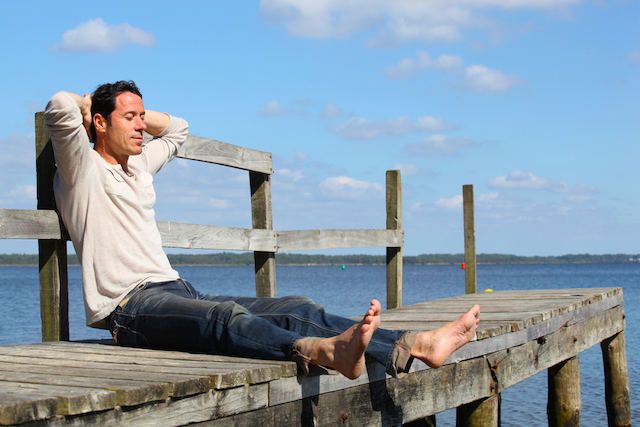
    Man sitting on pier

    “I never found a companion that was so companionable as solitude.” ~Henry David Thoreau

    Meditation makes you realize it’s not so much the silence as it is the not being around people that’s so profound. No human interaction, a human break if you will, is its own simple kind of joy.

    Who knew that as a species who can’t function without the social ties of community, it is solitude that re-charges us and gives us the strength to go out into the big, bad world and interact with that lovely mess I like to call humanity?

    In our hyper connected, overworked, extroverted, always-on-the-go American culture, the very idea of solitude can seem anathema to what we as Americans hold dear. The mere possibility that a person would skip out on social gatherings or not respond to work emails on the weekends because they want some alone time seems downright un-American.

    For most of my life I was (and still am, I admit) a quintessential “busy person.” I pretty much came out of the womb with a list of things on my to-do-list, and as I got older that to-do list became longer… and longer… and longer….

    But that was the way I liked it. Each time I ticked off a box I’d get a sense of satisfaction, a rush not unlike I imagine one feels after doing a line of cocaine or popping some ecstasy tablets. And, as with most drugs, once the satisfaction of accomplishing something on my list wore off, I would work on accomplishing the next thing, chasing that next rush, and so on and so forth, ad infinitum.

    I made the drug comparison purposely, because the constant need to be doing something can feel like an addiction if taken to the extreme. After each line on my to-do-list was checked off I couldn’t wait to add ten more things.

    And, not surprisingly, my incessant busyness was reinforced at every turn. It encouraged me to get good grades and load up on the extra-curriculars in high school, which in turn helped me get into an ivy league school for college, which then helped me get into a highly competitive medical school program… you get the gist.

    But once in medical school I kind of reached a breaking point and realized this treadmill life where I never gave myself a break was not sustainable.

    It was fitting then, that around this time I started to learn about meditation. I find it ironic that in the hyper competitive, fishbowl of an existence that is medical school I found the one thing that advocated the exact opposite.

    Once I started going to meditation classes and getting better at being in the present moment, I began to gain some introspection, which made me rethink this whole busyness thing.

    I actually started to worry a bit about my poor little restless soul and wondered if this is what it was going to be like for the rest of my life. This constant need to fill my days with something—anything—so I wouldn’t have to face the vast emptiness of doing… well, absolutely nothing. It was unfathomable to me.

    Living alone, however, made me change my perspective. As I got older and could afford to live without roommates, this whole world of solitude opened up.

    At first it was terrifying. As busy as I am, even I couldn’t fill every second of my waking days, so the restlessness grew stronger and stronger, until I thought I might explode.

    But once I got past this obsessive need to always be doing something, I loved it. I could just sit, literally. I started to feel like I had all the time in the world.

    Actually, I started to feel like time itself didn’t even exist anymore, and I could just sit there, forever, in my wonderfully empty apartment on my wonderfully empty couch with my wonderful self for company. I noticed that a previously unknown feeling started to make its way into my life. I believe they call this feeling serenity.

    A recent Pew Research Center survey asked: How important is it to you to have times when you are completely alone, away from anyone else? My answer: as important as being around people.

    In all my reverence for solitude, the fundamental truth is that solitude vs. sociability doesn’t have to be an either-or equation. They are both necessary if one wants to be a healthy, functioning adult. It’s just that we as Americans have way more of the sociability than the solitude.

    A wise person once said, “Don’t just do something, sit there.” So take some time out of your busy schedule each day to just be.

    No computer, no phone, no Internet, no TV, no music, no reading, no talking. Just you and your own crazy thoughts.

    Though it may be terrifying at first, you might be surprised at what you find lurking in the deepest corners of your mind. Peace, joy, forgiveness, clarity? There’s only one way to find out.

    Man sitting on pier image via Shutterstock

  • 6 Compelling Reasons To Spend Some Time Alone

    6 Compelling Reasons To Spend Some Time Alone

    “There are times when alone is the best place to be.” ~Unknown

    Some people think it’s awful to spend time alone—that it means you’re antisocial or no one needs you.

    Some people feel sad and lonely when they don’t have company every evening or weekend.

    But being alone doesn’t mean that no one needs you. And it can actually be quite useful to take some time to yourself.

    I am almost thirty. This is an age when you start to rethink your whole life, trying to understand what you should change or improve, what you should do next, and what specifically you need in your life.

    I felt this way a couple of months ago.

    I thought I’d achieved nothing in my almost thirty years, and I felt I should have changed something but couldn’t figure out what or how.

    I had to cope with my feelings, but the everyday chaos of my life didn’t allow me time to concentrate on myself.

    The decision came like a bolt from the blue—to spend some time completely alone.

    When you’re alone, nothing prevents you from listening to your inner voice, heart, and mind.

    Here are a few other benefits of spending time in solitude.

    1. It’s a great opportunity to recharge.

    We often try to make people around us happy and help them work through their feelings. This can be emotionally draining.

    For example, I have one friend who lives abroad, who comes online to talk to me only when she feels bad and wants to share all her problems with me. It takes a lot of energy and makes me sad and frustrated.

    Time spent alone helped me take a break from constant interaction with other people so I could recharge.

    2. It’s a good time to think and reflect.

    Life moves at a crazy speed. It doesn’t often give us time to stop and reflect. When alone, you have a great opportunity to focus on yourself.

    Thanks to my voluntary solitude, I had a chance to question whether I was moving in the right direction, I’ve realized what I should change in my life, and I’ve finally found time to relax and meditate.

    3. It’s a chance to understand what really makes you happy.

    When you spend time with other people, you often have to make compromises. There’s always a chance that what you want may not coincide with others’ wishes. When you’re alone, it’s only you who decides what to do.

    Do you want to spend the whole day lying on the beach? Go! Do you want to visit that contemporary art exhibition? There’s no reason to skip it. As for me, I’ve finally visited the city of my dreams, Prague. None of my friends ever had the time, money, or desire to go with me, but that no longer mattered.

    4. It makes you more productive.

    It can be fun and exciting to spend time with friends, but it can also distract you from things that are important to you, like exercise, hobbies, a long-delayed book, and unfinished work.

    Spending some time alone can be a good opportunity to make progress toward your personal goals.

    5. It makes you more self-reliant.

    We often seek approval from friends, colleagues, and family members before we take action or make a decision. There are times when it’s necessary to do this, but there are also times when it’s possible to act without consulting others first.

    When you’re alone, you’ll learn how to make decisions without anyone’s help. This was difficult for me at first, but in time I became more self-reliant.

    6. It teaches you to value people who are close to you.

    When you regularly take time for yourself, it becomes even more enjoyable to engage with others, as you’ve given yourself time and space to miss their company.

    Don’t be afraid of being alone. Very often it helps us understand who we are, what we want, and what we can do to become better people.

  • Why You Feel Alone with Your Feelings and Why You Never Are

    Why You Feel Alone with Your Feelings and Why You Never Are

    Man Alone

    “Life is actually really simple, but we insist on making it complicated.” ~Confucius

    There were times when I felt that my thoughts had complete control over my life. I could convince myself of anything, really. My thoughts would rarely lift me up and, instead, convince me I would fail.

    I would fail at relationships. I would fail at my job. I told myself I was a failure.

    I honestly believed that I was the only one who experienced this level of personal rejection. Of course, I knew that it wasn’t unique to me because I knew other people struggled with self-confidence.

    Yet, the people in my life never talked about their lives in this way.

    After years of feeling like this, I began to convince myself that I was indeed alone—nobody else could possibly have these crazy thoughts and feelings. As an introvert, even I wasn’t always comfortable talking about it.

    I wanted to know why my stomach always hurt before I talked in front of people, why I always sweat when I was nervous, and why I pushed people away, even though I desperately wanted to feel connected.

    As I discovered more about myself, I realized that I interpreted my emotions rather than actually experiencing them.

    For instance, I continue to get nervous before I formally speak in front of people. I don’t know if this will ever go away. As an introvert, it’s just not something I’m 100% comfortable with. In the past, I would turn this fear into a story.

    “I shouldn’t be nervous. I am better than this. I hate when I get this nervous because everyone will notice. I will look like a fool.” You tell yourself this often enough and you start to believe these stories. It becomes your identity.

    Now, I accept that I am fearful before giving a speech. That’s okay. It’s a human experience and it’s uncomfortable for people like me.

    I notice it and experience it for what it is. I don’t allow myself to make it something it’s not, and the nerves no longer snowball into the sweats, the stomach pain, the anxiety.

    I did this for so long because I couldn’t accept who I was. I wanted to be something I wasn’t. I marveled at people who appeared to be so confident and put together all the time. I wanted to be someone else, and I beat myself up whenever I didn’t meet those standards.

    The mind is a powerful thing—we all know this—so powerful it starts to analyze our basic human feelings, emotions, and experiences.

    Over time, this can cause debilitating anxiety or depression.

    After years of feeling this way, I got to a point where I was just exhausted. It was my own rock bottom.

    As an introverted guy, the biggest lesson I had to learn was that it is okay to feel emotions. That was the first step.

    At a deeper level though, it is also human to feel anything. This is just as natural as breathing, swallowing, chewing, and sneezing.

    I had to stop trying to control it all.

    It doesn’t mean I go around crying, laughing, and yelling at the world around me. I am just aware of my emotions, simply for what they are. Not intellectually aware, experientially aware.

    When we become aware of our feelings, thoughts no longer have the power to interpret them into something they’re not.

    I now understand that this is what connects all of us as people—our innate ability to experience life rather than analyze it.

    We are all capable of this.

    Despite this, why do we default to analyzing rather than experiencing our emotions? For one, I don’t believe we are taught and encouraged to talk about emotions. As a guy, this especially rings true. We are told from a young age to just buck up and figure it out.

    To the best of our ability at the time, we also try and protect ourselves from the world around us. Perhaps it was something we learned to cope as a child or young adult. The emotions were there but for whatever reason, we didn’t allow ourselves or were unable to experience them.

    But those emotions don’t just go away. So we busy ourselves to take our minds off of it. We rationalize how we feel (yet don’t actually feel). We overeat to mask how we are really feeling. Our stomachs continue to churn. We don’t sleep as well. We joke about our situation to make us feel better.

    We consciously or unconsciously build layer upon layer of protection, which only covers up what’s really going on.

    Only when we begin to peel away these layers and experience the pain we’ve covered up for so long can we begin to heal. The intellectual mind cannot do this because it continues to want to control and interpret how we feel.

    The more I peeled away these layers, the more I was able to let go of who I thought I should be and to experience the pain I’d held on to for so long.

    I thought I should be more successful. I thought I should be more driven. I thought I should be a better son, athlete, student, friend, and boyfriend. It was never enough.

    Only when I experienced the pain of the shame I felt as a younger guy, who made mistakes but did the best he could at the time, was I able to let go of that pain.

    The fascinating thing is after I experienced that pain, it no longer ate away at me. There was nothing to hide or cover up anymore. It was so simple. All of that pain was simply gone after years of it buried beneath protective layers of security.

    I let go of what should have been and experienced what was.

    The more you let go of control, the more you are able to experience an abundant life. The good, the bad, the beautiful, the ugly, the happy, the sad—they’re all part of the human experience. When we allow ourselves to experience all of it, we can then set ourselves free.

    We no longer act from a place of fear but rather a place of awareness.

    Start by allowing yourself to sit with your thoughts. As a thought arises, observe it for what it is—a thought, something this is not a part of your identity. Detach yourself from thoughts and, as you begin to separate thought from experience, you will see the two are vastly different.

    So, there really isn’t anything important in life to we need to make sense of, intellectually. Life is what it is and how we experience it. We need to remind ourselves of this:

    It’s perfectly okay to be human.

    Remember there are many other people out there struggling with some of the same things you are. After all, we are all human.

    We are not alone.

    Man sitting alone image via Shutterstock

  • Reclaim Your Power: Stop Waiting for Other People to Make You Happy

    Reclaim Your Power: Stop Waiting for Other People to Make You Happy

    Happy and Free

    “You alone are enough. You have nothing to prove to anyone.” ~Maya Angelou

    My knees hit the pavement, unable to hold me up as I watched my entire life purpose drive away.

    I had put my entire heart and soul into that relationship. I had sacrificed everything—my family, my friends, my career, my hobbies. And now I had nothing. What had gone wrong?

    I lay there for a while, quite convinced that the pain and unhappiness was going to be the end of me. I wallowed in the misery of it all.

    Then something touched my face. I brushed it away and opened my eyes.

    A breeze had shaken loose dozens of leaves from the autumn tree above me. Scarlet and gold and sunset orange leaves were drifting down to me. Beyond them was the periwinkle blue sky with gigantic fluffy white clouds floating about.

    I stared at the beauty around me. I had spent so long looking inward, criticizing myself, working to become better, to become enough for a person that had their own issues. And in doing so I had lost sight of just what a beautiful and amazing place the world could be.

    Putting my life on hold for others wasn’t getting me anywhere. I was miserable, I was broke, and I was alone. Enough was enough.

    Something was going to change, and in that moment I determined that what needed to change was me.

    I was no longer going to shut myself away from the world. I was no longer going to ignore all the good things that were out there. From now on I would live a life of open eyes, a life of appreciation, a life of simplicity, a life of happiness.

    In the following months I learned more about myself than I had in my entire lifetime, and in applying those lessons to my everyday life I became truly happy and deeply appreciative of the world around me. I also discovered the strength of the power within me.

    Here is what I have learned:

    No one will ever love you as much as you can love yourself.

    If all you want is to be loved, you need to understand that no one will ever fulfill that feeling as much as if you wholly and completely loved yourself. Many of us have grown up with movies like Jerry Maguire that promise a perfect person who will complete you.

    It may seem radical, but what if that person was you? What if you acted as your own true love? Choose love for yourself over the fear of being alone and realize your own power.

    No one is worth sacrificing your values for.

    We all sacrifice a certain part of ourselves for others, whether it’s deciding not to get a cat because your significant other is allergic, or getting up early every Saturday to drive your child to football practice. These sacrifices are a way of showing we care about another person’s happiness and well-being.

    But anyone who cares about your own happiness and well-being with never ever want you to sacrifice your values. Our values are what define us as human beings. To deny them is to deny our very essence. Stay true to them and to yourself.

    There is always something to be grateful for.

    Just as in my darkest moment I saw how truly beautiful this world could be, so can you find something to appreciate.

    Take time out every day to witness the wonders that exist not just around you but within you. From the way your body allows you to run and jump and dance and sing, to the sunshine and fresh fruit on a summer’s day.

    If you take the time to notice it, life is really very wonderful.

    Spending time alone doesn’t mean you have to be lonely or bored.

    When you spend time alone you learn more about yourself than you ever could in a crowded room.

    By being alone you can determine your own likes and needs without any external influences. You can discover passions you never knew existed, and when you don’t have to worry about what other people will think you are able to pursue them wholeheartedly.

    There is always something new waiting to be discovered. Seek it out and become your own best friend.

    When you say no, you open yourself up to more meaningful yeses.

    By being a people pleaser and saying yes to every opportunity that crossed your path, you may have thought you were doing yourself a favor—that people would appreciate you more. But without creating boundaries, you give people an opening to take advantage of your generous nature, and risk becoming burnt out and resentful.

    Instead, learn the power of no. Take time out for yourself so that when you do say yes, it’s sincere and meaningful.

    Change and grow a little each day.

    No matter how much you feel you’ve lost yourself, you can always instigate change and rediscover who you truly are. It’s okay to start small. Try a new hobby, go on a holiday, do something you’ve always wanted to try. Expand gradually. Learn a little more each day.

    By putting yourself first you can discover who you truly are and form an identity separate from any other person and unique to you.

    By forming a loving, happy, confident base to work with, you teach others to respect you as a person. When you become a whole and complete individual it doesn’t matter what storms appear in your horizon; you will have the strength to weather them.

    Photo by blob-fish

  • Are You Limited by the Fear of What Other People Think?

    Are You Limited by the Fear of What Other People Think?

    “It is not uncommon for people to spend their whole life waiting to start living.” ~Eckhart Tolle

    A few months ago, I found myself on the busy streets of London’s Covent Garden.

    It was a mild Friday evening in the capital and the masses were out celebrating the end of the working week, looking forward to the weekend ahead.

    But that’s not why I was there.

    I’d come to Covent Garden on that day for a special project.

    For most of my life, the fear of what other people thought of me had kept me trapped. It had prevented me from reaching my full potential and from enjoying life to its fullest.

    I couldn’t bring myself to dance in public for fear that people would point and laugh. At work I was unable to voice my opinions for fear they’d be thought stupid. And at my lowest point, even walking down the street became a struggle, as my mind ran wild with images of people talking about and laughing at me as I went by.

    I lived a half-life. I knew I was missing out. I also knew I had so much more to contribute to this world. But I was paralyzed by the fear that if I put myself out there I’d be ridiculed and rejected.

    And so the “real me” remained cocooned somewhere inside. I knew she was there, I knew who she was, but fear kept her trapped.

    But sixteen months ago, things began to shift. Filled with an increasing sense that I wasn’t living my purpose and a vast emptiness from the lack of meaning my life seemed to have, I quit my corporate office job in search of answers, determined to live a more fulfilling life.

    I made a commitment to myself then to face each and every one of my fears and to find a way to reconnect to the real Leah and let her out into the world.

    The last sixteen months of my life have been challenging, as I commit every day to living a little further outside my comfort zone. But being in that space of discomfort and crossing the threshold from fear into courage has led to the fulfilment I craved as I realize just how much I’m capable of.

    I’d be lying if I said I no longer gave a second thought to what others think, but for the most part I can push past that to do the things I know I need to do.

    And so it is that I arrived in Covent Garden, in the hope of now encouraging others to free themselves of that fear of what others think and embrace life in its entirety.

    And so there I stood, on the crowded streets of London that evening, holding a sign handcrafted from old cereal boxes, saying:

    “How often does the fear of what other people think stop you from doing something?”

    The reaction to this simple question left me gobsmacked.

    People stopped and took notice.

    Some smiled knowingly, acknowledging that their own lives had been affected by the fear of what others think.

    Some nodded with something of a sad look on their face. Perhaps there was something they really wanted to do but were being held back by that fear.

    Others engaged in conversation, sharing their stories of how the fear of what other people thought had touched their lives or how they’d learned not to care so much.

    That day, I experienced for the very first time the extent to which the fear of what other people think affects our lives—all of our lives. What might we be capable of if we could let go of that fear?

    I went home that evening having learned some valuable lessons…

    You’re never alone.

    Too often we suffer our fears in silence. We believe ourselves to be the only one.

    Everywhere we look we seem to be surrounded by confident people.

    But I’ve come to realize that everyone—those who appear confident or shy; extroverts of introverts—we all, each and every one of us, are struggling with our own fears.

    When the fear of what other people think is holding you back, take a look around and remember, everyone is living with his or her own fear. You are not alone.

    By confronting your fears, you help others confront theirs.

    More than anything, when you stop caring what others think and set out to achieve your goals and dreams, you give others the power to do the same.

    Someone is always watching and wishing they had your courage. By stepping up to your own fears, you really do help others face theirs.

    Be vulnerable and honest. Being open about your fears and confronting them head on could be the greatest gift you ever give.

    What you think they think isn’t the reality.

    Those people over there? The ones you think are talking about you? Judging you? They’re not. Really. They don’t have time. They’re too busy worrying about what people are thinking about them!

    And even if they were looking at you, judging you, talking about you, you can be almost certain they’re not saying the awful things you imagine.

    Instead, they’re envying the color of your hair, your shoes, the way you look so confident.

    What we think people think of us usually doesn’t come close to the reality.

    Freedom from the fear of what others think is possible.

    The fear of what other people think of us is like a cage.

    Over time you become so used to being inside that cage you eventually come to forget what the outside might be like. You resign yourself to living within its walls.

    By taking deliberate and purposeful action to overcome the fear of what others think of you, you slowly regain your freedom and escape from the confines of the prison you’ve created for yourself.

    And life outside that cage? It’s pretty awesome!

    It’s a place where you can be the person you always knew you were meant to be.

    And that, being fully self-expressed, being everything you know you are, fulfilling your greatest potential in life, well, that’s the greatest feeling you could ever know.

    Don’t let the fear of what other people think stop you from living the life you were born to live.

    Photo by PhObOss

  • Hang Up the Superhero Cape: We Don’t Have to Do It All Alone

    Hang Up the Superhero Cape: We Don’t Have to Do It All Alone

    Superhero

    “When we can no longer change a situation, we are challenged to change ourselves.” ~Viktor Frankl

    In the spring of 2008 when my son was only seven months old, I received a text message from his stay-at-home dad while I was at work. The text read, “He’s in the crib.” I did not respond because those five words said everything I needed to know.

    My son’s father had left us, and worse, he had left my son alone in his crib. I was at work fifteen miles away. 

    Adrenaline is an interesting thing. I don’t remember many details about that day except the text and the number of red lights I drove through to get to my son. Four.

    No one is ever prepared for events like these at any time in their life. Trauma, loss, and adapting to change are hard for all of us and for the people around us, as well.

    I come from a family culture that encourages “being strong,” which translates roughly into not asking for or needing help and continuing on with life as if all is well—at least on the outside.

    In fact, I have spent most of my adult years cultivating a life of self-sufficiency and independence, and I approached this experience no differently. I went into action mode and didn’t allow myself too much time to think about or feel the emotional impact of what had happened.

    I did not miss a single day of work through all of this. I just woke up, did what I needed to do, and went to bed. Every day.

    When my son went through a superhero phase, I wore the outfits too. It fed the image I had of myself as able to take on anything life wanted to throw at me. And I could even do it in white vinyl boots.

    Self-sufficiency worked well for me in the past as a single person, but not as a single parent.

    Facing this new life that involved another person (my son), using my old coping skills, slowly caught up with me in the form of health issues, depression, and problems with relating well with others in almost every area of my life.

    It become clear to me that something had to change. But I was not ready to let go of the idea that I could handle everything. If anything, I thought what I needed was more money, a different home, or maybe a different job.

    On some deeper level I knew that I had to internally change, but I convinced myself that to do so was impossible with my current life situation. I had to be strong.

    Instead of starting up the face of what I perceived as an impassable mountain, I clung to the hope that something external would change and I could do life the way that I had always done it.

    I did not or could not see that holding on to my old way of relating to the world was requiring far more energy and resulting in far more pain. I was not living self-sufficiently. I was still in survival mode, which is never a viable long-term solution.

    But then, as often happens to the most stubborn of us, I hit bottom. I was ill, alone, and worried about my son’s future, with or without me.

    That was when I finally embraced the possibility that I could completely let go of and live my life without ground under my feet. This would require me giving up my current self-image. And I had no idea what the outcome would be.

    What I learned was that by making these internal shifts, my life would improve without anything (or anyone) changing around me.

    Hang up the superhero cape.

    I became willing to let go of the idea that I could (or should) do everything, be everything, and handle everything on my own.

    Notice that I said, “Became willing.” I hung up my superhero cape and relinquished the badass title. But the cape is in the closet and I admittedly peek at it now and again. I just don’t let myself put it on unless it’s Halloween.

    Engage in a daily mindfulness practice.

    I went back to a consistent yoga and daily meditation practice.

    When I stopped the constant activity and started paying attention to what was going on inside of me, I began to notice how quickly things come and go if we let them be. Happy, sad, joyful, anxious—here now and then gone.

    This daily practice has helped me learn to stay in the moment and not take my thoughts very seriously. So, when the urge to put on the superhero cape returns, I gently say, “thinking.”

    Practice gratitude.

    I began to accept my life the way it is rather than hoping it would one day change. By practicing mindfulness I spend less time in my head planning how I would like things to be one day.

    When I wake up in the morning, before I get out of bed, I say thank you and smile. I do the same when I go to bed. It is such a small act but with such profound results. Try it.

    Give freely and receive freely.

    The giving part is pretty easy for me. But asking for and receiving help is still an ongoing challenge.

    Staying in the moment helps identify the feelings that arise that try to convince me that asking for help is a sign of weakness and that receiving help makes me a burden.

    The truth is that giving and receiving help are two of the greatest gifts we can give to ourselves and to others. When we drop the superhero cape and receive from others, we are allowing them an opportunity to be of service, feel good about themselves, and to improve their karma!

    Don’t take life personally.

    It takes a lot of useless energy to determine why things happen. I could spend hours replaying the events of my life with different endings, wondering what I could have done differently or trying to determine who is to blame.

    The truth is, no matter how much we try to exert control, we will all face challenges and we will all experience suffering at some point in our lives. No one is exempt from pain. No one.

    In fact, taking some time to recognize the extent to which people suffer is a useful exercise that helped me develop acceptance of my own situation and allowed me to develop compassion—for myself, for my son’s father, and for others.

    It’s a spiritual work-out.

    Many people have great ideas to help you in this process but few talk about how hard it can be. It can be hard, but not as demanding as being a superhero.

    It also feels, at times, very confusing to travel a great distance in how I respond to the world only to find myself completely lose it—I mean really get hooked back into the old ways one day with a partner or at work or in traffic.

    Don’t get too caught up in an end result. If thoughts come up about what a waste of time all of your efforts to date have been, just notice them and gently say “thinking.” You might need to say, “thinking” a few dozen times. This is good. It is all good.

    Breathe.

    Probably the single most important thing you can do to change your life for the better without changing a thing around you. Take a deep breath.

    Let it be.

    Photo by Zach Dischner

  • Why We Need Disconnected Alone Time (Without Social Media)

    Why We Need Disconnected Alone Time (Without Social Media)

    “Do not rely completely on any other human being, however dear. We meet all life’s greatest tests alone.” ~Agnes Macphail 

    I have found that the more time I spend alone, the more comfortable I become in my own skin because I can truly get to know myself. This provides me with more patience to accept myself as I am, wherever I am in my journey, on a daily basis.

    This lesson was something I learned after spending a summer alone in Italy with a family friend.

    I embarked on the journey, turning off my phone for the first time, well, probably ever. I would be jetting all over America then landing in a country with a family basically unknown to me.

    It wasn’t until two years after I returned that I wished I had spent more time living in the moment while experiencing the greatest adventure of my life. I was not comfortable enough in my own skin to truly be present in the magical moments presenting themselves in a foreign country.

    My mind stayed distracted as I wondered what people were thinking of me, and what I would post online to my friends back home.

    At nineteen years old, it seemed much more important to capture photos to upload to social media. The Internet was a crutch for me to not feel so alone in an unknown territory. As brave as I was to be completely alone in my adventure, I had a thousand people to “connect” with on my lonely nights!

    Two years later I realized that I could have filled my days with activities for growth.

    I now wish I had traveled to nearby cities, spent my days reading in a cafe, tried acupuncture—anything out of the ordinary.

    The truth was I didn’t have the hobbies I have now. The trip did help me grow, but I regret that I could not simply enjoy the moments instead of wanting thousands of others to see I was enjoying them.

    I discovered that if I want to be happy, it would be my own doing. Happiness is an interior process and comes without validation from others.

    This is something that is a lesson to be relearned each day.

    Spending small moments of time alone—sans phone, tablet, laptop, TV, and radio—allows one to really tune in. We need to ask ourselves things like: What is my body telling me today? How do I feel today?

    There are all kinds of things we can do to enjoy our alone time, some of them very simple. I enjoy my shower, my yoga practice, and the scenic drive home, all without communication to the exterior world. This helps me to really absorb my practice and just “be.” I find it helpful to journal, old fashion style, with a pen and paper after this little escape.

    To figure out if you are relying on others, ask yourself: What have I done today, only for myself? Do I need to have my cell phone? Or can I stow it away and just be?

    You may also want to ask yourself: Am I taking a photo so I can remember this occasion, or so others can see how I spent my hour? Am I updating my social media because I want to, or because I need validation through likes and posts to be happy?

    Lastly, ask: What would happen if I stopped seeking the opinions of others to fuel my happiness? Would the world still accept me if I spent less time trying to win their approval?

    The only one keeping you away from your true self is you.

    Practice spending an hour a day doing something just for you and keep it a secret. Relish in the fact that this activity is just for you.

    Once you grow fond of spending time alone, you can start to increase the amount of time you spend on your “secret” activities. Eventually, your presence in the moment will grow as you stop seeking approval and recognition from others.

    I find that when I take a day off and unplug, I emerge fully ready to engage with others with more energy and enjoyment.

    When your brain stops worrying about what others think of you, what you should have said or done, you can truly listen to your friends and provide feedback and attention.

    Trust in yourself and feel powerful in the fact you are taking your happiness into your own hands.

  • Signs: A Simple Short Film on Communication

    Signs: A Simple Short Film on Communication

    Signs is a simple short film about reaching out, connecting, and feeling less alone. We are never alone.

  • Helping Others Helps Us All: We’re All in This Together

    Helping Others Helps Us All: We’re All in This Together

    breaching

    “Pain is not a sign of weakness, but bearing it alone is a choice to grow weak.” ~Lori Deschene

    I, like many of you I’m guessing, am a wanderer. A student of the soul. At times it can be a bewildering path. Most days I give thanks for the adventure. Many others I wish for clarity and certainty.

    But though I am a wanderer, I am not aimless: I have a path as deep and true as any other. I simply have no map to guide me, only my intuition, and the myriad teachers that cross my path: people, places, books, ideas, synchronicities.

    I have learned to trust my inner senses. When I am on my path, my life feels good and right; off it, I am aware that I am scrambling through the undergrowth and finding my way at the edge of cliffs.

    For a long while I wondered what this path actually was. What was it that defined some actions as “right” for my soul direction, and others “wrong”? Especially when many of them seemed to appear synchronistically, out of the blue, and were counterintuitive.

    The idea of a “path,” or what Lao Tzu calls “the Way,” works for me.

    It’s as though there is a channel through life that is “right” for each of us to take. An invisible highway of least resistance in the midst of white noise, which resonates at the same frequency that we do and seems to draw us forward, exerting some sort of magnetic pull.

    When we are on it everything makes sense, we find flow better, we feel right in ourselves, we have a sense of something larger than our own small ambitions guiding us.

    I have begun to see that the path, this invisible pull to our souls, is in fact our own personal way to wholeness: our own unique healing prescription.

    Our path, I have learned, takes us through the experiences, thoughts, and meetings that will heal every aspect of our selves, even, and especially, those that are hidden from our conscious awareness.

    The words “whole” and “heal” come from the same root. To reach wholeness, we must heal from the wounds and distorted vision that life and our perceptions have wrought on us.

    Therefore, each healing path must be unique, as each of our woundings is unique. And yet they each share many similarities, because in the end we are all humans and our stories cross over.

    This is the part that many of us miss. We are so focused on “finding me,” on healing ourselves, that we walk on our individual paths looking down at our feet. We forget the fellow travellers around us. And this is where our ability to fully heal is lost, because we cannot do it alone.

    The emphasis in Western medicine, the self-help and personal development movements is very much on the individual. “You’re the most important thing in your life” messages have trumped the greater truth, which is that we are tribal creatures and herding mammals.

    We are only as strong as our weakest members. The fate of us all lies in all our hands.

    If you see a group of migrating birds, a shoal of fish, or a herd of wildebeest, there is a constant communication going on between them. They move as one, navigating canyons and predators.

    They listen for the calls of others, and they listen to the instinct within. Both guide and steer them. Both have equal weight. But the overriding aim is to find the path and stay on it together, to find the safe way, the yielding way together—to get through together.

    One day last week, feeling frustrated at myself and the seemingly disparate roles that I could not quite reconcile, I had a realization of immense clarity; I could not let go of any of them because they were all actually different facets of the same thing: healing.

    The internal guidance system that leads my work as a writer, teacher, editor, and artist; my roles as mother, daughter, partner, and friend, are all one big journey of healing myself, and sharing that process with others for their own healing.

    My instinct to heal and to help others heal are equally strong driving forces that determine my whole life.

    This is what I love about all of my heroes: their dedication to healing, and their willingness to reflect on their pain and share what they have learned.

    Then I zoomed out and saw it from a much larger perspective—that this is some human instinct, a basic herd instinctthe need to help to heal the herd, to keep us all together, all moving in the same direction. 

    Like the race that an African tribe does, the aim of which is not who wins or runs longest or fastest, but that everyone finishes together.

    Sue Monk Kidd reflects on this herd healing in her beautiful book, Dance of the Dissident Daughter.

    She recalls watching a nature program about whales and seeing these behemoths throwing themselves out of the water and crashing down on their backs.

    The narrator shared that naturalists believe that breaching, as it is called, might be their way of communicating when the seas get rough. A spectacular way of creating strong vibrations in the water, marking their route so that the others in their group would not get lost.

    She reflects on how women do this too, an example that I feel applies to all humans:

    “Women must have the whale’s instinct. When we set out on a woman’s journey we are often swimming in a high and unruly sea, and we seem to know that the important thing is to swim together—to send out our vibrations, our stories, so that no one gets lost.”

    So here we are, the waters are rising on this precious Earth of ours, the storm waves crashing. Many of our global population are tired, have lost our bearings. But the instinct is strong. Many of us who are aware of the need for healing are calling out, breaching: “This way, this way!” we call.

    We share our stories, show our healing, so that others might find their way onto the path of healing too. So that person by person, community by community, country by country we might find a better way to live. So that we can find healing for our whole herd, and a path, a way through.

    Sometimes I doubt myself. I wonder why I do my work. But now I know. I do it for me just as much as I do it for you.

    I speak or paint or write or dance with One Billion Rising, because I am adding my vibration, which is the most basic thing I can give. Because I yearn to the depths of my soul to be healed. To be free from suffering. To see those I love and those I don’t know free from suffering too.

    So I ask you, every time you feel the instinct rise, like a whale breaching in the center of your soul, with the urge to reach out and share words of love, gratitude, kindness, forgiveness, appreciation, hope, and healing, do it.

    Every time you feel the desire to give a stroke, kiss, hug, gift, or smile, but you think it makes no difference, or that you don’t have time, do it.

    It matters. More than you could ever know.

    In fact, it’s really the only thing that does.

    Photo by Nesbitt Photo

  • Relationships Should Complement Our Identities, Not Define Them

    Relationships Should Complement Our Identities, Not Define Them

    “On a deeper level you are already complete. When you realize that, there is a playful, joyous energy behind what you do.” ~Eckhart Tolle

    The first rain after a long draught gets people talking about cozy things. Being with others, being physically close to others, going out in groups, staying in with someone. Sharing affection. Cold weather seems to always entail groups and partnerships.

    What about when those groups and partnerships are missing from the tableau? The other night I was sitting in my apartment with my lanterns on, some incense burning, and some good reading material. The rain was trickling outside my window. The moment was perfect.

    For once in my life, I didn’t have my normal thought: “This moment is so beautiful, but it would be better if someone was here to share it with me.” I was completely at peace, enjoying the presence of my own heart and mind.

    This might not seem like a huge “Eureka!” moment, but it was for me.

    I grew up an only child, so I’ve always craved that group interaction and the comfort of crowds. I made friends easily and was sometimes accused of serial monogamy; I was rarely single for longer than six months. I always felt surrounded—and by being surrounded, I felt protected.

    Three months ago, however, I quit a job that made me unhappy and a relationship that was going nowhere, which had filled most of my time. I was face to face with myself in a frightening and jolting pause. I no longer had the noise of others to fill my silences.

    Friends advised me to go out, work out, or find someone else. I did all three, sometimes in excess.

    It alleviated my pain for a brief time. But I still felt hopeless, directionless. I took the long way in realizing something important: I needed to fall back in love with myself, which meant getting to know myself again, apart from the influences of everything else in my life.

    I had spent so much time being something for others, filling my life with adaptation, that I had forgotten what it was like to be me. (more…)

  • Pushing Outside Our Comfort Zone: 3 Empowering Lessons

    Pushing Outside Our Comfort Zone: 3 Empowering Lessons

    “Our lives improve only when we take chances and the first and most difficult risk we can take is to be honest with ourselves.” ~Walter Anderson

    I recently returned from four weeks of traveling by myself in Europe. No, I’m not bragging, although it was pretty awesome.

    What made it amazing, besides the lovely scenery, tasty food, cultural experiences, and wine, was that I had a few great opportunities to re-visit some lessons that I think many of us could resonate with.

    1. It is awesome to make decisions based on what supports our goals, not our fearful feelings.

    Let me explain: My main goal in traveling alone was, well, to get comfortable traveling alone!

    At the start of my trip I stayed with a great friend in Germany, and the plan was to catch up with her for three days before going on to Berlin (and the rest of my trip) on my own. The day before I was to leave her, I received an email from the person I was renting the Berlin room from. They informed me they had a family emergency and the room would not be available.

    At first, I wanted to take it as a sign that I shouldn’t go on to Berlin. Every part of me that was unhappy about traveling alone screamed, “Stay here, it’s easy and comfortable, don’t go…”

    I spent about five minutes wondering if it was a sign not to travel on, and then I got over it. I got online and very quickly found a great Berlin apartment to rent for the amount I had been prepared to spend on only a room. Sweet!

    If we look back over our lives, many of us would recognize that there are all sorts of things we would not have done if we’d listened to our feelings.

    How about not applying to our dream school because we didn’t feel smart enough? Or not asking out that hot guy or gal due to fear of rejection? Or, oh man, not singing karaoke because we don’t want to be laughed at (which is actually what’s supposed to happen when we sing karaoke)?

    We would have missed out on some pretty fun and fabulous experiences if we hadn’t sometimes put our feelings aside and taken a bit of a leap. (more…)

  • Reaching Out for Help When The Road Gets Rough

    Reaching Out for Help When The Road Gets Rough

    “Pain is not a sign of weakness, but bearing it alone is a choice to grow weak.” ~Lori Deschene

    There was a time in my life when I struggled to share my pain. I actually took great pride in how stubborn I had become. It wasn’t until I started looking within myself that these prideful attitudes started to shift. Actually, my whole life started to change.

    Once I started my journey of self-discovery, I no longer wanted to deal with my pain by myself. I slowly reached out to others and asked them for help.

    It was in asking for help and sharing my pain with others that I felt myself getting stronger. 

    I didn’t expect, however, that I’d need to ask for help repeatedly.

    In August of 2006, I was with a small group of people inside a airplane hanger that was used as a classroom to give instruction for skydiving. Worn-out couches and old beanbag chairs formed  a circle where we gathered. The décor on the walls was something you’d find in a local head shop that sold 60’s and 70’s paraphernalia.

    A positive vibe filled the room, as a young instructor prepped us on the safety procedures needed for jumping out of the plane.

    It had been sixteen years since I had made my first jump. When I shared this information with the instructor, she asked me, “What took you so long to come back?”

    I didn’t respond out loud, but simply smiled. I wasn’t brave enough to explain why I had come back this time.

    Initially, I jumped in the fall of 1990 as a way for me to turn my life over to  a higher power; that jump marked the beginning of my inner journey.

    Skydiving had helped me change my life from despair to hope. For me, it wasn’t about seeking adventure or adrenaline; it was about letting go and finding myself. I had no intention of making a second jump.

    But I eventually discovered that my first jump was only the beginning of my journey.

    Why did it take me sixteen years to come back? Pride and stubbornness kept me away. I didn’t want to admit that things in my life had become difficult. When I did, I felt that I needed to return to skydiving to help me, once again, let go. (more…)

  • Depending on Yourself in the Uncertain, In-Between Space

    Depending on Yourself in the Uncertain, In-Between Space

    “To get something you never had, you have to do something you never did.” ~Unknown

    Life has been strange the past few days.

    All summer there was a trip or an event to count down to the final move—my brother’s wedding in Sedona, Captiva Island with my boyfriend’s family, Thailand with a girlfriend and, finally, a week in Atlanta.

    I have nine days left before the movers come, and I feel as though I’m existing in a space without anything to hold on to.

    My world here in Florida will soon be a memory, and I have no way of knowing what my life in North Carolina will look like. I fantasize about it, but it’s all conjecture.

    The summer getaways provided a distraction for me, obscuring the view of the unknown that was swiftly approaching. My former relationship acted as a life preserver that I knew would be with me no matter where I floated. Now, both have dissolved into the past.

    Very few people in this world feel an obligation or a desire to plan their lives around you.

    Although I have been gifted with amazing and loyal girlfriends, they have their own lives. It’s my parents and significant others that I have counted on for the heavy labor, when the help I need is neither sexy or fun.

    Although my ex-boyfriend would help me move with kindness in his heart, I don’t want to depend on him for this. It seems like I would be carrying on the illusion that I still have the security of our partnership. And what about my parents? Isn’t that always a loaded question…

    At 29, I am confused about my parents’ role in my life.

    While they offer to do whatever is in their power to make difficult times easier for me, their assistance comes with some strings attached. As I move toward making decisions in my life with less input from them, I am also electing to forgo their help in many ways.

    People with long-time partners or even those who still have a cozy and safe place with their parents can say, “What’ the big deal? You’re a grown woman; you can move by yourself.” (more…)