Tag: afraid

  • How to Coexist with Fear (and Spiders)

    How to Coexist with Fear (and Spiders)

    “If you are willing to look at another person’s behavior toward you as a reflection of their relationship with themselves rather than a statement about your value as a person, then you will, over time, cease to react at all.” ~Yogi Bhajan

    Several years ago, I hiked into the remote forestlands of Bukidnon, a mountainous province in the southern Philippines. I was there to make a documentary about the Pulangiyēn people, an Indigenous community living in the village of Bendum. No roads led there. No running water. Just a winding trail upwards, a slow-moving carabao pulling my camera gear, and a few kindhearted villagers helping me climb.

    I had come with the intention to listen—to observe daily life, record sounds, and learn what I could. What I didn’t know was that one of my deepest lessons would come not from the forest or the people, but from a spider.

    A very large spider. Hairy. Big and spidery.

    My lodging was a small, hand-built hut with bamboo walls and a woven floor mat. I felt honored to stay there, grateful for the simplicity and peace and the respite from the rains. But my gratitude dimmed a little when I noticed, down on the floor in the corner of the room, a dark shape—a spider. Motionless. The size of my outstretched palm.

    I asked one of the locals if it should be, well… removed.

    They smiled gently. “It lives there,” they said.

    That was it. No concern. No plan to catch it in a cup and carry it away. The spider wasn’t a problem. In fact, to interfere might have been seen as disrespectful—not only to the spider, but to the spirits believed to dwell in all things, visible and invisible.

    So I had a choice: coexist or live in fear.

    The Challenge of Coexistence

    At first, I couldn’t sleep. Every creak of bamboo startled me. I imagined the spider descending on my face in the middle of the night. But day after day, the spider never seemed to move around much; at least I was not aware of any major roaming around by the beast. And slowly, I began to wonder—what exactly was I afraid of?

    It wasn’t just the spider. It was the unknown. The loss of control. The feeling of being vulnerable in a place far from what I understood.

    But here’s what I learned: coexistence is not about agreement or comfort. It’s about choosing not to reject or destroy what we don’t yet understand. It’s about pausing long enough to see whether what we fear is truly dangerous—or whether it’s just unfamiliar.

    That spider became a mirror.

    Fear Isn’t Always a Problem to Solve

    Over time, my relationship with the spider shifted. I stopped checking the corner obsessively. I still noticed it, but I didn’t react. I stopped trying to protect myself from something that wasn’t actually threatening me.

    In the quiet of those forest nights, I began to think about all the other things I’d tried to avoid or control in life—conversations, emotions, uncertainties, even my own sense of failure. The pattern was the same: discomfort would arise, and I’d try to evict it.

    But this experience showed me a different way: you don’t always need to solve the fear. Sometimes, you just need to sit with it. Let it stay in the corner.

    And over time, your relationship to the fear changes. You grow larger around it.

    In the Indigenous worldview of the Lumad people, coexistence isn’t an abstract concept—it’s life. Trees, rivers, stones, animals—everything has a presence, a role, a spirit. You don’t have to like every being you share space with. You just have to respect it.

    This is echoed in many traditions. In Buddhism, the practice of metta encourages us to extend loving-kindness not only to friends but to enemies, strangers, and even things that scare us. In modern mindfulness practice, we learn to observe our experience without judgment, to allow thoughts and sensations to come and go.

    Even ecology tells us: thriving systems are diverse, and balance depends on the peaceful presence of all things—even spiders.

    What I Tell My Students Now

    I’ve taught filmmaking and storytelling for many years. My students often wrestle with fear—fear of being seen, of not being good enough, of making mistakes. Before, I tried to coach them out of it. Now, I teach them to make room for it.

    I tell them about the spider.

    I tell them about the time I shared a hut with something I was afraid of—and how, by coexisting with it, I changed more than it did. The fear didn’t go away. But it stopped running the show.

    So the next time something in your life scares you—not because it’s harmful, but because it’s unfamiliar—see if you can let it stay in the corner a little while longer. Don’t push it away. Don’t judge yourself for feeling it. Just breathe.

    Let it be there.

    You might discover, like I did, that peaceful coexistence is possible—even with the things you never thought you could accept.

    And once you learn that, there’s very little left to fear.

  • How to Release the Fear That Keeps Our Lives Small

    How to Release the Fear That Keeps Our Lives Small

    “Being cut off from our own natural self-compassion is one of the greatest impairments we can suffer.” ~Gabor Mate

    It was late at night, and I couldn’t sleep. I could almost hear the thudding of fear that was exploding in my chest. I tried to identify the singular cause of the fear, but it didn’t feel like there was just one thing.

    There were so many things.

    It was the world at large and problems in it; it was how my kid was feeling this morning when they got home from school. It was the rift between my husband and me, feeling so much like I couldn’t reach him to build a connection again. It was work and the state of my health. I was eating too much, always unexercised, ever stressed.

    And I could feel that night the icy fear that liked to crawl up my spine and fill me with abject horror.

    I just wanted my life to change in so many ways, so I could rid myself of this fear and be over it already.

    After this night, and the hundreds of other nights like it where I lay awake unable to sleep, feeling so very bad about my life, I learned something very important. That the fear that existed inside of me was actually very, very old, and it was the same fear that was simply playing on repeat, over all my life. Instead of dealing with the hundreds of things that scared me, I had to go to the source of the fear.

    Fear had embedded itself into my bones at an early age, passed on from my parents, and exacerbated by terrifying experiences that I’d had. And it had stayed locked in my body like a confined animal lying in wait, because I had never received enough emotional safety to allow it to release from my body.

    Oh, how I hated this fear.

    The list of things I was terrified about was overwhelming, and it filled me with such deep shame about who I was now—a grown adult with children, a business, and a husband. That I could be someone who was almost afraid of their own shadow repulsed me.

    When I reflect back and think now about that woman, that poor, terrified woman, looking out at the world and feeling so alone in her fear, I feel so much sadness. Not so much about how scared I was—I understand now why I had so much fear in my body and why it stayed there—but because I felt so much shame for feeling that way.

    It was like a double whammy of emotional pain—fear in itself is a big, hard, tough emotion to experience day in and day out. And it requires compassion and understanding. Adding deep feelings of shame that, somehow, I was wrong to feel like this, made the fear so much harder to handle.

    I yearn to scoop up that woman and hold her and say, “It’s okay. It’s going to be okay.”

    What made the difference to that woman lying in perpetual fear and to the woman I am now was that I learned about how emotions actually work. And I learned how to work with emotions so they didn’t stay trapped inside my body, growing ever bigger by the decade, creating a life that kept getting smaller as the fear seemed to have seeped out and tainted so much of it.

    I no longer have a growing list of things that scare me. In fact, I have an ever-shortening list of things that scare me, as I have learned how to not just work with the emotion of fear in the present, but to release the gigantic weight of the past fear that I had been carrying.

    Decades of fear that had stayed in my body, unable to release and coloring my world view so dramatically.

    What really helped me make a huge shift was when I learned to support myself through feeling the emotion of fear. To build a feeling of safety to hold these feelings in my body. To allow them, the sensations they create, in order to be fully present. Feel them and then they have the chance to release.

    And this is because our emotions want to be seen, felt, and heard. It may sound illogical, but just because we are feeling emotional doesn’t mean we are actually feeling our feelings.

    Most of us, to be honest, are resisting our feelings—trying to move away from them as fast as possible, thinking our way out of them, trying to talk our way out of our feelings or fix the situation/our lives/the people we feel are to blame.

    We aren’t accepting them, welcoming them, and allowing them—which is what our emotions want.

    When emotions arise, the first thing we need to do, instead of staying on the runaway train of thoughts—the endless cascade of thoughts that all humans have all of the time—is move our attention to our bodies.

    We notice: How is the emotion showing up in my body?

    What does it look like or feel like?

    What sensations am I noticing? Heat, heaviness, tension, constriction?

    And when we notice the sensations, maybe the sensations get stronger. I like to think of it like it’s relieved that, finally, we are paying attention to it.

    When we aren’t used to paying attention and staying with the sensations of, say, fiery anger or nauseating fear, it can feel like a lot. So we want to be gentle with ourselves, taking baby steps to learn how to tolerate the sensations the feeling is creating in our body. Taking tiny sips of the emotion until we can hold more.

    Emotions love to be met with empathy and understanding, so this is my next step. For many of us we have gotten so used to feeling aggrieved or scared by our feelings that we will feel judgment about the feeling being here.

    I shouldn’t feel like this!
    What’s wrong with me that I get so angry / sad / scared all the time?
    Why can’t I just stop feeling so ashamed?!

    So, if that’s you, if you load on judgment when you notice your feelings, try this instead.

    Offer a pause and some empathy.

    Oh, look, fear is here. That’s a tough one for me.
    It makes sense that I feel like this.
    It’s hard to be with this emotion, but I am going to support myself to feel this.

    We can then see what happens when we turn toward that feeling with an attitude of acceptance, understanding, and empathy. How does it respond? What does it feel like to be allowed to have that feeling in your body?

    All emotions are natural. All emotions are valid. What makes us human and able to live such rich and rewarding lives and relationships is that we have feelings. When we learn how to fully feel our emotions, we get to become aware of their purpose, their ability to guide us to living and being more authentic in our lives.

    Most of us don’t know how to be with the sensations our feelings create, so we get tangled up in how badly we feel about them.

    Now, we don’t want to pour our feelings onto people; we don’t want to shout or scare people. But we do want to fully acknowledge our feelings with compassion.

    When we can be curious about how we feel, it helps us open up to the possibilities of supporting ourselves through the feelings we are having. And when we offer ourselves compassion, it helps us develop a more trusting, loving, and gentle relationship with ourselves.

    Instead of trying to push through or ignore our feelings, when we turn toward them with compassion and empathy, it actually helps us to move through the feeling so much faster.

    Once the feeling has been fully felt, when we’ve been able to stay with the sensations that it creates, it will then release.

    And when we’ve released that feeling from our body, wow, we feel so much lighter, calmer, with a renewed sense of possibility.

    As an added bonus, once our feelings have been seen, felt, and heard, we get to access the part of us that is awesomely productive. The part that’s great at coming up with ideas and solutions, feels confident, and enjoys life. And we have a lot more energy.

    When we are able to be with our feelings, understand them, hold them with a feeling of safety and possibility in our body—and once we start doing this over and over again—this is where we get to reduce the amount of fear we hold in our body. And wow, that is a beautiful sensation!

  • Why I Sense Threats Everywhere and Panic All the Time

    Why I Sense Threats Everywhere and Panic All the Time

    “Traumatized people chronically feel unsafe inside their bodies: The past is alive in the form of gnawing interior discomfort. Their bodies are constantly bombarded by visceral warning signs, and, in an attempt to control these processes, they often become expert at ignoring their gut feelings and in numbing awareness of what is played out inside. They learn to hide from their selves.” ~Bessel A. van der Kolk

    I have a prescription for Lorazepam.

    After coming home from picking up my first ever bottle from the pharmacy several years ago, I threw the bottle at the wall and cried.

    I used to find those orange bottles of medication in my mom’s bathroom and tucked away in kitchen cabinets. Zoloft, Ambien, Xanax. It was how I figured out what was “wrong” with my mom—by looking up what a particular medicine was used to treat it.

    But instead of helping her, her cocktail of pills caused side effects that seemed to make things worse. Was she suicidal because of her mental state or because of her medication?

    Seeing that orange bottle holding an anti-anxiety medication labeled with my name felt like a death sentence. I was doomed to go down the same path.

    I didn’t grow up afraid of going to the dentist. Or maybe I did; I just didn’t know or feel it. Feigning okayness was how I moved through the world. Maybe I was doing it at the dentist too. Maybe I always dissociated.

    About a year and a half after having my first child, I was at a routine dental cleaning when a panic attack hit. I remember the way it felt like time was stuck, like I was stuck, trapped. I remember acting casual as I put up my hand, laughed, and told the dentist that I really needed the bathroom.

    In the bathroom, I stared at myself in the mirror, berating myself for being embarrassing and ridiculous. “Pull yourself together! You’re fine!”

    Months later, I went to an endodontist for a root canal. As soon as I sat down, I knew I wouldn’t be able to do it. This time, I was honest with the doctor, who very kindly listened, told me a lot of people fear dental treatments, and suggested I speak to my GP about medication.

    I had never taken any sort of anti-anxiety medication before. I barely take ibuprofen for cramps and, when I do, one pill feels like more than enough. I saw what medication did to my mother—the way she became dependent and addicted and how her medication seemed to intensify her madness. Also, with my yoga background, I couldn’t possibly willingly ingest toxins and chemicals!

    But I needed the root canal, and I knew that it would get worse the longer I put it off. I asked my therapist, and he agreed with the endodontist that using medication to help me get through this specific stress-inducing situation was the right choice.

    I returned for my root canal appointment with a dose of Lorazepam in my system and I got through it. I haven’t taken another dose since.

    I avoided the dentist for five years before finally making an appointment with a new dentist, hoping for a fresh start. I spoke to him about how scared I was, and he suggested a slow and gentle plan, which put me at ease. An appointment just to talk about my dental goals, an appointment just for X-rays, never too much at once. I arrived each time with my support system: a member of my family, my kids’ security blankets, and Friends playing in my AirPods.

    The dentist told me that the first thing he recommended was fixing a broken crown and filling the beginnings of a cavity. It would take two hours, and he recommended that I book it reasonably soon. I felt confident I could get through the appointment. I had built trust with the doctor; I felt safe at the clinic. I didn’t have to pretend I wasn’t scared when I was, and that had to count for something.

    I ended up rescheduling the appointment six times. Each time, there was some sort of moderate conflict, but the real reason, of course, was fear.

    The day before the appointment I would ultimately keep, I considered the Lorazepam. Despite never having taken it since that first time, I always have an updated bottle on hand. There’s something about knowing that it is there that helps.

    I gave myself a pep talk that I hadn’t had a panic attack in years now and that I could do this! My husband was coming with me, and I would have my kids’ blankies. It would be fine.

    On the morning of the appointment, I woke up in dread. I had butterflies in my stomach. I kept having to go to the bathroom. I felt shaky, a nervous energy. But I showed up. I told myself how good I would feel on the other side.

    As I was being prepped in the chair, I told the dental assistant that I was scared. She assured me that the doctor was the best—so good, so fast. I asked for a breakdown of the two hours. I breathed deeply. I could do this.

    Within seconds of the treatment beginning, I was sitting up, taking the protective—claustrophobic—glasses off saying, “I’m sorry. I’m so scared. I don’t know if I can do this. I need to get up. Can I get up? Can I walk around? I’m sorry.”

    The doctor said, “Of course. It’s no problem. We have plenty of time.”

    My body shaking, I got up and paced the hallway. I exhaled through fluttered lips. I thought about my dog shaking her whole body after a stressful encounter, and I shook out my arms and hands.

    I returned to the room and repeated my apologies and my confessions of fear.

    “You’ve done the most painful part already—the numbing shot,” the doctor said encouragingly.

    “I know, but I’m not afraid of pain. I’m afraid of having a panic attack again,” I said, clarifying to everyone, including myself, the exact source of my fear.

    It was an important, necessary distinction to make. My fear of the dentist was not actually of dental procedures. No, this fear was rooted in repressed childhood trauma that exploded into uncontrollable symptoms that severed me from who I thought I was.

    I apologized again, and the dental assistant said something I really needed to hear: “There’s nothing to be sorry about. You can’t control how your body reacts.”

    What she said alleviated me from blaming and shaming myself. Logically, I understood that I was fine, safe even. But my body—where trauma is stored—was not present. It was back at that dental cleaning where panic overtook it, and further, it was back in my childhood when life truly was scary, shocking, unpredictable, unsafe.

    I wanted to get through the appointment. The main thing I needed to feel was that I was not going to be trapped. What if I needed to sit up? Was it okay if I swallowed? Went to the bathroom? Got a drink of water? Just had a break? I was assured that all of those things were possible; there would be no point where we would not be able to stop.

    I felt the support of the dentist and dental assistant and, most of all, my husband, who sat at the end of my chair and held my foot through the entire treatment. I felt my breath. I clutched my kids’ security blankets. I focused on the lighthearted banter and cheesy jokes of Friends.

    I got through it.

    And I was elated.

    I felt emotionally and mentally drained for the rest of the day, but I expected that would be the case. Mostly, I felt relieved and happy.

    The next day, carrying my toddler down four flights of steep stairs in an old Tribeca walkup, I was suddenly hit with a feeling of unsteadiness. It was a humid and rainy day, and my glasses had been falling off my face, something I recently learned is contributing to dizziness as my eyes struggle to focus outside the center of my lenses, where the prescription is most accurate.

    As logical as it was to feel unsteady in that moment, fight-or-flight mode was triggered, and I felt off for the rest of the day.

    The grooves of something-is-wrong are so deeply worn that my mind and body effortlessly magnetize toward and embed within them.

    I sense threat everywhere: Is my kid going to get hurt at camp? Is a mass shooter around the corner? Why am I so dizzy? Is it my brain? And why does it feel hard to take a deep breath? Is it my heart? For a while, I’m caught in an oppressive whirlpool of fear until something snaps me back to reality, to the present.

    I think it helped that I did a cardio-heavy workout in the middle of that day—energy got moved around. And then a thought saved me: This is all the residue of anxiety from the dentist appointment yesterday.

    As quickly as I had that thought, my physical symptoms eased. It’s like my body had been searching for and straining itself to find something to fear. And as no answers arose, it was trying harder, fighting harder.

    I relayed all of this to my therapist.

    “How are you feeling right now?” he asked.

    “I’m fine!” I reflexively answered, perhaps a pitch too high.

    “Fine doesn’t really give us much information. Close your eyes. What do you feel?”

    I closed my eyes and realized my body felt lighter than I expected. “This is kind of strange, but I can’t really feel the seat underneath me.”

    “What does your skin feel like?”

    I patted my arms and noticed I couldn’t really feel any sensation. “Wow, I almost feel numb,” I said.

    I was not in my body.

    My therapist explained that dissociation is a common trauma response. It’s an emergency action taken during actual danger, a mental escape when physical escape is not possible. However, it’s not effective when there is no danger and counterintuitively preserves the fear you so desperately are trying to avoid.

    Dissociating tells the body we are back in danger, and the body responds appropriately to danger. Except there is no danger.

    Dissociating disconnects the body from the present moment so that instead of protecting yourself from a perceived yet false fear, you’re ultimately depriving yourself from a sense of safety.

    The wiring of the trauma brain can feel impossibly tangled, even irrevocably damaged, like Christmas lights that were improperly stored. Trauma alters neural pathways so that we experience the world through a lens of fear.

    But our brains are malleable—neuroplastic. For me, therapy is like a mental and emotional Botox to smooth out the trenches of my trauma and anxiety. I crave the intellectual understanding of what is happening in my body and mind and how they infinitely inform and impact each other.

    When my mind thinks about the past, my body thinks we have gone back in time, and it reacts accordingly. My body is desperate to keep me safe, so it reverts to various trauma responses and coping mechanisms. The mind then detects a disparity between the circumstances of the present and the physiological reaction of the body and, to put it bluntly, freaks out.

    But I recognize a potential re-centering in this trauma pattern. If a sudden feeling of physical unsteadiness can untether my mind from reality and send my body into a spiral of fear, it is logical to assume that the opposite can also be effected—that a conscious grounding of my body in physical space and in present time can coax my mind away from fear of the past.

    This isn’t to say that freedom from symptoms is as simple as intellectually understanding that you are no longer a child or moving your body through exercise. Those are simply pieces of a much more layered puzzle of each of our psyches. But for me, it’s a helpful reminder that there are always anchor points I can return to: breath, the present moment, and people who are looking out for me, like my husband holding my foot.

    Because as much as healing is inner work, we don’t have to do it alone.

  • How to Move Through Your Fear by Retraining Your Brain

    How to Move Through Your Fear by Retraining Your Brain

    When you’re in fight-or-flight mode, everything you do or don’t do teaches the brain something about the perceived threat. When you avoid or flee the situation, your brain experiences a wave of relief. The amygdala learns that avoiding that situation is how you stay safe from that threat.

    This is exactly how you want the brain to respond if the threat is a grizzly bear. But what if the perceived threat is something less biologically adaptive, like a worry about being judged or teased?

    Let’s say you’re invited to a party full of new people, and you have thoughts of looking dumb, making a mistake, or being judged. The fear response is triggered, and you decide not to go to the party. Whew…relief! You don’t have to be judged!

    However, you’ve now taught the brain that parties are dangerous (even the ones without tequila), and avoiding them is how you stay safe. The next time you have to attend a party or event, the anxiety response is even stronger—the brain desperately tries to get you to flee, because that’s how you’ve stayed safe in the past.

    Anxiety gets worse and worse as you avoid it and can even start to generalize. A fear of parties can spread to all social events and then to brief interactions with baristas at the coffee shop. It can become debilitating, preventing you from doing things you really want to do.

    That’s what happens when you train your brain to sound the alarm when there’s no real danger—but it doesn’t have to be that way.

    Retrain Your Brain

    Let’s say you choose to behave differently when you’re anxious but not in real danger. You recognize your fear, accept it, and go to the party anyway. In fact, you go to a lot of parties, even though your fight-or-flight response kicks in.

    The brain is collecting data about what happens and soon realizes, Wait a minute, nothing bad is happening! Maybe this isn’t actually dangerous! Over time, you retrain your amygdala about what is safe, and the fear response becomes less intense or disappears.

    If you sit around waiting to feel comfortable, you’ll be waiting forever. Your brain won’t magically retrain itself. You have to act before it feels comfortable, before you feel ready.

    You can choose to do things that scare you—to feel the fear and act anyway. Avoiding your fears makes your world smaller; facing them expands it.

    Maybe you can’t relate to the party anxiety scenario, but I bet there is at least one area in your life where you are afraid to fail. It could be your work, your finances, your relationships, your body, your reputation, your legacy…there are many possibilities. We all have something we’re afraid to ruin, and that fear holds us back from taking that very thing to the next level.

    With the right training, though, your brain can unlearn its fear of virtually anything, even things you would think are unquestionable…like lions.

    Facing the Lions

    My best friend Joe and I were in Kenya visiting the Maasai community. It was the perfect chance to fulfill our dream of going on a safari, so one morning, we woke up before sunrise to hit the plains. It was a rugged outfit, riding around the Serengeti in doorless Land Cruisers trying to get close to elephants and big cats.

    And we did—a little too close, actually.

    It had been pouring rain through the night, and the ground had turned into a few feet of mud. We were attempting to get our tires unstuck when our guide said in a hushed but urgent tone, “DON’T. MOVE. BE. QUIET.”

    On the right side of the car, a giant lioness with the drooling jaw of a cold-blooded killer was walking directly toward me. There was nothing between us but three feet of air—not even a car door. In this much scarier version of The Lion King, Nala crouched, we locked eyes, and I felt her slink past my legs just as we were able to peel out from the mud.

    My life flashed before me as I pissed my pants and imagined my obituary reading, “In death, Bridget became what she loved most in life: a delicious meal.” Hakuna matata.

    Seek to Understand

    We thought the mega cat’s demon stare was the true embodiment of fear, but we hadn’t quite seen it all yet. Later that afternoon, we were inching through the tall grass, looking for signs of life, when we saw a figure coming toward us in the distance. It didn’t look like an animal, but there were no roads or villages in that direction for miles and miles.

    Twenty minutes later, a Maasai woman appeared, her traditional bright red and blue patterned Shuka standing out starkly against the endless brownish-green grass. We were stunned. It was 100 degrees with no water in sight, and we were in a vast, open valley.

    We expected to see giant cats in this area at any moment, and she was just waltzing through? And what was she carrying on her back? Wait… was that a baby?

    She walked up to us, and we chatted. I told her about our close encounter with the lion and said incredulously, “Aren’t you scared of the lions while you’re walking all by yourself?”

    She laughed at me and said, “No. I am only afraid of the hippos.”

    The Maasai know from experience that lions are lazy and unlikely to attack humans unless they feel threatened (they certainly could have fooled me). On the other hand, hippos (yes, the giant water pigs) are highly aggressive and kill more people each year than lions, elephants, leopards, buffalo, and rhinos combined. Hungry, hungry hippos indeed.

    So there you go—even the things that seem genuinely worth fearing might not be what they seem. More often than not, the more you understand something, the less scary it becomes. Of course, most of us aren’t going to encounter lions in the wild (or hippos, for that matter), but this holds true for everything you might fear, including other people.

    Don’t Fear the Other

    “Cow blood. Cow meat. And cow milk.”

    That’s what a Maasai warrior told me when I asked what they liked to eat. “Wait… that’s it?!” I exclaimed. “Yes—it’s very good, very simple,” he said with a laugh.

    As I admired his muscles glistening in the sun, I took a sip (not bad!) and briefly contemplated switching my diet before remembering the extremely low chances of the granola health stores back home in LA selling bulk cow blood.

    On the surface, the Maasai people could hardly be more different from me. Our attire, what we eat, our daily activities, our language, our surroundings, our communities—we seem to have nothing in common. But the more time I spent with them, the more I realized how untrue this was.

    This warrior welcomed us into his village with genuine hospitality. We found common ground in music, my first love and a huge part of their culture. They taught us their traditional songs and dances and told us that contemporary Tanzanian and Kenyan hip-hop artists often incorporated Maasai rhythms into their songs.

    The women of the tribe showed us how they make the gorgeous jewelry they sell to tourists. We made a fire together, had a jumping contest (I lost miserably), and listened to exciting tales of life in the bush. Yes, we are different on the surface, but when it comes to values, we share more than I ever expected.

    We love music, our community, and the outdoors. And a juicy steak, of course.

    Get Closer

    As human beings, it’s simply in our nature to draw a line between “us” and “them”—our people and other people. “Other” people are the ones we don’t understand or relate to, and we’re much more likely to perceive them as scary or threatening, whether they really are or not.

    We see this repeated endlessly throughout history, all over the world, and it continues today. The solution to this fear is simple: get closer. The better you know people, the harder it is to demonize them.

    Talk to enough people, and you’ll begin to see that everyone has their reasons for thinking and living the way they do. Most people aren’t crazy or evil—they’ve just arrived at a particular set of conclusions based on the experiences they’ve had and the information they’ve been given. When you recognize that most strangers are just friends you haven’t met yet, you can do away with the labels and fear and just listen to each other with empathy and open minds (hey, a girl can dream!).

    Everything You Want is On the Other Side of Fear

    To help you start to dissolve your own fears (whatever they may be), try the following exercise. First, think of one specific thing that fear is holding you back from going after. For example, here are some common ones:

    • Traveling to a new country
    • Taking a new job or trying a new career
    • Moving to a new city
    • Learning or using a new skill
    • Committing to a romantic relationship
    • Making new friends/socializing

    Now, focus on that one fear and answer the following questions:

    1. If you did what you’re afraid to do, what negative things might happen?
    2. What would be so bad about that? What would it mean about you if your fear came true?
    3. What does this tell you about what you believe about your safety, worth, competence, or lovability?
    4. Where did you learn to believe this about yourself?
    5. How does this belief keep you from pursuing your dreams?
    6. What would you do if you believed something different about yourself?

    Ultimately, when you master your own ego and stop worrying about the judgment of others and potential negative outcomes, fear can evaporate, and you’ll be surprised by how fast the voice of dissuasion disappears.

    Feeling the Fear… And Doing It Anyway

    Let me share an example of what I mean. Some time ago, I had the opportunity to speak alongside Sir Richard Branson. He was my idol; years prior, I had even listed getting beers with him as an experience I really wanted to have.

    This was my chance—but there was a problem. A huge one. I was petrified of public speaking.
    As I focused on that fear, though, I started to realize that what I was actually afraid of was something far deeper. Every time I thought about speaking in public, I was terrified I would be exposed as a fraud. I didn’t have an unshakeable belief in my own competence, and that had stopped me from pursuing my dreams of speaking on stages for my whole life.

    But what if, I asked myself, I let myself believe in my own innate worth? What if I pushed back against the fear that I would be exposed as a fraud? I knew that doing so would expand my world and give me the chance to meet my hero—so that’s what I decided to do.

    It wasn’t easy, but it was worth it, because after the talk, I got a chance to live my dream: Sir Richard and I shared a few beers. As we were talking, I mentioned how scared I had been to get up on stage, and then he said something that changed my life forever. He was terrified of public speaking, too.
    To hear that someone insanely accomplished felt that way gave me hope for myself. It wasn’t just beginners like me. I knew I could remember that the next time I felt nervous on stage—that we’re all human. And it would be okay.

    With that newfound revelation, I started working to overcome my lifelong phobia, and as I did, each step I took gave me the confidence to push past my fear. Now, just a few years later, speaking is my passion and livelihood. The cave I feared to enter held the treasure I was seeking.

  • How to Release the Fear That Holds You Back and Keeps You Small

    How to Release the Fear That Holds You Back and Keeps You Small

    “The purpose of fear is to raise your awareness, not to stop your progress.” ~Steve Maraboli

    I used to hate my fear because it scared me. It terrified me that when fear arose, it often felt like it was driving me at full speed toward the edge of a cliff.

    And if I were driven off a cliff, I would lose all control, all function, perhaps I would collapse, perhaps I would shatter into a million pieces. I was never totally clear on the details of what would happen if I let the fear get out of control. That’s because I spent most of my life trying to control it.

    It’s why, when things don’t go according to plan, when I am running late or things change at the last minute, I can get snappy and sound angry. I feel rage when people come along and do things that seem to amplify my fear—like my husband using the bathroom three minutes before the train is leaving, or not locking the front door at night with all its three locks.

    Oh, I had so much judgment around this fear. I hated it, but I hated even more that I seemed to be an overly fearful person. I felt disgusted and full of shame for not wanting to do things that other people seemed to find easy, like flying, or for freaking out when I was sick, thinking I was dying.

    I carried the shame of fear around with me, hoping I didn’t have to reveal it, and if I did, if I had to show people how terrified life made me, I would be horribly self-deprecating.

    Because I had this sense that I shouldn’t be like this. It wasn’t normal. So I blamed it on myself as a character default.

    That’s why I wouldn’t want to walk toward scary things. That’s why I avoided things that brought up the fear because if I didn’t, it would have driven me off the cliff so freaking quickly, and I’d think, how stupid could I have been to allow it?

    I see now that my fear lived at such a low-level frequency in my body that I didn’t notice it was there. It was on a low buzz all the time, like a refrigerator noise—not really in my awareness but controlling how I made decisions.

    I know this because, when I was really paying attention, I realized I was always trying to pick the least scary option. But when I kept choosing the least scary option, the least challenging to me, my life got smaller and smaller.

    I was not even really aware that I was doing this. It just felt like I was being sensible.

    But sometimes I would get this glimmer of another world where I did the most interesting and exciting things, like exploring alone somewhere new or taking a belly dancing class. Where I lived unleashed and unbounded by fear. I said what I meant, I did what I wanted, and I didn’t worry all the time about terrible things happening to my loved ones.

    Living a life immersed in fear felt like being bound with invisible rope that no one could see. And because people couldn’t see this rope, they would ask me to do things that I couldn’t possibly say yes to.

    Things started to change when I didn’t just ask how I could get the fear to stop, but I started to learn why there was so much fear in my body, where it came from, and how it was affecting how I experience life. So much of my fear came from a lack of emotional safety, and sometimes physical safety, as a child and young woman.

    When I learned to start being curious about the fear that confined me and not judge it as a character defect, I started unraveling it. This, along with some powerful emotional processing and nervous system regulation, transformed how I now experienced fear in my life.

    Here’s the thing: We don’t intentionally create bodies that can’t handle emotions like fear. We don’t intentionally create nervous systems that are jumpy and hyper-vigilant. We don’t create sensations of immense doom for pleasure.

    How we were taught to be with emotions, how we were taught to allow or not allow them, how we were cared for when we were in the midst of emotions—this all informs how we now deal with fear.

    It makes sense that fear feels too much for our bodies to handle when we have lived with too much fear; when we haven’t had enough emotional support of someone helping us hold that fear; when we’ve had experiences that have terrified us down to our very bones, that have stayed trapped in our bodies; when our lives have been rocked by tragedy; when sudden life-changing events shake any sense of stability from us; when fear has just been too much for too long.

    We need to learn how to provide deep emotional support, a sense of safety, love, empathy, and validation, to our bodies that have held so much pain and discomfort. We need to learn how to tend to and meet our needs.

    Emotions need to be seen, felt, and heard. When we haven’t learned how to do that, how to hold emotions and really be with them, we get pushed into a part of our brains where things feel deeply overwhelming and urgent—our survival reactions.

    It’s a part of our brain that uses primal methods for dealing with emotion—meant to be utilized in emergencies and when our survival is under threat, but too commonly used to discharge uncomfortable emotions. And none of these survival reactions feel good.

    When we are in our survival reactivity, we can feel doomed and trapped; we can feel like there are no options; we can feel the red mists of rage or a deep-freezing panic. We can go into overdrive doing too much, or sometimes we just slow down and shut off. Everything feels like too much.

    That’s why we feel we could go over the edge. That’s why we don’t feel safe. That’s why we desperately try to stay in control. Because we have this sense of an unknown, dark, and terrifying force in our bodies that feels like something beyond what we can handle.

    We don’t know how to deal with this part of our brain, these survival reactions, so we spend our lives attempting to control our fear, hoping that it won’t rear up and push us over the cliff edge.

    But there is another way. And it’s not by feeling the fear and doing it anyway. I couldn’t dislike that piece of advice more because of how wildly misunderstood it is. You can only feel the fear and do it anyway if you have a comfortable relationship with fear and it doesn’t push your nervous system into overwhelm and survival reactivity—where you feel like you are actually fearing for your life.

    If you are in survival mode, you don’t want to be pushing through anything.

    In fact, quite the opposite.

    You want to be doing everything to reassure yourself that you are physically safe, that there is no emergency, that all is well.

    And that is step number one. That’s the first place I go to when I feel the escalating sensations of fear.

    It’s learning to look after yourself and meet your needs in ways that maybe you have never done before. You learn to build your own safety, and to repair all the damage that has been done to that solid feeling of protection that others seem to have but you sense you deeply lack.

    There are several things you can do for this..

    1. Stop the overwhelm.

    My first suggestion is an exercise you can do when you feel you have entered that survival mode of things feeling like way too much—when you are overwhelmed, feeling doomed or trapped. This is an exercise called regulating breath. The aim is to activate your parasympathetic nervous system, which is where you are “resting and digesting.”

    It’s super simple—short, quick inhale, long exhale. Then repeat this until you are moving away from that deep overwhelm. It’s a signal to the brain that you aren’t unsafe; this isn’t an emergency; you are safe to move out of survival mode and back into your body. I use this breath daily to keep my nervous system regulated and feel a sense of physical safety.

    2. Be curious about why the fear is here.

    The fear didn’t just show up unannounced today. If the fear feels like too much, there is definitely a history that you can trace back. And when you know your history, it can help you drop a lot of the judgment that you feel about it.

    Ask your fear: Where have you been showing up in my life, and how far does this go back?

    3. Ask your fear what it needs.

    Uncomfortable emotions like fear are expressions of needs that have been unmet perhaps for all of your life. Needs like clarity, structure, peace, or consistency. When you can learn to really connect with your emotions and hear what they have to tell you, you can then start meeting those needs.

    I love to talk to my fear. I ask it questions on a regular basis. I ask my fear: What do you need? Why are you here? What are you trying to tell me?

    When I am able to really sit with the fear and hold it in my body, it will tell me things like: I’m just trying to keep you safe. I just want you to be protected. I don’t want you to do unsafe things!

    When I know that the fear just wants to keep me safe, I can then reassure it, and myself, that I can provide the safety that I need. That I know how to make good choices; I know, as an adult, how to look after myself.

    4. Offer empathy and validation.

    Give yourself the deeply nourishing support of validation and empathy. Fear is a normal emotion that manifests as physical reactions in the body because of how we’ve learned to be with emotion, or due to the limited support we have received around big, challenging experiences.

    When you recognize this, you can start to not judge your reactions. You can say to yourself: It makes sense that you feel like this. It’s okay, I’ll stay with you. I will support you through this. 

    You can give yourself the tender validation and empathy you would offer to someone you deeply love—your child, a friend, your partner. You can treat yourself as someone deserving of being wrapped in beautiful, loving empathy.

    When you do things like double-check the locks at night or keep checking your phone to see if your teenager has messaged, when you are asked to take a trip to a place you haven’t been to before, instead of getting lost in the fear or loading yourself down with shame about it, offer empathy and validation instead.

    “You know what? This is bringing up a lot of fear. And it’s understandable that I have fear around this; it’s completely okay. So I am going to support myself through this feeling. I am going to tend to my needs around this feeling. And I am only going to do what feels best for me. What feels right for my body right now.”

    By meeting the needs your emotions are expressing we start to change our relationship with the emotions we find most uncomfortable. When we try to white-knuckle through, we often end up more rattled, more exhausted, more overwhelmed, and sometimes with more trauma than if we had actually taken tender, gentle care of ourselves.

    And by taking loving care of ourselves, by showing up and giving our feelings—and our sense of overwhelm—attention, we can end up naturally starting to want to do those things that maybe we were too scared to do before.

    By giving ourselves the empathy that our emotions so yearn for, we create a much deeper, more loving and trusting connection with ourselves. When we know how to emotionally support ourselves then we can learn how to emotionally support other people.

    My relationship with fear is a work in progress. Sometimes it slips out of my grasp and escalates before I have the chance to process it. But I know now that I can always bring myself back from that edge. I can always bring my nervous system back into regulation, even when it feels a bit messy.

    When we know that we can handle any emotion that comes our way, we have so much more freedom in our lives to make the choices we want to make instead of just choosing the least scary thing.

    Fear is a normal part of life. It’s there to help us stay safe and protected and make good choices. But sometimes, when we have had experiences that have intensified our fear, we can end up keeping ourselves small. Changing how we take care of ourselves to support ourselves in these big emotions is a great first step to living a more exciting, fulfilling life. I hope these tips have been helpful.
  • 4 Anxiety-Calming Techniques I Wish I Used When I Freaked Out on a Plane

    4 Anxiety-Calming Techniques I Wish I Used When I Freaked Out on a Plane

    “When thinking about life, remember this: No amount of guilt can solve the past, and no amount of anxiety can change the future.” ~Unknown

    I was buckled in on a small, twenty-person airplane, and we were heading toward the runway, when I looked out the window and saw the airplane wheel was wobbling.

    I gathered my courage, unbuckled my seatbelt, and approached the flight attendant, who told me to sit back down.

    “I think there’s something wrong with the wheel,” I said.

    He looked out the window and said, “It’s fine.” But then he radioed the pilot, who turned the plane around.

    They checked it out, and it turns out the wheel was fine.

    In retrospect, I recognize I wasn’t responsible for the pilot turning the plane around. That was his decision, based on the information I’d provided. But the wheel wasn’t, in fact, wobbling. My anxious mind was just playing tricks on me.

    I felt guilty that one passenger, a surgeon, had to miss his scheduled surgery and that others were delayed. And the ironic thing was that I was on the flight to attend the somatic psychotherapy program where I was learning to reduce my anxiety and how to help others.

    I learned a lot from this experience and wanted to share the techniques that have helped me calm my anxiety since then.

    1. Move your body.

    Anxiety is part of the fight-or-flight response, which is designed to keep your body safe. The trigger for the anxiety is external, but you must complete the stress cycle on the nervous system level.

    In her New York Times bestselling book Burnout, Dr. Emily Nagoski shares that the stress cycle has a beginning, a middle, and an end. If you get stuck in the middle, you need to help your body complete the stress cycle.

    In the past, you would be chased by a lion, and then hopefully a neighbor would open the door and you’d run in, slamming the door behind you.

    It may seem like you’d feel better because the lion was gone, but on a scientific level, we now know you’d feel better because you ran and the endorphins helped you complete the stress cycle.

    If you’re feeling anxious, go for a walk around the block or put on your favorite song and dance. Even on the plane I could have pushed my feet into the floor and squeezed the arm rests to process some of my anxiety physically, but I didn’t.

    2. Feel your anxiety

    As best you can, detach from the thoughts and welcome the physical sensations of anxiety into your body. Notice where your anxiety is located in your body and what it feels like. Describe it: “I feel a buzzing in my chest.” “I feel a tightness in my throat.” And as best you can, welcome this vibration into your body. All humans get anxious; nothing has gone wrong, and you can handle this.

    When you believe that anxiety shouldn’t be happening, you actually create more anxiety about your anxiety. Welcoming it in reduces that.

    On the plane, I wasn’t at all aware of what was happening in my body. I was stuck in my mind, worrying about whether or not to say something. And thinking that I’d really regret if I didn’t say something and the plane crashed. I was completely detached from my body and fully overwhelmed by the feeling of panic.

    If I’d noticed where the anxiety was in my body, perhaps I’d have made a different decision. Or maybe I wouldn’t have; it’s hard to know…

    But what I know for sure now is, when I welcome the sensations in physically, I feel better afterward. So try this out.

    3. Voice your anxiety.

    Simply saying “I’m feeling anxious” can help you feel calmer. A recent study showed that putting your feelings into words reduces activity in the amygdala, the part of the brain that regulates emotions and stress.

    On the plane, a classmate had been sitting right behind me but moved so she could have her own row. After the plane landed, she wondered, if I had been able to tell her that I was feeling anxious about the wheels, would that have been enough for me to regulate my nervous system? Again, we can’t know for sure, but according to the research, that’s probably true.

    So if you’re feeling anxious, say out loud to yourself or someone else, “I’m feeling anxious.” This will help you observe and detach from the emotion just a little bit so it’ll feel less overwhelming.

    4. Make physical contact.

    If a child was scared or anxious, you’d instinctively hold their hand or pick them up to soothe the fear. And there’s research that hugging and self-soothing touch, like putting a hand on your heart, can lead to lower cortisol levels after a stressful situation.

    If I’d had a loved one to hold my hand or give me a hug, this would have soothed my anxiety to a degree.

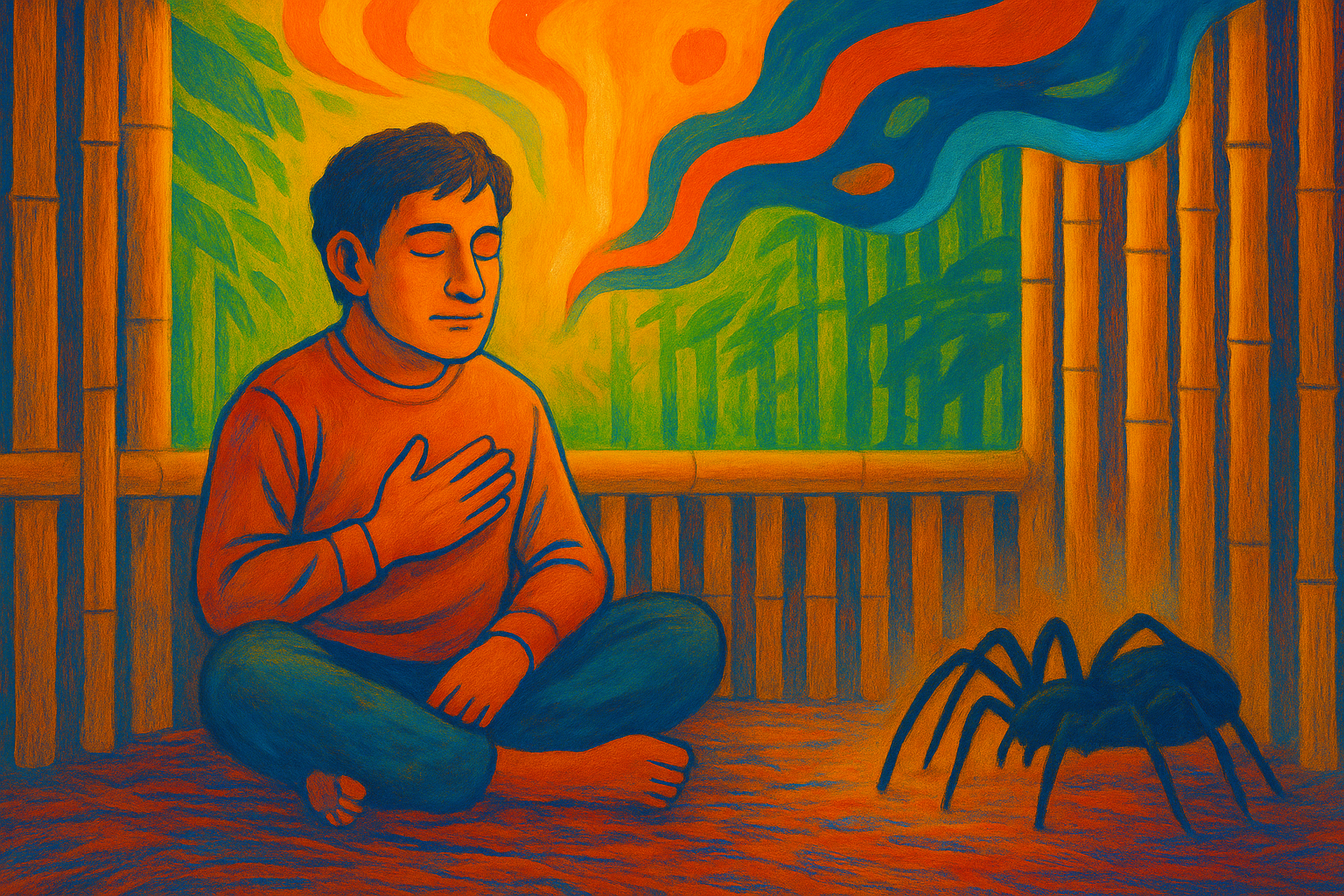
    So hug your friend or your dog. And if you’re alone, put a hand on your heart to assure your nervous system that you’re safe.

    After this incident, I had to process the shame around making this mistake. At first I felt completely terrible, like a total nutcase and an out-of-control loser.

    But now I see it differently. I see myself as someone who experienced trauma in her childhood, who was on her healing journey and genuinely doing her best at that time. I’m proud that I stood up and used my voice and did what I thought was right in the moment.

    And also, I regret the negative impact it had on some of the passengers and crew. The surgeon was understandably upset. And others were probably too, even though they didn’t say anything.

    The pilot was super friendly and talked to me after checking out the wheel to reassure me that everything was fine. And one passenger came up to me at the end of the flight and thanked me for keeping an eye out and being brave, even though in this case everything was fine. His stance was that it’s better to be safe than sorry.

    Life is complex. I now fully forgive myself this even though I do see it as a mistake. I know I was doing my best at the time and I’ve learned from it.

    I still get anxious sometimes, but it’s reduced significantly. The more I get to know my body and the different techniques that help complete the stress cycle, the less my anxiety controls my life.

    I’m happy to report I haven’t turned around any airplanes or cruise ships since applying these techniques, so I wholeheartedly recommend you use them to reduce your anxiety too!!

  • 7 Reasons I Was Scared to Take up Space and How I Boosted My Confidence

    7 Reasons I Was Scared to Take up Space and How I Boosted My Confidence

    “You are allowed to take up space. Own who you are and what you want for yourself. Stop downplaying the things you care about, the hopes you have.” ~Bianca Sparacino

    I deserve to take up more space. Plain and simple. By taking the space I deserve, I further build the confidence I need to live a rich life that resonates with who I truly am.

    Over the past several years, I’ve had to navigate a new life after hard breakups, difficult career transitions, and moving back home. I’ve had to face the feeling that I’m not doing enough. That I am not enough. That I don’t deserve to take up space. To be seen, felt, and heard with all of the faults that scatter among all my strengths.

    I know I owe it to myself to show up. I know I owe it to myself to be present as I am. I know I owe it to myself to finally come out from the back curtains and take center stage where my heart can shine.

    I deserve to take more space in my presence around others and to be truly seen.

    I deserve to take more space in my voice in a loud world and to be truly heard.

    I deserve to take more space in my heart and take care of my needs first.

    Because I know these things, I now try not to make my voice small when I want to speak so loudly that it hurts.

    I try not to be apologetic for taking the time to express what I feel to others when the person I should be accommodating first is myself.

    I try not to bottle up my emotions because the longer I do, the longer it will take to get past ignoring them.

    After taking moments to pause and breathe, I gently remind myself again that I am enough. That I deserve to speak from the heart and to be heard. That my thoughts, opinions, and voice matter.

    Over time, I’ve recognized the reasons why I lacked the confidence to take the space I deserved, and I’ve also identified what I need to do to change.

    7 Reasons I Was Scared to Take up Space (And How I Changed)

    1. I lacked confidence in my communication and overused apologetic terms, which minimized my opinions.

    I used to say sorry a lot in my interactions, if I thought I’d made a mistake or I interrupted a conversation, for example.

    Research shows that when you say sorry, people tend to think less of you. I may have thought that I was displaying myself as a nice and caring person, but I was actually sending the message that I lacked confidence.

    “Sorry” isn’t the only word I needed to watch out for. These 25 limiting words diminished my statements. For example, with the word “just”—if I was “just wondering” or telling someone it will “just take me a minute.”

    There’s no need to use minimizing words. My needs and opinions are as important as others’. I built more awareness and confidence by flipping the script and being firmer in my conversations. I started saying phrases like “Thanks for pointing that out” or “Here, let me get out of the way” or “It will be a minute.”

    2. I thought it was unkind to say no, even if something didn’t align with my priorities.

    By consciously saying no to one area, I am confidently saying yes to another more important one. I don’t want to give my space away without consideration of what the true cost is. I need to protect my time like it is my most valuable commodity.

    Saying no is not a natural response for many of us, though. We often feel nervous about creating conflict with others and tend to value others’ needs more highly than our own.

    At least for me, I have learned to please others by being kind and helping those who ask for it. I tend to say yes because I want to be seen as caring, selfless, and generous. I didn’t realize that the ability to say no is closely linked to self-esteem.

    So how did I start to say no without feeling bad about it? I kept my responses simple and to the point. I learned how to strengthen my delivery and not over-apologize.

    Sometimes, when I provide too many details, I get caught up in the why behind my decision to say no. I’ve learned that there’s no need to overanalyze, and that I have the right to say no as much as yes. I just need to remember that I’m not saying no to the person, I’m saying no to the request. Also, I’ve learned not to take someone else’s no personally. Sometimes their no means “no for now.”

    3. I didn’t realize my thoughts can contribute to a richer conversation.

    Sometimes, it’s been easier for me to keep quiet and listen to the entire conversation without saying a word. I’ve learned that I have a seat at the table, and with every word I speak, the more confidence I gain.

    I know I have many valuable thoughts that could add a new perspective to the conversation at hand. Whether it’s in a work meeting or hanging out with friends, I consciously remind myself not to hold back my voice.

    The world benefits when we all find our voice. Whether it’s to elevate good ideas or discuss alternatives to bad ones, speaking up is how we arrive at the best outcomes.

    4. I struggled with being vulnerable because I worried about what people thought of me.

    Vulnerability is consciously choosing not to hide your emotions and desires from others.

    Being vulnerable with others is scary and uncomfortable for me because it’s letting go of what people think of me. When I’m not afraid of what other people think, that’s when true confidence begins to grow.

    Vulnerability bridges connections and helps me build confidence in the relationships I am creating. Vulnerability frees me up to share personal stories that others can relate to. Vulnerability sparks conversations that allow me to move beyond fear to a place of shared experiences.

    Connecting with others by being vulnerable—as opposed to overcompensating and trying to get everyone to like you—will result in some of the best interactions and relationships of your life.

    5. I felt insecure about sharing my dreams and achievements along with my mistakes and failures.

    I needed to let myself be excited and proud in order to build confidence in what I’ve accomplished. Sometimes I have to be my own cheerleader to keep the confidence going and be okay with that.

    By sharing my successes, I hope to inspire others and kickstart them in a direction that helps them on their journey.

    By sharing my failures, I accept the mistakes I’ve made along the way. I’ve built confidence by taking the lessons learned and continuing to strive toward my dreams.

    6. I felt uncomfortable asking for help.

    It’s hard to ask people for help. Like most people, I’ve been taught to carry all the weight on my own. To be independent. To be self-sufficient. When you ask for help, people may say no, but it doesn’t hurt to simply ask. Each ask will give you confidence for the next.

    Most people like helping others by sharing their time, knowledge, and experiences. I realized I am in a village where others look to help me, which in turn helps the entire village.

    Asking for help isn’t a sign of weakness, it’s a sign of strength. Asking for help is uncomfortable because it’s a behavior I wasn’t used to. But it gives me the confidence to know others are there along the way to support my dreams and goals.

    7. I didn’t realize how much I have to offer.

    There are times I thought I didn’t have much to offer to others, but I now know I do. I possess a wealth of experiences that can help others live a brighter, more confident life. Whether it’s sharing how I aced a job interview or how I created a fine-tuned budget, there are people out there seeking my help.

    As I started to offer my knowledge to others, I was surprised by how many people I began to help. By being of service to others, I built confidence that I have more to give than I realized. I am a wealth of knowledge and experience that can help others build their own confidence.

    I’ve learned that my thoughts and needs matter—that I matter. That I can speak up unapologetically, say no when I need to, share my successes and failures, ask for help when I need it, and make a real difference for other people. I just need to let myself take up space, knowing I deserve it, and the world is better off because of it.

  • 3 Approaches to the Coronavirus (and Which Is Smartest)

    3 Approaches to the Coronavirus (and Which Is Smartest)

    EDITOR’S NOTE: You can find a number of helpful coronavirus resources and all related Tiny Buddha articles here.

    “Don’t try to calm the storm. Calm yourself. The storm will pass.” ~Buddha

    As we all now know, the coronavirus (COVID-19) has been spreading globally. It is a serious threat, less because of the raw numbers involved (as of March 22, 2020, there are less than 340,000 known infected cases with a global population of over 7 billion people), but more because the trajectory is dangerous, the spread is exponential, and the growth occurs very quickly.

    The virus contained would not have been that big of a deal. The virus spreading is a big deal. It is now clear the virus is spreading far and wide quickly.

    The main issue is that the hospitals in affected areas don’t have the capacity to treat the huge spike in coronavirus cases.

    We have already seen this in Italy: People are dying because there are not enough ventilators and other medical resources to keep them alive.

    Yogically, we are trained to make decisions from a place called “neutral mind.” There are three yogic mind centers: positive mind, negative mind, and neutral mind. Ideally, we activate and use all three minds, but the best decisions come from a place of neutrality. This neutrality helps maintain balance.

    Below is an overview of these three mind states and how they might influence your decisions relating to the coronavirus.

    The Negative (or Protective) Mind is given for survival. It is reactive, protective, and searches for potential danger. It is sensitive to pain, and it seeks to shield you from the forces that may disrupt or destroy.

    The negative mind might say:

    -I’m buying toilet paper, bottled water, face masks, surgical gloves, and rations for the next six months. I’m hiding all these rations and developing a plan to fend off my neighbors. If I hear that hospitals are short of face masks and surgical gloves, I’ll ignore it. I need to keep these things for the future. Things are probably going to get ugly—I need to take care of myself first and worry about my community later.

    -The virus is increasing in my area, so I’m going to leave and go outside the city to sit things out for a while. And if the new place gets too many cases of the virus, I’ll leave there too. My plan will be to stay a step ahead of the virus and leave whenever I notice the number of confirmed cases is getting high.

    -I’ll check the local and national news from the big mainstream sources every hour to get an update on the spread of the virus. I’ll update my Facebook feed each hour with whatever I learn. And I know if I add lots of exclamation marks, more people will read what I wrote, so I’ll make sure each post starts with READ THIS!!!!!!!!!!!!

    -I know the virus can travel through the air, so I will stay indoors with the windows closed and the blinds down until the virus is contained. Despite the fact I have a private, enclosed backyard, I won’t use it or even look at it. You just never know…

    It is easy to see how our negative mind can spin out of control. The worldwide spread of the coronavirus is extremely serious. Panic and over-reactivity are not just counterproductive, they are potentially dangerous.

    Hoarding resources when others are in dire need may cost lives. Undermining government efforts for containment is dangerous and may cost lives. If free movement hasn’t been taken away in your area, it means you need to be even more diligent and responsible about your actions. Your poor judgment may cost lives.

    The Positive (or Expansive) Mind searches for pleasure, fulfillment and possibility in how you can utilize things in your experience. It is constructive, risk-taking and active.

    This mind might say:

    -Self-isolate/shelter-in-place means I can work from home. Apart from that, I can still go out and do my regular things.  I’ll try to rally my running group for a run and since most restaurants are closed, I’ll invite my friends over to my house for dinner. If I do this right, shelter-in-place can be a great socializing tool!

    -I feel 100% fine. There is no way I have the virus. And if I get the virus, then I get the virus. I’ll risk it. I’m healthy and young, so I’m going to carry on with my business as usual. Vulnerable people should stay in, but since I’m not in that category, I’m going to take a more relaxed attitude.

    -I don’t personally know anyone who has the virus. I understand it is an issue, but I don’t think I have it in my community or my social groups. And keeping our mental well-being is important too. I’m going to continue to hold my events until someone I know falls ill.

    In the environment of the coronavirus, the positive mind can be dangerous. It is important to understand the big picture and how your positive mind might actually endanger other people during this period. We are in the middle of a serious worldwide crisis battling an infectious disease. It is everyone’s job to get educated, accept the reality of the situation, and exercise personal responsibility. Lives are at stake.

    The Neutral (or Meditative) Mind is the mind that judges and assesses without attachment in relation to your own purpose and reality. The Neutral Mind observes the actions of both the Negative and Positive Mind and judges both in relation to your higher self. 

    In order to maintain balance, this is the mind we need to use when making decisions. The neutral mind might suggest:

    -I’m taking self-isolation seriously and not going out unless it is a mission-critical task. I’m keeping my immune system healthy, keeping a rhythm to my days, and staying as productive as possible. This too shall pass, but it might be months, not weeks.

    -I’m studying the virus growth trends but not obsessively. I want to stay informed, but I understand focusing on bad news I can’t control over an extended period of time is bad for my immune system. Instead, I’m exercising extreme self-care. I’m eating well. I’m making my environment comfortable and nurturing. I’m working out and staying connected with people who are close to me through video and calls. In fact, I’ve even reconnected with some people I haven’t spoken with in a while.

    I continue to be mindful of my news sources as I read about the virus. I’m not getting pulled into sensationalism by going to mainstream news sources to get an update on the coronavirus. That would be misguided. I’m triangulating sources between the Center for Disease Control and Prevention, World Health Organization, and my own county or country’s health organization to stay current on the spread of the virus.

    -When I get invited to do something by someone else, I remind them that I am staying in because I understand the gravity of the situation. I remind them:

    1. The fact they are “feeling fine” is irrelevant. The virus can pass asymptomatically (with no symptoms).
    2. The virus can live on surfaces in excess of seventy-two hours.
    3. The virus can pass through the air for over three hours.

    I understand that unless I’m extremely careful, I might start the day without the virus and end it with the virus because of someplace I went or something I touched.

    I don’t yell and scream at my friends who want to get together, but I help them understand the situation more clearly. And most importantly, I am staying in.

    -I understand the virus can pass through the air, but I’ve done my research carefully and I understand I can go outside, alone, and maintain appropriate distance from other people. I’ll try to use my own yard as much as possible, but if I exercise the right precautions, I understand I could take a walk outside while minimizing my risk.

    -I’m trying to find ways to be useful and of benefit during this period. Lots of people are struggling. I wonder if I can help them.

    -I’m realistic this virus has ushered in a new way of life. I’m focusing on how I can succeed and thrive in this new environment. I’m researching new ways to do business online, and I’m using this time to sharpen my skills. I’m not focusing on when we can get back to “business as usual” because I understand there no longer is business as usual. I’m staying open and alert for opportunities that are heading my way as a result of this new world we are in.

    I write this because I’m observing a lot of chaotic thinking and everything that goes along with that. There seems to be a worldwide mix of the negative mind in overdrive and the positive mind in denial.

    The coronavirus also gives us a great opportunity to exercise more balanced thinking. Scientists predict more situations like this over the next decades from extreme weather and natural disasters, to widespread disease and epidemics. If we are going to survive and thrive in this new world we’ve created, we are going to need to learn to access, cultivate, and exercise our neutral mind.

    Thank you for reading this. Stay safe.

  • Being Shy Made Me Strong, and It Can Do the Same for You

    Being Shy Made Me Strong, and It Can Do the Same for You

    “Never assume that loud is strong and quiet is weak.” ~Unknown

    This quote seems counterintuitive, right?

    For many years, I, too, scoffed at the idea.

    Having dealt with crippling shyness throughout my life, I know firsthand what it’s like to feel weak, powerless, and trapped because of it.

    As a child, I remember clinging to my mom’s leg and using her body to hide from strangers. Then, as I got older, this shy behavior manifested into a fear of speaking my mind, interacting with others, putting myself out there, and so on and so forth.

    My quiet and timid nature led to me being known as “the shy girl,” a label that followed me through my formative years and made me feel stuck inside a box of limitations throughout my adult life.

    During these years, my shyness did nothing but hold me back from being who I wanted to be. It felt like a dark cloud hanging over me, and I couldn’t escape.

    Until, one day, I realized that being shy got me nowhere. I was living a life of loneliness and fear where I had no close friends, no social life, and no happiness.

    I refused to allow myself to fall victim to being shy. So I chose to do something about it.

    Looking back, it’s been a long road to get where I am today, but I can honestly say that I’m a stronger person because of what I went through as a result of all of it. I’m thankful I went through the challenges that come with being a shy person because it forced me to make a choice: shrink or grow.

    So if you, too, are dealing with debilitating shyness, here are some things that may help.

    Challenge yourself.

    Feeling stuck? Then it’s time to shake things up.

    If you’re extremely shy then, chances are, you’re scared to put yourself out there. And why would you? Especially when your comfort zone is just so comfortable.

    I know what that’s like because I’ve been there myself. It’s easier to live your life within the confines of what’s familiar because there are no risks and no surprises. But there’s also nothing to be gained from an unchallenged life.

    From a young age, I recognized that my big ambitions were tethered on a short leash because of my shy nature. I was never going to reach any of my goals if I kept living my life in fear. And that thought alone scared me more than the thought of putting myself out there.

    For that reason, I saw my transition from middle school student to high school freshman as an opportunity for a fresh start. I knew I wanted to do something I never had the guts to do before.

    So I decided to take a theater class offered by my school. I saw it as the perfect challenge because, not only was it completely out of character, the mere thought of performing on stage terrified me.

    What better way to help me break out of my shell than taking a class that involves speaking in front of an audience?

    Skipping ahead to my first performance, I remember my face being beet red, my palms were sweaty, my heart was beating out of my chest, and my anxiety was through the roof. I was in fight-or-flight mode and, and while I would normally choose flight, this time I was determined to fight throughout.

    At the end of the performance, I felt an amazing rush. It didn’t matter how I did or what people thought. All that mattered is that I pushed through my fears and did it.

    I saw this as a huge victory in the battle against my shyness.

    So if you want to take a step toward overcoming your shyness, then it’s time to step outside of your comfort zone. Do something that scares you. Think of an activity you’ve always wanted to do but never had the guts to try and start there.

    It’s terrifying, and chances are you’ll second-guess yourself throughout the entire process, but what you feel once you get through it will make all of the anxiety worth it in the end.

    Don’t give up.

    While theater classes helped me learn to face some of the challenges that came with my shyness, it wasn’t until college where I really broke out of my shell.

    As you can probably imagine, social situations were a nightmare for me because of how shy I was around others. I didn’t know how to connect with people and, more importantly, I was scared to try.

    My life up to this point consisted of a nonexistent social life and friends who were mostly just classmates or acquaintances.

    However, that changed when I took a job at a local restaurant.

    At first, I despised the job. Everyone seemed so close and I felt like I didn’t fit in, which is why, within the first week, I wanted nothing more than to give up and quit

    All of my life I’ve felt like an outsider, so I assumed that this would be no different. Despite that feeling, though, something told me that I needed to stick it out and stay.

    So I did. And it paid off.

    Over the next few months, I became more comfortable talking to my coworkers, which turned into spending time together on lunch breaks and then getting together after work hours. Pretty soon, these people who were once nothing more than strangers to me became the friends I had longed for throughout my life.

    Because I stuck it out and pushed through the discomfort and fear, I was no longer an outsider and I loved my job. It was a complete 180 from where I was when I first started working there, and all it took was patience and effort.

    This experience taught me that anything worth having takes persistence. A self-defeating attitude will only keep you trapped within the limitations of your shy tendencies.

    If I had given up, I would have never met the people who became my closest friends, and still are more than a decade later.

    So when the going gets tough, dig deep and push through it. Changing a pattern like shyness is no easy task, but if you don’t give up, you could end up with something amazing.

    Practice makes perfect.

    Change doesn’t happen overnight.

    In order to break away from your shy tendencies, you need to do more of what gets you out of your comfort zone.

    For me, that’s socializing.

    Because of my shy, introverted nature, I’m typically more comfortable being by myself and, as a result, I tend to withdraw from others.

    Yet, despite those tendencies, deep down, I’ve always wanted to be a social person, somebody who’s confident in social situations and has no problem approaching people.

    So I decided that I was going to practice.

    Coincidentally, all of this took place after my twenty-first birthday, so the nights out on the town with my friends became a way for me to practice my social skills.

    I’ll admit, at first I felt extremely awkward and uncomfortable. In the presence of large crowds, I would typically shrink down and avoid talking to others. Because these skills didn’t come naturally for me, it took some time for me to break away from those habits, but eventually, I did.

    I continued to push myself to talk to strangers whenever I would go out with my friends. Granted, this was a lot easier considering that the people I spoke to were typically a few drinks in, but it still did the job.

    Pretty soon, the thought of approaching someone and having a conversation wasn’t as scary as it once was in the past. In fact, I actually started to enjoy it.

    I like to think of social skills like a muscle in the body. It may start out weak and exercising it can be painful, but the more you work out that muscle, the more it grows and the easier the exercise gets.

    Shyness can be debilitating if you let it take over your life. So practice socializing, having conversations, approaching people and anything else your shyness holds you back from doing. While it can seem impossible to overcome at times, with practice, you can come out on top.

    If I can do it, you can too.

    After spending most of my life feeling like a victim to my shyness, I now appreciate that it made me stronger. That’s because, as a shy person, it takes so much more effort and energy to put yourself out there. It’s going against familiar habits and causing friction that, hopefully, results in change.

    It’s easy to succumb to shyness, to stay within your comfort zone, and to be controlled by fear. And anyone who has pushed through and challenged those tendencies in order to live a fulfilled life knows that it takes a tremendous amount of work. It’s a constant uphill battle, but it does get easier if you’re willing to push through.

    So challenge yourself, don’t give up and practice.

    It’s time to own your shyness instead of letting it own you.

  • How to Love Yourself into Speaking Up When You’re Frozen in Fear

    How to Love Yourself into Speaking Up When You’re Frozen in Fear

    “Always speak the truth, even if your voice shakes.” ~Unknown

    You may not want to admit this to others, but I know the truth about you.

    You freeze, clam up, and shut down when tensions rise and your spidey-sense detects a hint of conflict in the air. You run for cover during the storm, and when it’s over, you judge yourself for not having delivered the perfect soliloquy in the heat of the moment to convey your point and get what you need and deserve.

    And then you collapse into a hot mess of blame and shame.

    I get it. I used to be an expert in hiding.

    I vividly recall finding myself in tears in a colleague’s office after a particularly difficult meeting. My work was sidelined, and it was made abundantly clear that my contribution and presence weren’t valued.

    I felt passed over, ignored, and worst of all, not seen.

    I was too scared to say anything in the moment, and I didn’t even have the right words to express what was on my mind.

    What I wanted to say was nothing out of the ordinary. But when you’re feeling intimidated, that really doesn’t matter. Even sharing something as benign as what you’ve been working on seems impossible, let alone requesting a teeny, tiny amount of air time to do so.

    I left work that day unable to make sense of what had happened and how to move through the emotional state that I was left in.

    Sadly, this wasn’t the only difficult interaction that I came across early on in my career. The other ones involved yelling, passive-aggressive remarks, dysfunctional team dynamics, and me, remaining silent, not knowing how to handle it all, while expertly judging myself for not doing better.

    Yes, I was that person.

    Perhaps you can relate?

    Maybe you’re afraid to confront a loved one who has violated your boundaries because you don’t want to damage the relationship. Or perhaps you’re in an abusive situation and you’re worried that others won’t believe all of the awful things you’ve lived though. Or maybe you’ve been “hiding” in the workplace, not wanting to broach a difficult issue because you don’t want to create conflict or lose your job.

    I get it. There are risks to rocking the boat. And sometimes those risks are worth taking because the cost of remaining silent is too high.

    That cost is carrying the trauma of these negative interactions inside of us. It lingers there, eating away at us, waiting to be released while it leaks out in unhealthy ways. We might take our frustration out on ourselves by overeating or drinking, or we might let our feelings build until one day we explode on some innocent person who doesn’t deserve our rage.

    And so, I’d like to share what I’ve learned about loving yourself into speaking up when you’re frozen in fear. My hope is that this will help you remember who you truly are in those difficult moments.

    So here goes…

    First and foremost—and I know that this is the very last thing that you want to do—stop thinking. Stop wondering. Stop second-guessing yourself and admit that you’re scared.

    I know it’s hard, but accept it. Accept it all—the tension, the anger, the fear, the raised voices, the freezing… all of it. The only way through is to first accept the situation for exactly what it is, and it certainly doesn’t mean agreeing with what happened.

    Then, and this is even scarier, I know, tell someone. Not anyone, but just one compassionate witness. Someone who will listen, not judge, and not tell you what to do next.

    This is one of the best ways to begin your healing. What stays inside of you unacknowledged and unspoken festers and turns into shame and/or rage. When you let someone else in and receive their empathy and understanding, you’re better able to offer these beautiful gifts to yourself.

    You’ll then be ready to understand (not with your head, but with your heart) that freezing is a brilliant response to feeling scared.

    We’re biologically wired to use this survival technique to help us ward off predators. My cat freezes every time I take her to the vet, and it’s no better than fighting or fleeing as a response. So please stop judging yourself for doing what the universe innately programmed you to do.

    And now, for the biggest leap of faith that you’ll be asked to take in this lifetime… To effect any real change, you’ll need to love yourself exactly as you are right now.

    That means loving the frightened, insecure, self-judging little one inside of you who hates herself* (or himself or themselves) for not doing better.

    Yes, her.

    Instead of telling her that she’s not good enough, speak to her in the way you’d talk to a child who froze in fear when confronted with a threatening situation. What might you say?

    “It’s okay… you’re safe now, you’re loved. No one can hurt you. You are enough, just as you are. You don’t need to change a thing.”

    Once that little one feels truly comforted, she’ll be ready to entertain the possibility of speaking up, and then find the courage to do so. Self-love creates strength, confidence, and resilience—and these are the things you need to give yourself a voice. You need strength to speak up, confidence to hold your ground regardless of how you’re received, and resilience to handle the response, whatever it may be.

    This may take a while.

    Have patience.

    When she does find her voice, she’ll stumble.

    Her words will come out all clunky at first. She’ll feel both embarrassment and exhilaration. Just let her be. Let her live through all of those wild and wonderful emotions, while telling her how incredibly proud you are of her.

    Eventually, she’ll come to see the brilliant wisdom in the unique voice that she’s been holding back. And she’ll learn how to finally love herself, even when she was the one who did something wrong.

    Please remember to celebrate her in that moment.

    As that little one becomes wiser, she’ll also realize that “resolution” doesn’t necessarily mean working it out with the other person. She’ll find the courage to speak her truth and walk away with integrity when necessary, finding comfort in the fact that she did her best even when others didn’t agree with her decisions.

    And now for the kicker… you’re seriously not going to believe this one, but trust me, it happens.

    Once you figure out how to speak up while feeling love and compassion for the scared little one inside of you, you’ll almost magically help others move out of their own fight, flight, and freeze reactions.

    And for the most part, you’ll happily discover that you can build bridges where you once saw impasses.

    But deep down somewhere you already know all of this, don’t you?

    My wish for you is that you allow yourself to live it a little sooner, so that life is a little less painful for you.

    But I also know that it’s through this struggle that you become stronger, so as I write these words I hesitate to even suggest taking that journey away from you. Just know that you will get there.

    Dedicated to CDM, the queen of love bubbles who had the infinite patience needed to teach me how to unfreeze.

    *Author’s Note: In this post, I use she/her pronouns because I’m speaking from my own lived experience. However, this message is meant for anyone it resonates with, regardless of gender identity. Please feel free to replace the pronouns with those that feel right for you.

  • Yes, I Am Afraid to Fly, But I Won’t Let My Fear Control Me

    Yes, I Am Afraid to Fly, But I Won’t Let My Fear Control Me

    “Feel the fear and do it anyway.” ~Susan Jeffers

    Let’s do a thought exercise together.

    I have flown, I don’t know two or four times a year since I was eighteen and a few times before that, and I am now almost thirty-seven. On the low end that puts me around forty times. On the high ends that is, what seventy-five times in my life? Let’s split the difference and say I have flown fifty-five times because I have never kept track of things like that.

    Also, I have jumped out of planes before. Yep, it was beautiful, and seriously it is only the first step that is the hardest, because after that you are totally involved. So, if that is something you want to do, just close your eyes and step out. But I digress.

    Recently (over the last two years), I have become terrified to fly. I blame it on a trip where I had a bit of what I would consider severe turbulence. Really, though, it has just been a growing fear. With each flight, with each significant life event I have been ill prepared to handle, with each death I had to fly home for, the fear and anxiety has quietly and sometimes loudly and harshly grown.

    Most flights I have not enjoyed. However, there was a time I do remember when I loved to fly. The spooling of the engines, the way you are pushed back into your seat at take-off, that moment of lightness you feel right at the top of the take-off.

    I loved watching out the little window as the people, trees, and buildings would get smaller and smaller as you climbed to altitude. I even loved when we would fly over different farm areas and see the different colored plots of ground.

    Then there is the opportunity to watch the sun rise and set from 30,000 feet in the air. Morning flights are so great for this. It’s just darkness with little color lights below, but as you watch out into the darkness, the nothingness, slowly the darkness begins to turn into these beautiful, rich, and warm reds, yellows, and oranges. They pull across the sky and stretch into memories and dreams almost.

    And the clouds, I love the fluffy ones, the heavy, wintry ones that are filled with a mixture of snow and rain, and the long, airy ones. These are my favorite; they stretch and dance across the sky like little fairy wisps.

    When I think about it now, safely on the ground, it feels beautiful and calm. Picturesque as I travel to some place beautiful that is full of opportunity to explore.

    Flying offers me a mixture of beauty and fear. The last time I flew was the worst I have ever had. The flight itself was merciful and calm. However, I have never had a panic attack that severe before.

    I knew I had to fly. I didn’t want to. With every fearful bone in my body, every muscle tensing at just the idea of leaving my house, I really didn’t want to. But I had to. I tried to figure out how long it would take to drive, if there was a way to cancel, if I could just say no.

    Those weren’t options. I had to fly.

    So, I did my preparations. I have been a long believer in cognitive based therapy and the thought records my therapist has used to help me.

    I did as much research as I could on statistics of flying, specific airlines, the best time of the day to fly; I watched turbulence maps, checked weather forecasts as well as historical weather maps. I read safety numbers and statistics galore from reputable and not-so-reputable places on the internet.

    I found calming techniques like writing with your non-dominant hand over and over again, listening to quiet and calming music (I chose loud and high-based EDM), and coloring. I even got prescribed medicines from my primary care physician to take the edge off.

    I did as much preparation that I thought I could. But I was still afraid. My body ached and pulled from all of the adrenaline. I was terrified in a way that I have never been before, and even with the medication my doctor gave me to calm my nerves, the thought record in hand, and coping mechanisms in place, it was still incredibly hard to get on the plane.

    I almost didn’t do it, and if I didn’t need to get there by a certain time that day, I would have driven the fourteen hours to my destination.

    It is amazing how fear can control us, can take us to that lizard brain level and win. That’s a hard and harsh reality for me because there are so many places I want to go. So many things I want to see and experience.

    Not everyone wants to travel. Not everyone has a calling to their soul that says, “But what’s over there?” What have you not seen, felt, or experienced that could be just on the other side of that mountain? But I do. I am a traveler at heart.

    There are so many places across this world that are filled with cultures and history I have not seen or experienced in the very real sense of just being present in it. Where you can taste the excitement, feel it in the air and in the music that has its own unique song for those who listen close enough.

    I love going new places, meeting strangers, breathing in the experiences with every breath. I crave that. I dream about it. And of course, I save pictures and research these exquisite places and daydreams to my Pinterest boards because I am unsure I can break the fear enough to go.

    That is until recently. I had a moment of pause the other day. A moment of realization that struck a chord so much that I am writing to you.

    I have this pain in my leg. It has been here for months and when I called the doctor to schedule they immediately thought it was a blood clot and sent me directly to the emergency room.

    After many tests, they determined it wasn’t a blood clot in my big important veins and sent me home. I still have no idea what it is or why it causes me so much pain, but I know it isn’t a blood clot.

    However, a few days ago it was aching noticeably again and a moment of “oh gosh” hit me. Being an anxious person, the immediate question of “could it be cancer?” came to my mind.

    For many people, I am sure that question probably doesn’t pop up. But my mother got cancer at thirty-eight, and my thirty-seventh birthday is less than a month away. It was breast cancer and she’s fine now. But my stepdad died of cancer two and a half years ago. Watching his experience of slowly getting sicker and sicker and the cancer spreading across his body still haunts my thoughts.

    For the record, his was also not cancer in the leg. But sometimes your mind just starts with an idea and attaches to it immediately and starts going with the what-ifs.

    At that moment, though, I didn’t play out what-ifs; I didn’t think about the medical procedures and things I would have to do if it really did turn out to be cancer. My thoughts did not do the dizzying spiral they normally do. I had only one thought at that moment.

    I went immediately to the looming fear of flying and my desperate, aching desire to see more of the world and asked myself if this was really cancer, if there was a sickness that was about to affect my entire life, would I no longer be petrified of flying?

    I realized at that moment I have a 100% chance of dying. Absolutely, unequivocally, I am eventually going to die. And it very much could come from this random pain in my leg, from cancer, or even from a plane crash (although statistically I have a much greater chance of the cancer than the crash).

    But I realized something I had never before, and that is I could die today. Now don’t get me wrong, I have had many days and thoughts of dying over the years. Through weird and not even logical ways of dying. But this moment was real, was higher than my lizard brain fears, was calm.

    And I had to decide, am I going to do the things I fear so I can see the things I dream of?

    I realized it’s okay that I am still afraid, it’s okay that I need medicine from my doctor, strong coping mechanisms, and research, but I have to go. If exploring is important to me the way I feel it is, then I am going to have to explore and accept that anxiety and fear might be traveling companions, but they do not have to be roadblocks. Not anymore.

    So, I am writing to you, people I don’t know, who may experience similar things, who may be terrified of flying too, to offer you this simple yet real realization.

    I am still very much afraid today, but I am going to book my next flight and leave room for my anxiety and fear to come along. Maybe one day they won’t accompany me on my trips, but I know I am going to ensure they do not stop me in the meantime.

  • Don’t Try to Get Over Your Fear; Go Through It Instead

    Don’t Try to Get Over Your Fear; Go Through It Instead

    Woman with lantern

    “I must not fear. Fear is the mind-killer. Fear is the little death that brings total obliteration. I will face my fear. I will permit it to pass over me and through me. And when it has gone past I will turn the inner eye to see its path. Where the fear has gone there will be nothing. Only I will remain.” ~Frank Herbert, The Bene Gesserit “Litany Against Fear,” from the novel Dune

    When I was very small, my grandmother would watch me while my parents were at work. Nana often wanted a break, and her house held very little to stimulate a pre-schooler, so she’d put a VHS tape in and sit me down in front of the TV.

    The movie she put in most? La Bamba.

    Maybe you’ve seen it, maybe not. I’ll give you a bit of history. It’s the life of Ritchie Valens, leading up to that fateful night he, Buddy Holly, and the Big Bopper all died in a fiery plane crash in Iowa.

    So that was my introduction to air travel.

    I probably watched that movie twice a day for months at a time. I can still vividly picture the opening scene’s fiery mid-air collision.

    I haven’t seen La Bamba since I was seven or eight, but the deep, primal fear of flying it instilled in me lived on until I was almost thirty.

    Now slide forward to my teenage years, and the first time I gave up a free trip to New York City, and then a class trip to Australia, because I was afraid. Then to my early twenties, when I passed up vacations and travel outside the country. I limited the colleges I wanted to apply to based on whether or not they were in driving distance.

    And then, somehow, when I ended up moving all the way from Georgia to upstate New York for school, I drove that distance in a U-Haul, and didn’t see my family for years because it was too far to drive again. When I finally did see them, three years later, I drove the fifteen-plus hours (one way), most of it in snow.

    Not everyone needs to fly to have a happy life, but I think I did. I wanted to travel all over the world, but most of all, I hated that something so mundane was holding me back from anything. I needed to get over it, but I didn’t know how.

    I tried self-hypnosis and guided hypnosis. I tried just “sucking it up.” I tried learning the mechanics of flight so I’d understand, rationally, that it was safe. I considered drugging myself with tranquilizers and having my family haul me onto an airplane while I couldn’t think about it. But the fear lingered on for fifteen years after I decided I wanted to end it.

    The One Thing That Finally Helped Me Move Past My Fear

    I first bought the book Dune, by Frank Herbert, when I was in high school. I first read it about eight years later, when I could find interest in more than the cover art. Since then, it’s become my favorite book. My husband and I are reading it together now, me for the second time and him for the first.

    It’s a huge book. Epic, engrossing, transcendental—just like my fear of flying. If you haven’t read it, do. I can’t recommend any other book as highly, and not just for the literary value or entertainment, but also for the lessons it teaches—not overtly, not preachy.

    Dune teaches environmentalism, politics, race and gender issues, religion, and philosophy without saying it. When you read it, you internalize all of those issues without even realizing it.

    And that’s where I found the beginning of the ending to my fear.

    There is a mantra repeated several times, taught to the Bene Gesserit, a sect of women who are highly trained in physical and mental arts that skim the border between possible and impossible in our world. That mantra is the Litany Against Fear, quoted at the top of this essay. The Bene Gesserit, and the son of one, our hero in Dune, use the mantra to remind themselves not to bother with fear.

    It goes beyond looking in a mirror and telling yourself “you’re good enough, you’re smart enough, and doggone it, people like you,” as Stuart Smalley said on SNL.

    In Dune, the Litany Against Fear can change the entire mental space of the character reciting it. Its value is that it allows a person to defeat the chaos fear brings to our minds. If they defeat that chaos, Dune’s heroes can get through suicidal situations, or mentally slow their life processes down so they don’t need air for half an hour. While that kind of physiological control is probably outside of our human abilities, the value is still apparent:

    We can alter our response to fear.

    How Fear Causes Chaos

    Fear is a natural response, but it brings chaos with it. Our heads fill up with black, chaotic thoughts, and depending on how strong the fear is, we’re left stuck, unable to act. This is what happened to me with my fear of flying. I was stuck, constantly, in a state of indecision: I wanted to go places. I wanted to accept invitations. I couldn’t.

    Maybe if I wait a day or two, I could, I would think. But I never did.

    What Dune teaches us with the Litany is that humanity can overcome fear where animals can’t. Our primal urge when confronted with fear is to run, hide, escape. But as humans, we don’t have to do that. We don’t have to react just because fear acts.

    The second half of the Litany reads:

    I will face my fear.
    I will permit it to pass over me and through me.
    And when it has gone past I will turn the inner eye to see its path.
    Where the fear has gone there will be nothing. Only I will remain.

    There is the answer to the chaos fear causes.

    There is no inherent problem with fear. The problem comes when the fear remains because then that chaos lives on, affecting our minds and bodies with its insidious, chronic destruction.

    When I first read the passage containing the full Litany, I got chills. I realized I was facing this fear of flying over and over, day after day, without resolution, when I could just face it once, let it pass over me and through me, and once I’d landed, I could look back and there would be nothing.

    “Just face your fear” is way easier said than done. We all know that. But what if you looked at it differently? What if you didn’t tell yourself it would be okay, that it’s not actually as scary as it seems, that everything would be fine?

    I’ve heard that fear kills you over and over, when instead you could die just once at the end of a good life.

    What if you told yourself: I know I’m afraid. This is really scary. But, I’m doing this anyway because every time I fear this thing, it kills me over and over—just as much as if the plane really did go down. I may have to face the fear again in the future, but each time I do, I’ll be better at it and stronger than it.

    Because you can’t go through life letting fear stop you, or you’ll never start anything. And you’ve got a life for a reason. You’re meant to start something amazing with it. But you’ve got to accept your fear first.

    Don’t try to get over fear. Go through it instead.

    Let yourself be afraid the first time you do something that scares you. Let yourself feel the fear for a moment, and then acknowledge it and let it flow past you.

    Destroying the Chaos and Moving Past Fear

    When I fully internalized that realization, I knew I would never let fear dominate me again. I was afraid of flying, but so what?

    I got a single line from the Litany tattooed on myself, where few people would see it, and written backwards so that whenever I stood in front of a mirror, I’d see it, read it, and remember it.

    The day I first stepped onto an airplane, I stood in front of the mirror for a long time, staring at that tattoo. I told myself I was afraid. I told myself we might crash. And then I got on the plane.

    Now I look back and there’s nothing there.

  • If You’re Scared to Share Yourself and Your Gifts

    If You’re Scared to Share Yourself and Your Gifts

    Hiding Woman

    “True happiness involves the full use of one’s power and talents.” ~John W. Gardner 

    If you’re afraid…

    …to launch your project,

    to share your voice,

    to sing in front of someone,

    to dance in public,

    to write a book,

    to show who you really are to the world,

    to ask someone out,

    to tell someone you love them,

    to try something new,

    of what other people will think of you…

    if you’re afraid of any of these things or more, I have three simple words for you:

    Do it anyway.

    Do it anyway! Isn’t that liberating? Come on, isn’t it kinda?

    You don’t actually have to overcome your fears to do any of the things you’re afraid of. Every single time you become conscious that you’re frozen from fear you get to make a choice. You get to choose to continue to be stuck or you get to choose to move through the fear.

    Moving through the fear does not mean that fear is going to go away. And let’s just be clear here: trying to be fearless is a waste of our time and energy.

    Trying to be fearless is an attempt to make it easy to do something that feels difficult. It could also be called avoidance. Instead of avoiding, you can choose to feel the fear right now and do what you need to do in spite of it. Yes, it’s going to feel scary. But so what?

    If we want to focus on how things feel for a minute, let’s think about this deep desire you have to share your art. (When I say art, I’m speaking about your gifts, your service, the thing that your soul is screaming to share.)

    So, you have this deep calling to share your art but there’s also this other part of you that is afraid. So you think about all of the reasons you’re scared and you analyze them and you go back to your art and you try to make it more perfect so you can squelch any potential haters.

    Then it’s time to share and you get scared again, and this cycle goes on.

    This might look a little differently for you.

    You might just be frozen in fear. You might be so scared you haven’t even started your art. You might be avoiding it. You might be perfecting it, so convinced that a true artist spends a lifetime perfecting something when you’re really just scurrrred. Yes, you are.

    And all of this that I’m describing, all of it spells out A.N.X.I.E.T.Y. So let’s take the power out of fear.

    So let’s take the power out of fear. If we do it anyway, if we launch the project, if we stop perfecting, if we take any kind of leap that feels risky, we’re telling fear that its voice doesn’t hold any weight.

    Isn’t that more fun than all of the anxiety around avoiding the leap? Just jump. It’s the most difficult and yet the simplest thing you can do. And the trick is that once you do it the first time, it gets a little bit easier to jump the next time.

    One of my favorite Paulo Coelho quotes is handwritten on a chalkboard in my kitchen. It says, “No matter how you are feeling, get up every morning and prepare to let your light shine forth.”

    I write a lot about the fleeting nature of feelings. They come and go. They’re not stable. They blow with the wind. So yeah, it would be lovely to be stoked to share your gifts with world. But the truth is that when it comes to being seen and heard, most of us are scared, and most of us are scared of what other people think.

    What other people think about your work is none of your business. Your business is listening to your soul and abiding by it.

    Your business is connecting with the depths of yourself and living a life so fulfilling that there could never be such a thing as regret.

    Your job is not to worry about someone else, change yourself for someone else, or stifle yourself out of fear of someone else.

    And let’s just shift our perspectives a bit. We spend so much energy worried about whether people will misunderstand us, dislike us, or mistreat us. The truth is that most people are supportive. Most of the people we fear will surprise us and say, “Hey what you’re doing is awesome. I admire it.”

    And the very few who don’t, the ones who want to critique you instead of looking at themselves, they’re the last people you should be worrying about. Judgment comes from fear. And when someone else projects their fear onto you, it’s not worth an ounce of your energy. Keep it movin’.

    No, it’s not easy to do things that feel scary. It can be painful to show the parts of yourself that are really you. It can be really hard to hear people say mean things about your art.

    The truth is that there are really unpleasant things about being alive, but there are also things that are more important than feeling good.

    When your soul is screaming loud enough you’ll have no choice but to listen and leap. But maybe do it before then. Maybe choose to move through the fear as soon as it shows its face. Maybe do it anyway.

    Hiding woman image via Shutterstock

  • 5 Fear-Based Decisions that Limit Our Potential

    5 Fear-Based Decisions that Limit Our Potential

    The Sky is the Limit

    “The only thing we have to fear is fear itself . . .” ~Franklin D. Roosevelt

    You’ve heard that quote more times than you can count.

    You’ve also made fear-based decisions; we all have.

    Looking back, you can point to times it has happened and caused you to fall short of what you could have achieved.

    It has certainly has happened to me.

    I was three years into my first career as a high school science teacher. I had always wanted to live abroad, specifically Mexico, and I had always wanted to learn Spanish (after taking an embarrassing amount in high school and college without really ever picking it up).

    So when I met a lady that had a connection to a high school in Monterrey, Mexico, where they taught the classes in English and had an opening for a science/math teacher, I jumped on it.

    I contacted the school and expressed an interest. When they told me if I ever came through Monterrey they would be happy to speak to me, I immediately booked a flight and flew down during the upcoming spring break.

    I went to the interview and told them I would be happy to teach science or math, or both. They told me about the program, and that they support all of the teachers with intensive Spanish-immersion classes.

    It was exactly what I wanted—a way to live in Mexico, learn Spanish, and keep teaching.

    I left the interview excited.

    A couple months later, they contacted me and told me I had the job if I still wanted it.

    Perfect, right? I got exactly what I had been dreaming of.

    I turned it down.

    I rationalized the decision at the time because I had already told my current school I would be there the next year and had already committed to a trip to Europe with friends that I would have to miss because the school year started earlier in Mexico.

    The reality is that my school would have understood and my friends would still be my friends (and Europe wasn’t going anywhere) if I took this opportunity, which I had been talking about for years.

    The real reason I didn’t take the job was that I was scared. Scared to move to a new country where I didn’t know anyone. Scared to leave my comfort zone. Just generally scared of the unknown.

    Now, looking back, I have a lot of regret about that decision. Over ten years later, I still haven’t lived abroad and I still don’t speak Spanish fluently.

    But I have also learned from that experience to push back when fear pops up to stop me from moving forward.
    And importantly, I’ve gotten much better at recognizing when it is fear that is stopping me, even when it isn’t so obvious.

    And that’s what I want to share with you.

    How You Can Target Fear and Beat It

    Below are five common, but not-so-obvious, ways fear works to limit our potential.

    And importantly, how you can recognize that fear for what it is, and then push through anyway.

    1. You procrastinate.

    We have a lot of faith (for no apparent reason) that the version of us that wakes up on Monday will start that thing we want to do.

    It’s like we believe some other person will be responsible for getting us up and moving.

    It’s hard to start now, when we are the ones in charge. Why?

    Fear lives in starting. Because starting means one of two things will happen: You will do the thing you set out to do, or you will fail.

    And failure is scary; we fear it. So we decide to start later.

    The problem is that later is quite elusive. So the change never really happens.

    Even though you think you are protecting yourself from failure by procrastinating, you are actually just ensuring it. By not starting, you take success off the table; the only thing left is failure.

    The solution is simple, but not easy:

    Recognize your procrastination for what it is—you letting fear prevent you from moving forward.

    Move anyway. It doesn’t have to be a huge movement, but just do something that commits you to either success or failure.

    2. You create your “big-hairy goal” and then wait for the magic to happen.

    I know, you’ve been told to set a “big-hairy goal.”

    The problem is that the definition of a big-hairy goal is a goal that seems impossible. Because it seems impossible, you don’t actually believe you can achieve it. So you don’t act. You just wait for some cosmic shift to occur.

    You are scared that if you act you just will prove that it is impossible. That fear paralyzes you.

    To overcome this, you have to set smaller, more approachable goals, after you set the “big-hairy” one. Goals that you see as possible, but that add up to the end game.

    Come up with three small goals that you believe are doable and that will get you closer to the “big-hairy goal.” They don’t need to get you there. They just need to head you in the right direction.

    When you’re done with those, come up with three more. Keep that up and that almost-impossible goal will become inevitable.

    3. You let “emergencies” get in the way.

    Have you ever decided that something you’ve been “meaning” to do for months, like organizing your closet, has now become a must-do thing?

    You are probably using your newly minted “must-do” task to avoid starting something that might open you up to failure.

    While organizing a closet isn’t fun, you aren’t going to fail at it, so it’s not scary. Even though it feels very much like you are being productive, you are actually paralyzed.

    If you hear yourself saying things like, “I know I said I would do X today, but I actually can’t because I really need to get Y done first,” you are probably falling victim to this fear-based behavior.

    The solution is easy: Realize that you haven’t done Y for the past two months, and so not doing it today will probably be fine and do X instead.

    4. You focus on the judgment of others.

    As soon as you go from, “This is going to change my life for the better” to “What will so-and-so think about it?” you have almost certainly sunk your chances of moving forward.

    Everyone wants the approval of their peers and seeks to avoid their disapproval. But you can’t let fear of disapproval prevent you from acting.

    It’s not easy. But, when you feel judged by your peers, and you feel like it is stopping you from moving forward, consider these questions:

    • Does this peer lead a life I value?
    • What values are they using to judge me?
    • Do I even want to live up to those values?

    If you don’t want to live up to their values, just shrug off their judgment and move on.

    5. You forget that your life is one big science experiment.

    Science is all about failure. And your life should be all about failure too.

    Science comes up with an explanation for the data available, and then tests that explanation.

    As soon as the explanation fails, everyone goes back to the drawing board and comes up with a new idea, incorporating the data that was collected as a result of testing the first idea.

    Over time, science gets more and more right. That is what life is about.

    You aren’t going to live a perfect life. You aren’t going to achieve everything you could possibly achieve. But, you can get closer to perfect. You can achieve more than you have so far.

    But to do so, you have fail. You have to try something new. And doing so, you will fail. Which is great. Because then you get to learn from your failure, and try again.

    To start, try to get three people to tell you no every day, ask random people to do things for you, ask for discounts on retail or food, whatever.

    I know it sounds stupid, but the whole idea is to get used to failing and so dampen the fear of it. Then you can see failure for what it is:

    A big billboard telling you are going in the right direction but that you just need to adjust your course a tad to take into account what you learned from the failure.

    Now What?

    You have the tools to recognize fear for what it is and to shine a light on it when it pops up its ugly head—no matter what form it is using.

    Then you can then address that fear, knowing that it is largely, if not totally, of your own making. And you can stop the rationalizing that you will inevitably use to avoid doing the scary thing that led to the fear in the first place.

    Once you have done that, you will start pushing the envelope of your potential and achieving more than you thought possible.

    So look fear in the eyes. Call it out. And, keep moving.

    The sky is the limit image via Shutterstock

  • Fear Can Only Hurt Us If We Let It

    Fear Can Only Hurt Us If We Let It

    Scared Boy

    “Fear keeps us focused on the past or worried about the future. If we can acknowledge our fear, we can realize that right now we are okay. Right now, today, we are still alive, and our bodies are working marvelously. Our eyes can still see the beautiful sky. Our ears can still hear the voices of our loved ones.” ~Thich Nhat Hanh

    I lay in bed staring into the darkness feeling physically ill with an acute sense of anxiety the like of which I hadn’t experienced in quite some time.

    It felt like I had a soccer ball sized, black, dense object consuming the entire center of my stomach, causing nausea to ripple up into my throat uninvited.

    I knew it wasn’t that hot, with the air conditioning on full, yet my legs were sweating, as was the back of my head. I could feel the damp pillow under me and the bed sheets sticking to me whenever I moved.

    I cursed my own stupidity and replayed the previous week’s events over and over again in my mind as though under some illusion that the more I did this the easier things would become. As a coping strategy it wasn’t one of my proudest moments.

    You may think I’m describing some event from my dim and distant past. When the high stress of working in big-ticket sales would cause me endless sleepless nights as I fretted over deals missed and even deals made that may go wrong.

    But this was last month.

    Wind back in time to April with tax day looming. After I forgot to send some bank statements to my accountant she had to file for an extension to help avoid a fine from the IRS.

    I had put aside some money based upon what my tax bill was last year with a little bit extra. I called my accountant a few weeks later and asked her if she could estimate the amount I would owe.

    In fairness to her she was reluctant to do so, but the figure she gave me after much prompting had me punching the air in delight, imaginary high-fiving my dogs, and grinning like a demented Cheshire Cat. It was way lower than I anticipated.

    Shortly after, we got the confirmation that our best friends were coming over to stay for two weeks later on in the year. It was going to be the first time they’d visited in almost five years and to celebrate I suggested we go on a five-day Caribbean cruise.

    They agreed and shortly after everything was booked and I was chilled and thrilled. Then it all went wrong. Horribly wrong.

    No more than forty-eight hours later I got an e-mail from my accountant saying the final tax bill wasn’t what she had advised, but eight times higher.

    How could that be? I called her and she apologized profusely, but it was what it was and there was nothing more she could do.

    As I lay in bed that night I was cursing myself for rushing to book the cruise and for not making higher regular payments to the IRS as I had been advised.

    I have said many times, “I have no sympathy with people complaining about their tax bill, as they can’t charge you for what you haven’t earned.” In the early hours of the morning this was the biggest stick I had to beat myself with, and trust me, it was a very big stick.

    Stress, fear, and anxiety are all much the same thing. They all stem from a feeling that we’re not in control of life’s events. This stimulates the fight, flight, or freeze reaction triggered by the sympathetic nervous system, courtesy of the Limbic System in the brain.

    There was no way I could fight the IRS and I’m not sure where I would fly to, so I lay in bed frozen with anxiety.

    After several hours lying there listening to my own self-recrimination, I remembered to tell myself that it was okay to feel anxious under such circumstances. That it was a perfectly natural response to a negative event, and it was just a feeling.

    And fear is only a feeling, albeit a powerful one. There is no thing called “fear.” You cannot touch it, smell it, see it, or taste it. As with any emotion, you can only feel it.

    Also, we cannot experience fear if we are truly and congruently living in the present moment. Fear is always the mind projecting an inability to cope with a future event or situation.

    It’s not real per se. Fear itself cannot hurt you. It’s how you respond to the perceived threat that hurts you.

    Fear has a valuable evolutionary purpose in the survival of the human species because (for the most part) it stops us doing things that can threaten our health, safety, and well-being.

    However, the worst strategy in dealing with fear is to fight it by resisting. Or to feed it by seeking out the worst possible scenarios to relatively benign situations.

    I was doing both. I was feeding it by dragging myself through an imaginary court of stupidity in my own mind. At the same time I was also resisting it by telling myself I was being stupid to worry about such a thing.

    Finally common sense kicked in and I decided to observe it, to be curious about it and to drop the futile resistance that was only giving it more strength.

    I thanked it for its concern and reminded it that between the two of us we had dealt with every single-issue life has thrown at us for over half a century, and that we would deal with this also.

    I could feel the black ball start to slowly melt and the nausea subside.

    You too have dealt with everything life has thrown at you to date otherwise you wouldn’t be reading this post.

    There is nothing in your life you haven’t coped with and there is nothing you won’t cope with. Sure, there will be times when it doesn’t feel like that, when the fear demon is whispering in your ear that things won’t be okay and you start to let it take control.

    But, he is mistaken and the only power he has is the power you give him. Just hug him (or her) and say with sincerity, “Thank you for looking out for me. I know you have the best intentions, but everything will be okay. I promise.”

    Scared boy image via Shutterstock

  • Most of the Things We Fear Are Highly Unlikely to Happen

    Most of the Things We Fear Are Highly Unlikely to Happen

    Fear

    “Only when we are no longer afraid do we begin to live.” ~Dorothy Thompson

    Australia is full of biting, pecking, threatening animals.

    Swarms of mosquitos puncture our skin every summer, flies are everywhere, we’ve got spiders bigger than my hand, our magpie birds swoop and peck at our heads during spring, and don’t get me started on the sharks and crocodiles and those mighty big bites.

    I am most scared of the snakes. Australia has twenty of the top twenty-five most venomous species of snakes in the world. We have a hundred and forty species of land snakes and thirty-two species of sea snakes. That’s a lot.

    I grew up in the Australian bush. My family had a small property that was covered in trees and long grass.

    Throughout my youth my parents and others constantly reminded me that I had to be watchful and careful of animals that bit, pecked, or did other horrible things, particularly snakes.

    If we were walking anywhere outdoors, it was important to make noises to scare snakes away. I sang, whistled, and stamped a lot and saw almost every stick as a potential snake. The longer the grass, the more noise I made and the more I watched for any movement.

    It didn’t help that when I was very young my parents had a bonfire. It was dusk and I trotted over to the fire, all happy and youthful, and a black snake reared up in front of me.

    I’ve never forgotten the shiny eyes, the glisten on its scales. It was absolutely terrifying. We stared at each other for a moment and then I employed a bit of first class noise creation by screaming at the top of my lungs, and it slithered away.

    Dad also used to tell stories of growing up in country Australia in a big old house with snakes everywhere.

    One his favorite stories was of the time he walked into their outdoor toilet and got a big shock when he saw a two meter long brown snake curled up on the floor enjoying the afternoon sun.

    The toilet was a bench of wood with a hole, and because there were so many snakes, Dad was in the habit of crouching over the hole rather than sitting on it for fear of snakes biting his bottom.

    It didn’t end there. There was also a small island on the lake in front of where he lived called Snake Island, and it was apparently infested with them.

    I’ve seen Snake Island and it’s covered in long grass and bushes, the perfect holiday destination for slithering scary things. Oh yes, and the big brown snakes could swim, yes, swim. That’s how they could go on their holidays to the island.

    Can you imagine how much I loved hearing these stories, as every kid loves a scary story, but also how much these and other snake stories impacted a child with a very big imagination?

    It didn’t help that snakes were spotted on the property every now and again. As I grew up and throughout my adult years I never stopped watching for snakes in the bush. That’s a long time to be scared of the outdoors.

    The Camping Trip & the Confrontation with the Slithering Things

    Two months ago I went on a camping trip with my family. We were camping at a remote dam surrounded by beautiful arid bush, lots of gum trees, crickets buzzing, rough ground, and dare I say it, lots and lots of sticks. A gazillion sticks, actually.

    After the sun set over the lake and we’d eaten apricot chicken in front of a campfire flickering away in a rusty old bin, I took my torch and proceeded to walk the five minutes in the darkness to the toilet block to brush my teeth.

    My snake routine started again: torch flashing over ground, eyes seeing long thin objects, stamping my feet as I walked, some humming. It didn’t help that my torch was dimming and nearly out of batteries.

    There were shadows and movement everywhere and so many sticks. These sticks could bite me at anytime and inject me with deadly poison, and our campsite was far from medical help.

    And then it happened. I hadn’t camped in a while or been out in the bush in a while. I had been through a period of my life where I had suffered terribly from an illness and had faced many fears and had overcome many of them. I was in the habit of facing things head on.

    I thought, “What’s the chance of being bitten out here? Had my father who had basically lived in snake kingdom in his youth ever been bitten? Had anyone I know, any friends of friends, anyone, ever been bitten?”

    I watched myself looking over the dim ground. I watched my brain wanting to invent snakes, seeing movement when the only movement was the shadows cast by the torch and the wind in the gum leaves. I was dumbfounded. What had I been doing all these years?

    As soon as I got back to my tent, I got onto Google and looked up exactly how many people had been bitten by snakes in Australia. It turns out that out of Australia’s population of twenty-three million people only one or two people die from snakebites per year.

    Most bites are because people try to pick up the snake or kill it. If I wanted to get bitten I would have to chase the snake down and pick it up and hug it. I also found out that sharks only kill one or two people in Australia per year as well, and the average is only a little higher for crocodiles.

    I lay back on my sleeping bag and comprehended what Google was saying. That all my life from a young age I’d been programmed to be fearful of something that was extremely unlikely to happen. 

    It dawned on me that my sense of alarm and my fastidious watchfulness was misplaced. It had taken years and years of reinforced programming to get me to a place that I couldn’t walk in the bush without being fearful.

    What a silly state to be in. I remembered that a couple of years ago I’d hiked through New Zealand and one of the truly delightful days was walking through grass as high as my waist without fear. There are no snakes in New Zealand. I’ve never forgotten the ecstasy of it.

    Reminding Ourselves About the Nature of Fear

    My realization about snakes also highlighted to me how heavily programmed fear can make us completely lose our perspective. We don’t even question whether what we fear has any basis at all. We don’t test it. We don’t think about it other than to react.

    Albert Einstein said that we must not stop questioning, and this applies when we feel fear. We should question it, investigate the nature of it, and test our preprogramed and sometimes deeply subconscious hypothesis about the ways we should live our lives.

    Sometimes the result of our investigation will be that our fears are founded. For example, we probably should be fearful of walking across a canyon on a tightrope. But what if there’s no rational explanation?

    What if there’s a brilliant world out there that we are not experiencing to the fullest in this very short time on earth?

    We have some tough genetic programming to overcome. Our brains are used to looking for threats in the environment. In the past it was a tiger, now it’s whatever we deem threatening.

    I was recently doing some research on fish and found a study examining whether fish experience pain. It turns out that even fish avoid objects that have previously caused them pain.

    Our natural animal instinct is to avoid what has hurt us before or, similarly, what we perceive could hurt us in the future. Our alarm mechanisms are inbuilt.

    We also live in a complex world full of stimulation, and it’s hard for our brains to keep up with what is a true threat such as a car heading straight for us and what’s not. There’s just so much for our minds to deal with.

    The good news is that we are equipped with tools such as logic, information, and awareness to help us overcome our fears.

    I’m finding the more I confront my fears and do the opposite of what they are warning against, the more my consciousness understands that these things are a programmed mirage.

    I know we’ve all heard this wisdom, we all inherently know that most fears have no basis in reality, but my little snake adventure reminded me that I don’t often apply this knowledge to my everyday life. So this time I decided that it was about time that I did.

    So how does a woman who has treaded heavily all her life for fear of sticks learn to live again? I’ll tell you how I learned. Later that night I had to go to the bathroom and I ventured outside my tent, turned off the torch, and walked—not stomped, walked.

    I drank in the vision of the moonlight touching the gum trees, the lake, the rough dry land and it was glorious. That’s how.

    Face everything and rise image via Shutterstock

  • 7 Simple (and Surprising) Tips to Help You Realize Your Dreams

    7 Simple (and Surprising) Tips to Help You Realize Your Dreams

    Kid trying to catch a star with a butterfly net. Digital watercolor.

    “Don’t be pushed by your problems; be led by your dreams.” ~Unknown

    It’s tricky sometimes, isn’t it?

    Trying to find our place on this planet.

    Tapping into our inner desires.

    Sometimes we know what we want but not how to get there. Sometimes we know “this isn’t me,” but we have no clue who “me” is. And sometimes we think we’re already there, then something out of the ordinary happens and we realize, this isn’t me at all.

    At each stage there are pitfalls than can keep us looking in the wrong direction, stuck in fear, or stressed about how to move forward.

    I know, I’ve been back and forth through all of them.

    At twenty-five I had a postgraduate science degree and no wish to use it. At thirty-five I wanted to teach, write, and paint, but no idea what form this would take. And at forty-one, my work is read by thousands and every day I receive emails telling me what I do makes a difference.

    (Keeping it real: People also email me and tell me I suck.)

    Through it all, I’ve learned simple laws to help navigate the ups and downs of discovering and following your dreams.

    1. Don’t think about “your path in life.”

    Sounds contrary, doesn’t it?

    Because isn’t that exactly what we should be thinking about?

    Yes, and no.

    Where it can be detrimental is when we stand at the precipice of making a decision and we worry, “Is this my path in life?”

    A path is a track laid down to walk on. A path implies there’s only one way, a preconceived singular course. It implies that you can make a wrong decision.

    Watch it! Don’t step off the path!

    Yes, our life is wonderfully, marvelously one of a kind. No doubt. And trying to make it look like someone else’s is a first class ticket to unsatisfied-ville. But thinking about our path, now, can put unnecessary pressure on us. It makes us feel nervous.

    There are infinite routes to a satisfying, uplifting, life. Whatever decision you make—and have made before—you’re on the right path. It’s all “the path.”

    2. Forget everything your guidance counselor said.

    Do you remember after high school, tossing around a hodge-podge of career options—trying to decide what to do with your life?

    Should you become a podiatrist (have your own clinic), or an actuary (pays well)?

    You talk to other podiatrists. You find out what an actuary actually does.

    You listen to your parents. You seek advice.

    We live in a world saturated with messages about what we should do. There’s nothing wrong with advice. Sometimes. In moderation. You just gotta push it through your “no one but me knows my dreams and desires” filter.

    It’s not that our guidance counselor/parents/spouse/bus-driver don’t mean well. They do. They just don’t know. They can’t.

    And we might not know either, at first anyway.

    Whatever we hanker for, this gives us the greatest joy. And it’s often not some grand thing—that’s our mind (ego) imposing society’s rules.

    I knew a woman once whose three greatest loves were her children, fishing, and next to that, working on an assembly line—she loved the camaraderie and seeing things get done.

    3. Ask this simple question.

    When I was young, if you’d asked me what job I’d like, assuming I had all the skills necessary, I’d have thought it was a trick question. I thought everyone wanted this.

    I wanted to be a writer and painter.

    If only I had been given those talents! And I surely hadn’t. (Can’t draw, painting even more tragic, messy handwriting.)

    I trained in nutrition science. I was even fairly good at it. But I don’t believe it’s what I’m here to do.

    Pay attention to your desires, even when—no, especially when—they seem ludicrous. Roll the idea around in the back of your mind. 

    What life would you choose if you could wave a wand and have every skill that you needed?

    No pressure. Just notice.

    4. Stop worrying about how to get there—or if “there” is even a good idea.

    Human beings are wired for safety. This is why we want our trajectory mapped out.

    An illusion for sure.

    To get to where we really want to go, there is no pre-drawn map. The good news is that we don’t need one! All we need is the next step. And we always know this.

    For instance, say you have the feeling that you’d like to make shoes. Rather than worry about the fact that almost no-one makes shoes by hand anymore, consider, what do you feel moved to do, right now?

    Maybe it’s a simple as ordering a copy of How to Make a Shoe. Or arranging to meet a friend of a friend who’s a clothes designer.

    Big changes come from a series of incremental decisions. Trust that there is a wise hand guiding you (because there is). Take notice of seemingly small inclinations.

    Sure the shoe thing seems far out, but so would most successful ventures when they started.

    5. Learn the difference between an inner desire and unhelpful mind talk.

    Most of us know the value in listening to our intuition. But it’s confusing sometimes.

    Is the voice telling us to buy snowshoes—even though we live in Texas—our intuition? Or is it our mind (ego) fooling with us.

    Here’s how I tell:

    My mind uses logic and likes to copy others. It sounds like: “Bill moved to Italy and now his life is awesome, so I should go.”

    When my heart (intuition) speaks, it’s more like a deep feeling. I can see myself wandering around Rome, eating pizza.

    (Then, what usually happens is that my mind comes up with reasons not to do it—”You’re gluten free, you’ll starve in Italy.”)

    As author Chetan Parkyn says, some people are guided by strong gut feelings that hold true from start to finish. For others, their gut feeling is less sure, and where they find clarity is by taking a tentative step, then reassessing.

    If you’re not sure, dip your toe in. See how it feels.

    6. Be happily confused!

    What if (after everything) we can’t feel the tug of our inner desires? Or, we’re uncertain about the next step?

    Answer: Don’t worry.

    Don’t worry, because the only way to get where we’re going is through uncertainty (and sometimes turmoil). Feeling discombobulated is part of it.

    It’s not a bad thing. Rejoice!

    You’re on your way!

    You might be drawn to actively search for an answer. Or maybe you feel like sitting back and giving it some time. Or a combination.

    Go easy on yourself. Be lazy. Have fun. Try things. Spend time just sitting and being quiet. Spend less time online. Take a job and don’t worry about how it fits into your plans.

    Allow yourself to be in a state of confusion. It’s not always comfortable, but it’s perfectly normal.

    7. Expect to feel afraid.

    Making a lunge for what’s important to us is scary.

    Always is.

    Every time I’ve followed what was in my heart, most people thought I was loopy. But you know what? The voice of derision you most need to watch out for is your own.

    I’ve found these things helpful:

    • Mentoring
    • Not telling people what I’m doing—I didn’t tell anyone about my blog for six months.
    • Reading books like The War of Art by Stephen Pressfield
    • Reading books about others who followed their dreams (or blogs like Tiny Buddha)

    Finding our way is as much about getting out of our own way. Letting go of ideals that have been imposed on us. Taking leaps. Stumbling and getting up. Trusting our inner guidance.

    And remembering, always, we’re doing fine. Even when it seems like we’re making a mess of it. We’re not.

    Photo by Ingo Schmeritschnig

  • Living an Exciting Life When You Fear Leaving Your Comfort Zone

    Living an Exciting Life When You Fear Leaving Your Comfort Zone

    On top of the world

    “One day your life will flash before your eyes. Make sure it’s worth watching.” ~Unknown 

    What if you realized on evening of December 31st, that the past 365 days were the best yet? Imagine a single year in which you scared yourself into your deepest fears and faced more challenges than you ever had from all the previous years combined?

    Moving forward, how would you feel about one-upping that year? Overwhelmed? Anxious? Scattered? Yeah, me too.

    This was the question that I asked myself on the last evening of 2013 that left me thinking back on distant memories, adventures, and the beginning of true uncertainty.

    The Best Year Yet: 2013.

    Last year began my personal journey of fully embracing the uncomfortable.

    I decided to seek the truth and hoped to eventually have enough courage to share my experiences with those who were curious. I left with no travel plans, but only a mission. Adventure.

    Thailand. Cambodia. Malaysia. Singapore. Laos. Vietnam. Hong Kong. Japan. Hawaii. San Fran.

    I experienced most in backpack form over the course of 108 days.

    My reality was completely shaken. I moved from confusion to clarity. What I believed to be important in my life no longer mattered. Returning home, I was filled with a deep sense of appreciation, gratitude, and really wide eyes.

    I leaned into what I thought was once impossible due to the laundry list of excuses I had created. Not enough money. No one will go with me. It’s not safe. This isn’t the right time.

    Those were only four of the hundreds of thoughts that swirled through my monkey brain, which was doing its best to protect me, right?

    This is the short form of the journey that scared the pants off of my fears. Along the way, I learned quite a few lessons. Some the hard way, others rather easy, but all well worth it.

    You’ll never have everything figured out.

    Imagine for just a moment that you stopped allowing your excuses to own you. There’s a part of you that wants to embrace change, yet every time you think about going after your vision, you’re dumbfounded with objections.

    Unfortunately, the only time that you won’t have an excuse will be when you’re six feet under. The fear that resides within each of us will always create a story; yet, we are the ones with the power to make the decision. Ready. Fire. Aim.

    It only takes one second to be courageous.

    Think about how long it actually takes to do anything you’ve ever wanted to do? It takes one second to make the decision.

    One second to click the submit button. One second to say hello. One second to smile. One second to jump in. One second to leave no chance for regrets. One second to hand over your two week notice. One second to say, “This isn’t working.” One second to believe. One second to choose. It only takes one second to be courageous.

    Befriend uncertainty.

    Whether you’re ready for it or not, the unpredictable will show its face. While we have a tendency to negatively associate with the unknown, realize that you can make the empowered decision to accept the reality.

    Byron Katie says this best, “When I argue with reality, I lose—but only 100% of the time.” Try bringing uncertainty along for the ride. You may notice a greater sense of meaning and fulfillment finding its way into your life.

    If it makes you feel safely uncomfortable, please proceed.

    If you find yourself in a situation that makes you feel safely anxious, awkward, nervous, and/or uneasy, it very well may be the best thing for you. As Tony Robbins says, “The quality of our lives is directly related to the amount of uncertainty we can live with comfortably.”

    Remember, though, these uncomfortable experiences must also align with your preferences and values. When in doubt, intuitively listen to your soul.
    As you continue to slowly build your uncomfortable muscles, you’ll gain more clarity around what feels right. Each adventure will not only contribute to rapid personal growth, but will also increase your threshold for dealing with such unsettling feelings.

    Replace “What will they think of me?”with“What’s really important to me?”

    Say hello to your ego. And now, please ask him/her to keep quiet. When we find ourselves in moments where we might be exposed to internal feelings of nervousness, embarrassment, or anxiousness, we usually tend to run the other way.

    We’ve got this incredible internal system that was designed to protect us from real danger, the fight or flight response. Unfortunately, our brain can’t distinguish the difference between our fear of public speaking versus being chased by a bear.

    However, you have the ability to differentiate between the two situations. When you find yourself safely immersed within an uncomfortable situation, try sitting with it. Before you know it, the related negative feelings will disappear.

    Each day, we get to paint our own canvas. What will you be remembered for, soul sibling?

    Give yourself permission to live uncomfortably. I dare you.

    Photo by Lara Cores

  • Getting Unstuck: Work Through Fear and Change Your Life

    Getting Unstuck: Work Through Fear and Change Your Life

    Im Free

    “When you become comfortable with uncertainty, infinite possibilities open up in your life.” ~Eckhart Tolle

    We’ve all been there. Feeling stuck is very distressing, and it can often make a situation feel even more difficult than it already appears to be.

    Many of us may have felt trapped in a job, a relationship, a place; any unfavourable situation, really, that we see little way out of can leave us feeling deeply discouraged.

    The uncertainty of it all becomes overwhelming and, over time, paralyzing.

    I have felt the frustration, the sadness, and the hopelessness that accompany this predicament many times.

    In fact, I’ve lived most of my life feeling stuck in one thing or another—a volatile family situation, unhealthy relationships, various jobs. For a long time, I rarely made proactive decisions about anything.

    I had a number of distractions I used to try to avoid thinking about it. I drank heavily, took drugs, took trips, took on other people’s problems, overworked, over-exercised, over-sexed, under-slept, worried constantly, and generally avoided thinking about the specifics of what I needed out of life, a job, or a relationship.

    Opportunities and endings did flow through my life, as they inevitably will, but they were seldom based on what I wanted.

    After a while, negativity and worry used up much of my energy. I was diagnosed with cancer at twenty-six, and started to have other major physical ailments, not to mention regular nightmares. I knew I had to make changes.

    I started with my diet, something that I felt was within my control. I gained a lot of knowledge about food, health, and lifestyle very quickly and just soaked it all up.

    I also learned a lot more about our inner emotional lives and about taking responsibility for my feelings, my actions, and my words.

    I started practicing meditation and continued to deepen my yoga practice with a new awareness of my mental and emotional environment. I’m now able to observe my thoughts and am quick to see how my thought patterns change when I feel stuck.

    Those negative, self-defeating, fearful thoughts come creeping back into my mind, whispering to me that I don’t have any other choice.

    The depressed feelings and anxiousness come quickly too, and I often start to wonder, if I’d done something differently in the past, would I be here now? I tell myself that only if a certain event happens in the future will I be able to make a change.

    Dwelling on the past and obsessing about the future is a surefire way to stay stuck.

    I now know that I need to be careful not to qualify decisions based on imagined future events happening or not happening, and not to make decisions out of fear. Sometimes doing what is best for you means facing those fears head on.

    When I was diagnosed with cancer, I told myself I’d only take time off work if I started to feel really physically ill. I was afraid I’d face financial difficulties if I took a leave. I didn’t give myself nearly enough space to process the emotional effects, and I didn’t give my physical body the time to rest that it was clearly telling me it needed.

    I got very ill with a string of severe infections in the two years following my recovery because I never proactively made a decision to take care of myself.

    When I start bargaining with myself, I know I’ve given away my power. I’m no longer listening to my intuition or connecting with what’s really best for my well-being.

    I’ve realized that the only way to get unstuck is to detach from the outcome of our decisions and the fears about things not working out, and instead focus solely on what exactly we want and need. In this way, the uncertainty can lead to opportunity.

    There are a few things I did make proactive decisions about over the last ten years—like pursuing a degree in Environmental Studies, moving to Australia, and committing to building a more healthy lifestyle—that have turned out better than I could’ve imagined.

    It has become more and more clear that the decisions I make from now on need to be based on my true desires, not my fears.

    I now recognize that I’ve kept myself in unhealthy situations mainly because I didn’t have the tools to help myself.

    When I’m having trouble getting unstuck, I use some of these small actions that can be helpful in creating space to move through and out of the undesirable situation:

    Take time.

    One of the most difficult things about feeling stuck is that you want to fix it right away. This urge to control the situation really doesn’t help solve the problem.

    If you’re having trouble moving out of a bad situation naturally, you’ll need time to process all the feelings that will come up as you move toward a new phase of your life. Let it happen and enjoy it as much as you can. The best approach you can take in this situation is to trust that things will improve over time.

    Don’t wait for this-or-that to happen.

    This is a big one. If you’re always waiting for something else to happen before you act, you won’t make proactive decisions in a way that’s in line with what you want. 

    Stop thinking about it.

    I like to practice meditation and yoga, read a good book, or take a nap. The trick is to not think about the issue actively, but just take some time to enjoy where you are now.

    Obsessive thinking can do far more harm than good and never actually causes any change. Once you start feeling more present, you’ll take less joy in feeding the mental drama around the situation and naturally be less willing to put up with negativity it brings.

    Get some perspective.

    Taking a short (or longer) time away can break emotional ties in a big way and allow you to see things in a different way. You may also be motivated to make change as you recognize how much better you feel when you’re out of the environment where you feel stuck.

    Get healthy.

    Focus on yourself. Make your physical, mental, and emotional health your biggest priority. Once I started letting go of all the stress I’d been holding onto for so long, I was truly shocked by how great I could feel. I knew I wanted to pursue that amazing feeling.

    The key here is really to figure out what works for you to help you get unstuck. That may be chatting with one of your friends, taking a weekend out of town, or walking by the water. Then do it as much as you need to until you feel better.

    Don’t lose sight of what’s important to you. And if you’re not sure what’s important to you, make finding out a priority.

    I am still stuck, as I write this, in an unsatisfactory situation. I’m far from being able to completely avoid feeling trapped by certain situations I’ve gotten myself into, but I am committed to the personal values I’ve uncovered within myself, and I’m working hard to build the life I want. I also don’t let depressive and self-defeating thoughts take over at these times.

    Over time, you will learn to move past jobs, people, and places that don’t work for you more quickly and with ease.

    In the meantime, it always helps to remind yourself that you’re doing the best you can, as fast as you can. When you’re finally able to let go of your fears and be proactive about your decisions, you will find that life is yours again, to be shaped and lived in any way you like.

    Photo by Rob Lee