Tag: adapt

  • From Injury to Insight: A New Kind of Yoga Practice

    From Injury to Insight: A New Kind of Yoga Practice

    “Healing may not be so much about getting better, as about letting go of everything that isn’t you—all of the expectations, all of the beliefs—and becoming who you are.” ~Rachel Naomi Remen

    For years, yoga was my safe space—the place where I felt strong, grounded, and whole. My practice wasn’t just physical; it was my sanctuary, my moving meditation. So, when a shoulder injury forced me to change the way I practiced, I wasn’t just in pain—I was lost.

    At first, it seemed minor. A nagging soreness, nothing I hadn’t worked through before. I convinced myself that more movement would help, that yoga—my forever healer—would fix it. I stretched, I modified, I doubled down on my alignment. But the more I tried to push through, the worse it became.

    Eventually, even the simplest tasks—getting dressed, washing my hair—became difficult. That’s when I finally sought medical help. The diagnosis: shoulder impingement and frozen shoulder. A combination of overuse, aging (a humbling realization as I turned forty), and factors no one could fully explain.

    I asked the doctor how to prevent it from happening again. The answer wasn’t clear. There was no perfect formula, no guarantee. That uncertainty unsettled me.

    Surrendering to the Process

    Healing wasn’t linear. It was slow, frustrating, and at times, disheartening. I cycled through physical therapists, reluctantly took medication, and spent months modifying my movements. But the hardest part wasn’t the pain—it was the mental and emotional struggle of letting go of what my practice used to be.

    I grieved the loss of my old yoga practice. I felt betrayed by my body, resentful that the thing I loved most had, in a way, turned against me. And yet, somewhere in the frustration, I realized—this was part of my practice, too.

    Yoga isn’t just about movement. It’s about presence. Acceptance. Surrender.

    I started leaning into the lessons my injury was trying to teach me:

    • Ahimsa (Non-harming): I had to stop fighting my body and instead extend it kindness, just as I would for a loved one who was struggling.
    • Satya (Truthfulness): I had to acknowledge that my practice would change—and that wasn’t necessarily a bad thing.
    • Aparigraha (Non-attachment): I had to let go of my rigid expectations and open myself to a different, gentler way forward.
    • Santosha (Contentment): I had to find peace with what my body could do, rather than mourning what it couldn’t.

    The moment I stopped resisting, something shifted. My body didn’t heal overnight, but my perspective did. I started seeing healing as an ongoing relationship rather than a destination. I gave myself permission to slow down, to listen, to trust.

    Rebuilding with Compassion

    As I modified my practice, I discovered new ways to move that honored my limitations rather than fought against them. My yoga practice became softer, more mindful. I focused on breathwork, grounding postures, and gentle movement. I let go of the idea that I had to push myself to prove something.

    I also realized something deeper: healing isn’t just about getting back to where we were—it’s about growing into who we’re becoming.

    We all face moments where we’re forced to slow down, to reevaluate, to shift. And in those moments, we have a choice. We can resist and suffer, or we can soften and grow.

    If you’re navigating an injury, a setback, or an unexpected change, know this: Your healing doesn’t have to look like anyone else’s. You are allowed to grieve. You are allowed to feel frustrated. But you are also allowed to find joy in the process. To discover new ways of being. To trust that even in the slowing down, there is wisdom.

    Healing is not about returning to what was—it’s about embracing what is and finding beauty in what’s possible now.

  • How I Turned My Disability into Desirability with a Simple Perspective Change

    How I Turned My Disability into Desirability with a Simple Perspective Change

    “Stop thinking in terms of limitations and start thinking in terms of possibilities.” ~Terry Josephson 

    I was affected by the deadly poliovirus when I was six months old. Most people infected with it die. Even today, there is no cure for it. I miraculously survived, but lost my ability to walk.

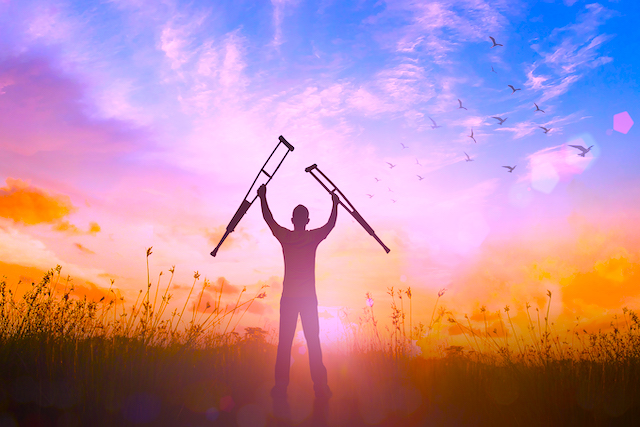
    During the first twenty years of my life, I evolved through crawling on the floor, lifting my leg with my hands, wearing prosthetics, using canes, and finally learning to walk, painfully, with crutches. As I grew up, I experienced post-polio syndrome, which weakened the other parts of my body.

    Some forty-five years ago, there were no educational or medical facilities in the remote area of India where I lived. That slimmed my chances of getting any education. When I reached the age to go to school, the only way possible was to wear prosthetic braces weighing forty-five pounds on my leg, which was more than my weight. It was incredibly painful to walk while wearing them. In those braces, I could barely take one baby step at a time.

    Experiencing Victim Mode

    The result was me being bullied, left behind, and teased by my classmates all the time. There were times when I had to drag my iron-casted leg back home alone for over a mile using the strength of my stomach muscles. It used to take me two hours, which felt like a lifetime. That cycle repeated for many years, and my emotional pain grew more and more.

    Every time, I asked, “Why me?” The more I asked, the more unpleasant the answers got in my mind.

    Stepping into Fighter Mode

    That misery got me into a fighter mode. I remember that many of the motivational books I read stressed one thing: “Break the walls.” So I secretly subjected myself to the harshest physical exercises, torturing myself, hoping someday I would get better at my disability. But the more I tried, the more my emotional and physical problems escalated—to the point of a breakdown. Charged with much willpower, I did not realize that perhaps I was fighting against the wrong wall. I failed.

    As I see it now, the actual wall that was limiting me was less my physical disability and more my self-limiting beliefs. I had made up unreal, perceived walls in my mind, thinking that I wouldn’t be accepted unless I walked like ordinary people.

    These made-up walls were the ones that were actually stopping me. I was doubly disabled—externally and internally.

    Spotting the Windows

    Every time I was left behind, I made a pact with myself: If I couldn’t walk with my legs, I would walk faster with something else. But the big question was: with what? But then, a simple perspective shift I call “windows through the wallschanged my life and put me on the path of personal transformation to achieve excellence.

    I gradually realized that my disability gave me some gifts I did not recognize earlier. I had no social interruptions, no spoiler friends, and not much mobility. Because of those three things, I had plenty of distraction-free time at my disposal, which was a gifted environment. What could I do with this unique leverage?

    Reading books was the best thing I could do while being contained in a chair. I remember the first book I read, by Dale Carnegie, was much ahead of my age. Soon I mastered poetry, physics, palmistry, psychology, and philosophy while reading any book I could afford to buy or borrow.

    By rigorous reading and learning through science books, I became an engineer at the age of twenty-one, and a year later, I became a technology scientist. It stunned the people who never believed I could do so. The hunger to learn faster led me to earn two doctorates, more than 100 international credentials, and some of the world’s highest certifications.

    “I couldn’t walk with legs—now I teach people how to walk faster in what they do.”

    My lack of speed made me obsessed with gaining it in another area. That became the unique expertise that took me places. I became a performance scientist, helping people speed up their learning and performance skills.

    Not only this, I leveraged my ability to learn and started sharing my learnings with others. My social isolation did not persist, and soon I had one of the largest friendship circles around.

    With my circumstances, I could engage in daydreams that developed my vivid imagination. Soon, a writer inside me woke up. I wrote dramas, stories, poetry, articles, and many things at a very young age. While I could not afford to buy one book then, I have authored twenty books now.

    While glued to that chair, I had similar leverage as other kids—that is, my hands. I developed my skills in painting, drawing, and sketching and received an international award for my art from back then.

    As I reflect back on it, my disability hardly ever got in my way while achieving these things. Rather, it helped me go faster. When I saw my crisis, my disability, my limitations, I did not see them as walls that I should break. Instead, I chose to spot windows among them—windows of opportunities, leverages, and advantages. I’ve leveraged everything my limitations ever offered me.

    Two Important Lessons

    I learned two important lessons in my journey.

    First, not all the walls that seem to be limiting us are real. We need to find the wall that indeed is limiting us and then break it.

    Second, we don’t always need to break every wall because some have windows. No matter the circumstances, we all should focus on spotting the windows.

    Once we change our perspective, we will be surprised at the number of advantages we find in our adversities, desirability in our disabilities, and leverages in our limitations.

    Are We Enough?

    When we experience a loss, we may feel less than others. That’s okay. Sometimes, the crutch I use as an aid for walking reminds me of what I lack. But that’s okay because I wouldn’t be where I am today if it was not for my disability. I think my loss, my disability, defines who I was yesterday, who I am today, and who I am going to be tomorrow.

    However, some of us have been groomed to chant motivational mantras like “I am enough.” It is like convincing our minds that the glass is full, so our minds might stop looking for possibilities.

    But when we realize our glass is half-empty, we become hungry to find windows of leverages in our misfortunes or limitations to fill it up somehow. That’s when we create new possibilities for ourselves.

    Leverage Your Losses

    Think about the losses that you have experienced due to your adversities, failures, or misfortunes. How could you leverage these losses to go from feeling less than others to being a lesson for others?

  • Why We Need to Learn to Let Go and Adapt If We Want to Be Happy

    Why We Need to Learn to Let Go and Adapt If We Want to Be Happy

    Charles Darwin is believed to have said that in nature, it’s not the strongest or most intelligent that survives but those who are most adaptable to change.

    No matter what kind of life we live, we all need to learn to adapt, because everything changes. Good and bad come and go in everybody’s life. It’s one of the reasons resilience is so critical.

    We plan our lives expecting good to come our way, to get what we want, and for things to work out how we planned. At the same time we’re chasing the good, we try to avoid the bad.

    One of the biggest sources of our unhappiness and discontent is not being able to adapt to change; instead, we cling to things we’ve lost or get upset because things don’t unfold as we want them to.  

    What we overlook is that this is a fundamental law of life, the ups and downs, ebbs and flows. Things come and go, nothing stays the same, and we can’t control most of the things we’d like to. Accepting this and learning to adapt and go with the flow brings us one step closer to happiness.

    I’ve just come back from a meditation retreat. It sounds relaxing, and it was, but it was also difficult in many ways.

    I had to adapt to a new routine, which meant a 5:30am alarm, sitting for long periods of meditation, and periods of complete silence and solitude.

    And there were lots of other changes: Not having my morning cup of tea or evening chocolate—or any caffeine or dairy—and adjusting to a vegan diet. Being without WiFi and my cell phone, and braving the sub-zero temperatures up in the mountains of NZ in winter. Having to do karma yoga work—things like cleaning toilets and stacking wood. Not to mention the kind of emotions, thoughts, and feelings we’re confronted with when we start to disconnect from the world and spend time with ourselves.

    I was so pleased to be returning home, but then instantly thrown into the chaos of a busy airport with all flights grounded due to fog. I then realized that I would not be going home, and to attempt that tomorrow meant a bus ride to the next airport and finding some overnight accommodation to wait it out, with the hope that the weather would be fit for flying in the morning.

    Despite my Zen-like state post-meditation, I was frustrated, upset, and I just wanted to get home to see my partner, sleep in my own bed, and not feel so helpless.

    I had my plan, my expected outcome, and for reasons beyond everyone’s control, this wasn’t possible. I wasn’t going to get what I wanted.

    Now, a week later, I find myself having to learn the skill of adaptability once again.

    Many years ago I played soccer. I wasn’t bad, either. I loved it. It was my passion. As a kid, I’d play all day on my own in the garden, and once I found a team I’d never miss a match. However, my career was cut short in my early twenties after a ruptured cruciate ligament that was surgically repaired, re-ruptured.

    I had to give up on my passion and for many years didn’t play soccer. It was as a result of this devastation that I found yoga—my new passion and lifesaver for the past seven years, something I do every day.

    I’ve just had a further operation on this ailing knee, and while I’d adapted over the years from the injury, I found myself once again having to adapt to changes: Not being able to walk, being housebound, using crutches and the difficulties this brings. Finding a way of sleeping comfortably and seeing through the fog the painkillers seemed to create. Not being able to do my morning yoga routine and struggling to meditate because I couldn’t adopt my usual cross-legged ‘proper’ meditation position.

    Sometimes what is, is good enough. Acceptance is key to helping us adapt. 

    If I can breathe, I can meditate, and I’ve enjoyed some of my lying down meditations (the ones where I’ve managed to stay awake!).

    And now, as I reduce the meds and ease off the crutches, I can see positive change occurring. I can do a few standing yoga asanas and can take short walks with support.

    The devastation of leaving my beloved sport morphed into another form of exercise I fell in love with that I may never have otherwise discovered. And my recent operation led me to new ways of enjoying this passion.

    These recent lessons caused me to reflect on how life has changed for me over the last year or so and how I’ve been adapting along the way (sometimes kicking and screaming).

    I’ve gone from a nomad traveling the world to settling down in a city I’d said I’d never live in due to the wind and the earthquakes. I’ve experienced some of the worst winds and biggest earthquakes of my life since being here and learned to love it all the same.

    I’ve recognized the positives and come to love the bits that make this city (Wellington, NZ) great: the small town feel, the laid back lifestyle, the friendly residents, the ocean, the beach suburbs and beautiful scenery, the wonderful array of cafes and restaurants, not to mention the abundance of yoga, meditation, and wellness related activities.

    I’ve gone from being single and happy to living with someone else and having to think about someone else, taking into account more needs than just my own.

    I’ve had to learn to love again, take risks, and face fears while navigating a long-term relationship and our different wants and needs. I’ve had to learn to share a home and build a nest, and think about the future in ways I’d never have thought I could, feeling very blessed if also a little apprehensive and scared at the same time.

    Very often those in long-term relationships may envy the free, single, fun life of others, while at the same time those who are single are chasing the dream of finding their soul mate and settling down like the married couples who envy them.

    I’ve learned that everything has its pros and cons, each cloud has a silver lining, and each silver lining has a cloud. It’s what we choose to focus on that impacts our happiness.  

    We could always be chasing the next thing, looking for greener grass. But if we do this, the grass will always be greener even when we get there. And if we live like this, we miss out on all the good stuff we already have, all the silver linings that exist in the now, in our current situation.

    New relationships generally start well because it’s new and we’re in love. But what about when the novelty wears off, years down the track when we’re living together and bringing up kids?

    We realize that our new love is, in fact, human. We get tired, we get irritated, we find they do actually leave clothes on the floor and leave the lid off the toothpaste.

    In the same way our new, latest model dream car becomes not so new, or the dream job turns out to be a bit tougher than we thought.

    Everything has good and bad, so stop expecting perfection and clinging onto an unrealistic ideal. This results in us always be disappointed.

    Life changes as the seasons do. What we needed then may not be what we need now, and either way, we might not have control of what exactly is unfolding. Learn to adapt with these changes, not fight against them. Trying to keep everything the same is like trying to tell the leaves not to fall from the trees in autumn.

    Whether the weather doesn’t hold during a party we’ve planned or a long-term relationship ends, things don’t always go to plan. Things change and we don’t always get to hold on to good stuff forever.

    Embracing this is key to happiness, as is living in the present and enjoying each moment as it is.  Whatever is happening now won’t last, which is great news if we’re going through a tough time but not so great if things are going well and we’ve just got the promotion we wanted or met our soul mate.

    Life is not about what happens to us but how we react to it, and some of our biggest disappointments can lead to better things in life, bringing us new beginnings, if we learn to adapt and embrace change.  

    Expect life not to go to plan and then you won’t be so disappointed. Accept what is, look for the silver lining, and adapt. Keep looking for the good in every moment and learn from the tough ones.

    This is how we not only survive but thrive: by embracing each moment for what it is and choosing to make the best of it.
  • 4 Lessons on Embracing a Major Life Change

    4 Lessons on Embracing a Major Life Change

    In a Field

    “If you’re not terrified of the next step, you eyes are still closed. A caged bird in a boundless sky.” ~Jed McKenna

    It was day two of living at the Zen Center. Sitting on the side of the dirt path, I had my head buried in my knees.

    “I can’t do this babe,” I cried to my husband.

    Just 12 days prior to this, I was a corporate banker and real estate agent in Phoenix. Now, I was a full-time Zen student deep in the mountains of Carmel Valley, working in the dining room and serving summer resort guests.

    “I’ve never even waitressed before. I sat in front of a computer the past decade doing seemingly important work. And now—now, I’m scraping food into a compost bin?” I sniffled.

    An hour before then, I’d held back tears the entire time as the dining room crew head was showing me how to set up a tea table and fill tea caddies.

    Before coming to Carmel Valley, we’d rented out our comfortable, suburbia five-bedroom, three-bath home. Now, we were living in a 10 x 8 rustic Japanese cabin at the base of a canyon, completely offline from the digital world.

    I was sharing a bathroom with 10 other women.

    “I’m not a nature girl either. I can’t sleep alongside spiders. Each time I close my eyes, I see a creepy crawler,” I continued to vent, in between an endless stream of tears, gasping for air to get all the words out. “I grew up in suburbia with pest control.”

    This life was a radical change. It felt like I’d decided to go cliff jumping—and there was no net.

    My conscious decision to leave all the worldly ambitions behind and take this sabbatical year came from my deep belief in taking a pause. Iknew on so many levels that I needed to be there. (more…)