Tag: action

  • A Powerful Way to Motivate Yourself to Pursue What You Want

    A Powerful Way to Motivate Yourself to Pursue What You Want

    Chances We Didn't Take

    “See the positive side, the potential, and make an effort.” ~Dalai Lama

    Until fairly recently, I was somewhat afraid of talking to girls.

    Well, that’s not exactly true. I was afraid of talking to girls if I had a romantic intent. If it was an innocuous conversation, I could be cool as a cucumber.

    As you can imagine, this stifled my romantic life somewhat. If I met someone and things were going well, once I realized that she liked me a little and I could move things forward, I would freeze up. Self-sabotage.

    This was very frustrating to me, and I know that I’m not the only one who has experienced this phenomenon. In some ways, it looks kind of like a classic case of “fear of success.” But in reality, it was more subtle than that. Consider the following situations:

    Scenario #1: Imagine that you see someone who you are attracted to walking down the street. You’d like to go strike up a conversation with this person, but you feel some anxiety. What if they don’t like you? How embarrassing it could be! Your mind fills with all kinds of negative thoughts.

    Scenario #2: Now imagine someone on their bike loses control and is barreling down the sidewalk toward them, but the object of your attention doesn’t notice. How much would you hesitate before yelling at them to move out of the way, or even to grab them and help move them out of harm’s way? I’ll bet you didn’t have to think twice.

    In each of these situations, the action that you want to take is to talk to someone who you are attracted to. But the intent behind each is incredibly different.

    I realized that when I wanted to talk to a girl in a romantic context, the intention behind my action centered on my wanting something from the girl. There was no malice or anything—it’s just that I felt as though I needed to “get” their romantic interest. It’s something I was “taking” from them.

    In hindsight, this was such a silly thing to believe! I must have felt that somehow I wasn’t good enough, that she wasn’t going to receive some benefit from talking to me. She would be doing me a favor by giving me attention, and I was somehow imposing a burden upon her.

    You can imagine how this intention might make me feel bad about going after what I want.

    But that need not be the intent that I go into the interaction with. I’m a pretty cool guy and I have a lot to offer. Instead of my intention being “I want to get her to like me,” why not “I want to make her smile,” or “I want to share my positivity with her”?

    When I started going into my interactions with women with a positive intent, the difference was extraordinary.

    I used to be far more hesitant, but why would I hesitate to share my positivity with someone? Most people are very welcome to having positive experiences, so why would I be nervous?

    That is the power of having a positive intent. But while dating may be one of the most obvious and easy to relate examples, this principle can be extended to many other areas of your life.

    It’s far easier to motivate yourself to take any action when you know you are doing so with a positive intent. And when you do take that action, you are more likely to be successful with it.

    Let’s say you are considering applying for a job that you think you’d love, but it might be a stretch to get it.

    You might be thinking something along the lines of “I want this job because I know I’ll get paid a lot and have a good time doing it. But they are asking for five-plus years of experience and I only have three, so maybe I shouldn’t bother
”

    It’s a very understandable intent (who doesn’t like getting paid and enjoying their work?), but it leads to a thought process that isn’t conducive to your success. You can see how much less likely it is that you’ll even apply for this job in the first place. And if you do apply, do you really think your best self will shine through?

    Far better would be to have a different intent: “I want this job so that I can make a positive contribution to an organization that I believe in.”

    Even if you don’t have all the experience that the job listing is asking for, you still want to contribute to this organization, so why wouldn’t you apply? And if you get an interview, you are far more likely to focus on how you can help the organization, and that will improve your chances of getting an offer.

    The next time you are feeling unmotivated or are anxious about doing something, examine your intentions.

    Getting yourself to actually pursue what you want could be as simple as reframing your intent.

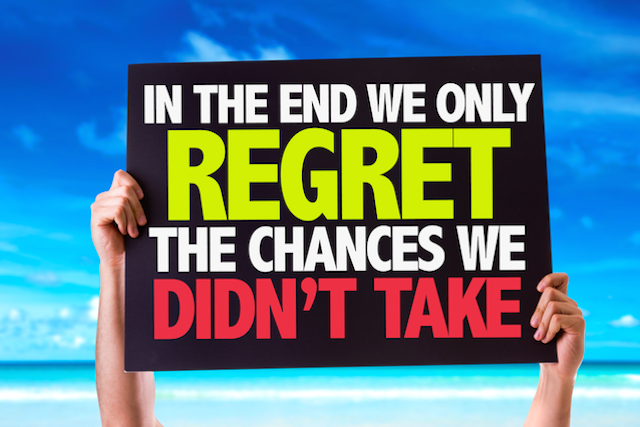
    Regret quote image via Shutterstock

  • Lessons from a TV Detox: Stop Watching and Start Doing

    Lessons from a TV Detox: Stop Watching and Start Doing

    Man Watching TV

    “Action may not always bring happiness but there is no happiness without action.” ~Benjamin Disraeli

    Back when I was a ballroom dance instructor, I never watched TV. This was because online streaming wasn’t yet available, and I worked Monday through Friday from 1pm-10pm.

    But over the past couple of years (and in a new career as a solo-preneur), it’s become way too easy to watch TV episodes on my computer. My one or two favorite shows a week turned into binge watching other recommended series.

    It all started out innocently enough. I enjoyed it as a way to unwind. But it slowly turned into an avoidance tactic.

    When I didn’t want to deal with the mounting laundry, or all the papers to file in my office, or those emails that had me cringing, I escaped into another TV show episode. It was great. I could get swept away into someone else’s drama for hours.

    But when I spent an entire weekend in bed streaming movies and shows for thirty-plus hours, I knew something had to change. Moreover, I knew I was going to have to do it myself. It wasn’t like I was addicted to drugs or alcohol. No one was going to have a TV show intervention with me.

    I decided to put myself on a twenty-one day TV show detox.

    Here is what I learned:

    1. To be more spontaneous.

    Before the detox, it felt like I needed time to completely turn my brain off. I needed time to shut it all down.

    Yet, when I no longer had TV shows to use as an escape, I realized that “need” was a story I was telling myself. I didn’t really need to turn off my brain. Rather, my ego had convinced me that it was important.

    What blossomed as a result was the ability to say yes to last minute adventures with friends. I had more time in my day because I hadn’t wasted it escaping into TV Shows. I learned that it wasn’t downtime I needed; it was creative time. Adding more fun and play in my life, felt great.

    Action: If you too have declined last minute offers to stay at home and watch TV, ask yourself: Is it because the activity is truly not your idea of fun? Or, is it because you’re living in another story? Perhaps it’s the “I’m too tired” story, or, “I need to turn off my brain” story. Acknowledging the fact that it is a story is the first step toward change.

    2. To choose activities that fed my soul.

    Usually after watching an episode or two, my negative self-talk voice would start saying things like, “You’re such a slacker. Look how much time you’re wasting, again! You are so unreliable. How can you help anyone, look at yourself?”

    It wasn’t until I banned TV that I realized how much my negative self-talk relied upon my all-consuming TV habit as its trigger, and why it was so negative—I was yearning for activities that fed my soul.

    Of course, I still allowed myself downtime during the detox, but I chose activities that allowed me to relax without checking out mentally, like reading or connecting with friends.

    Action: Instead of choosing TV as a “downtime” activity, list three activities you can do that help you relax and feed your soul—things that recharge and rejuvenate you.

    3. To face my stuff immediately.

    I don’t know about you, but reading work emails can put me on edge. It’s hard not to take things personally. So, I used to avoid responding by escaping into a TV character’s drama. The character’s overwhelm was far more entertaining. Not to mention the fact that they always came out looking like the hero.

    Without TV, I had to learn how to handle the emotional overwhelm of email in the moment.

    Action: If you, too, use technology or entertainment to delay responding to things that make you feel upset or wonky, practice keeping a small notebook and pen with you. I wrote out all my intense emotions in the notebook. It was my outlet, and it allowed me to get to the core of the issue.

    Writing has the duel affect of being a great way to vent and to spark your creative mind. This helps you come up with a powerful solution that works for everyone. Experiment with it and share below in the comments what happens for you.

    4. To be more social.

    Since I no longer had my TV show “friends,” I was forced to face my loneliness. Being a solo-entrepreneur, I don’t get a lot of social interaction with others unless I specifically plan it.

    So, I joined more meet-up events and met new people. I also scheduled phone dates with friends and I hung out with my family more. It felt good and surprisingly I became more inspired in my work.

    Action: Instead of sitting in front of a screen, sign up to attend an event, or go to a class by yourself (not with your group of friends) and introduce yourself to five other people. Meeting new people can be a big step outside of our comfort zones. But it can also be incredibly rewarding. I’ve met some of my closest friends this way.

    5. To get healthier.

    The most fun result of my TV show detox was that I lost weight.

    I am single and often eat alone at night. So, I used to give myself permission to watch a show while I ate dinner. The problem with this was that I would eat for forty-five minutes instead of the twenty minutes it took me to finish my plate. I would keep munching on things (that bag of chips or those pieces of chocolate) until the show was over.

    Action: Instead of eating and watching TV or eating and doing work, create three dinner dates for yourself this week. (They can be dates with yourself.) Put on your favorite music and take the time to enjoy tasting your food. Or, invite a friend over and prepare a meal together. When you pamper yourself this way, your body naturally relaxes.

    6. To stop distracting myself.

    My TV detox was not a perfect path. I still had low-energy, and overwhelming days. There were nights where I desperately wanted to curl up in my bed and watch a movie. There were also times that I caught myself distracting myself in other ways, by listening to audio books, for example.

    When I felt this way, I realized that what I really wanted was a hug and for someone else to hold me up for a while. So, I created a list of healthy, self-loving activities and I did them instead; for example, taking a hot shower or painting my toenails. By the time I was done, I had my energy back.

    Action: Create a list of twenty-five self-loving activities and post them somewhere that is highly visible. When your energy is low you don’t want to have to go fishing for the list. Instead of disappearing into your low energy by watching a TV show, you release the draining energy and feel even better for showering yourself with love.

    Deciding to put myself on a twenty-one day TV show detox was not the easy choice. It meant facing a bad habit and exploring all the affects it had on my life. But I am eternally grateful for the opportunity to see where I was “hiding” in life and stop the patterns of playing small.

    Man watching TV image via Shutterstock

  • How to Turn Worries About the Future Into Action Right Now

    How to Turn Worries About the Future Into Action Right Now

    “Every day brings a choice: to practice stress or to practice peace.” ~Joan Borysenko

    After years and years of living with anxiety, I can’t tell you exactly what I have been anxious about.

    Is it a pervasive thought about how my life will end? Is it a constant worry about my financial security? Is it simply that I’m nervous to give a speech in front of people? Or a combination of all of them?

    Even thinking about anxiety causes more anxiety. Ahhh!

    Anxiety is also really hard to define. It’s so subjective.

    I don’t think my anxiety will ever truly go away. I still have thoughts about the future, and the “what ifs” still run through my mind.

    I’m not some blissful angel walking around in a constant state of Zen. At least, this is how I imagine how I would be anxiety-free. There doesn’t seem to be a cure for anxiety that works for everyone. If you find one, please let me know.

    However, I know that I am no longer miserable. It’s different now than before. There are some positive things that have worked for me.

    One of the worst parts of my anxiety was that nobody could tell I had it. When I told people, they responded, “Wow, you always seem so calm and put together.”

    That is not how I felt on the inside. Why was what I felt on the inside so different than how others perceived me? I wanted to change this, and I wanted to be comfortable.

    I have found some ways to cope with and significantly reduce my anxiety about the future. Because that is what anxiety is all about—the future. Yet, I experience anxiety in the moment, not in the future.

    Rationally, this does not make any sense. How is feeling anxious in this moment going to fix or solve any problem in the future? It can’t. Oh, how I wish it were that cut and dry.

    However, telling myself this simple fact somehow helps a little. Anxiety isn’t logical. The more I treat it that way, the less I struggle with it. Still, even if it isn’t logical, it is very real.

    I’ve found that small action steps can turn some of these thoughts into real positive change, which helps me be a little more comfortable. The best part is the more you do them, the easier it becomes. It’s like a muscle you need to keep working out.

    Here is a breakdown of action steps to take when you’re worrying about the future.

    First, acknowledge what you’re worried about.

    Let’s say I have constant anxiety about an upcoming work conference where I know I will have to interact with important people. When I acknowledge that I’m feeling anxious, and why, I can then begin to take action.

    Next, ask yourself, what I am actually afraid of, and why?

    Write it out if you’d like. In the above situation for me, it would have been the fear of passing out or throwing up as someone important approaches me or asks me a question. Why? Because I get uncomfortable in social situations and don’t want to embarrass myself.

    Imagine the worst-case scenario.

    My worst-case scenario is sweating profusely and having a room full of people laughing and pointing at me because of it. Oh, and then I’d have a heart attack. Sound crazy? Think about something unusual you have convinced yourself to be absolutely true.

    Move from fear to action.

    Ask yourself, how can I take this fear and turn it into something I can do today—something that will most likely not cause the absolute worst-case scenario to happen?

    We want to increase our odds here.

    How can I break this down into an action that will help?

    In my case, I could approach some friends at work and make conversation; nothing serious, just more than I usually do.

    Or, maybe I could go home tonight and research one of the speakers at the conference to get to know them a little better.

    If I’m feeling really brave, I could volunteer to present something small to a couple of coworkers or even to an all staff meeting.

    Maybe I could sign up for an improv class to get comfortable in front of people.

    Maybe I could just talk to someone I trust about how I’m really feeling.

    The more I take action toward that future moment, the less pervasive my thoughts.

    Think about the desire to become an expert at something. You can ruminate over and over again how you wish you could play the piano, but it won’t make a difference if you never take action and sign up for just one lesson.

    If you can do something of value at your best today, there isn’t anything about the future you need to worry about.

    You see, every single moment becomes another moment, and then becomes another.

    I’ve found that if I can do one action today toward something I am anxious about, and do it my best, that is good enough for me.

    If you take many small actions over time, when the big moment actually becomes the moment (no longer in the future), not only will it become easier to handle, but you’ll most like realize that it wasn’t worth all the stress.

    I like to think of life in this way: I don’t know how it will all end, nor do I want to. I know that I can’t control my fate. I’m not perfect and I make mistakes. And that’s okay.

    One thing I do know for sure, if I do my best today I can look forward to a future that’s much better than my worst fears about it.

  • How to Reach Your Goals Faster: A Simple Technique to Try Today

    How to Reach Your Goals Faster: A Simple Technique to Try Today

    “Stop being afraid of what could go wrong, and focus on what could go right.” ~Unknown

    I used to think that getting to a goal only required tangible action. It was a simple equation:

    • Study hard in high school = getting admission to a good university.
    • Or, diet + exercise = losing weight.

    Yet, life is not always that straightforward. It’s not always just about physical action.

    Just a few years ago, when I was building my first business, there was something getting in my way, something that had nothing to do with the physical action I took. It was worry.

    Building a business has the magical ability to bring any type of fear out in the open. Unexpectedly, I found myself thinking:

    • What if it doesn’t work?
    • What if my friends think I’m crazy?
    • What if it takes forever to get somewhere?
    • Why am I doing this?

    It wasn’t long before I realized that these types of thoughts were interfering with my progress. The more I focused on them, the less physical action I took for my business, and the more likely I was to feel burnt out.

    Most importantly, the more I worried, the more likely I was to take the wrong physical action, the action that would count more as “busywork” rather than “effective work.”

    I knew I had to find a solution out of this. Ugh. “If I were a robot, then I wouldn’t have any of these problems!” I thought.

    Think about it: If we were robots, then these simple physical action equations would actually work. We would wake up in the morning, do our thing, stick to our schedule, and lo and behold, our dreams would materialize. No struggle, no “I don’t feel like doing it,” no distractions, no “What if it doesn’t work?”

    If we were robots, then our productivity would be close to 100%, and we would achieve our dreams two times, four times, maybe even ten times faster! Plus, we would get there without struggle. Aahh, that sounds so nice.

    I realized that physical action was no longer enough. We also need to be in the right state of mind—let me say, the “robot” state of mind.

    If we only take physical action, then we’ll only be working harder for nothing. For example, if you want a promotion, you don’t to only work harder; you also need to communicate your accomplishments so that others know how valuable your contributions are.

    However, if you’re afraid to stand up for yourself, then you’ll be left feeling unappreciated and undervalued.

    So to get the promotion, yes, you need to work harder, but you also need to overcome your fear of standing up for yourself. If you only work harder, then despite your hard work, you’ll still not get the promotion.

    So the winning equation is: Work harder + develop ability to stand up for yourself = promotion.

    If you think like a robot, then you’ll stand up for yourself in full confidence. No problem! If you don’t think like a robot, then all sorts of second-guessing glitches may come up.

    But let me clarify: By robot, I’m not referring to deactivating our feelings. Au contraire! We need feelings to march forward. We need excitement and optimism. We even need worry sometimes. What we don’t need though is excessive worry.

    Worrying about an issue for five minutes and then doing something to solve it isn’t excessive worrying. When we worry about things we can’t control, ask “What if this and that?” and second-guess ourselves, we just get in our own way.

    But how do you worry less? How do you turn self-doubt? How do you think more like robot? The answer lies in this Master Technique.

    Here’s what happens when you don’t think like a robot:

    Say you want to get leaner and fitter. You go to a yoga class where everyone is doing better than you.

    You start thinking, “I’m so unfit, I will never become as good as they are.”

    After an hour of berating yourself about not being fit already, you leave the class feeling exhausted, intending to never go back.

    Your mind is stopping you from getting to your fitter and leaner dreams.

    Now here’s how you’ll get yourself back to thinking like a robot, if only you use this Master Technique.

    Use “The BUT Technique” to Reach Your Goals Faster

    With “The But Technique,” you don’t let destructive thoughts stop you.

    How much time are you already spending judging yourself or worrying?

    Two hours every day? Maybe 50% of your workday and 80% of your free time?

    Once you start practicing this technique, you’ll instead spend this time on things that actually make you productive. Why?

    Because negativity, or just aimless worrying, will no longer stop you! You’ll be unleashed! A force of nature!

    How does “The BUT Technique” work?

    “I’m so unfit, I will never become as good as they are.”

    But…

    • Today I worked out more than yesterday.
    • It’s unfair to compare my own first day to other people’s 1,000th day.
    • My body no longer feels rusty, and people in the class seemed supportive, not judgmental.
    • Other people used to be in exactly the same unfit situation as mine, but they found a way to get fitter. If they did it, I should be able to do it too.
    • The walk to the yoga studio was enjoyable, as today’s sunshine was precious.
    • I’ve been in other unfavorable situations in the past, and I managed to turn them around. I should be able to do that with fitness as well.
    • Maybe this class was advanced and I should try something easier at first, so that I get to focus more on getting the poses right, and less on how clumsy I look in the mirror.

    Please notice:

    • With every new “but,” you’ll feel better and better. You’ll feel relief. The more “buts” you include, the more positive mental action you’ll take and the happier you’ll be by the end of the exercise.
    • By taking positive mental action, you’ll stop discouraging yourself from pursuing your dreams. Instead, you’ll encourage yourself to keep going. You might even make yourself feel excited about the delightful life that is in front of you! Now that’s how you become 20, 50, or 100% happier!
    • Make practicing this Master Technique a habit, and you’ll become the happiest person you know. You’ll become unstoppable!

    Why This Technique is So Powerful

    The “But” Technique doesn’t fight with your negative, discouraging thoughts. Doing so would leave you feeling worse than before. Instead, it accepts them and then it moves you forward.

    So yes you are unfit…but
but
but
but


    And then with every “but” you feel better, until you’re able to say, “Everything is alright” and actually believe it.
    And that’s exactly how you take mental action to achieve your dreams. The more you practice it, the more you can act like a robot—in a good way! 

    I’m now using this technique almost daily. Whenever I find myself worrying about anything, I immediately pull it out of my toolbox. Yes, I worry, but, but, but


    So now it’s your turn to practice this technique! Take any negative worrisome thought and add but, but, but. Let me know how it works!

  • 5 Ways to Seize the Moment and Live Without Regrets

    5 Ways to Seize the Moment and Live Without Regrets

    The Jubilant Man

    “Accept your past without regret, handle your present with confidence, and face your future without fear.” ~Unknown

    Samara is my colleague at work. She is one of the most pleasant ladies I know. She always has a smile and an encouraging word to give.

    She really is the kind of woman you want to speak to on the days you feel like life has dealt you a bad hand, because she always has something comforting to say. As we got closer, I confided more and more in her about the challenges I was going through in my life.

    I envisioned that her life must be perfect since she has such inner strength.

    But I was wrong.

    One day I noticed she had a sad countenance. That was strange because Samara was like sunshine itself. However, her sad countenance did not last, and before long she had her signature smile back on.

    But I was not deceived. I knew that deep inside her, she was experiencing some pain, so I asked her what was wrong.

    At first, she smiled and said that all was well. But I insisted that she confide in me. She looked me in the eyes, thanked me for caring, and then dropped the bombshell.

    “My six-year-old daughter has been in a critical condition for the past six months because of my carelessness. I saw her yesterday and her situation seems to have worsened. I think she is going to die.”

    For a second, I could not speak. I was in shock.

    “I am so sorry,” I managed to stammer, trying not to let her see how shaken I was by the shocking statement I had just heard.

    She explained to me that six months ago, she had stopped at a supermarket to get a few things. And because she was in a hurry, she had left her daughter in the car with the engine running. Her daughter had managed to engage the gear and the car had sped into the road, right into an oncoming trailer, and she had been seriously injured.

    The tears rolled down my face as she narrated this horrific story to me.

    She assured me that she had managed to forgive herself and had replaced regrets with gratitude for the six years she spent with her daughter.

    I recalled with a sense of embarrassment all the fuss I sometimes make over little things that, in light of what I’d just heard from Samara, now seem really insignificant.

    My marriage was not working out the way I wanted it to and everyday I lived with regret that I married my husband. I made a career change, which has turned out to be a very poor decision, and I have not been able to forgive myself.

    I realized that I spend too much of my time dwelling on all the mistakes I have made in the past. I spend too much time regretting things that I have no power to change. I spend too much time wishing things were different. I spend too much time beating myself up over what I’ve done.

    Over the years after that encounter, I determined to live a more positive life, free of regrets. Here are five ways I’ve learned to do that:

    1. Live your life with purpose.

    I realized that my career was doing badly because I did not have a career plan. I just drifted through my days without something to look forward to, so my life lacked momentum.

    Determine to live a life of focus. Today, take a stand on one thing you want to achieve in your life and draw up a plan to accomplish it.

    2. Stop making excuses.

    I blamed everybody else for the way my life turned out. I blamed my husband for the failure of my marriage and I blamed my boss for not promoting me.

    I am responsible for my life and not anybody else. Instead of making excuses, I need to take responsibility.

    It doesn’t matter what the obstacles in your life are. You can achieve almost anything if you put your mind to it. Helen Keller and Jon Morrow are examples of people who achieved excellence despite physical disabilities.

    Look within yourself. There is something waiting to be birthed. Find what that something is and do it, without excuses.

    3. Choose not to be a victim.

    At a point, I thought I had made such a mess of my life that there was no point trying to put things right. So I gave up trying. I mulled over my mistakes every day and went deeper into regrets.

    None of this helped me. I only started making progress when I embraced my mistakes, determined not to make them again, and resumed chasing my dreams.

    Life is not fair for any one of us. There will be storms and you will make mistakes. But be determined to get up as many times as life pushes you down. Forgive yourself, learn the lessons, and go on working toward your goals.

    The more time you spend feeling sorry for yourself, the less time you have to pursue the life of your dreams.

    4. Stop comparing yourself to others.

    I could not stop comparing myself to others. Everybody seemed to be happier than me, their marriages seemed to be faring better, and I seemed to be the only person with a less than fulfilling career.

    This made me feel even worse. I wondered what others were doing that I was not. Their progress in life seemed to dampen my spirit.

    Over time, I realized that comparing yourself with others is one of the greatest mistakes anybody can make. No matter who you are or where you find yourself in life, always remember that you have your own unique path to walk.

    Never compare yourself, your struggles, and your journey to anyone else, for that would only distract you from your own.

    We are all different. Forget about others and focus on fulfilling your own life dreams.

    5. Take action now.

    After I drew up a career plan for myself, I still lacked the courage to follow my plan. I wasted a lot of time because I was afraid that I would fail and I did not have to courage to start. So I continued to push things off.

    It’s funny how so many people seem to think that tomorrow is better than today for getting things done. We put off those things that are important to us and we lie to ourselves by saying that we will do them later.

    Whatever you need to do, do it now! Today is the tomorrow you planned for yesterday, so start today.

    My chat with Samara that day was a wake up call. I promised myself that day that I would not waste any more precious moments of my life regretting. I have been able to do that and have discovered inner peace in the process.

    So I urge you to do the same. Don’t waste any more time on regrets. Learn the lesson and move on. There’s still a lot of life in you. Go out there and live it!

    Photo by Benson Kua

  • 5 Tips to Help You Take Action to Overcome Your Fear

    5 Tips to Help You Take Action to Overcome Your Fear

    “Thinking will not overcome fear, but action will.” ~W. Clement Stone

    I made it all the way to my thirtieth birthday without learning how to drive. After I turned twenty-one, people often asked me why I hadn’t learned yet. My go-to story was that I lived in a place with abundant public transportation options and never had any intention of buying a car.

    The truth is that I wanted to learn, but I was terrified, and the fear grew with each year.

    What if I got in an accident? What if people laughed at me for learning so late or honked angrily at me? What if I chose a bad driving school with unforgiving teachers?

    I used these fearful questions and the fear responses that came along with them as obstacles to stop me from taking any action toward learning. I felt as though their presence meant that I couldn’t take an action. I wanted them to go away before I took any steps.

    The one thing I was avoiding was the key to me overcoming my fear. It sounds so obvious, but how many of us have wanted to do something, felt afraid, and then spent more time thinking and talking about it than actually taking action?

    I put “learn how to drive” on my New Year’s resolution list for the last time and decided to find a way to make it happen, despite my fear.

    When you think of taking action, you might have some big, scary idea of what I’m talking about. I’m not talking about deciding one day that you want to jump out of a plane and then an hour later booking your flight. Or in my case, deciding that I wanted to learn how to drive and then getting right in the driver’s seat.

    None of this is necessary.

    I’ve learned five helpful things about taking action that helped me move from thinking about learning how to drive to getting behind the driver’s wheel and actually driving confidently.

    If you already know how to drive, which I’m assuming most of you do, these things can easily apply to anything else you’ve wanted to do but haven’t yet tried out of fear.

    1. Start at the beginning.

    One reason that we hesitate when we have something we are afraid to do is because we are thinking only of the end result and likely feel incapable of getting to that point from where we are now.

    Forget about the end result, or at least take your laser focus off of it long enough to determine what the first step might be. In my case, the first step was visiting my state’s Registry of Motor Vehicles website to find the process for getting a learner’s permit.

    The more you focus on all of the actions you have to take to get to the end result, the less likely you are to actually take any steps. So just focus on the first step and start there.

    2. Remember that small steps count too.

    Each action step doesn’t have to be big.

    Your brain, ego, or that limiting, fearful part within will try to convince you that your steps are too small. They couldn’t possibly count, it says, so better to just not try. It’s lying to you.

    Every accomplishment, like baking a cake, publishing a book, or learning to drive, is made up of small steps made over and over and over again.

    Learning about the learner’s permit process led to picking up a driver’s manual, which led to spending time every day studying the manual, which led to scheduling the permit test. All these small steps built up to me ultimately learning how to drive.

    3. Realize it’s not how you feel; it’s what you do.

    One of my obstacles was thinking that the presence of physical fear symptoms meant I couldn’t take action. You can be terrified, with a quick pulse or shaky hands or shallow breaths, and still take action.

    It’s the steps that count, not how you feel when you take them.

    When I had my first driver’s lesson, my hands shook so badly that I wasn’t sure I would be able to hold the steering wheel. But I got through the lesson, one step further in my journey to learn, and decided that I would celebrate the fact that I showed up, in spite of fear, rather than judging myself as a failure for how nervous I felt physically.

    4. Get high on taking action.

    There is this magically wonderful high that occurs after you’ve taken action that you were afraid to take. I’m not sure how many of you have experienced it, but talking to other people who have done things that terrified them, I found that I’m not alone in noticing this.

    Use that high to your advantage. Make it an incentive that leads you, especially in moments when you are doubtful, that you can handle the fear of taking another step.

    After my first lesson, I wrote down how I felt (excited, proud, happy) and I referred to it again before my next couple of lessons when I forgot how good I felt and needed a reminder to help tone down my fear.

    5. Know that action builds confidence.

    Deciding to take action to overcome my fear of learning to drive has not only meant a new skill, it has also brought me confidence in my ability to learn new things, handle mistakes, work toward and achieve a goal, meet new people, and much more.

    Action has many unintended opportunities for growth beyond the specific area we decide to work on.

    It’s in the action that we test our hypothesis about life and about ourselves. It’s in the action that we grow confident about ourselves and our abilities. It’s in the action that we find out what mistakes are experientially and how much stronger we are by learning from them as we go.

    So today I can say I know how to drive. I even look forward to it. I couldn’t have said that though had I just continued to wait to take action until I no longer felt afraid.

    What action can you take to overcome your fear today?

  • The Antidote to Criticism: Turn Others’ Doubt Into a Standing Ovation

    The Antidote to Criticism: Turn Others’ Doubt Into a Standing Ovation

    Clapping

    “Criticism is something you can easily avoid by saying nothing, doing nothing, and being nothing.” ~Aristotle

    Gangly and skinny, I never attracted much attention from the opposite sex during high school. I was the friendly and funny sidekick to the popular girls—fun to hang out with but not to date.

    When an older guy approached me during my last year of high school, I thought it would be a normal high school romance.

    It turned out that our relationship wouldn’t be anything close to “normal.”

    As I began to get to know him, everyone around me started to object to our interest in each other. My family, my friends, even people I hardly spoken to in years, they all opposed our budding relationship from the start.

    One time, a friend of my parents came up to me at a restaurant and said, “He’s not for you. You’re a princess and you deserve a prince,” before walking off. It felt like a hit and run.

    They said we weren’t right for each other. They said we didn’t run in the same circles. They said we were brought up differently. They said the long distance we’d have to endure wasn’t worth it.

    They said so many things, but it didn’t matter.

    Despite their objections, we continued our relationship on and off for four years, suffering under the weight of the rejection of our loved ones. We didn’t understand why they couldn’t see how simple and right our relationship was. We didn’t understand why it was such a problem for us to be together.

    As much as we fought it, our relationship eventually buckled under all that judgment and fell to pieces.

    Now, looking back on everything I went through, I can see just how much I gained from that suffering and criticism. Not only did I enjoy a beautiful relationship and friendship for four years, I also gained something else entirely:

    I gained the opportunity to do something of my own, making my own actions and decisions based on my own criteria.

    No matter if people’s criticism were right or wrong, what matters is that I learned to follow my heart and make decisions that are important to me.

    I withstood the rejection of the people closest to my heart, all because I believed strongly in what I was doing. I was strong and steadfast—attributes I didn’t know I had.

    Hindsight is 20/20, right?

    All of those lessons are what I can see now, after everything has been over for years, but the moments when I felt attacked by their criticism were difficult to get through back then. It would’ve helped me understand it all better while I was going through it, so I started wondering…

    Why do people criticize in the first place?

    Through my conversations with friends and family that once criticized me, it seems to me that there are a few main reasons why people may criticize—all related to fear:

    1. Fear of failure.

    Most of the people that criticize our decisions are fearful of our failure. They want to protect us, and telling us their objections are their way of attempting to keep us safe from failure.

    2. Fear of change.

    Sometimes, the people who criticize us are afraid of how our decisions and actions will cause changes to the status quo. We like how things are right now, so why change them? Change means we don’t know what will happen next, what’s lying in wait around the corner.

    3. Fear of action.

    What this really means is insecurity. This is probably the most hurtful kind of criticism, but it’s very simple to break down.

    Sometimes, people criticize us because they too wish they could make these decisions or take action similar to ours. They’re afraid that they don’t have it in them to pull off what we’re trying to pull off, and they turn to criticism to deal with that fear.

    Most of these come from places of love—love for us or love for themselves. Identifying that would’ve helped me deal with what I went through years ago, but it helps me now, too, whenever I face criticism.

    Sure, there are many more reasons for criticism and not everyone gives it from a place of love, but these few examples have helped me dive deeper into why criticism arises and how I can turn it into something great.

    What can criticism turn into?

    When I suffered from the judgment of my loved ones (and the scorn of people I hardly knew, like the lady in that restaurant), I followed my heart and did what I thought was best, despite the hurt. I wasn’t aware that those few years of steadfastness would turn into what I now call a “standing ovation” of sorts.

    Recently, I was at a party with friends when an acquaintance approached me and said, “Marcella, I know we’re not close or anything, but I wanted to tell you that I admire you for standing up to everyone when you were in love. You stood up for what was right, and that was a beautiful thing to do.”

    The very people who criticize us are the same people who later on applaud our efforts.

    While it’s wonderful that someone saw the value in my struggle, I’ve recognized even greater value the more time goes by. Facing criticism and following what felt right with my first love trained me to do the same as I grew up.

    Dr. BrenĂ© Brown says, “If you’re not in the arena getting your butt kicked, I’m not interested in your feedback.” I’d add to that with the following: I hope that me being in the arena getting my own butt kicked can inspire others to enter the arena, as well.

    Photo by Martin Fisch

  • 5 Steps to Overcome Fear and Meet Your Goals

    5 Steps to Overcome Fear and Meet Your Goals

    Standing on a Bridge

    “I learned that courage was not the absence of fear, but the triumph over it.” ~Nelson Mandela

    The world can be a scary place.

    As we go through our daily lives, we face many challenges, and often these challenges can bring about fear. We may fear the loss of something, or perhaps the lack of fulfillment. We may experience fear when going on a job interview or a first date.

    The greatest challenge with fear is that it can hold us back from achieving our goals, but it doesn’t have to.

    Over the past six months I have let one fear hold me back from achieving the one thing I feel I wholly deserve. I’ve had a fear of not meeting my soul mate.

    After being single for nearly six years, I felt a sense of loneliness and a desire to build a relationship with someone.

    I turned to online dating last fall, a method I tried for over eight months. I was able to meet many people and enjoyed dinners and walks with potential mates, but nothing ever developed past two dates with the same individual.

    After many dates that didn’t lead to anything long term, I felt deeper fear, sadness, and a loss of hope.

    I came to realize that my desire to meet the person I would potentially spend my life with had manifested into a fear that drove away any hope of building something real and lasting.

    Dating began to feel like a chore, and it became unenjoyable. For love to happen, I had to overcome my fear and enjoy the time I spent meeting new people.

    I believe in the power of intention. But in setting forth an agenda, we must learn to let go and have faith. Things may not happen when we want them to, but often a delay is the result of greater things at work.

    Wayne W. Dyer wrote in The Power of Intention, “if we focus on what’s ugly, we attract more ugliness into our thoughts, and then into our emotions, and ultimately into our lives.”

    Intention is related to fear because if we can trust our own intentions and allow our minds to focus on the potential positive outcomes, we will face less fear in most situations.

    It’s easy to let fear play a part in our daily lives. I’ve had many opportunities to face my fears lately, but I knew little about overcoming them. Alas, I learned several key facts that have broken down my fears and allowed me to focus on achieving my goals.

    These five techniques will help you overcome fear in your daily life:

    1. Start small.

    Fear comes in many shapes and sizes. Facing it doesn’t have to be a grand gesture.

    My fear of living life alone created immense challenges. “I’m going to grow old alone,” I once said. Deep down, I knew this wasn’t true, but my mind had saturated into a restricting fear around the worst-case scenario.

    I broke down my anxiety into smaller, more manageable pieces. Instead of wondering how I could meet my soul mate, I thought about how I could make new friends instead. By focusing on meeting new people, I have increased my odds of reaching my goal without the anxiety and pressure of finding “the one.”

    Instead of focusing on the end result, I can now focus on more manageable goals.

    No matter how large or small your fears may seem, scaling down to a more manageable size will be beneficial. Slowly step out of your comfort zone and begin moving towards your goal.

    2. Have faith.

    While achieving your goal may not happen on your preferred timetable, it is important to have faith that time will bring success. Trusting that achievement is not only possible, but probable will help soften your fears.

    Think back to an event in your life that may have seemed bad at the time but allowed for certain circumstances to occur that brought about a greater and more wonderful event. That’s proof that the world is not against us but is indeed working with us.

    3. Write it down.

    Making a list of your fears is a great way to work through them.

    Writing in a journal has been very helpful for me to overcome my fear of not meeting my soul mate. I have written about particular dates I went on and how the meetings made me feel.

    I’ve found it useful to write down a fear and then describe on paper why I feel I have it. This task has been essential in helping me chart my progress and list what I have learned in the past.

    Writing has allowed me to accept that things are evolving, even if they don’t seem that way—which brings me to the next important technique for overcoming fear: acceptance.

    4. Accept what develops (or doesn’t).

    When I was using an online dating service, every first date felt like a blind date. Profiles only went so far in explaining other individuals’ personalities. I had to accept the fact that the first date might not lead to a second and that he might not be “the one.”

    I had to accept that I couldn’t force a relationship, nor could I force the timing of true love.

    The Dalai Lama said, “If you have fear of some pain or suffering, you should examine whether there is anything you can do about it. If you can, there is no need to worry about it; if you cannot do anything, then there is also no need to worry.”

    5. Let go.

    Letting go can be one of the greatest challenges to overcoming fear. At times, we hold on to something because we feel it empowers us; however, holding on only weakens us.

    Once we have accepted what may or may not develop, we need to detach ourselves from the outcome. Letting go of our fears allows us to focus more on the present moment and less on the fear itself.

    After following these techniques, I no longer have a fear of spending my life alone, because I know and trust that there are great things ahead. Now I can enjoy meeting new people and going on dates without fear.

    Photo by Geraint Rowland

  • When You Keep Learning Instead of Taking Action

    When You Keep Learning Instead of Taking Action

    “Begin, be bold, and venture to be wise.” ~Horace 

    It was day five without food, meditating in a cave in the Sahara desert.

    In 2009, I skipped out on two weeks of my senior year of college to go to the desert.

    Ever since I was a young I had been into exploring the boundaries of the self. I had always wanted a period of time when I could totally be alone for days—not a word spoken to me, where I could go deeper into my mind than ever before until I simply evaporated.

    So there I was.

    Just the desert sands, the sky, and me.

    And I was bored.

    The mind-bending impenetrable boredom was the first thing that hit me. Hard.

    And I’m not one of those people who is constantly multitasking. You can put me in a room for 3 hours and tell me to do something quietly and I’ll come out fine, sanity-intact.

    However, there was something so stubborn about this boredom. I was wondering if perhaps I should’ve just gone back to my daily meditation routine instead of flying all the way into the Sahara desert.

    The days eventually passed, the sun rose and set like it should, and every once in a while I had little visitors stop by.

    A dragonfly.

    I thought that was a little weird, since I knew dragonflies don’t go far from water.

    Two dragonflies. Hmm.

    Five dragonflies.

    A cloud of dragonflies flying in formation. That was pretty bizarre, I thought.

    As the days wore on, I started experiencing the subtle effects of hunger. Pain and nausea wore off after day 1—and afterwards I just experienced weakness from the lack of food. (more…)

  • On Getting Started When You Don’t Feel Ready

    On Getting Started When You Don’t Feel Ready

    Jumping

    “Don’t wait for your feelings to change to take the action. Take the action and your feelings will change.” ~Barbara Baron

    A few months ago I challenged myself with Adventure Boot Camp. I thought, “What would be more challenging than waking up at five in the morning and working out with a group of ladies for an hour, four days a week?”

    And I have to say, it was tough! I couldn’t walk for three days.

    But as the days progressed and my muscles acclimated, it occurred to me: I’m someone who can roll out of bed at  five in the morning, and within a half hour, lift eight-pound weights over my head while jogging a track. I didn’t know that I could do that!

    That’s the thing about taking an action. You don’t know that you can do it until you do it. And then you become someone who does it. (more…)

  • Lessons on the Trapeze: the Art of Making Things Happen

    Lessons on the Trapeze: the Art of Making Things Happen

    Trapeze

    “Never ignore a gut feeling. But never believe it’s enough.” ~Robert Heller

    A couple months ago, when I was almost done producing a teleseminar and spending way too much time hunched over at the computer, I decided to do something different. Something that would bring me joy, that would get take me out of my normal environment and actually excite me.

    So, I did what had been on my list to do for a long time: I went flying.

    I didn’t know what to expect making the forty-five minute trek out to the Sonoma County hills to fly on a trapeze. I just knew I had been wanting to do it for a while and it was closer than then the outfit I’d been considering in Texas (which was also outdoors).

    I also knew I had to go because just the thought of flying through the trees excited me more than anything I had done in a really long time.

    I made the trek by myself because no one wanted to join me and I figured why wait? I was greeted by, what I learned, was a core group of women who met there every weekend.

    One of the women who was in her seventies comes as often as she can. She was flying through the sky doing twists without a harness. (She got her pilot’s license in her sixties, which gives you a clue about her!)

    Another woman was a single mom who came with her son every weekend and made this her retreat. (more…)