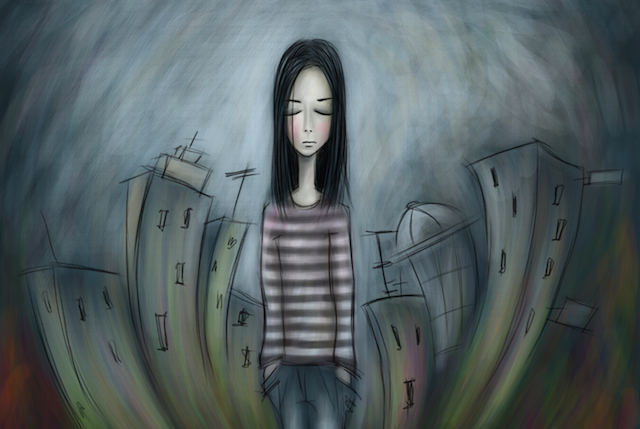
Tag: accept

  • How to Make Anxiety Work for You, Not Against You

    How to Make Anxiety Work for You, Not Against You

    Lonely Girl

    “Growth begins when we start to accept our own weakness.” 
~Jean Vanier

    I got fired from my job, my boyfriend left me, and my father died in one day.

    In reality, my career was going super well, I didn’t have a boyfriend, and my father was amazingly healthy, but what I did have was something I call an ultra amazing imagination, where I would make up fascinating stories about things that could happen and worry about them. (Or as other people call it, general anxiety disorder.)

    I met my now BFF anxiety when I was about ten years old. Initially, she wasn’t that much of a drag, except for casually letting me know that I should dread going to school on Mondays because something terrible was going to happen.

    I didn’t understand why she was telling me this.

    Rationally I knew it wasn’t true. I loved school. But I couldn’t get her words out of my mind. I tried explaining what was happening to my sweet and caring father, but the only words I could get out were: “Dad, I feel bad, and I don’t know why.”

    Anxiety took the liberty of moving into my room and accompanied me through my teenage years and twenties. She had black greasy hair that covered her face, and shrivelled, pale white skin that looked like it was starving for something. I just didn’t know what.

    The more I ignored her, the more she dug her dirt-filled, jagged nails deep into my bare skin.

    There was nothing I could do to escape her. I obviously couldn’t tell anyone. She assured me people wouldn’t understand.

    Besides, I had grown used to the feeling of having knots in my stomach every day and the sleepless, nightmare-filled nights. If I didn’t have these experiences anymore, who would I be?

    That’s until I turned thirty and had, well, as public speaker and shame researcher Brené Brown calls it, a spiritual awakening (a breakdown). I had reached breaking point and realized I couldn’t live the rest of my life like this.

    There had to be another way.

    I did all the typical things people do when they have a spiritual awakening.

    I journaled profusely, saw a psychologist, joined an eight-week mindfulness-based meditation class for people with anxiety and depression (I took the class three times), and learned something called Psych K to change my subconscious beliefs about myself.

    These things helped immensely. But what really changed the way I felt about anxiety was watching, wait for it, a teen, Hollywood, science fiction movie—Insurgent.

    (Warning, spoiler alert). There’s a scene in the movie where the main female character, Tris, has to pass a variety of simulations to escape a futuristic prison she’s been captured in.

    The particular simulation that changed my life shows twenty-something, short-haired Tris standing face to face with her beautiful clone, who’s embodied the anxious voices in her mind.

    She sees the clone running at her full force, trying to physically kill her. (If you’ve ever had major anxiety, a lot of the time, that’s what it feels like.)

    They duel it out, Matrix style, by flying around the room trying to attack each other, while smashing into thick glass windows.

    Her clone violently shouts out all the things Tris tries to avoid hearing such as: no one will forgive you and no one loves you. (I might have added the love part in, but hey, it adds to my point).

    Tris then stops fighting as she realizes she’s the only one who can accept her ego and says lovingly: “I will forgive you. I will love you.” The clone stops attacking her, the simulation dissolves, and she’s passed the test.

    After watching this scene I collapsed into what looked like a hunched over tree that had been hit by a storm. I burst into inconsolable tears, while my little white, fluffy dog looked at me with his head tilted as if to say: “What’s wrong, girl?”

    I thought about how all these years I’d been talking to myself like I was worthless. Every time I felt sadness or anxiety I berated myself further and emotionally smashed myself into the ground whenever I needed help.

    I was the one who had turned anxiety into some sort of creepy horror movie character, when really all she was, was a version of me who just wanted to be heard and loved.

    I decided that day to change anxiety’s name to “sweetheart.”

    Sweetheart and I get along really well now, and she’s so much happier too. She now has a rosy complexion; long, shiny black hair; and beautiful, glowing skin.

    When she feels worried, I tell her I am there for her, and she smiles. When she’s angry, I listen to what’s bothering her, and she relaxes.

    The most important thing is I give her attention when she wants it, and she thanks me and happily skips away to wherever she goes instead of torturing me. (I am assuming my mind has a virtual Starbucks where she hangs out, and it now offers coconut milk.)

    When you accept and love parts of yourself that you deem unacceptable, a strange thing happens. Those parts start working with you instead of against you.

    I don’t really look at anxiety the same way anymore. I look at it as an unbelievably creative imagination. (UCI is the medical term I give it.)

    If it’s used or channelled out of me through writing, I feel awesome, energized, and optimistic. If I don’t do anything with it, I catastrophize doom and gloom, feel exhausted, and see the worst in everything.

    I believe having UCI is a sign showing me my life calling, which is a career in story telling through writing and public speaking. I would never have figured this out unless I paid attention to the voice in my head.

    If you are currently struggling with UCI (aka anxiety), believe me, I understand how you feel and how dark things can get. But I also believe we are given certain traits or tests in life to teach us something and move us in a certain direction.

    Rather than seeing UCI as something that needs to be removed, think about the gifts it brings to your life and choose to see it differently.

    Now that I can see my anxiety as a gift, I know what I need to do to get back to inner peace, something I don’t think I’ve ever really been able to do.

    So go forth my friends, find the sweetheart of your mind, and listen to what she wants to tell you. You may be surprised at how cool and wise she really is…

    If that fails, watch Insurgent with your dog.

    Lonely girl image via Shutterstock

  • Learn To Flourish When You Are Not In Control

    Learn To Flourish When You Are Not In Control

    Woman Throwing Arms in Air

    “Incredible change happens in your life when you decide to take control of what you do have power over instead of craving control over what you don’t.” ~Steve Maraboli

    On December 31, 2011 I experienced something I will never be able to blink away. I watched as my twelve-year-old daughter convulsed, turned blue, and stopped breathing on the floor of our living room.

    Time stood still. I heard my blood whoosh through my ears. I became a helpless observer. This simply couldn’t be happening to us; she was fine only a moment ago.

    I remember the exact moment when I realized that I was thinking that my daughter was dead.

    I will never forget that choking fear that everything in my life had just changed forever. Nothing mattered in that moment other than her. I begged her to breathe for me. I needed her to breathe. Fear dug in hard and wouldn’t let me go.

    After several moments of stillness, she took a very slow breath and then another. Her eyes were vacant and staring beyond me. Her arms and hands still twisted beneath her chin, against her chest. It would be hours before she would know who I was.

    Little did I know this was the beginning of an unimaginable journey.

    While I would lose her to a neurological conditional and medication side effects over the next four years, we would also learn and grow together, find happiness in the little things, and learn how to deal with the things we couldn’t control.

    She was diagnosed with Epilepsy within a few weeks. I was hopeful we could manage this and get on with life. We followed her doctor’s orders diligently, and I was meticulous with her medications.

    She had more seizures. We increased her medications. We changed her diet. I sought out alternative health practitioners and healers.

    Time had a way of slipping by, first in days, then months, and soon years had drifted by without me noticing. We went to the best hospital in the United States and we were told there was nothing more we could do. This was not what I could accept. Instead, I continued to hope.

    Her seizures increased. She couldn’t learn. She slept all the time. Depression and anxiety followed.

    Her medication side effects were brutal, and I didn’t even recognize my daughter anymore. Her beautiful spirit had retreated, held hostage there by the thirty anti-seizure pills she took each day. I knew I couldn’t give up on her.

    As her primary caregiver, I was sleep-deprived, anxious, terrified, and living in fear of the next seizure. She got worse, and I was drowning because I couldn’t control any of it. She required care, supervision and support that I felt I had no idea how to provide.

    One evening, I woke to find her having a Grand Mal seizure in her bed. I sat alone in the dark with her, crying, because I had nothing left to give. I had no way to help her. I had done everything I could and it still was not enough. I couldn’t change things.

    I crawled into bed with her so I could watch her breathe. Exhaustion settled over me, but I awoke with a shot of adrenalin when she began to seize violently against me. Again, I begged her to breathe.

    I crumbled in the fatigue and the stress and knew that something had to change or we were going to be totally destroyed by this.

    Surrender your desire to control.

    In that moment, I knew that I had to surrender my desire to control the uncontrollable. I had tried for four years to manage the things beyond my control. This choice got me nowhere and stole my energy faster than I could refuel. I was now absolutely depleted.

    I had to come to terms that I couldn’t control how long this beautiful child would have on earth. I could not breathe for her. I couldn’t watch her every single moment. This was not for me to determine.

    This was the hardest thing I have ever had to do, but it made the greatest impact on my well-being, and ultimately hers, because I was able to show up differently for her.

    In fact, while focusing on my daughter’s health, my son was hit by a car while riding his bike. This was a wake-up call to me that trying to control the uncontrollable was nothing but an enormous energy leak.

    I couldn’t control the seizures, the side effects, or the memory loss. But I could control where I allowed my energy to flow.

    Shift your focus.

    I decided instead to shift my focus. I could control her schedule. I could make certain she got her medications.

    I could get her to doctor’s appointments and scans. I could be supportive and give her my time. I could help her see moments of joy. I could help her with schoolwork. I could be her advocate at school. I could give her more of what she needed between seizures.

    As I began to focus my energy on the things I could control, I regained some purpose.

    I felt more energized. My hope returned. I was less depleted and more strategic. I began to see new options and opportunities where before my fatigue saw nothing but closed doors. I felt a significant shift. I was spending my limited energy stores in a different way.

    Practice gratitude.

    The other thing I did was I began to practice gratitude.

    When you have something so massive pressing down on you, it becomes very hard to not be focused on that. We had been focused on her being sick. We fed the fears. We lived in anticipation of the next catastrophe. We forgot that we still had much to be grateful for.

    I began to look for things every day that brought me joy: the sun on my face, a warm cup of creamy coffee, or hearing my kids laughing in the other room. The more I looked for these lovely slivers of joy and hope, the more I saw them.

    Soon, I was focused on how blessed I felt and the joy that had always been around me but that I failed to see when I was looking the other way. Even in times of struggle, I continued to look for these simple things, and they were always there for me. I just had to decide to see them.

    What this personal struggle ultimately taught me is that letting go of what you cannot control is hard, but holding on to these uncontrollable things and trying to manage them is much harder. My energy was best spent on things that could bring me desirable outcomes, not on trying to hold the wind in an open hand.

    Our journey has taught me that I am in control of my thoughts, and when I pick my thoughts carefully, I can still flourish in challenging circumstances.

    Over four years has passed since this journey begun, and I am pleased to say that my daughter has recently enjoyed a couple months virtually seizure-free.

    We have begun to reduce her medications and introduced homeopathic medicine into her daily care. I am hopeful, energized and optimistic about her future.

    There is no doubt in my mind that had I not surrendered and let go of the things I could not control, I would never have had the energy and focus to continue our fight for a seizure free life.

    I know it is hard, but letting go of things you cannot control does not mean you do not care. It means you understand that letting go can lead you to a happier, less stressful life.

    Woman throwing arms in air image via Shutterstock

  • The Pain Won’t Stop Until You Accept What Is

    The Pain Won’t Stop Until You Accept What Is

    “Accept what is, let go of what was, and have faith in what will be.” ~Sonia Ricotti

    Life is sometimes ridiculously hard. It sucks. It rips out your heart and your entrails, spins them around the room, and stuffs them back in unceremoniously through the hole from which they were ripped.

    And it expects you to smile and carry on. People expect you to carry on. Because that is what we think people do.

    I felt like this a few years ago when my marriage ended. Luckily, I had good people around me. They didn’t expect that from me.

    I, on the other hand, expected me to get right back on that horse. I had to keep going, to be stronger. To not let it affect me that much. So I berated myself. I got angry with myself. I hated myself (because that was exactly what I needed, right?)

    The thing is, when you are in the thick of it, you don’t know what you need. You know there is pain and you want it to stop. Please, please, just stop!

    And then there is the anger. This is the hurt you don’t understand yet. Hurt without compassion, hurt without direction.

    It explodes. It finds a way, a way out, somehow. Eventually.

    My expectations were so high. Or should I say, it was my hopes that were high. It had to stop.

    I couldn’t function until it stopped. I couldn’t forget until it stopped. And I wanted to forget so much.

    I wanted to forget how I felt now. I wanted to forget how I felt before—because then I wouldn’t miss it so much. I wanted to forget the good things she did because remembering caused pain.

    Conversely, I wanted to forget the bad things she did because those memories caused pain, too.

    In addition, I wanted to forget every small little detail of the stupid things I’d said and done that I wished I hadn’t, the things I went over and over and over in my head. Those sharp, jagged memories I just couldn’t switch off, each one like a fishhook being carefully placed beneath my skin, then mercilessly torn from its grip.

    I scurried desperately for refuge inside my head. I stayed in there. Outside were people.

    People would want to talk to me, to make eye contact. I was incapable of either. I was scared.

    I was frightened and ashamed and I didn’t want to see caring in someone else’s eyes. I didn’t want to hear kind words. I didn’t know how I would respond.

    I didn’t know if I would break down in tears, descending to that place I hated where I was a pathetic, whining fool who brought it all on himself. Or alternatively, to the place where I got so angry at how I was treated that I didn’t want anyone to see the look in my eyes. To see the raw anger and furious energy that burned inside of me.

    I didn’t want to be seen. Being seen asked questions. Questions I wasn’t ready to answer.

    It was like a living volcano raging inside me. I went to counseling because I needed an outlet. I needed to get it out.

    The hope inside of me that we would get back together restricted me from talking to people close to me. “What if we got back together?” What if in my pain and my hurt I said things about her, how would people see her when she came back? That would make it difficult for her.

    In retrospect, I think I knew it was over, deep down, but I was still fighting what was. This false hope also gave me a reason not to open up or face things.

    I look back with gratitude that I somehow found the wisdom in the bottom of that cold, dark place to take that step, to actually do something.

    All of my life I had bottled up feelings. I had been strong. I had controlled my emotions.

    I wasn’t a walking unfeeling marble statue. I did let loose some emotions. But I never really fully let go.

    I never allowed myself to feel it all completely. I never surrendered. I was always fighting reality.

    When I finally relinquished my hold on trying to control everything, it all changed. I allowed it to fall, to break free. I held nothing back.

    It was here, in this moment, I finally grasped that accepting where we are is the most important step in any change process.

    It was the only way through any journey of pain, to allow yourself to feel it without judgment. From the maelstrom of confusion, darkness, hail, wind, and rain in my mind, the storm started to pass.

    It was like waking up lying on a beach after a shipwreck. Battered and bruised, feeling empty inside, lost, lonely, not knowing where you are, where you are going or how. But in the center, deep inside, there is a calm. Something that whispers, “The worst is over.”

    Suddenly, I was able to sleep again. I woke each day without that feeling of readying myself for battle. My food tasted better.

    I still had the hurt, but it was dulled. I still had the memories, but the sharpness around the edges began to blur a little. I had still to figure out what my life was going to be like without her in it, but I had survived.

    All of this I allowed when I surrendered.

    When I stopped fighting reality my mind calmed, and I understood that what has happened outside of me “is what it is.” I cannot change that, only how I respond. Accept.

    My prolonged and persistent pain was coming from my refusal to accept this. When I stopped fighting what was, when I stopped trying to fight against the waves rather than letting them carry me to shore, I finally found peace. Surrender.

    The reality wasn’t different. I still had to deal with my new situation, with my new life. But the storm in my mind had quieted. It was easier to see.

    What I learned here wasn’t just about a break-up. It wasn’t just about dealing with pain. For me, this was a massive life lesson.

    There are still many times when storm clouds amass in my mind. I remember not to fight the reality, whatever is going on in my life. I remind myself, “This too shall pass.”

    Everything is transient. Everything ends. Good and bad.

    So I wait during the bad times. I watch, I observe, I learn. I focus on what I can control and I don’t resist and fight what I can’t.

    And I remember to cherish the good moments because they too shall pass. Life is so much richer when we surrender to it rather than fighting it. It all starts with accepting what is.

  • What to Do When Things Go Wrong and You Feel Sorry for Yourself

    What to Do When Things Go Wrong and You Feel Sorry for Yourself

    Sad Woman

    “We can always choose to perceive things differently. We can focus on what’s wrong in our life, or we can focus on what’s right.” ~Marianne Williamson

    I was down in the dumps the other day and was feeling sorry for myself.

    For some reason everything was just off. You know when you have one of those days when nothing seems to go right? And you get easily irritated and extra sensitive with everything?

    It all began the night before. I was expecting a call from a guy who I’ve been getting to know. He said he was going to call but never did. I woke up the next morning feeling disgruntled.

    My day proceeded with me stubbing my toe against the bed post, burning my toast, and then receiving a call from the bank to inform me that my debit card had been tampered with and someone had withdrawn over $1,000 from my account. (Luckily, my bank will be filing a fraud claim and I’ll get my money back, which is a blessing!)

    After breakfast, I went to check out a health shop owned by a friend of a friend. We were introduced to each other via Facebook. On the way, I ran into every single red light possible, making me late.

    When I got there I was enthusiastic to pass on a heartfelt hug from my friend, but it seemed her friend was surprised and a bit taken aback, as she leaned in for a lukewarm hug.

    From there things felt awkward to me. Perhaps it was because I’d envisioned a different type of reception and expected my friend’s friend to be equally warm and enthusiastic. Instead, I felt like I was in an intense interview.

    My ego started to stir, criticizing me because I was not prepared to respond to what seemed like 21 questions.

    Feeling flustered over the visit, I was looking forward to meeting up with a friend whom I hadn’t seen in a long time for a catch up. To my dismay, I received a text saying she had to cancel and reschedule because something came up, but she promised she would make it up to me.

    I then got lost in myself. The voices in my head got louder, debating about my worthiness. I felt like a loser that day, and my ego felt deflated. 

    My emotions got the best of me over the most trivial things. And as much as I’d like to blame it on my hormones being out of whack because of jetlag, the truth is I was acting like a child. I was focused on all the “wrong” things that were happening to me, and I was consumed with myself.

    I knew I needed to purge what was on my mind, so I opened my laptop and started to type away. After about fifteen minutes, I felt better. My inner critic stopped and was under control.

    I decided then to check my Facebook page with a strict intention to find an inspirational post or article.

    Soon, I saw a post from a friend of mine who is one of the happiest people I know. She’s on a mission to make people smile and to change the world, one hug at a time.

    In her Facebook post, she revealed that she recently learned she has a rare form of cancer. And although she was shaken by the news, she realized it’s just an unfortunate part of her life’s journey.

    Instead of letting the news get her down, she is choosing not to feel sorry for herself, but to accept it and make the best of it. Or as she wrote, “laugh with cancer.” Because why live in misery, if she knows her time may be up soon? She might as well have fun and go out with a bang.

    Reading her post brought me to tears. It made me realize how self-absorbed I was that day, and how I wasn’t able to appreciate the good things around me because of it. I also realized I’d closed my mind to different ways of seeing things. It was all about me. My expectations.

    When my unspoken expectations weren’t met, I made up stories of what had happened, which led me to my self-pity party.

    It was a great reminder for me to:

    • Not sweat the small stuff
    • Pivot my thoughts to what feels good
    • Change my perspective on the things that happen
    • Refocus my energy on what can I do to serve others instead of being consumed with my own thoughts and feelings

    Once I shifted my attention, the world expanded. I stopped feeling sorry for myself. 

    I realized everything that happened to me within the last twenty-four hours was not just about me. There is more than what meets the eye, and it’s important to not be so quick to judge and form a conclusion about a situation.

    Often the stories we create in our mind are just figments of our imagination, and they do not represent a holistic picture of reality.

    For example, my friend’s friend was probably asking me a lot of questions because she was interested in getting to know me. But for some reason, because I was emotionally off that day, I interpreted her curiosity as interrogation.

    So the next time you are feeling sorry for yourself, turn your focus away from yourself, put yourself in someone else’s shoes, or look at the situation from a third person’s perspective.

    You’ll be amazed by how changing your focus and your thoughts will help soothe your mind and get you to a better feeling place.

    Sad woman silhouette via Shutterstock

  • How Losing All Hope Can Be Freedom

    How Losing All Hope Can Be Freedom

    Kneeling Silhouette

    “Losing all hope was freedom.” ~Edward Norton in Fight Club

    We naturally think of hope as a positive thing, as we do freedom, but this quote says that losing hope brings freedom. It may seem contradictory, but losing hope has been my most unexpected lifesaver.

    My Mental Breakdown

    I struggled with severe anxiety four years ago. The onset was abrupt.

    Until I was twenty-five, I was the healthiest person I knew. I never got sick, would play basketball six hours straight, and always felt great. That changed suddenly in 2011.

    I woke up one morning with an itchy spot on my chest; I looked down and saw two small fang marks. A spider bite. After a few more minutes, the toxins set in and I started convulsing a little bit, so my dad took me to the ER.

    At the ER, they gave me a steroid shot in the butt and antibiotics to prevent infection (such wonderful memories).

    Long story short, the whole experience shook me, and I developed severe health anxiety, constantly worrying about what would happen next. I feared going asleep because I couldn’t protect myself. I could be seen visibly shaking upright in my bed.

    Spider bites are rare, right? I shouldn’t have worried about it, right? I thought so too until another spider bit me a few days after the first one did! Luckily, my body didn’t react so… emphatically to the second bite, but it still made me even more paranoid.

    In this short period of time, I went from being calm to only knowing how to be really anxious. It was a strange and unexpected slippery slope of worrying, not getting enough sleep, being scared to sleep, and freaking out because I was freaking out. Meanwhile, I hoped for it all to go back to the way it was. I had never hoped for something so much in my life.

    Hope’s Dark Side

    Hope has a dark side in the way that it impacts the mind.

    It’s an intense yearning for something to happen: You hope to conquer anxiety or depression. You hope to get into your favorite college. You hope to find love one day. You hope to overcome the pesky problem that’s weighing you down. You hope the Detroit Lions will (please) just win one Super Bowl.

    Hope can become an ironic mental prison by its mere intensity and dominance of your thoughts.

    “Letting Go”

    I’ve studied the self-help book market quite a bit, and one of the most popular, best-selling topics I’ve noticed is that of “letting go.” Last I checked, several of the top 20 self-help books were about letting go of one thing or another.

    Letting go of whatever dominates your mind (including hope) instantly frees it to think of other things such as warm breezes, the beauty of friendship, and the simplicity of enjoying a meal. We lose out on these small joys of life when our big problems take more than their deserved mindshare.

    But there’s still the issue of hope. Why would letting go of hope—something seen as positive—bring freedom and not darkness?

    How Is Losing Hope Helpful?

    I beat my downward spiral because I lost hope. Nothing else worked.

    When I was in the worst part of the struggle, I hoped so much for things to just go back to normal. The worse it got, the more I hoped. Why can’t this nightmare end? I hoped that my next breath would be drawn out and deep and relaxing, but it never was. I hoped to go back in time and punch that spider’s fangs out. I hoped and tried to change without success.

    Hoping is like a weaker form of expecting something. When you expect something, you’re almost sure it will happen. When you hope for something, you don’t know it will happen, but you’d like it to happen.

    Hope is dangerous when it compels you fight a battle you can’t win. 

    For example, in my situation, I could theoretically relax and “beat this,” so I did what people instinctively do: I threw the gauntlet at the problem. For example, I tried adjusting my breathing, but it backfired because I became hyperconscious about it; it made things worse.

    My hope kept me fighting so hard. But fighting is not what I needed to do.

    In life, like in war, we must know when to attack, and equally important, when to retreat. Not all enemies can be defeated in a straightforward conventional way.

    I remember the very day I purposefully lost hope and “gave up.” I was in the kitchen, being really anxious for no reason, and I was fed up with this fight, so I decided to quit. I gave up hope in winning this fight. I was surprised when, over time, the enemy walked away!

    Here’s specifically how I changed my behavior when I lost hope: I stopped trying (and hoping) to not get butterflies in my stomach for no reason. I stopped caring about my breathing frequency and depth. I even began to be playful with my problem, showing that I didn’t care: “Only five butterflies this time? That’s it? Give me a few more!”

    Losing hope meant I stopped trying to fight the battles. And that’s how I won the war and regained my mental freedom!

    I know, it’s a story as inspiring as Braveheart. But did you know this concept has been shown elsewhere?

    One day, novelist Leo Tolstoy’s brother told him to sit in a corner until he stopped thinking about a white bear. Much later that day, Tolstoy remained in the corner, his mind fixated on the white bear he needed to stop thinking about. He was finally able to stop thinking about the white bear when his brother gave him permission to think about it.

    This experiment has been replicated, and the result is always the same: when people forbid themselves or attempt to rid their mind of something, it boomerangs back to them with alarming consistency and persistency.

    “Studies show that the more you try to suppress negative thoughts, the more likely you are to become depressed.” ~Kelly McGonigal, PhD. (The Willpower Instinct)

    Hope drives persistence, which is why losing hope in an area that requires retreat is so often freedom. 

    More effort does not always bring greater results. Smarter strategies always bring greater results.

    Think of an area in your life in which you are trying, fighting, and hoping without making progress. What would losing hope and letting go look like?

    This is most helpful with areas like anxiety, worry, fear, and depression. When you accept them and stop hoping they go away, they lose a considerable amount of their power over you.

    For me, losing hope was freedom. Maybe it will be for you too.

    Kneeling silhouette via Shutterstock

  • 5 Love Lessons to Help Your Relationship Thrive

    5 Love Lessons to Help Your Relationship Thrive

    Couple Silhouette

    “Some people come into your life as blessings. Others come into your life as lessons.” ~Mother Teresa

    Going by experience, I should have been petrified of men and marriage.

    Forced into an arranged marriage at twenty, something that is common in India, it took me over a decade to draw up the courage to leave a toxic, abusive situation and to chart my own path in a conservative society, with two little kids to fend for.

    But due to an inner conviction in the workings of a larger universe, I somehow made it through with my sense of wonder (and humor) alive.

    Despite the social stigma, the day-to-day struggle of being a single mom, and the hardship of my first full-time job, I was driven by hope, not fear. When I look back at those difficult, grey years now, I see the magic, not the misery.

    Because, you see, I was optimistic when it came to life and love. A voice inside me constantly said, “Life is meant to be joyful. Relationships are meant to make you whole.” I was convinced that my first experience had been an exception, not the rule.

    On cue, I met a man who expected his woman to be strong, independent, and to take care of herself. He expected an equal partner, not a legal slave.

    We had a torrid romance with no thought whatsoever of the future, and then decided to marry like good Indian folks (and save on the rent).

    And so, it’s the vows of matrimony again for me. But this time, I am not the blind, impotent, self-styled victim of the first time around. Every day brings with it lessons—wholeness is a process, after all—as well as blessings.

    Here is what I have learnt about love and relationships.

    Accept everything.

    There’s a lot that comes along with a committed relationship besides a new nameplate on the door. Hers is the face you see first thing in the morning when you wake up. His is the mess in the kitchen you clean up after he’s done making fish curry. Hers is the laptop that is never put on charge until you do it.

    What’s the solution? Acceptance. What you resist persists, and what you accept doesn’t bother you anymore.

    Accept your partner, wholeheartedly, warts and all, for better or for worse.

    I used lessons learnt from motherhood and applied them to my relationship with my life partner. Like my child, no matter what my husband does, he is mine after all. Love is best served unconditional.

    Honor yourself.

    Keep in mind there is a difference between accepting your partner and accepting abuse.

    I walked out on my first husband because I could not accept him as the man with supreme spiritual and legal right over my body and life. In a healthy relationship, both people feel empowered and free.

    Respect who you are, your dreams, and your passions. Do not compromise on any of them. Only when we respect and honor ourselves can we truly respect and honor others.

    You’re potatoes in a sack.

    Relationships and living together cause friction, like potatoes rubbing up against one another in a sack. But the thing to remember is that the bump and grind serve an important purpose; they polish us, peel the dirt off our beings, and clean us out.

    Every time your partner behaves in a way that bothers you, use it to search where in your being your anger begins. Every time your partner hurts you, use it to discover your deepest sore spots. Your partner is just the trigger; the anger or hurt is already within you, craving to be heard.

    Kids and partners and parents can be irritating to live with, but we must be grateful for the opportunity they give us to become cleaner, shinier versions of ourselves; to uncover our oldest suppressed wounds; and to rid ourselves of them once and for all. (Of course, nothing is permanent but let’s save that for another post.)

    Your partner is a reflection of you.

    This is a difficult lesson to learn: that your partner is a reflection of who you are. In that case, I must have been a terrible person in my first marriage and I must be a very admirable person this time around.

    But, no. I’m the same person. What has changed is the way I see myself.

    Our relationships aren’t about our partners. They’re about us. We make happy marriages when we are happy people, when we love ourselves, when we respect our own needs and desires.

    We make unhappy marriages when we’re bruised inside, when we devalue ourselves, and when we abuse our own sacredness.

    So the most significant way of ensuring a long, happy love life is to love yourself first, above all else.

    We do not become whole because our partner is in our life. On the contrary, our partner is in our life because we are whole. (And because wholeness is a process, our partner then makes us more whole. Go figure.)

    Love is a verb.

    Love is hard work. Love is gritting your teeth because he left the toilet seat down, shaking your head because the bills weren’t paid on time, clenching your fists because she is immersed in his phone during ‘us-time’—and then forgiving it all because you know you’re not perfect either.

    Love is giving your best shot, showing up, being there, hugging for no reason, making up after a fight, and doing the laundry in the middle of the night. Not because you have to, but because it’s yet another way of demonstrating your love, and you just can’t get enough of those.

    A decade ago, I walked out of a toxic relationship, stoically seeing it as a lesson I needed to learn. Today, I count both my relationships among my blessings—the bad one taught me to value the good one.

    That’s the thing about love: it starts from within and works equally in all directions—ourselves, our lovers, our families, our exes, our friends, our past, our future. When we open our hearts to love, love opens the world to us.

    Couple silhouette via Shutterstock

  • You Were (and Are) More Beautiful Than You Think

    You Were (and Are) More Beautiful Than You Think

    Melissa Jeffcott

    “Beauty is not in the face; beauty is a light in the heart.” ~Kahlil Gibran

    Does a loved one have a favorite photo of you? A photo by their bedside or on their screensaver that reminds them of a special time and place and memory?

    Can I also hazard a guess that this isn’t your favorite photo of yourself? I bet you look at yourself critically and dislike how your face looks, or maybe your body is not cast in its most flattering light. I was reminded of this recently, and it made me think of how I view photos of myself in a whole new way.

    My husband and I met in beautiful Byron Bay a long, long time ago. Since we lived in different cities, and we were both young, wild (in the hair department, at least), and free, we would often meet up and spend our holidays there.

    This was always a wonderful time, as my love and I reconnected and spent many happy days hiking, surfing, swimming, and discovering the things we enjoyed about each other.

    I look back on these days at Byron as some of the most fun and carefree of my life. In my mind there are few better feelings than being young and in love, walking down a beautiful beach at sunset with nowhere to be and nothing to do.

    Wow, I was good at practicing mindfulness without even knowing what it was!

    Now, this was an era well before the age of selfies and sticks that take photos of both sides of your body. In fact, we didn’t even have digital cameras back then. (Someone pass me a stick of the walking variety—I’m so ancient!)

    Therefore, there are only a few photos in existence from this time, and those I do have are all stuck in photo albums sitting at the top of my cupboard gathering dust.

    However, there is one photo of me from that time that my husband has always loved. I am sitting on the beach against the rocks, and I’m not more than twenty-two. I am in my favorite purple Mambo swimsuit, with hubbys trusty old Malibu surfboard right next to me.

    I am sure if I asked him, he’d say that this photo invokes memories of some of the happiest days of his life. What’s better than being at one of your favorite spots in the whole world, enjoying the freedom of surfing the waves with your beloved, then happily sitting on the beach under the glorious Australian sun?

    It will come as no surprise to you that I have never really liked this photo (hello, inner mean girl). I’ve always felt like I had a silly look on my face and my hair (which is crazy enough, at the best of times) was looking particularly wild and windswept.

    However, there is no doubt that it invokes great memories, and over the ensuing twenty or more years, my hubby every now and then looks at me with love in his eyes and says, “Hey, my beautiful Mambo girl. ”

    You probably just read that and thought, “Aw, how sweet.” But me, the object of such affection and love, would typically roll my eyes and sarcastically say something along the lines of “Yeah, yeah, whatever,” while feeling nothing like that young, carefree girl relaxing on the beach.

    You see, I felt that somewhere along the way of getting older and becoming a mother, with the many responsibilities that entails, I had somehow lost the essence of that young girl sitting there, full of love and hope for the future.

    However, I can honestly say that as a woman who is now on the other side of forty, with a newly renewed sense of self-belief and self-love (and who still has crazy hair but maybe not those long slender legs) I can look at myself a bit differently. This is what I would say to that young girl:

    Hey, you beautiful Mambo girl. In this photo you are young and carefree and in love, and guess what? That nature-loving, long-haired surfie boy taking this photo will go on to be your husband and the amazing father of your three wonderful children, and you won’t believe what else. He still sees you exactly the same way all these years later. Can you believe it?

    I can believe it now.

    The next time you look at a photo that someone else loves of you, I encourage you to remove your self-judgment and look at it with eyes of love and acceptance. You might be amazed by what you see.

  • Stop Trying to Blend In: The Simple Secret to Being Yourself

    Stop Trying to Blend In: The Simple Secret to Being Yourself

    Stand out from the Crowd

    “Be yourself—not your idea of what you think somebody else’s idea of yourself should be.” ~Henry David Thoreau

    How many times have people told you to just be yourself? A million times perhaps.

    How many times have you felt able to do this?

    Until a few months ago, I thought this was frighteningly hollow advice, like “Don’t worry.” And I had no clue how to be myself. What does it even mean?

    The Simple Secret to Being Yourself

    My friend continuously tells me that being yourself means doing things you want to do and not caring about what others think.

    I disagree with that definition. It makes “being yourself” too simplistic. I learned what it really means to be yourself after an eye opening incident.

    I always thought parties signified fun, but no matter how much I tried to enjoy them, I couldn’t. I hated the entire process of getting ready, going, dancing, eating, and coming back. I would have preferred to read a book or visit a monument any day.

    For years, I thought I didn’t know how to have fun.

    But I have fun when I read or visit monuments, the same way people have fun when they go to parties.

    I struggled to accept that, because this required me to accept that I didn’t have fun in the conventional sense. It meant accepting that my idea of fun might be boring to many people.

    Being yourself means having the courage to accept yourself. It means having the courage to understand that you are a particular set of characteristic and no matter what you do, there will be a few things that will never be you.

    It’s hard to do this because you have to accept that you’re different from other people. But that difference doesn’t have to depress you or define you.

    You cannot be everything. You don’t have to be everything.

    You simply have to be you. And that is enough.

    3 Steps to Being Yourself

    There are no rules to being you because being yourself is (and has to be) different for everyone. I humbly offer a few guidelines that will help.

    1. Get to know yourself.

    In order to be yourself, you first need to find out who you really are. Are you a party person or not? Do you like starting things or ending them? Do you take small steps or huge steps?

    This involves a lot of soul searching. I did this by asking myself a lot of questions on many different topics.

    This is the only way you will ever get to know who you are.

    Some questions to consider:

    • Am I an early riser or a night owl?
    • Am I comfortable being part of a large group or do I prefer to have a few close friends?
    • Am I an introvert or an extrovert?
    • Do I thrive on adventure or like to keep things low-key?
    • Do I prefer change or consistency?
    • Do I like to jump right in or take things slowly?
    • Do I embrace rules or rebel against them?
    • What makes me unique?
    • How do I want people to remember me when I’m gone?
    • What do I value most in life?
    • What do I like to do with my free time?
    • What makes me excited? Does that make me happy too?
    • Do I value things more than experiences, or vice versa?
    • How do I define success in life?
    • What would I do if money were no object?

    2. Become comfortable with yourself, flaws and all.

    Once you start learning about yourself, it is essential not to judge yourself.

    Judging yourself will create a barrier to embracing who you really are.

    You need to accept all of yourself, flaws and all. We are all imperfect.

    I frequently say things that I regret later. This is a flaw, and I am working on this. But every once in a while I disappoint myself, and then I start judging myself. This leads to a state of mind that isn’t conducive for making positive changes.

    There are other things you’ll discover about yourself that you don’t have to “work on.” I may be tempted to judge myself because I don’t like parties, but that’s not actually a flaw.

    In addition to letting go of your own judgment, you have to stop worrying about what others think about you.

    Don’t be indifferent to other people’s opinions; merely be detached. There is a difference.

    Indifference says, “I don’t care,” whereas detachment says, “I accept whatever others think about me.” It means not hating other people for having different opinions or being influenced by their perception of you.

    3. Stop once in a while to check in with yourself.

    Life is busy. And I love that. I can’t handle slow. I find it painfully boring.

    But the busyness of life can also be an obstacle to being yourself if it means you don’t have time to reflect, or you end up living on autopilot and don’t know what you want anymore.

    We need time to rest and rejuvenate so we can check in with ourselves.

    There are a few easy ways to stop once in a while:

    • Travel alone and don’t read or use your phone.
    • Take ten minutes at night to think about your actions and motivations. (I did that because…)
    • Go for a walk in the park and instead of listening to music, listen to your thoughts.

    All of this might be hard and uncomfortable if you don’t already do these things regularly. You might be tempted to reject yourself and you may need to use your limited supply of courage.

    I was scared too. In the end, though, it was worth it.

    Striving to Be a Better You

    This leaves us with a single question.

    Does being myself mean I do not strive to be a better me?

    The answer is yes. And no. Well, it’s complicated. Yet simple.

    If striving to be better means you constantly focus on your flaws and judge yourself, then it’s stupid to strive to be better. Because however good you get, there will always be room for improvement.

    However, if it means you are happy with who you are and think you could be even more, then yes. Striving to be better is the way to go.

    It takes courage to accept who you truly are, but it’s a lot easier if you remember there’s nothing wrong with who you are—and the only way to be happy is to embrace it.

    Stand out from the crowd image via Shutterstock
  • The Path to Freedom: Facing Painful Thoughts and Feelings

    The Path to Freedom: Facing Painful Thoughts and Feelings

    Sad Man

    “Life is an endless process of self-discovery.” ~James Gardner

    My thoughts lately have been so hurtful.

    Things like: I’m not a good writer. I’m ugly. I’m stupid.

    I’m not funny. I can’t carry a meaningful conversation. I’ll never be special.

    The world is out to get me. People take advantage of me. I’m boring and don’t matter.

    Like I said, hurtful. Crippling, demoralizing thoughts. One not-so-nice thing after another, and it makes me want to cry.

    Why the pain? Why the negative thoughts? Well, recently I spent two weeks playing a video game.   From the time I walked through the door at work till the time I left to go home at the end of the day I played.

    It was my escape. Finally, just recently, I put the game away. I took the toy away from the little boy.

    What I’m left with is that which I try to escape from—my negative thoughts and feelings.

    Whether it’s through video games, women, Instagram, Facebook, or food, to name a few distractions, I’ll use just about anything to check out from me. To not be present with my feelings of low self-worth and low self-esteem.

    That’s what I did with the video game for two weeks. I opted to numb out rather than sit with my thoughts and feelings and the struggles I’ve been facing with writing my first book. The video game was easier than dealing with the pain.

    Funny thing is, the pain from two straight weeks of video games and the inability to put them down became much worse than the pain of sitting still with my thoughts and feelings.

    Each day my eyes would hurt and my contacts would blur so much I couldn’t focus. Each day every muscle in my body would tense up as I followed around a little man on a dirt bike racing around on a tiny computer screen.

    No wonder I’ve had a stiff neck the past few days. No wonder my head feels like it’s in a vice. I’ve been hurting myself.

    We do that, don’t we? Run from our thoughts and feelings, that is. We run from anger, pain, shame, guilt, and fear.

    We run from thoughts that tell us horrible things. Things like we wont amount to anything, that we are not likable, not lovable, and don’t matter. We run and actually think that we’re helping ourselves.

    News flash: Running, checking out, numbing yourself, or whatever you want to call it isn’t helping. It’s hurting. It’s taking you away from the gift of being fully present with yourself. Yes, I just called it a gift. So then why run?

    For me it’s because I was never taught how to like and love myself. I was never taught how to deal with my emotions nor a head full of negative thoughts. Self-esteem? I had none.

    See, my mother died when I was three-and-a-half years old, and I grew up alone with my rageaholic father. Through him, I learned to believe that everything was my fault, that the world was out to get me, and that I didn’t matter. No wonder I want to escape.

    Feel feelings of low self-worth? No, thank you. I think I’ll check out with a video game.

    Don’t know how to esteem myself? Let’s find a woman. She can esteem me and solve all my problems.

    Yet in the end, don’t we always come right back to where we started? Doesn’t checking out from ourselves and our feelings only offer a temporary solution? It sure did, and still does, for me.

    For years I thought a woman was the answer to all my problems. A woman to complete me and make me whole. Yeah, not so much.

    My problems were right there waiting for me when it didn’t work out with the girl. Hi, ugly! So, I’d try again with a different girl thinking I’d get a different result. Nope. Same result. My pain and low-self worth were still right there waiting for me.

    I repeated this pattern for the better part of my adult life, until one day I realized that it wasn’t about finding something or someone to make me feel better about myself; it was about me. I realized that it was about me and my inability to esteem myself. My inability to like and love myself.

    So I did something I had never done before, ever: I turned inward and chose the path labeled self-discovery rather than continue down the one labeled self-pain. Most of us have or we wouldn’t be here on this beautiful site. Be proud of that; love yourself for that.

    Turning inward for me looks like learning how to love the side of myself that’s in so much pain.

    It looks like putting down the video game, wrapping my arms around that side of myself, and remembering that I’m okay and that I always have been. It also looks like me getting honest and sharing what I’ve shared with you here today.

    The path to freedom is learning to sit still with my thoughts and feelings, not a video game. In return, I get better at esteeming myself and recognizing the true authentic me, the beautiful man that I was born to be.

    San man image via Shutterstock

  • How to Handle Life: Get Out of Your Critical Head

    How to Handle Life: Get Out of Your Critical Head

    Stressed

    “Just trust yourself, then you will know how to live.” ~Johann Wolfgang von Goethe

    There was a time when I lived almost completely inside myself. I couldn’t handle much of the outside world.

    Yes, I am an introvert, but back then, I had such low self-esteem that the only place I felt safe was inside my own head. I had a low tolerance for problems and mistakes. I was life intolerant.

    Yet, my inner world wasn’t exactly a peaceful sanctuary; it was a cold, discomforting, and harsh place to be. Mainly because I was fat. Or so I thought. I was obsessed with how I looked. My study time was directed at my legs. I appraised my ankles, I graded my thigh gap. And for those failings, I beat myself up.

    What terrible thing could have befallen me for me to have retracted into my shell like that? The answer: nothing major. In fact, my childhood was good and my parents were great.

    But there was something, or a series of somethings in my childhood that led me to live inside my critical head.

    One was that I wasn’t allowed to do much. If anything, I was kind of spoiled. That didn’t really help me because I unconsciously stamped this message on my psyche: “Unable to perform tasks.”

    Second of all, I wasn’t allowed to rectify my mistakes. Just small things—a plate I broke was cleared up before I had a chance to, a garden rake was taken out of my hands because I didn’t know how to weed properly. The underlying takeaway for me was: “Just can’t handle stuff.”

    With those mottos, I plodded through life, slightly shy and fearful.

    But I’m not like that today. In fact, I’m the opposite. My self-talk now is mostly positive, and I encourage myself. I’m kind to myself, and I look out for me.

    How did this come about?

    A not-so-great relationship. I met someone, and unsurprisingly, depended on them for my self-esteem.

    If they thought I was good enough, then I was good enough. But how tumultuous it is to live on the rough seas of someone else’s appraisal! Somehow, amidst those choppy waters, I saw a lighthouse; and it was therapy. I took myself there, and I found a safe harbor.

    I also went to meditation classes.

    Those two things slowly worked away at me, chipping away at those walls I’d put up around myself. I became mindful through meditation, and through therapy I came to realize I needed to become my own best friend.

    So I did. I changed my self-talk. It was a challenge, but I pushed through.

    From there on out, my allergy to living life went away. The relationship ended, but I was equipped with new tools for living. I go out and socialize, I embrace challenges, I live my life with my eyes open—and I can handle it.

    These are the tools I learned along my way.

    Accept.

    Accept what is happening, be it a critical remark or a mistake. When you accept whatever is in front of you, you are allowing yourself to feel discomfort and trusting that you can handle it.

    It can feel quite vulnerable to be so open with no defenses and say, “Yes, this is really happening.” But once you start accepting, it gets easier, because you learn that you can cope with it.

    It’s not pushing away, or denying, which can feel stressful. It’s a calm response to life. Start with accepting small, inconsequential things like spilling food or sending an email with a typo. This will put you in good place to start accepting the bigger toughies down the road.

    Talk kindly to yourself.

    When the going gets tough, you need some back up, and the best are self-soothing sentences.

    “Everything is okay.” “I am capable.” “I trust that I can handle this.”

    They don’t just pop up; you need to work on them daily so that they are there for you when you need them.

    This is where mindfulness and meditation come in, because these practices are like sending your concentration muscle to the gym.

    Once you become mindful in your day, you become aware of how you are talking to yourself. Making it a daily commitment to change negativity into an upbeat outlook is training yourself for the day when something big goes down. When it does, those self-beliefs will come to your aid.

    Allow yourself to be imperfect.

    Sometimes you will need to engage with critical people who make judgments on who you are or a public faux pas, and they will demand that you respond.

    You have choices in how you do so. It takes time to accurately measure which response is best, so try a few.

    You don’t have to be defensive all the time. In fact, you can send your ego on holiday and even agree with some criticism. It can be a huge boost to your self-esteem when you finally allow yourself to not be absolutely perfect, and laugh at yourself instead.

    You can choose to own up to a mistake and try again. No big deal, just “Let me start again,” or “That wasn’t right, I’ll come back with it fixed.” No catastrophizing, but solutions instead.

    Once you start trusting yourself to find solutions, mega worries become tame, because you have learned that you are someone who can find a way forward.

    Finally, you can choose to explain openly what happened, or not. A bit of self-defense is not a bad thing, because you are worth looking out for, after all.

    From today onward, believe in yourself and practice self-acceptance. May your life be a wonderful journey that you take part in, every step of the way.

    Stressed woman image via Shutterstock
  • How to Cope When People Disappoint You

    How to Cope When People Disappoint You

    Disappointed Woman

    “Blessed is he who expects nothing, for he shall never be disappointed.” ~Alexander Pope

    Growing up, I had a wonderful relationship with my mother. We did all the usual mother-daughter things together—went shopping, had brunch—and we supported each other when my father left.

    In 2011, I was happily pregnant. I felt supported by my family and ready to take on motherhood. My husband and I were elated by the birth of our little boy.

    It’s fair to say that I may have been a little naïve about what was to come. I knew it would be hard work, but I didn’t quite realize how hard.

    The other expectation I had was ongoing support from my family. You know, the kind of situation where family (both parents and siblings) rally around you to welcome a new little person into the world. The kind of situation where there are regular visits and an influx of babysitting offers.

    In particular, I expected the bond with my mother to strengthen—because in my mind, having your first child is the time when you are deeply supported by your mother. What happened next fell entirely short of what I had imagined life to be like post-baby. I was utterly disappointed.

    I felt blessed for the birth of my little boy but resentful for the lack of support from my family.

    You see, although my little boy was healthy in the most important ways, he was a screamer. He was diagnosed with severe acid reflux, and we endured an extremely unsettled baby (and toddler) for the first eighteen months.

    My husband and I didn’t sleep for more than two hours per night (on shifts) for the first four months, and it improved only marginally from there. There were feelings of despair, helplessness, and confusion as we paced the floors trying to help our little boy.

    At first, my mother stayed with us in our house and helped us tirelessly. But at month four she relocated overseas. By this time, I felt disillusioned by the experience of having an unsettled baby, and disappointed that what was supposed to be a beautiful time had become somewhat negative and relentless.

    Looking back, I realize expectations played a huge part in my disappointment.

    I had expected a blissful experience—picnics in the park with my (sleeping) newborn! My disappointment was closely linked to my expectations of how it would be, with my baby, and with support from my family.

    Had I not expected a certain outcome, I would not have felt so low about what occurred. Had I been more open-minded about what may eventuate, I may not have felt abandoned and resentful at a time when I needed the most help.

    My little boy is now healthy, happy, and three. Granny has moved back to this side of the world, and she visits weekly. There is still minimal involvement in comparison to the vision in my head, but I have come to terms with it. Acceptance is liberating sometimes.

    The following philosophies have helped me to be more at peace with my own feelings, and you may find them helpful when facing disappointments in your world too.

    You have the right to feel what you feel.

    So don’t ignore your feelings of disappointment. But try to obtain a renewed sense of the other person’s perspective.

    We all have different expectations.

    Most people are inherently good. They are on their own journey, and although disappointment can feel personal, it’s often not. The other person’s expectations are simply different to yours.

    Disappointments aren’t always all bad.

    What may seem like a challenge may be a blessing in disguise—or a blessing in waiting; it may only be a matter of time before you recognize that your disappointment is actually the universe working its magic for you. For example, my challenging start with my first born has led me to support other mothers through their own hard times.

    It helps to shift your focus.

    Resolve to do things that bring you joy. Focus on what is new and good, start manifesting, and leave those disappointing thoughts behind.

    It will pass.

    No matter how deeply you are disappointed, in time you will move through the feeling.

    Weed out the people who consistently disappoint you.

    Be mindful of people who regularly disappoint you or let you down, and make more time for those who don’t. Maintain a positive sense of yourself through happy relationships with people who are uplifting and energizing.

    We’re all on our own paths (even grannies). We have our own lives to live, our own choices to make, our own wishes and wants, and our own free will.

    Our closest connections can’t be expected to live on our terms, or to live inside the box we have created for them in our minds. So release your disappointment and get ready for the next adventure the universe will send your way.

    Disappointed woman image via Shutterstock

  • We All Deserve to Receive What We Need (and It’s Not Selfish)

    We All Deserve to Receive What We Need (and It’s Not Selfish)

    Woman with Open Arms

    “We think that we have to learn how to give, but we forget about accepting things, which can be much harder than giving…Accepting another person’s gift is allowing him to express his feelings for you.” ~Alexander McCall Smith

    We all know the importance of giving. In fact, it feels rather nice to give to others; we have all experienced that warm glow in the stomach when we do something thoughtful for another person or exchange kind words. To make someone smile is one of the best feelings in the world.

    But sometimes, do we get so caught up in the giving that we forget to receive? And in doing so, do we give too much?

    I have always been a people pleaser.

    My parents were divorced when I was five years old. It was a complicated situation, one that I didn’t fully understand as a child.

    My sister and I grew up with our grandparents, having contact with our dad during holidays, while the contact with our mum dwindled down to nothing.

    I hadn’t realized until recently that my five-year-old self felt completely abandoned by my parents. We never talked about the situation as a family; feelings were not something you shared, so they stayed bottled up.

    I grew up with the belief, deep down, that my parents left me because I wasn’t good enough.

    As a consequence, I tried my best to be as agreeable as I could to everyone around me. This meant having no opinion, going along with what others wanted all the time, not communicating my needs, and trying my best not to upset anyone.

    Then maybe, I would be good enough to love. This was pretty exhausting.

    I developed OCD for a period of time, frequently staying in the bathroom for hours, performing hand-washing rituals until my hands were raw and brushing my teeth until my gums bled.

    If I performed these rituals, bad things wouldn’t happen anymore. My granddad, who developed terminal cancer, eventually gave up his battle to the disease after a long period of suffering, and the rituals stopped.

    Instead, I sunk further into depression.

    As a result of my negative thinking patterns and my deeply held beliefs, I fell into a series of damaging relationships.

    Just wanting to be loved, by them, by anyone, I desperately tried to make things work with guys who were either not right for me or, more often than not, emotionally unavailable. I was replicating the relationships that I had known from my childhood.

    Relationships are equal give and take, not the constant giving that I had developed in the hope of making people love me back. Instead, ironically, this pushed people away.

    The thing was, I was desperately looking for love, when deep down, I didn’t like let alone love myself. Secretly, I believed I didn’t deserve to be loved. I wasn’t good enough for anyone; what could I offer to anyone?

    I would sleep with men early on in the relationship, figuring that giving my body was the only thing of worth that I could offer.

    It all came to a head when yet another relationship failed. Each time, the other person ended the relationship, which dealt a blow to my already fragile sense of self-esteem.

    I’d slide into depressive episodes with scary frequency, when I would cry constantly, finding it a mammoth task to even just get out of bed, having no interest in life and isolating myself from people.

    Then one day, I had serious thoughts of ending my life. It was then that I knew it was time to change.

    Reaching out and receiving the help I needed was the best decision of my life. I spoke to my GP who referred me on to a Cognitive Behavioral Therapy counsellor.

    This time, I was completely honest about what I was feeling; I told them about the suicidal thoughts, about not wanting to be here anymore so I wouldn’t feel the constant pain.

    It felt like a weight had been lifted. I was able to tell them everything. I have had counselling before, but it hadn’t been right for me. Like most things, you need to keep trying until you find what speaks to you.

    CBT, which challenges negative thoughts, helped me to realize that I was automatically thinking negatively. It showed me that my thoughts were not fact. I started to understand about my deeply held beliefs, which colored everything I thought.

    Above all, it showed me that I actually had needs and wants; there were things that I wanted to do with my time and not just go along passively with other peoples’ decisions.

    In giving all my time and attention to others and not taking the time to receive back from them, I was hiding from the fact that I didn’t feel I was worth other peoples’ efforts.

    I was hiding from myself that I had deep-rooted issues that needed to be dealt with—and that I needed people to help me to do this.

    There are a few things that I have learned through therapy:

    1. Show yourself that you are worth caring for by starting to care for yourself.

    A tendency of people pleasers is to give relentlessly without a thought for themselves. Take time for yourself, pamper yourself—do something kind for yourself each day.

    2. Allow others to help you when it is needed, and don’t be scared to reach out.

    You can start with small things, like asking a friend to pick up a parcel for you when they are passing the shop.

    3. Surround yourself with people who help make you feel good about yourself.

    I’m so lucky to have an incredibly supportive and loving sister who listens to me and helps when times are tough as well as good. Spend as much time as possible with people who reinforce your self-worth, not bring it down.

    4. Say “no” occasionally.

    It’s important to assess what your needs and wants are and communicate these with people. Saying “no” sometimes does not make you selfish; it means you are taking care of yourself, and you will attract more respect from others as a result.

    5. Keep a positive journal.

    Note anything that happens that makes you feel good—positive feedback from a boss, a kind word from your friend, a compliment from a stranger—and remember to accept these, not dismiss them.

    6. Think about what you want from life.

    Think about what makes you tick and therefore a more contented person, able to receive from others.

    I’ve discovered my passion for photography, which has built up my confidence and therefore lessened my need to please people all the time.

    7. Don’t be scared to have an opinion.

    Occasionally, we really don’t mind either way. But if you do genuinely have an opinion on something, don’t be scared to speak up. People want to know the real you, not someone you think they want.

    I am working through this journey of self-discovery, and no doubt, always will be.

    I am learning to accept the good things that people do for me and the kind words they say. I’ve realized that you don’t have to be perfect for people to love you. You don’t have to constantly give for people to want to spend time with you.

    I am enough.

    For the first time in my life, I’m devoting the time and attention I normally would reserve solely for other people to myself. You don’t want to forget about others, but you also don’t want to forget about yourself.

    In doing so, I’m building up my sense of self-worth and becoming more able to accept love from others. And just maybe, I’m also letting that other person feel a warm glow in their stomach too.

    Woman with open arms image via Shutterstock
  • Radically Accept What Is Instead of Labeling it “Good” or “Bad”

    Radically Accept What Is Instead of Labeling it “Good” or “Bad”

    Peaceful Woman

    “The boundary to what we can accept is the boundary to our freedom.” ~Tara Brach

    I was in the heart of my Ph.D. program when I received the diagnoses: OCD, depression, and binge eating disorder.

    It explained a lot, of course. All those years of anxiety, self-doubt, and intrusive thoughts were not normal after all. Eating to the point of gaining forty pounds in a few months was foreign to most people.

    I wanted an explanation. Why me?

    I had done everything right: I made a decent living, I was kind to everyone, and I was presenting my scientific research at international conferences. Why was I being punished?

    I turned to my past and looked for an explanation—something I could pin the blame on. Was it my parents? Had years of moving from place to place as a military child scarred me?

    What about my peers? Those uncomfortable years of being teased and bullied for my grades and general good-girl behavior must have led to this.

    Perhaps I was to blame? Had I overachieved my way to a mental health breakdown? Had I failed myself?

    Those first few months of therapy were the most difficult. I was forced to face all these questions and more, digging into my past and present with both fervor and hesitation. What if I didn’t like the person I found underneath all these layers of expectations?

    As I stripped away the beliefs I held about myself, I watched as my worst fears came to life. It appeared that I was to blame after all. I had allowed myself to take on everyone else’s feelings about me and make them my own.

    My self-identity was a conglomeration of things I had been told over the years. I was smart, I was capable, I was good, I was bossy, I was sweet, I was stubborn, and I was so many other adjectives.

    There was nothing inherently wrong with these descriptors, particularly the positive traits, but I didn’t necessarily relate to all of them.

    My family saw me as “a sweet girl,” when I felt more tart than saccharine.

    People told me I was book smart, when I knew that I was a good mix of both academic intelligence and common sense.

    Some who were uncomfortable with women in power called me bossy, when really I was assertive.

    I had brought this breakdown on myself, I thought. How could I have let others define who I would become? Why was I so weak?

    It was around this time that one of my therapists introduced me to the idea of radical acceptance.

    It’s a concept based in Buddhist philosophy that is used by psychologists to help their clients heal and accept challenges in their lives.

    Rather than encouraging us to decide whether something is good or bad, as we often do automatically, radical acceptance encourages us to simply accept that things are.

    We have a tendency to apply labels to things. In my story, I had been labeled as smart, an overachiever, a worrywart, and other things. In turn, I labeled my newfound mental health situation as a misfortune, a major obstacle, a life changer, and other (mostly negative) things.

    Imagine how much more freeing it would be to live a life apart from labels! The key to this mindset, of course, is to realize that your feelings about an event do not change the event itself.

    Let’s say you got into a car accident. You may feel angry, hurt, frustrated, and many other emotions. Those are all valid feelings, and you have a right to experience them.

    But your anger won’t undo the accident. The accident happened. The accident is.

    Let’s take this one step further, however.

    After the accident you become angry that you have become frustrated. How could you allow yourself to get worked up over something that you can no longer control?

    You can also attempt to radically accept your feelings.

    Your emotional reactions are natural, and it’s counterintuitive to get worked up over what you “should” be feeling. What you are feeling is neither a bad nor a good thing, it simply is.

    What situations might you apply radical acceptance to in your daily life?

    • You wake up later than you planned to.
    • Your cat throws up on your new rug.
    • You fail a test that you prepared for extensively.
    • Your partner overdrew the checking account.
    • You didn’t get the raise you were expecting at work.

    Imagine accepting each of these events as something outside your control and training yourself to not get worked up over unexpected circumstances.

    This is not an easy task, and it will take time to incorporate the practice into your daily life. Be gentle to yourself.

    I dropped out of my Ph.D. program after my first year of therapy. My journey into my brain showed me that I was heading down a path that others had set for me, one that I had not bothered to ask myself about.

    This major change in my life was labeled by others. To outsiders, I was a quitter, I couldn’t handle the pressure of academia, and I was not living up to my potential.

    But for me, this was simply a change. It was neither good nor bad, it was merely different.

    Since my mental health breakdown, I’ve experienced a lot of changes, both in my life and in my career. Some of them have been good changes, and some of them have been bad.

    But I don’t allow myself to fall into that black-and-white thinking as easily anymore.

    I have learned to own my story and my circumstances, and I love myself more because of it.

    Change can be good; change can be bad. But, most often, change simply is.

    Peaceful woman image via Shutterstock

  • How to Let Go of Expectations: Lessons from My Dog

    How to Let Go of Expectations: Lessons from My Dog

    Stay committed to your decisions, but stay flexible in your approach.” ~Tom Robbins

    Have you ever finally gotten something you longed for only to find that things didn’t work out as expected?

    I know I have.

    I firmly believed that having a dog was the answer to some of my desires, such as having more meaning in my life and receiving love on demand from another life.

    I bought into irrefutable sayings like, “Dogs love unconditionally,” and, “Dogs are man’s best friend,” and, “Dogs are loyal.”

    As it turns out, the reality can be very different. And yes, those statements are true, but the results of expectations don’t manifest out of thin air. It takes patience, understanding, and a willingness to give more love than you take.

    A Day That Changed Our Lives

    My partner and I talked about having a dog for a while. He set his heart on West Highland Terriers because of their friendly, playful, and gentle nature. We couldn’t decide on the finer details, like shall we get a pup or “rescue” one that really needs a new home?

    Not having children, we thought a dog would be an ideal way to introduce some fun, responsibility, and meaning into our lives, and of course to get an abundance of joy and love. We fought our own demons around the same time; my partner had the blues, and I was still searching for myself.

    Then, by a series of “coincidences,” we found Mowgli. We spent hours scanning the classifieds and had gone to see a couple of Westies already, but none of them felt right.

    One cold February day, we visited a local shelter and set our eyes on an interesting-looking yellow terrier, one that would do.

    As we took him out to the playpen, we admitted to the keeper how we gave up on finding a Westie because the right one was hard to come by. Our jaws dropped when he said, “One’s actually coming in tomorrow. He’s five years old, and his name is Mowgli. Would you like to see him?”

    We could barely contain our excitement!

    My partner turned up the next day, and his first words will always ring true in my ear: “He’s perfect.” He walked him tirelessly for two hours every day until we could take him home a couple of weeks later.

    What Have We Done?

    But things weren’t as smooth as I had pictured. It took me a while to fully accept this little creature into my heart and life.

    We knew he had some behavioral issues that weren’t apparent until we brought him home.

    The first time I realized this was when my partner left the house and Mowgli repeatedly displayed his disapproval by messing in the wrong places. And my empathetic reaction to this? “I see now why they wanted to get rid of him!” However, the situation was more complex.

    After some research, I discovered he suffered from separation anxiety—common among some rescue dogs. Knowing this made it easier to understand what he was going through, and we started to take corrective action.

    Ironically, I was also dealing with my own anxiety problems, and this little dog helped me in some ways to change. I unreasonably chastised him when I was no better. As time went on—using ingenuity and creativity to calm him—small improvements became noticeable.

    Then came the jealousy; he formed a strong bond with my partner, and I felt left out. He didn’t love me as much. Every time I took him out, he didn’t want to go—he kept pulling me back home. I lost sight of the bigger picture and started to resent this poor animal.

    A Sobering Wake-Up Call

    The wake-up call came when he was attacked by another dog in a field and got injured. We all limped home shocked and bemused. My partner and I were irresponsible to let him off lead since we barely even knew him. We could’ve lost him right there.

    I took time off work to look after him, and we began to get closer. I nursed him and took him on walks, carefully introducing him to other dogs. While I got to know local dog owners, I faced my own fear of people too.

    A year on, we have a much better relationship. He still prefers my partner, but I no longer have bad feelings about him. I now understand his needs and emotions better, and I fully accept him and the way he behaves.

    On reflection, he was also teaching me some important lessons—I needed rescuing from my own expectations and rigid beliefs.

    He’s a content little dog most of the time, and we love having him around!

    A Dog’s Wisdom on People and Life

    Take a good look in the mirror.

    The dog’s behavior was a catalyst for me to recognize I needed to change some of my attitudes.

    He was afraid of being apart from my partner, and I was afraid of interacting with people. But he required daily walks, and inevitably we’d meet humans and canines along the way. Slowly, he got used to spending more time with me, and I was getting better at small talk.

    Sometimes you get so caught up with everyday life that it takes a big change to jolt you into reflection on how things really are. Use difficult events in your life as reminders to take a good look in the mirror and ask, “How can this help me?”

    Cultivate patience and let events unfold.

    Clearly, you cannot hurry bonding with a dog. Same goes for human interactions—deep and meaningful relationships will take time to form.

    Chatting in the park regularly can make friends out of acquaintances. I now know a number of people from town who I would have never met if it weren’t for catering to my dog’s needs. If something goes awry, try and try again.

    Befriend acceptance.

    Be willing to receive wholeheartedly what you are faced with instead of judging and wanting to change it. I learned that it was better to acknowledge how things were rather than fighting them and wishing to be different without doing the work.

    Be more present.

    You can immerse yourself in the right now instead of focusing on how things should be. Whatever you experience in the moment, embrace it. And some of it won’t be pretty. But each of them contributes to your understanding and reaction to events.

    Release the need to control.

    One reason you become paralyzed by expectations is because you want to feel in control of every situation coming your way—to be able to deal with everything efficiently and to have a handle on them. But, it’s okay to be out of your depth and admit you don’t have all the answers and may need to learn something.

    Find your role.

    You’ll get more satisfaction out of a seemingly lost situation if you can recognize your part in it.

    I didn’t get instant or unconditional love from this dog, but I had another role to play in supporting both him and my partner while we were figuring him out. I found the answers for his behavior, which enabled me to see my value, making me a whole lot happier.

    Adopt a flexible outlook.

    Consider letting go of rigid beliefs and give yourself permission to change your mind. We all hold onto some values and ideals that we think define us. Sometimes we don’t see the woods for the trees because of recurring patterns we are trapped in.

    Look for opportunities.

    Go beyond the initial projections you had about a situation, and be willing to see what else may be possible. It could be the ideal time for gaining better understanding about yourself and expanding your horizons, thereby allowing for growth that was not apparent before.

    Remind yourself of the bigger picture.

    When all else fails, think of the big reasons for why you’re doing something. Why did we want to take the dog in the first place? A living, breathing soul in need of a forever home and a loving family to take care of him. In this light, all my prior expectations dissipated.

    Turning Around Unhelpful Expectations

    Expectations are like first dates. You put them on a pedestal to which they rarely match up. They confine and limit your vision, clouding anything else that may be out there.

    But they don’t have to paralyze you. Have an open mind. Have the courage to be wrong. Find the usefulness in seemingly lost causes.

    Like a wise old sage, you’ll become skilled at finding valuable lessons even when things don’t go as planned.

    And what you thought was the worst thing that’s ever happened to you might just turn out to be one of the best.

    Western Highland Terrier image via Shutterstock
  • You Are Not Your Thoughts and Feelings, and They Don’t Have to Bring You Down

    You Are Not Your Thoughts and Feelings, and They Don’t Have to Bring You Down

    Woman in Tree Pose

    “Give me the serenity to accept the things I cannot change, the courage to change the things I can, and the wisdom to know the difference. ” ~Reinhold Niebuhr

    Think about the future! Don’t do something you’ll regret! You need to plan for tomorrow! I wish I hadn’t done that! Will things ever work out? Why did they do that? Will I ever find happiness? Why has life made me the way I am? What’s wrong with me?

    Around and around it went inside my mind, a never-ending internal conversation full of questions and uncertainties—the not knowing driving me insane and the desperation increasing every day. I must be able to resolve this, I thought. I need answers. I was overwhelmed by questions, uncertainty, indecision, paralysis, and fear.

    I couldn’t hold on to jobs or relationships. I became depressed, hurt the people I loved, and coped with it all by losing myself in drink and drugs. I was either reckless or petrified. I couldn’t communicate for fear of saying the wrong thing, but I desperately wanted to tell someone.

    The truth is I felt liberated when I couldn’t think. When the internal conversation was either struck dumb or so garbled I could laugh it off, I had some sort of respite.

    Later I would learn that I was self medicating for a generalized anxiety disorder but, at the time, I just knew that being out of my mind was preferable to being in it.

    Change Is Possible When We Act Mindfully

    I was extremely lucky. I live in a society that has within it people who understand and services that give support. Most importantly, I have an incredible family and true friends.

    When I needed it, was ready to make a change, and able to accept responsibility for my own behavior, my recovery began.

    During my recovery I was taught and used a behavioral model called Acceptance and Commitment Therapy (or ACT.) This is based upon three basic concepts:

    Acceptance

    I learned to foster greater acceptance for my own thoughts and feelings, other people, events beyond my control, and the beliefs I held at any given moment. By doing so I was able to break away from my preoccupation with anxiety and focus upon my recovery.

    Commitment

    I committed to change—to focus upon moving toward the things that really mattered in my life and to travel through the spiral of change on my own journey of recovery.

    Behavior

    I changed my behavior through mindfulness. I learned that regardless of my circumstances or the thoughts that colored my perception, my behavior could either move me away or toward the things that mattered to me. I had a choice. Not necessarily an easy choice, but a choice nonetheless.

    The Importance of Just Being

    I was one of the many with an addiction who had learned to act mindlessly. This is not to say that my behavior was without reason. Far from it.

    I always had good reasons to get wasted. I was feeling anxious and told myself I couldn’t cope, or I was angry and couldn’t see the point, or I was happy and felt like celebrating. In fact, I had an inexhaustible supply of reasons.

    I had learned a coping strategy that enabled me to manage my condition. Just like learning to drive or making coffee in the morning, I behaved on autopilot, without awareness of my own behavior.

    There’s nothing wrong with this psychological process. It’s an important part of being able to function. If every time you got behind the wheel or wanted a coffee you had to consciously relearn the process, your day would soon become totally unmanageable.

    Autopilot behavior like this is learned by repetition and sits in our subconscious, ready to be put into action when we need it. This is fine as long as the behavior benefits us and moves us toward the things that we need. Like driving us to work.

    The problem comes when the behavior not only takes us away from the things we value but also starts to create more problems than it solves.

    This was the nature of my addiction. Beyond the physical dependency (brutal but relatively short lived through medical detox), I discovered that my sense of self had been replaced by a yearning to be someone or something else. Something not me. Not me at all.

    I’d developed an obsession with wanting to become—become free from anxiety; become a more interesting person; become relaxed; become fulfilled; become happy.

    It was my desperation to change that led me to stay the same for ten years.

    How Living In The Now Changes Everything

    Acting mindfully and being aware of the now changed everything for me. As Eckhart Tolle so wisely wrote, “…the past gives you an identity and the future holds the promise of salvation, of fulfillment in whatever form. Both are illusions.”

    I discovered that I am not who I think I am.

    My thoughts are my own but they do not describe me. Because I think or feel anxious, that doesn’t mean that I am anxious. It means I am experiencing the symptoms of anxiety, not that I am anxiety.

    If I am aware of now, then I notice these symptoms as they elevate my heart rate, dry my mouth, place intrusive thoughts in my mind, and push me toward “fight or flight response.”

    By noticing these sensations, I can be an observer of them and no longer a slave to them. I choose to identify them and give them a name. I choose to look at them in their stupid faces. Yes, it’s uncomfortable, but I have learned to be comfortable with feeling uncomfortable.

    I do not need to compensate for the things I feel or believe because they are simply thoughts and sensations that cannot harm me.

    If we are self-aware and mindful of behavior, then we can exercise choice over what we do right now. We can act not in response to the pressure of our thoughts and feelings, but because we are aware of what we value.

    Noticing is key. If we don’t notice what’s happening, then we can’t have a choice over how we respond to those things (whatever they may be).

    If I go to a room I’ve never been in before, open the door, and meet a person I’ve never met before who then tells me that I look ugly, I will have an emotional response. I can no more control those circumstances or my emotional response than I can the orbit of the planets.

    By noticing my reaction, I can accept my thoughts, feelings, and the reality of my situation. If I don’t, I will probably just react to the way I feel. Perhaps I’ll cry, shout abuse, or even take a substance to “help me calm down.” However, if I am aware and I notice what’s going on for me, then I have another option.

    I can pause before I act. I can choose my behavior based upon my awareness of both the situation and what matters to me.

    I have let go of trying to change the way I feel, and of trying to become something or someone else. I am simply living in the now, and I know that only my behavior shapes my destiny, regardless of my thoughts.

    I am aware of my behavior and I can control it; and, in doing so, I am living my life with purpose.

    If like me, you have struggled or are currently struggling with anxiety, mindfulness could help you, as well. You are not your thoughts, beliefs, and feelings. You don’t need to try so hard to control them; you just need to accept them and come into the present moment so you can control what you do.

    Woman in tree pose image via Shutterstock
  • Do You Think You Need to Be Perfect to Be Accepted?

    Do You Think You Need to Be Perfect to Be Accepted?

    Hiding Behind Hood

    “What you resist, persists.” ~C.G. Jung

    There it is: Perfection, Eureka!—the holy grail of achievement, like an elusive mirage in the middle of a desert or that pesky little pot of gold we are always hunting for at the end of the rainbow, purring with all of its possibilities, protection, and promise.

    Yet, despite its charm and the value we tend to assign to the trait, as well as on those who possess it, perfectionism ultimately leads to the same destination. In striving for perfection, we may soon find ourselves disappointed, dissatisfied, and even sometimes, knee-deep in suffering and denial, like I did.

    What does it really mean to be perfect? To do things perfectly? To be a perfectionist?

    For me, perfectionism is best described as a constant striving—the sense that you or the circumstances in your life are unacceptable as they are. This also goes far beyond a healthy desire for excellence or improvement.

    The chance to do more and to be more consumed me. And ultimately, the chance to become the living, breathing, endlessly disciplined and carefully retouched image of my actual self was just too tantalizing.

    It seemed to offer me the ability to control the circumstances as well as the people around me, shaping them all and living life according to my own terms and conditions.

    We are often taught that along with perfectionism, and its corresponding high level of accomplishment, comes an automatic sense of admiration, security, certainty, and predictability—all acting as some sort of insurance or safeguard against the painful, frustrating, and seemingly unavoidable irritations and nuances of our day-to-day lives. 

    What I realize now is this: I longed to be admired by all, yet truly seen and known by none. For me, perfectionism became a way to mask all those less-than perfect, too different or undesirable aspects of my self.

    Growing up, I felt fundamentally different from my peers, which at the time, translated to feeling inferior and never quite fitting or blending in. I had decided I stood out like a sore thumb.

    Being biracial and heavily influenced by my Peruvian culture growing up, I remember longing to fit in or to be more like those around me—to watch American television shows, to listen to American music and radio in the car, and to eat American food every night for dinner.

    At school, I desperately hoped to fit in and be accepted, but despite my best efforts, oftentimes, I felt like I was on the outside looking in.

    I did not understand then that what made me different actually gave me insight, depth, openness, compassion, and the ability to empathize with others.

    I longed to push my differences deep down, far enough that I could just about convince myself that they had actually vanished, and that I was victorious.

    Later on, my obsession with perfectionism and its illusion of control took up most of my time, consumed my mind, yet left me riddled with feelings of anxiety, depression, unworthiness, shame, guilt, and several increasingly unbalanced and unhealthy relationships in its wake.

    It was never enough. The harder I tried, the more I felt sure I was failing, and the pain inside grew stronger. I came to better hide my true self, feeling ashamed of the parts that did not measure up.

    I had already decided I was unworthy, because I was simply too bossy, too sensitive, too shy, too fearful, too quiet, too reactive, too emotional, too unfocused, too messy, too raw, and entirely too quirky. I was too imperfect as I was.

    In being so judgmental of myself, it is no wonder that this critical perspective began to spread and apply to everything and everyone around me.

    Once I am perfect, or closer to perfect, we find ourselves thinking, I will finally be that much closer to being able to truly and wholly accept and love myself. At last, I thought, I can be safe, decidedly removed from all judgment and ridicule—no longer vulnerable or ashamed.

    I was no longer forced to see and accept things as they were—the good and the bad, all braided together into one and, always already beyond the span of my control.

    The incessant worrying, people pleasing, and the constant search for external validation through the approval of others all culminated in the implosion of a four-year romantic relationship that I had been doing just about everything in my power and beyond to maintain—even at the expense of my overall well being.

    This was my misguided attempt to ensure everything appeared seamlessly and seemingly picture perfect for everyone around me.

    Nights spent crying and mornings where I could not bring myself to get out of bed, I knew I was drained and broken down. I could not keep pushing forward and denying myself, and I could no longer disguise or deny the chaos lurking only inches below the perfectly polished façade.

    I had been denying my true self, my needs, my wants, and my feelings to the point where they became unintelligible to me. In fact, I am still working to decode, understand, and listen to them.

    But I do know this much: What I was craving more than anything was to be seen and accepted for who I was—without all that extra effort and perfectionism piled on top.

    I wanted to belong, to be desired, and to be loved for who I am already. And I was looking for that stamp of approval outside of myself and from others.

    When I looked around me, all I could see were my unrealistically high expectations mirrored back at me. The seeds of expectation and subsequent suffering had now firmly taken root.

    With reality on one side and my demands and expectations on the other, I found myself bridging the chasm, clinging to both sides, exhausted, and using nearly every last bit of energy in my reserve to unsuccessfully close the gap between expectation and reality.

    The solution: complete and total acceptance of what is—of your present set of circumstances: self, feelings, wants, and needs, for better or for worse.

    Here is the key: you don’t have to be happy with or even have chosen your present set of circumstances in order to acknowledge them or to simply see them as they are in their unfiltered state.

    Not you, nor your circumstances, nor the people in your life need to be perfect (or even any different than they are at this exact moment) in order for you to accept them.

    You can accept uncertainty, and you can accept that sometimes, temporarily, you may not be feeling happy, and you might even be feeling pain inside. Allow it. Feel it. Listen to it.

    The reason this is possible is because everything changes—all circumstances and feelings are constantly rearranging, changing, and forever in flux. Nothing is truly permanent, fixed, or secure. And perfectionism does nothing to change that.

    To accept means to see and to acknowledge what is—with brutal and unflinching honesty. It means seeing without resistance and reserving the desire to control or to change what you see. No more hiding from or resisting reality.

    Fortunately, this is the foundation for genuine and enduring self-love, self-compassion, and being truly grounded and in touch with your true self. This in turn, becomes the most natural way of authentically being able share boundless and replenishing love and compassion with others.

    Hiding man image via Shutterstock
  • When You’re Hurting and Healing: Give Yourself a Break

    When You’re Hurting and Healing: Give Yourself a Break

    Give Yourself a Break

    “Stop beating yourself up. You are a work in progress, which means you get there a little at a time, not all at once.” ~Unknown

    Often these days, I would like nothing more than to move forward. If I could only figure out which way was forward, I would definitely start heading in that direction. If you couldn’t already tell, I’m going through a break-up, the most major break-up of my life so far.

    Again, I’m often disappointed that if I were to check a box to describe my “relationship status” it would most likely be “It’s complicated.”

    Truthfully, it’s not as complicated as I make it; however, at times it has me spun around to the point that I don’t know my direction. Pain and confusion are part of daily life.

    Recently, after a tearful conversation with my ever-supportive sister, I was looking forward to sitting down on my cushion and experiencing the sadness and pain I was feeling.

    I had spent a day intently focused at work, and, when my mind wandered, holding back tears. I was looking forward to letting those tears flow. I was ready to let these emotions live and to acknowledge and accept them, to live with them.

    I thanked my sister for everything, hung up the phone, walked to my cushion, and sat. I set the timer. I pulled my head up high. I collapsed, crying. I pulled myself up again. I collapsed again, bawling.

    Merely the thought of pulling my chest up again was exhausting. All day I had looked forward to a moment when I could let these emotions be, and now I felt too weak to experience them in the manner I thought I should.

    Experiencing the discomfort, however, did not seem to be my current problem.

    These emotions had something to teach me, and I wanted to learn. If I could just sit in meditation with the pain I was experiencing, I could begin to understand the lessons—or so I thought. I thought the lessons would tell me what to do and how to move forward.

    I wanted to be strong and stable. I wanted to sit with my head high and feel the pain. I wanted to not be a pile of howling self-pity on my bedroom floor. Sitting on the cushion, I realized I might not have an option.

    It was undeniable. At this moment I might just be a weeping mass on my bedroom floor. A word came to mind: overwhelm. I was overwhelmed.

    So I reset my timer. Five minutes. For five minutes I could cry my heart out. Then, I decided, I’ll get up, cook dinner, eat dinner, drink a cup of coffee, and read a novel, and then I’ll come back to the cushion.

    The new plan went much better. Only, I wept for about thirty seconds, and then I lay there breathing deeply. The timer went off and I got up.

    I remembered Pema Chodron’s advice about lightening up, which is exactly what I needed to do. She said, splash water on your face, go jogging, do anything different. I put on Donna Summers instead of the cathartic break-up music I’ve been playing recently.

    I danced while I cooked dinner. I had my dinner, my coffee, my reading. I sat on my cushion. I experienced the feelings that had now transitioned into numbness.

    The gratitude I have for that experience, for being able to recognize my needs and provide them for myself, to simply give myself a positive, healthy break, is immense.

    I gave myself the space I needed. I had hoped to sit on the cushion and get that space, but I found it shaking to “Bad Girls” instead.

    It’s not uncommon to want ourselves or our situation to be different. It is the desire to be a better person that pushes us to grow, change, and actually become better people. However, personal growth is often a slow and painful process.

    The expectation to be something we are not, whether temporarily or permanently, is a form of aggression toward our selves.

    The best thing we can do is nurture ourselves and our circumstances just as they are. Listen to yourself and do not try to force yourself or your situation to be something it is not.

    When you give yourself a break, you create space. Allowing things to be, just as they are, without judgment or expectation, gives you room to breathe. And that is good for clarity. You may find things start to get better, if you let them.

    My situation remains “complicated,” and I still experience confusion. However, the confusion has slowly begun to dissipate. I am more willing to rest in that confusion, to accept complicated.

    The truth is, I am moving forward, day by day, no matter what my choices. There is nothing disappointing about complication; it’s a sign of growth and transition. It’s hard to see sometimes, but the joy of living is in the unknown.

    Letting myself be weak gave me strength. Letting myself be confused gave me clarity. Letting my life be complicated simplified it. Letting myself off the hook gave me a really pleasant evening when I needed it most.

    Girl meditating image via Shutterstock

  • Why You Don’t Need to Eliminate Self-Doubt and Fear

    Why You Don’t Need to Eliminate Self-Doubt and Fear

    Man at sunset

    “The more you hide your feelings, the more they show. The more you deny your feelings, the more they grow.” ~Unknown

    Self-doubt has been a companion that has followed me around like a trained dog follows his master. Every step I’ve made outside of my comfort zone, it’s been there, right beside me.

    Moving from Germany to England to attend high school, I was full of high hopes and aspirations. But despite my intensive English course and hard work, I could hardly understand anyone in the first few weeks.

    Feeling left high and dry by my so-called “English skills,” I started feeling shy and nervous. My German accent made me sound different, and doubtful thoughts like “Can I ever cope here?” and “Do I belong?” entered my head.

    Whatever it is that you want to accomplish, should that be starting a new chapter in your life like I did, doing creative work, or changing your career, self-doubt and fear can creep up.

    The problems start when fear and self-doubt take over, when they stop you from doing what you once loved to do or from taking the actions you know you need to take to move ahead. This kept me wondering: What’s the right way to deal with self-doubt and fear?

    Entering the War

    I was taken over by society’s notion that self-doubt and fear were bad things that I urgently needed to eliminate.

    At the beginning of high school, I avoided interacting in class and kept away from meeting new people to calm down my fear.

    Today, I see I was simply running away from these difficult feelings and thoughts. I did everything to avoid being in the horrible situation of having to repeat myself because the person I talked with didn’t understand what I was saying.

    But trying to avoid difficult feelings and thoughts can become a trap, if we start constructing our life in a way that allows us to avoid them instead of constructing our life around our desires and dreams.

    What’s known as “experiential avoidance” can take over our lives.

    For me, avoiding uncomfortable feelings meant avoiding fun opportunities such as being part of certain sport teams or going out with friends. By avoiding situations that could bring discomfort, I enormously reduced the amounts of joy and fun that I could have had.

    But who says we need to eliminate or run away from our feelings and thoughts?

    Eckhart Tolle wrote, “Whatever you fight, you strengthen, and what you resist, persists.”

    So, what if we could stop striving for elimination and learn to accept self-doubt and fear as our companions? If we let the dog be where it wants to be?

    Diving deeper into the philosophy of ACT (acceptance & commitment therapy), I discovered that there was an alternative way to deal with self-doubt and fear: the path of acceptance.

    The 3-Step Process to Deal with Self-Doubt and Fear

    Self-doubt and fear are normal human reactions that we all experience, no matter how “far ahead” or successful we already are. So, why we are still surprised when they show up? Here are three steps that I wish I knew back in high school.

    1. Witness.

    Become aware of what’s going on inside of you; witness the voice inside your head when it speaks from a place of fear and doubt. What is that voice saying?

    The majority of your daily thoughts are repetitive. Sometimes your mind just tells you different versions of the same old story.

    Observe your thoughts and feelings. Witness when you’re playing your “self-doubt story.” Like an internal observer, simply watch and notice in a loving and self-caring manner, without harshly criticizing yourself for anything that shows up.

    2. Accept.

    Accepting means allowing your fear and doubt to be within you, to give them room, and not try to escape them. Whatever thoughts and feelings come up inside of you, start to be okay with them.

    Stop resisting what you feel and think, and soon you’ll develop the capacity to hold your difficult feelings and thoughts inside you.

    As Russ Harris, author of the bestselling book The Happiness Trap wrote: “Your capacity to accept pain directly related to your long-term happiness level.” Because anything that matters to us comes with a whole range of difficult thoughts and emotions. Avoidance is not the answer.

    Despite them being painful, they are not the problem; your reaction to them is. Problems arise when you try to get rid of or control your self-doubt and fear.

    Today, I’m still sometimes in the situation where people don’t understand my English or I don’t understand what they are going on about. But I accept that’s just the price I pay for talking in a language that’s not my native one.

    When you start accepting how you feel and think in any given moment, you start noticing that feelings and thoughts are just like clouds in the sky—they are merely passing by.

    Also, become aware of the urges that may come up to escape or eliminate this fear or doubt. Simply notice the urge, hold it inside you, and realize you don’t need to act on it.

    Whenever I feel the urge to not talk to someone or not take part in something, I try and catch myself and act on what I truly desire: making meaningful connections and enjoying life to the fullest.

    3. Shift your attention.

    Your mind isa past-future based machine designed to keep you alive and alert of dangers. Your doubt and fear are there to keep you within your comfort zone and, therefore, safe.

    So, whenever unhelpful thoughts enter your head, thank your mind for doing its job. It is just trying to keep you safe! Next, shift your attention back to the activity in hand.

    I had to learn to shift my focus away from worrying and hoping that I did not have to repeat myself to focusing on the actual interaction and on what I wanted to say.

    Venerable Wuling, author of Path to Peace, wrote,  “In a task, we can control the effort but not the outcome.”

    So, let go of the need to control it, because you can’t. I can’t control if my counterpart understands what I am saying. But I can control how well I articulate myself.

    When you cling onto the idea of how something should turn out or should come across, you create stress and fear. Have an intention of what you want to do and achieve, but stay open to the actual and maybe even different outcome.

    Today, I believe acceptance is the best way to deal with fears and doubts—to witness and not resist what’s showing up inside and instead shift focus back to the task at hand.

    What’s your experience with doubt and fear?

    Man at sunset image via Shutterstock
  • 3 Surefire Ways to Embrace Being Different

    3 Surefire Ways to Embrace Being Different

    Different

    “To be nobody but yourself in a world doing its best to make you everybody else means to fight the hardest battle any human can ever fight and never stop fighting.” ~e.e. cummings

    I’m gay. I’m married to a woman and we have a beautiful daughter together. I also have an ex–boyfriend that I was with for quite a significant time. Most of my friends are straight, and I thought I was too until about five years ago when I fell in love with my now-wife.

    It was a crazy time, and I suddenly had to deal with being different than most of my friends.

    I was extremely lucky because I had a huge support network of people who loved me no matter the gender of the person I loved. There were many that didn’t get it and treated me differently or completely cut off contact.

    That was hard, and it took me a little while to deal with it. I would get upset easily and then seriously wonder what the hell I was doing. I almost considered walking away from it all.

    Thank goodness I came to my senses and realized that love is love, and I was going to spend the rest of my life with this person no matter what. I learned to deal with the negative people and discovered three sure-fire ways to make sure I didn’t let them get to me.

    I worked at it, and at times it was difficult. I found that by remembering these three things I was able to get through it to where I am now perfectly fine and happy being different than most people I know.

    1. Stay hell bent in your belief of yourself.

    I knew that no matter what happened I was a good person in love with an amazing woman. We weren’t hurting anyone, and I came to realize that if she can put up with me all the time, then I’m going to keep her around!

    I knew that we were seriously in love and no one was going to keep me from being happy. As long as we had each other, we were okay. I really believed in the love we have, and still have to this day.

    Believe in yourself and who you are deep down. Know that you are a great person with so much to give to this world. If you have self-belief, then no one can ever bring you down unless you let them. Own it.

    2. See it as an opportunity to teach others.

    Like I mentioned, many of my friends are straight, and they were under the impression that I was too until I surprised them one day. So along come the awkward questions: “Did you always know you were into women?” and “Does this mean that you don’t like guys anymore?”

    Instead of getting frustrated, I decided to use this opportunity to teach others about being in a same-sex relationship. This was vital once our daughter came along too, and we are so open with anyone that asks about her conception and any other questions they might have about her existence.

    We use it as an opportunity to teach that families come in all shapes and sizes, and that a child can thrive with two mums or two dads as much as they would having both a mum and a dad.

    Use whatever is different (or, as I like to call it, rocking) about you to teach others.

    Sometimes people just don’t realize, or are ignorant to things they don’t know much about. Once people know, they tend to change their tune. They become supportive because they have more of an understanding. People are just scared of what they don’t know, so inform them.

    3. Surround yourself with your cheer squad.

    You know those people, the ones that always have your back no matter what situation you get yourself into. Those people are always going to support you and give you sound advice.

    Use them to your advantage whenever you need. Call them, hang out with them, and make sure they are around you to keep that resolve that you have burning strong. You need them. Guaranteed they don’t think that there is anything different about you anyway.

    On the flip side, don’t give your time to negative people. You don’t need to be around them. Let them slowly drift from your life. In their space bring in the positive people. They will lift you up.

    Not everyone has access to this cheer squad. Sometimes you’re out there on your own, and that’s perfectly okay. You have a few options here to maintain your strength and self-belief.

    One is to write affirmations to yourself and put them in places that you will see often. They should include the traits that are awesome about you. When you read these you’ll remember that you absolutely rock. They’ll help pick you up if you ever get down.

    Another thing along the same lines is to put alarms in your phone throughout the day saying the same positive affirmations.

    At noon, I get a message from my phone that reads “You are a gem. You are caring and thoughtful and beautiful just as you are. Stay true to you.” Thank you phone, you are so lovely!

    If you need a bit more connection than you would get from your phone, head online. There are so many forums, support networks, and websites that you can access to talk to people going through the same thing as you.

    These people will become your tribe and your online cheer squad. The beauty of the Internet is that you can use an alias and not your real name. You can remain anonymous and still get access to beautiful people in a similar situation to you.

    We wouldn’t be here today if it wasn’t for the unbelievable supportive people that we have in our lives. We don’t feel different, and although our situation isn’t normal, all the people in our cheer squad make us feel like it’s a non-issue.

    It doesn’t define us as people. It is what it is and all our people are totally cool with it. They make it so much easier for us. We are very lucky.

    These three things helped me deal with the shame and embarrassment I felt initially when I told people about what was going on. I didn’t really “come out,” as they say. I just told everyone that I was seeing someone and she was a woman. That was it—although at the time it was one of the scariest things I have ever done.

    In the end I had no reason to feel ashamed or embarrassed. It was crazy to think that everyone would have an issue with it, and although it wasn’t smooth sailing all the time, it was easier than I expected. It can be for you too. I promise.

    Give people the benefit of the doubt. You’re not doing anything wrong, and these days the majority of people are more open about sexuality than in previous generations. This is the same no matter what’s rocking about you. There is a lot more understanding in our world about uniqueness and differences.

    Embrace your differences. That’s what makes this world of ours so magical and interesting. Don’t change to be like anyone else. You are unique and beautiful just the way you are.

    Different image via Shutterstock

  • A Mindful Way to Find Relief from the Pain of Envy

    A Mindful Way to Find Relief from the Pain of Envy

    “The more you hide your feelings, the more they show. The more you deny your feelings, the more they grow.” ~Unknown

    Envy is such an overpowering and overwhelming feeling, often something hidden, or masked by a smiley face, or fuelled into rage and resentment. I’ve experienced all of these emotions in my life, and as I neared my fortieth birthday, I felt that I could not go on. I was crippled by the “envy story” stuck on repeat mode inside my mind.
    As I watched friends and family swoop by me in terms of outer achievements and success, the envy door took me to places within that I’d not expected.

    Envy began to feel like this creepy character, always waiting to erode my self-esteem and to crush those around me through criticism and put-downs.

    What I discovered was that life will give us more and more reasons to be envious until it teaches us the power of deep surrender to what is. It can show us that sometimes what appears rosy on the outside is not always the case.

    My envy had begun in primary school when my best girlfriends made new friends and I was left on the sidelines.

    I lacked social confidence; I was quiet and quite shy, and my envy grew as most of my friends signed up for the school show, got boyfriends and I didn’t.

    Envy continued into my adult life because I had tried to avoid it and managed to stuff it down with food and distractions, but it found new reasons for me to be envious. This time it was not friendships, but appearance and achievements.

    It brought me to a crucial stage in my life where almost everyone I knew was getting every single thing I had ever wanted.

    My bucket list was empty while everyone else’s was overflowing, with nice houses, greater financial prosperity, lots of vacations overseas, and so on.

    At one point it felt like life was having one big cosmic joke on me as I looked into my purse and saw nothing there, while people on social networks were complaining they could not afford a new smartphone.

    And so it continued until it amplified.

    This experience gave me no choice but to do the one thing I had been avoiding all along—surrender to what is.

    In 2013 I began a practice of mindfulness, after what felt like a long time of failing to positive-think my way into a better life.

    Through mindfulness I saw how great this envious feeling was within me. I could no longer avoid it, ignore it, or smother it with over-working or over-eating. I knew this emotion had a great gift for me and now was the time for me to find out what it was.

    As life showed me other people’s higher levels of outer achievements, I realized that I could no longer keep re-playing my failure story. It wasn’t possible that I was here to fail forever.

    I noticed that I couldn’t fight envy by amassing greater riches than my neighbors. Envy wouldn’t go away if I got my teeth straightened, lost weight, met someone new, or became top in my chosen career.

    There would always be more that my ego wanted. There would always be somebody who had straighter teeth, who was slimmer, who was higher up the professional ladder than me.

    If an envy story is playing, it will always seep into our way of viewing the world until we meet it at the front door and welcome it in.

    Recently, I attended my younger sister’s wedding. She’s twenty-five, in her ideal job, now married to the love of her life, and they are about to buy their first home.

    Together, they are financially abundant and she is socially confident. Because of this, my comparison junkie reared its ugly head, with loud flashing lights and alarm bells. My sister, through no fault of her own, was a red flag to my envy bull.

    As a single woman, in my late thirties, renting my tiny flat and currently living on a tight budget, the wedding threw up so much envy.

    It was pelting me like tomatoes and rotten eggs at a criminal in the medieval stocks, but this time I knew how to handle what was coming up in me. I welcomed it all in.

    Being more of a social introvert, I watched as more gregarious characters interacted at the wedding, as extroverts mingled easily and took to the dance floor during the evening, and I felt this whoosh of envy plough through me, starting at my solar plexus and rushing up through my heart and becoming lodged in my throat.

    The envy wanted to scream, “Give me a break!” I breathed slowly, and gently said inwardly “Welcome envy, welcome.”

    This did not take the envy away. It’s not a fast-food approach to personal growth; it’s a mindful acceptance of what is and an act of self-kindness to the hurt, sad child within who remembers times before when she didn’t feel good enough.

    And by welcoming envy, I left the wedding soothed—not upbeat, not calm, not even happy, but a bit more at peace, and I was okay with this. This was a new experience for me, and I was grateful that envy had something to teach me.

    Envy can pervade our identity, close our hearts to loved ones, and prevent us from experiencing meaningful relationships.

    It can also be a gift, but not until we are willing to unwrap this gift can we see it for what it really is—a journey inward to the place where a more compassionate understanding can be revealed.

    To bring relief from the pain of envy, you need to accept it, not resist or suppress it. It may feel scary to embrace this feeling, but it can help tremendously to acknowledge it and tell yourself, “I’m feeling envious at the moment, and that’s okay.”

    You can then use your envy as a driving force toward achieving your goals or passions in life, but make sure they are your goals.

    Sometimes in the heat of envy we can get lost in the achievements and outer reality of others and believe that we need to be like them to be popular, confident, likeable, and so much more.

    Make sure you do a check-in with your own values. Are your goals based on your true inner passions, wants, and needs? Or are you pursuing something because you have compared your life with another’s and are feeling inferior?