Category: Kindness

  • Tiny Wisdom: Be Good to Yourself

    Tiny Wisdom: Be Good to Yourself

    “Be gentle first with yourself if you wish to be gentle with others.” -Lama Yeshe

    All too often we’re unforgiving and cruel to ourselves in a way we’d never treat our friends.

    We’d never look a friend in the eyes and tell her she’s not good enough. We’d never beat a friend up over one mistake he made years ago. We’d never expect a friend to move mountains when she’s exhausted and clearly needs a rest.

    Why do we sometimes do these things to ourselves?

    So often when we think about self-love, we think about the big picture—forgiving ourselves for past mistakes and accepting ourselves, imperfections and all.

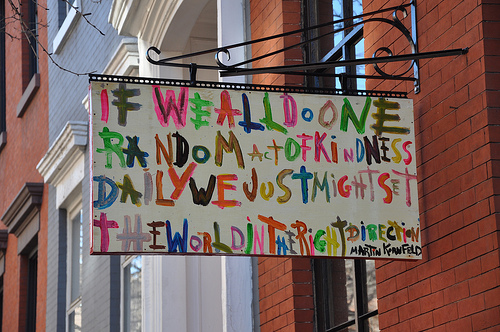
    But in much the same way we show love in relationships through tiny acts of appreciation and consideration, we can love ourselves through small, maybe even random acts of kindness.

    For me, that means allowing myself to relax if I need to, even if I feel like I should be productive. It means treating myself to a nice lunch every now and then, even if I feel I should save money. It means responding to negative thoughts in my head with the same uplifting advice I’d give my sister.

    Sometimes it also means seeing in the mirror that little girl who I used to be—the little girl who always did her best and wanted nothing more than to have someone hug her and tell her it was good enough. It’s my job to do that now.

    It’s all of our jobs.

    Today, give yourself the consideration and kindness you’d extend to the people you love. If you’re dissatisfied with your progress, remind yourself of all you’ve accomplished. If you made a mistake, cut yourself from slack. If you’re tired, take it easy.

    All the goodness you put out into the world starts with how you treat yourself.

    Photo by AlicePopkorn

  • Tiny Wisdom: Every Request Contains an Offer

    Tiny Wisdom: Every Request Contains an Offer

    “It is one of the most beautiful compensations of life that no man can sincerely try to help another without helping himself.” -Ralph Waldo Emerson

    There was a time when I met every request with two instinctively defensive thoughts: “What are you trying to take from me?” And “What’s in it for me?”

    Of course I didn’t say these things out loud. I either denied the request without really considering it, or passively aggressively tried to elicit some type of reciprocal offer.

    In retrospect, I don’t think I did these things because I was selfish and heartless (though I know I acted selfishly and shut my heart down at many points in my life.)

    It was more that I didn’t trust anyone, and I assumed the worst in their intentions and actions. Deep down, I believed everyone was against me. They were competition. They wanted me to fail.

    Eventually I realized the irony: I was afraid no one had my best interests at heart, and as a result I failed to offer them that same courtesy.

    How could I ever expect people to believe in me if I didn’t believe in them?

    I realized then that every request contains within it an offer and an opportunity.

    If someone asks you to pick your brain over coffee, they’re not just asking for your time—they’re also offering theirs. You never know what you might teach other.

    If someone asks you to make an introduction for them, they’re not just asking for your connections—they’re also offering to be connected. You never know how one introduction may benefit everyone involved.

    Whatever the request, it comes with an opportunity to recognize yourself in someone else, and meet them with the kindness you would want to receive.

    I’m not suggesting we should say yes to everything people ask of us, or that we should only say yes because really, there’s always something in it for us.

    I’m suggesting that sometimes when we think we’re the ones helping, we’re also the ones being helped.

    We can either walk through our lives trying to get ahead, suspecting others want to pull us down; or we can choose to walk side by side, as friends, not adversaries.

    If we’re willing to fully believe that we are all in this together, we can create a far more supportive world, one in which we can all thrive together instead of struggling apart.

    Photo by Irene2005

  • Tiny Wisdom: Why We Sometimes Don’t Accept Praise

    Tiny Wisdom: Why We Sometimes Don’t Accept Praise

    “Praise is like sunlight to the human spirit: we cannot flower and grow without it.” ~Jess Lair

    There was a time when I could turn almost any positive feedback into something negative.

    I don’t know if this was my attempt to confirm my unworthiness or my belief that people were usually hurtful, but I had a knack for distorting people’s words to avoid accepting praise.

    If someone found me after a play and said I was a talented singer, I wondered if she was really thinking about my subpar dancing.

    If a teacher told me that I showed promise and reminded him of my sister, I assumed he meant that I was a second-rate version of the student he met first.

    In short, I thought very little of myself, and constantly looked for proof that everyone else did, too.

    You might not be able to relate to the low self-esteem that I once had, but maybe you’ve also negated praise before. I hear people do it all the time—and sometimes I find myself doing it, too—with phrases like, “It was nothing,” and “I just got lucky,” and “He was just being nice.”

    We all like and need to feel valued and appreciated, so why is it sometimes so hard to simply smile and say “Thank you”?

    I suspect there are times when we disbelieve what others say; after all, people occasionally say flattering things just to be kind. Other times we may question their motives or downplay our achievements because we’re fishing for more confirmation—or attempting to appear humble.

    But it might also have to do with vulnerability. Accepting a compliment is akin to receiving validation, and no one wants to reveal that validation is something they want or need.

    Whatever the case may be, when we reject positive feedback, we rob ourselves the opportunity to feel valued and appreciated, and deny the other person the joy of honoring us.

    We all need to be on both sides of that coin. We need to see and be seen for the light we have to offer the world—so why not give that gift to ourselves and other people?

    So today I propose a challenge for you and for me: receive all compliments without questioning them, analyzing them, or negating them. Simply accept it, and know that you deserve it.

    Photo by ingridtaylar

  • Tiny Wisdom: Sharing Moments with Strangers

    Tiny Wisdom: Sharing Moments with Strangers

    “If a man be gracious and courteous to strangers, it shows he is a citizen of the world.” -Francis Bacon

    The other day, I visited a new doctor, and noticed the nurse who took my vitals seemed somewhat withdrawn. He didn’t make eye contact while taking my pulse, or engage in conversation. While I realize a medical appointment is not a social outing, I got the sense he was going over something in his head, and I found myself wanting to connect a little.

    So while he was taking my blood, I asked, “Do you ever get squeamish when doing this? I think I’d pass out!”

    He laughed and told me he’d gotten used to it. After all, he’d been in his job for 15 years.

    His smile touched me, because I realized there was a good chance I could have left without seeing it. I could have sat there, said nothing, and then went along my merry way, knowing him only as the man who put a needle in my arm.

    I realized then how much I appreciate sharing little moments with strangers—and how grateful I am when I get the opportunity to view people outside the context of our labels.

    It’s when you bond with the person behind the counter at a coffee shop because he recognized you both have the same phone. Or when you laugh with the crossing guard because you both know what it’s like to be around rowdy kids.

    It’s when all of a sudden we aren’t limited by the roles we play, but instead see each other as people just like us.

    The other day I read that connecting isn’t the cure for loneliness—intimacy is. I suspect this is true. You can have countless acquaintances and yet still feel like no one really knows you. We need to really see and be seen by people, but we can also give and receive a lot from these brief encounters with strangers.

    Every day, we come into contact with hundreds of people without ever knowing them beyond faces in the crowd. It’s tempting to bunch people into groups—your people, and the people you don’t know.

    But there’s something immensely gratifying about blurring the lines a little. It’s not possible to get to know everyone. But it’s possible to know you shared a real moment, and made a difference in each other’s day.

    Photo by goat_girl_photos

  • Tiny Wisdom: Judging by First Impressions

    Tiny Wisdom: Judging by First Impressions

    “When you judge another, you do not define them. You define yourself.” -Wayne Dyer

    The other day, I reached out to someone I admire, and felt disappointed by the experience. I perceived her response to be somewhat curt and even condescending, which surprised me. Based on my earnest enthusiasm and admiration—and what I thought I knew about her—I expected more.

    For a minute I thought, “She’s not who I thought she was at all.”

    While this was clearly a lesson in releasing expectations, it also got me thinking about (what I call) the judgment/assumption principle: when we judge someone based on one impression, and then assume that’s how and who they are—always.

    I suspect we do this more than we realize.

    Maybe you see an interview with a public figure, and, based on the topics discussed, assume she’s a shallow person. Or you meet a friend of a friend when he’s having a difficult day and, based on his withdrawn demeanor, assume that he’s unfriendly.

    It can be tempting to judge someone by an isolated moment in time, especially if it’s a first impression and a particularly negative one.

    But none of us would want to be sized up that way. We are so much more than what we may convey in any one encounter—and sometimes, we have good intentions, but they get muddled in translation.

    I know I haven’t always put my best foot forward; and I’m sure I’ve also said things and sent emails that could have been interpreted as curt, even though I meant well.

    None of us should have to tolerate chronically rude or inconsiderate treatment; but we may be surprised by what we learn about people when we give them the benefit of the doubt.

    Today if you’re tempted to form a snap judgment based on one interaction, remember: When you judge someone by one of their worst moments, you rob yourself of the opportunity to see and appreciate their best.

    Photo by spencer341b

  • Tiny Wisdom: How We Pit People Against Us

    Tiny Wisdom: How We Pit People Against Us

    “When you live on a round planet, there’s no choosing sides.” -Wayne Dyer

    I’ve read a lot of articles about achieving your dreams and creating the life you want. There is a common message that always creates a disconnect in me: Many otherwise empowering articles lose me when the authors suggest we should “tune out our haters.”

    This seems to imply that there are people out there who want us to fail–who purposely act hateful with the intention of pulling us down.

    I know the world is a lot simpler when we view things in black and white terms–good and bad; right and wrong; for us and against us. But labels can hurt us far more than they people to whom we assign them because they generally come from fear. Fear keeps us from seeing things as they really are. Very little is as it seems.

    Some people may seem to be purposefully hurtful, but in all reality, they’re dealing with their own struggles and insecurities, and that translates as a lack of support. Some people may seem to be negative or judgmental, but in all likelihood, they’re simply trying to help you see things from a different perspective.

    This doesn’t mean that people always have good intentions; it just means far fewer have poor intentions than we think.

    It might be a lot quicker and simpler to put people into narrow little boxes. It certainly takes a lot less energy to assume certain people are on your side and certain people aren’t.

    But we end up seeing people as enemies and allies instead of realizing we’re all on the same team. It is possible to tune out words that don’t serve us without labeling the people who speak them as bad and assuming they want us to fail.

    This leaves us with a choice: We can shut other people, assuming they’re not on our side; or we can break down a wall by trying to see where they’re coming from, so that sides no longer exist. The world becomes a far more  understanding and supportive place when we choose to be understanding and supportive.

    Photo by igb

  • Tiny Wisdom: On Creating Beautiful Moments

    Tiny Wisdom: On Creating Beautiful Moments

    “Because of your smile, you make life more beautiful.” -Thich Nhat Hanh

    The other day, I was looking through friends’ Facebook albums–and by friends, I mean teenage cousins, readers I’ve yet to meet, and acquaintances from high school.

    It all started so innocently, clicking on a recently added photo on my wall, and before I knew it, I was knee-deep in the lives of people I rarely see, have never seen, or haven’t seen in years.

    There were, of course, hundreds of photos of each person in different exciting destinations–kind like that garden gnome that shows up in pictures from places around the world. That’s a big part of the Facebook photo appeal, after all; it’s a memorial for all the fun you want to remember you had (or show other people you had).

    But what mesmerized me weren’t the exotic locations or momentous occasions. What captivated me were the smiles. The real smiles, the kind that starts with your eyes and reveals that you are present, peaceful, engaged, and truly grateful for the moment you’re enjoying. They had no idea, but their smiles brightened my day.

    I started thinking about some research I read recently that revealed Facebook can make people unhappy, because we tend to compare ourselves unfavorably to other people, based on their updates and photos. In that moment, I realized that regardless of where we go or what we have to celebrate, we can all have that same unbridled joy–if we’re willing to create it.

    We can all make time for the people and things we love and create those beautiful, genuine smiles. Ultimately, that’s what we all want–not other people’s lives, but the joy we sometimes forget is always available to all of us.

    Today if you start feeling like you don’t have a lot to smile about, ask yourself: What do I love, and how can I fit it in today?

    Photo by DaveyBoyee

  • Tiny Wisdom: On Connecting

    Tiny Wisdom: On Connecting

    “Don’t wait for people to be friendly. Show them how.” -Unknown

    From what I can tell, my next door neighbor doesn’t make eye contact with anyone. For a while I thought she was just avoiding me, but I’ve observed that she’s like this with all of our neighbors. By keeping her eyes fixed on her feet, she never has to exchange pleasantries or smiles, let alone get into full-fledged conversations.

    She always seems withdrawn and lethargic, and this makes me feel sad for her. I’ve been in that place before–and if she’s feeling anything like I did then, I know that it isn’t easy.

    When I avoided eye contact, it was generally because I felt depressed and disconnected, or scared and guarded, or angry and cynical. Behind it all, there was fear, loneliness, and a deep, tragic longing for real, intimate connection.

    Yet I rarely opened myself up to people because it made me feel vulnerable. After all, you never know what kind of person someone is when you don’t really know them. You don’t know if they’re friendly or kind.

    But you also don’t know that they’re not.

    The truth is that we’re really not all that different. We all occasionally walk around with things weighing on our minds. We all shut down sometimes when we’ve had a hard day. And we all want to feel safe to connect with each other, both superficially and meaningfully, so that we feel like we belong to something larger than ourselves.

    Today if you see someone who appears unfriendly, remember: They may be hurting and desperately in need of a smile.

    Photo by jrwooley6

  • Tiny Wisdom: On Being Kind

    Tiny Wisdom: On Being Kind

    “Be kind, for everyone you meet is fighting a hard battle.” -Plato

    Sometimes it can seem like everyone’s out to get you. There’s the person in traffic who refuses to let you into his lane. The customer service representative who rushes you off the phone without helping even a little. The friend who didn’t tell you the whole story, which left you feeling hurt.

    We’ve all met these people. We’ve also been these people. We all have days when we’re not as considerate, helpful, or honest as we’d like to be.

    Sometimes it’s because we’re rushed. Other times it’s because we’re tired and irritable. And other times it’s because we’re hurting emotionally and maybe we’ve yet to really acknowledge and deal with it. Maybe we don’t think we can, and so we let it fester inside while we go through our day, feeling hopeless, trapped, and alone in our sadness.

    Today if you come across someone who gets on your nerves, consider that maybe underneath their rudeness or insensitivity is a pain that’s yet to be healed. It doesn’t condone their actions, and it doesn’t mean you shouldn’t stand up for yourself when necessary.

    But it may make it easier to feel a modicum of compassion. I don’t know about you, but on days when I am hurting, that’s what I want and need: a friendly face that says, “I understand, and I care.”

    Photo by Big Mind Zen Center

  • Tiny Wisdom: On Everyday Kindness

    Tiny Wisdom: On Everyday Kindness

    “No act of kindness, no matter how small, is ever wasted.” -Aesop

    Recently I read about a research study that suggested kindness is literally contagious. According to Science Daily:

    “When people benefit from kindness they ‘pay it forward’ by helping others who were not originally involved, and this creates a cascade of cooperation that influences dozens more in a social network.”

    One simple act of generosity, consideration, or thoughtfulness can literally have a domino affect, eventually touching people you may never meet. In a very real way, a simple act of kindness can expand your positive impact on the world beyond the limitations of your individual reach.

    We might not be able to see it or measure it, but if we all make a conscious choice to be kind, we can create the kind of world we want to live in, starting with ourselves.

    I recently contributed to the Kindness Manifesto, a free download available on TheBridgeMaker.com that includes 132 ideas to make kindness a daily habit. My suggestions included:

    • Listen without forming an opinion or judgment.
    • Give without expecting something in return.
    • Help without feeling or acting superior.
    • Be willing to say no if it’s the best thing you can do.
    • Be kind to yourself–it’s the first step in being kind to everyone else

    How do you spread kindness around you?