Category: Attitude

  • Tiny Wisdom: Creating Perfect Plans

    Tiny Wisdom: Creating Perfect Plans

    “Expect the best, plan for the worst, and prepare to be surprised.” -Denis Waitley

    The other day I was watching reruns of a show I’ve recently found and now love. In one scene, the main character talked about the “perfect moment” that never came to be—an isolated point in time when things would have worked exactly as he imagined they would, and as a result, there would only be positive consequences to his choices.

    This got me thinking about my own instinct to create perfect moments according to what I’ve visualized—and also the times when I’ve been part of other people’s plans.

    In high school, I reconnected with an old friend from junior high, who’d also been bullied back then. I was going through a lot emotionally and wasn’t in a place to date him. He told me he was disappointed because he “wanted me for his senior year.”

    He had a specific vision of me being the one on his arm at the prom. It wasn’t just about being with me; it was about being with me in a very specific way.

    I’ve done the exact same thing at times. I know I want to have children—but in an ideal world, I’d have them in the next two years, and I’d have created a situation that allows me to spend equal time on the east and west coasts, to be close to family in both places. I realize, however, that in two years time, I may not have created those conditions.

    Life doesn’t always work out in the way we imagine would be ideal. We can either resist that, feeling crushed when we don’t get exactly what we wanted, or accept reality at every step of the way and adapt to make the best of what we get.

    We’re often advised to visualize the future in specific detail so that we may create it; to see in our heads the environment, the people, and the situations we want to manifest. This can be a powerful exercise because it helps us get clear about what we really want.

    It will be a far more effective practice, though, if we remember that what we really want isn’t the perfect moment—it’s happiness from moment to moment. That comes from choosing to embrace and work with what is, instead of bemoaning and fighting it.
    Photo by magical-world

  • Tiny Wisdom: All the Fun You Missed

    Tiny Wisdom: All the Fun You Missed

    “Don’t let the past hold you back; you’re missing the good stuff.” -Unknown

    There have been times when I’ve regretted that I missed out on so much when I was younger.

    Because I held onto pain so tightly, I missed out on countless opportunities for fun while sitting alone and feeling bad for myself.

    Because I felt so insecure for so long, I missed out on the chance to make strong friendships while shutting down and assuming people would hurt me.

    And because I was afraid of failing, I missed out on all kinds of professional opportunities while doing what felt easy and safe.

    Now, in my early 30s, it’s tempting to look back and feel bad for squandering those years when I was so full of potential. Then I remember: I still am.

    The other night, I attended a family function with many of the amazing, interesting people who I didn’t fully appreciate when I was caught up in my personal dramas. I planned to leave early because I was somewhat tired, but I ended up dancing until the last song with my big fat Italian family.

    I remember looking around at my cousins, ranging in age from 11 to 35, my aunt in her 50s, and friends of all ages in between, and recognizing that we were all the same on the dance floor.

    We were all losing ourselves in the music, likely thinking about nothing, simply choosing to be together and move. It was almost as if in that moment, we were ageless. What had come or what was coming didn’t matter right then.

    All that mattered was that we all had the same choice to make: sit it out, or dance (yes, like in the song).

    That’s the choice we’re faced with every day.

    We can focus on the fun things we could have done but didn’t, or we can do something fun right now.

    We can dwell on the mistakes we made in past relationships, or we can focus on enjoying the relationships we’re in right now.

    We can think about all the opportunities we missed out on, or we can focus on embracing possibilities right now.

    There will always be something we didn’t do yesterday, but we get to choose right now how yesterday looks when we get to tomorrow. Right now, whatever age we are, this is our chance to live.

  • Tiny Wisdom: Do You Believe?

    Tiny Wisdom: Do You Believe?

    “The outer conditions of a person’s life will always be found to reflect their inner beliefs.” –James Allen

    Do you believe you can do work you love? If you don’t believe it, you likely won’t try for it.

    Do you believe you can be in a happy relationship? If you don’t believe, you likely won’t open up to it.

    Do you believe you can adopt that healthier habit? If you don’t believe it, you likely won’t stick to it.

    Do you believe you can fully release your anger toward that person who hurt you? If you don’t believe it, you likely won’t let go of it.

    Do you believe you should be treated with respect? If you don’t believe it, you likely won’t require it.

    Do you believe this moment is good enough? If you don’t believe it, you likely won’t enjoy it.

    Do you believe you deserve happiness? If you don’t believe it, you likely won’t let yourself feel it.

    It’s not true that anything is possible—I can say with absolute certainty that none of us will grow wings tonight and fly out our bedroom windows. But it is true that far more is possible than we often realize.

    It starts with what we believe. And beliefs are thoughts that aren’t fact—meaning we can change them if we really want to.

    We can change the stories we tell ourselves. We can change the limits we’ve set for ourselves. Most importantly, we can change what we do for ourselves, starting right this moment. Every passing second is a new opportunity to be who we want to be, if we believe we can.

    I may not always have believed the best about and for myself, but in this moment, I choose to believe and act on it. Do you?

    Photo by Augapfel

  • Tiny Wisdom: The Sacrifices That Lead to Happiness

    Tiny Wisdom: The Sacrifices That Lead to Happiness

    “As long as you make an identity for yourself out of pain, you cannot be free of it.” -Eckhart Tolle

    This weekend, a reader presented an interesting question about letting go of old beliefs and attitudes to make room for happiness and open up to a relationship.

    He suggested that this would require a lot of sacrifice on his part, and would leave him humbled and lost—as if he’s somehow “giving in” and losing touch with who he really is.

    He asked how he can reconcile the instinct to change with his resistance to becoming something he is not.

    I suspect a lot of us struggle with this. We know we want to transform our lives, but we’ve thought and behaved in certain ways for so many years that we identify ourselves with those ideas and actions.

    For a long time, I believed people were basically selfish, which made me feel constantly defensive. I thought I “earned” this belief because I had been hurt. Letting go of it felt like letting the people who’d hurt me off the hook—like saying they didn’t cause my pain, I did.

    But the reality was that my defensiveness hurt me more than anything anyone else had ever done—and for far longer. Sacrificing it might have been humbling, but the alternative was (and is) to sacrifice my potential for joy.

    We are not the beliefs that we, at one point, decided serve and protect us. We are not the thoughts that, if we’re honest, we know only cripple us. We are not the sum of our internal workings.

    Of course letting go of these will feel like giving in if we believe they define us. It will feel like a sort of death—like acknowledging there’s something wrong with us, and the only way to find happiness is to essentially rid ourselves of ourselves.

    Freedom is realizing that letting go isn’t losing anything—it’s gaining everything. It’s stepping into the present moment free from limiting thoughts, beliefs, memories, fears, and judgments, to see what’s in front of us with clear eyes.

    We have the potential to become anything—in fact, if we learn to let go, we will never stop becoming. But that means we need to want presence and happiness more than we want to cling to the past and our pain.

    Photo by Aschaf

  • Tiny Wisdom: The Best Disappointments

    Tiny Wisdom: The Best Disappointments

    “Remember that sometimes not getting what you want is a wonderful stroke of luck.” -Dalai Lama

    Opportunity often hides in the most unlikely places, but it isn’t easy to see it when you’re disappointed life didn’t meet your expectations.

    Michael Jordan’s high school coach cut him from the basketball team, which may have pushed him to work harder and become an NBA superstar. Soichoro Honda wanted to be an engineer at Toyota until he was rejected, inspiring him to start his own company.

    You never know when a disappointment might pave the path for something great. What wonderful stroke of luck have you had lately, and what can you do to benefit from it?

    This post was originally published in September, 2009. Photo by LisaRoxy.

  • Tiny Wisdom: Seeing the Good in the Bad

    Tiny Wisdom: Seeing the Good in the Bad

    “Instead of complaining that the rose bush is full of thorns, be happy the thorn bush has roses.” -Proverb

    I once read that people who journal to identify lessons from painful situations generally move on more quickly and easily than people who write merely to vent their emotions.

    In discovering opportunities for growth, we empower ourselves to see whatever we’ve been through as something that can be ultimately beneficial, even if it’s tremendously uncomfortable in the short-term.

    It’s not always easy to do that, particularly because there are so many things that happen that we may never understand—and plenty of events that seem downright unfair.

    Why do some people retain their health despite poor choices, while others wake up seriously ill one day with no reason or warning? Why do some people enjoy great fortune without having to expel much effort, while others struggle all their lives without ever enjoying rewards or stability?

    When you look at the world through this lens, it’s easy to be bitter. We want there to be order—to know that if we’re good, good things will happen, and bad things won’t. But that’s just not a guarantee.
    What is a guarantee is that we can always decide how to interpret what we see.

    Over the past two years, countless readers have submitted posts for this site, many of them sharing stories about overcoming sickness and loss, among other personal challenges.

    There’s nothing as inspiring as seeing the world through the eyes of someone who is determined to see something good.
    After a blood vessel ruptured in Brian Webb’s brain, he couldn’t walk for months—but after running his first marathon he realized his injury taught him to appreciate life.

    Brandy Harris renamed her Crohn’s Disease “Crohn’s Teacher,” and uses her feelings about her symptoms as fuel for writing and sketching.

    Alexandra Heather Foss decided that there’s beauty in her scars—that her past struggles contributed to the strong, wise woman she is today.

    Life is always going to contain a little darkness, but we get to decide whether or not we recognize and appreciate the light.

    Photo by PrescottFoland

  • Tiny Wisdom: When You Fear Making Mistakes

    Tiny Wisdom: When You Fear Making Mistakes

    “The greatest mistake you can make in life is to be continually fearing you will make one.” -Elbert Hubbard

    The other day I read that most of our fears can be boiled down to a fear of inadequacy, and, consequently, rejection. I know this is true for me.

    When I feel a sense of panic about the potential to fail, it’s really more about being seen as a failure. When I make mistakes without witnesses, assuming the mistakes don’t cause me immense discomfort, I generally rebound fairly quickly. It’s almost like a tree falling the wrong way in the woods–if no one sees it, did it even happen at all?

    I suspect this is true for most of us. A stumble that no one saw isn’t nearly as mortifying as a stumble with an audience.

    When you factor in assumptions about other people’s judgment, suddenly a mistake seems like more than a poor decision; it seems like an admission of weakness. It seems less about our choice in a moment and more about our character on the whole.

    But there’s something ironic about fearing judgment for being fallible, since this is something we all have in common. If we can just embrace our vulnerability and accept that our mistakes don’t define us, they can lead to a greater sense of meaning and connection.

    Most of the purpose-driven people I’ve met feel motivated by the need to help people with struggles they’ve already faced. Because we err and hurt, we can feel for other people and do our part to help ease their pain. And because we know we’re fallible, we learn to be humble, which helps us appreciate and forgive.

    There’s no denying that there are some mistakes that we wouldn’t make if we could re-live those moments. But the reality is that’s never an option. All we can ever do is make the smartest, bravest choice based on what we know in this moment.

    The bravest choice is to do what we really want to do, regardless of who might see and form opinions. It might not always feel comfortable to risk being seen as inadequate, but the alternative is to risk feeling partially alive.


    Photo by Wonderlane

  • Tiny Wisdom: Let Yourself Be As You Are

    Tiny Wisdom: Let Yourself Be As You Are

    “Let yourself be open and life will be easier. A spoon of salt in a glass of water makes the water undrinkable. A spoon of salt in a lake is almost unnoticed.” ~Buddha

    “My brain has been moving slowly all day.” As I told my boyfriend this, I felt each word roll out of my mouth with all the speed of a hill-climbing turtle. Like everything else I’ve done today, I’ve been speaking at a glacial pace.

    I’ve retraced my footsteps over these last few days, double-checking how much I’ve eaten and how well I’ve slept. But despite playing low-energy detective, I’ve found no clear explanation for my overall sense of weariness. Accept it or not, I’m just having one of those days when I need to take it easy. I don’t always do well with these.

    When I’m slow on the uptake and I struggle to complete my to-do list, I’m tempted to get frustrated and impatient with myself–to push myself to be more effective and productive instead of cutting myself some slack. But this doesn’t actually make me more productive or effective. It only serves to create a nagging sense of guilt and stress.

    Maybe you’ve been there before: You have things to do and expectations to meet, but your body has a different agenda. You can either indulge a sense of urgent panic about the things you’re not doing, or not doing well. Or you can accept yourself as you are in this moment and do what you need to do for your well-being.

    We all have responsibilities and goals, and we instinctively want to create and maintain a sense of momentum with them. But in the grand scheme of things, our happiness has less to do with how quickly we progress and more to do with how kind we are to ourselves at each step of the way.

    Let yourself be as you are today. Accept what you feel in your body and mind, without feeling the need to fight it, deny it, ignore it, hide it, or push through to the other side. And then take good care of yourself. Sometimes the best way to help yourself is to stop fighting yourself.

    Photo by Wonderlane

  • Tiny Wisdom: How We Pit People Against Us

    Tiny Wisdom: How We Pit People Against Us

    “When you live on a round planet, there’s no choosing sides.” -Wayne Dyer

    I’ve read a lot of articles about achieving your dreams and creating the life you want. There is a common message that always creates a disconnect in me: Many otherwise empowering articles lose me when the authors suggest we should “tune out our haters.”

    This seems to imply that there are people out there who want us to fail–who purposely act hateful with the intention of pulling us down.

    I know the world is a lot simpler when we view things in black and white terms–good and bad; right and wrong; for us and against us. But labels can hurt us far more than they people to whom we assign them because they generally come from fear. Fear keeps us from seeing things as they really are. Very little is as it seems.
    Some people may seem to be purposefully hurtful, but in all reality, they’re dealing with their own struggles and insecurities, and that translates as a lack of support. Some people may seem to be negative or judgmental, but in all likelihood, they’re simply trying to help you see things from a different perspective.

    This doesn’t mean that people always have good intentions; it just means far fewer have poor intentions than we think.

    It might be a lot quicker and simpler to put people into narrow little boxes. It certainly takes a lot less energy to assume certain people are on your side and certain people aren’t.

    But we end up seeing people as enemies and allies instead of realizing we’re all on the same team. It is possible to tune out words that don’t serve us without labeling the people who speak them as bad and assuming they want us to fail.

    This leaves us with a choice: We can shut other people, assuming they’re not on our side; or we can break down a wall by trying to see where they’re coming from, so that sides no longer exist. The world becomes a far more  understanding and supportive place when we choose to be understanding and supportive.
    Photo by igb

  • Tiny Wisdom: When Things Feel out of Control

    Tiny Wisdom: When Things Feel out of Control

    “Life is 10% what happens to you and 90% how you react to it.” -Charles Swindoll

    “I can’t wait to leave LA. Seriously, we should consider moving within a year.”

    I said this to my boyfriend as we were sitting in bumper-to-bumper traffic a few streets away from our apartment, anticipating at least 10 more minutes of chaos. All around us, drivers were weaving in and out of lanes, honking at each other, and, in some cases, hurling swears at each other. Despite just meditating, I felt agitated.

    Since we moved here just recently so my boyfriend can pursue film, moving isn’t the smartest option. And truthfully, I don’t want to move. I said it because I felt stuck, and in that moment, professing my desire to leave felt like a proactive alternative to simply sitting with that out-of-control feeling.

    Suddenly I realized that this was good practice, because I will feel out of control in far more troubling situations many times in my life. We all will.

    We may have to wait to find out if we’ll lose our homes, or our jobs, or our health, or people we love. Or we may lose those things and wonder how we can go on, knowing we’re not sure how things will turn out. We may have to watch people we love struggling, knowing we have no clue how to help, or if we even can.

    It’s inevitable that we’ll feel out of control in life, over and over again. The good news is that we can always control how we respond to our circumstances, and we can practice this skill a little every day if we’re willing to breathe through uncomfortable feelings.

    Today if you find yourself scrambling for control–over your time, your circumstances, or the outcome of your efforts–take a deep breath. Then remember: It’s far more productive to learn through this moment than it is to resist it.

    *Email subscribers: This was the post from Thursday, but due to an error on my part, it didn’t make it into the email. Photo by fakelvis

  • Tiny Wisdom: On Letting Go of Painful Stories

    Tiny Wisdom: On Letting Go of Painful Stories

    “The past has no power to stop you from being present now. Only your grievance about the past can do that.” -Eckhart Tolle

    Today I read that Elizabeth Smart, who was kidnapped in 2002, is going to join ABC as a correspondent, covering missing persons.

    In case you haven’t followed this case, Elizabeth was only 14 when Brian David Mitchell abducted her from her Salt Lake City home. Her parents had previously hired the homeless man for a day’s work, something they did often to help people who were down on their luck. And yet for nine months he hid Elizabeth, subjecting her to daily cruelty.

    In response to her new position, ABC News spokeswoman Julie Townsend said, “…her contributions will be focused on looking ahead, not looking back at her own story.”

    As I read this, I thought about how easy it would be for her to let that story define her and her life. People have done it with far less traumatic events.

    She could wake up every day bitter and guarded. She could take comfort in a victim identity, expecting other people to take care of her. She could rehash what happened over and over again to anyone would listen–and we would understand. After all, she’s been through so much.

    But when you focus on all the bad things you’ve been through, it’s nearly impossible to recognize when you’re going through something good. It’s even more challenging to create something good with what you have.

    The stories we tell and wrap our lives around can easily limit who we become if we let them. The alternative is to let go of that pain identity. To stop dwelling on how you’ve been hurt. To decide that, right now, you have choices, and you’re not going to let your fear and anger make them for you.

    Today if you find yourself rehashing a painful past, remember: It may help to talk things through, but if you want to experience real happiness, at some point, you need to let go.

    Photo by JapanDave

  • Tiny Wisdom: On Changing How You See Problems

    Tiny Wisdom: On Changing How You See Problems

    “If you don’t like something change it; if you can’t change it, change the way you think about it.” -Mary Engelbreit

    In a recent response to my blog post about dealing with difficult people, an anonymous commenter mentioned that she has a negative team member, an irrational supervisor, and an ineffective HR manager. Since she feels that leaving her job isn’t an option, she asked for advice about what she should do.

    I could relate to that feeling of being stuck–when you’re in a situation you don’t like, but you feel powerless to change it.

    When I’ve been in those circumstances, the last thing I wanted to hear was that I should change my perceptions and responses. After all, other people were causing problems–why should I have to change?

    In fact, I spent years stubbornly fighting with people who I thought were in the wrong. Because I felt confident in my judgments–that they needed to be more considerate, or less abrasive, or whatever–I essentially justified a negative attitude by bemoaning their negativity.

    Instead of actively seeking workable solutions, I sat around complaining about how other people caused the problems.

    In doing so, I became the problem. The victim mentality was the problem. My stubborn righteousness was the problem. These were the things that were keeping me stuck–not what other people did.

    We’re going to feel powerless sometimes. Sometimes we’ll have to stay with difficult roommates, even if just temporarily. Sometimes we’ll need to work thankless jobs just to make ends meet. We can either fight what is, or choose to see opportunities within it.

    Today if you feel stuck in a situation you don’t love, ask yourself: Do I have the power to change this, and, if not, how can I respond positively and proactively in a way that can help me grow?

    Photo by Mark Mrwizard

  • Tiny Wisdom: On Realizing It’s Never All Dark

    Tiny Wisdom: On Realizing It’s Never All Dark

    “Turn your face toward the sun and the shadows will fall behind you.” ~Māori Proverb

    People often comment that the Tiny Buddha emails come at just the right time for them, and I think there’s a simple explanation for that. They all address universal challenges–things we all deal with, and often. They’re the things we sometimes forget connect us.

    We all deal with pain, heartache, disappointment, frustration, fear, anxiety, and loss. We don’t deal with it at the same times, in the same ways, or for the same reasons, but we all experience the same emotions–over and over again.

    Just when we think everything is perfect, something changes and we realize nothing is permanent. Just when we think we have everything figured out, we realize how much we don’t understand, and maybe never will.

    But we also have something else in common: No matter how dark things can seem in our lives, we always have at least a little light–and sometimes far more than we realize. Very rarely is all lost.

    If things aren’t going great with work, you may still have amazing friends who remind you that you are so much more than what you do for a living. If you don’t have the relationship you dream about, you might have family members there to remind you that you are never alone.

    We always have good things in our lives. It’s just that sometimes we get too distracted by what’s lacking to recognize what’s going right.

    Yesterday I asked on Facebook, “What advice would you give to yourself, 10 years ago?” I would tell myself to stop worrying that I was missing out on the good life, because I was actually missing out on life because of all the worrying.

    Though none of us can go back and do things differently, we can remember what we’ve learned and use it.

    Today I commit to enjoying the light, wherever it may be. What light is there in your life?

    *This is an updated version of a post from 2009. Photo by law_keven

  • Tiny Wisdom: On the Power of Trusting

    Tiny Wisdom: On the Power of Trusting

    “You may be deceived if you trust too much, but you will live in torment if you don’t trust enough.” -Frank Crane

    I had one of the most disheartening experiences of my life when I was 24. Some people I trusted conned me out of a huge chunk of my savings and then dropped off the face of the earth.

    Later, I  questioned if I was being naive whenever an incident looked slightly similar. I instinctively mistrusted a lot of people, projecting past hurts onto them before they even had a chance to show their good intentions.

    It was like everyone was guilty until proven innocent. And worse, I was constantly defensive and bitter. I didn’t want to be caught off guard when someone inevitably disappointed me again.

    A couple years back, I found a blog post that offered an interesting perspective on trust. The author described how a cab driver tricked her to steal her backpack, including her wallet and $500 worth of possessions. Her friend concluded that they should trust people less.

    But the author, she decided that losing faith is far worse than losing stuff.

    She wrote, “Spending $500 every once in a while is a small price to pay to be able to continue trusting people…I consider the loss to be part of the optimism tax.”

    It just plain hurts to suspect everyone. It hurts to hold onto past disappointments, as if it’s only a matter of time until other people let you down. That’s not to say we shouldn’t trust our instincts when we suspect we’re in harm’s way. But the world is a far more peaceful place when you believe in people.

    Today if you mistrust someone, remember: You tend to find what you’re looking for. Are you more invested in finding reasons to doubt or reasons to believe?

    Photo by Alice Popkorn

    **Clearly, we migrated the site to the new server without a hitch. (Let me know if you notice any problems!) Thank you to the amazing Joshua Denney who handled the switch. And though I believe I emailed everyone personally, thank you so much to everyone who donated to help with upgrades. Your kindness made a huge difference!

  • Tiny Wisdom: On Everyday Teachers

    Tiny Wisdom: On Everyday Teachers

    “If we learn to open our hearts, anyone, including the people who drive us crazy, can be our teacher.” -Pema Chodron

    Many people go through their days collecting moments that annoyed them. How another driver turns without signaling. How your coffee barista moves at a glacial pace—so slow she has to ask twice what you ordered. The way a coworker talks loudly on her cell phone, even though you practically share the same cubicle.

    Things like this happen all the time. We live, work, and play on top of each other—people we know, don’t know, want to know, and don’t know we want to know. We’re bound to get in each others way.

    What we don’t often realize is that all those different people can enrich our way if we let them.

    That careless driver reminds you to stay alert. Your greatest power in an unpredictable world is your ability to respond well to things that happen around you.

    The barista teaches you to take a deep breath and slow down. Nothing is so important that a late arrival justifies an ulcer.

    Your coworker provides an opportunity to practice effective communication under stress—an invaluable skill both in work and in life.

    Today if you encounter someone who presents a challenge to your plan for the day, ask yourself: What can I learn from this experience that will help me in the future?

    Photo by The Fayj

  • Tiny Wisdom: On the Power of a Smile

    Tiny Wisdom: On the Power of a Smile

    “Sometimes your joy is the source of your smile, but sometimes your smile can be the source of your joy.” -Thich Nhat Hanh

    Last weekend, I had a difficult day. My brother had just flown 3,000 miles across the country after visiting me, which reignited an internal conflict about living so far from my family.

    I always feel a familiar emptiness when I deal with that conflict. It’s my instinctive resistance to the undeniable truth that everything in life is a trade off. I can’t simultaneously follow my instinct to be in LA and my instinct to be near my family. Each choice entails sacrifice, and I struggle with that sometimes.

    I didn’t leave my apartment that day. I burrowed under the covers, feeling down and helpless, waiting for something outside me to change my state of mind. Eventually, it did change. And it was something external.

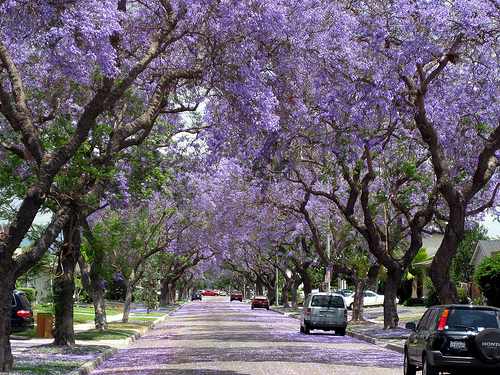
    I decided to take a five-minute walk just to stretch my legs and get some fresh air. At the end of my street, I saw what looked like a million purple leaves from a Jacaranda tree, sprinkled all over the sidewalk.

    Scattered so colorfully and delicately, they looked like pure bliss–like a spa that sprung up through the cement to soothe me right when I needed it. So I smiled, just a little, and then slowly, a little more, until I realized I was somewhere I hadn’t been all day: firmly planted in the present moment, grateful for how beautiful it was.

    It didn’t change that there are things I struggle with. We’ll always have challenges in life. But sometimes the best thing we can do when we get caught up in our heads is make a conscious choice to get outside of it. If we want to know joy, we must first be willing to smile.

    Photo by cheekycrows3

  • Tiny Wisdom: On Seeing

    Tiny Wisdom: On Seeing

    “What we see is mainly what we look for.” -Unknown

    Whatever you believe about people and the world, you will likely find proof to support it.

    If you look for selfishness, you’ll find it. If you look for animosity you’ll find it. If you look for injustice, you’ll find it. If you’re invested in seeing the world this way, you can probably explain a lot of what you see with negative interpretations.

    Conversely, if you look for good intentions, you’ll find them. If you look for loving gestures, you’ll find them. If you look for possibilities, you’ll find them.

    Much of what we see is based on how we want to interpret things–whether we judge people or give them the benefit of the doubt; whether we play the victim or find opportunities in struggles.

    So the real question on any given day isn’t why you’re seeing what you’re seeing; it’s why you’re invested in that interpretation.

    Today if you find yourself clinging to a negative story about a person or situation, ask yourself: What’s the payoff in holding onto this interpretation? Does it make you feel right? Or justified? Or safe? And more importantly: How might you be able to improve your state of mind or situation if you chose to see things differently?

    Photo by Sigi K

  • Tiny Wisdom: On Conflict

    Tiny Wisdom: On Conflict

    “Peace of mind is not the absence of conflict from life, but the ability to cope with it.” -Unknown

    There are some days when I want everything to stop.

    I want the calls to stop, the emails to stop, the requests to stop, the expectations to stop, the confrontations to stop, and the struggles to stop. Essentially, I want everything to feel quiet and easy.

    Then I realize that if everything stopped, life would be boring, uneventful, and static.

    If everything stopped, I wouldn’t have any opportunities to create, grow, learn from other people, or share what I’ve learned with them. Life would not be peaceful–life just wouldn’t be happening.

    What I really want on those chaotic days isn’t for the world to stop. I just want to stop seeing the world as a million fires I need to put out. I want to stop interpreting everything as a conflict or crisis. I want to stop living life in a constant state of reaction, and instead focus on the actions that matter to me.

    I suspect that’s what we all want: the ability to nurture a sense of peace that doesn’t crumble every time our circumstances get challenging.

    The truth is we can access that on any day we choose to. We just need to choose–and then keep choosing instead of responding with stress, fear, and angst.

    Today if your world seems less than peaceful, remind yourself: I can deal with whatever happens outside me. It starts by taking responsibility for what happens inside.

    Photo by mahalaie

  • Tiny Wisdom: On Strength

    Tiny Wisdom: On Strength

    “Some people think it’s holding that makes one strong—sometimes it’s letting go.” -Unknown

    Sometimes admitting that something is over can feel like defeat. After all, we hear a lot of messages that tell us to never give up–to hold on and keep fighting at all costs.

    But if you’re honest with yourself, you’ll know when it’s time to move on.

    You’ll know when a relationship no longer serves you, and you’re just staying because you’re too scared to leave. You’ll know when a job no longer makes you happy, but you’re staying because you think it will be hard to find something else. You’ll know when a business idea didn’t work, and it’s time to cut your losses and start the next thing.

    Somewhere inside you, you always know.

    You just have to stop ignoring the symptoms of your awareness or discontent, and decide it’s time to let go–of the relationship, the friendship, the job, the hobby, the idea, the religion, and in some cases, the illusion of something that you never even had to begin with.

    Today if you’re unsure whether you should hold on or let go, create space and stillness and then ask yourself: If you were fully honest about your motivations and needs, and not letting your fear choose for you, which choice would you make?

    Now all you need is the strength to make it. So the real question is: Are you strong enough to choose for your happiness?

    Photo by zedmelody

  • Tiny Wisdom: On Enjoying the Light

    Tiny Wisdom: On Enjoying the Light

    “If you spend your whole life waiting for the storm, you’ll never enjoy the sunshine.” -Morris West

    Today I watched Finding Nemo, one of my absolute favorite Disney movies. When Dory and Marlin are searching for his lost son Nemo and it seems like they’re doomed to fail, Marlin says, “I promised I’d never let anything happen to him.”

    Dory responds, “Hmm. That’s a funny thing to promise. You can’t never let anything happen to him. Then nothing would ever happen to him. Not much fun for little Harpo.”

    As someone who has often worried about people I love, I find this incredibly insightful. The truth is we never can know for certain when a storm is coming. We can’t fully protect ourselves or the people we love from hardship.

    What we can do is choose not to cause ourselves pain by shutting down, fearing everything that might go wrong. When we hide from the worst that could possibly happen, we also close ourselves off from the best.

    Today if you’re feeling fearful about things that might go wrong tomorrow, come back to the present and recognize things that are going right today.

    There’s a lot of sunshine to enjoy in life, but we can only appreciate it if we’re willing to be firmly rooted in the here and now.

    Photo by Nieve44/La Luz