Author: Lori Deschene

  • Tiny Wisdom: On Beautiful Things

    Tiny Wisdom: On Beautiful Things

    “The most beautiful things in the world cannot be seen or even touched. They must be felt with the heart.” -Helen Keller

    Gratitude. Kindness. Joy. Vulnerability. Passion. Hope. Inspiration. Motivation. Loyalty. Awe. Authenticity. Selflessness. Thoughtfulness. Patience. Understanding. Trust. Simplicity. Serenity. Relaxation. Purpose. Peace. Generosity. Honesty. Integrity. Balance. Bravery. Love.

    Look around. It’s a beautiful day, and because of all the good you do and create, you’re a beautiful part of it.

    Photo by AlicePopkorn

  • Tiny Wisdom: On the Power of Trusting

    Tiny Wisdom: On the Power of Trusting

    “You may be deceived if you trust too much, but you will live in torment if you don’t trust enough.” -Frank Crane

    I had one of the most disheartening experiences of my life when I was 24. Some people I trusted conned me out of a huge chunk of my savings and then dropped off the face of the earth.

    Later, I  questioned if I was being naive whenever an incident looked slightly similar. I instinctively mistrusted a lot of people, projecting past hurts onto them before they even had a chance to show their good intentions.

    It was like everyone was guilty until proven innocent. And worse, I was constantly defensive and bitter. I didn’t want to be caught off guard when someone inevitably disappointed me again.

    A couple years back, I found a blog post that offered an interesting perspective on trust. The author described how a cab driver tricked her to steal her backpack, including her wallet and $500 worth of possessions. Her friend concluded that they should trust people less.

    But the author, she decided that losing faith is far worse than losing stuff.

    She wrote, “Spending $500 every once in a while is a small price to pay to be able to continue trusting people…I consider the loss to be part of the optimism tax.”

    It just plain hurts to suspect everyone. It hurts to hold onto past disappointments, as if it’s only a matter of time until other people let you down. That’s not to say we shouldn’t trust our instincts when we suspect we’re in harm’s way. But the world is a far more peaceful place when you believe in people.

    Today if you mistrust someone, remember: You tend to find what you’re looking for. Are you more invested in finding reasons to doubt or reasons to believe?

    Photo by Alice Popkorn

    **Clearly, we migrated the site to the new server without a hitch. (Let me know if you notice any problems!) Thank you to the amazing Joshua Denney who handled the switch. And though I believe I emailed everyone personally, thank you so much to everyone who donated to help with upgrades. Your kindness made a huge difference!

  • Tiny Wisdom: On Being Seen

    Tiny Wisdom: On Being Seen

    “Enthusiasm is the greatest asset in the world. It beats money, power, and influence.” ~Henry Chester

    Influence has become a huge buzz word, particularly now that social media has taken the world by storm. There are sites to measure it. Blog posts that dissect it. Books that analyze the psychology of it. Collectively, we’re obsessed with the ability to persuade other people.

    It’s not just about driving consumer behavior, although clearly that’s a big part of it–everyone needs to earn a living. It’s also not all about the ego–having the most followers, the most retweets, or the most influential friends. I suspect it’s also about the desire to be seen.

    With so many people sharing their thoughts, feelings, and gifts, it’s easy to feel like you’re not being heard. Like you’re not making a difference. But sometimes in our desires to be seen by others, we stop looking into ourselves.

    There’s no denying that a spotlight can magnify the impact that someone can make. But if you think back to the last time someone affected you in a profound way, odds are it had nothing to do with authority or influence.

    What really makes a difference is heartfelt, inspired action, backed by authentic, positive intention.

    It’s not power of persuasion that moves us; it’s the power of passion.

    That’s something we can all access, and it does make a difference–even if it doesn’t reach masses of people. More importantly, passion makes a difference for us. No amount of approval or validation can provide the same joy that comes from looking into and following your heart.

    Today, if you feel like you’re not being seen, ask yourself: What am I passionate about, and how can I use that passion today to be the person I want to be?

    Photo by florianpusch

  • Tiny Wisdom: On Loving Life

    Tiny Wisdom: On Loving Life

    “If we look at the world with a love of life, the world will reveal its beauty to us.” -Daisaku Ikeda

    Whenever I visit my family in Massachusetts, I notice changes all around me. Sometimes it’s something major, like a Rite Aid where a Mom and Pop shop used to be. Sometimes it’s something less noticeable, like a new door on my parents’ neighbor’s house.

    Other times, these changes take place in my family. My mother’s changed her hair color, or my sister looks completely different after weeks on a new diet, or my father’s decided to embrace bright-colored clothes–despite formerly insisting to my mother that they’re “beige and earth tones people.”

    Minor or major, outside or inside, every change catches my eye when I’m visiting because I’m there so infrequently. Each shift reminds me that a lot of life has happened in my absence, and it’s imperative that I notice and appreciate every beautiful detail while I have the chance to do it.

    Anything can change in a heartbeat, and so much often does before we have the chance to stop, admire, and enjoy the beauty in how things are.

    If we want to, we can make a million-and-one excuses to get caught up in our heads, wondering when things are going to get good. I know I’ve done it before, and I’ve missed a lot in the process.

    The alternative is to make a point every day to notice all the beautiful details, as they are, while they’re there. This moment will never come again. What’s there to love today?


    Photo by Ste3ve

  • How to Enjoy Food More: 7 Tips to Savor Meals

    How to Enjoy Food More: 7 Tips to Savor Meals

    “We are indeed much more than what we eat, but what we eat can nevertheless help us to be much more than what we are.” –Adelle Davis

    As I mentioned before in my blog post about needing less money, I recently decided to offer barter advertising through Tiny Buddha—meaning I plan to promote products and services I support in exchange for things I need.

    This week I started my first barter arrangement with L.O.V.E. Delivery, a company here in Los Angeles that delivers organic produce right to your door.

    Before my first shipment arrived two days ago, I actually found myself anticipating its arrival with giddy enthusiasm, like a kid on Christmas.

    It was kind of exciting to know I’d be getting a more diverse assortment of produce than I’d purchase in the store; and it would all be naturally produced, fresh, and personally packaged by someone who loves the work he does.

    I also appreciated that receiving this food created a sense of mealtime mindfulness that started with the delivery, extended to the preparation, and then culminated with a sense of hyper-awareness while eating. It’s instinctive to savor food when you feel a sense of respect and even awe for it.

    I haven’t always felt that way. As a teen and in my early 20s, food was my enemy. I felt happiest when I felt in control of it—meaning I ate a minimal amount of it.

    Even after I adopted a healthier attitude toward food, it remained a rival of sorts. All too often, I hurried through the grocery store, piled the cheapest and easiest-to-prepare items in my cart, and then rushed through the acts of cooking and eating, like items to be checked off my to-do list.

    Anyone who has traveled internationally knows that many other cultures enjoy the experience of preparing and eating meals far more than most of us do in the United States. (more…)

  • Tiny Wisdom: On Being Hard on Yourself

    Tiny Wisdom: On Being Hard on Yourself

    “When there is no enemy within, the enemies outside cannot hurt you.” -African Proverb

    Sometimes we judge ourselves pretty harshly. We blame ourselves for things we have absolutely no control over. We criticize, berate, and even disparage ourselves, treating ourselves far worse than we’d ever treat other people.

    It’s just all too easy to hold ourselves to high standards, and then get frustrated if we fail to meet them. I know I have done this before, and, at the risk of sounding defeatist, I know I will do it at some point again.

    I believe that in much the same we will inevitably have conflicts with other people, we will also go through times when we’re not kind and loving to ourselves.

    Perhaps the key to silencing the enemy within is accepting that it is there–that we all possess both darkness and light within us–and then learning to create a higher ratio of self-affirming to self-diminishing thoughts. Maybe the goal shouldn’t be to always be positive, but to recognize when we start being self-critical so that we can shift our thoughts more quickly and effectively with each internal struggle.

    In a perfect world, we would always know the exact way to think and thing to do to nurture ourselves and honor our needs, and we’d instinctively always do those things. Maybe some people do. But I can’t speak for them, because I sometimes struggle.

    What helps me is to focus on progress, not perfection–to forgive myself when I’ve gotten negative, and then start anew from right where I stand.

    Today if you get down on yourself, remember: You’re doing the best you can, and you have the power to choose, right now, that your best is good enough.

    Photo by Chi King

  • Tiny Wisdom: On Playing

    Tiny Wisdom: On Playing

    “We don’t stop playing because we grow old; we grow old because we stop playing.” -George Bernard Shaw

    Playfulness becomes difficult when we get bogged in worries. Worrying sucks the joy out of everything. I know, because I’ve been there many times before.

    You start a new project focused on your passions, and shortly after starting, you stress about where it’s going. Or you set aside some time to do something you enjoy, and before you know it you’re fixating on everything you have to complete on your to-do list.

    We don’t stop playing because we no longer enjoy it. It naturally feels good to connect, explore, and discover. We stop playing because we think we should be doing other things, and that creates fear, anxiety, and, eventually, paralysis.

    There will always be something that needs to be done, and there will always be the possibility that doing it won’t take you where you want to go. Even the most disciplined, hard-working people in the world deal with uncertainty and elements beyond their control. We can either sit around stressing about everything we don’t know, or we can live passionately right now, in the only moment we know for sure we have.

    Time is going to pass, whether we enjoy it or not. And the unknown will be unknown, whether we embrace that or not.

    Today if you find yourself stressing and taking everything too seriously, ask yourself: What do you need to let go of to allow yourself to have more fun?

    Photo by cdsessums

  • Tiny Wisdom: On Discovering the Best in People

    Tiny Wisdom: On Discovering the Best in People

    “When we seek to discover the best in others, we somehow bring out the best in ourselves.” -William Arthur Ward

    I read somewhere once that we tend to judge ourselves by our intentions and other people by their actions. In other words, we give ourselves the benefit of the doubt, whereas we’re more apt to assume other people mean to be cruel, inconsiderate, or hurtful when they make poor choices.

    I suspect this is a survival strategy: We need to believe that we are good people in order to live with ourselves, and we want to quickly assess which other people aren’t to make sure that they won’t hurt us. It’s a mental shortcut, if you will–the sooner you discover the worst in people, the sooner you can plan how to protect yourself.

    But what it if we decided that just like us, most other people mean well, and then instead of fearing the worst, focused on finding the best? What if we put all our energy into recognizing the light in other people, and in doing so, brightened the light within us?

    I know that whenever I believe in someone else, it awakens a sense of possibility inside me. It makes me feel more connected to other people, more empowered to collaborate with them, and more passionate about what we can all accomplish if we work with each other, not against each other.

    Today if you feel tempted to focus on another person’s flaws, ask yourself: What good qualities am I overlooking, and what possibilities could I create if I focused more on those?

    Photo by emilio labrador

  • Tiny Wisdom: On Dropping Excuses

    “We are all faced with a series of great opportunities brilliantly disguised as impossible situations.” -Charles R. Swindoll

    Joshua Denney, who designed this site and does a ton behind the scenes, found this video and posted it on Facebook yesterday with the heading, “No excuses.”

    What could you accomplish if you stopped making excuses and started focusing on making a difference?

  • Tiny Wisdom: On Everyday Teachers

    Tiny Wisdom: On Everyday Teachers

    “If we learn to open our hearts, anyone, including the people who drive us crazy, can be our teacher.” -Pema Chodron

    Many people go through their days collecting moments that annoyed them. How another driver turns without signaling. How your coffee barista moves at a glacial pace—so slow she has to ask twice what you ordered. The way a coworker talks loudly on her cell phone, even though you practically share the same cubicle.

    Things like this happen all the time. We live, work, and play on top of each other—people we know, don’t know, want to know, and don’t know we want to know. We’re bound to get in each others way.

    What we don’t often realize is that all those different people can enrich our way if we let them.

    That careless driver reminds you to stay alert. Your greatest power in an unpredictable world is your ability to respond well to things that happen around you.

    The barista teaches you to take a deep breath and slow down. Nothing is so important that a late arrival justifies an ulcer.

    Your coworker provides an opportunity to practice effective communication under stress—an invaluable skill both in work and in life.

    Today if you encounter someone who presents a challenge to your plan for the day, ask yourself: What can I learn from this experience that will help me in the future?

    Photo by The Fayj

  • Tiny Wisdom: On Connecting

    Tiny Wisdom: On Connecting

    “Don’t wait for people to be friendly. Show them how.” -Unknown

    From what I can tell, my next door neighbor doesn’t make eye contact with anyone. For a while I thought she was just avoiding me, but I’ve observed that she’s like this with all of our neighbors. By keeping her eyes fixed on her feet, she never has to exchange pleasantries or smiles, let alone get into full-fledged conversations.

    She always seems withdrawn and lethargic, and this makes me feel sad for her. I’ve been in that place before–and if she’s feeling anything like I did then, I know that it isn’t easy.

    When I avoided eye contact, it was generally because I felt depressed and disconnected, or scared and guarded, or angry and cynical. Behind it all, there was fear, loneliness, and a deep, tragic longing for real, intimate connection.

    Yet I rarely opened myself up to people because it made me feel vulnerable. After all, you never know what kind of person someone is when you don’t really know them. You don’t know if they’re friendly or kind.

    But you also don’t know that they’re not.

    The truth is that we’re really not all that different. We all occasionally walk around with things weighing on our minds. We all shut down sometimes when we’ve had a hard day. And we all want to feel safe to connect with each other, both superficially and meaningfully, so that we feel like we belong to something larger than ourselves.

    Today if you see someone who appears unfriendly, remember: They may be hurting and desperately in need of a smile.

    Photo by jrwooley6

  • Tiny Wisdom: On Being Openly You

    Tiny Wisdom: On Being Openly You

    “What I am is good enough if I would only be it openly.” -Carl Rogers

    When I was in high school, it was trendy to be “alternative.” It was a time of Green Day, grunge, and wallet chains, and everyone and their brother did their best to blend in by pledging nonconformity.

    It was an ironic time for self-expression–we were unified by our mutual declaration of individuality, underscored by an unspoken need to belong.

    Though it’s been a long time since I wore a thermal shirt with self-cut thumb holes, I still feel tempted on occasion to shapeshift to please people. Generally, the change is subtle–more of a gloss than a mask. Still, it’s a choice that reinforces that I need to be something other than what I am.

    I suspect that if we’re honoring our authentic selves, we will occasionally, and maybe even often, feel rejected.

    We will sense that some people don’t get, understand, or appreciate us for who we really are. It’s inevitable when we’re being our true selves that some people will dislike what they see and judge.

    Perhaps the key to accepting ourselves is accepting that it’s perfectly OK if other people have negative opinions.

    In fact, it’s actually a positive choice to allow other people to think what they will, knowing there are plenty of people who love you, just as you are–and that you are one of those people.

    Today if you feel tempted to censor yourself for fear of not being accepted, remember: It’s better to be judged for something you are than to be accepted for something you’re not.

    Photo by beggs

  • Tiny Wisdom: On Forgiveness

    Tiny Wisdom: On Forgiveness

    “The weak can never forgive. Forgiveness is the attribute of the strong.” ~Mahatma Gandhi

    Someone wronged you. Maybe they treated you thoughtlessly without your feelings or best interests in mind. Or maybe they hurt you with full awareness in a moment of anger orfrustration.

    Your pride’s bruised, and your expectations destroyed. Why should you extend compassion to them when they didn’t offer you the same? Why should you reach out to them when you’re not the one who was wrong?

    You could easily come up with a laundry list of excuses to stay righteous and unyielding. Unfortunately, no one benefits when we fester in anger, bitterness, or negativity—least of all, ourselves.

    It takes tremendous fortitude to acknowledge we all make mistakes and let go of our pain. The alternative is to hold it close to our hearts, where we can feel right and hurt over and over again.

    The Buddha said that, “Holding on to anger is like grasping a hot coal with the intent of throwing it at someone else; you are the one who gets burned.”

    Put this way, it makes a lot of sense. We can’t possibly feel better if we choose to hurt ourselves. And yet it can still be so hard to forgive and move on.

    Psychologists suggest we don’t do anything unless there’s a payoff in doing it. We’re wired to seek pleasure and avoid pain; we’d only cling to a hot coal if we feared a worse pain in dropping it.

    But that’s the thing: We can’t possibly know how it will feel to let go until we muster the strength to do it. We can’t even fathom the transformative and healing power of forgiveness until we challenge ourselves to embrace it.

    Many times, it will be a challenge—perhaps the greatest we’ve ever known. It might take time, and it might require a sense of compassion we don’t feel someone deserves. Regardless, we deserve that relief.

    In giving it to ourselves, we may finally feel the peace to consider that someone else does, as well.

    Not all relationships can be healed, but all pain can transform into healing. That means it’s up to us to decide whether it’s time to let go of the person, or let go of the story that keeps us in anger.

    It’s only in doing what we need to do to forgive that we’re able to set ourselves free.

    Photo by mhaller1979
  • Tiny Wisdom: On What We Envision

    Tiny Wisdom: On What We Envision

    “We are limited, not by our abilities, but by our vision.” -Unknown

    Have you ever cut yourself off right in the middle of imagining a possibility? I did it to myself earlier today. As I wrote in my recent blog post about needing less money, I am happiest when I have enough, but don’t devote countless hours to the pursuit of abundance.

    Today I was thinking about a world where I could take care of all of my needs through barter, when suddenly I stopped short and thought, “All is a little unrealistic.” I then started making a mental list of all the things I would still need money for, regardless of which items and services I could get in trade.

    Suddenly I realized I had limited my ability to imagine what could be by immediately fixating on what I assumed couldn’t. By jumping to what didn’t sound realistic, I paralyzed myself before I had a chance to visualize a new reality.

    I suspect a lot of us do this often. In the process, we snuff out our enthusiasm before we get to see how far it could take us.

    Just because we envision something, that doesn’t mean it will manifest as we saw it–but it won’t even have a chance if we don’t let ourselves dream. Dreaming leads to planning leads to doing leads to creating. Why not dare to dream?

    Today if you find yourself limiting your visions, ask yourself: What amazing possibilities could I create if I forgot about what sounds realistic?

    Photo by @sahxic < twitter

  • Tiny Wisdom: On the Power of Dreams

    Tiny Wisdom: On the Power of Dreams

    “The poor man is not he who is without a cent, but he who is without a dream.” -Harry Kemp

    A while back, I found a research study that revealed a lot of trust fund babies end up struggling with depression. Since they don’t need to work to earn a living, many of them feel a sense of emptiness and purposelessness.

    Even with all the money they could ever need, they often feel that their lives are lacking.

    I’m sure most of us wouldn’t mind a little extra money to play with, but there is no wealth like the joy of having passion and intention.

    When you have a dream, you have something put your heart into. You have something that you believe is larger than you. You have something to create, little by little every day.

    A dream is an opportunity, not just because of where it could lead, but because of what it allows you to do and feel on the way there. When you throw yourself into something you love, the output is as rewarding as the outcome.

    Today if you feel like your life is lacking, ask yourself: What is your dream, and what you can create today to support it? Fulfillment isn’t something you get. It’s what you feel when you put your heart into something you believe in.

    Photo by thrillseekr

  • Tiny Wisdom: On Being Part of the Solution

    Tiny Wisdom: On Being Part of the Solution

    “Never look down on anybody unless you’re helping him up.” -Jesse Jackson

    I’ve always believed that there is a fundamental difference between compassion and pity: Compassion stands beside someone; pity stands above.

    Sometimes it’s tempting to stand in that place, and not just because we’re being judgmental or cruel. Oftentimes, it feels safer up there. You don’t need to understand that person, or what they’re dealing with.

    You also don’t need to get too close. You can simply remove yourself without getting too invested or involved, knowing that you feel bad, but there’s nothing you can do.

    Compassion suggests a level of responsibility. It’s not just a matter of recognizing that someone else is in a bad place. It’s about knowing what that feels like, even if you’ve dealt with different challenges, and being a willing participant in healing that pain.

    I remember when I was at the lowest point of my life there were two distinct types of friends: the friends who listened fully, and the friends who interrupted me with judgments and advice before I even had a chance to explore what hurt me.

    I want to be the friend who listens–the one who may not always have the answers, but intends to be part of the solution, not the problem. I suspect that starts with a simple assertion, followed by a question: I am here. How can I help?

    Who needs your help today?

    Photo by Andrew Dyson

  • Tiny Wisdom: On the Power of a Smile

    Tiny Wisdom: On the Power of a Smile

    “Sometimes your joy is the source of your smile, but sometimes your smile can be the source of your joy.” -Thich Nhat Hanh

    Last weekend, I had a difficult day. My brother had just flown 3,000 miles across the country after visiting me, which reignited an internal conflict about living so far from my family.

    I always feel a familiar emptiness when I deal with that conflict. It’s my instinctive resistance to the undeniable truth that everything in life is a trade off. I can’t simultaneously follow my instinct to be in LA and my instinct to be near my family. Each choice entails sacrifice, and I struggle with that sometimes.

    I didn’t leave my apartment that day. I burrowed under the covers, feeling down and helpless, waiting for something outside me to change my state of mind. Eventually, it did change. And it was something external.

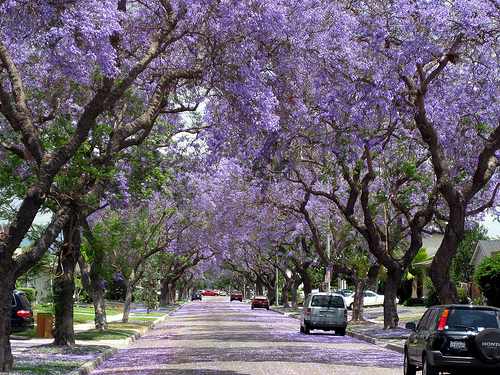
    I decided to take a five-minute walk just to stretch my legs and get some fresh air. At the end of my street, I saw what looked like a million purple leaves from a Jacaranda tree, sprinkled all over the sidewalk.

    Scattered so colorfully and delicately, they looked like pure bliss–like a spa that sprung up through the cement to soothe me right when I needed it. So I smiled, just a little, and then slowly, a little more, until I realized I was somewhere I hadn’t been all day: firmly planted in the present moment, grateful for how beautiful it was.

    It didn’t change that there are things I struggle with. We’ll always have challenges in life. But sometimes the best thing we can do when we get caught up in our heads is make a conscious choice to get outside of it. If we want to know joy, we must first be willing to smile.

    Photo by cheekycrows3

  • Tiny Wisdom: On Choosing Optimism

    Tiny Wisdom: On Choosing Optimism

    “I am a pessimist because of intelligence, but an optimist because of will.” -Antonio Gramsci

    They say that ignorance is bliss, and there’s a really good reason for it. There are a lot of things we learn as we get older that can get us down if we dwell on them.

    The world feels a lot safer when you believe in Santa Claus and magic, and haven’t yet learned about the tragedies and injustices that happen every day, all over the world.

    It’s a lot easier to feel happy when you believe that everyone has pure intentions, and don’t yet realize that people sometimes hurt other people, knowingly and intentionally.

    If you want to, you can easily find tons of reasons to live your life scared and negative. You can use all kinds of logic to justify a bitter, guarded attitude, as if it’s the only way protect yourself from bad things that could happen.

    The irony is that this is the worst thing that could happen, because it makes the space inside your head persistently painful–and it doesn’t actually prevent pain or misfortune. It’s a self-made prison that you can only escape by choosing to shift your perspective.

    Since tomorrow is always uncertain, you can torture yourself hiding from the bad things that could happen, or you can decide to take responsibility for creating the good. But you can’t do both at the same time.

    Today if you’re feeling like the odds are stacked against you, ask yourself: Which would you prefer–to assume that things will go wrong and then find evidence to confirm you’re right, or to believe that good things will happen and then make every effort to create them?

    Photo by raichovak

  • Tiny Wisdom: On Feeling Good

    Tiny Wisdom: On Feeling Good

    “No one can make you feel inferior without your consent.” -Eleanor Roosevelt

    My boyfriend makes me feel unworthy. My mother makes me feel inadequate. My sister makes me inferior. My boss makes me feel incompetent.

    Have you said something like this recently? We all do it sometimes–give our power away to other people as if they have complete control over what we feel.

    For a long time, I believed it was impossible to change how I responded to certain events. If someone said something hurtful, I had no choice but to feel sad and rejected–and it was all their fault. If someone judged me, the only possible response was to feel self-conscious and angry–and it was all their fault.

    I almost felt obligated to feel these things.

    I’d sit around stewing in my instinctive emotional response, rehashing the event and feeling bad about it, as if that was my only choice. Soon I realized that most of my life was one giant negative reaction, mixed with righteousness and blame. If I didn’t start to take responsibility for my feelings, that’s all I’d ever know.

    It’s a whole lot easier to dwell on what someone else did wrong than it is to let go and create a more positive state of mind. Sometimes I still struggle with this–it’s not an easy to skill to master. But as with everything, it gets easier with practice.

    Today if you struggle with uncomfortable feelings and believe someone else is to blame, ask yourself: Would it be worth completely letting go of that story if it allowed you to feel good?

    Photo by Orin Zebest

  • 20 Things to Do When You’re Feeling Angry with Someone

    20 Things to Do When You’re Feeling Angry with Someone

    “If you are patient in one moment of anger, you will escape a hundred days of sorrow.” ~Chinese proverb

    As Tiny Buddha grows larger, I find there are a lot more people emailing me with requests. The people-pleaser in me wants to say yes to everyone, but the reality is that there is only so much time in the day—and we all have a right to allocate our time as best supports our intentions, needs, and goals.

    Recently someone contacted me with a request that I was unable to honor. After I communicated that, he made a sweeping judgment about my intentions and character, ending his email with “Buddha would be appalled.”

    As ironic as this may sound given the context of this site, I felt angry.

    I felt angry because I have always struggled with saying no, and this was exactly the type of uncomfortable encounter I generally aim to avoid.

    I felt angry because I felt misunderstood and judged, and I wanted him to realize that he was wrong about me.

    I felt angry because I assumed he intended to be hurtful, and I didn’t feel like I deserved that.

    I ended up responding to his email fairly quickly with a little bit of defensiveness, albeit with restraint. After I pressed send, I felt a little angry with myself for letting this bother me. Then I realized that this was a wonderful exercise in learning to deal with anger.

    It’s inevitable that I’ll feel that way again—and many times, with people I know well and love. We all will. We’ll all have lots of misunderstandings and annoyances, and lots of opportunities to practice responding to anger calmly and productively.

    If we’re mindful, we can use these situations to better ourselves and our relationships. (more…)